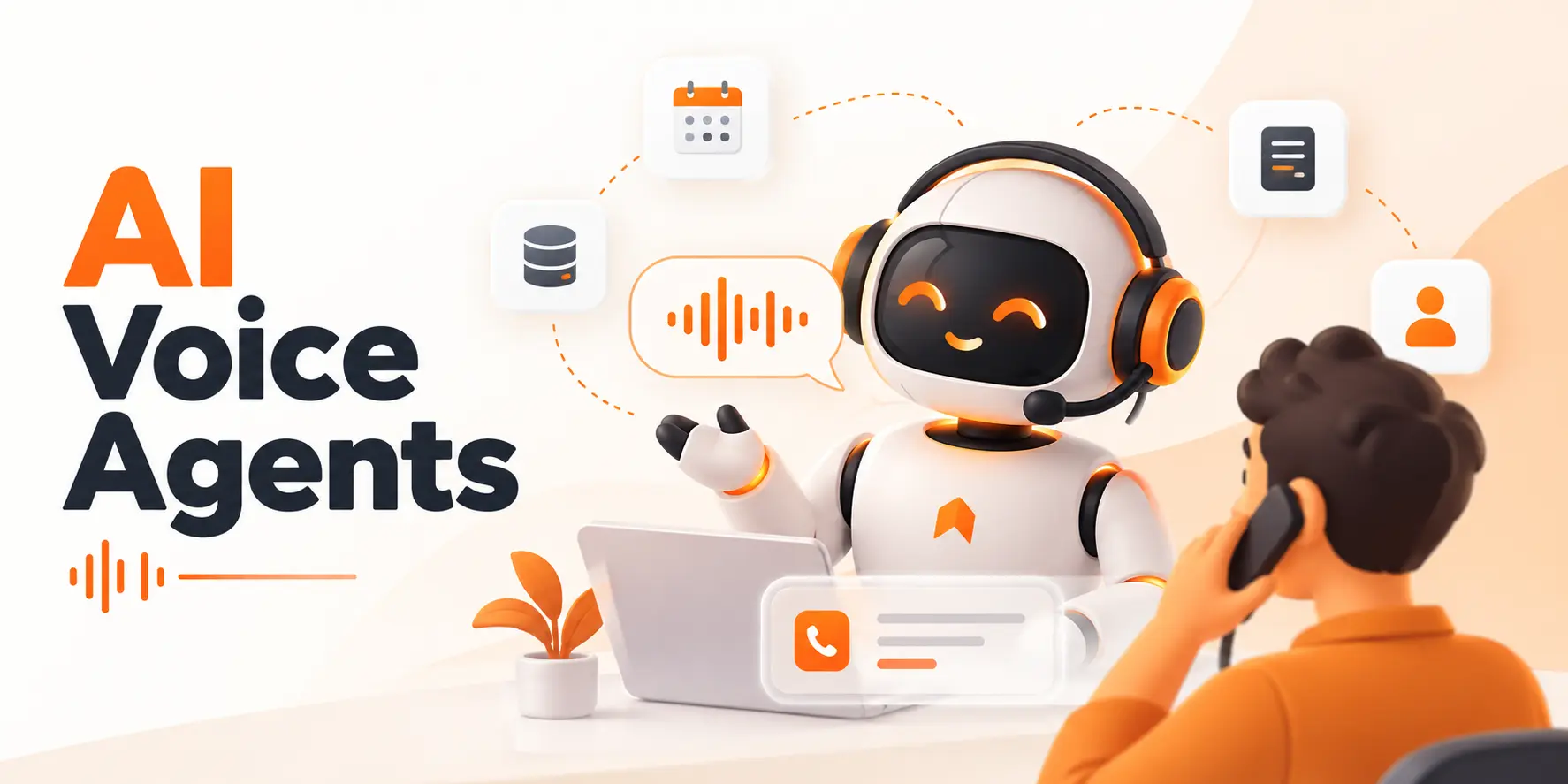
AI voice agents are software systems that understand spoken requests, hold conversations, and complete tasks using artificial intelligence. They can answer customer questions, check account information, schedule appointments, and interact with business software through connected tools.
Unlike traditional phone menus, they allow people to explain what they need in their own words. But natural speech alone doesn't make an agent useful. The real value comes from completing the task accurately, without forcing customers to repeat themselves or wait through a complicated process.
For a startup considering voice AI, I would look beyond the quality of the voice and focus on how the system handles decisions, business data, and real customer requests.
How AI Voice Agents Work
An AI voice agent connects speech processing, conversational reasoning, business tools, and audio generation into a continuous interaction.
The process starts when someone speaks and ends when the agent provides a useful response or completes the requested action.
Understanding Spoken Requests
When a customer speaks, the system first processes the incoming audio.
In a modular voice pipeline, a speech-to-text (STT) model converts audio into text. The application then passes that text to a language model along with the conversation history and relevant instructions.
A customer might say:
"I was charged twice this month. Can you check my subscription?"
The transcription system captures the request, and the language model identifies that the customer needs billing assistance.
The agent must also determine when the customer has finished speaking.
Voice Activity Detection (VAD) identifies the presence or absence of speech in an audio signal. However, detecting silence is not the same as understanding that a person has finished a sentence.
A customer who pauses while remembering an invoice number should not be interrupted halfway through the request.
Turn detection and interruption handling help manage that distinction.
Understanding Context and Making Decisions
Once the system identifies the request, the agent determines what information or action is required.
For a billing question, it might need to retrieve the customer's subscription details, check recent transactions, and identify the relevant billing policy.
These operations require access to business systems.
A language model does not automatically have permission to read customer accounts or modify subscription records. The application must provide approved tools and enforce authorization through its backend.
The agent can request an operation, but the backend must validate whether that operation is permitted.
This separation prevents a spoken request from becoming an unrestricted command to the company's systems.
Generating a Spoken Response
After receiving the necessary information, the agent prepares a response.
In a modular architecture, text-to-speech (TTS) converts the generated text into audio.
The customer hears something such as:
"I found two charges on your account. One is your monthly subscription, and the other is an additional workspace license."
The agent can then answer follow-up questions using the current conversation context.
A well-designed voice system also allows the customer to interrupt, correct a misunderstanding, or change the request without restarting the interaction.
AI Voice Agent Architectures
There are two major architectural approaches to building conversational voice applications.
Both can support tool access and business workflows, but they offer different levels of control over speech processing.
Modular Voice Pipelines
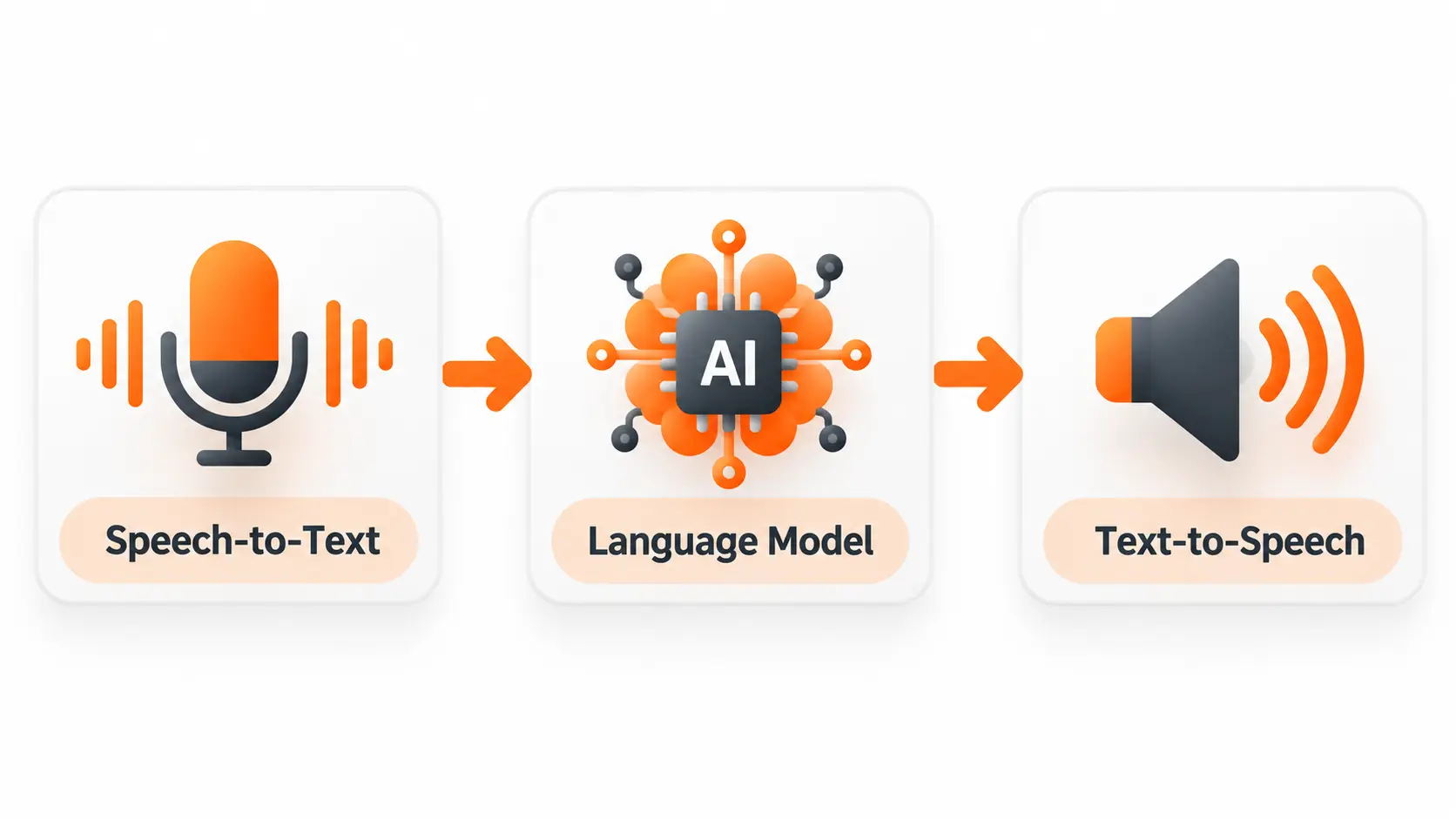
A modular pipeline processes speech through separate components:
Speech-to-Text → Language Model → Text-to-Speech
This structure allows developers to select individual providers for speech recognition, reasoning, and voice generation.
It also exposes intermediate text, making it easier to inspect transcripts, apply business rules, and investigate recognition errors.
For a startup working with complex account data, I would consider this structure when detailed control over each stage matters more than minimizing architectural complexity.
The trade-off is managing several components and the delays introduced by their interactions.
Direct Speech-to-Speech Models
A speech-to-speech architecture uses a model that processes audio and generates spoken responses within an integrated realtime interaction.
This reduces the need to construct a separate transcription and synthesis pipeline.
It can also preserve vocal information that a text-only intermediate representation does not fully capture.
The Speech-to-Speech vs STT-LLM-TTS decision should be based on the application's requirements for latency, intermediate transcript access, provider flexibility, tool integration, and conversational behavior.
For an interactive voice assistant where natural exchanges and interruptions are central, I would evaluate a realtime speech model.
For a workflow requiring explicit inspection of every recognized request before a sensitive operation, I would evaluate a modular pipeline or an architecture that separates realtime speech from controlled backend execution.
Neither architecture removes the need for authorization, reliable tools, or response validation.
AI Voice Agents vs Chatbots and IVR
Voice agents are not simply chatbots with a microphone.
The communication channel changes how users express requests, how the system manages interruptions, and how quickly it needs to respond.
Traditional Interactive Voice Response (IVR) systems rely on predefined menus, keypad inputs, or constrained speech commands.
Text chatbots accept written messages and return text responses. Their capabilities depend on their models, integrations, and application logic.
AI voice agents bring conversational interaction to spoken channels while supporting reasoning and connected actions.
The practical difference becomes clear when comparing user needs.
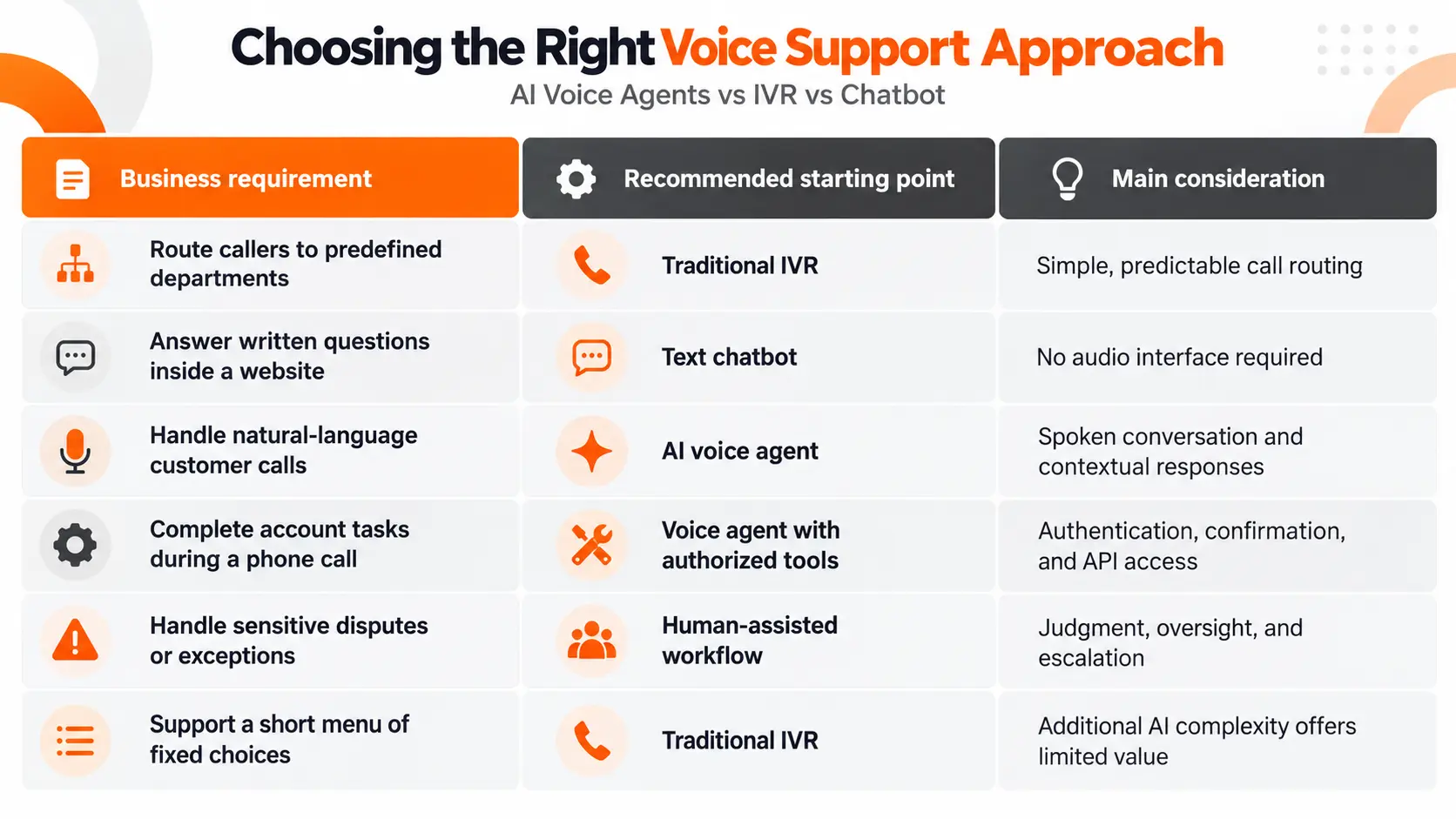
I wouldn't replace a functioning IVR system just because voice AI can sound more natural.
If customers only need to select a department, a simple menu can meet that requirement.
A voice agent becomes more valuable when customers need to describe problems, ask follow-up questions, or complete tasks that don't fit neatly into predefined options.
AI Voice Agent Use Cases
For businesses, the strongest applications involve repeatable conversations with clearly defined outcomes.
Customer Support
A voice agent can answer questions about subscriptions, orders, accounts, and product features.
With approved system access, it can retrieve customer-specific information and guide callers through supported service requests.
I would begin with requests that have clear policies and verifiable results, such as checking an order status or explaining a billing charge.
Appointment Scheduling
A voice agent can check availability, offer suitable appointment times, and create bookings through an integrated scheduling system.
The booking must be confirmed by the scheduling service before the agent tells the caller that the appointment is complete.
This distinction prevents conversational confirmation from being mistaken for a successful transaction.
Sales and Lead Qualification
A voice agent can collect information about a prospect's requirements, explain product features, and schedule a conversation with a sales representative.
The system should follow approved outreach and consent requirements when making outbound calls.
For sales teams, I would measure qualified appointments and verified follow-up actions rather than the total number of conversations.
Internal Business Operations
Voice agents can also support employees.
An internal assistant might retrieve company policies, answer IT support questions, or check the status of a service request.
These applications still require access controls. An employee's ability to speak to an assistant does not establish permission to retrieve every company record.
AI Voice Agent Example in a SaaS Business
Consider a fictional SaaS startup called DeskFlow.
DeskFlow provides project management software with several subscription plans. Its support team receives calls about billing, workspace permissions, and account upgrades.
The company wants to automate a specific request: helping customers change their subscription plans.
A customer calls and says:
"I want to move my team to the Business plan. Will the new price apply immediately?"
Identifying the Request
The agent recognizes that the customer wants to change a subscription and understand the billing implications.
It needs information about the current plan, the requested plan, and DeskFlow's billing rules.
The agent should not assume that the caller is authorized to modify the subscription simply because they know the company name.
Retrieving Account Information
After the required identity and authorization checks, the agent uses an approved API to retrieve the workspace's subscription details.
The billing service returns the current plan and applicable upgrade conditions.
The agent can then explain how DeskFlow calculates the change.
For example, the billing policy might state that upgrades take effect immediately and any applicable prorated charge is calculated during the transaction.
The agent should use the actual billing response rather than inventing an amount.
Confirming and Completing the Change
Before making the change, the agent summarizes the requested action and the confirmed financial implications.
The customer approves the upgrade.
The application then validates the authorization and confirmation, executes the subscription update, and returns the operation's result.
Only after the backend confirms success should the agent announce that the subscription has changed.
If the operation fails, the agent must not claim that the upgrade was completed.
This is the difference between a voice assistant that talks about account changes and an agent that reliably performs them.
Building vs Buying an AI Voice Agent
A startup has two practical options: use an existing voice agent platform or build a system with selected components.
The right decision depends on the product's requirements and the team's engineering capacity.
Using a Managed Voice Agent Platform
Platforms such as Vapi, Retell AI, and ElevenLabs provide infrastructure for building and deploying voice agents.
Their capabilities include combinations of speech processing, model integration, conversation management, telephony connectivity, and tool access.
A managed platform is worth evaluating when the team wants to launch a defined workflow without maintaining the full realtime audio infrastructure.
I would examine its supported integrations, deployment regions, data-handling controls, operational limits, and pricing structure.
Platform convenience is valuable, but it shouldn't determine the application's security model.
Building a Custom Voice Agent
A custom implementation gives the development team greater control over architecture and integrations.
A startup could combine realtime communication infrastructure, speech models, a language model, and its own business APIs.
Frameworks such as LiveKit provide components for handling voice sessions, tools, and conversation flow.
I would consider custom development when the product requires specialized workflows, strict infrastructure control, or integrations that a managed platform cannot support adequately.
The trade-off is responsibility for testing, infrastructure, reliability, monitoring, and maintenance.
Selecting the Right Approach
Before choosing a platform, I would document three requirements:
The task: What must the agent accomplish during a conversation?
The systems: Which business records and APIs does it need to access?
The operating conditions: What security, latency, reliability, and cost requirements must it meet?
A platform demo can demonstrate conversational quality. It cannot establish whether the service meets a startup's specific operational requirements.
AI Voice Agent Costs and Business Value
The cost of running a voice agent includes more than the price of its language model.
Depending on the selected architecture, the application may incur charges for speech recognition, speech generation, model inference, realtime communication, telephone minutes, and platform usage.
Development, monitoring, and support also contribute to the total operating expense.
AI Voice Agent Pricing needs to be evaluated using the expected workload rather than a single advertised per-minute rate.
For a SaaS business, I would estimate monthly costs using:
Number of calls and average conversation duration
Speech processing and language model usage
Telephony and platform charges
Backend infrastructure and integrations
Monitoring, maintenance, and human escalation costs
These inputs establish the expected operating expense.
However, cost per minute alone doesn't indicate whether the system is financially useful.
Cost per Completed Task
Suppose DeskFlow deploys a voice agent to handle subscription changes.
The relevant outcome is not how many minutes the agent spent speaking. It is how many authorized subscription changes were completed correctly.
I would calculate the cost per verified completed task by dividing the total attributable operating cost by the number of successfully completed tasks.
This helps compare AI-assisted operations with the existing support workflow.
Human handling costs, repeat contacts, and failed transactions should be included when assessing the broader business impact.
An agent that reduces the cost of individual calls but creates more follow-up work may not deliver an operational improvement.
Voice Agent Performance and Customer Experience
A voice agent can give factually correct answers and still create a frustrating experience.
Long pauses, premature interruptions, repeated questions, and incorrect tool actions can make the interaction difficult.
I would evaluate speech quality and task outcomes together.
Response Speed
AI Voice Agent Latency is best examined through the time between the end of a user's turn and the arrival of a useful spoken response.
That delay can include speech processing, model inference, external API calls, audio generation, and network transmission.
A quick acknowledgment such as "Let me check" should be measured separately from the actual answer.
For production testing, I would track typical response times alongside slower interactions, including the 95th-percentile latency.
The objective is a consistent conversation rather than an impressive result from one demonstration.
Conversation Quality
A natural conversation depends on more than a realistic voice.
The system must recognize when a customer has finished speaking and when an interruption requires it to stop.
It should also distinguish background noise from intentional speech.
If the customer says "Wait, I meant the annual plan," the agent needs to stop the previous response and update the current request.
That correction must also be reflected in any pending business operation.
Task Success
Voice Agent Evaluation should measure whether the system completes its intended work accurately.
For DeskFlow, useful measures include verified subscription changes, unauthorized operations prevented, successful human transfers, and requests requiring repeat contact.
Speech recognition accuracy and response latency remain important, but they are supporting measurements.
A pleasant conversation is not successful if the wrong subscription is activated.
I would test realistic conversations containing background noise, interrupted sentences, account verification failures, and unavailable backend services before allowing the system to handle production requests.
Security, Privacy, and Human Oversight
Voice agents work with information that customers share during live conversations.
That can include account identifiers, financial details, addresses, and other personal information.
A production deployment must establish how this information is collected, processed, stored, and accessed.
Customer Identity and Permissions
A caller's voice or telephone number should not automatically grant access to private records.
Sensitive requests require an appropriate verification process.
The backend must also validate the permissions associated with every requested operation.
For example, a workspace member may be allowed to view subscription information but not change the company's billing plan.
The language model's interpretation of a request does not override these permissions.
Recording and Consent
Recording rules depend on the applicable jurisdiction and the circumstances of the call.
The business needs a lawful basis for collecting and processing audio, along with appropriate notices, consent procedures where required, retention limits, and access controls.
The system should also clearly communicate that the customer is interacting with AI rather than impersonating a human representative.
Transfer to Human Support
Some requests need judgment, negotiation, exception handling, or access beyond the agent's approved capabilities.
The design of Human Handoff in AI Voice Agents should define when a transfer is required and what information can be passed to the representative.
For example, DeskFlow might transfer a billing dispute involving an unauthorized charge.
A useful transfer includes the customer's verified identity status, the reason for the call, completed checks, and the unresolved issue, subject to the organization's privacy rules.
The objective is to prevent customers from having to explain the same problem again.
An AI-to-AI agent handoff and a telephone transfer to a human are different operations. A production workflow must implement the actual call transfer rather than simply changing the active AI agent.
Deploying AI Voice Agents in Production
I would begin with a narrow workflow and expand only after its results are measurable.
For DeskFlow, subscription inquiries provide a more controlled starting point than granting an agent permission to modify every account setting.
Define the First Workflow
The team should specify the requests the agent can handle and the outcomes it must produce.
For subscription changes, that includes account verification, plan eligibility, customer confirmation, backend updates, and responses to failed operations.
Every supported action needs a defined success condition.
Test Complete Conversations
Testing a single question doesn't reveal how an agent behaves throughout an entire call.
The team should test customers who change their minds, provide incomplete details, interrupt the agent, or ask for a human representative.
Tool failures and interrupted calls also deserve explicit test cases.
The important question is whether the complete interaction reaches a valid outcome without violating permissions or misrepresenting the result.
Release with Operational Controls
Before accepting live customer traffic, the system needs monitoring, error reporting, escalation routes, and a way to disable or restrict problematic actions.
I would keep high-impact operations behind backend authorization checks and explicit confirmations.
Production logs should preserve enough information to investigate failures without collecting unnecessary sensitive data.
The team should also define what happens when speech processing, a model provider, or a connected business system becomes unavailable.
Expand Based on Verified Results
After a controlled release, the team can compare completed tasks, customer feedback, escalation rates, operating costs, and response times against the previous workflow.
Those results provide evidence for expanding the agent's responsibilities.
The goal is not to automate the greatest possible number of conversations. It is to complete suitable customer tasks reliably and maintain a clear route to human assistance when needed.
Final Thoughts
AI voice agents bring conversational AI into spoken interactions, allowing businesses to answer questions and perform tasks through connected systems.
For a startup, the technology becomes valuable when it reduces friction in a real workflow, not simply when it produces a convincing voice.
I would begin with a specific customer need, select an architecture that supports the required controls, and measure verified task outcomes before expanding.
A reliable voice agent should know what it can do, respect the limits of its access, and provide a clear path forward when a request requires human involvement.
FAQ
Can a voice agent understand two people talking on the same call?
A voice agent can process multi-speaker conversations when its audio pipeline supports speaker identification or diarization. Overlapping speech introduces additional recognition challenges. Applications requiring this capability should be tested with simultaneous speakers rather than assuming that single-speaker recognition performance will transfer to conference-style conversations.
What happens if a call drops right after the agent updates an account?
A completed backend transaction should remain recorded independently of the voice session. The application needs persistent operation identifiers and transaction-status checks so a reconnected caller can receive an accurate update. Idempotency controls also prevent the same requested operation from being executed twice after a connection failure.
Can I use the same voice agent on my website and phone line?
Yes. The same business logic and approved tools can support multiple channels through separate audio and communication interfaces. A website can use browser-based realtime audio transport, while phone calls require telephony infrastructure. Audio handling, authentication, and session management must be configured for each channel.
Can customers switch languages halfway through a conversation?
Language switching is possible when the selected speech models and conversation system support the required languages. Recognition, reasoning, and speech generation must all handle the transition correctly. Multilingual evaluation should include changes of language within a sentence, regional accents, and product-specific terminology.
Will my voice agent remember a customer from their previous call?
Cross-call memory requires an application-managed persistence system and a permitted way to associate the new session with the customer's records. Conversation context stored for one live session does not automatically establish persistent memory. The business must define which information can be retained, how it is retrieved, and when it should be deleted.

Fatemeh Jahangard
Technology & AI Writer at PinerookFatemeh Jahangard covers AI, emerging technologies, and digital innovation for Pinerook, focusing on how technology shapes startups and industries.
 Seen first.