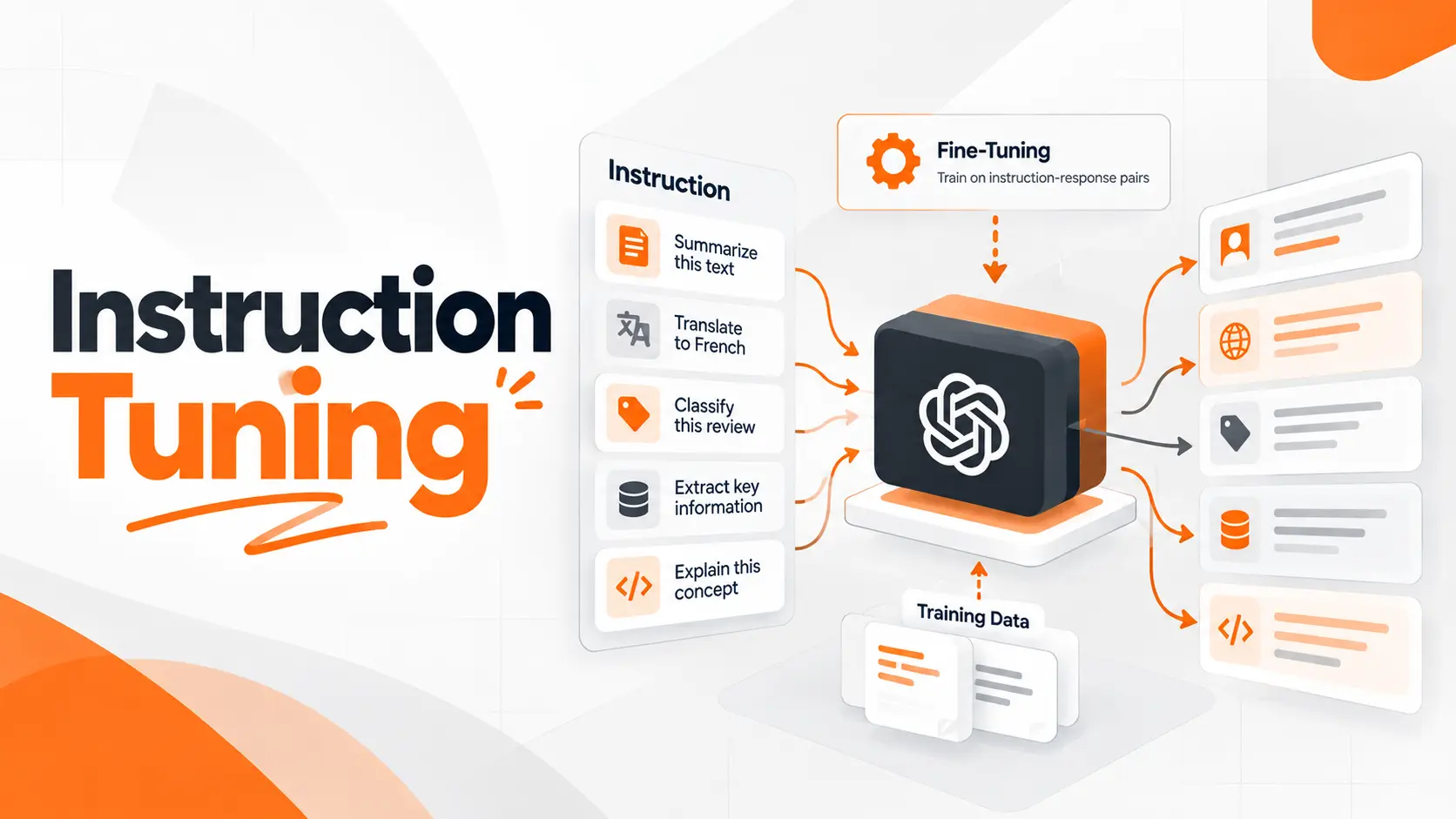
Instruction tuning is a training technique that teaches large language models (LLMs) to respond to human instructions instead of simply predicting the next piece of text. By learning from pairs of instructions and expected responses, a pretrained model becomes better at handling requests such as summarizing documents, translating sentences, extracting information, and following specific output requirements.
The distinction matters in AI Model Fine-Tuning because improving a model's knowledge and improving its ability to follow instructions are not the same objective. A model can contain the information needed to answer a question yet fail to recognize how the user wants that information presented.
Base Models vs Instruction-Tuned Models
The difference between a base model and an instruction-tuned model becomes clear when both receive the same request.
Consider this instruction:
User: "Summarize the following customer complaint in one sentence: I ordered a laptop on Monday, but it arrived damaged and the seller has not responded."
A base language model is trained to predict the next tokens in a text sequence. Depending on its pretraining and the prompt format, it could continue the text, produce another customer complaint, or generate a summary.
An instruction-tuned model has received additional training demonstrating that requests like this should produce a relevant response.
Expected instruction-tuned response: "The customer received a damaged laptop and has not received a response from the seller."
This is an illustrative comparison, not the recorded output of a particular model.
The important difference is how the model interprets the request. The base model has learned language patterns, while the instruction-tuned model has also been trained to treat natural-language instructions as directions for its response.
This distinction explains why model repositories offer separate Base and Instruct versions of the same architecture. The Instruct variant has undergone additional training to improve its ability to respond to requests.
Instruction tuning improves the model's learned behavior. It does not install a deterministic rule system or guarantee that every instruction will be followed.
How Instruction Tuning Works
Instruction tuning uses supervised learning to connect natural-language requests with responses that demonstrate the intended behavior.
The process begins with a pretrained model that has already developed language representations through large-scale training. Instead of repeating that general learning process, instruction tuning introduces examples that show how the model should respond to different requests.
Each training record contains an instruction, any context needed to complete it, and a reference response.
During training, the model processes the instruction and predicts the target response token by token. A loss function measures how the predictions differ from the reference tokens, and optimization updates the trainable parameters to reduce that difference.
With repeated exposure to varied instructions, the model learns relationships between the language of a request and the structure of an appropriate answer.
For instance, the instruction "Extract the invoice number" establishes a different response objective from "Explain the invoice to a customer." Even when both requests contain the same document, the expected outputs serve different purposes.
I consider this distinction more important than the surface format of the examples. The training data must demonstrate not only correct information but also the action the instruction requires.
Instruction and Response Formatting
For conversational models, training examples also need a structure that distinguishes user messages from assistant responses.
Chat templates handle that structure through model-specific message markers and formatting rules. A compatible template ensures that the model receives conversations in the form expected by its tokenizer and training setup.
The same formatting convention should be respected during inference. A mismatch between training and deployment formats can reduce instruction-following performance, even when the underlying model weights have not changed.
Instruction Tuning Examples
The quality of an instruction dataset depends on whether its examples demonstrate the behaviors the model needs to learn.
A useful dataset contains multiple kinds of requests rather than repeated variations of a single task.
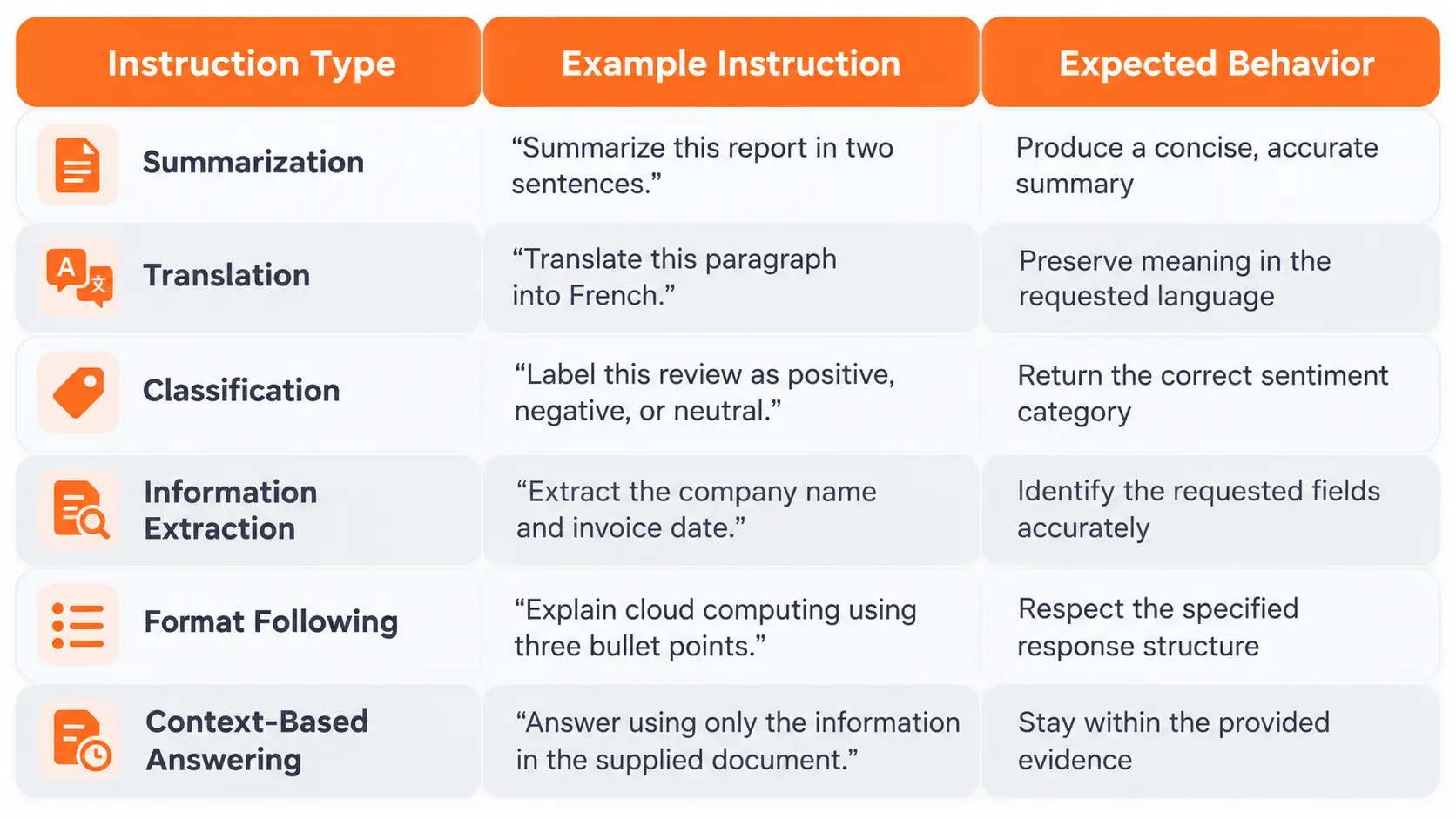
These examples cover different aspects of instruction following, including task recognition, response formatting, and the use of supplied context.
The reference response must demonstrate the complete requirement. If an instruction requests three bullet points, the target response should contain three bullet points. If the instruction limits the answer to a supplied document, the response should not introduce unsupported details.
I also distinguish between the wording of an instruction and its underlying purpose. Two requests can express the same objective using different language, and the dataset should reflect those differences.
Instruction Diversity and Zero-Shot Generalization
One of the most valuable outcomes of instruction tuning is improved performance on tasks that were not explicitly included in the training examples.
This is known as zero-shot generalization when the model performs a task from an instruction without receiving task-specific demonstrations in the inference prompt.
The original FLAN research demonstrated that training language models on diverse tasks expressed as natural-language instructions can improve their performance on unseen tasks. Later FLAN research examined the effects of increasing task diversity, model scale, and training data.
The central lesson is that instruction diversity matters.
A model trained exclusively on classification requests learns a narrow relationship between instructions and labels. A model exposed to classification, summarization, extraction, translation, and other tasks has more opportunities to learn how different instructions define different response objectives.
Instruction Diversity Beyond Task Categories
Diversity is not limited to including several tasks. It also involves variations within each task.
Consider these instructions:
"Summarize this article."
"Give me the main points without technical terminology."
"Condense this explanation into a short paragraph for a beginner."
All three require summarization, but each introduces different expectations about style, audience, or length.
Training examples that capture these distinctions provide evidence of how language changes the requested behavior.
The dataset should also represent instructions containing multiple constraints, incomplete information, and requests that require clarification.
However, zero-shot generalization does not mean the model can successfully execute every unfamiliar task. Performance still depends on the pretrained model's capabilities, the training data, and the difficulty of the new request.
Measuring Generalization to Unseen Tasks
I separate two evaluation scenarios when assessing generalization.
The first uses new instructions from task categories represented in training. This measures how well the model handles unfamiliar wording and inputs.
The second uses entire task categories excluded from instruction training. This provides stronger evidence about transfer to genuinely unseen tasks.
For example, if summarization examples appear in training, testing new summarization requests does not establish the same level of generalization as testing an entirely held-out task category.
That distinction is essential when interpreting claims about instruction-tuned models and zero-shot performance.
Instruction Tuning vs Supervised Fine-Tuning
Instruction tuning and Supervised Fine-Tuning (SFT) are closely related, but the terms describe different levels of specificity.
Supervised Fine-Tuning is the broader training approach. A pretrained model learns from input-output examples, and those examples can support specialized tasks such as classification, extraction, or domain-specific response generation.
Instruction tuning focuses specifically on training models to respond to natural-language instructions. It is a form of SFT in which the examples demonstrate how requests should be interpreted and completed.
A model fine-tuned to classify one type of document has undergone supervised training. That training does not automatically establish broad instruction-following ability.
By contrast, a model trained on varied instructions and responses is being optimized to recognize and execute different requests.
This is why instruction tuning is also called instruction fine-tuning in technical literature.
The two concepts overlap in their training mechanisms, but their objectives and dataset composition are not identical.
Instruction Tuning vs Prompt Engineering
Prompt engineering changes the instructions supplied to a model during inference. It does not modify the model's learned parameters.
Instruction tuning changes those parameters through training.
A carefully written prompt can improve a model's performance on a particular request without any additional training. Instruction tuning aims to improve how the model responds to instructions across a broader range of inputs.
The methods work together. An instruction-tuned model still depends on clear prompts, appropriate context, and well-defined application requirements.
Instruction Tuning Process
Building an instruction-tuned model involves more than placing requests and responses into a training file.
The first decision is selecting a pretrained model with sufficient existing capabilities. Instruction tuning can improve how those capabilities are expressed, but it cannot guarantee that the model acquires specialized knowledge or reasoning abilities absent from its underlying representations.
Selecting the Training Tasks
I begin with the types of requests the model should handle after training.
For a general-purpose assistant, the task collection should include varied language operations and response requirements. For a more focused application, the examples should represent the range of instructions encountered within that application.
The key is maintaining enough variation to teach instruction interpretation rather than memorization of fixed prompt patterns.
Preparing Instruction-Response Pairs
Each record needs an unambiguous request and a reference response that satisfies it.
Data can come from human-written demonstrations, existing annotated datasets, or synthetic instruction examples that have undergone quality checks.
Research such as Self-Instruct has demonstrated how generated instructions can expand training data. However, generated examples still require filtering because incorrect instructions, duplicated patterns, and unreliable responses can undermine training quality.
Before training, examples must be converted into the schema and chat format supported by the chosen model and framework.
Training the Model
Instruction tuning can be implemented through supervised training frameworks such as Hugging Face TRL, which provides an SFTTrainer for instruction-response and conversational datasets.
The training objective rewards predictions that match the expected responses. Depending on the dataset format and trainer configuration, loss can be calculated over completion tokens or selected assistant responses.
The same process can use full-parameter updates or parameter-efficient methods such as LoRA.
I keep the training configuration separate from the instruction-learning objective. Changing Learning Rate, Batch Size, or LoRA Rank affects optimization, but those adjustments do not substitute for representative instruction examples.
Validating the Trained Model
The resulting checkpoint must be compared with the original model using independent instructions.
A successful training run should improve response behavior on the intended task distribution and demonstrate acceptable performance on previously supported capabilities.
Validation should include instructions with unfamiliar phrasing, combined constraints, and tasks not directly represented in the training examples.
Evaluating Instruction Following
Instruction-following performance cannot be established by checking whether the model produces fluent answers.
A response can be grammatically correct and factually accurate while still violating the user's instruction.
Consider this request:
"Summarize the following report in exactly three bullet points. Do not include information that is absent from the report."
A useful evaluation checks three separate outcomes: the summary accurately reflects the document, it contains exactly three bullet points, and it introduces no unsupported information.
I evaluate these dimensions separately because each failure reveals a different limitation.
Instruction Compliance
Instruction compliance measures whether the model satisfies the requested constraints.
The IFEval benchmark is designed around verifiable instructions, including requirements involving specific words, formatting, and response length. These constraints can be checked programmatically.
This makes IFEval useful for measuring a defined part of instruction following, but it does not provide a complete measure of factual correctness, reasoning quality, or response usefulness.
Task Accuracy and Response Quality
Task accuracy measures whether the requested operation was completed correctly.
For classification, this means comparing predicted labels with reference labels. For information extraction, the evaluation checks whether required fields contain the correct values.
For open-ended requests, a documented evaluation rubric provides a consistent basis for assessing relevance, completeness, and instruction adherence.
I prefer evaluating these qualities individually rather than reducing every response to a single subjective score.
Combined and Conflicting Instructions
The evaluation set should also include requests containing several requirements.
For example, the model may need to explain a concept accurately, avoid certain terminology, and stay within a specific length.
Instruction hierarchy is another important consideration. A model needs to respect higher-priority application instructions when user requests conflict with them.
Passing straightforward instruction tests does not establish that a model can resolve every conflicting request correctly. These behaviors require dedicated evaluation.
Applications of Instruction-Tuned Models
Instruction-tuned models are valuable in applications where people communicate objectives through natural language instead of selecting predetermined commands.
Customer support assistants use instruction following to interpret requests, ask for missing details, and respond according to service rules. Document-processing systems use it to switch between extraction, summarization, and explanation based on the requested task.
Writing assistants depend on instruction-following capabilities to adapt tone, length, audience, and content structure.
Development tools use instruction-tuned models to interpret requests such as explaining a function, reviewing a code change, or producing an implementation from a description.
In each case, the practical benefit is flexibility: the same model can respond to different instructions without requiring an independent model for every operation.
However, instruction tuning does not provide external data access, guarantee factual accuracy, or enforce application rules by itself.
Those requirements still depend on appropriate system design, evaluation, and runtime controls.
Limitations of Instruction Tuning
Instruction tuning changes model behavior, but its benefits depend on the capabilities of the base model and the quality of its training examples.
A model can learn to produce well-structured answers without consistently producing correct answers. Improved instruction compliance and improved factual accuracy are separate outcomes.
Training data can also introduce response patterns that are too rigid. If nearly every example uses the same format, the model can become excessively attached to that structure even when a different response would be appropriate.
Another concern is the preservation of existing capabilities. Additional training can reduce performance on previously supported tasks, making baseline comparisons important before deployment.
Instruction tuning should therefore be evaluated as a behavioral adaptation method, not as a guarantee of accuracy, safety, or universal task performance.
Conclusion
Instruction tuning helps bridge the gap between a language model's ability to generate text and its ability to respond to human requests. By training on diverse instruction-response examples, developers can improve how models interpret tasks, respect response requirements, and generalize to unfamiliar instructions.
The most meaningful measure of success is not whether the model produces more polished answers. It is whether the instruction-tuned model completes the intended tasks more reliably than the original model, including when the wording and constraints differ from its training examples.
FAQ
Can I instruction-tune a model that's already instruction-tuned?
Yes. An existing instruction-tuned model can undergo additional supervised training on a new instruction dataset. The new training objective must be compatible with the model architecture and available training framework. Evaluation is necessary to establish whether the additional training improves the intended behavior without degrading existing capabilities.
Can I mix different languages in my instruction-tuning dataset?
Yes. A multilingual instruction dataset can contain instructions and responses in different languages. The dataset should include representative examples for each target language, and evaluation should measure performance separately across those languages. Mixing languages does not guarantee that a model will achieve equal proficiency in all of them.
Can instruction tuning make a smaller model better than a larger base model?
Yes, on specific evaluation tasks. Instruction tuning can enable a smaller model to outperform a larger untuned model when the benchmark rewards effective instruction following. This does not establish that the smaller model has greater overall knowledge, reasoning capacity, or performance across unrelated tasks.
Can I teach an instruction-tuned model to call APIs and use tools?
Instruction tuning can teach a compatible model to generate tool calls in a required format and select tools based on user requests. Actual tool execution depends on the surrounding application, available APIs, permissions, and runtime infrastructure. Training the model does not independently grant access to external systems.
Can I remove an instruction from the dataset after training and make the model forget it?
Removing an example from the dataset does not remove its influence from an already trained checkpoint. A new training run or a supported machine-unlearning process is required to attempt that change. The result must be evaluated because deleting a training record does not guarantee removal of the learned behavior.

Fatemeh Jahangard
Technology & AI Writer at PinerookFatemeh Jahangard covers AI, emerging technologies, and digital innovation for Pinerook, focusing on how technology shapes startups and industries.
 Seen first.