
LLM Inference Optimization improves how large language models generate responses by reducing latency, increasing throughput, and using GPU memory more efficiently. The most effective techniques include KV caching, continuous batching, quantization, speculative decoding, and optimized inference engines. Each addresses a different performance limitation.
The challenge is choosing the right technique. A model that responds slowly to one user does not necessarily have the same problem as a service struggling with hundreds of concurrent requests. Effective optimization starts with identifying the bottleneck, measuring its impact, and selecting a change that improves performance without compromising output quality.
Diagnosing LLM Inference Bottlenecks
Before changing model settings or adding hardware, the first task is to identify where execution time and computing resources are being consumed.
LLM inference involves processing the input prompt, generating output tokens, and managing requests competing for the same hardware. Each stage places different demands on the system.
Prefill and Decode Performance
The two computational stages of text generation behave differently.
During prefill, the model processes the input tokens and calculates the internal representations needed to begin generating a response. This stage performs substantial parallel computation, particularly when processing long prompts.
During decode, the model generates subsequent tokens sequentially. Each new token depends on the preceding context, creating a different performance limitation.
The distinction covered by Prefill vs Decode explains why reducing prompt processing time does not necessarily improve the speed at which subsequent tokens appear.
A system can produce its first token quickly but deliver the remainder of the response slowly. Another system can generate tokens efficiently after spending considerable time processing the initial prompt.
These situations require different optimization strategies.
Identifying the Performance Constraint
The most useful diagnostic information comes from the relationship between latency, request volume, GPU memory usage, and token generation speed.
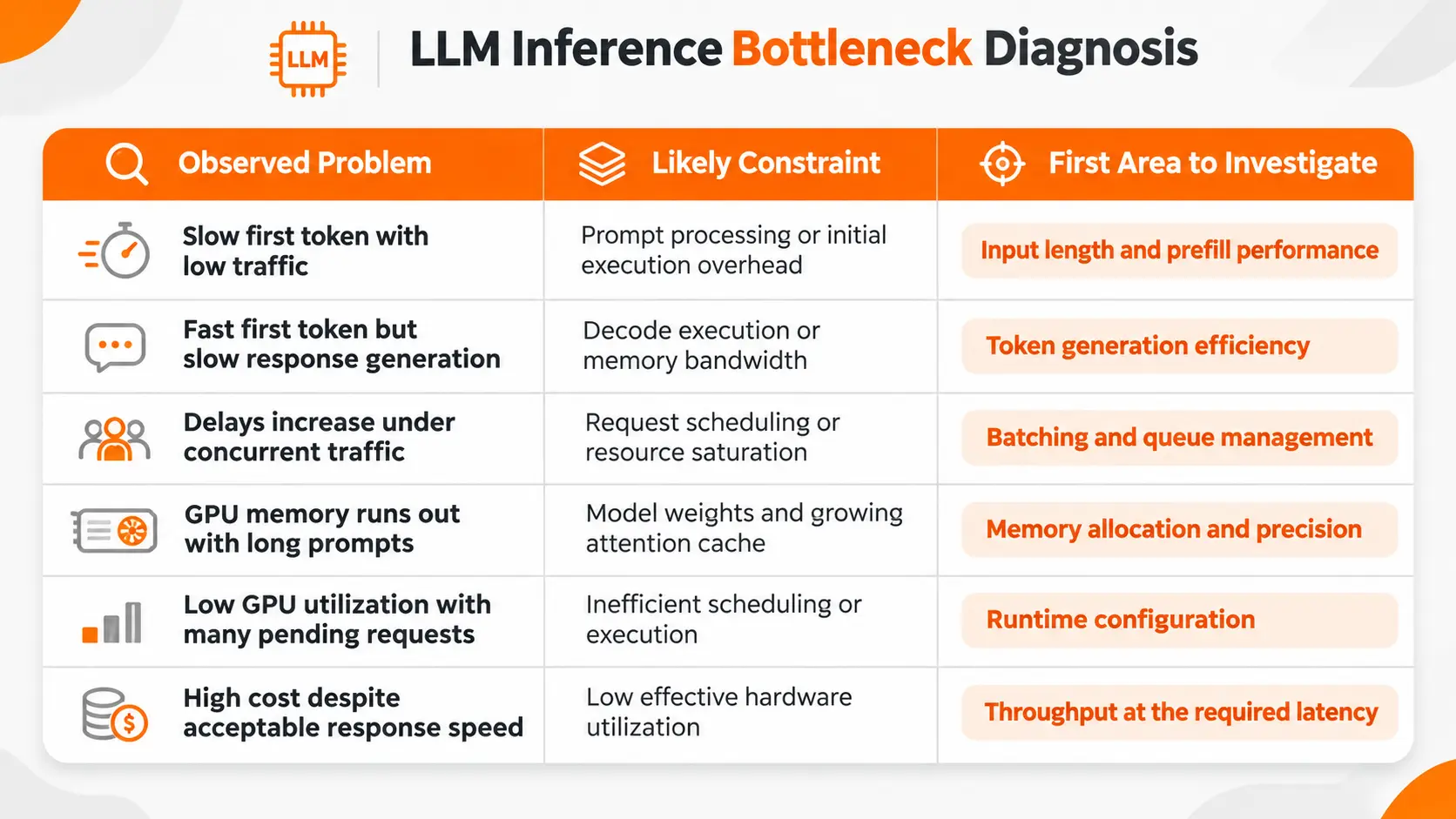
This table provides an initial diagnosis, not a substitute for measurements.
A slow first token can also result from request queues, network delays, or application processing. Those components must be separated from model execution before attributing the delay to prefill.
For reliable results, measurements should reflect the actual distribution of input lengths, output lengths, and concurrent requests.
Core LLM Inference Optimization Techniques
The main optimization methods improve different parts of model execution. Some reduce repeated computation, while others improve scheduling, memory efficiency, or the number of operations required to generate output.
KV Cache and Memory Reuse
Autoregressive text generation depends on information from previously processed tokens.
Without caching, the model would need to repeat attention calculations involving earlier tokens as it generates new ones.
A KV cache stores previously calculated key and value tensors so they can be reused during subsequent generation steps.
The mechanism described in KV Cache in LLMs reduces redundant computation, but the stored tensors consume GPU memory.
As the context grows, the cache expands. Running multiple requests concurrently increases the total memory required for active sequences.
This creates a practical tradeoff: caching reduces computation, while cache allocation can limit the number of requests that fit in memory.
Memory management techniques such as paged attention address this constraint by allocating cache capacity more efficiently.
For applications that repeatedly use identical prompt prefixes, compatible prefix caching can also avoid recalculating shared portions of the input.
Continuous Batching and Request Scheduling
A GPU can process multiple inference requests together, improving the amount of useful work completed during each execution cycle.
Traditional fixed batching introduces inefficiencies when requests have different input and output lengths. A short request can finish while other requests continue consuming processing time.
With Continuous Batching for LLMs, the serving system schedules active sequences dynamically and introduces new requests as capacity becomes available.
This improves resource utilization and increases the number of requests the system can process.
The main benefit is aggregate throughput rather than a guaranteed improvement in latency for every individual user.
Large batches can increase contention for memory and computing resources. The serving system therefore needs limits on concurrent sequences, active tokens, and memory allocation.
The correct configuration is the one that delivers the greatest useful throughput while satisfying the application's latency requirements.
Speculative Decoding and Faster Generation
Sequential token generation introduces latency because each output step depends on the previous one.
Speculative Decoding addresses this limitation by using a faster draft mechanism to propose several tokens before the main model verifies them.
The target model can validate multiple proposed tokens during a single execution step, reducing the number of sequential operations required to complete a response.
The effectiveness depends on the speed of draft generation, verification cost, and the number of proposed tokens accepted.
When those conditions are favorable, decoding latency decreases.
When draft generation creates excessive overhead or few proposed tokens are accepted, the additional work can eliminate the performance benefit.
Properly implemented verification can preserve the target model's original generation behavior. Faster generation does not require accepting unverified predictions from the draft model.
Quantization and Model Memory
Model weights occupy a substantial portion of GPU memory.
For example, seven billion parameters stored using 16 bits per parameter require approximately 14 GB for the weights alone. Runtime buffers and attention caches increase the total memory requirement.
Quantization reduces numerical precision to decrease the storage and memory bandwidth required by selected model components.
LLM Quantization for Inference covers techniques such as INT8, FP8, and four bit weight representations.
Reducing weight precision can allow a model to fit on hardware with less memory or leave additional capacity for concurrent requests.
However, smaller weights do not guarantee faster execution.
The result depends on hardware support, numerical formats, optimized kernels, and the additional operations required by the quantization method.
Lower precision can also affect model outputs. Evaluation against the original model is essential when numerical differences matter to the application.
The practical goal is to select the lowest acceptable precision that meets both performance and quality requirements.
Attention and Execution Efficiency
Additional improvements come from reducing unnecessary memory movement and optimizing the operations executed on the GPU.
Optimized attention kernels, including FlashAttention, improve the efficiency of attention computation by reducing memory traffic.
Architectural choices such as grouped query attention also influence the memory required for key and value representations.
These capabilities depend on the model architecture and supported execution environment.
Their impact should be evaluated alongside caching and batching because the system's performance is determined by the combined execution path, not one optimization in isolation.
GPU Memory and Hardware Efficiency
GPU selection matters, but hardware capacity alone does not determine inference performance.
A model's memory requirements include its weights, attention cache, intermediate tensors, and runtime buffers.
Memory bandwidth also matters because decoding repeatedly accesses model parameters and cached information.
A GPU with substantial computing capability can remain underutilized when its memory subsystem limits token generation.
This explains why adding more computing power does not automatically remove a decoding bottleneck.
Model Placement and Parallelism
When a model cannot fit on one GPU, its computation can be distributed across multiple devices.
Tensor parallelism divides supported tensor operations across GPUs. Pipeline parallelism distributes groups of model layers across devices.
Both introduce communication requirements.
Increasing the number of GPUs can reduce memory pressure per device, but communication overhead can offset part of the performance benefit.
If a model fits comfortably on one GPU, running separate inference replicas can provide better aggregate capacity than splitting every request across multiple GPUs.
The decision depends on model size, hardware interconnects, memory capacity, and concurrent traffic.
Context Length and Memory Pressure
Long contexts increase the amount of information the model must process and retain.
A larger context consumes more attention cache memory and increases the work associated with processing and attending to tokens.
Setting an unnecessarily large maximum context allocation can also restrict concurrency in serving systems that reserve memory according to configured limits.
The practical approach is to measure actual context requirements and configure capacity around the workload.
Reducing unused context and selecting appropriate cache limits can improve resource efficiency without changing model weights.
Choosing the Right Optimization Technique
The best optimization method depends on the performance constraint the application needs to resolve.
Consider three different systems using the same language model.
Interactive AI Assistant
An interactive assistant needs a short delay before displaying its first response and a steady stream of output tokens.
For this workload, time to first token and token generation speed directly affect the user experience.
The first investigation should separate queueing delays from prefill time and decode performance.
If long prompts dominate the delay, input processing and caching deserve attention. If output generation is slow, decode efficiency becomes more important.
Increasing total system throughput is useful only if the application's response time requirements remain satisfied.
High Volume Text Processing
A document processing service generates summaries for large numbers of requests.
Unlike an interactive assistant, each request does not need immediate streaming feedback.
The priority is completing the greatest amount of useful work within an acceptable processing window.
Batching, request scheduling, and efficient model placement become central considerations.
The service can accept longer individual request latency when that choice materially improves overall processing capacity.
This is why a configuration optimized for interactive chat should not automatically be reused for batch processing.
Memory Constrained Deployment
A third application must execute a language model on limited GPU hardware.
Its primary constraint is memory capacity rather than request volume.
The first step is to calculate the resources required for weights, cache, and runtime execution.
Quantization, context limits, and compatible memory management strategies can reduce the required capacity.
If the model still exceeds available resources, a smaller model or an alternative hardware configuration becomes necessary.
This approach prevents wasted effort optimizing scheduling when the model cannot run within the available memory budget.
Latency, Throughput, and Cost Tradeoffs
Inference performance cannot be summarized by a single speed measurement.
Latency describes the time experienced by an individual request.
Throughput describes how much work the system completes over a given period.
Cost efficiency describes how much infrastructure expense is required to deliver that work.
These objectives interact.
Increasing concurrency can improve aggregate token throughput while increasing waiting time for individual requests.
Allocating more hardware can reduce latency but increase operating expenses.
Reducing numerical precision can improve memory efficiency while introducing quality or compatibility constraints.
The objective is not to maximize every metric independently. It is to select the best configuration within the application's requirements.
Useful Throughput and Latency Limits
A particularly important distinction is between total throughput and throughput that satisfies a service's performance requirements.
Consider two configurations:
Configuration A produces more tokens per second but causes a substantial share of requests to exceed the application's latency limit.
Configuration B produces fewer tokens overall, but more requests finish within the required time.
Configuration B can provide greater operational value because more of its output meets the service requirements.
This concept is often described as goodput, meaning useful work completed within defined performance constraints.
When comparing configurations, we should evaluate throughput alongside latency percentiles rather than rely on average token generation speed.
Inference Cost per Token
The cost of serving an LLM depends on hardware usage, processing capacity, and the amount of useful output generated.
For a dedicated GPU instance, a basic infrastructure measure is:
Cost per Million Output Tokens = GPU Operating Cost ÷ Millions of Output Tokens Generated
This calculation becomes meaningful when the measured output reflects actual requests and the GPU operating cost covers the same period.
A complete service cost also includes supporting infrastructure, idle capacity, storage, networking, and operational expenses.
Input tokens require processing as well, so comparing systems solely by output token cost can conceal substantial differences between workloads with short and long prompts.
The same workload and accounting boundaries should be used for every configuration being compared.
Measuring LLM Inference Performance
Performance optimization requires a baseline that can be reproduced.
The essential metrics cover initial response time, token generation speed, completed requests, memory consumption, and infrastructure cost.
LLM Inference Benchmarking provides the methodology for evaluating these measurements across controlled workloads.
Essential Inference Metrics
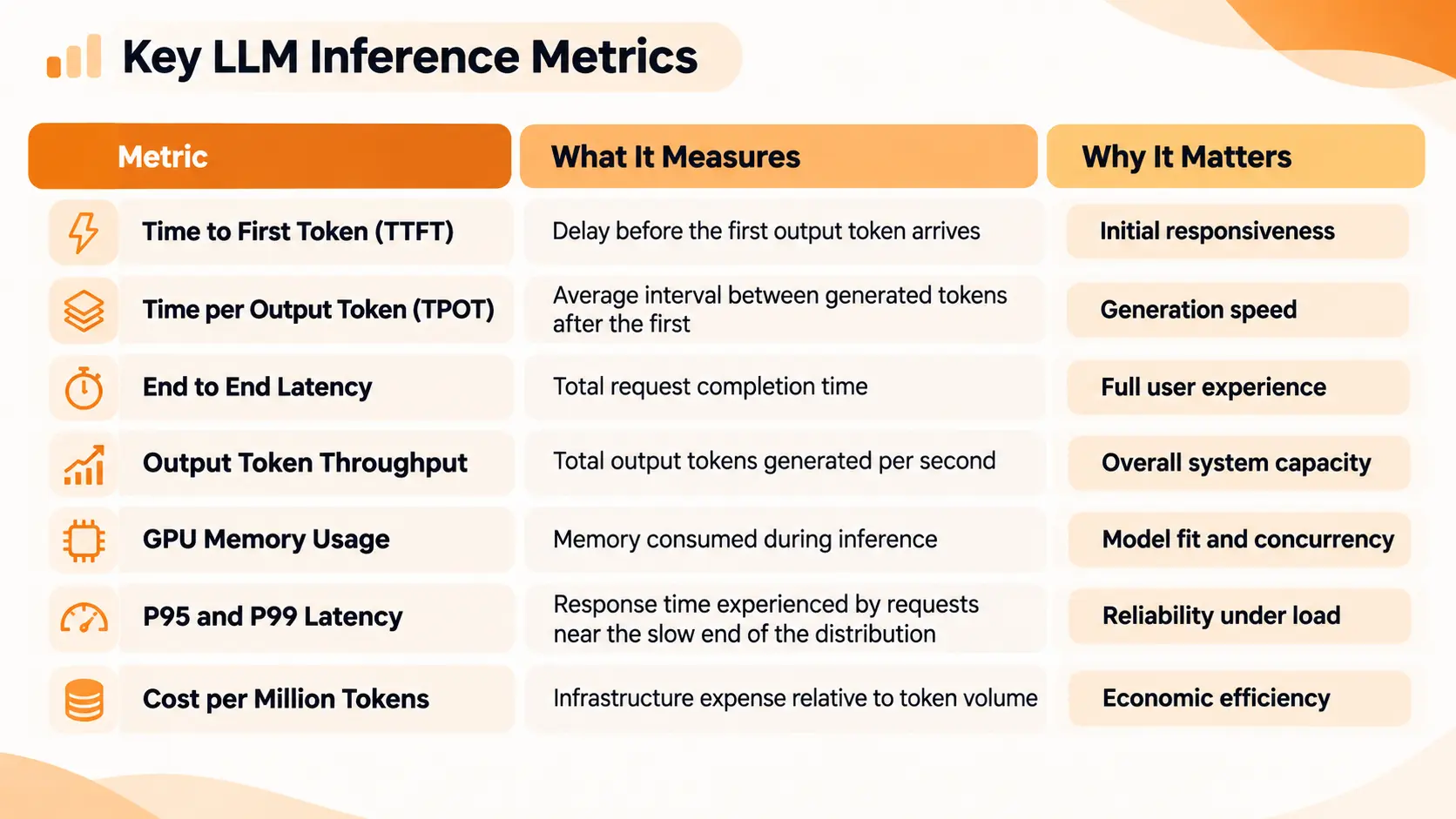
These measurements answer different questions.
A high token throughput result does not establish that users receive fast responses. Likewise, excellent single request latency does not demonstrate that the service can sustain production traffic.
Metrics also need consistent definitions. Output token throughput across a service is different from token generation speed for one user.
For credible comparisons, the benchmark must record the model, numerical precision, inference engine, hardware, input lengths, output lengths, and concurrency settings.
LLM Inference Engines and Runtime Selection
Optimization techniques depend on the software responsible for executing the model.
Modern runtimes manage request scheduling, cache allocation, memory access, and optimized GPU operations.
LLM Inference Engines compares platforms such as vLLM, SGLang, and NVIDIA TensorRT LLM, which provide different combinations of supported models, hardware capabilities, and execution optimizations.
The correct engine is not necessarily the one reporting the highest benchmark result.
A runtime must support the target model architecture, required numerical format, hardware platform, and operational features.
It must also deliver acceptable results under the application's actual traffic pattern.
For example, an engine that performs exceptionally well with long prompts and high concurrency might offer no advantage for a service processing short, isolated requests.
Before changing frameworks, benchmark the existing runtime with its appropriate configuration. Replacing an engine can introduce engineering costs without resolving the underlying performance limitation.
Optimizing LLM Inference in Production
A reliable optimization process begins with measurements and proceeds through controlled changes.
Establishing the Baseline
Start with a representative workload.
Record the distribution of prompt lengths, expected response lengths, concurrent requests, and request arrival patterns.
Capture TTFT, TPOT, throughput, memory consumption, and operating cost.
The baseline must also identify the exact model and serving configuration so subsequent results can be compared fairly.
Selecting the Optimization
Identify the dominant limitation.
For a compute intensive prefill workload, evaluate input processing and attention efficiency.
For a service constrained by decoding speed, investigate memory bandwidth, execution precision, and compatible generation acceleration.
For a system limited by concurrent traffic, examine request scheduling and memory allocation.
Change one major factor at a time when establishing its individual effect. Once the contribution is understood, compatible optimizations can be combined and tested together.
Validating the Result
A performance improvement is valuable only when it satisfies the application's quality and reliability requirements.
Record changes in latency, throughput, memory consumption, and cost under the same workload.
If the optimization changes numerical behavior, compare model outputs against the approved baseline using representative evaluation data.
Quantization deserves particular attention because numerical precision changes can affect generation.
The same evaluation discipline applies when changing inference engines, kernels, or model configurations.
Testing Under Production Traffic
A configuration that performs well with one request can behave differently when many requests arrive together.
Production validation should include sustained traffic, traffic bursts, realistic context lengths, and representative output sizes.
Measure the system at several concurrency levels.
The preferred operating point is the configuration that provides the highest useful throughput while remaining within the latency, memory, reliability, and quality limits.
This is a stronger basis for deployment than selecting the configuration with the greatest peak tokens per second.
Inference Performance and Output Quality
Optimization should preserve the application's required behavior.
Some improvements change execution without changing the model's intended output distribution. Others alter numerical precision or select a different model, which can affect predictions.
The distinction matters when comparing results.
A faster model is not necessarily a better choice if its outputs fail the application's acceptance criteria.
Evaluation should use tasks that represent production requirements, including factual accuracy, structured output validity, instruction following, and domain specific performance.
For applications generating code or structured data, parsing and execution checks can provide more reliable evidence than judging response quality from a few examples.
The same evaluation set should accompany performance testing so teams can assess speed and model behavior together.
Building an Efficient LLM Inference System
LLM Inference Optimization is a process of removing measurable limitations from model execution.
KV caching reduces repeated attention computation. Batching improves GPU utilization across requests. Speculative decoding can reduce sequential generation work. Quantization reduces memory requirements, while optimized runtimes coordinate these techniques with hardware execution.
Their value depends on the workload.
A responsive assistant, a large document processing pipeline, and a memory constrained application place different demands on the same model.
The most reliable approach is to identify the bottleneck, establish a measurable baseline, choose a suitable optimization, and verify the result against performance and quality requirements.
FAQ
Can we optimize LLM inference if we're using an API instead of hosting the model?
Yes, but optimization is limited to controls exposed by the provider and changes within the application. Teams can reduce unnecessary input tokens, use supported prompt caching, select suitable model variants, and manage request concurrency. They cannot directly change the provider's internal GPU kernels or memory allocation unless those capabilities are explicitly available.
Does streaming make the model generate tokens faster?
No. Streaming changes how generated tokens are delivered to the application. It allows users to see partial output before the full response is complete, but it does not inherently accelerate the model's computation. The underlying generation rate must be measured separately from the time required to transmit and display tokens.
Why does our LLM respond slowly after being idle?
The delay can result from loading model weights, initializing the inference runtime, allocating GPU resources, or restoring capacity after a service has scaled down. This is known as a cold start. Keeping suitable capacity available can reduce the delay, but reserved resources increase operating costs.
Can two LLMs running on the same GPU slow each other down?
Yes. Models sharing a GPU compete for memory capacity, memory bandwidth, and computing resources. Their execution can also interfere through scheduling and resource allocation. Dedicated instances, controlled concurrency, and resource isolation can provide more predictable performance when latency requirements are strict.
How do we check whether an optimization affects non English responses?
Use an evaluation dataset containing the languages and tasks supported by the application. Compare the original and optimized configurations using the same prompts, generation settings, and acceptance criteria. Include language specific accuracy, formatting, and instruction following checks because performance changes observed in English do not establish equivalent results across other languages.

Fatemeh Jahangard
Technology & AI Writer at PinerookFatemeh Jahangard covers AI, emerging technologies, and digital innovation for Pinerook, focusing on how technology shapes startups and industries.
 Seen first.