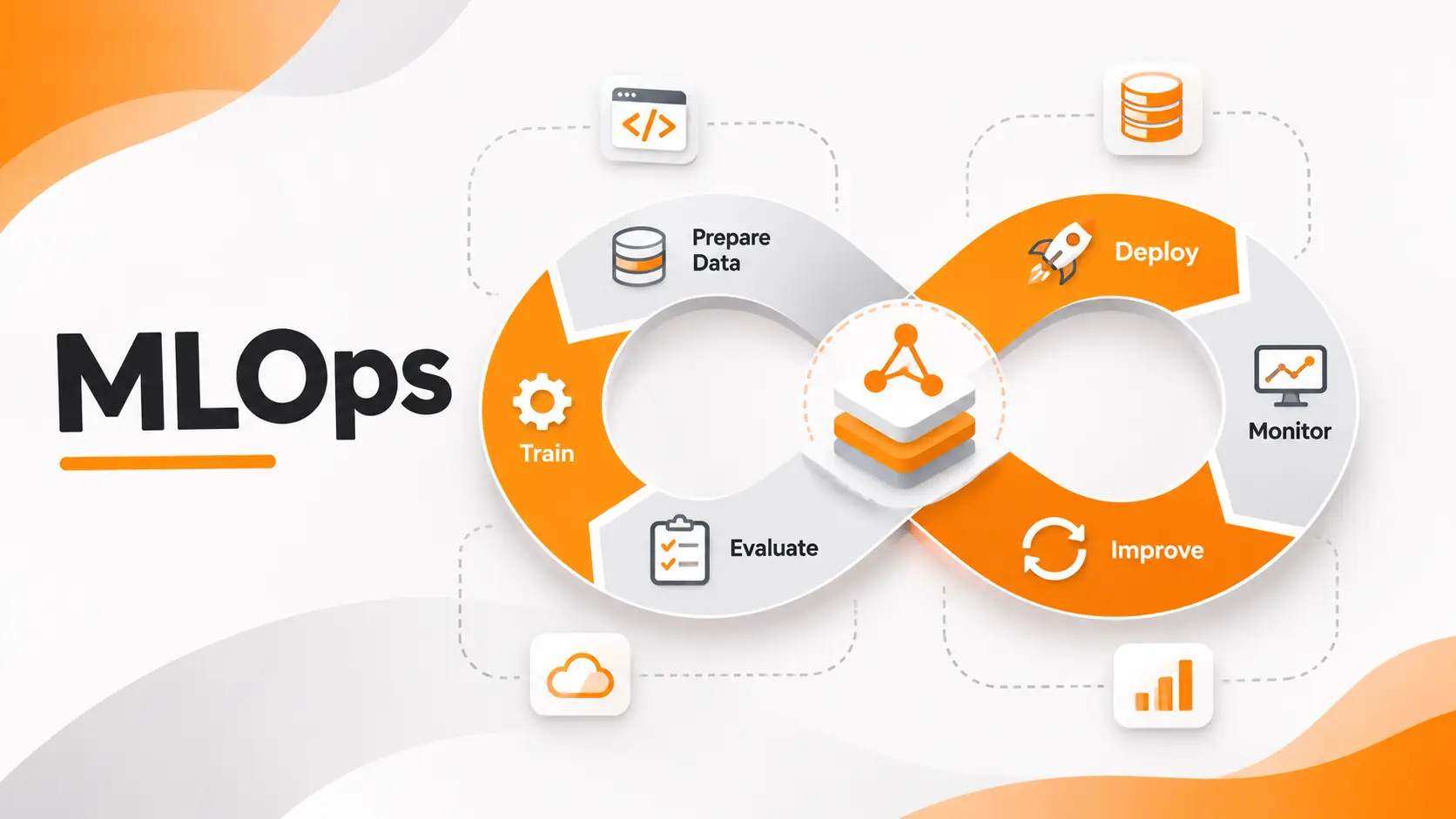
A machine learning model can achieve impressive results during development and still struggle once it reaches real users. Customer behavior changes, incoming data takes new forms, and predictions that worked during testing no longer meet business expectations.
MLOps (Machine Learning Operations) is the practice of managing machine learning models throughout their lifecycle, from data preparation and training to deployment, monitoring, and continuous improvement. It brings software engineering, automation, and operational controls into machine learning so models remain reliable and manageable in production.
When I evaluate an ML system, I look beyond its accuracy score. I want to understand how the team releases new versions, identifies performance problems, reproduces previous results, and responds when a model stops meeting expectations. That is where MLOps becomes essential.
The MLOps Lifecycle
The MLOps lifecycle connects model development with the systems responsible for keeping it operational. Instead of treating training as the final stage, it establishes a repeatable process that continues after a model enters production.
Each stage produces information or artifacts required by the next. Training creates a model candidate, evaluation determines whether it meets requirements, and production feedback helps the team decide whether changes are necessary.
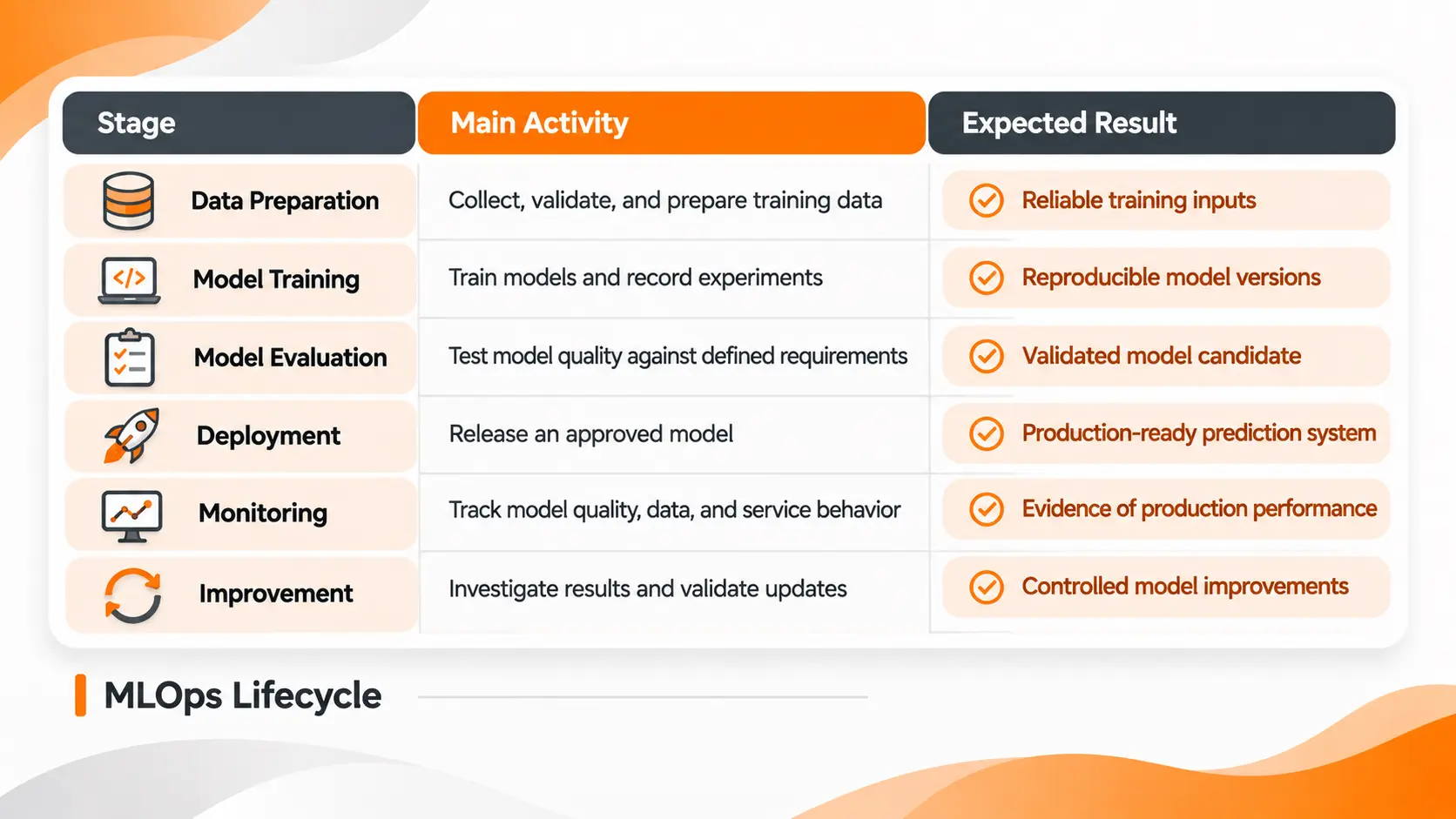
The lifecycle is continuous, but that does not mean every detected change should trigger retraining. Production feedback must first be evaluated to determine whether the problem comes from the model, the data pipeline, or the application itself.
A new model should replace an existing version only after it satisfies the required validation and release criteria.
MLOps Architecture and Core Components
An MLOps architecture connects model development, production infrastructure, and operational feedback. The objective is to make every important action traceable, from the dataset used during training to the model version serving predictions.
The architecture relies on several components that perform different responsibilities.
Model Release and Production Monitoring
Model Deployment moves an approved model from development into a production environment. The model can serve predictions through an API, process scheduled batches, or operate within an application. The release process must account for dependencies, compatibility, and the ability to restore a previous version.
After release, Model Monitoring provides visibility into the system's behavior. Engineers track prediction quality, input characteristics, response times, error rates, and other indicators relevant to the application.
One important signal is Model Drift, which describes changes in the data or relationships affecting a model after training. Detecting these changes helps teams investigate whether the model still represents the environment in which it operates. Data drift alone does not establish that prediction quality has declined.
Model and Feature Management
An ML Model Registry provides a centralized record of model versions and their associated metadata. It helps teams identify which models have completed evaluation, which are approved for release, and which versions are running in production.
A Feature Store manages reusable feature definitions and makes them available to machine learning workflows. This becomes particularly valuable when multiple models depend on the same customer, transaction, or product attributes. Consistent feature processing also reduces discrepancies between training and inference.
Together, these systems improve traceability and consistency across the development and operational environments.
Automation and Operational Tools
CI/CD for Machine Learning extends automated software delivery practices to machine learning systems. It supports testing, validation, packaging, and controlled releases while accounting for changes in code, data, and model artifacts.
Choosing the right MLOps Tools depends on the existing infrastructure and operational requirements. Experiment tracking, workflow orchestration, artifact storage, and monitoring can be handled by specialized platforms or combined within managed cloud services.
I would not select an elaborate technology stack before defining the workflow. Each component should solve a specific operational requirement rather than add another system for the team to maintain.
MLOps in Practice: A Product Recommendation System
Consider an online store that uses machine learning to recommend products based on customer interactions, purchase history, and product information.
The initial model performs well during testing. After deployment, the store adds new products, inventory changes, and customer interests shift. The model continues producing recommendations, but the team needs evidence that those recommendations still support the intended business outcome.
An MLOps workflow makes that evaluation possible.
The data pipeline collects updated interactions and product information. The training process creates a new candidate model, which is evaluated against the existing production version. Before release, the team verifies that the candidate meets recommendation-quality requirements and respects product availability.
Once deployed, the model is evaluated through technical and business indicators, including prediction response time, recommendation engagement, and conversion performance.
If the results fall below established requirements, the team investigates the underlying cause. Retraining becomes an option when evidence shows that the model needs to learn from updated data.
If a newly released version performs worse, an approved previous version can be restored while the problem is investigated.
This is the practical value of MLOps: the organization maintains control over model behavior instead of relying on the results of its original training process.
MLOps vs. DevOps
MLOps builds on DevOps principles such as automation, version control, testing, and collaboration. However, machine learning introduces a dependency that traditional software delivery does not address on its own: model behavior is learned from data.
An application can continue running without software errors while its predictions become less useful. That makes monitoring model quality just as important as monitoring system availability.
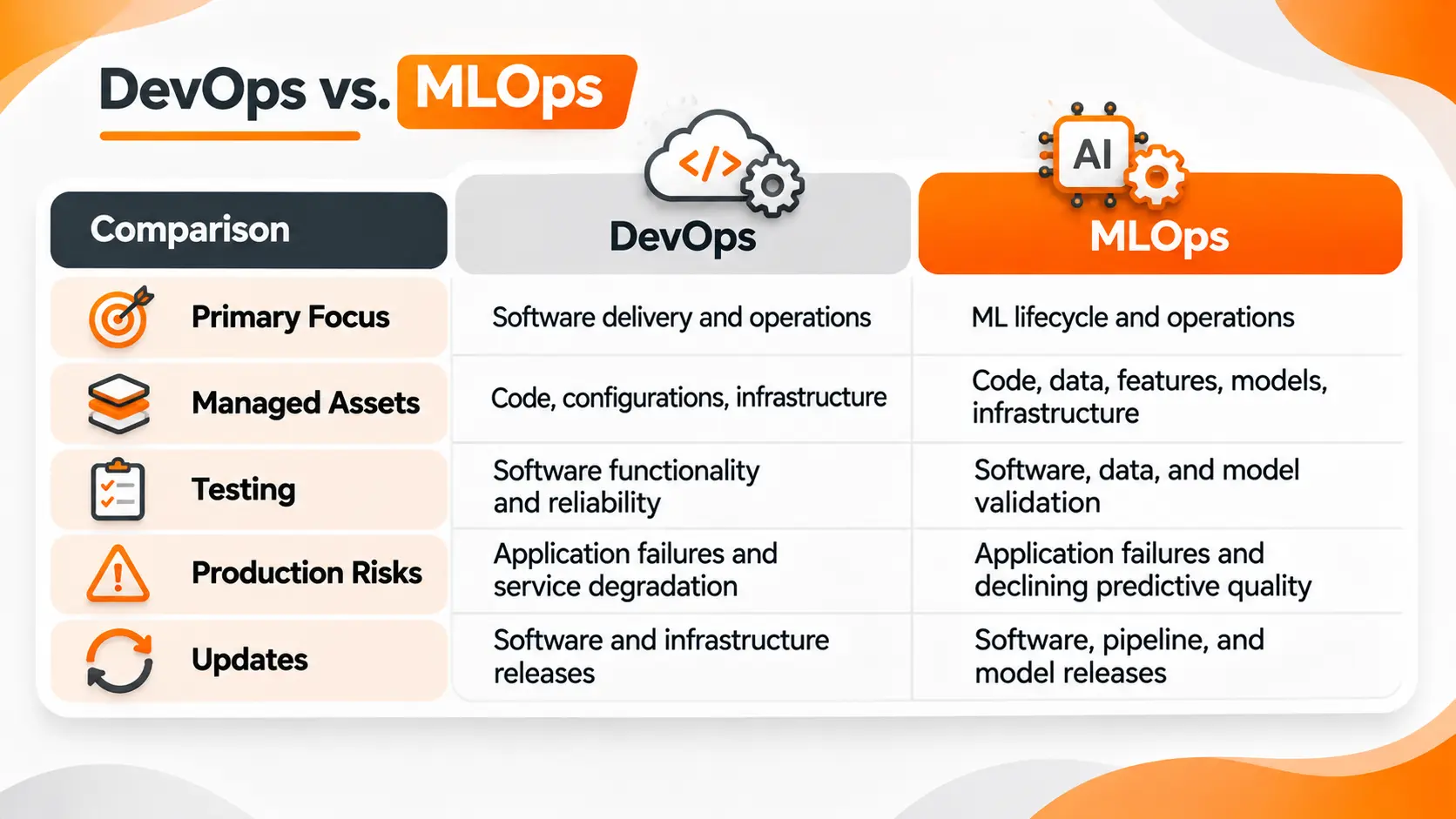
MLOps does not replace DevOps. It extends operational engineering practices to systems whose behavior depends on learned patterns.
For a production ML application, both are necessary: the software must remain available, and the model must continue meeting its defined quality requirements.
Benefits of MLOps for Machine Learning Teams
The benefits of MLOps become more visible when a company moves beyond individual experiments and starts maintaining models that support real business processes.
Faster model releases
Repeatable validation and deployment workflows reduce manual handoffs between data scientists, software engineers, and operations teams. Model changes can move through a documented release process without rebuilding the workflow for every update.
Reproducible experiments
Versioned data references, training code, configurations, and model artifacts allow teams to reproduce previous results. When a new version behaves differently, engineers can identify what changed instead of reconstructing the experiment from incomplete records.
Reliable production performance
Continuous operational visibility allows teams to identify problems through measured evidence. A model that becomes less accurate, receives invalid inputs, or exceeds response-time requirements can be investigated before those issues spread across the application.
Clear ownership and accountability
Release approvals, operational responsibilities, and documented model versions establish who owns each decision. This is particularly important when several teams contribute to the same machine learning system.
Better resource management
Tracking training expenses, inference usage, and infrastructure consumption helps organizations evaluate the cost of maintaining each model. Additional computational resources should be justified by measurable improvements in performance or business value.
These benefits come from maintaining reliable processes. Installing an MLOps platform without defining responsibilities, validation requirements, and release controls does not deliver the same result.
MLOps Implementation: From Development to Production
A successful MLOps implementation starts with the requirements of the machine learning application, not with the number of tools available.
When planning an operational workflow, I begin with a simple question: what must the team be able to verify before and after a model reaches production?
The answer determines the implementation priorities.
1. Define Production Requirements
Identify the purpose of the model and establish measurable acceptance criteria. These include prediction quality, response time, service availability, and business constraints.
The team should also define the conditions under which a model release must be rejected or reversed.
2. Make Model Development Reproducible
Record the code, dependencies, configurations, training data references, and experiment results associated with each model version.
A trained model without this information is difficult to reproduce and investigate. Reproducibility gives engineers the evidence required to explain differences between experiments.
3. Establish Validation and Release Controls
Introduce automated checks for data schemas, model quality, and application compatibility.
Each model candidate should pass its defined tests before promotion into production. Release approvals and rollback procedures should be documented as part of the workflow.
4. Collect Production Evidence
Build a monitoring process that captures system health, input quality, prediction behavior, and observed outcomes where available.
The organization must also define how monitoring alerts are reviewed and who is responsible for investigating them.
5. Create a Controlled Improvement Process
Use production findings to determine whether changes are required. The solution might involve correcting a data pipeline, updating application logic, adjusting model settings, or retraining the model.
Every proposed update should pass validation before release.
The amount of automation should match the system's operational needs. A project with infrequent updates can use manual approvals within a reproducible process. A system with frequent releases requires stronger automation and more extensive testing.
The objective is reliable operation, not automation for its own sake.
Essential MLOps Platforms and Technologies
The MLOps ecosystem contains technologies for experiment tracking, workflow orchestration, model management, and infrastructure operations.
Selecting a platform requires understanding which capabilities the team already has and which responsibilities the new technology must support.
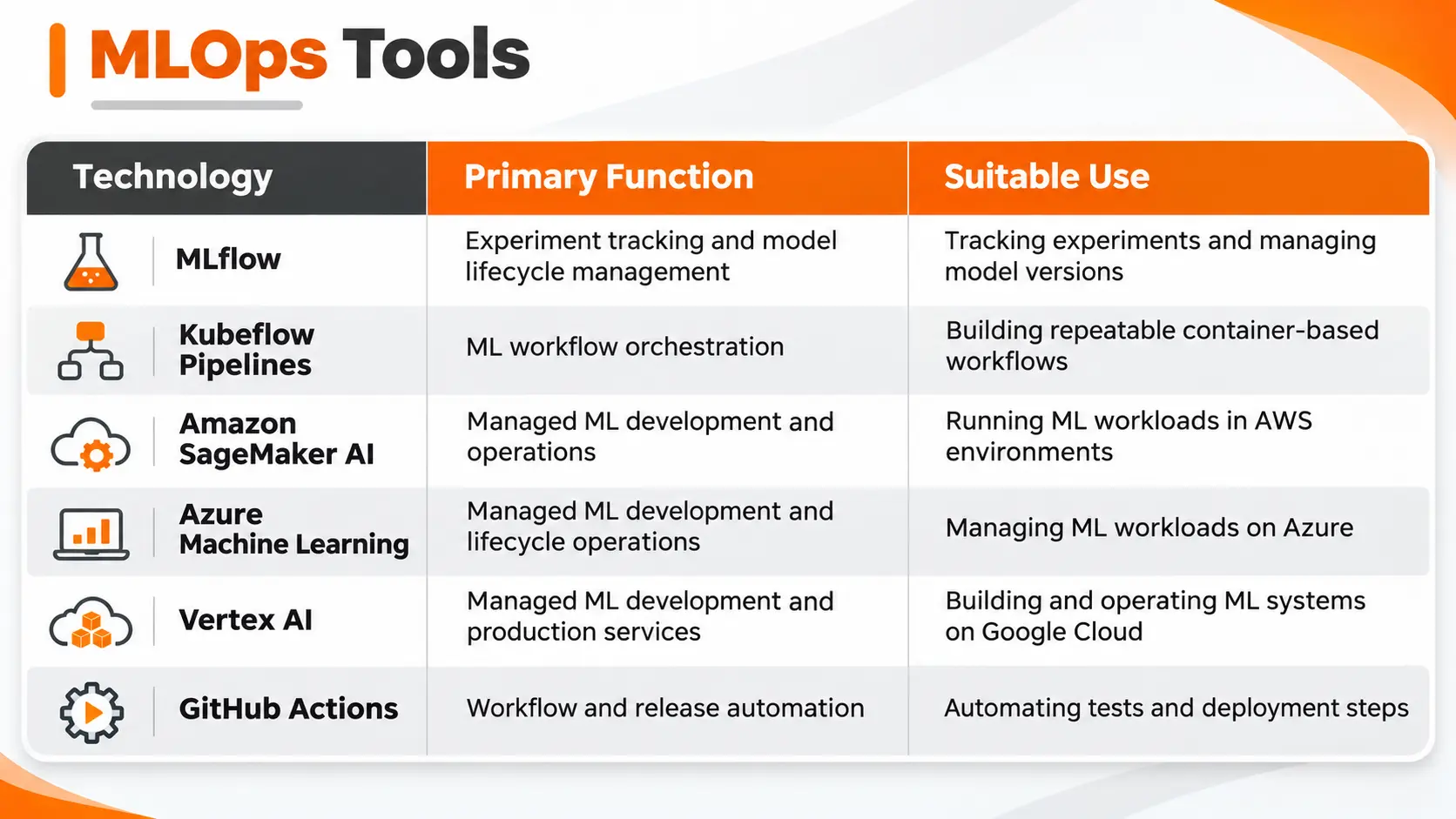
These platforms are not direct substitutes for one another. Some provide broad managed environments, while others focus on a specific part of the ML lifecycle.
A small team can combine a limited set of specialized tools with its existing infrastructure. Larger organizations need to consider integration, governance, access control, scaling, and operational ownership across multiple projects.
The best stack is the one the team can maintain while meeting its production requirements.
MLOps Performance Metrics
Model accuracy alone does not establish whether an ML system is performing successfully in production.
A reliable evaluation process separates model quality from data health, infrastructure reliability, and business outcomes.
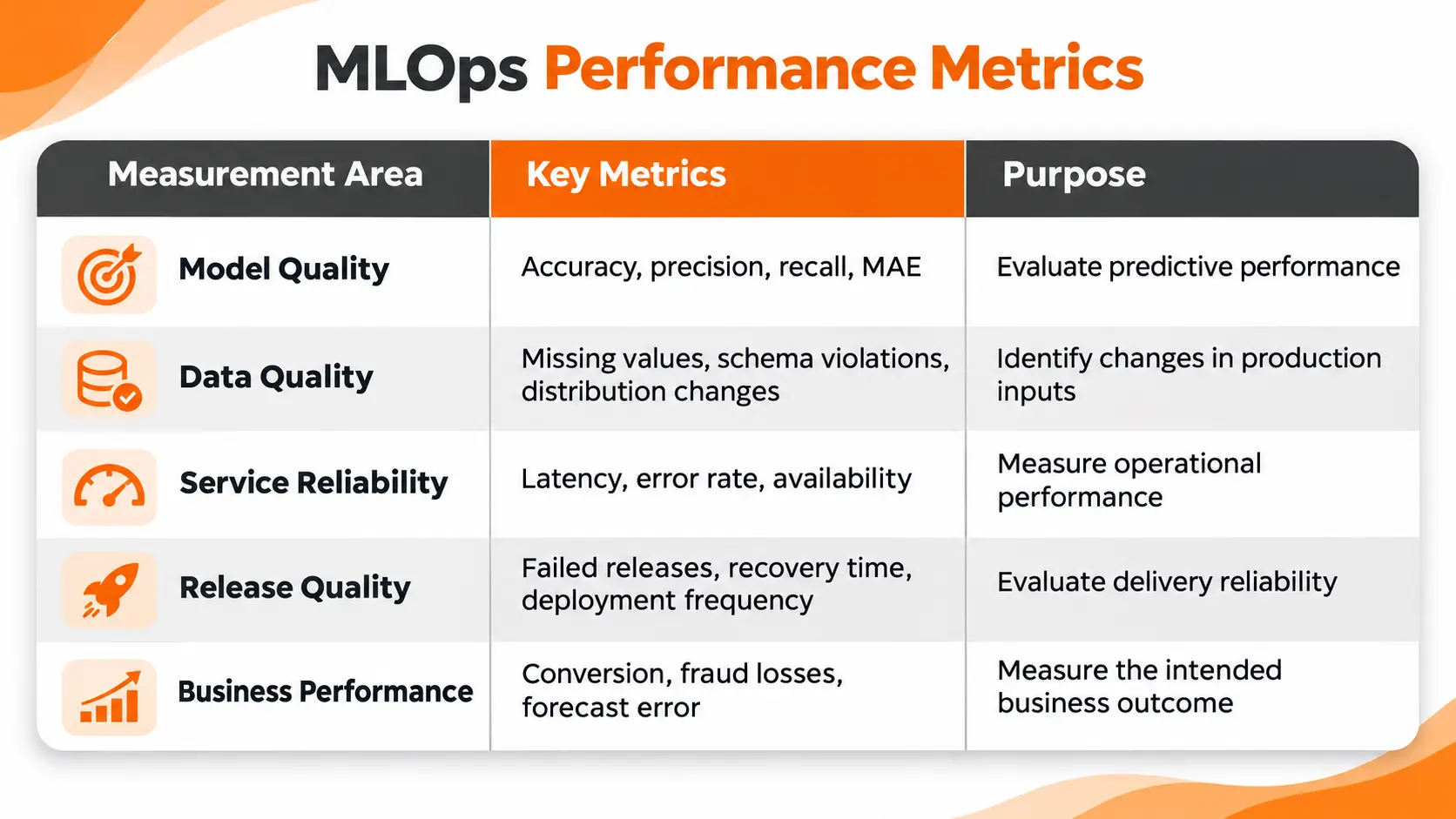
A fraud detection system needs to measure its ability to identify fraudulent transactions while controlling false positives. A demand forecasting model requires measures of prediction error and forecasting usefulness.
There is also a difference between observing a change in data and measuring a decline in prediction accuracy. Data distribution changes provide a reason to investigate. When actual outcomes become available, comparing them with earlier predictions provides direct evidence of performance.
I consider this distinction essential. Without it, teams can spend resources retraining models that do not need to change while overlooking problems elsewhere in the system.
MLOps Challenges in Production Environments
The operational complexity of machine learning increases when multiple datasets, pipelines, models, and application teams depend on one another.
One major challenge is maintaining consistency between training and production data. If features are calculated differently in each environment, the model can receive inputs that do not match those used during development.
Another challenge is evaluating new model versions. A candidate can achieve a better overall accuracy score while performing worse for a customer segment or business condition that matters to the organization.
Release validation must reflect those requirements instead of relying on a single aggregate metric.
Operational security also requires attention. Training datasets, model artifacts, credentials, and production prediction records need appropriate access controls. Organizations handling personal or regulated information must apply the relevant privacy, retention, and compliance requirements.
Finally, automation needs boundaries. A pipeline can successfully produce a new model without establishing that the model is suitable for release. Approval criteria, deployment safeguards, and recovery procedures remain necessary.
These requirements are easier to manage when responsibilities are defined before the number of models increases.
MLOps and Long-Term Model Reliability
A machine learning project does not end when a model reaches production. Its operational value depends on whether the organization can maintain performance, investigate unexpected behavior, and introduce improvements without losing control of the system.
That is how I assess a mature MLOps process. I look for reproducible development, validated releases, meaningful monitoring, and clear operational ownership.
A system with those capabilities provides a stronger foundation than a collection of automated pipelines without reliable evaluation and accountability.
MLOps turns machine learning from an isolated development activity into an operational process that can support real applications over time.
FAQ
Do I really need Kubernetes to use MLOps?
No. MLOps does not require Kubernetes. Machine learning systems can operate through managed cloud services, virtual machines, serverless environments, or scheduled batch-processing infrastructure. The appropriate environment depends on workload requirements, scalability, cost, and the team's operational capabilities.
What if my model only runs once a day?
MLOps supports scheduled batch inference as well as real-time prediction services. For a daily model execution, the operational process should verify input freshness, job completion, output quality, execution time, and delivery to downstream systems. Monitoring and recovery procedures must follow the application's execution schedule.
How can I check accuracy when the real results come weeks later?
Predictions can be stored with permitted identifiers that allow them to be matched with outcomes when those outcomes become available. Until then, data quality, prediction distributions, and system performance can be monitored. Actual predictive performance should be calculated after the corresponding results are collected.
Can I use MLOps with an AI model built by another company?
Yes. An organization can apply MLOps practices to externally provided models through configuration management, version tracking, evaluation tests, operational monitoring, and access controls. The organization remains responsible for validating the model's behavior within its own application, even when the provider manages the underlying model infrastructure.
What if a new model gets better results overall but performs worse for certain users?
The release decision must account for relevant user segments and operational requirements, not only aggregate performance. The team should evaluate the affected groups, investigate the differences, and reject the release if the model violates established quality, fairness, or compliance requirements.
Can I start using MLOps without a dedicated engineering team?
Yes. A small team can establish MLOps practices using managed cloud services and lightweight automation. Start with experiment tracking, model versioning, and basic deployment controls. Assign clear ownership for monitoring and maintenance before expanding the infrastructure.
How much does it cost to implement MLOps?
MLOps has no fixed implementation cost. Expenses depend on compute resources, data storage, model complexity, cloud services, and operational requirements. Open-source tools can reduce software licensing costs, but infrastructure, integration, and ongoing maintenance still require investment.
Is MLOps worth it if I only have one machine learning model?
Yes, when that model supports a production application. Even a single model needs reliable version control, performance monitoring, and recovery procedures. The implementation should match the model's operational importance rather than the number of models an organization maintains.
How do I know when my MLOps setup is ready for production?
An MLOps setup is production-ready when the team can reproduce a model version, validate its performance, deploy it safely, detect operational failures, and restore a previous approved version. These capabilities should be tested before the system becomes responsible for real business decisions.
Who should be responsible for maintaining an MLOps system?
Responsibility should be shared across clearly defined roles. Data scientists own model development and evaluation, ML engineers manage pipelines and model integration, and platform or operations engineers maintain infrastructure reliability. Each production model also needs a designated owner responsible for coordinating incidents, approving changes, and maintaining operational standards.

Fatemeh Jahangard
Technology & AI Writer at PinerookFatemeh Jahangard covers AI, emerging technologies, and digital innovation for Pinerook, focusing on how technology shapes startups and industries.
 Seen first.