A founder can have an excellent product and still be difficult to trust. Prospective customers may understand the software but know nothing about the judgment behind it. A promising candidate may like the role but wonder whether the founder can lead through uncertainty. An investor may appreciate the market opportunity while struggling to verify the founder’s expertise. Personal branding for founders addresses that credibility gap by making relevant experience, decisions, and evidence easier to discover and evaluate.
The goal is not to become an influencer or turn every working day into a public performance. A useful founder brand makes it clear who the founder helps, what they understand, what evidence supports their views, and why a conversation with them might be worthwhile. The strongest approach connects personal reputation to real business outcomes without treating attention as a substitute for customer value.
In this guide, we will move from defining a credible professional position to choosing channels, publishing useful evidence, handling reputational risks, and measuring whether the effort produces better opportunities. Each step should remain practical for a founder with limited time and no dedicated media team.
What Personal Branding Means for a Founder
Personal branding is the set of associations people form around a person’s expertise, judgment, conduct, and public record. For founders, those associations influence how prospective customers, investors, hires, partners, and journalists interpret the business. The founder brand exists even when the person never posts online because meetings, past projects, public profiles, references, and search results already shape an impression.
The work is therefore to align what a founder wants to be known for with what an informed outsider can actually verify. A polished profile can communicate a claim. A useful product demonstration, a clear argument about a difficult tradeoff, or a documented customer result can support it. A reputation becomes stronger when repeated public claims match private decisions over time.
Personal branding should also be distinguished from general marketing. Marketing promotes offers and creates demand; a founder brand reveals the perspective and accountability of the individual responsible for the organization. The overlap is useful, but the two activities should not be measured or managed as if they were identical.
Why Founder Reputation Matters More in 2026
The pressure to become visible is increasing, but it should be interpreted carefully. In a November 2026 LinkedIn study, 80 percent of surveyed founders said they had needed to become content creators to build credibility and reach, compared with 61 percent in a study conducted six months earlier. In the same report, 84 percent said their personal brand added direct credibility to their businesses. Those are self reported perceptions, not proof that posting causes growth.
Trust research also points to limits. Clutch surveyed 408 consumers in June 2026 and found that among respondents who followed brands or executives, 26 percent trusted a founder’s personal post most, compared with 19 percent who favored the company’s post. Yet 47 percent of all respondents followed neither. The implication is not that founder content always wins. It is that visibility, relevance, and trust must each be earned, and that the founder cannot assume a large audience is waiting.
The practical business case is narrower than popularity: a credible founder can make an introduction warmer, help a candidate evaluate leadership, offer context when a buyer researches the company, or make a journalist more confident about an expert source. Those benefits tend to accumulate through clear evidence and relationships, not through a single viral post.
Start With the Person You Need to Reach
A founder often tries to speak simultaneously to customers, investors, employees, and other founders. That produces generic commentary because each audience has a different decision to make. Begin with the next important business constraint. If the company needs customers, the founder should become useful to buyers and practitioners in its category. If recruitment is the constraint, candidates may need evidence of technical judgment and the way the team operates. Investor visibility matters only if it serves a specific capital or relationship goal.
The first exercise is to write one sentence describing the relevant audience, the decision they face, and the kind of firsthand evidence the founder can offer. For example, a founder building software for compliance teams might want compliance leaders at growing financial firms to associate them with practical risk reduction, not with generic optimism about artificial intelligence.
This audience choice does not have to be permanent. It should be stable long enough for a reader to recognize a pattern, and flexible enough to respond when the company’s strategy changes. A few hundred relevant professionals can be more useful than thousands of unrelated followers.
Build a Distinct Point of View That Can Be Supported
A credible brand position is not a collection of flattering adjectives. Words such as visionary, innovative, and passionate reveal little about what the person can do. A better position combines a narrow problem, a clearly defined audience, a distinctive judgment, and evidence from work. Founder Brand Positioning becomes more useful when it answers what a founder understands that the intended reader might not yet see clearly.
Consider an illustrative founder who helps midmarket logistics companies reduce errors in warehouse operations. A generic profile might say the founder is transforming supply chains through technology. A stronger point of view might explain why companies should fix data ownership before buying more automation. The second claim invites questions and can be tested against real operating experience. It also provides a coherent theme for articles, interviews, and conversations.
A founder should be willing to show how an opinion was formed, where it applies, and what would change the conclusion. That is more credible than issuing confident declarations about every industry trend. Being recognizably thoughtful is a better goal than being constantly provocative.
Keep the Founder and Company Brands Connected but Distinct
The founder and company should support each other without becoming interchangeable. A company needs a promise that customers can rely on regardless of who posts that week. A founder can bring firsthand context, an independent professional history, and a more personal explanation of why certain choices are made. Founder Brand vs Company Brand is an important distinction when deciding what belongs on personal channels and what must remain an official company commitment.
An individual can discuss an operating principle or lessons from building a product, while the company page remains the authoritative place for pricing, service commitments, security policies, and formal announcements. This separation also protects the business when a founder changes role or reduces public activity. The objective is shared credibility, not dependency on one personality.
Match Each Audience to the Proof It Needs
Before producing more content, identify what each audience is trying to verify. The same achievement may be persuasive to a buyer and irrelevant to an investor. The following framework helps a founder choose evidence rather than publish indiscriminately.
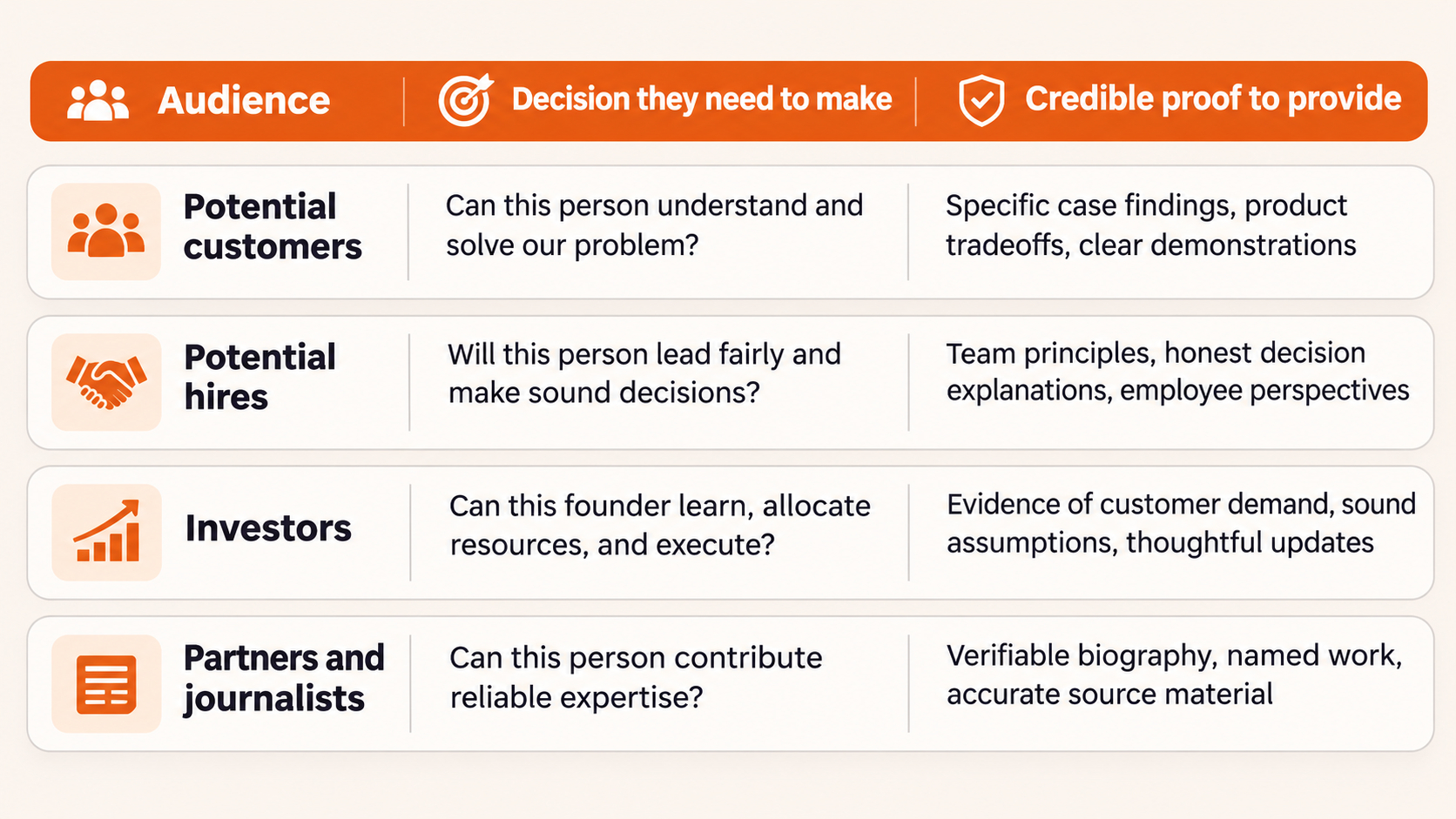
A proof map prevents one common mistake: presenting social reach as evidence of operational competence. A large audience might demonstrate an ability to attract attention, but it cannot by itself establish customer outcomes, financial discipline, or trustworthy leadership. Use proof that corresponds to the decision being made.
Choose Channels Where the Right People Already Pay Attention
The best platform is not necessarily the platform producing the largest numbers. A founder selling specialized enterprise software may get more useful conversations from a narrow LinkedIn audience than from broad entertainment content. A developer founder may find relevant peers in technical communities, while a consumer founder may need visual demonstrations and community discussion.
For professional audiences, LinkedIn Personal Branding for Founders can provide a focused starting point, particularly when the profile is clear, posts demonstrate relevant work, and comments contribute something useful to active industry conversations. The platform should be a distribution channel for substantive thinking, not the sole place where a founder’s identity exists.
An owned biography, stable professional website, and a carefully maintained archive make prior work easier to verify over time. Public profiles should agree on the founder’s current role, company, areas of expertise, and past achievements. Search visibility is helpful, but appearing in an AI answer or search result is not a certificate of authority. The underlying information still needs to be accurate and supported.
Create Content From Decisions and Experience
Founders rarely run out of potentially useful material. They make tradeoffs, encounter objections, test assumptions, and change their minds. The challenge is capturing these moments without exposing confidential information or manufacturing certainty. Founder Thought Leadership Strategy starts with a repeatable process for turning firsthand work into arguments that others can learn from.
A reliable content pattern is to describe a concrete problem, explain the decision, show the available evidence, acknowledge the tradeoff, and state what changed. For example, a founder can explain why a launch was delayed because reliability mattered more than publicity. They should describe the reasoning and what the company learned, without sharing sensitive customer details or framing ordinary setbacks as dramatic hero stories.
Thought leadership is not a claim of superior intelligence. It is an observable record of careful judgments that readers can compare with their own experience. Editorial support or AI tools can help organize notes, but the founder should verify facts, approve claims, and own the final view.
Share the Journey Without Turning the Business Into a Spectacle
There is value in showing the work behind a company. Building in Public for Startups can make experimentation visible, invite useful feedback, and help others understand how a founder approaches uncertainty. Yet sharing progress is not the same as publishing every financial, customer, or personnel detail.
Good boundaries should be established before posting. Customer information needs appropriate permission, internal disagreements should not become public entertainment, and unverified product plans should not be presented as commitments. A founder can share a lesson from a failed experiment without revealing proprietary methods or making employees responsible for personal content goals.
A useful distinction is between an observation and a promise. The founder may say that one experiment suggested an improvement for a certain customer segment. They should not imply that the result generalizes to every customer or that a planned feature will definitely ship on a specific date when the team has not approved it.
Use Independent Recognition Carefully
External references can make a founder easier to assess, but borrowed prestige is a poor substitute for substance. Founder Media Relations works when a founder can offer genuine expertise, timely evidence, or a clear interpretation of an issue that matters to a publication’s audience. A relevant interview or an independently edited industry article is more useful than a list of low quality placements created only to show the person’s name.
Prepare a short factual biography, a clear description of the company, a few topics the founder can discuss competently, and examples that may be independently checked. Pitch the story or insight rather than the desire for publicity. Any paid placement or sponsorship should be identified as such according to the publication’s rules.
A founder should not describe every press mention as independent endorsement. Articles can contain mistakes, sponsored material has a different context from reported journalism, and a quote may support only a narrow point. Maintaining those distinctions is part of building trust rather than merely collecting appearances.
Protect an Accurate and Consistent Professional Record
Reputation is shaped by what other people can find as well as what the founder publishes. Founder Online Reputation Management includes maintaining accurate profiles, correcting outdated professional details, documenting public achievements, and responding appropriately to legitimate criticism. It is not about suppressing every negative opinion or manufacturing favorable reviews.
A useful quarterly review asks whether important profiles agree on basic facts, whether a reader can distinguish the founder from people with similar names, and whether public claims have links to credible supporting work. When something is wrong, request a correction through appropriate channels, keep a record of the change, and avoid retaliatory responses that make a small issue more visible.
This layer is particularly important when a founder works in a regulated or sensitive industry. Credentials, financial claims, partnerships, results, and customer examples must be precise. A visible correction can increase credibility when it demonstrates accountability; a polished but misleading profile will eventually weaken it.
Convert Attention Into Relationships and Opportunities
Visibility is not the same as influence, and influence is not the same as commercial value. A founder should make the next useful step obvious without turning every contribution into a sales pitch. A buyer might be invited to a relevant product demonstration, a candidate to read a transparent description of the working environment, or a partner to request a technical discussion.
For a software startup, an informative founder post might generate several qualified questions and one valuable customer conversation, even if it receives few public reactions. Another post might attract a large audience interested in the founder’s personality but no one who can use the product. The first can be more useful for the business. Ask how each channel creates the opportunity to advance a real relationship, not merely whether it increases reach.
A founder should also ensure that useful attention can transfer to the organization. Publish company documentation, let team members contribute expertise, and clarify which inquiries should be handled by sales, recruiting, or partnerships. If every prospect must always speak to the founder, a successful personal brand may become an operational bottleneck.
A Practical 90 Day Founder Brand Plan
A personal brand becomes manageable when it is built like a small operating system rather than a campaign. For a founder with limited capacity, the first 90 days should prioritize clear positioning, verifiable assets, a repeatable publishing practice, and a small number of outcome signals. This example plan is illustrative, not an industry benchmark.
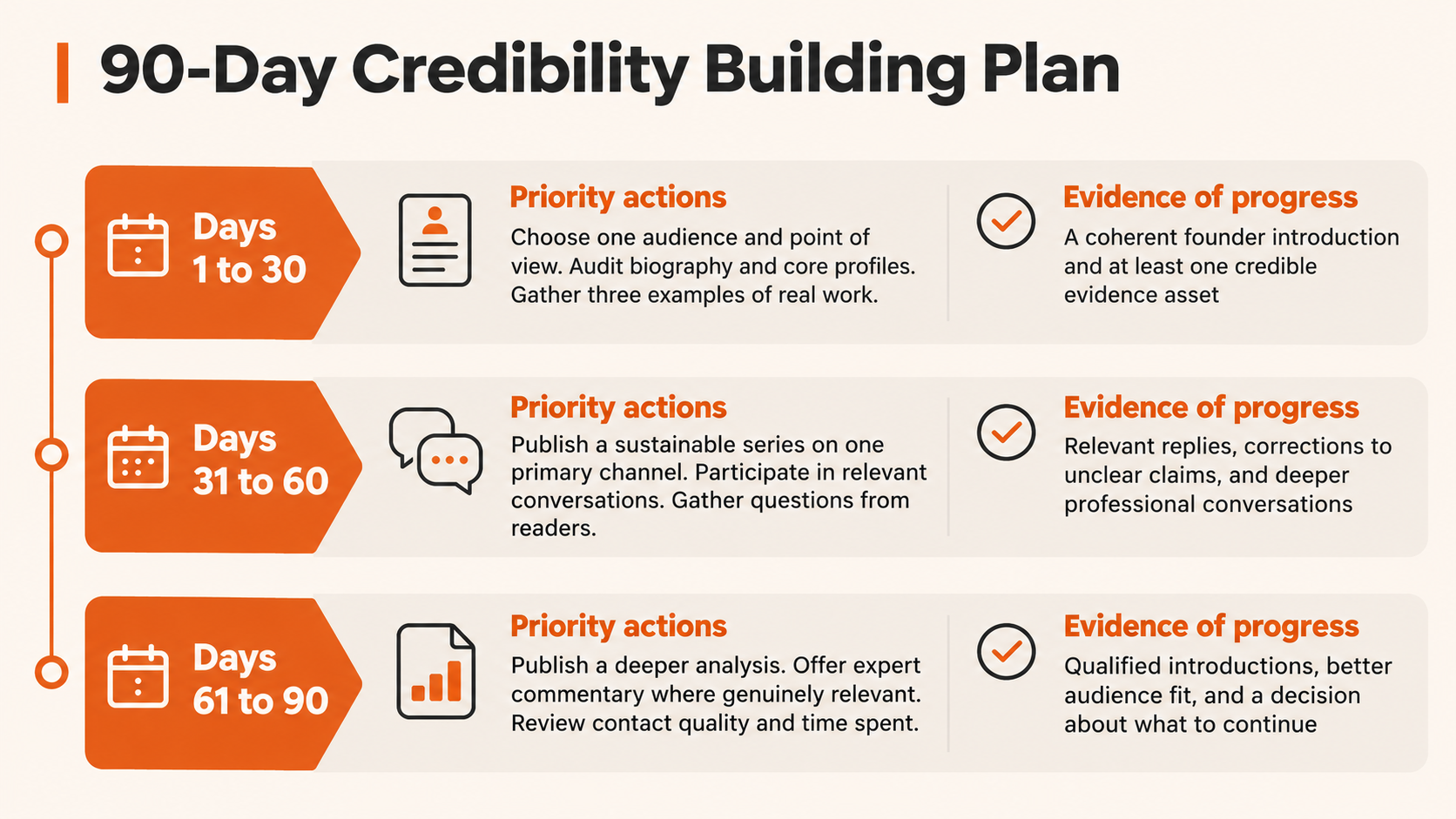
After 90 days, the founder should be able to answer three questions: Do the right people recognize the subject of my expertise? Can they verify the claims I make? Has the activity improved any useful professional relationship or decision? If the answers remain unclear, refine the position or channel before increasing publishing frequency.
Measure Trust and Opportunity, Not Just Followers
Measurement must reflect the purpose of the work. Measuring Founder Brand Impact starts by separating attention signals, credibility signals, and business outcomes. Profile views, impressions, and follower growth describe distribution. Qualified invitations, substantive questions, and independent references suggest relevance or trust. Customer conversations, referrals, strong candidates, and appropriate partner introductions can be tied more closely to business value.
Attribution will rarely be perfect. A buyer may read an article, hear a recommendation, search for the founder, and contact the company weeks later. Simple methods such as asking how the person discovered the business and recording the first meaningful interaction can help, but should not be treated as causal proof. Compare the type and quality of opportunities over time, along with the founder hours required to sustain the effort.
A small organization should review only a few measures each month. Useful examples include qualified conversations influenced by founder content, relevant invitations, the proportion of inbound messages from the intended audience, and the founder time spent producing and approving work. If public reach rises while relevant outcomes decline, the content may be attracting the wrong audience.
Common Mistakes That Weaken Founder Credibility
Publishing opinions without firsthand evidence
Generic commentary may be easy to produce but gives readers little reason to remember a specific person. Add the conditions, observations, and tradeoffs behind the conclusion. When the founder lacks firsthand expertise, cite a qualified source or clearly describe a question rather than asserting an answer.
Confusing authenticity with unlimited disclosure
A founder can be candid without exposing private information. Treat customer trust, employee dignity, contractual duties, and financial accuracy as limits on content production. The public should receive a thoughtful account, not an unrestricted view into every internal process.
Making the company depend on one voice
A founder brand can become fragile when no one else can speak credibly about the business. Encourage independent expertise from team members, maintain company owned knowledge, and keep formal promises in official channels. Personal visibility should strengthen the institution, not replace it.
Overreacting to algorithms and trends
Frequent changes in format, platform, and subject can make the founder difficult to understand. Adapt presentation when necessary, but keep the central subject stable long enough to establish recognition. A modest publishing cadence that survives busy weeks is more valuable than an unsustainable burst.
When a Founder Should Scale Back Personal Branding
Not every stage justifies more public activity. When product reliability, customer delivery, legal obligations, or internal leadership requires immediate attention, these responsibilities should take priority. Founders should also reconsider their approach when their desired audience is not reachable through public channels, when the subject involves sensitive disclosures, or when maintaining the brand consumes time without producing learning or useful relationships.
The alternative is not disappearance. A founder can maintain accurate profiles, publish occasionally when there is something substantive to say, and invest in direct professional relationships. The right level of visibility depends on the business, the founder’s capabilities, and the opportunity cost of the work.
The Founder Brand Decision
A strong founder brand is not created by being present everywhere. It begins with one audience, one credible area of expertise, and a public record that supports what the founder claims. Channels and formats matter, but they should be chosen after the founder understands which relationships and decisions the reputation is meant to influence.
The practical objective is to become easier to evaluate, not merely easier to notice. When buyers, candidates, investors, and partners can understand the founder’s thinking, verify important claims, and decide whether to engage, personal branding becomes part of building a more trusted business rather than a separate pursuit of visibility.
FAQ
What is personal branding for founders?
It is the deliberate development of a founder’s professional reputation through clear expertise, consistent communication, and verifiable evidence. The goal is to help relevant people understand the founder’s judgment and decide whether to trust or work with them.
Does every startup founder need a large social media audience?
No. A narrow audience that includes relevant customers, partners, and candidates can be more useful than broad attention. Founders also build reputations through direct relationships, quality work, interviews, and trusted references.
Should a founder build a personal brand before launching a startup?
A basic, accurate professional presence can be valuable early. However, the founder should not delay testing an actual customer problem to produce a polished public identity. Credible work and customer evidence should remain the foundation.
Which platform is best for a founder personal brand?
Choose the place where the people relevant to the next business goal already interact. LinkedIn often suits professional business audiences, while technical forums, newsletters, podcasts, and other communities can be more appropriate for different groups.
Can a founder use AI to create personal branding content?
AI can assist with transcription, editing, organization, and drafting. The founder should still verify facts, protect confidential information, and contribute original judgments. Automated generic opinions are unlikely to create a trustworthy record of expertise.
How long does founder personal branding take to produce results?
There is no universal timeline. Profile clarity may improve quickly, while recognition and trustworthy relationships can require many months of consistent work. Assess relevance and opportunity quality alongside reach, rather than expecting a fixed return from a certain number of posts.

Mohsen Avid
Founder & Editor, PinerookMohsen Avid is the founder of Pinerook, covering entrepreneurship, startup strategy, digital business, and the decisions behind building new ventures.
 Seen first.