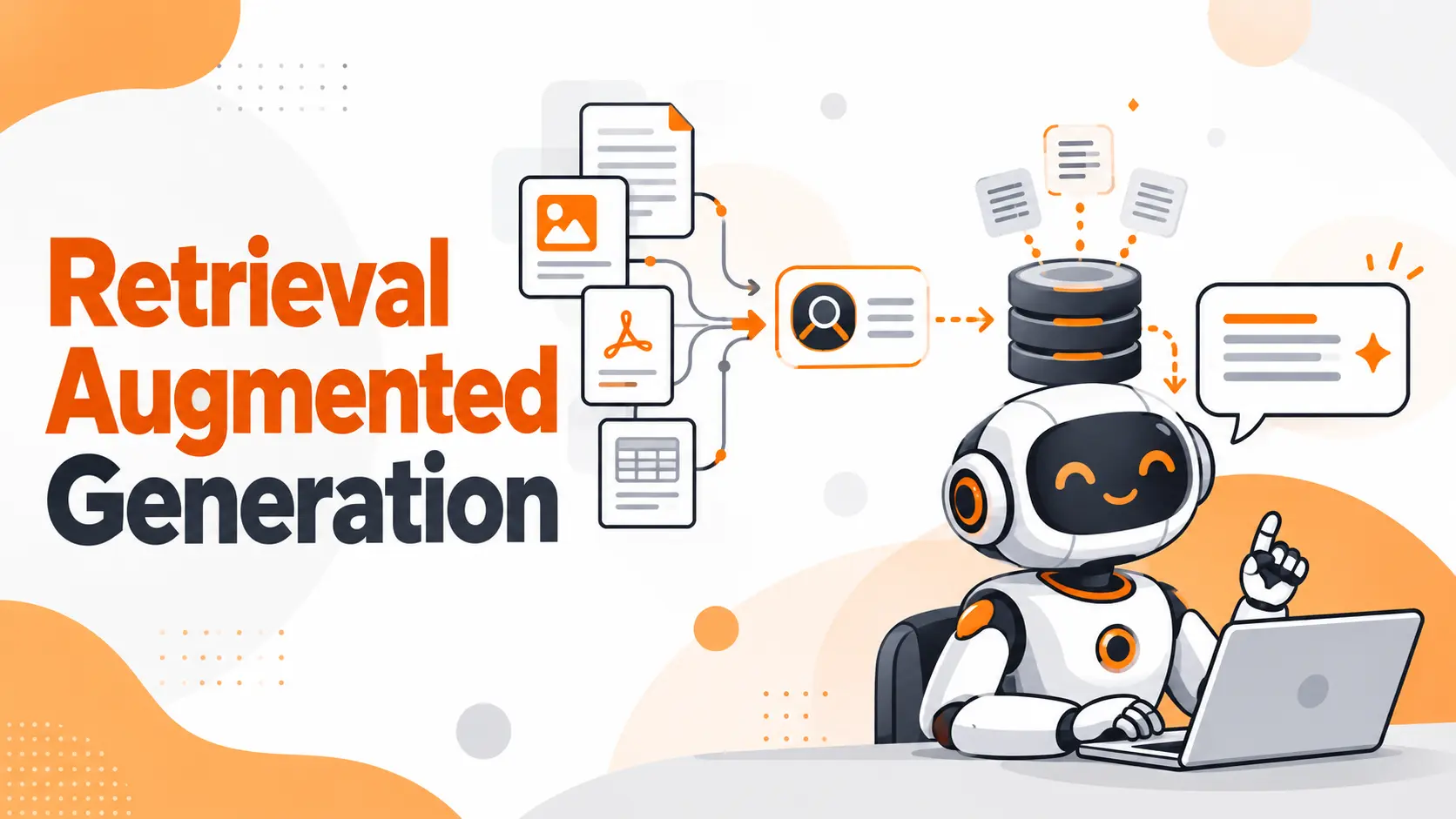
Retrieval Augmented Generation (RAG) connects large language models to external information, allowing them to generate answers using relevant documents rather than relying entirely on their training data.
For a startup, this means an AI assistant can answer questions using current product documentation, internal policies, or customer support records without retraining the model.
The interesting part is how the information reaches the model. A useful RAG system doesn't simply search documents and generate text. It must find the right evidence, preserve its context, and produce an answer that users can verify.
How Retrieval Augmented Generation Works
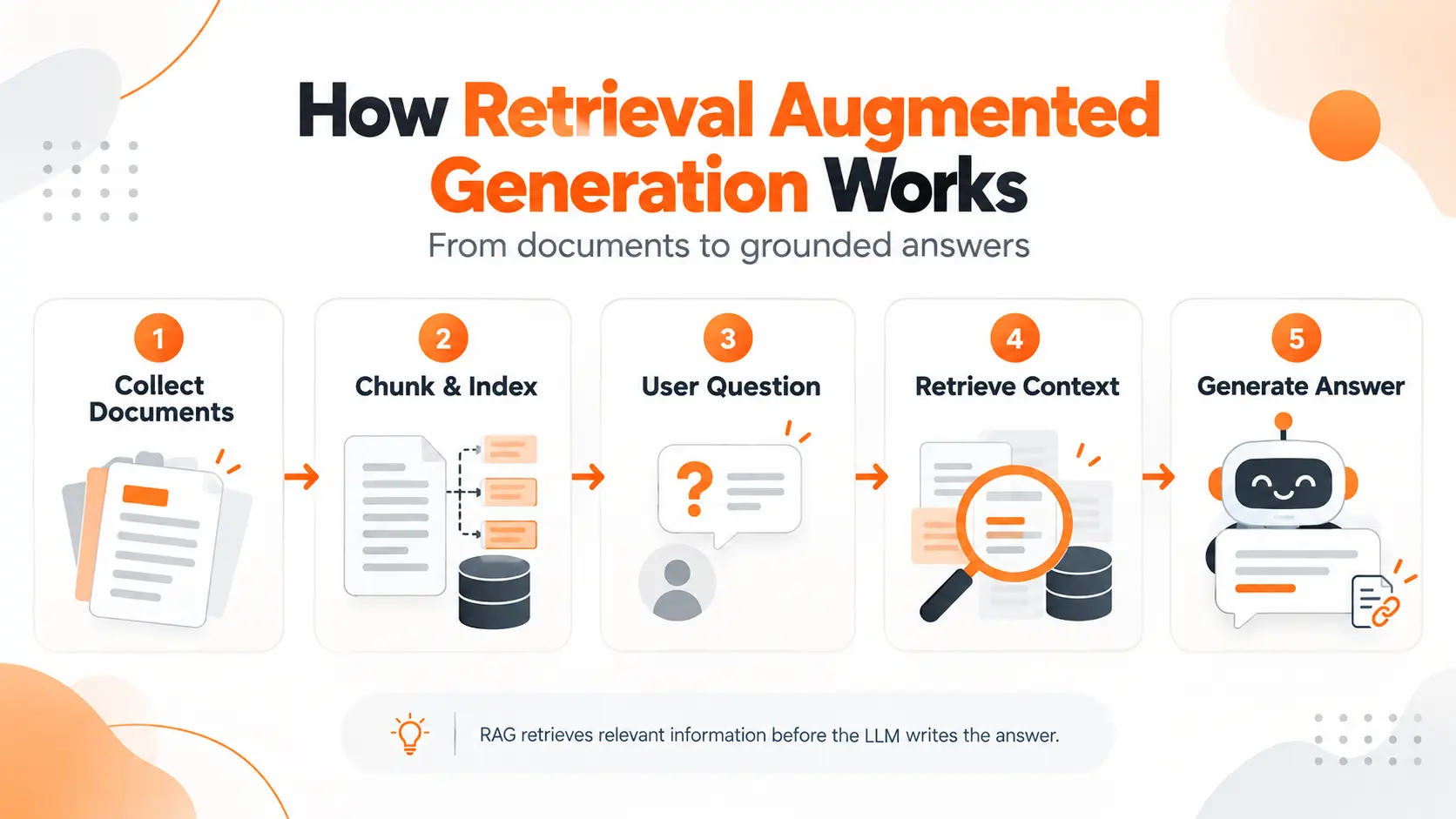
I find it easier to understand RAG by separating the process into two stages: preparing information before a question arrives and retrieving the right information when a user asks something.
The first stage creates a searchable knowledge base. The second uses that knowledge base to supply relevant context to a language model.
Here's how the complete RAG pipeline works.
1. Collect and prepare the documents
The system receives information from sources such as product documentation, PDF files, support articles, and internal knowledge bases.
These documents are cleaned and divided into smaller, meaningful sections called chunks. Each chunk should contain enough context to remain understandable when retrieved independently.
2. Index the information
The system creates a searchable representation of the document content. This can involve semantic vectors, keyword indexes, or both.
The index also needs to preserve information about each document's source, version, and access permissions.
3. Retrieve relevant information
When a user submits a question, the retrieval system searches the index and selects content related to the request.
For example, a question about subscription limits should retrieve the relevant pricing policy, not a general article about account management.
4. Add context to the model's input
The retrieved passages are combined with the user's question and instructions defining how the answer should be produced.
The model now has specific information to work from.
5. Generate and return the answer
The language model produces a response based on the supplied context. The application can attach references to the source passages so users can inspect the supporting evidence.
The important distinction is that RAG doesn't update the model's trained parameters. It supplies additional information during inference.
That makes it possible to change the available knowledge by updating the source documents and their search index.
RAG Architecture and Core Components
A RAG architecture combines document processing, information retrieval, and language generation.
The components are straightforward. What matters is how well they work together.
Document Processing and Chunking
Before information can be retrieved, the application needs to turn source documents into searchable content.
Consider a product manual containing 200 pages. Storing the entire manual as one searchable item makes it difficult to identify the section that answers a specific question.
Splitting the document into smaller sections allows the retrieval system to locate relevant passages.
I would preserve headings, section relationships, and source metadata during this process. A paragraph explaining a subscription limit becomes less useful if it loses the plan name or conditions attached to that limit.
Chunk size is also a trade-off. Very small chunks can separate related facts, while oversized chunks introduce unrelated information into retrieval results.
The right chunking strategy should be selected using actual questions from the application, not an arbitrary universal chunk size.
Embeddings and Semantic Search
Traditional keyword search looks for matching terms. Semantic search uses numerical representations to identify content with related meaning.
Text Embeddings represent text as numerical vectors that capture patterns of semantic similarity.
For example, a user might ask about "adding colleagues to an account," while the documentation describes "inviting workspace members."
A semantic search system can recognize the relationship between those phrases without requiring identical wording.
Both the stored content and the query need compatible representations so their similarity can be compared.
Embeddings support retrieval. They do not independently determine whether a document is accurate, current, or sufficient to answer the question.
Document Indexes and Storage
Once the content has been processed, the application needs an efficient way to search it.
A Vector Database provides storage and similarity-search capabilities for vector representations. Systems such as Pinecone, Weaviate, and PostgreSQL with pgvector can support this part of the architecture.
A dedicated vector database is not mandatory for every RAG application. Existing search infrastructure or a database with suitable vector-search capabilities can be sufficient.
For a startup, I would first examine the infrastructure already available. Introducing a separate database adds operational work that should be justified by actual search and scaling requirements.
Retrieval, Ranking, and Context Assembly
The search system returns candidate passages, but not every relevant-looking result answers the user's question.
A reranking step can evaluate those candidates more closely and place stronger evidence above loosely related content.
The application then selects which passages enter the model's context window.
This selection matters because the model receives a limited amount of information. Passing too many unrelated passages can make the answer less focused and increase processing costs.
I would also retain the source document identifiers throughout this process. Without them, providing reliable source references in the final answer becomes more difficult.
Retrieval Augmented Generation Example in a SaaS Startup
Consider a fictional SaaS company called DeskFlow that provides project management software.
DeskFlow has pricing documentation, setup guides, security policies, and hundreds of help articles. Its support team spends time answering questions that already have documented answers.
The company wants to build an AI assistant that retrieves the correct information and explains it in plain English.
A customer asks:
"Can I add 30 people to our Pro workspace?"
For this example, suppose DeskFlow's current policy states that the Pro plan supports up to 25 members.
Retrieving the Subscription Policy
The retrieval system searches the product knowledge base and finds the section describing Pro plan membership limits.
It returns the relevant policy text, its document identifier, and the version information available in the index.
The application passes this information to the language model along with the customer's question.
Generating a Grounded Response
Using the retrieved policy, the assistant can produce an answer such as:
"The Pro plan supports up to 25 workspace members. A team of 30 exceeds that limit. Please review the available plan options before adding more members."
The application can also display a reference to the relevant pricing policy.
This response is more useful than an unsupported answer generated from general knowledge because the application has retrieved a document containing the specific limit.
The model still needs to interpret that document correctly. Retrieval alone does not guarantee that the final wording is accurate.
Handling Changes to Product Information
Now suppose DeskFlow changes the Pro plan limit.
The company updates its official pricing documentation, and the RAG system processes the change into its searchable index.
Subsequent requests can then retrieve the updated policy once the index has been refreshed.
The language model does not need to be retrained for this change.
This is one of the most useful applications of RAG for SaaS products: connecting AI responses to business information that changes independently of the model.
RAG vs Fine-Tuning, Long Context, and Direct APIs
Before adding RAG to an AI product, I would identify the problem the application needs to solve.
RAG is designed to retrieve relevant knowledge and provide it to a generative model. It is not a replacement for every form of data access or model customization.
Fine-tuning adjusts model parameters through additional training. It can improve behavior on a specialized task, but it doesn't provide the same query-time access to a changing document collection.
Long-context models allow applications to place substantial amounts of source material directly into a prompt. For a small, fixed document collection, that can eliminate the need for a separate retrieval layer.
Direct database queries or APIs are more appropriate when the application needs exact structured information or must execute a defined operation.
Here's how I would distinguish these approaches for a product team.
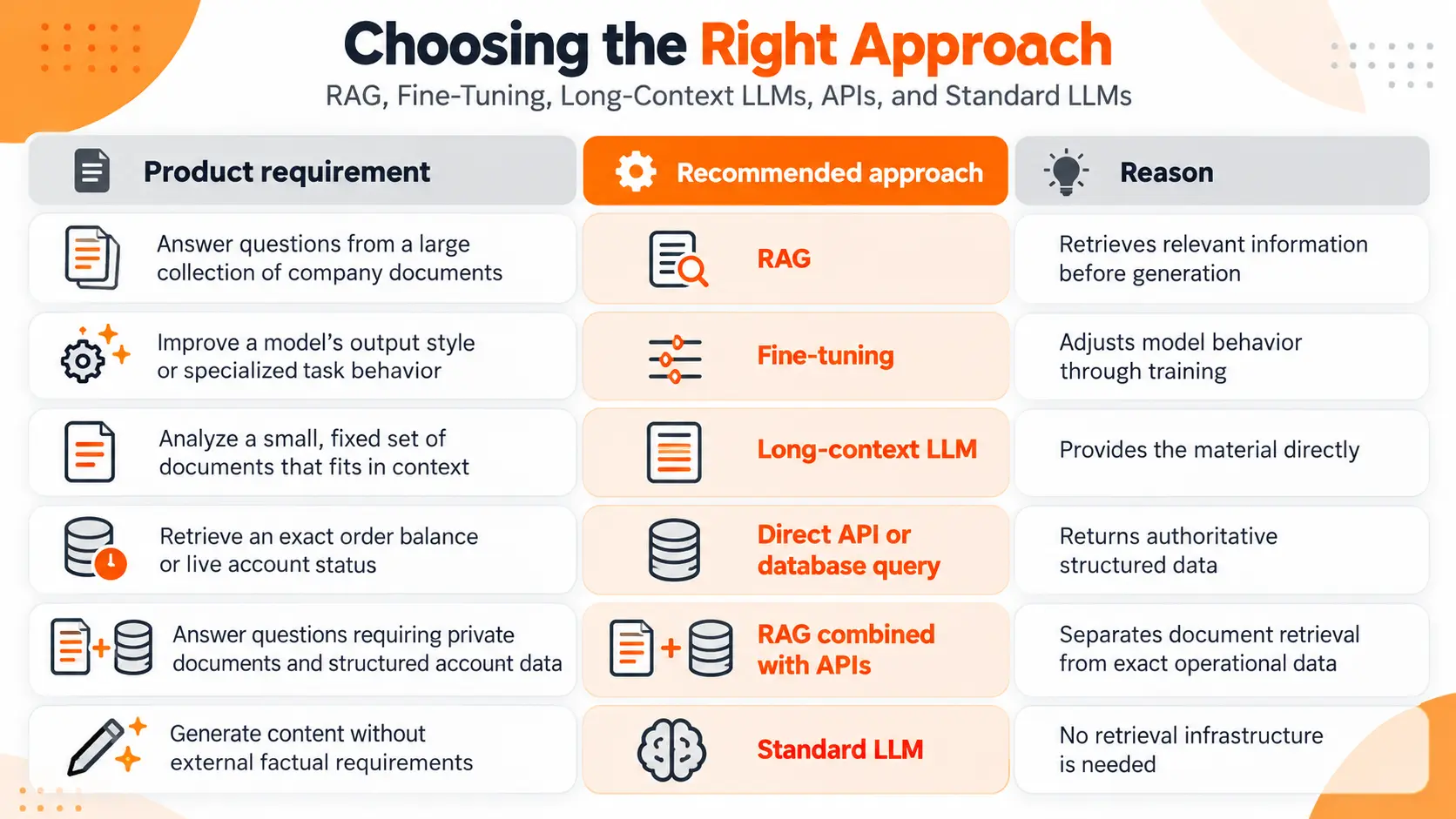
RAG and fine-tuning can also work together. A fine-tuned model can receive retrieved information just like a general-purpose model.
The decision should follow the information requirements of the product rather than the popularity of a particular AI architecture.
Building a Basic RAG Pipeline
For an initial implementation, I would keep the system narrow enough to evaluate without introducing unnecessary infrastructure.
A product documentation assistant is a better starting point than an application expected to answer questions across every company department.
Define the Knowledge Sources
Start by selecting a controlled collection of documents.
For a SaaS support assistant, that could include pricing policies, onboarding instructions, product limitations, and support documentation.
Identify which documents are authoritative when different sources contain conflicting information.
Also define who can access each document. A customer-facing application must not retrieve internal financial or personnel records merely because they exist in the same storage system.
Prepare and Index the Content
Extract readable text and preserve meaningful document structure.
Split the content into sections that correspond to the kinds of questions users ask.
Store enough metadata to identify the source, document version, and relevant access restrictions.
Then create the indexes required by the selected retrieval method.
For the first version, I would use one consistent document-processing pipeline and measure its results before experimenting with multiple indexing strategies.
Connect Retrieval to the Language Model
When a user submits a question, the application retrieves relevant passages and constructs a model input containing the question and approved context.
The generation instructions should establish clear boundaries.
For example:
"Answer using the supplied product documentation. Do not invent subscription limits. If the documents do not contain sufficient information, state that the answer cannot be confirmed."
The application should also retain source identifiers so the response can be checked.
This design separates the retrieval system's responsibility from the model's responsibility.
The retriever finds candidate evidence. The model explains that evidence.
Test the Complete Workflow
Before connecting the system to customer-facing channels, prepare a set of representative questions.
Include questions with direct answers, questions requiring information from more than one passage, and questions the documents cannot answer.
For every test, inspect both the retrieved passages and the generated response.
This reveals whether a failure originates in document preparation, retrieval, or generation.
Without that separation, developers can spend time changing model prompts when the real problem is that the correct document never reached the model.
Improving Retrieval for Complex Questions
Semantic retrieval is a useful starting point, but it is not sufficient for every document collection.
Consider a technical support knowledge base that contains product identifiers, error codes, and software version numbers.
A user searching for an exact error code needs the search system to respect that identifier. Semantic similarity alone can prioritize related explanations over the precise match.
Hybrid Search combines semantic retrieval with keyword-based search, allowing the system to use both conceptual similarity and exact terminology.
The results can be merged and reranked before the strongest passages are sent to the language model.
I would evaluate this approach when the source collection contains a mixture of natural-language explanations and identifiers that must match precisely.
A different challenge appears when answering questions that depend on relationships across many documents.
Imagine an analyst asking which product teams, customers, and recurring technical issues are connected across hundreds of support records.
A conventional document search might retrieve several relevant passages without providing a complete view of those relationships.
GraphRAG introduces graph-based representations and retrieval strategies to support questions that depend on connected entities and information distributed across a larger collection.
Neither approach is automatically necessary for a basic documentation assistant.
I would add retrieval complexity only after testing shows which kinds of questions the simpler system fails to answer.
Measuring Retrieval and Answer Quality
A RAG system should be evaluated as two connected processes: finding the right evidence and producing a correct answer from that evidence.
I would not judge quality solely by whether an answer sounds convincing.
A well-written response can still be based on the wrong document.
RAG Evaluation provides a framework for measuring retrieval performance, answer quality, and the relationship between generated claims and supporting evidence.
Retrieval Quality
The first question is whether the system retrieved the information required to answer the user's request.
A useful test dataset contains questions and the documents or passages expected to support their answers.
Metrics such as Recall@k can show whether relevant evidence appears among the first k retrieved results.
I would also inspect the ranking of those results. Returning the correct passage in position 20 is not equivalent to returning it first when the application only passes a few results to the model.
Answer Groundedness and Completeness
After retrieval, the generated answer needs a separate assessment.
Groundedness measures whether the claims in the response are supported by the supplied evidence.
Completeness examines whether the response covers the information needed to answer the question.
These are distinct requirements.
An answer can be fully supported by its sources while omitting an important condition from the original policy.
For the DeskFlow example, stating that the Pro plan supports 25 users would be incomplete if the policy also contained an important exception for enterprise customers.
Testing Unanswerable Questions
I would include questions that the knowledge base cannot resolve.
A useful assistant must recognize insufficient evidence rather than construct a plausible response.
Testing should also include contradictory documents, outdated policies, and questions with ambiguous wording.
The application needs a defined rule for resolving source conflicts. If no authoritative answer exists, it should report the limitation instead of selecting an unsupported claim.
This is how a team moves from demonstrating that retrieval works to establishing whether the complete system is dependable.
RAG Limitations and Production Requirements
A prototype that answers a handful of documentation questions is different from a system used by customers every day.
The underlying RAG pipeline remains recognizable, but production introduces additional responsibilities.
Source Quality and Freshness
Retrieval cannot correct inaccurate source material by itself.
If the knowledge base contains outdated pricing information, the assistant can generate an answer that faithfully reflects an obsolete policy.
I would establish a clear source-of-truth hierarchy and a process for updating indexed documents.
Document versions, publication dates, and ownership help determine which information should be considered authoritative.
Access Control and Data Privacy
A RAG system must enforce document permissions before sensitive content reaches the language model.
For a multi-tenant SaaS product, one customer's documents must not become available to another customer through shared retrieval infrastructure.
The application needs verified user identity, authorization rules, and retrieval filters that enforce those permissions.
I would also treat retrieved documents as untrusted input for instruction-following purposes. A malicious document can contain instructions intended to redirect the model away from its assigned task.
The application must distinguish source content from trusted system instructions.
Latency and Infrastructure Costs
RAG adds work to the response process.
The system must search for evidence, process retrieval results, and send the selected context to the language model.
Reranking, additional searches, and larger context windows increase resource consumption.
I would measure end-to-end response time and cost per successful answer, rather than looking only at the language model's API price.
Document processing and reindexing also create costs that should be included in the operating budget.
Source Traceability
For internal research or customer support, the ability to inspect the supporting document is part of the product experience.
A reliable implementation should preserve references to the specific passages used during generation.
These references help users verify answers and allow the product team to investigate disputed results.
A citation alone is not proof of correctness. The cited passage must actually support the claim.
Choosing RAG for a Real AI Product
The clearest reason to use RAG is that your application must answer questions using information that lives outside the model and needs to remain accessible as that information changes.
For a startup, that can include internal knowledge assistants, customer support systems, document research tools, and applications that explain domain-specific information.
I would start with a defined collection of authoritative documents, a small set of real user questions, and measurable answer requirements.
Once the retrieval system consistently finds useful evidence, the team can improve ranking, expand the knowledge sources, and address more complex queries.
The goal isn't to build the most elaborate retrieval architecture. It's to deliver answers that users can trace to information they have reason to trust.
FAQ
Can I run a RAG system on my own laptop without using cloud services?
Yes. A local implementation can use an offline embedding model, a local search index, and a locally hosted language model. The computer must have sufficient memory and processing capacity for the selected components. A fully offline workflow also requires all source documents and necessary software dependencies to be available locally.
Can RAG read scanned PDFs that don't contain selectable text?
Yes, but the document-processing pipeline must extract information from the scanned pages first. Optical character recognition or a document-vision system can convert page images into searchable content. Extraction quality should be checked before indexing, especially for tables, diagrams, and documents with complex layouts.
Can I build a RAG application without writing Python code?
Yes. Managed knowledge-base services and visual AI development platforms provide document ingestion, retrieval, and model integration features without requiring a custom Python application. The available configuration options, deployment capabilities, and ongoing costs depend on the selected service.
Can RAG answer questions in different languages from the documents?
Yes, with a retrieval and generation setup that supports the languages involved. Multilingual embedding models can help match queries and documents across languages, while the language model produces the response in the requested language. Cross-language retrieval and factual accuracy should be evaluated using representative queries in each supported language.
Can I show the exact PDF page that supports an AI-generated answer?
Yes. The ingestion process needs to preserve page numbers and document identifiers as metadata. Retrieved passages can then carry that information into the response-generation process. For reliable page-level citations, the application must verify that the referenced page contains the evidence supporting the specific claim.

Fatemeh Jahangard
Technology & AI Writer at PinerookFatemeh Jahangard covers AI, emerging technologies, and digital innovation for Pinerook, focusing on how technology shapes startups and industries.
 Seen first.