
Startup Exit and M&A covers the ways founders and investors can realize value from owning a startup. These include selling the business, merging with another company, going public, or selling existing shares to private investors. Each route affects ownership, control, and the amount of money shareholders can receive. A successful exit requires more than an attractive purchase price. Founders must also understand the deal structure, payment terms, investor rights, and potential risks.
The price announced in an acquisition is not always the amount paid to shareholders. Debt, transaction expenses, liquidation preferences, and other contractual rights can reduce or change the proceeds available to founders. Payments may also depend on future performance or remain restricted for a period after the deal closes. These details can make two offers with similar valuations produce very different financial outcomes.
This guide explains the main startup exit routes, how acquisitions and mergers work, and what founders should consider before selling a business. It also covers public offerings, private share sales, acquisition valuation, and the steps involved in closing a transaction. A practical example shows how a $30 million acquisition can result in a much smaller distribution to founders.
Startup Exit and M&A: Understanding Shareholder Liquidity
A startup exit takes place when shareholders realize value from their ownership through a sale, acquisition, public offering, or another permitted transaction. An exit may involve the entire company, but it can also provide partial liquidity to selected shareholders. Founders can sometimes sell part of their holdings while continuing to lead the business.
Founders and investors may have different reasons for pursuing an exit. Venture capital investors often seek returns within their funds' investment periods, while founders may want financial security, access to larger markets, or the opportunity to continue building the product with a strategic partner. These objectives should be discussed before negotiations become advanced.
Selling is not the only reasonable outcome for a growing startup. A company with stable revenue and sufficient capital may benefit from remaining independent. Another business may gain more value by joining a larger organization with stronger distribution or technical resources. The right decision depends on the company's prospects and the opportunities available at the time.
Developing a Startup Exit Plan
An exit strategy defines how business owners intend to realize value and what conditions would make a transaction attractive. It should consider expected financial returns, market conditions, potential buyers, and the company's ability to continue operating independently. Because these factors change over time, the plan should remain flexible.
A practical startup exit strategy connects these goals with the realities of building and financing a young company. Founders should examine their ownership structure, future capital needs, investor expectations, and possible buyers. They should also understand which company milestones could improve their negotiating position, such as stronger revenue retention, improved profitability, or reduced dependence on individual customers.
Preparation creates more options. A company with reliable financial records, clear ownership rights, and stable operations can respond more effectively when a buyer expresses interest. It may also be in a better position to reject an offer that does not reflect its value.
Main Startup Exit Routes
Startups can provide liquidity through several transaction structures. Some transfer control of the business, while others allow selected shareholders to sell without ending the company's independent operations. Each option involves different legal requirements, financial outcomes, and responsibilities.
The following table compares the principal exit routes and their implications for founders.
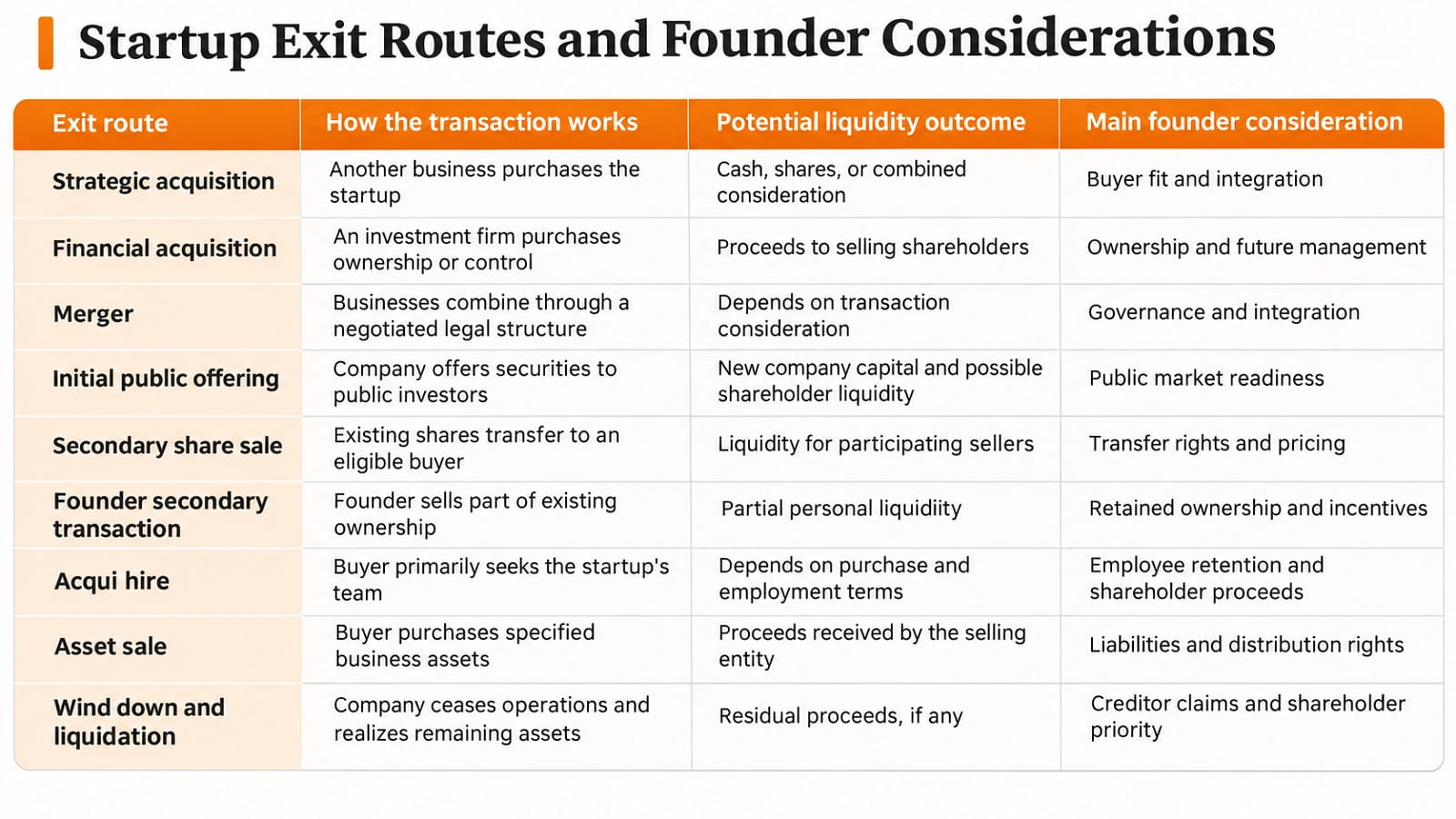
These routes are not always mutually exclusive. A founder may complete a partial share sale before a later acquisition, while a buyer may offer both immediate cash and future payments. The economic outcome depends on the full agreement, including restrictions on transferred securities and how existing obligations are treated. Comparing the timing and certainty of proceeds is therefore as important as comparing headline prices.
Startup Acquisitions and Strategic Buyers
A startup acquisition occurs when a buyer purchases a company, a significant ownership interest, or selected business assets. Buyers may seek new technology, customers, specialized employees, intellectual property, or access to a market. Financial investors may instead focus on future earnings and opportunities to improve the business.
A strategic buyer may value a startup because combining the two businesses creates advantages that neither could achieve as efficiently alone. For example, a large software provider might acquire a smaller company to add a specialized product to its existing distribution network. The buyer could reach more customers without developing the technology from the beginning.
Founders should understand why the buyer wants the business. An acquirer planning to preserve the company as an independent operation may offer different terms from one intending to absorb its products and teams. These plans can affect employee roles, management responsibilities, and payments linked to performance after closing.
Mergers and Acquisition Structures
Founders searching for mergers and acquisitions startups are often trying to understand how young companies are combined with or purchased by larger businesses. Although mergers and acquisitions can have similar commercial goals, their legal structures differ.
A merger combines businesses under an applicable corporate law framework. An acquisition can involve purchasing shares or specific assets. A share purchase generally transfers ownership of the target company, while an asset purchase identifies the assets being acquired and the liabilities the buyer agrees to assume.
These distinctions affect corporate approvals, contractual consents, taxes, and risk allocation. A buyer may prefer an asset purchase to limit certain exposures, while shareholders may favor a different structure based on the proceeds they expect to receive. The final choice should reflect legal and financial analysis rather than valuation alone.
Initial Public Offerings
A startup ipo allows a company to offer shares to public investors for the first time, typically alongside a stock exchange listing. An offering can help an established startup raise growth capital and create a potential market for existing shareholders' securities.
However, going public does not guarantee immediate liquidity for founders. Share sales may be restricted by applicable laws, contractual agreements, or market conditions. A company's public market valuation also changes with investor demand, which creates uncertainty about the amount shareholders can eventually realize.
Public companies face ongoing reporting, governance, and disclosure obligations. Founders should consider whether their organization has the financial systems, management resources, and operating maturity needed to meet those requirements. An IPO can support long term expansion, but it involves responsibilities that differ from those associated with a private sale.
Secondary Shares and Founder Liquidity
Selling secondary shares allows existing shareholders to transfer previously issued securities to another eligible investor. Unlike a primary financing, the proceeds of a conventional secondary sale go to the selling shareholder rather than directly to the company.
Private share transfers may require company approval or compliance with investor agreements and securities laws. The price can also differ from the valuation of a recent funding round because the shares may have different rights and restrictions.
A founder secondary is a transaction in which a founder sells part of their existing holdings while potentially retaining a leadership role and substantial ownership. This can provide personal liquidity without requiring a complete company sale. Investors often consider how much ownership the founder retains and whether the transaction supports continued commitment to the business.
Acqui Hire Transactions
An acqui hire is a transaction primarily motivated by the buyer's interest in a startup's employees and specialized expertise. It may occur when a company has developed a capable engineering team but has struggled to establish a sustainable commercial business.
The buyer may offer employment opportunities, retention incentives, and consideration for selected assets or shares. These payments must be distinguished carefully because employee compensation is not necessarily the same as proceeds distributed to existing shareholders.
An acqui hire does not guarantee a profitable exit. Investor preferences, liabilities, and the way the agreement allocates consideration can substantially affect the outcome. Founders should evaluate the benefits for employees alongside the actual financial return to shareholders.
Acquisition Valuation and Deal Economics
Acquisition valuation estimates the economic value of a business in a proposed purchase. Buyers consider factors such as revenue, profitability, expected cash flow, customer retention, market position, intellectual property, and future growth. Strategic buyers may also assess the benefits of combining the target with their existing operations.
The valuation approach depends on the company. A business with stable earnings may be assessed using profitability or cash flow measures. A younger software company may receive greater attention for recurring revenue, growth, and customer retention. Different assumptions can lead buyers to offer different prices for the same company.
Enterprise Value and Equity Value
Enterprise value generally represents the value of the operating business, while equity value reflects the amount attributable to shareholders after relevant adjustments.
A simplified calculation is:
Equity Value = Enterprise Value − Debt + Cash
Actual transactions may include working capital adjustments, excluded cash, debt equivalents, and expenses. Even after equity value has been calculated, shareholder distributions can depend on liquidation preferences, conversion rights, and other contractual provisions.
A Practical Startup Acquisition Example
Consider Northbridge Software, a fictional enterprise software company that receives an acquisition offer from a strategic buyer. The buyer proposes an enterprise value of $30 million. Northbridge has $2 million in debt and $1 million in cash that is included under the assumed transaction terms. With no additional adjustments, the estimated equity value is $29 million.
Assume preferred shareholders hold an $8 million nonparticipating liquidation preference and that receiving this amount is more favorable than converting their securities into common shares. After this distribution, $21 million remains for common shareholders. The founders hold 70% of the common shares, while other common shareholders hold 30%.
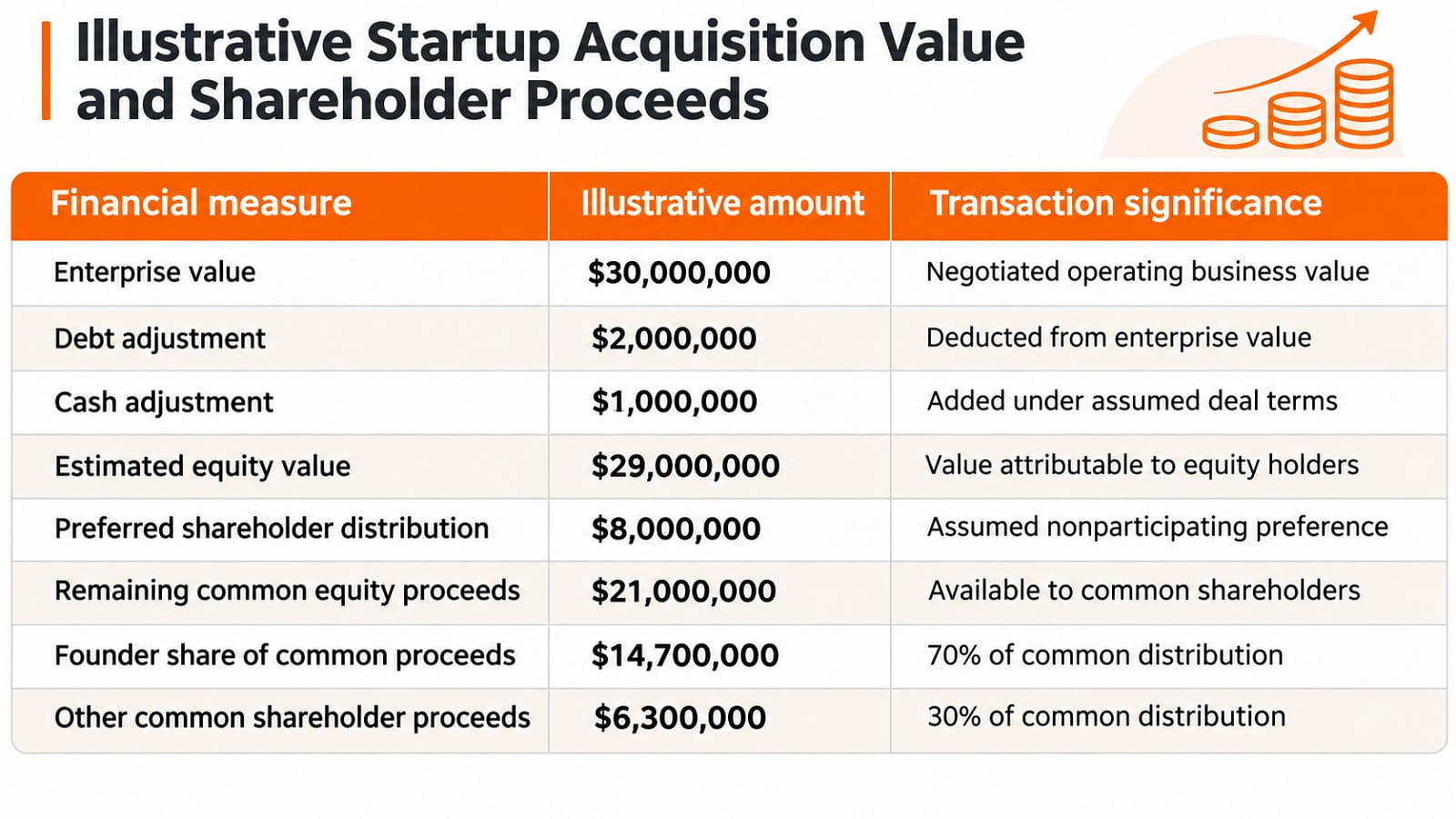
Under these assumptions, founders receive $14.7 million before personal taxes and expenses excluded from the model. The example assumes that the preferred shareholders elect the stated preference and have no additional participation rights. Actual distributions may differ because of multiple share classes, options, conversion elections, contingent payments, or escrow arrangements. Founders should review the complete distribution waterfall before estimating their proceeds.
Liquidity Events and Payment Terms
A liquidity event is a transaction or qualifying occurrence that enables shareholders to realize value from their ownership. Acquisitions, public market transactions, and certain private share sales may create liquidity, although financing agreements can define the term differently.
Shareholders may receive cash, shares in the acquiring company, or payments that depend on future conditions. Some proceeds may be delayed or held in escrow. This means the amount announced in a transaction is not always immediately available to the sellers.
Founders should compare offers based on both value and certainty. A higher offer with substantial contingent payments can carry more risk than a smaller offer that provides immediate cash. Understanding these differences helps shareholders evaluate the economic value of each proposal.
Preparing a Startup for an Exit
Exit readiness begins with accurate information about the company's financial position, ownership, contracts, and operating performance. Buyers need evidence supporting the business's revenue, customer relationships, technology rights, and growth expectations.
Founders should maintain consistent financial reporting and confirm that important ownership agreements are properly documented. Outstanding convertible instruments, investor preferences, and employee equity arrangements should be reflected in the capitalization model. These records influence the distribution of proceeds and can affect negotiations.
Management should also consider what makes the company attractive to a buyer. An established customer base, distinctive technology, capable employees, or access to a growing market may contribute to strategic value. Clear evidence of these strengths is more useful than unsupported growth claims.
The Startup M&A Transaction Process
A sale often begins with discussions between founders and potential buyers. These discussions may lead to an indicative offer or letter of intent describing the proposed price, transaction structure, and major conditions. Such documents do not necessarily guarantee that an acquisition will be completed.
The buyer then investigates the company through financial, commercial, legal, and technical reviews. The findings can influence the purchase price, contractual protections, and conditions required before closing. Significant issues may lead to further negotiations or cause the buyer to reconsider the transaction.
Definitive agreements establish the parties' obligations and the payment arrangements. Closing may require shareholder approvals, regulatory clearance, or consent from relevant third parties. Depending on the deal, founders may continue working with the acquiring business or assist with integration after ownership transfers.
Choosing Between Selling and Remaining Independent
Founders should compare an exit opportunity with the value and risks of continuing to operate independently. Selling can provide liquidity and access to a larger organization's resources, but it may reduce control over the company's future.
Remaining independent allows shareholders to participate in potential growth while retaining responsibility for financing, competition, and operating risks. The decision should consider available capital, buyer interest, shareholder expectations, and the probability of achieving future milestones.
The most attractive transaction is not necessarily the one with the highest announced price. Payment certainty, retained obligations, and the value actually available to shareholders are equally important when evaluating an offer.
Final Thoughts
Startup Exit and M&A offers several ways for founders and investors to realize value from the businesses they have developed. Acquisitions, public offerings, and private share transactions create different opportunities, but their financial results depend on more than the valuation announced.
Founders should understand how transaction structures, shareholder rights, and payment conditions affect their proceeds. Reliable financial records, clear ownership documentation, and realistic growth assumptions can also improve a company's readiness for buyer scrutiny.
A successful exit aligns the transaction with the company's circumstances and shareholder objectives. Comparing available alternatives carefully allows founders to pursue opportunities that offer appropriate financial value, manageable risks, and greater certainty about the final outcome.
FAQ
What Is a Startup Exit?
A startup exit occurs when shareholders realize value from their ownership through an acquisition, public offering, private share sale, or another permitted transaction. It may involve a complete sale or partial liquidity.
What Is the Most Common Startup Exit Route?
Acquisitions are a major exit route for venture backed companies. Their suitability depends on buyer demand, financial performance, market conditions, and shareholder objectives.
How Does an Acquisition Differ From an IPO?
An acquisition involves purchasing a business, ownership interest, or selected assets. An IPO involves offering securities to public investors and creates a different framework for ownership, financing, and liquidity.
Can Founders Sell Shares Without Selling the Company?
Yes. Subject to applicable restrictions and approvals, founders may sell existing shares to eligible investors while the business remains private.
How Do Buyers Value Startups?
Buyers assess financial performance, growth potential, customer relationships, competitive advantages, strategic benefits, and transaction risks. The valuation methods depend on the company's maturity and business model.
Do Founders Receive the Full Acquisition Price?
Not necessarily. Debt adjustments, investor preferences, dilution, expenses, and contractual terms may affect the amount distributed to founders.
What Happens to Employees After an Acquisition?
Employees may remain with the acquired business, join the buyer, or experience changes to their roles. The outcome depends on integration plans, employment agreements, and applicable laws.
When Should Founders Begin Planning an Exit?
Founders can consider possible ownership outcomes while developing their financing strategy. More detailed preparation becomes important as the company matures or attracts serious buyer interest.

Mobina Khanki
Venture & Funding Writer at PinerookMobina Khanki covers venture capital, startup funding, fundraising, and startup finance for Pinerook, focusing on founders and investors.
 Seen first.