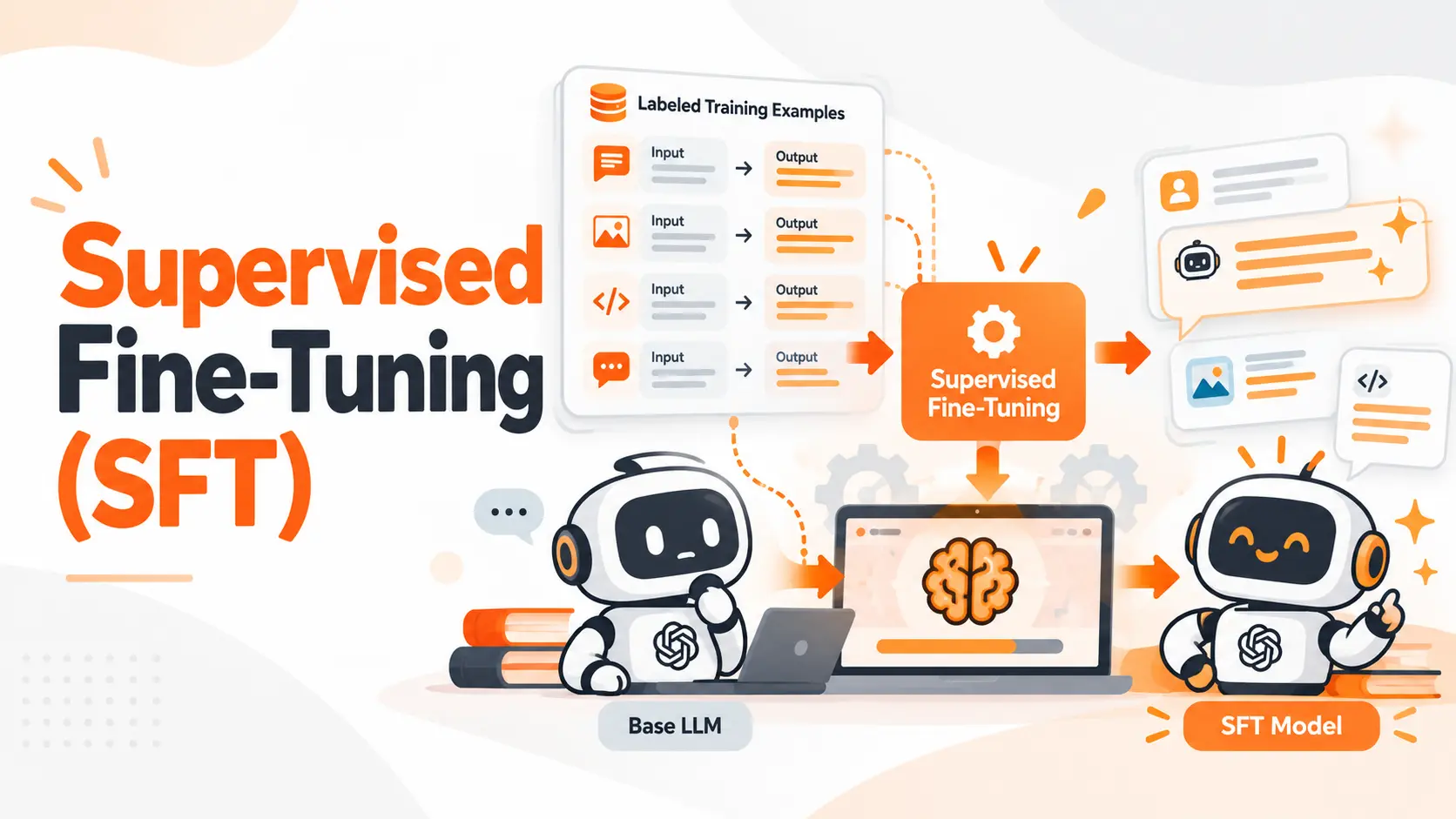
Supervised Fine-Tuning (SFT) is a training method that improves a pretrained language model using examples of inputs paired with desired outputs. It teaches the model to follow specific instructions, produce consistent responses, and handle specialized tasks by updating its parameters based on those examples.
For me, the value of AI Model Fine-Tuning comes down to measurable changes in model behavior. A successful SFT process should make the model better at its intended task without sacrificing capabilities the application still needs. Understanding how the model learns from each example is the starting point.
How Supervised Fine-Tuning Works
Supervised Fine-Tuning trains a language model to assign higher probabilities to the responses provided in its training dataset. Rather than learning exclusively from large collections of general text, the model receives examples demonstrating the behavior it should reproduce.
Consider a customer service application that needs to classify incoming messages.
Example input: "I was charged twice for my order."
Expected output: "Billing: Duplicate charge"
The training example tells the model that this customer message should produce a specific classification. The same training process can teach a model to summarize documents, extract information, follow instructions, or generate responses in a defined writing style.
During SFT, the model processes the input and predicts the next tokens of the target response. Its predictions are compared with the reference tokens using a loss function, typically token-level cross-entropy or negative log-likelihood.
The optimizer then adjusts the trainable parameters to reduce that loss. Across training examples and optimization steps, the model learns patterns that make the desired responses more likely.
For prompt-completion training, the loss can be calculated exclusively on the target completion. Conversational training also supports calculating loss only on assistant responses. The exact behavior depends on the dataset format and training configuration.
The important distinction is that SFT does not simply store the correct answers. It changes the model's probability distribution so it can generate learned response patterns for new inputs.
That is why representative examples and independent evaluation matter more than repeating identical questions with identical answers.
SFT in the LLM Training Process
Supervised Fine-Tuning builds on capabilities acquired during pretraining.
During pretraining, a language model learns statistical patterns in large collections of text through next-token prediction. This process develops language representations and a broad range of capabilities.
SFT continues training using a more targeted collection of examples. In instruction tuning, those examples show how the model should respond to requests rather than simply continue arbitrary text.
The underlying next-token prediction principle remains closely related to pretraining. What changes is the training data, objective context, and intended model behavior.
For example, a pretrained model can understand the language used in financial documents but fail to consistently extract specific information in the format required by an application. SFT provides demonstrations of the exact extraction behavior.
SFT also plays an important role in post-training pipelines that include preference optimization. Developers can first train a model on high-quality demonstrations and then refine its behavior using comparisons between preferred and rejected responses.
These stages solve different problems. SFT demonstrates acceptable behavior, while preference-based methods help distinguish between competing responses.
Supervised Fine-Tuning Process
I approach an SFT workflow as a sequence of decisions that should be validated before committing resources to a complete training run.
1. Establish the Base Model Performance
Before preparing training infrastructure, I define the task and measure how well the existing model performs it.
For a customer support classifier, this means testing representative customer messages and recording the model's classifications. For document extraction, the baseline includes the accuracy of individual extracted fields.
I also test the model with a clear system prompt and appropriate output constraints. If the application already meets its requirements without modifying model weights, a fine-tuning run adds unnecessary complexity.
A baseline gives the training process a measurable objective instead of treating lower training loss as proof of success.
2. Prepare the SFT Training Examples
SFT requires input-output examples that demonstrate the intended behavior.
I pay particular attention to the relationship between each request and its target response. The answer must be correct, consistent with the application's requirements, and supported by the information available in the input.
For a support assistant, the training data should cover different customer intentions, communication styles, incomplete requests, and situations requiring clarification.
The dataset must also reflect the response standards expected during deployment. If the application requires concise answers, contradictory examples containing unnecessarily long responses weaken that objective.
Training and evaluation records should be separated before training, with related examples kept within the same split to prevent information leakage.
3. Select the Model and Training Framework
The base model determines the available context length, tokenizer, supported architecture, and computational requirements.
I check whether the chosen model supports the intended training approach and whether its original capabilities are sufficient for the target application.
For open-weight language models, Hugging Face TRL provides an SFTTrainer designed for supervised fine-tuning. It supports conversational training data, prompt-completion datasets, and integration with parameter-efficient training methods.
The choice between updating all model parameters and training adapters depends on available hardware, model size, and the level of adaptation required.
4. Configure and Run Training
Once the model and data are compatible, the next step is configuring the training process.
The central settings are learning rate, batch size, gradient accumulation, maximum sequence length, and the number of training epochs.
Learning rate controls the size of parameter updates. Batch size and gradient accumulation determine how examples contribute to optimizer steps, while sequence length establishes how much input and target content the model can process.
I start with a controlled training run and inspect validation results before extending training.
The strongest checkpoint is not necessarily the one trained for the greatest number of epochs. Continued optimization can improve performance on training examples while reducing generalization to unseen requests.
SFT Dataset Formats and Training Requirements
Two data structures are particularly relevant for LLM supervised fine-tuning.
Prompt-completion datasets contain a request and its expected response. They work for instruction following, information extraction, classification, and other tasks with clearly defined outputs.
Conversational datasets organize examples into messages with roles such as system, user, and assistant. They preserve the structure required to train chat-oriented language models.
These records are converted into tokens before training. For conversational data, the model's chat template determines how message boundaries and role information are represented.
A training pipeline also needs to distinguish tokens used as context from tokens included in the loss calculation. Applying the wrong masking behavior can train the model on text that was intended only as input context.
JSONL is supported by several fine-tuning platforms, but the required schema depends on the provider and framework. JSONL is a file format, not a universal definition of an SFT example.
The dataset should pass schema validation, token-length checks, and target-response inspection before training begins. A valid file alone does not establish that the examples teach the intended behavior.
Full Fine-Tuning, LoRA, and QLoRA for SFT
Supervised Fine-Tuning describes the learning objective, not the number of model parameters that must be updated.
Full-parameter fine-tuning updates the model's trainable weights throughout the selected architecture. It provides broad adaptation capacity but requires substantial training memory and computational resources.
Low-Rank Adaptation (LoRA) keeps the pretrained base weights frozen and trains smaller adapter matrices. This substantially reduces the number of trainable parameters.
QLoRA extends parameter-efficient training by combining low-rank adapters with a quantized base model, reducing the memory required to store the frozen model weights during training.
The distinction matters because LoRA and QLoRA are not alternatives to SFT. They are methods that can be used to perform supervised fine-tuning.
For a resource-constrained project, adapter-based SFT provides a practical starting point. However, the selected approach must still be evaluated against full fine-tuning or the original model when the required performance justifies that comparison.
Lower training memory does not establish equivalent model quality, and freezing base weights does not guarantee that the adapted model will preserve every original capability.
SFT vs RLHF and DPO
Supervised Fine-Tuning, Reinforcement Learning from Human Feedback (RLHF), and Direct Preference Optimization (DPO) are related post-training techniques with different learning signals.
SFT learns from demonstrations of desired responses. Each example provides a target that the model is trained to reproduce.
RLHF uses human preference information to guide optimization through a reward-based training process. In a conventional RLHF pipeline, preference comparisons are used to train a reward model, which then guides policy optimization.
DPO uses preference comparisons more directly. Its training examples contain a prompt, a preferred response, and a rejected response. The model is optimized to favor the preferred response relative to the rejected alternative without requiring a separate explicit reward-model training stage.
The practical difference is the information available for training.
If I have approved examples demonstrating exactly how the model should respond, SFT fits the learning objective. If the main challenge is choosing better responses among several acceptable alternatives, preference optimization provides a different training signal.
SFT can also establish an instruction-following model before a later preference-optimization stage. These methods are complementary rather than interchangeable.
Choosing SFT for the Right Application
SFT is useful when a model needs to learn consistent behavior from representative examples. It is not the right mechanism for every problem involving an LLM.
I use the following distinctions to identify the appropriate starting approach.
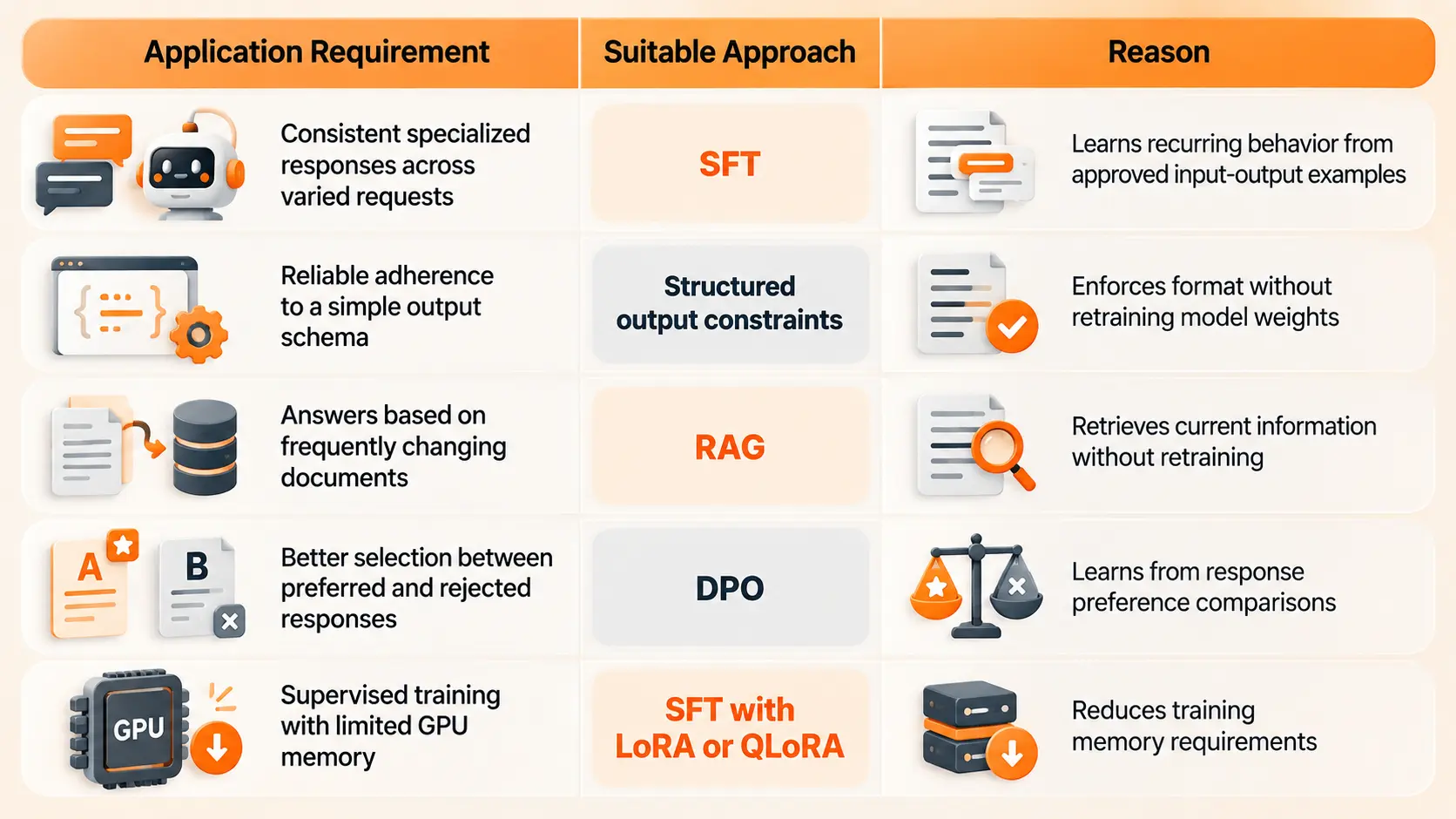
For example, a company that updates its product catalog every day does not need to fine-tune its language model after every inventory change. Retrieval provides a more direct way to supply changing information.
By contrast, a document-processing application that repeatedly fails to classify specialized records according to an established taxonomy can benefit from SFT when high-quality training examples are available.
The determining factor is whether the problem requires changing the model's learned behavior or supplying better information and constraints at inference time.
Evaluating SFT Model Performance
A completed training run is not evidence that the resulting model is ready for production.
I evaluate the fine-tuned model against its original checkpoint using the same independent test examples, prompts, and inference settings.
The evaluation criteria must correspond to the task.
For classification, accuracy alone can conceal weak performance on underrepresented categories. Precision, recall, and macro F1 provide a clearer picture of performance across different labels.
For structured information extraction, exact-match accuracy and field-level correctness establish whether the output contains the required information.
For response generation, I use a defined evaluation rubric that measures instruction adherence, factual correctness, relevance, and consistency with application requirements.
The evaluation should also establish whether the new training damaged capabilities the model previously supported. Improvements in a specialized task do not justify regressions in essential general behavior.
Interpreting Training Loss and Validation Results
Training loss measures how well the model predicts the target tokens in its training examples. Validation loss measures the same learning objective on held-out examples.
A lower validation loss is useful evidence of generalization, but it does not guarantee stronger performance on every downstream task.
For example, a customer support model can improve its token-prediction loss while continuing to select the wrong support category for ambiguous requests.
I therefore compare checkpoints using task-specific evaluation results rather than selecting a model based on loss alone.
The final decision should reflect the application requirements, not simply the optimizer's progress.
Limitations of Supervised Fine-Tuning
SFT learns from the quality and coverage of its examples. Incorrect target responses can reinforce undesirable behavior, while narrow datasets can leave the model poorly prepared for requests outside their training distribution.
It also cannot guarantee that a model will follow every instruction or produce factually correct answers. A specialized training objective does not replace factual verification, safety testing, or application-level validation.
Sequential fine-tuning introduces another concern: changes that improve the new task can weaken previously acquired capabilities. Preserving relevant evaluation benchmarks and original checkpoints helps identify this deterioration.
SFT is also an inefficient substitute for continuously updating a model's access to external information. Information retrieval and training solve different problems, and choosing the wrong approach creates additional maintenance work.
The strongest applications of SFT have a defined behavior to improve, representative examples of that behavior, and measurable acceptance criteria.
Conclusion
Supervised Fine-Tuning gives developers a way to adapt language models through approved examples rather than relying entirely on inference-time instructions. Its effectiveness depends on choosing the right task, preparing consistent training targets, configuring the learning process correctly, and measuring improvements on independent requests.
I consider SFT successful only when the resulting model delivers a measurable improvement that matters to the application. Selecting the training method is part of that work, but the final standard is whether the model performs its intended job more reliably than the original.
FAQ
Can I use AI-generated answers to train an SFT model?
Yes. Synthetic responses can be used as supervised training targets when their quality has been validated and their use complies with applicable licenses and service terms. Generated answers should be checked for factual accuracy, task compliance, and consistency with the intended behavior before inclusion in the training dataset.
Can I fine-tune the same model for multiple languages?
Yes. Multilingual SFT can train a compatible language model using examples from multiple languages within one dataset. Each target language requires representative training and evaluation examples. Model performance must be measured separately for each language rather than inferred from aggregate results.
Can I remove a bad training example after fine-tuning is finished?
Deleting a record from the dataset does not reverse its influence on an already trained model. The corrected dataset must be used in a new training process, or an earlier checkpoint must be restored. Retraining does not automatically prove that all influence from the removed example has disappeared.
Can I continue SFT training from an existing LoRA adapter?
Yes, when the training framework supports resuming from the adapter and the adapter remains compatible with the base model and configuration. Continuing training updates the adapter from its existing state. The resumed model should be evaluated against the previous adapter checkpoint to detect unwanted changes in behavior.
Will SFT automatically teach my model to use external tools?
No. Tool use requires a compatible model, correctly structured training examples, and an application that exposes and executes tool calls. SFT can improve how a model selects or formats tool calls, but it does not independently provide access to external APIs or execute tools during inference.

Fatemeh Jahangard
Technology & AI Writer at PinerookFatemeh Jahangard covers AI, emerging technologies, and digital innovation for Pinerook, focusing on how technology shapes startups and industries.
 Seen first.