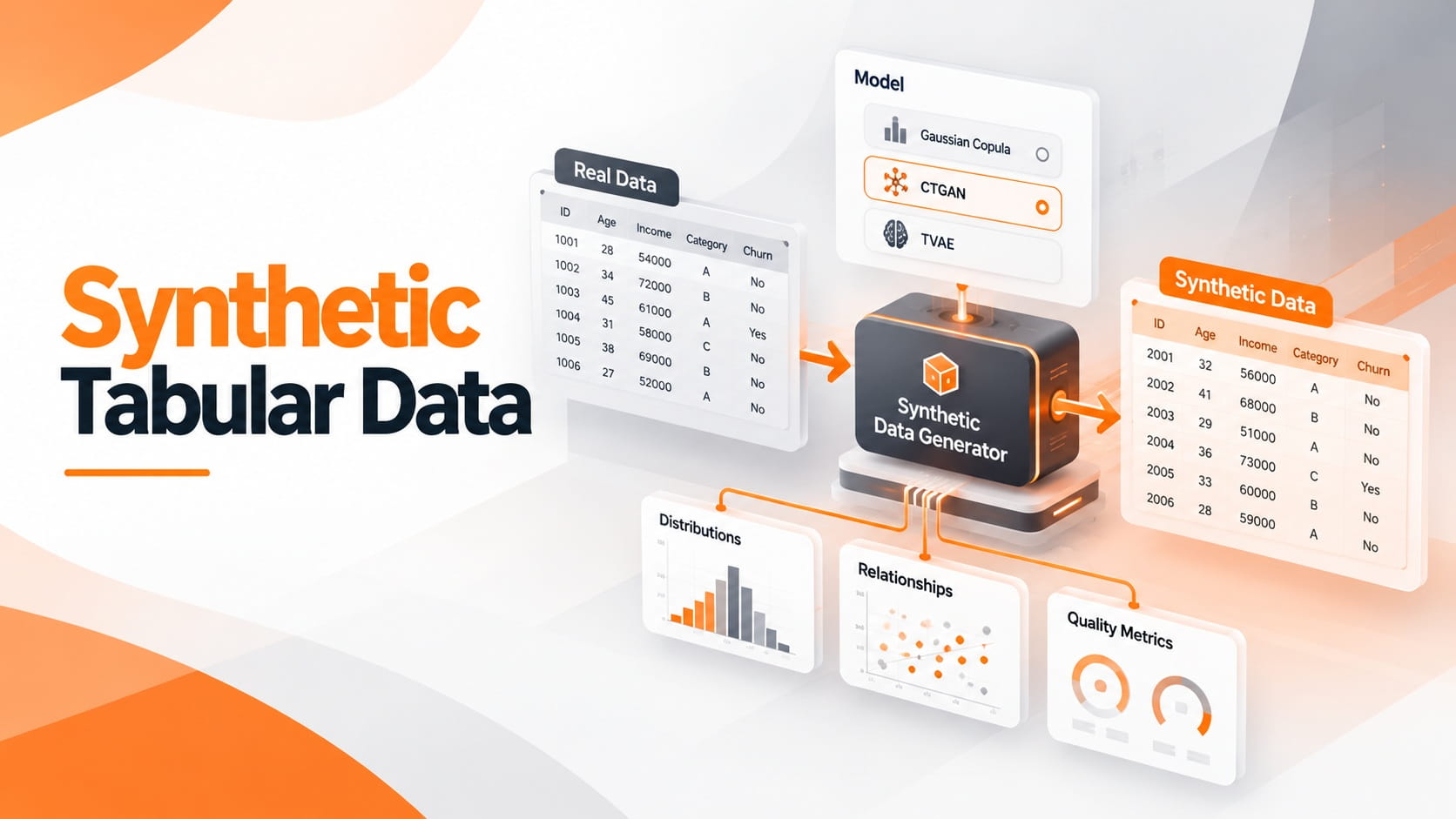
Synthetic tabular data is artificially generated data organized into rows and columns, designed to reproduce the statistical patterns and relationships found in real datasets. It allows developers to create realistic-looking customer records, financial transactions, and business datasets without simply copying existing rows.
Creating useful Synthetic Data takes more than matching column names and generating random values. The real challenge is preserving relationships between variables. A dataset where individual columns look realistic but their combinations make no sense can produce unreliable machine learning results.
How to Generate Synthetic Tabular Data
The most practical approach to synthetic tabular data generation starts with an existing dataset, a clear description of its structure, and a generator capable of learning relationships between columns.
For a first experiment, I would use a single-table dataset and a statistical synthesizer before moving to more computationally demanding models. This establishes a baseline that makes later comparisons meaningful.
The generation process follows these steps:
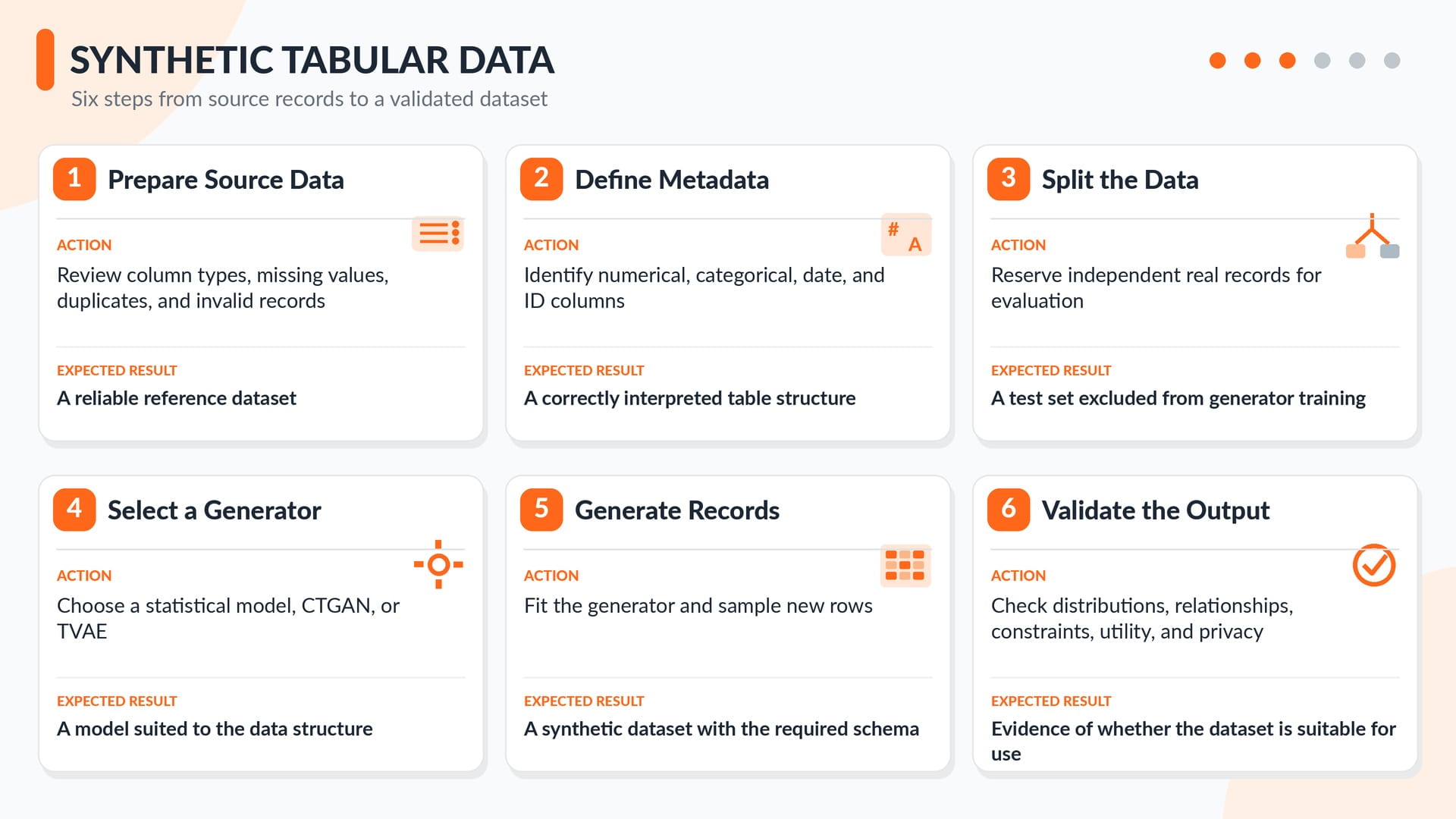
Preparing the Source Dataset
Before generating new records, I examine the original data for inconsistencies that could influence the resulting dataset.
A customer database containing negative ages, duplicated records, or incorrectly formatted dates provides unreliable material for a synthesizer to learn from.
Missing values deserve particular attention. A blank field can represent unavailable information, an inapplicable attribute, or a collection failure. Those distinctions affect whether the synthetic dataset should reproduce the missingness pattern.
I also identify columns that contain personal information or unique identifiers. These should not automatically be treated as ordinary numerical or categorical features.
Defining Column Metadata
Metadata describes what each column represents.
For example, a customer ID may contain digits but should be treated as an identifier rather than a measurable quantity. Subscription status is categorical, even when encoded using numbers.
An incorrect metadata definition can produce invalid records or misleading statistical relationships.
The metadata should capture the relevant column types, primary keys, and other structural requirements supported by the selected tool. Business rules that are not automatically enforced by the generator need separate validation.
Training the Generator
After reserving an independent real-world test set, the generator learns patterns from the remaining source data.
A statistical synthesizer estimates distributions and relationships between variables. A neural generator learns representations from which it can produce new combinations of values.
The generator then samples records using its learned model.
Generating more rows increases the number of available examples, but it does not create knowledge about patterns absent from the source dataset. That limitation becomes important when the original data contains very few examples of a particular group or event.
Synthetic Tabular Data Example
Consider a subscription business with four columns: Customer Age, Subscription Plan, Monthly Spending, and Cancellation Status.
One illustrative real record might describe a 34-year-old customer on a Premium plan, spending $79 per month, with no cancellation.
A synthetic generator could produce a new customer aged 36 with the same plan, spending $82 per month. The values are invented, but the record remains plausible within the intended business scenario.
That is the basic objective of tabular data synthesis.
The difficult part is reproducing patterns across the entire dataset.
For example, if Premium customers consistently spend more than Basic customers in the source data, the synthetic dataset should preserve that relationship to the degree required by its intended use.
Likewise, if cancellation rates vary substantially by plan or spending level, those conditional patterns matter for training a churn prediction model.
A dataset with realistic ages, spending amounts, and cancellation labels can still be unsuitable if those variables no longer relate to one another as they do in the real data.
This is why independent column-by-column sampling is not a sufficient substitute for learning the joint data distribution.
Synthetic Tabular Data Generation Methods
Several approaches can generate structured synthetic data. Each makes different assumptions about the patterns it can reproduce.
Statistical Models and Gaussian Copula
Statistical generators model distributions and dependencies using mathematical methods.
Gaussian Copula is an established approach for tabular synthesis. It models individual column distributions and their dependency structure through a copula-based representation.
I would start with Gaussian Copula when establishing a baseline because it provides a relatively straightforward approach that does not require training a large neural network.
Its limitations become apparent when the dataset contains complex relationships that are not adequately represented by the selected statistical model.
CTGAN
Conditional Tabular Generative Adversarial Network (CTGAN) is designed for tabular data containing a mixture of numerical and categorical variables.
It uses adversarial training, where a generator produces artificial samples while a discriminator learns to distinguish generated records from real ones.
CTGAN introduces techniques for handling continuous features and imbalanced categorical values, making it relevant to datasets with heterogeneous column types.
However, handling categorical imbalance does not guarantee accurate reproduction of rare categories.
CTGAN requires more training resources than a simple statistical baseline, and its performance depends on the dataset and training configuration.
TVAE
Tabular Variational Autoencoder (TVAE) uses an encoder and decoder to learn a latent representation of structured data.
During generation, the model samples from that learned representation and decodes the result into tabular records.
TVAE provides a different neural approach from CTGAN, without relying on the same adversarial training process.
Its effectiveness depends on how successfully the learned latent distribution represents the original dataset.
Diffusion-Based Generators
Diffusion models offer another approach to tabular synthesis by learning a process that transforms noise into samples resembling the target data distribution.
They have been studied for mixed numerical and categorical datasets, including settings with complex feature relationships.
Their training and sampling costs depend on the implementation, and they do not consistently outperform statistical or adversarial methods across every dataset.
The appropriate method should be selected through evaluation rather than assuming the newest model architecture produces the strongest synthetic data.
Synthetic Tabular Data Tools
Several tools make synthetic tabular data generation accessible without requiring a generator to be developed from scratch.
Synthetic Data Vault (SDV) is a Python ecosystem for generating and evaluating structured synthetic data. It supports statistical methods such as Gaussian Copula and neural approaches including CTGAN and TVAE.
For an initial SDV workflow, the source table is loaded, metadata is defined and validated, a synthesizer is fitted, and the trained synthesizer generates new rows. Its evaluation tools help compare the synthetic output with reference data.
MOSTLY AI provides tools for generating synthetic structured data, including datasets with relationships between tables. Its quality assurance capabilities support comparisons of statistical properties and privacy-related characteristics.
NVIDIA's synthetic data tooling includes approaches for generating structured records and evaluating synthetic datasets as part of AI development workflows.
The important selection criteria are whether the tool supports the actual data structure, the required privacy controls, reproducible generation, and suitable evaluation methods.
For a simple CSV dataset, a single-table synthesizer provides a reasonable starting point. For connected business records, relational support becomes essential.
Preserving Data Distributions and Relationships
A synthetic table needs to preserve more than realistic individual values.
The generator must capture relationships that are meaningful to the intended analysis or machine learning task.
Column Distributions
For numerical features, I examine ranges, averages, percentiles, and the overall shape of distributions.
For categorical features, I compare category frequencies and check whether important groups remain represented.
These checks reveal whether the generator reproduces the basic characteristics of each column.
However, matching marginal distributions does not establish that the synthetic dataset preserves relationships between features.
Relationships Between Columns
Correlations and conditional distributions help reveal whether related variables behave consistently.
In a customer dataset, Monthly Spending might depend on Subscription Plan, Account Age, and Product Usage.
Checking spending amounts independently would miss errors in those relationships.
Pairwise comparisons provide additional evidence, but they still cannot fully describe every interaction involving three or more variables.
For predictive applications, relationships involving the target variable deserve particular attention because they influence the patterns a downstream model learns.
Business Rules and Constraints
Some relationships represent mandatory rules rather than statistical tendencies.
An order total should be consistent with its applicable pricing components. An end date must not precede a start date when the business process prohibits that sequence.
These conditions should be expressed through supported generation constraints or verified with explicit validation checks.
A synthesizer that produces statistically similar records but violates essential business logic is not ready for production use.
Single-Table and Multi-Table Data Generation
A single-table dataset contains the relevant information in one structured table.
Customer profiles, product catalogs, and transaction-level datasets can be represented this way when each row corresponds to a defined observation.
Multi-table datasets introduce relationships between separate tables.
Consider an e-commerce database containing Customers, Orders, and Order Items.
Each customer can have several orders, and each order can contain multiple items. The tables are connected using primary and foreign keys.
Generating these tables independently can produce orphaned orders, invalid customer references, or incorrect numbers of related records.
A relational synthesizer must account for the connections between tables as well as the statistical characteristics of their contents.
Two technical requirements are especially important:
Referential integrity: Foreign keys must refer to valid parent records, subject to the database's defined nullability rules.
Relationship cardinality: The generated data should represent the intended one-to-many and other supported relationships between entities.
The choice between single-table and multi-table generation should follow the original data model. Flattening a relational database into one large table can introduce duplication and distort relationships during generation.
Evaluating Synthetic Tabular Data Quality
A synthetic dataset should not be accepted solely because its records look realistic.
I evaluate it through three independent dimensions: statistical fidelity, downstream utility, and privacy risk.
Each answers a different question about whether the generated dataset can serve its intended purpose.
Statistical Fidelity
Data fidelity measures how closely the synthetic data reproduces relevant properties of the reference dataset.
For tabular records, useful checks include column distributions, category frequencies, correlations, and column-pair relationships.
SDMetrics provides statistical quality reports that evaluate column shapes and relationships between columns.
A high statistical similarity score is useful evidence, but it does not establish complete dataset quality. Important higher-order relationships or rare patterns can remain poorly represented.
I would inspect metrics relevant to the business task rather than relying exclusively on a single overall score.
Downstream Utility
Utility measures whether synthetic data supports the intended analysis or model-training objective.
One established evaluation approach is Train on Synthetic, Test on Real (TSTR).
A machine learning model is trained on synthetic records and evaluated against an independent real test set.
Its results can be compared with a baseline trained on real data and tested on the same real test set, known as Train on Real, Test on Real (TRTR).
For classification, precision, recall, and F1 score are suitable choices. Regression tasks require appropriate error metrics.
Both experiments should use comparable model configurations and evaluation procedures.
This comparison provides direct evidence of how much predictive usefulness the synthetic data retains.
A crucial detail is separating the real test records before fitting the synthesizer. Otherwise, information from the evaluation data can influence the generated training records and distort the results.
Privacy Risk
Synthetic records are not automatically anonymous.
A generator can reproduce individual records or preserve combinations of attributes that expose information about people represented in its training data.
I would check exact and near-duplicate records, unusually close matches to source individuals, and privacy attack risks appropriate to the dataset.
Membership inference and attribute inference assessments can provide additional evidence about potential disclosure.
Differential privacy provides formal guarantees when implemented with a valid privacy mechanism and documented privacy parameters. Merely using a synthetic data generator does not provide those guarantees.
Privacy evaluation must be considered separately from statistical fidelity. A dataset can closely resemble its source and still carry unacceptable disclosure risks.
Applications of Synthetic Tabular Data
Synthetic tabular data is useful when organizations need structured examples but face limitations in collecting, accessing, or distributing real records.
In financial services, synthetic transaction data can support testing of analytics pipelines, fraud-detection development, and controlled experiments.
Healthcare researchers can use synthetic patient-like records to explore analytical methods, provided privacy risks and scientific validity are assessed before any data release or interpretation.
For software development, synthetic tables can populate test databases without requiring production customer records in development environments.
Customer analytics teams can generate structured datasets for evaluating segmentation models, testing reporting pipelines, and experimenting with additional scenarios.
The acceptance criteria differ between these applications.
A synthetic table designed to test software functionality needs valid schemas, relationships, and edge cases. A dataset intended to train a predictive model must also preserve the statistical signals needed for reliable performance.
These are different objectives and should not be judged by one universal quality score.
Selecting a Synthetic Tabular Data Method
The final choice of generator should reflect the source structure, available data, computational budget, and intended use.
For an initial single-table experiment, I would establish a Gaussian Copula baseline and evaluate its performance before introducing a neural synthesizer.
If the baseline fails to preserve important relationships, CTGAN or TVAE can be evaluated under comparable conditions.
For relational datasets, the generator must support connected tables and preserve the database relationships required by the application.
For privacy-sensitive datasets, the decision also depends on disclosure-risk assessments and the availability of appropriate privacy protections.
The strongest method is the one that satisfies the project's requirements on independent evaluation data, not necessarily the one producing the most realistic-looking individual rows.
Conclusion
Synthetic tabular data provides a practical way to generate structured records for machine learning, analytics, and software testing. Its value depends on preserving meaningful data relationships, respecting structural constraints, and meeting the requirements of the intended application.
A useful synthetic dataset needs evidence of statistical quality, downstream performance, and acceptable privacy risk. Selecting a generator is only part of the work; validating what it produces determines whether the generated records can be trusted.
FAQ
Can I create synthetic tabular data without having any real dataset?
Yes. Rule-based generators, predefined statistical distributions, and other configurable generation methods can produce artificial tables without original records. However, the resulting data cannot be assumed to represent real-world relationships without external evidence or domain validation.
Can I generate synthetic tables without writing Python code?
Yes. No-code and low-code synthetic data platforms provide interfaces for uploading datasets, configuring generation, and exporting results. Their available features, privacy controls, and supported table relationships vary by provider.
Do I need to regenerate my synthetic dataset when the original database changes?
A source-schema change requires reviewing metadata, constraints, and downstream compatibility. Changes in the underlying data distribution require fresh evaluation and can justify retraining the generator. An existing synthetic dataset does not automatically reflect new source records.
Can I generate reliable synthetic data from just 30 real rows?
A generator can produce additional rows from a dataset containing 30 observations, but such a small reference set provides limited evidence of the underlying population distribution. The resulting records should not be treated as representative without independent validation or strong domain assumptions.
Can I reproduce exactly the same synthetic records in another training run?
Reproducibility depends on the generator, random seed, software versions, hardware, and execution settings. A fixed seed can improve repeatability, but it does not guarantee identical output across different environments or implementations. The complete generation configuration should be retained when exact reproduction is required.

Fatemeh Jahangard
Technology & AI Writer at PinerookFatemeh Jahangard covers AI, emerging technologies, and digital innovation for Pinerook, focusing on how technology shapes startups and industries.
 Seen first.