
Acquisition valuation determines how much a buyer may reasonably pay to acquire a startup. The process involves evaluating revenue, profitability, future cash flows, growth opportunities, and business risks. However, an estimated company value is not necessarily the amount shareholders will receive. Debt, cash balances, working capital adjustments, and transaction terms can change the final purchase price.
Within Startup Exit and M&A, valuation helps founders distinguish an attractive headline offer from an economically favorable transaction. A startup may receive considerable interest because of its technology, customer relationships, or market position, but each buyer can assign a different value to these capabilities. The negotiated price depends on the evidence supporting the business and the benefits the buyer expects to achieve.
Understanding acquisition valuation requires examining both how a startup's operating value is estimated and how that estimate becomes a purchase price. Founders should understand the assumptions behind valuation multiples, discounted cash flow forecasts, and comparable acquisitions. They also need to recognize the adjustments that can reduce shareholder proceeds. This guide explains the principal valuation methods, the financial information buyers examine, and how to evaluate an offer using a practical calculation.
What Is Acquisition Valuation?
Acquisition valuation is the process of estimating the economic value of a business in connection with a proposed purchase. It provides a basis for negotiations, financial modeling, and decisions about whether the transaction is attractive to the parties involved.
A valuation is not a fixed property of the startup. Different buyers may reach different conclusions because they have different assumptions about growth, risk, financing costs, and the benefits of owning the business.
For example, a software company with recurring revenue may be attractive to a financial investor seeking predictable cash generation. A strategic buyer may value the same company more highly if its technology can improve an existing product or reach a larger customer base.
Founders should distinguish three concepts: the standalone value of the business, its potential value to a particular buyer, and the negotiated consideration that sellers ultimately receive. These figures can differ without any of them necessarily representing an error.
What Buyers Examine When Valuing Startups
The financial profile of a startup influences which valuation methods are appropriate and how reliable their conclusions may be.
For a subscription software business, buyers may evaluate annual recurring revenue, customer retention, gross margins, growth rates, and cash requirements. These measures help determine whether current revenue is likely to continue and how much investment will be required to support expansion.
Profitability becomes particularly important when a company has an established operating model. Buyers may examine normalized EBITDA or free cash flow to understand earnings after removing selected unusual or nonrecurring effects.
However, normalization requires evidence. A founder cannot automatically exclude every inconvenient operating expense when presenting adjusted profitability. Buyers will examine whether proposed adjustments are reasonable and whether similar costs are likely to recur.
Other factors include customer concentration, competitive positioning, technology ownership, management quality, and reliance on key employees. Two startups with identical revenue may deserve different valuations if one has predictable customer relationships while the other faces significant renewal uncertainty.
Main Startup Acquisition Valuation Methods
Several methods are commonly used to estimate business value. Each approaches the question from a different perspective, so the resulting figures may not be identical.
Comparable company analysis examines how investors value publicly traded businesses with similar characteristics. Precedent transaction analysis considers prices paid in completed acquisitions. Discounted cash flow analysis estimates value using the present value of expected future cash flows.
Other approaches may be relevant for businesses with limited earnings history, substantial tangible assets, or unusual financial characteristics.
The following table explains how these methods work and when their limitations matter.
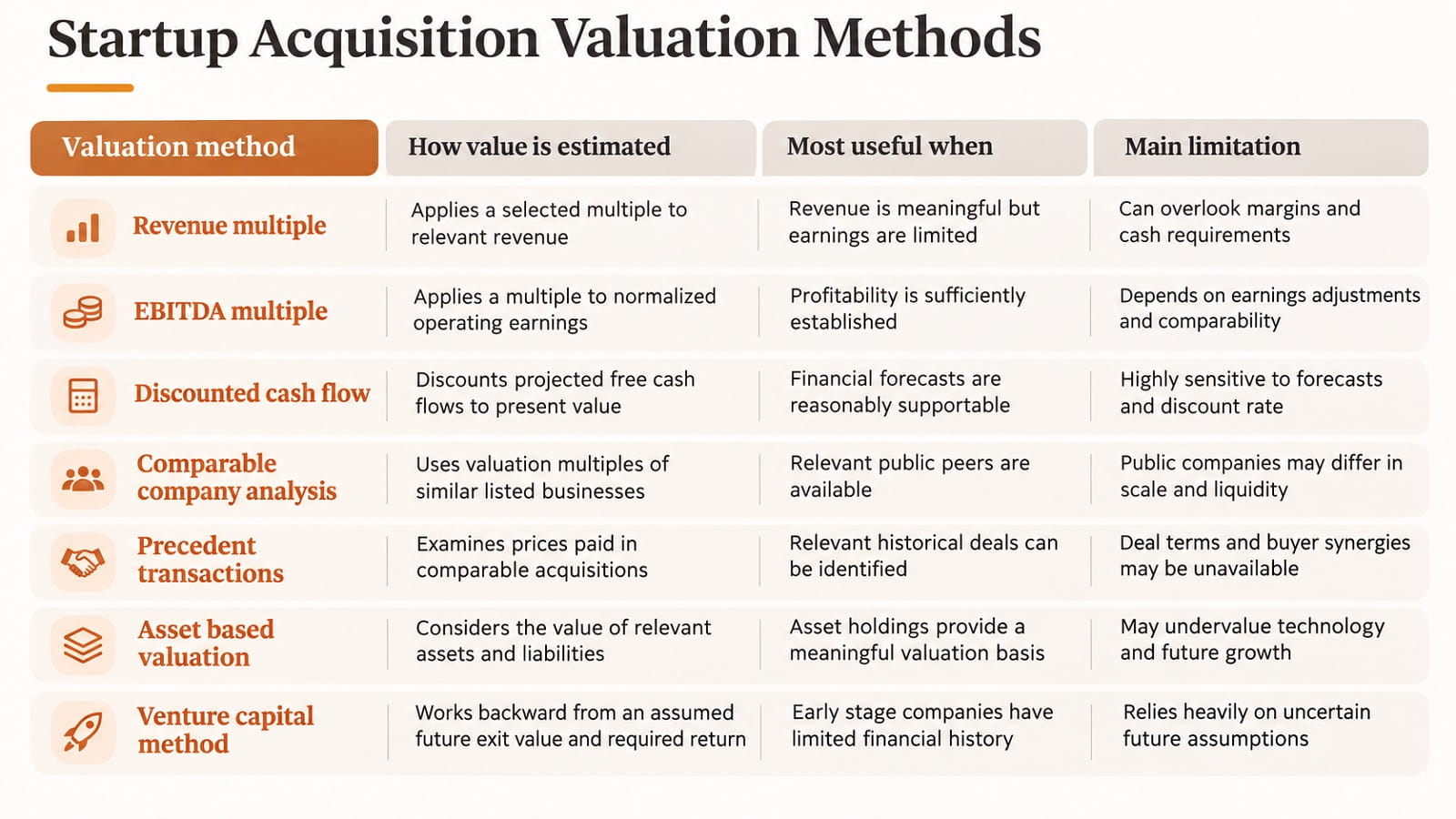
No single method produces a universally correct purchase price. Analysts often compare several approaches to understand why their estimates differ. A revenue multiple may suggest a higher value than a cash flow model if the business is growing quickly but requires substantial future investment. Founders should examine these differences rather than automatically select the method producing the highest result.
Revenue Multiples and Startup Valuation
Revenue multiples are frequently considered when assessing companies whose commercial scale is more established than their profitability. The basic calculation multiplies a selected revenue measure by an appropriate valuation multiple.
For example, a software business generating $5 million in annual recurring revenue would have an illustrative enterprise value of $25 million at a multiple of five times that revenue.
However, the choice of multiple requires careful analysis. Revenue growth, gross margin, customer retention, profitability, market conditions, and company size can all influence the range supported by comparable evidence.
Buyers also distinguish recurring contractual revenue from one-time sales. A business that generates predictable subscription payments may have a different financial profile from one relying on irregular project revenue.
Founders should confirm that the revenue definition matches the multiple being applied. An ARR multiple should not be applied indiscriminately to total revenue that includes nonrecurring services.
The resulting calculation is a starting point for analysis, not a guaranteed acquisition price.
EBITDA and Earnings-Based Valuation
For startups with established earnings, buyers may use an EBITDA multiple to estimate enterprise value.
EBITDA represents earnings before interest, taxes, depreciation, and amortization. Although useful for comparing certain businesses, it does not directly measure cash available to shareholders.
Buyers often assess normalized EBITDA to remove genuinely exceptional items or reflect a sustainable operating cost structure. Any adjustment should be supported by financial records and a reasonable explanation.
A company with $3 million in normalized EBITDA valued at eight times earnings would have an illustrative enterprise value of $24 million.
However, capital expenditure, changes in working capital, taxes, and financing requirements remain important. Two companies with similar EBITDA may produce substantially different free cash flows.
The appropriate multiple should therefore reflect the quality and sustainability of earnings rather than being selected solely because another company received that valuation.
Discounted Cash Flow Valuation
Discounted cash flow analysis, or DCF, estimates business value based on expected future free cash flows discounted to their present value.
The method requires forecasts of operating performance, capital expenditure, taxes, and working capital needs. It also requires assumptions about the discount rate and the value of cash flows beyond the explicit forecast period.
A DCF model can be useful when a startup has sufficient financial history to develop credible operating forecasts. It can also help explain how changes in customer retention or margins influence estimated value.
Its weakness is sensitivity to assumptions. Small changes in long-term growth or discount rates can produce substantial changes in valuation.
For early stage companies with uncertain commercial prospects, a precise-looking DCF result may create more confidence than the underlying evidence justifies.
Founders should use scenario analysis to show how value changes under different operating outcomes instead of relying on a single optimistic forecast.
Comparable Acquisitions and Strategic Value
Precedent transaction analysis examines acquisition prices paid for businesses with similar operating characteristics.
Relevant comparisons may include companies in the same industry with similar revenue models, customer profiles, growth rates, and profitability. Transaction timing also matters because financing conditions and buyer demand change.
However, acquisition prices can contain strategic premiums. One buyer may pay more because the target offers unusually valuable technology or eliminates years of internal development work.
A founder should not assume that a high-profile acquisition establishes the appropriate multiple for every smaller startup operating in the same sector.
Strategic value is also buyer-specific. A feature that complements one acquirer's product portfolio may provide little additional value to another.
A credible valuation separates benefits available to any owner from synergies that depend on a particular buyer's capabilities. Negotiations then determine how much of those benefits the buyer is prepared to share with sellers.
Enterprise Value Versus Equity Value
One of the most important distinctions in acquisition negotiations is the difference between enterprise value and equity value.
Enterprise value represents the value attributed to the operating business under the selected valuation approach. Equity value represents the amount attributable to shareholders after relevant adjustments.
In a simplified transaction, the relationship can be expressed as:
Equity Value = Enterprise Value + Agreed Cash − Debt ± Other Agreed Adjustments
These adjustments depend on the agreement. Some cash may be excluded or required to remain in the business, while debt-like liabilities may include obligations beyond conventional bank borrowing.
A buyer may also expect the startup to deliver a normal level of working capital. If actual working capital differs from the agreed target, the purchase price may change.
Founders should therefore ask whether a buyer's proposal refers to enterprise value or equity value before interpreting the amount as proceeds available to shareholders.
Working Capital and Purchase Price Adjustments
Working capital supports everyday operations through balances such as receivables, inventory, and payables. Acquisition agreements often define a specific measure of net working capital and establish a target amount.
If closing working capital exceeds the agreed target, the seller may receive a positive adjustment under the contract. If it falls below the target, the price may decrease.
For example, an agreement might establish a working capital target of $1 million. If closing working capital, measured using the agreed definitions, is $800,000, a dollar-for-dollar adjustment would reduce the purchase price by $200,000.
The calculation requires consistent accounting treatment. Cash, debt, and items already included in another adjustment should not be counted twice.
Other negotiated adjustments may concern unpaid transaction expenses, debt-like obligations, or specific liabilities identified during financial diligence.
Because the resulting amount can differ from the initial offer, founders should understand these definitions before accepting an acquisition valuation.
A Practical Startup Acquisition Valuation Example
Consider CedarFlow Analytics, a fictional B2B software startup providing financial planning tools to enterprise customers.
CedarFlow generates $6 million in annual recurring revenue and has established positive customer retention, although it continues investing in product development.
A potential buyer uses comparable financial information and selects an illustrative enterprise value of $30 million. This corresponds to five times the company's stated annual recurring revenue.
The multiple is a hypothetical assumption for this example, not an observed market benchmark or a recommendation for similar companies.
The parties then examine CedarFlow's financial position to determine the estimated equity value. Assume that the agreement provides for cash and debt adjustments, a working capital adjustment, and a deduction for specified seller expenses.
Calculating the Equity Value
CedarFlow has $2 million in agreed cash, $4 million in financial debt, and $500,000 in additional debt-like obligations.
Its closing working capital is $300,000 below the contractual target. The selling shareholders are also responsible for $200,000 in transaction expenses not otherwise included in the valuation.
The following table presents the resulting calculation.
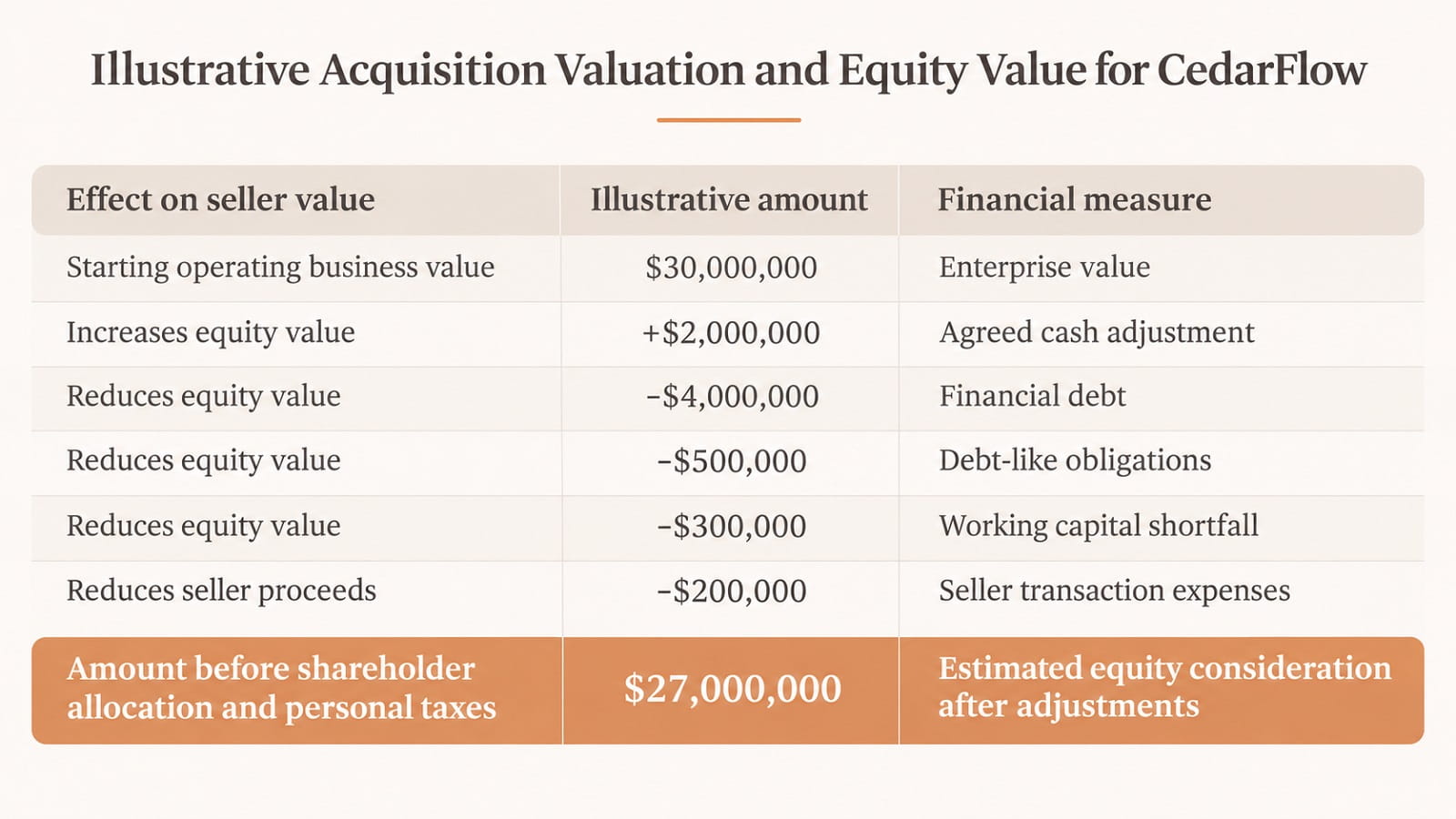
Table 2. Illustrative Acquisition Valuation and Equity Value for CedarFlow
Financial measureIllustrative amountEffect on seller valueEnterprise value$30,000,000Starting operating business valueAgreed cash adjustment+$2,000,000Increases equity valueFinancial debt−$4,000,000Reduces equity valueDebt-like obligations−$500,000Reduces equity valueWorking capital shortfall−$300,000Reduces equity valueSeller transaction expenses−$200,000Reduces seller proceedsEstimated equity consideration after adjustments$27,000,000Amount before shareholder allocation and personal taxes
Under these assumptions, the $30 million enterprise value translates into $27 million of estimated equity consideration after the specified deductions. The $3 million difference results from the net effect of cash, debt, working capital, and seller expenses. The calculation assumes no overlapping adjustments, undisclosed liabilities, or additional contractual payments. Actual proceeds could differ once final closing accounts and shareholder rights are applied.
Why the Headline Valuation Is Not Enough
CedarFlow's shareholders should not interpret the announced $30 million enterprise value as a promise that they will collectively receive that amount.
Even the estimated $27 million equity consideration may not be distributed equally across all outstanding securities. Preferred shareholders could have liquidation preferences, while employee options or other securities may affect the distribution.
The timing of payment also matters. If part of the consideration is placed in escrow or depends on future performance, the amount available immediately may be lower than the total equity consideration.
Founders should review a complete financial model showing the enterprise-to-equity bridge, shareholder distribution, and payment conditions before comparing competing offers.
How Due Diligence Changes Valuation
A buyer's initial valuation often depends on financial and commercial information supplied before detailed due diligence.
During the investigation, the buyer may test revenue quality, customer retention, operating expenses, debt balances, and forecast assumptions. The findings may support the original valuation or reveal risks requiring further negotiation.
For example, a startup may describe recurring revenue that includes customers without enforceable renewal commitments. If the buyer determines that future revenue is less predictable than expected, it may reconsider the multiple used in its model.
Other findings could involve customer concentration, previously unrecognized obligations, or higher costs required to maintain the product.
Not every concern justifies a price reduction. The parties may instead address specific risks through contractual protections, closing conditions, or other agreed mechanisms.
Founders should distinguish genuine changes in the economic assessment from negotiation tactics unsupported by new evidence.
Valuation Sensitivity and Negotiating a Fair Price
A valuation becomes more useful when founders understand which assumptions have the greatest influence on the result.
For a subscription business, these may include future revenue growth, customer churn, gross margins, operating expenses, and the selected valuation multiple.
Sensitivity analysis can demonstrate how the estimated value changes when these assumptions vary. This helps management identify where stronger evidence could improve confidence in the valuation.
Founders should also compare the buyer's assumptions with the company's operating plan. An offer based on unusually pessimistic forecasts may undervalue credible growth opportunities, while internal projections based on unrealistic expansion may exaggerate the company's value.
Negotiations should focus on the evidence supporting each assumption. Financial advisers can help develop valuation ranges and assess whether comparable transactions provide a reasonable basis for the proposed price.
A fair transaction is not necessarily the one producing the highest possible headline valuation. It should offer a defensible economic outcome after considering risk, adjustments, and payment certainty.
Common Acquisition Valuation Mistakes
One common mistake is treating the valuation of a previous financing round as the amount a buyer should pay for the entire business. Financing valuations may involve securities with rights that differ from those transferred in an acquisition.
Another mistake is applying a revenue multiple without considering profitability or cash requirements. High growth can be valuable, but growth that requires disproportionate investment may not produce attractive future returns.
Founders may also overlook debt-like obligations or the contractual definition of working capital. These items can materially change the price paid at closing.
A further problem is double counting strategic benefits. If expected synergies are already reflected in a valuation model, adding their full estimated value again can exaggerate the result.
Finally, some founders concentrate on price while giving insufficient attention to contingencies, deferred payments, or shareholder rights. The value of an offer should be evaluated in terms of the consideration realistically available to sellers.
Final Thoughts
Acquisition valuation helps founders understand how buyers assess a startup and how financial assumptions influence the price offered for the business. Revenue growth, profitability, cash flow, strategic opportunities, and risk all contribute to the assessment.
However, estimating operating value is only part of the transaction. Founders must also understand how enterprise value becomes equity consideration after cash, debt, working capital, and other negotiated adjustments.
A credible valuation uses evidence rather than unsupported multiples and distinguishes potential business value from actual shareholder proceeds. Reviewing these factors before accepting an offer allows founders to negotiate with greater clarity and evaluate the financial outcome of a proposed acquisition.
FAQ
What Is Acquisition Valuation?
Acquisition valuation estimates the economic value of a business in connection with a proposed purchase. Buyers use financial performance, forecasts, comparable businesses, and transaction evidence to support their assessments.
How Do Buyers Value Startups With No Profit?
Buyers may consider revenue growth, recurring revenue quality, technology, intellectual property, and future cash flow potential. The appropriate method depends on the company's business model and available evidence.
What Is the Difference Between Enterprise Value and Equity Value?
Enterprise value reflects the estimated operating business value. Equity value reflects the amount attributable to shareholders after relevant cash, debt, and other agreed adjustments.
Which Acquisition Valuation Method Is Best?
No method is universally best. Revenue multiples, EBITDA multiples, discounted cash flow, and comparable transactions provide different perspectives. Analysts may combine methods to assess a reasonable range.
Why Can Two Buyers Offer Different Valuations?
Buyers may have different growth assumptions, financing costs, strategic capabilities, and expectations about risk. A business may also generate unique benefits for one buyer that are unavailable to another.
Can Due Diligence Reduce an Acquisition Price?
Yes. Material findings concerning revenue, liabilities, contracts, or financial forecasts may lead a buyer to negotiate revised terms. The outcome depends on the findings and agreement between the parties.
Does Acquisition Valuation Include Debt?
Enterprise value is commonly adjusted for debt and agreed debt-like items when calculating equity consideration. The precise treatment depends on the purchase agreement.
Does a Higher Acquisition Valuation Mean Founders Receive More Cash?
Not necessarily. Shareholder rights, transaction expenses, debt adjustments, escrow, and contingent payments can affect the amount and timing of founder proceeds.

Mobina Khanki
Venture & Funding Writer at PinerookMobina Khanki covers venture capital, startup funding, fundraising, and startup finance for Pinerook, focusing on founders and investors.
 Seen first.