AI in education is changing how students learn, teachers prepare lessons, and institutions support academic progress. From intelligent tutoring and personalized exercises to automated feedback and educational analytics, artificial intelligence can make learning more accessible and teaching more efficient. Its value, however, depends on whether it helps students develop knowledge or simply completes their work for them.
The distinction matters. A student who receives an instant answer has finished a task, but a student who understands how to reach that answer has learned something. Effective educational AI supports the second outcome.
Applications of AI in Education
Artificial intelligence in education serves three main groups: students who need learning support, teachers who manage instruction, and institutions responsible for educational services.
Its applications extend beyond generative chatbots. Adaptive learning systems, speech recognition, predictive analytics, and intelligent tutoring technologies address different parts of the educational process.
AI Tutoring and Student Support
Students benefit from explanations that respond to their knowledge level rather than repeat the same textbook material.
For example, a student struggling with fractions can ask an AI tutor to explain equivalent fractions, work through another example, or provide practice questions.
The strongest tutoring experience does not immediately reveal every answer. It identifies where the student's reasoning breaks down and guides the next step.
This is the purpose of AI Tutors for Students: providing interactive practice, explanations, and feedback without requiring a teacher to respond to every individual question.
AI can also support language learning through conversational exercises and pronunciation feedback. These activities create opportunities to practice skills between formal lessons.
Lesson Preparation and Teaching Materials
Teachers spend substantial time preparing exercises, adapting reading materials, and developing classroom activities.
AI Lesson Planning Tools can turn a defined learning objective into a draft lesson structure, complete with activities, discussion prompts, and suggested exercises.
Consider a teacher preparing a science lesson about ecosystems.
An AI system can suggest an opening activity, generate questions about food chains, and propose a short assessment. The teacher then selects the material that fits the students' curriculum, language level, and existing knowledge.
The benefit is faster preparation, not automatic instructional quality.
A useful lesson still requires accurate information, appropriate difficulty, and a clear connection between activities and learning objectives.
Automated Grading and Feedback
Assessment creates another substantial workload, particularly in classes with many students.
AI Grading Tools can support the evaluation of objective questions, identify patterns in responses, and generate draft feedback based on assessment criteria.
For example, an automated system can identify which multiplication questions students answered incorrectly and organize the results for a teacher.
Evaluating essays and open responses requires greater care. A grammatically polished answer does not necessarily demonstrate accurate reasoning, original analysis, or mastery of the subject.
Teachers remain responsible for interpreting complex work, reviewing disputed scores, and making consequential grading decisions.
Personalized Learning
Traditional classroom instruction follows a shared curriculum, but students do not progress through every concept at the same pace.
Personalized Learning with AI uses information about learner performance to adjust activities, practice difficulty, or instructional recommendations.
A student who demonstrates proficiency in basic algebra can move to more demanding problems. Another student who struggles with the same material can receive additional practice on prerequisite concepts.
This is different from asking a chatbot to produce an easier explanation.
A personalized learning system needs a defined learning objective, a way to measure progress, and a process for selecting suitable next activities.
The purpose is not to give every student entirely different content. It is to provide appropriate support while maintaining consistent educational expectations.
Accessibility and Inclusive Learning
Artificial intelligence can help students interact with educational materials through different formats.
Speech recognition supports spoken input, text to speech systems provide audio access to written content, and image descriptions make visual information easier to interpret.
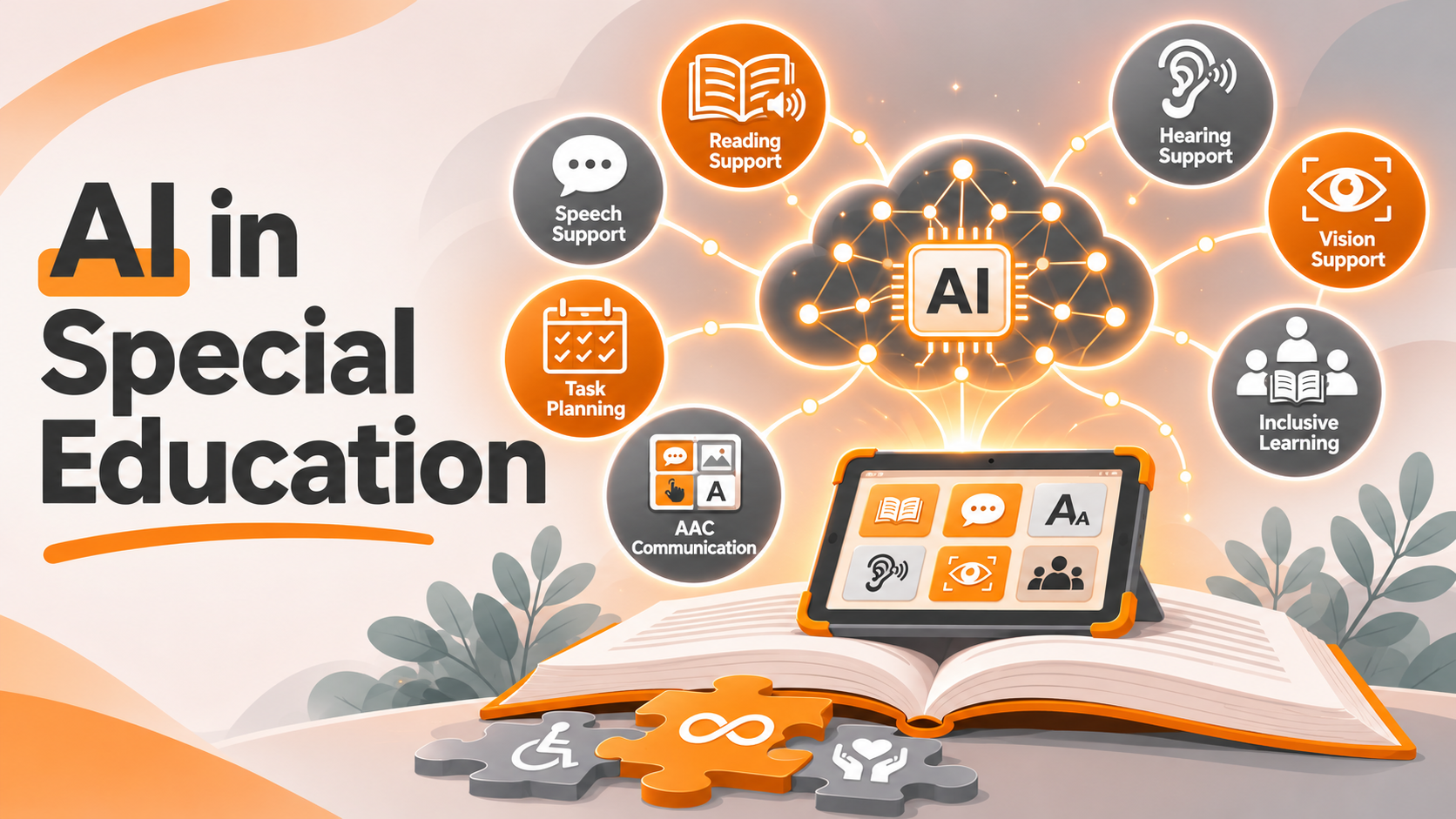
These capabilities have an important role in AI in Special Education, where learning materials and interaction methods need to accommodate different abilities.
For example, a student who has difficulty reading lengthy passages can use audio support while engaging with the same subject as classmates.
Accessibility tools must still be evaluated with the individual learner. Automated speech recognition, translation, and image descriptions can produce errors that interfere with understanding.
AI provides additional access methods, but it does not replace individualized educational planning or specialist support.
Educational Administration and Student Services
Educational institutions also use AI to organize information and identify operational needs.
Learning analytics systems can examine attendance, assignment completion, and course participation to highlight students who need additional support.
Administrative assistants can help staff answer routine questions about enrollment procedures, academic calendars, and institutional services.
These systems become valuable when they reduce repetitive work while directing important decisions to qualified staff.
An attendance pattern, for example, can justify a supportive conversation with a student. It should not automatically establish the reason for that student's absence.
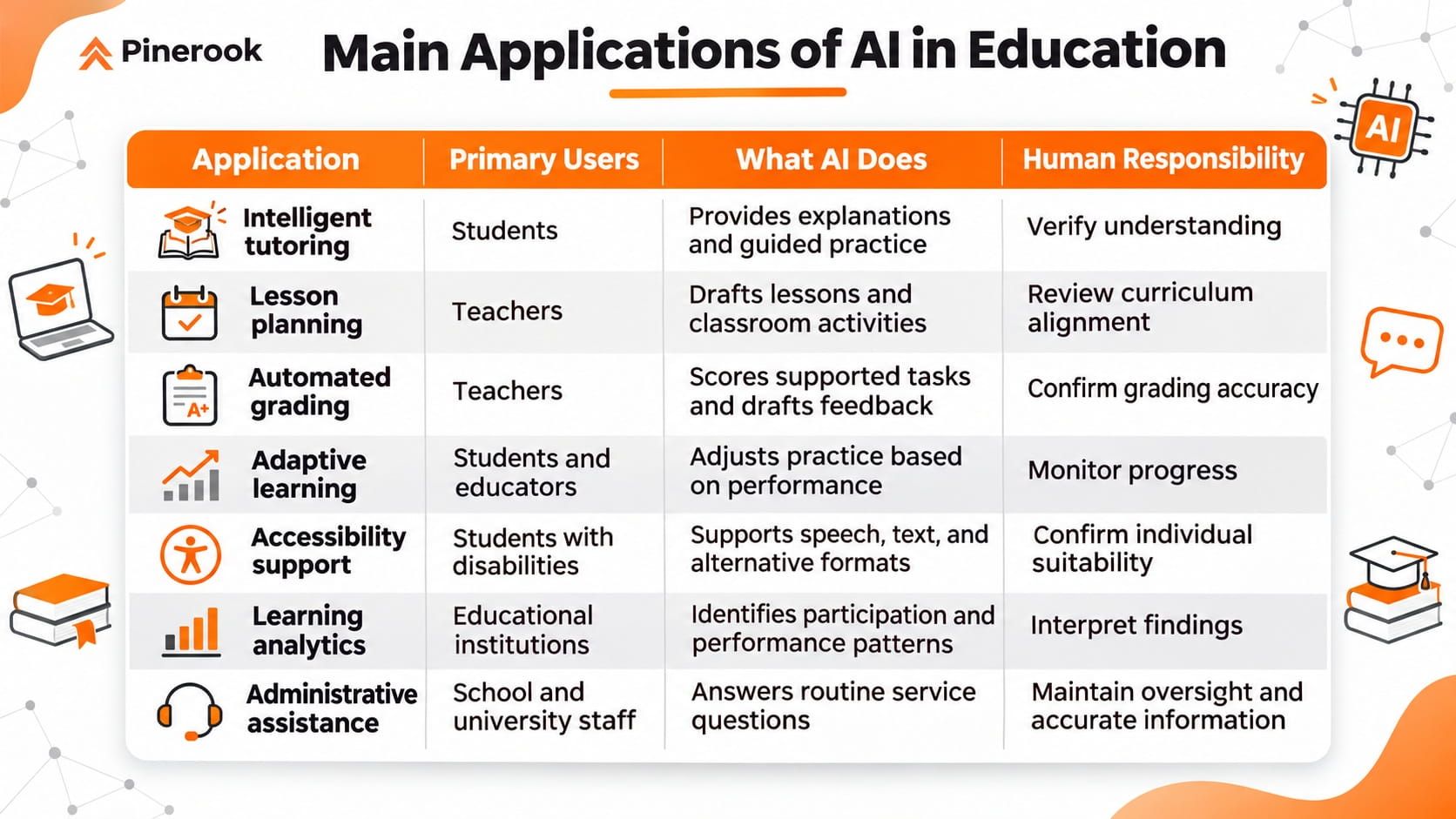
The table highlights an important distinction: AI performs supporting functions, while educators and institutions remain responsible for educational decisions.
Its effectiveness should be judged by the quality of those decisions and the learning outcomes they produce.
Real World Examples of AI in Education
Educational AI becomes easier to understand when its capabilities are connected to products already used for teaching and learning.
The following examples demonstrate different applications rather than competing solutions to the same problem.
Khan Academy and Khanmigo
Khan Academy developed Khanmigo as an AI tutoring and teaching assistant.
Its student tutoring experience supports guided learning conversations, while its teacher features help educators prepare learning objectives, rubrics, lesson materials, and classroom activities.
The distinction between these functions matters. Students need help developing understanding, while teachers need tools that support planning and instructional decisions.
Khanmigo illustrates how a single educational platform can serve both needs through different experiences.
Microsoft Reading Coach
Microsoft Reading Coach uses artificial intelligence to support reading fluency.
Students read passages aloud while the system analyzes their spoken reading and identifies words that require additional practice.
It provides feedback about reading performance and supports personalized reading activities.
This is a more specific educational application than a general chatbot. The technology is connected to a measurable skill: reading fluency.
Teachers can use the resulting information to guide additional instruction, while recognizing that automated reading measurements do not capture every aspect of comprehension.
Carnegie Learning MATHia
MATHia provides adaptive mathematics practice and feedback.
The software tracks student progress through mathematical concepts and adjusts instructional support according to performance.
It demonstrates the role of educational AI systems that use structured learning activities and performance information rather than relying entirely on open conversations.
The educational objective remains mathematical understanding, with the software supporting practice and progress monitoring.
Duolingo and AI Conversation Practice
Duolingo uses AI in language learning experiences that include interactive conversation practice.
Its Video Call feature allows learners to speak with an AI character and practice responding in the language they are studying.
The application addresses a specific limitation of independent language study: access to repeated conversational practice.
An automated conversation provides an additional practice environment, while human interaction remains important for understanding cultural context and real communication.
These four examples also show why AI in education should not be reduced to ChatGPT. Educational systems use different technologies depending on the learning task.
Benefits of AI in Education
The benefits of artificial intelligence become clearer when administrative efficiency is separated from educational improvement.
Completing a task faster is a measurable operational gain. Improving understanding, retention, or independent performance is an educational gain. The two require different evidence.
Faster Feedback and More Practice
AI systems can provide feedback immediately after a learner completes an exercise.
This shortens the time between a student's response and the opportunity to correct it.
A mathematics student can identify an incorrect calculation and attempt another problem without waiting for the next class.
The benefit depends on feedback quality. Revealing the correct answer is less instructive than explaining the reasoning needed to solve the problem.
Reduced Teacher Workload
AI can help teachers prepare drafts, organize information, and create variations of familiar activities.
Reducing time spent on repetitive tasks creates room for classroom discussion, individual support, and instructional planning.
However, time savings must account for the work required to verify AI output.
A generated worksheet that contains incorrect answers or unsuitable questions creates additional work rather than reducing it.
Greater Access to Learning Support
AI based learning services can provide additional practice outside scheduled classroom hours.
Students can request explanations, translate selected material, or revisit concepts at their own pace.
For learners without regular access to individual tutoring, this expands the availability of educational assistance.
Access still depends on suitable devices, internet connectivity, language support, and accessible software design.
Better Visibility Into Learning Progress
Educational data can help teachers identify concepts that require further attention.
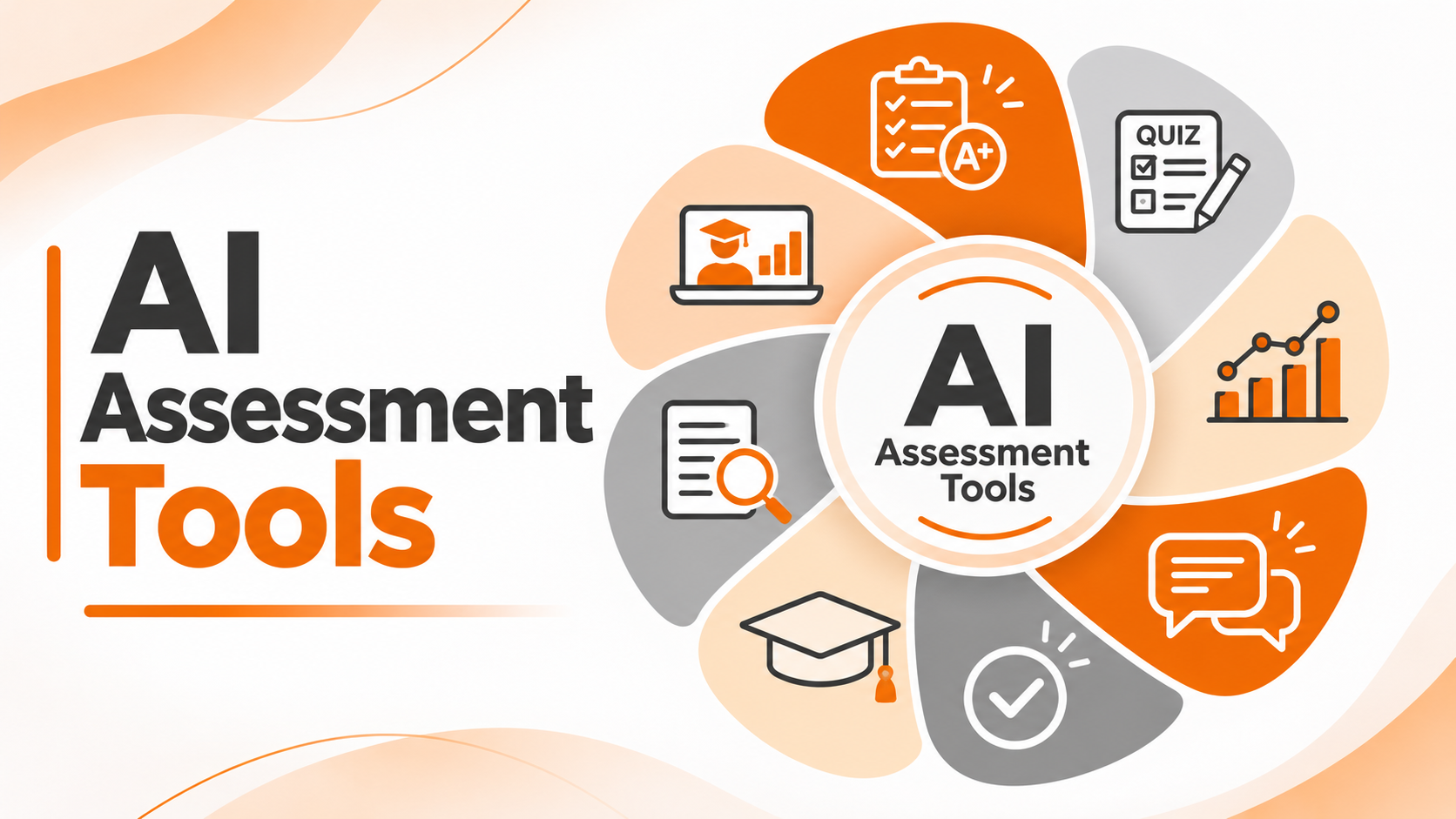
This is where AI Assessment Tools serve a different purpose from routine grading software.
Rather than assigning marks alone, assessment systems can examine patterns in student responses, track mastery of learning objectives, and provide information for instructional decisions.
A class that repeatedly struggles with the same algebraic concept needs a different teaching response from a class where only one student encounters difficulty.
The value lies in turning assessment results into appropriate teaching action.
Challenges and Limitations of AI in Education
Artificial intelligence introduces risks that educational institutions cannot manage through software selection alone.
The main concerns involve information accuracy, student privacy, academic integrity, fairness, and the possibility of students becoming dependent on automated assistance.
Accuracy and Misleading Explanations
Generative AI systems can produce confident explanations that contain factual errors, fabricated references, or incorrect calculations.
This creates a particular problem in education because learners do not always have enough subject knowledge to recognize an inaccurate answer.
A student using AI to understand a historical event could receive an invented quotation or an incorrect date presented as fact.
Educational materials therefore require verification against authoritative sources and established curricula.
Dependency and Reduced Independent Thinking
A student can use AI to finish an assignment without developing the skills the assignment was designed to measure.
For example, allowing a chatbot to construct every argument in an essay removes much of the reasoning and organization practice involved in writing.
The OECD Digital Education Outlook 2026 distinguishes improvements in task performance from genuine learning gains.
Its analysis shows why educational AI should support cognitive activity rather than simply replace it.
This is one of the most important considerations when evaluating the long term impact of AI on education.
Academic Integrity and AI Detection
The availability of generated essays, answers, and research summaries has changed how institutions approach academic integrity.
AI Plagiarism Detection is part of this discussion, but two different checks must be distinguished.
Similarity detection identifies text matching existing sources. AI writing detection estimates whether text has characteristics associated with generated content.
Neither result independently establishes academic misconduct.
Turnitin, for example, explicitly warns that AI writing detection can produce incorrect classifications and should not serve as the sole basis for disciplinary action.
A fair academic review requires evidence, institutional rules, and human judgment.
Student Privacy and Data Protection
Educational records can contain personal information, academic results, disability related information, and details about student behavior.
Uploading these records to an AI service creates questions about storage, retention, access, and further use.
Schools and universities need to establish whether a provider is authorized to process the information and whether appropriate contractual and technical protections are in place.
Students should not have to surrender unnecessary personal information to receive educational assistance.
Bias and Unequal Educational Access
AI models learn from data that does not represent every language, community, or educational context equally.
A system can produce stronger results for one student population than another.
Differences in technology access can compound the problem, giving well resourced institutions greater access to advanced systems.
UNESCO emphasizes human agency, inclusion, and educational equity in its guidance on generative AI.
These are practical requirements for selecting and deploying educational technology, not merely abstract principles.
Selecting AI Tools for Educational Needs
A useful way to evaluate an educational AI product is to begin with the learning task rather than the advertised technology.
A school seeking better reading fluency should evaluate reading performance and instructional suitability. A university seeking administrative efficiency should evaluate service quality, reliability, and data protection.
The following table provides a practical framework for choosing and evaluating tools.
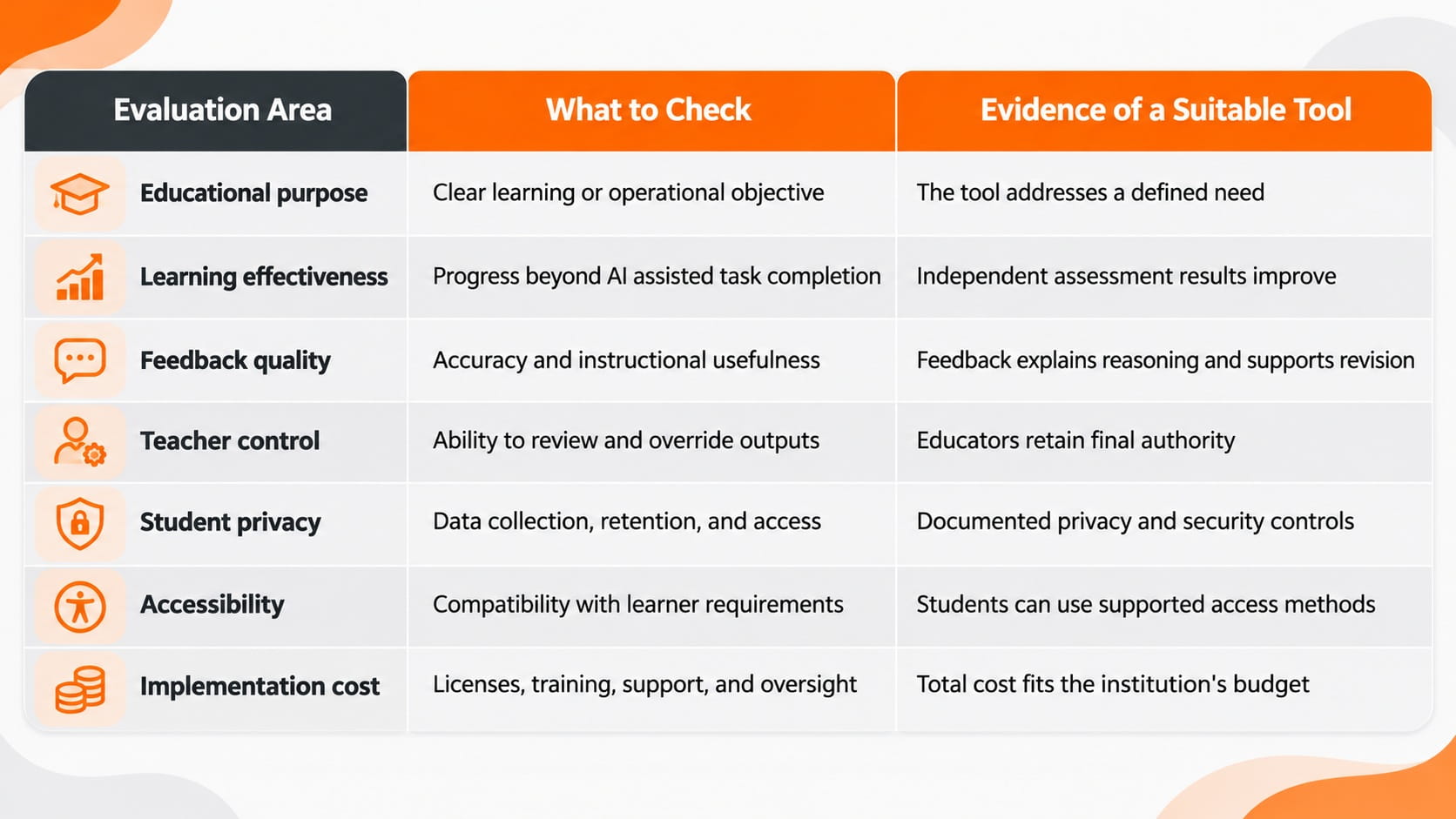
The most important criterion is evidence of effectiveness.
An attractive interface and fast response time do not establish that students learn more. Schools should examine whether improvements remain visible when students complete work without AI assistance.
A limited pilot with clear learning objectives provides more useful information than purchasing a platform solely because it advertises advanced AI capabilities.
AI in Schools and Higher Education
The educational setting changes how AI should be introduced.
Primary and secondary schools need age appropriate tools, structured activities, and close attention to student development.
For younger students, the objective is to support foundational knowledge without allowing automated systems to replace essential reading, writing, and reasoning practice.
Universities face additional demands involving independent research, complex assignments, and academic authorship.
AI in Higher Education also extends to research support, student services, course development, and academic administration.
For example, an instructor can use AI to generate preliminary discussion questions for a research methods course. Students can use approved tools to explore concepts while remaining responsible for evaluating evidence and producing original academic work.
Across both environments, institutions need policies that distinguish permitted assistance from work students must complete independently.
Those policies should reflect the educational purpose of the activity rather than treating every use of AI as equivalent.
Responsible AI Use in Teaching and Learning
Introducing artificial intelligence into education requires clear instructional expectations.
Teachers need to establish when students are allowed to use AI, what forms of assistance are acceptable, and how independent understanding will be evaluated.
A useful classroom approach is to allow AI to support preparation and feedback while preserving activities in which students must demonstrate their own knowledge.
For example, students can use AI to practice explaining a scientific concept, then complete an independent classroom exercise to demonstrate understanding.
Institutions also need teacher training. Reviewing generated material, recognizing unreliable responses, and selecting appropriate applications require skills that extend beyond writing prompts.
UNESCO's AI competency frameworks for teachers and students address the knowledge, judgment, and responsibilities needed to use these systems effectively.
Responsible use ultimately depends on educational design, human oversight, and the ability to evaluate results.
The Future of AI in Education
The future of AI in education will be shaped by how effectively technology becomes part of teaching and learning rather than how many tasks it can automate.
Adaptive learning systems, conversational tutoring, accessibility technologies, and educational analytics already demonstrate different directions for development.
The next challenge is evaluating their effects across diverse educational settings.
Schools need evidence that students retain knowledge, develop independent skills, and receive appropriate support. Teachers need systems that strengthen professional judgment rather than constrain it.
The OECD's 2026 research reinforces this distinction: educational value depends on how AI is designed and used, not simply on the availability of increasingly capable models.
The strongest educational applications will be those that connect technological capabilities with clear learning objectives and measurable outcomes.
Final Thoughts
AI in education provides practical support for teaching, learning, assessment, accessibility, and educational administration. Its applications range from guided tutoring and adaptive practice to classroom preparation and institutional analytics.
The benefits are substantial enough to warrant careful evaluation, but faster task completion should never be confused with deeper understanding.
Effective adoption starts with a clear educational objective, suitable tools, meaningful assessment, and continued human oversight. The central measure of success is not how much work AI completes, but how well students learn and educators teach.
FAQ
Can kids use AI without signing up for their own accounts?
Yes, when an educational institution provides access through an approved classroom or school managed system that does not require individual student registration. Availability depends on the provider's access arrangements, age requirements, and applicable consent rules.
Can teachers sell worksheets they made with AI?
Commercial use depends on the tool's terms, applicable copyright law, and the rights attached to any source materials. Teachers should verify commercial permissions and review the generated worksheets before distributing or selling them.
What if a student doesn't want to use AI for classwork?
The institution should review the student's concerns and determine whether an equivalent learning activity can be provided. Decisions must comply with applicable accessibility requirements and institutional policies while preserving the intended educational objectives.
Can an AI tutor help a student who's dealing with a serious personal crisis?
AI tutors are not substitutes for qualified mental health professionals or school safeguarding staff. A student reporting immediate danger, abuse, or a serious personal crisis requires appropriate human intervention through established safeguarding and emergency procedures.
Can AI translate an exam without changing its difficulty?
AI can produce an initial translation, but a qualified reviewer must check whether the translated questions preserve the original meaning, difficulty, cultural context, and assessed skills. Automated translation alone does not establish that two examination versions are equivalent.
Can AI learning tools work without an internet connection?
Some educational AI applications support offline features through locally installed software or models running directly on a device. Cloud based tutoring and generative AI services require connectivity for their online functions. Schools with limited internet access should verify offline capabilities before choosing a platform.
Can schools move student progress from one AI platform to another?
Data portability depends on the provider's export features and compatibility with the receiving platform. Schools should check whether learning records, assessment results, and progress histories can be exported in usable formats before adopting an educational AI system.
What if an AI education platform changes its model during the school year?
A model update can change the system's responses, feedback, and assessment behavior. Educational institutions should test updated versions against established learning tasks and evaluation criteria before using them for consequential academic decisions.
Can parents see what information an AI tutor collects about their child?
Access depends on the service provider, applicable privacy laws, and school policies. Educational institutions should explain what student information is collected, how long it is retained, and which procedures allow parents or eligible students to review and request corrections to those records.
What if a student says an AI tutor treated them unfairly?
The school should provide a human review process that examines the reported interaction, the system's output, and the relevant educational context. Confirmed problems should be documented and addressed through appropriate corrections, provider feedback, or restrictions on the system's use.

Fatemeh Jahangard
Technology & AI Writer at PinerookFatemeh Jahangard covers AI, emerging technologies, and digital innovation for Pinerook, focusing on how technology shapes startups and industries.
 Seen first.