Artificial intelligence startups are attracting unprecedented investor attention, but securing capital is not as simple as adding AI features to a product. Investors want to know whether a company has a genuine technical advantage, customers willing to pay, and a business model capable of supporting the cost of running its technology. These questions are especially important when training, computing, data, and infrastructure expenses can increase rapidly.
AI startup funding involves raising capital to develop, commercialize, and expand businesses built around artificial intelligence. Within the broader context of Investment Trends, this sector demonstrates how technological opportunity can attract enormous financial commitments while creating demanding expectations for founders. The amount of capital required depends heavily on whether the company develops foundation models, supplies infrastructure, or sells AI applications to customers.
This guide explains the AI funding environment in 2026, what investors examine, how to prepare a funding round, and how to calculate the financial resources an AI startup needs. It also includes a comparison of investment requirements and a practical example showing how inference costs and spending decisions affect financial runway.
What Is AI Startup Funding?
AI startup funding refers to capital raised by companies developing or commercializing artificial intelligence technologies.
Businesses may use that investment to recruit technical talent, acquire computing capacity, develop models, obtain suitable data, improve products, or expand customer operations.
The financing can come from venture capital firms, angel investors, corporate investors, grants, or other sources appropriate to the company's activities.
AI startups do not all require the same financial resources.
A company developing advanced foundation models may need substantial computing infrastructure and research expenditure before earning meaningful revenue.
A software startup that uses existing models to solve a specific business problem may require much less initial capital.
The distinction influences investment size, investor selection, financial forecasting, and the evidence founders need to present.
For investors, the central question is whether the startup can turn its technology into a valuable business while managing technical uncertainty and financial risk.
The AI Startup Funding Market in 2026
The scale of AI investment during 2026 demonstrates strong demand for companies associated with the technology.
According to Crunchbase data published on October 5, 2026, AI companies attracted approximately $102 billion in global venture investment during the third quarter.
That represented 64% of the approximately $159 billion invested across the global venture market during the period.
The United States shows even greater concentration. The PitchBook and National Venture Capital Association report for the third quarter found that AI accounted for 82.7% of American venture deal value during the first nine months of 2026.
These statistics describe different markets and measurement periods and should not be directly compared as equivalent shares.
Large funding rounds also have a substantial influence on the totals.
Crunchbase reported that 27 companies raised rounds of at least $1 billion during the third quarter. Together, these financings represented around one third of all global venture investment.
This concentration means strong AI funding totals do not necessarily indicate easy financing conditions for smaller companies.
Founders must distinguish the financing available to established technology leaders from the market for startups developing their first commercially viable products.
Which AI Startups Attract Venture Capital?
Investor expectations depend on the type of AI business, the maturity of its technology, and the financial resources required to reach commercial milestones.
Foundation Model Developers
Foundation model companies develop general purpose AI systems that can support a wide variety of applications.
Their activities may involve model training, research teams, specialized data, evaluation, and extensive computing resources.
Investors need to assess technical performance, research capability, access to infrastructure, and the financial requirements of future development.
A company may demonstrate impressive technical results while remaining far from commercial sustainability.
The investment case therefore depends on whether technical progress can support a defensible product and a credible source of revenue.
AI Infrastructure Companies
Infrastructure startups provide computing resources, model deployment systems, inference services, data processing, or other tools required to build and operate AI products.
These companies may benefit from growing demand for AI capacity.
However, infrastructure businesses can face substantial commitments related to hardware, energy, facilities, and supplier contracts.
Investors examine customer demand, capacity utilization, infrastructure economics, and the ability to finance expansion.
An infrastructure provider needs a realistic plan for converting expensive technical capacity into revenue.
Enterprise AI Applications
Enterprise AI startups use artificial intelligence to solve specific business problems.
Examples include document processing, customer support automation, workflow analysis, and specialized research tools.
These businesses may require less capital than foundation model developers, particularly when they rely on external model providers.
However, accessibility of the underlying technology creates additional competition.
Investors want evidence that customers value the complete product rather than a feature competitors can easily reproduce.
Customer retention, workflow integration, measurable business outcomes, and control over delivery costs become particularly important.
Robotics and Physical AI
Physical AI combines machine learning with robotics, industrial equipment, or systems that operate in physical environments.
These businesses often require hardware development, testing, safety procedures, and manufacturing capabilities.
Their financing requirements may be influenced by the time necessary to demonstrate reliable performance outside controlled testing conditions.
Investors need to understand technical milestones, potential customers, deployment costs, and the additional capital required to reach commercial scale.
What AI Investors Examine Before Providing Funding
AI investors typically evaluate both the commercial business and the technology supporting it.
A convincing demonstration alone is rarely sufficient because performance under controlled conditions may not reflect reliability, cost, or customer acceptance in actual use.
The following comparison shows how investment evidence changes across different AI business models.
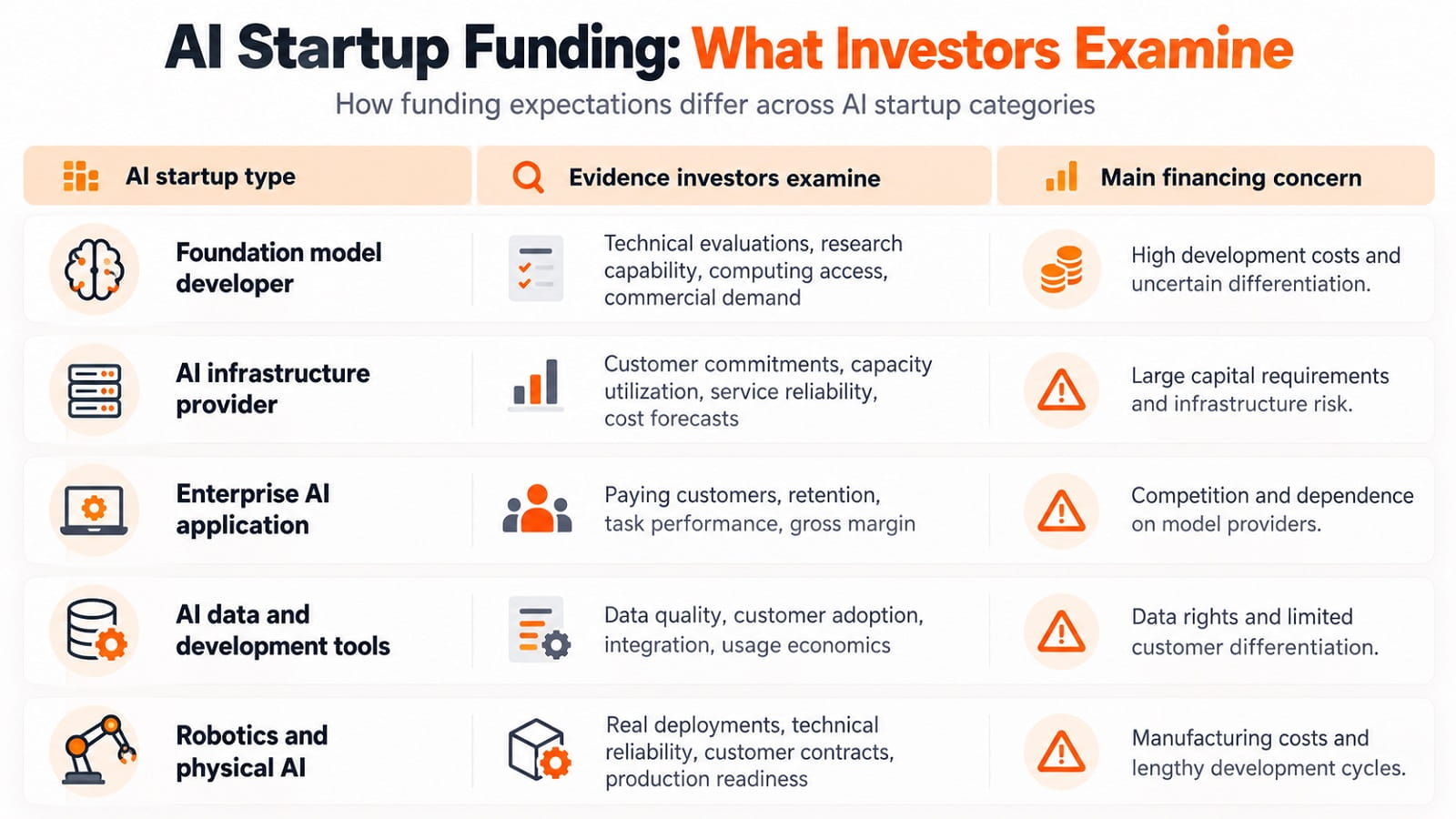
The evidence should match the company's actual stage.
An early research startup may not yet have recurring customer revenue. Investors may instead examine technical validation and the feasibility of the next development milestone.
A company already selling enterprise subscriptions should generally provide commercial performance data, including whether customers continue paying after initial deployment.
The important requirement is a clear connection between the funding requested and the evidence the company expects to produce.
How Investors Evaluate AI Product Quality
AI products create additional diligence requirements because their performance may vary across tasks, customers, and operating conditions.
Founders should show how product quality is measured and what happens when the technology produces an incorrect or unsuitable result.
Demonstrate Measurable Customer Value
The strongest evidence often comes from actual customer workflows.
A document automation company might measure processing time, the percentage of outputs requiring correction, and the cost of completing a task.
A customer support company might measure the proportion of requests resolved correctly and the frequency of human intervention.
Founders should compare results with a meaningful baseline, such as the customer's existing process.
Product usage is useful information, but measurable customer value provides stronger evidence of commercial relevance.
Test Reliability Beyond Demonstrations
A successful demonstration does not establish that an AI system will operate reliably across real customer situations.
Investors may examine evaluation datasets, error rates, monitoring procedures, and the company's process for investigating failures.
The assessment should reflect the consequences of incorrect outputs.
A minor error in an internal drafting tool may be manageable. An error affecting a financial transaction, medical workflow, or physical system may create substantially greater risk.
Founders should explain how the product handles uncertainty and when human review is required.
Explain the Technical Advantage
Using an external model does not automatically make an application unattractive.
However, investors need to understand why customers would choose it over alternatives.
A defensible advantage might come from specialized workflows, customer relationships, proprietary software, authorized access to valuable data, or superior integration.
Technical claims should be supported by evidence rather than assertions that the technology is uniquely powerful.
Why AI Unit Economics Matter
Artificial intelligence applications can have operating costs that change significantly with customer activity.
A conventional software product may serve additional users at relatively modest incremental cost.
An AI application might incur meaningful computing expenditure each time a customer generates a response, processes a document, or completes an automated task.
These costs can depend on model selection, input size, output length, processing requirements, and the amount of human review needed.
Founders should therefore understand contribution at the level of an actual customer or completed service.
Calculate the Cost of Delivering AI Services
Relevant delivery costs may include inference, cloud infrastructure, third party data, variable customer support, and other expenses directly associated with serving customers.
The gross margin calculation is:
Gross margin = (Revenue less cost of revenue) ÷ Revenue × 100
Suppose an AI application earns $400 per month from a customer and incurs $180 in direct service costs.
Monthly gross profit is $220, producing a gross margin of 55%.
However, the calculation should be updated when customer usage changes.
If direct costs increase while subscription pricing remains constant, financial contribution declines.
Investors may therefore ask founders to demonstrate how costs behave when customers use the product more intensively.
Account for Model Provider Dependence
A startup using an external AI service can face changes in pricing, availability, capabilities, or usage restrictions.
Those changes may affect product quality and delivery costs.
Founders should investigate whether alternative providers are technically and commercially viable.
A practical contingency plan may include evaluations of alternative models, usage monitoring, and architectural choices that reduce unnecessary dependence.
Provider flexibility does not eliminate technical risk, but it can make the company's operating assumptions more credible.
A Practical AI Startup Funding Example
Consider AtlasMind, a fictional enterprise AI startup selling document automation software.
The company has 200 paying business accounts, each generating $400 in monthly subscription revenue.
Monthly recognized revenue is therefore $80,000.
Its direct delivery costs total $36,000, including model inference, supporting infrastructure, variable customer support, and data services.
The company also spends $120,000 each month on operating activities outside those direct delivery costs.
Under these assumptions, gross profit is $44,000, and gross margin is 55%.
For the cash example, assume all revenue is collected during the month and all expenses are paid during that same period.
The startup begins with $1.2 million in available cash.
Management wants to understand how changes in computing expenses and commercial expansion affect its ability to continue operating before another financing round.
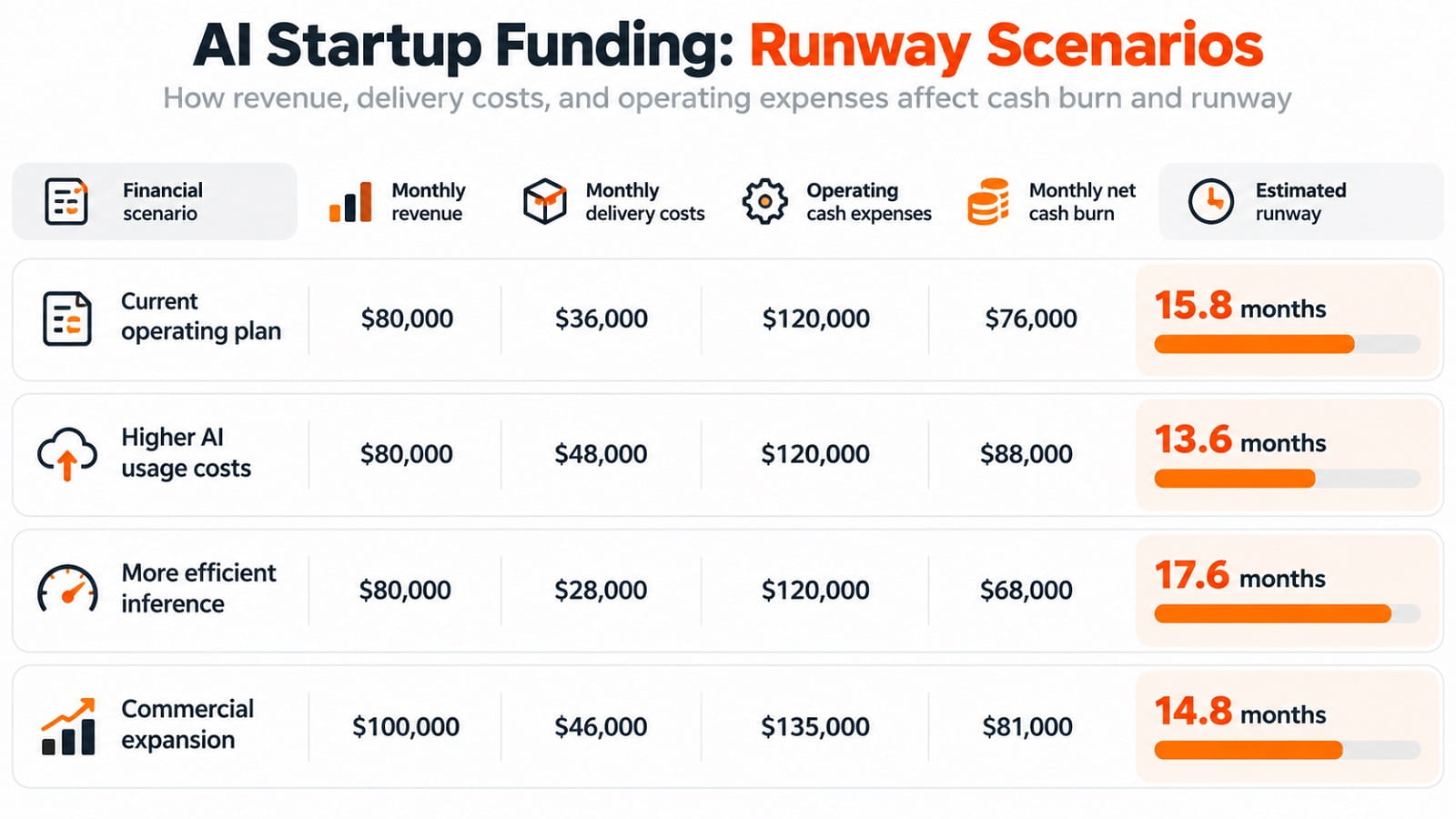
Each scenario calculates monthly net cash burn by adding delivery costs and operating cash expenses, then subtracting monthly cash receipts.
Estimated runway is calculated by dividing $1.2 million in available cash by that constant monthly net burn.
These figures are simplified planning estimates. They exclude financing transactions, capital purchases, taxes, changes in working capital, and changes in monthly customer activity.
The comparison reveals several important differences.
When AI delivery costs increase from $36,000 to $48,000 without additional revenue, monthly net cash burn rises to $88,000.
Runway declines from approximately 15.8 months to 13.6 months.
When inference efficiency improves, monthly delivery costs decline to $28,000 and runway extends to approximately 17.6 months.
The commercial expansion scenario increases revenue to $100,000 but also increases delivery and operating expenses.
Despite higher sales, runway becomes shorter than in the original operating plan.
This illustrates why investors examine whether revenue growth is supported by sustainable delivery economics.
A startup can generate additional revenue while becoming more dependent on future financing.
How Much Funding Does an AI Startup Need?
The appropriate funding amount depends on the business model, current cash resources, expected spending, and milestones the company must achieve before its next financing.
Founders should begin with a detailed forecast rather than choosing an amount based on rounds raised by prominent competitors.
A practical funding plan considers the cost of reaching the next milestone, the time required, and the cash reserve necessary if development or fundraising takes longer than expected.
For AtlasMind, the current operating assumptions imply approximately $76,000 in monthly net cash consumption.
Maintaining those assumptions for 18 months would require approximately $1.368 million in cash.
With $1.2 million already available, the difference is $168,000 before considering an additional financial buffer, future investments, or changes in operations.
This does not automatically mean AtlasMind should raise exactly $168,000.
The company needs to establish whether its next milestones require additional spending and how much cash it should preserve for uncertainty.
A credible investment request should explain these requirements individually.
How to Raise Funding for an AI Startup
Define the Commercial Problem
Begin with a clearly identified customer problem.
Investors need to understand who experiences the problem, how it is currently solved, and why the proposed AI product provides a meaningful improvement.
Technical sophistication is not a substitute for willingness to pay.
Prepare Evidence of Product Performance
Provide measurable results from relevant testing and customer deployments.
The evidence should include performance limitations and the processes used to manage incorrect outputs.
When possible, connect technical performance with customer outcomes rather than reporting model benchmarks alone.
Build a Defensible Financial Forecast
Forecast revenue using paying customers, contracts, pricing, or actual usage.
Calculate delivery costs separately and explain how inference expenditure changes under different usage conditions.
Include operating expenses, available cash, and the milestones the requested financing will support.
The forecast should distinguish observed data from management assumptions.
Select Suitable Investors
Not every venture firm finances the same category of AI startup.
Some focus on early enterprise software, while others specialize in infrastructure, scientific research, robotics, or major growth financing.
Founders should investigate relevant investment stages, typical capital commitments, technical expertise, and the investor's capacity to support future rounds.
Prepare for Technical and Commercial Due Diligence
Investors may request financial statements, customer contracts, product evaluations, data licensing records, security procedures, and information about model providers.
Founders should organize these materials before formal fundraising discussions.
Reliable documentation can make diligence more efficient and reduce uncertainty about the company's claims.
AI Startup Funding Options Beyond Traditional Venture Capital
Venture capital is important, but it is not the only possible source of financing.
Angel investment may support early development when technical and commercial uncertainty remains high.
Corporate investors may provide capital alongside access to industry expertise or potential customers.
Grants can be useful for eligible research or technical development, although they may have restrictions and may not be available for ordinary commercial activities.
Customer funded development, paid pilots, and advance commercial commitments can also reduce the amount of external capital required.
Certain infrastructure businesses may consider debt or asset financing when they have suitable assets, contracts, and repayment capacity.
However, debt creates obligations that can be unsuitable for startups without predictable cash generation.
The financing structure should reflect the company's development stage and financial risks rather than the popularity of a particular funding method.
How AI Startup Valuations Are Determined
AI startup valuations depend on investor expectations about future business performance, technical differentiation, market potential, capital requirements, and competitive risk.
A company with limited revenue may be evaluated partly through technical progress and expected market opportunities.
A business with established customers may be assessed through revenue quality, growth, margins, retention, and the resources required to expand.
High valuations in a popular sector do not automatically represent appropriate benchmarks for every company.
Founders should also distinguish valuation from the economic terms of financing.
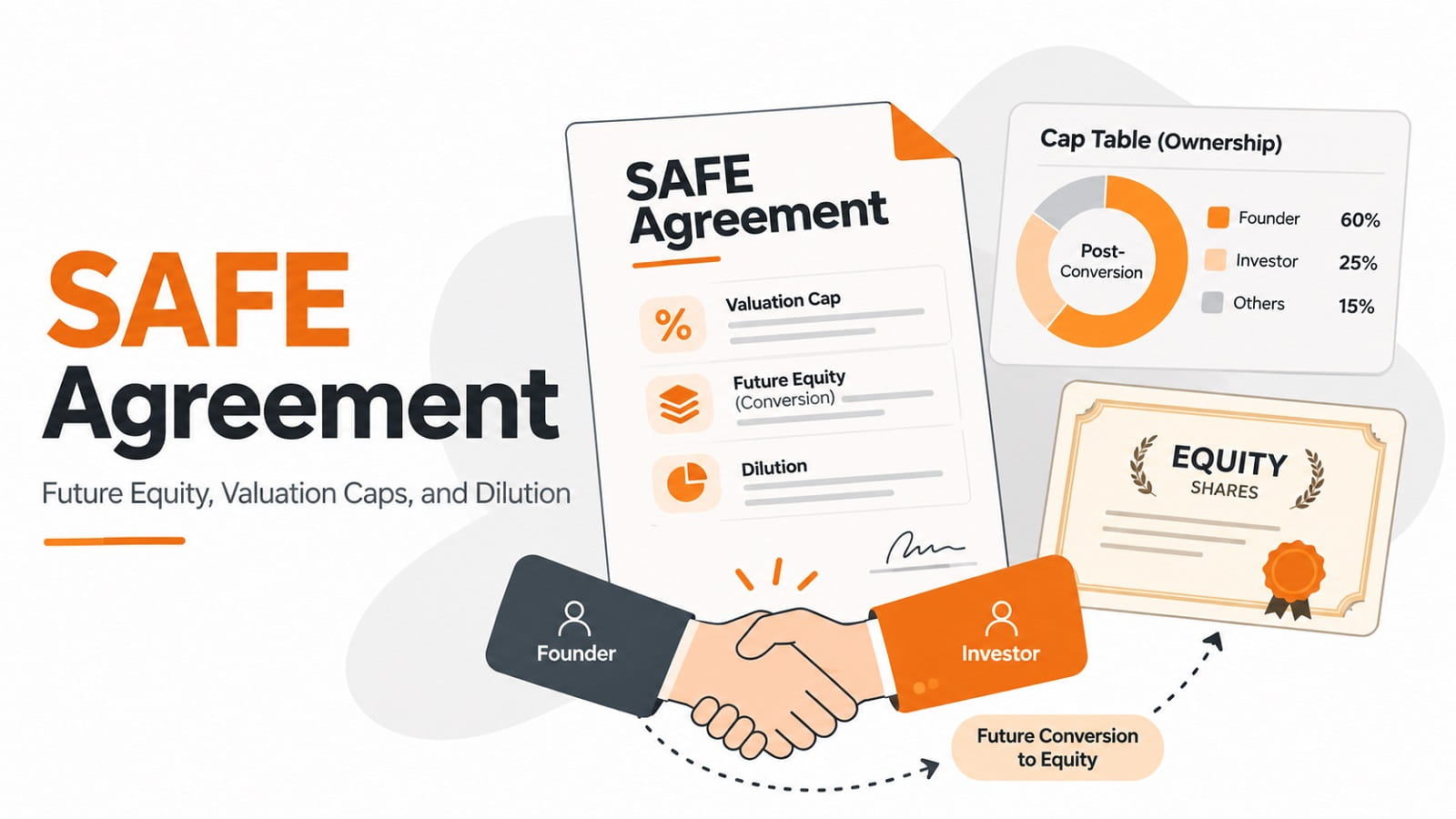
For example, a startup with a $12 million valuation before receiving $3 million in new equity capital would have a simplified valuation of $15 million afterward.
Under a basic ownership calculation, the new investment represents 20% of the company immediately after the financing.
Actual ownership may differ when option pools, convertible instruments, or other contractual terms are involved.
Founders should evaluate dilution and investor rights alongside the amount of capital raised.
Common AI Fundraising Mistakes
One common mistake is describing a business as an AI startup without demonstrating why the technology creates meaningful customer value.
Another is presenting benchmark results without showing whether the product performs reliably in actual customer workflows.
Founders may also underestimate inference and infrastructure expenditure, particularly when early development relies on promotional computing credits.
Customer forecasts become misleading when free users are treated as paying customers or temporary pilots are presented as reliable recurring revenue.
A startup can also become vulnerable when its entire product depends on one external model provider without a credible contingency plan.
Finally, raising a large amount of money does not remove the need for financial discipline.
Capital should support measurable development and commercial progress rather than spending that cannot be connected to a credible outcome.
What Happens After an AI Startup Raises Capital?
Completing a financing round creates new responsibilities.
Founders need to monitor whether the money is being used according to the operating plan and whether the expected milestones are being achieved.
For AI businesses, monitoring should include product reliability, customer adoption, recurring revenue where relevant, direct delivery costs, and available cash.
Changes in model pricing or customer usage can materially affect financial forecasts.
Management should update its assumptions when actual results differ from expectations.
Investors also need clear reporting that distinguishes technical progress, commercial performance, and future funding requirements.
The objective is to use capital to reduce important business uncertainties before additional financing becomes necessary.
Final Thoughts
AI startup funding in 2026 reflects both major technological opportunity and demanding financial expectations. Large investments in foundation models and infrastructure demonstrate confidence in the sector, but they do not establish that every AI company has an attractive business model.
Founders need to connect technical performance with customer demand, defensible differentiation, and realistic delivery costs. They also need to understand how computing expenses and operational decisions influence cash requirements.
The AtlasMind example shows that stronger sales do not automatically improve financial runway when additional activity requires greater spending.
The most credible fundraising strategy is built around evidence, measurable milestones, and an amount of capital appropriate to the company's actual development needs.
FAQ
How Do AI Startups Get Funding?
AI startups can raise capital from angel investors, venture capital firms, corporate investors, grants, and other suitable financing sources. The appropriate approach depends on technology maturity, customer evidence, capital requirements, and the company's stage.
How Much Funding Does an AI Startup Need?
There is no universal amount. Application startups using existing models may require substantially less capital than companies developing foundation models or major computing infrastructure. Founders should estimate financing needs from operational milestones and cash forecasts.
What Do Venture Capital Investors Look for in AI Startups?
Investors commonly examine customer demand, technical reliability, differentiation, delivery costs, financial performance, data rights, and the resources required to expand the business.
Can an AI Startup Raise Funding Without Revenue?
Yes. Early research and development companies may attract investment through credible technical progress, founder expertise, and clearly defined future milestones. However, the absence of revenue increases uncertainty about commercial demand.
Is Using an Existing AI Model a Disadvantage for Fundraising?
Not necessarily. A business using external models can still be attractive when it offers valuable customer workflows, meaningful differentiation, strong distribution, and sustainable economics. Dependence on model providers should be evaluated carefully.
Why Are AI Computing Costs Important to Investors?
Model inference and infrastructure costs can increase with usage. Investors need to understand whether customer revenue can cover those costs and whether the startup can maintain acceptable financial contribution as activity expands.
What Is the Best Funding Option for an AI Startup?
The best option depends on the company's financial position and development needs. Venture equity may suit businesses seeking rapid expansion, while grants, customer contracts, or strategic partnerships may support particular types of development.
Does Strong AI Funding Mean Every AI Startup Can Raise Capital?
No. Much of the reported investment is concentrated in a limited number of large transactions. Individual fundraising outcomes still depend on company quality, business evidence, investor fit, and financing conditions.

Mobina Khanki
Venture & Funding Writer at PinerookMobina Khanki covers venture capital, startup funding, fundraising, and startup finance for Pinerook, focusing on founders and investors.
 Seen first.