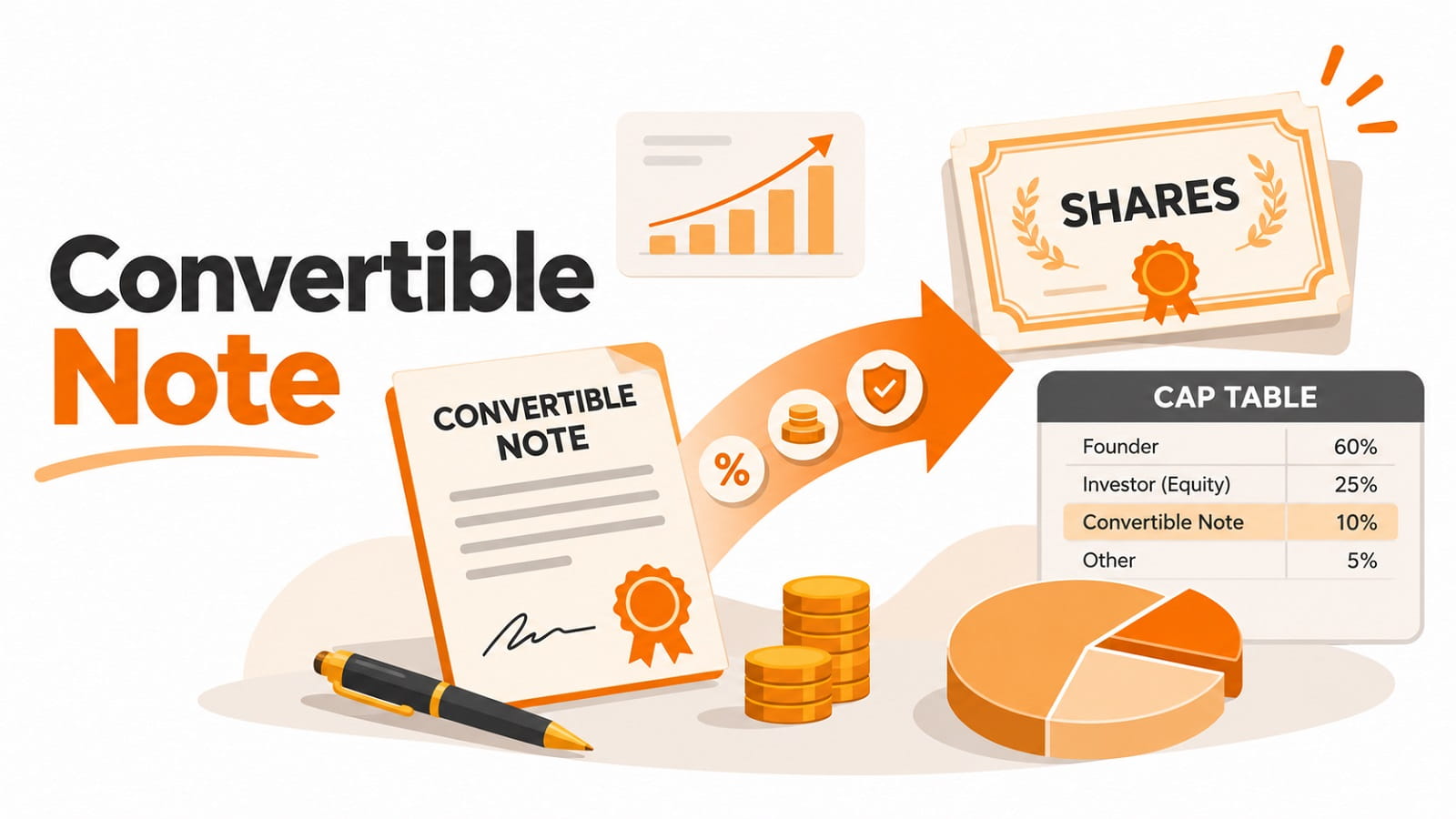
A convertible note is a debt instrument that allows a startup to raise capital today and convert the outstanding amount into equity when specified future events occur. It is commonly used during early fundraising when founders and investors want to postpone negotiating a definitive share price until a later financing round. Although this approach can simplify the initial investment, the note's interest rate, maturity date, valuation cap, and conversion discount can significantly affect future ownership.
Within Startup Debt and Alternative Funding, convertible notes occupy a distinct position because they begin as debt but may ultimately become shares in the company. Founders receive funding without immediately issuing priced equity, while investors obtain contractual terms governing how their investment converts. The arrangement can support early growth, but it also creates obligations that must be understood if the anticipated equity financing is delayed or never occurs.
This guide explains the main contractual provisions of convertible notes, the mechanics of conversion, and their effects on founder dilution. It also provides a practical financing example showing how accrued interest, valuation caps, and discounts determine the shares issued to an early investor.
What Is a Convertible Note?
A convertible note is a promissory debt instrument issued by a company to an investor with provisions allowing or requiring conversion into equity under specified circumstances. It commonly establishes an investment principal, interest rate, maturity date, and conversion conditions associated with a future priced financing.
For example, an investor may provide $300,000 to a startup before the company has negotiated a formal equity valuation. Instead of immediately issuing shares at an agreed price, the company records the investment as debt subject to the note's contractual terms.
When a qualifying equity financing occurs, the outstanding principal and applicable accrued interest may convert into shares at a price determined by the agreement. This price can be more favorable than the price paid by investors entering during the new financing round.
The financing instrument therefore postpones the final share calculation rather than eliminating it. Founders should understand that the conversion terms can create meaningful dilution even if no new shares are issued when the note is signed.
How Convertible Note Financing Works
A typical convertible note transaction begins when the company and investor agree on the investment amount and the terms governing the debt. The investor transfers funds, and the company becomes responsible for the obligations established in the note.
The instrument usually identifies events that trigger conversion, repayment, or another settlement outcome. A qualified equity financing is a common conversion event, although maturity, acquisition, and other circumstances may be addressed separately.
Issuing the Note
The company receives capital and issues the note according to the agreed investment documents. The amount advanced becomes the principal balance, while interest generally begins accruing under the specified calculation method.
Unlike a completed priced equity financing, the initial transaction does not ordinarily establish the final number of shares the investor will receive.
The company must nevertheless maintain accurate records of the outstanding debt, its contractual terms, and any interest that will be included in conversion.
Accruing Interest Before Conversion
Convertible notes commonly provide for interest to accumulate until the instrument converts or is otherwise settled. The agreement determines whether interest is simple or compounded, how it accrues, and whether payment in cash is required.
In many startup transactions, accrued interest is added to the principal amount that converts into shares. This increases the number of shares issued to the investor compared with converting the original principal alone.
Founders should avoid assuming that an interest rate has no economic impact simply because the investor does not receive regular cash payments.
Converting During a Priced Financing
When the company completes a financing that meets the note's contractual definition of a qualified financing, conversion may occur automatically.
The conversion calculation generally considers the outstanding amount and the applicable price per share. Where both a valuation cap and discount are offered as alternatives, the contractual mechanism often applies the price most favorable to the investor.
The company then issues the appropriate shares and settles the converted debt according to the agreement. The exact security issued, associated preferences, and treatment of accumulated interest depend on the transaction documents.
The Main Terms of a Convertible Note
The economic outcome of a convertible note depends on several provisions that operate together. A founder should evaluate the full contract rather than concentrating exclusively on the investment amount or valuation cap.
Principal and Interest Rate
The principal is the original amount advanced to the company. Interest increases the outstanding obligation over time according to the agreed rate and calculation method.
For example, a $300,000 note accruing simple interest at 6% annually generates $18,000 in interest over one year. If the note converts after 18 months, the accumulated simple interest would be $27,000.
This produces a total conversion amount of $327,000, assuming no additional payments or adjustments.
Maturity Date
The maturity date establishes when the debt becomes due or becomes subject to another contractual outcome. Notes are frequently structured around the expectation that a subsequent financing will occur before this date.
If no qualifying financing takes place, the agreement may provide for repayment, extension, investor election to convert, or other negotiated treatment.
Founders must review these alternatives before signing. A company may have limited liquidity at maturity even if its business is progressing commercially.
Valuation Cap
A valuation cap establishes a contractual ceiling used to determine the conversion price. It protects early investors from having their investment converted solely at a substantially higher valuation established during a later financing.
For instance, a note with an $8 million valuation cap may convert at a lower effective price than investors pay in a round priced using a $12 million valuation.
The precise calculation depends on how the agreement defines company capitalization and the valuation basis. A valuation cap should not be interpreted as automatically establishing the startup's current market value or guaranteeing the investor a fixed ownership percentage.
Conversion Discount
A conversion discount reduces the price per share used for the early investor relative to the new financing price.
If a financing round issues shares at $3.00 each and the note provides a 20% discount, the discounted conversion price is $2.40 per share.
Where both cap and discount mechanisms exist, founders must determine how the agreement selects the applicable conversion price. They should not automatically apply the discount to the already reduced cap price unless the contract explicitly requires that treatment.
Key Convertible Note Terms Founders Should Review
A convertible note's legal and financial provisions determine when the investment converts, how many shares are issued, and what happens if the company cannot complete the expected financing.
The following table summarizes the principal contractual elements and the corresponding review priorities for startup founders.
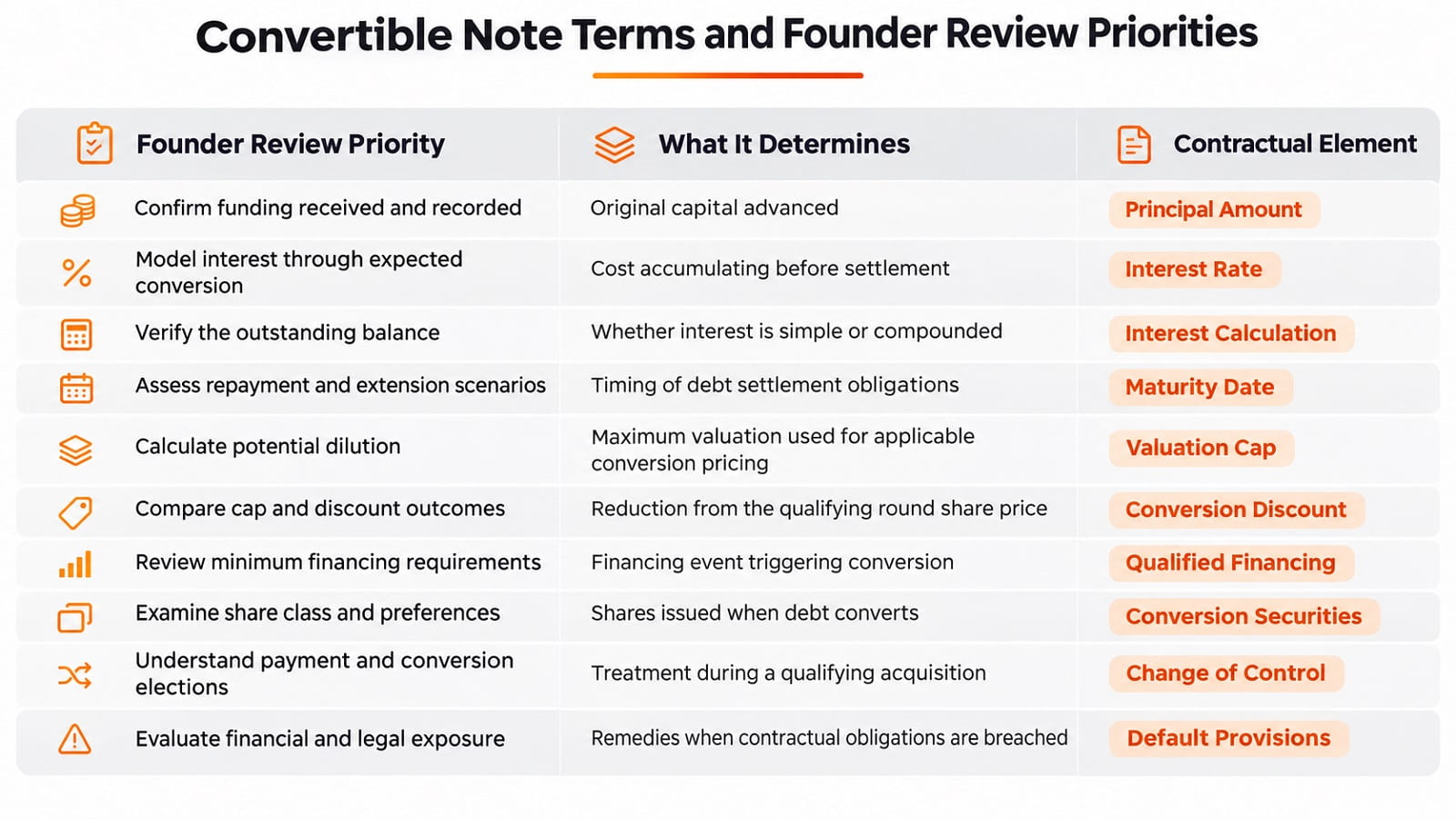
These provisions should be evaluated as a connected set of obligations. A low valuation cap may create substantial dilution even when the interest rate appears modest, while a distant maturity date can reduce immediate repayment pressure without eliminating the underlying debt. Founders should model the note's expected conversion and its alternative outcomes before agreeing to the investment.
A Practical Convertible Note Conversion Example
Consider Horizon Labs, a fictional software startup that raises $300,000 through a convertible note while developing its first commercial product. The company expects to complete a priced equity financing after demonstrating stronger customer demand.
The note carries 6% annual simple interest, an $8 million valuation cap, and a 20% conversion discount. For this example, assume the qualified financing occurs 18 months after issuance.
At that time, Horizon negotiates a new financing valued at $12 million before the new capital is invested. For the simplified calculation, assume the company has 4 million existing shares on the agreed pricing basis, producing a new investor share price of $3.00.
The illustration excludes option pool adjustments, other convertible instruments, financing expenses, and capitalization adjustments that may affect real transactions.
Calculating Principal and Accrued Interest
The investor originally provided $300,000. At 6% simple annual interest over 18 months, accrued interest equals $27,000.
The amount available for conversion is therefore $327,000, assuming the agreement provides for conversion of both principal and accumulated interest.
The company must then determine the applicable conversion price using the contract's valuation cap and discount provisions.
Comparing the Discount and Valuation Cap
The new financing price is $3.00 per share. Applying the 20% discount produces a conversion price of $2.40.
Under the example's simplified capitalization assumptions, the $8 million valuation cap divided by 4 million existing shares produces a cap conversion price of $2.00.
If the agreement provides for the lower of these two alternative prices, the cap price applies because it gives the investor more shares for the same outstanding balance.
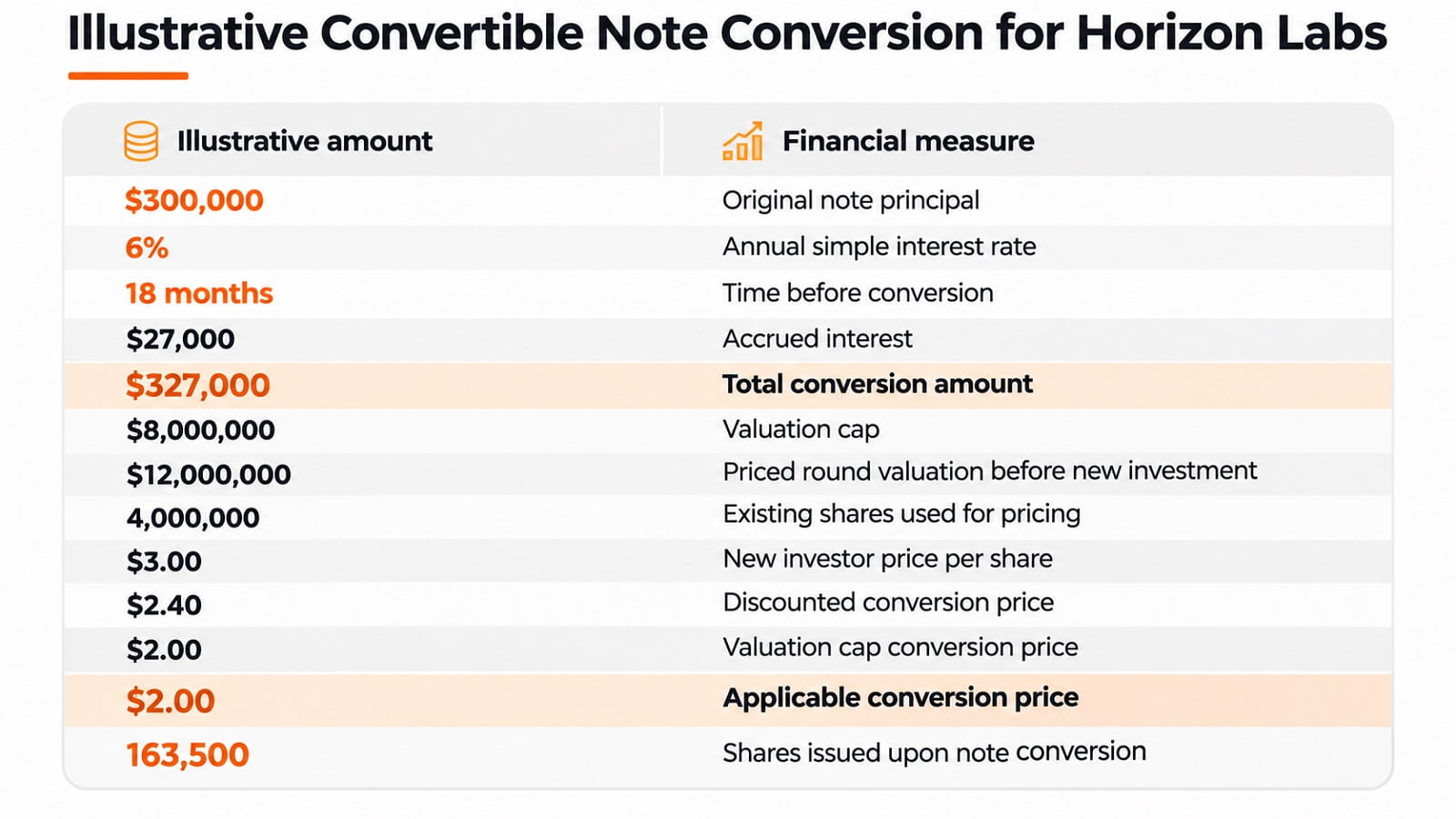
Under these assumptions, Horizon issues 163,500 shares to the noteholder by dividing the $327,000 conversion amount by the applicable $2.00 price. If the same amount were converted at the discounted price of $2.40, it would produce 136,250 shares instead. The valuation cap therefore provides the investor with 27,250 additional shares in this illustration. Actual contracts may define capitalization and share classes differently, so the definitive calculation must follow the signed financing documents.
How Conversion Affects Founder Ownership
Suppose Horizon raises $3 million from new investors at the stated $3.00 share price. This would create 1 million additional shares under the simplified assumptions.
Adding the 163,500 shares issued to the noteholder produces 5,163,500 total shares after the financing, assuming there are no other share issuances.
The noteholder would own approximately 3.17% of that total, while the existing 4 million shares would represent approximately 77.47%.
These percentages are illustrative rather than a universal cap table formula. In an actual priced round, conversion calculations may be affected by the treatment of convertible securities in the valuation, option pool increases, other notes, and different fully diluted share definitions.
The main lesson is that postponing share pricing does not eliminate dilution. Conversion terms determine how much ownership is transferred when the future financing occurs.
What Happens When a Convertible Note Reaches Maturity?
A maturity date can create financial and negotiating pressure if the startup has not completed the anticipated equity financing.
Depending on the agreement, the outstanding principal and interest may become payable, the investor may have a conversion option, or the parties may negotiate an extension.
An extension can provide additional time, but it may also involve revised financing terms, further interest accrual, or investor conditions.
Founders should review maturity outcomes before issuing the note rather than assuming investors will automatically agree to extensions.
Repayment at Maturity
When the note requires repayment and no conversion or extension applies, the company may need sufficient cash to settle the outstanding obligation.
This can be challenging for a startup that has invested its available capital in product development and commercial growth.
A company should therefore forecast its possible outstanding debt balance at maturity and assess whether repayment would be feasible without relying on an uncommitted future investment.
Extending the Note
The company and noteholders may agree to extend the maturity date, subject to contractual amendment procedures.
An extension may preserve operating flexibility, but founders should evaluate the additional interest and any amendments to conversion economics.
If several investors hold separate notes, obtaining the necessary approvals may be more complicated than negotiating with one investor.
Conversion Without a Qualified Financing
Some agreements provide alternative conversion arrangements when maturity arrives without a qualifying investment round.
The conversion price, security class, investor elections, and approval requirements depend on the note's wording.
Founders should not assume that reaching maturity automatically converts every note into ordinary shares. The legal outcome must be established by the relevant contract.
Convertible Notes and Founder Dilution
The ownership consequences of convertible debt become particularly important when multiple notes are outstanding.
A startup may issue notes at different times with different caps, discounts, and interest rates. Each instrument can produce a distinct conversion price and number of shares.
This increases the importance of maintaining an accurate capitalization model before negotiating a priced financing.
Management should model expected ownership under multiple potential valuations, including outcomes where the valuation cap applies and those where the discount produces the lower price.
The company should also identify any most favored nation provisions that may allow eligible investors to adopt specified more favorable terms issued later.
Such provisions can change expected conversion economics and should be reviewed before additional notes are issued.
When Convertible Notes Make Sense for Startups
Convertible notes may be appropriate when a company needs capital before it is ready to negotiate a priced equity round.
They can help founders complete a financing with fewer immediate valuation negotiations while giving investors an established mechanism for receiving equity later.
This can be useful when the company expects to achieve a meaningful milestone before raising a larger round, provided the expected timing is credible.
However, the arrangement may be less suitable when a company has no reasonable prospect of completing a qualified financing before maturity and lacks resources to manage alternative settlement obligations.
Founders should also evaluate whether the benefits of faster execution justify additional interest accrual, legal complexity, and deferred ownership uncertainty.
The appropriate instrument depends on the company's financial circumstances, investor expectations, and broader fundraising strategy.
Negotiating a Convertible Note Agreement
The valuation cap is often a central negotiating issue because it can materially influence conversion pricing. A lower cap generally favors the noteholder when the cap determines the applicable price.
Founders should negotiate the cap using a realistic understanding of potential future valuations and expected dilution.
Interest and maturity provisions deserve equal attention. A modest interest rate can still increase dilution over time, while an approaching maturity date may create pressure to negotiate with investors when the company has limited liquidity.
The definition of qualified financing should be sufficiently clear to establish when automatic conversion occurs. Founders should also review the treatment of smaller financing rounds that do not meet the threshold.
Other important matters include changes of control, default provisions, amendment procedures, payment rights, and the type of shares issued upon conversion.
Before signing, the company should prepare a capitalization model showing the consequences of the proposed terms under several financing outcomes.
Common Convertible Note Mistakes
A frequent mistake is assuming that a convertible note avoids dilution because no priced shares are issued immediately. The dilution is deferred until conversion, and unfavorable terms can transfer more ownership than founders initially expect.
Another mistake is treating the valuation cap as a guaranteed future company valuation. It is a contractual pricing mechanism rather than an independent valuation of the business.
Founders may also overlook accumulated interest when estimating the number of shares issued. If the interest converts with the principal, the conversion amount increases as time passes.
A further problem arises when several notes are issued using inconsistent capitalization definitions or conversion terms. These differences can complicate the next financing and create disagreements about share allocations.
Finally, failing to plan for maturity can leave the company negotiating under financial pressure. A credible fundraising plan should include alternative outcomes if the expected equity round is delayed.
Final Thoughts
Convertible notes allow startups to raise capital while postponing the final pricing of an equity investment. Their usefulness depends on understanding that the initial debt can produce future ownership dilution and may create repayment obligations if expected financing events do not occur.
Founders should evaluate interest, maturity, valuation caps, discounts, and alternative settlement provisions as connected parts of the agreement. A well prepared capitalization model can help explain the ownership consequences before the company accepts funding.
The strongest convertible note arrangement supports a realistic financing plan while giving the startup sufficient flexibility to manage delays and changing business conditions.
FAQ
Is a Convertible Note Debt or Equity?
A convertible note begins as debt and may convert into equity when specified contractual events occur. Before conversion, the investor generally holds a debt claim rather than the shares that may be issued later.
Do Convertible Notes Have Interest?
Convertible notes commonly accrue interest. The agreement determines the rate, calculation method, and whether accrued interest converts into shares or is otherwise settled.
What Is a Valuation Cap in a Convertible Note?
A valuation cap establishes a maximum valuation used for calculating a qualifying conversion price. It can allow investors to receive shares at a lower price than new financing participants.
How Does a Convertible Note Discount Work?
A discount reduces the new financing share price by an agreed percentage. For example, a 20% discount applied to a $3.00 share price produces a $2.40 conversion price.
What Happens if a Startup Never Raises Another Round?
The outcome depends on the agreement. The company may face repayment obligations, negotiate an extension, or follow an alternative conversion mechanism established by the note.
Can a Convertible Note Dilute Founders?
Yes. When the outstanding amount converts into equity, additional shares are issued. The resulting dilution depends on conversion pricing, accrued interest, and the company's capitalization.
Can Convertible Notes Convert During an Acquisition?
Some agreements establish specific payment or conversion rights following a change of control. The outcome depends on the contractual provisions and the circumstances of the acquisition.
Is a Convertible Note Suitable for Every Startup?
No. Convertible notes are most relevant when founders and investors can accept deferred equity pricing and the company has a credible plan for managing conversion or maturity obligations.

Mobina Khanki
Venture & Funding Writer at PinerookMobina Khanki covers venture capital, startup funding, fundraising, and startup finance for Pinerook, focusing on founders and investors.
 Seen first.