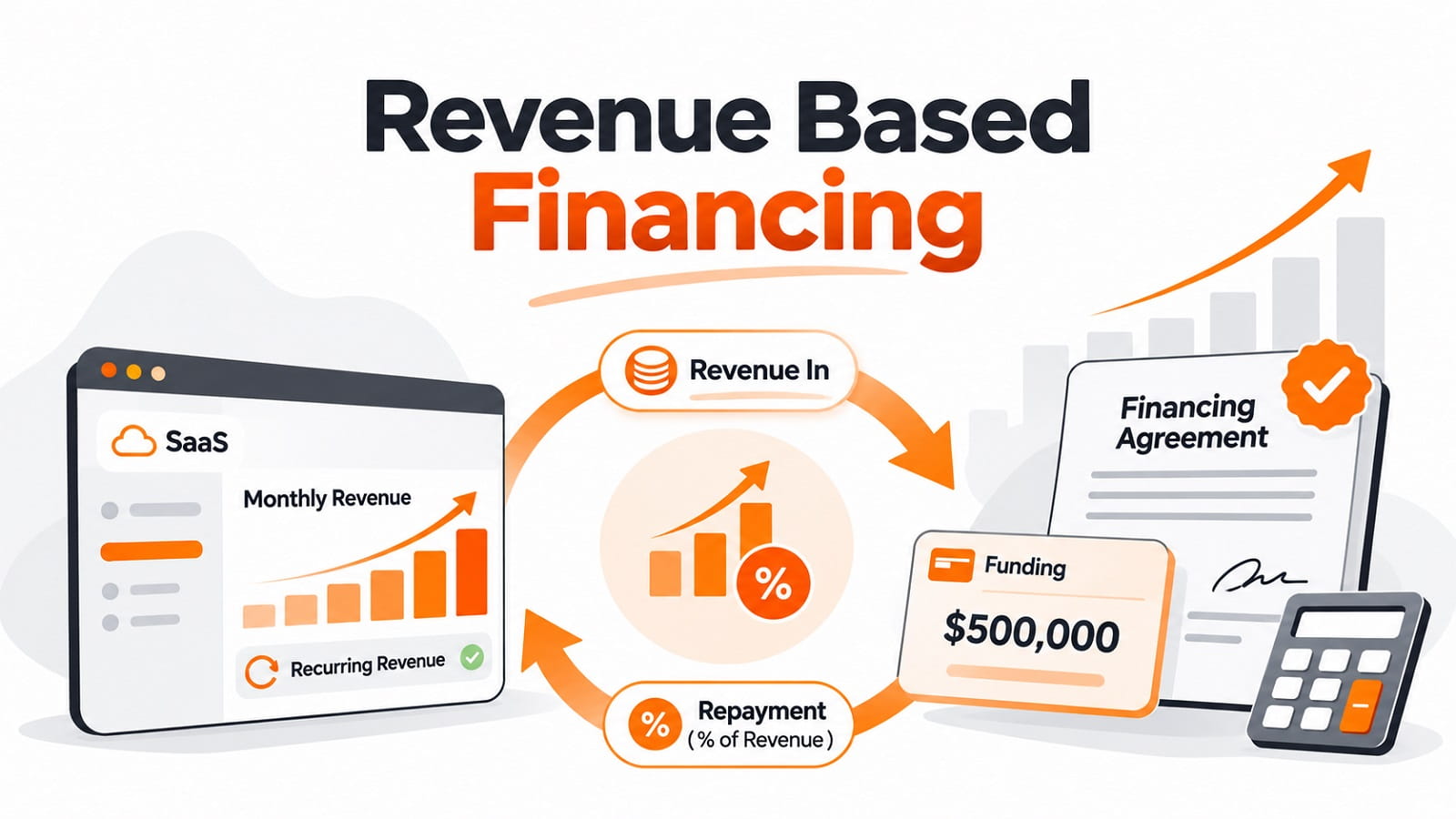
Revenue based financing allows startups to raise capital in exchange for a contractual percentage of future business revenue rather than issuing equity or committing to a conventional fixed loan installment. Payments generally increase when revenue grows and decrease when collections weaken, continuing until a specified repayment amount has been reached. This structure can appeal to companies with established customer demand, but its financial value depends on revenue predictability, operating margins, and the actual terms of the agreement.
Within Startup Debt and Alternative Funding, revenue based financing provides an alternative for founders who want to fund commercial growth while retaining ownership. Unlike traditional lending, many arrangements calculate payments using a defined share of revenue instead of a fixed monthly amortization schedule. However, a financing structure that adjusts to sales performance can still create significant financial pressure when the company has low margins or substantial operating expenses.
This guide explains the mechanics of revenue based financing, how providers assess businesses, and how repayment caps affect the total cost of capital. It also follows a fictional software company through different revenue scenarios to demonstrate how payment flexibility interacts with profitability, available cash, and the time needed to complete repayment.
What Is Revenue Based Financing?
Revenue based financing, commonly abbreviated as RBF, is a financing arrangement in which a company receives capital and agrees to make payments calculated as a percentage of specified future revenue or receipts. Payments typically continue until the provider has received an agreed total amount, often expressed as a multiple of the original funding.
For example, a company might receive $200,000 and agree to pay 6% of qualifying monthly revenue until cumulative payments reach $270,000. The company would pay more during periods of strong sales and less when qualifying revenue declines, assuming the contract contains no minimum payment requirement that overrides the percentage calculation.
This makes the timing of repayment dependent on business performance. Unlike a conventional installment loan, there may be no identical payment due each month. Nevertheless, some agreements include minimum remittances, repayment deadlines, or other provisions that limit flexibility.
The legal structure also varies. An agreement may constitute a loan, a purchase of future receivables, or another contractual financing arrangement. Its legal classification and associated protections depend on the actual documents and applicable jurisdiction, not merely the label used by the provider.
How Revenue Based Financing Works
Most arrangements involve three essential financial elements: the amount advanced, the percentage of qualifying revenue allocated to repayments, and the total repayment obligation.
The company receives funds after satisfying the provider's underwriting requirements. Once repayment begins, the provider calculates the agreed percentage using the revenue definition established in the contract.
Funding Amount and Revenue Share
The funding amount represents the initial capital provided to the company. The revenue share determines how much of the business's qualifying revenue is allocated to repayments during each calculation period.
If the company collects $100,000 in qualifying monthly revenue and the agreed percentage is 6%, the resulting payment is $6,000. If qualifying revenue falls to $70,000, the percentage calculation produces a payment of $4,200.
The agreement must establish exactly which receipts count toward repayment. Gross sales, net revenue, payment processor settlements, refunds, taxes, and customer credits may receive different treatment depending on the contractual definition.
Founders should not assume that accounting revenue and the amount measured by the financing provider are identical. Differences in recognition methods, payment timing, and contractual exclusions can affect actual cash deductions.
Repayment Caps and Funding Multiples
Many providers establish a maximum cumulative repayment amount using a contractual multiple.
For example, a financing arrangement with an advance of $200,000 and a repayment multiple of 1.35 requires total payments of $270,000 under the simplified structure. The difference of $70,000 represents the financing charge before considering additional fees.
The repayment multiple helps founders calculate the total nominal amount owed, but it does not establish the equivalent annual financing rate.
The time required to complete repayment matters because a financing provider receiving $270,000 over one year earns a different annualized return from a provider receiving the same amount over three years.
Founders should evaluate both the cumulative payment amount and the expected timing of those payments.
Revenue Reporting and Payment Collection
Financing providers may request access to bank statements, accounting information, subscription billing records, or payment processor data.
Some agreements provide for automatic collection based on daily, weekly, or monthly receipts. Others require periodic revenue reporting followed by a reconciliation of the amount due.
The reporting method should be consistent with the contractual revenue definition. Founders should understand how corrections, refunds, disputed transactions, and delayed payments affect calculations.
Collection procedures also matter because funds deducted automatically may become unavailable for payroll, supplier payments, or other essential operating requirements.
Which Startups Qualify for Revenue Based Financing?
Revenue based financing generally depends on evidence that the business already generates meaningful and reasonably predictable revenue. Providers need sufficient information to estimate future collections and assess the likelihood that contractual payments can be completed.
The exact eligibility requirements vary between financing providers, industries, jurisdictions, and transaction sizes.
Revenue Stability and Customer Retention
Businesses with recurring customer payments can provide useful evidence of revenue consistency. Subscription software companies, established digital service providers, and certain online businesses may be able to demonstrate predictable collection patterns.
However, recurring revenue does not guarantee reliable cash flow. Customer cancellations, payment failures, contract concentration, and seasonal demand can materially affect the amount collected.
Providers may examine historical monthly revenue, customer retention, growth trends, and the proportion of revenue generated by major customers.
A company dependent on a single large client may present different repayment risks from one with a diversified customer base, even if both report similar annual revenue.
Gross Margins and Operating Expenses
Gross margin is important because revenue based payments are commonly calculated before the company has covered all operating costs.
A business with strong gross margins may have enough financial room to allocate a percentage of revenue toward financing. A company with expensive fulfillment, infrastructure, or production requirements may find the same percentage much harder to manage.
Providers may therefore examine the relationship between sales, direct costs, recurring expenses, and available liquidity.
Founders should calculate how much cash remains after essential operating commitments rather than evaluating affordability solely through reported revenue growth.
Business History and Financial Records
A provider may request several months of bank statements, accounting records, revenue reports, or payment processor history.
The company may also need to disclose outstanding financing obligations, major contractual commitments, and anticipated changes in revenue.
Some providers use automated underwriting based on connected financial data, while others require a detailed commercial and financial review.
A startup should understand the data access permissions requested and whether the agreement permits continuing access after the financing has been completed.
Key Terms in a Revenue Based Financing Agreement
The commercial attractiveness of revenue based financing depends on more than the advertised percentage of revenue. Contractual definitions determine which receipts are included, how long repayment continues, and what happens if company performance changes.
The following table identifies the principal provisions founders should review before accepting an offer.
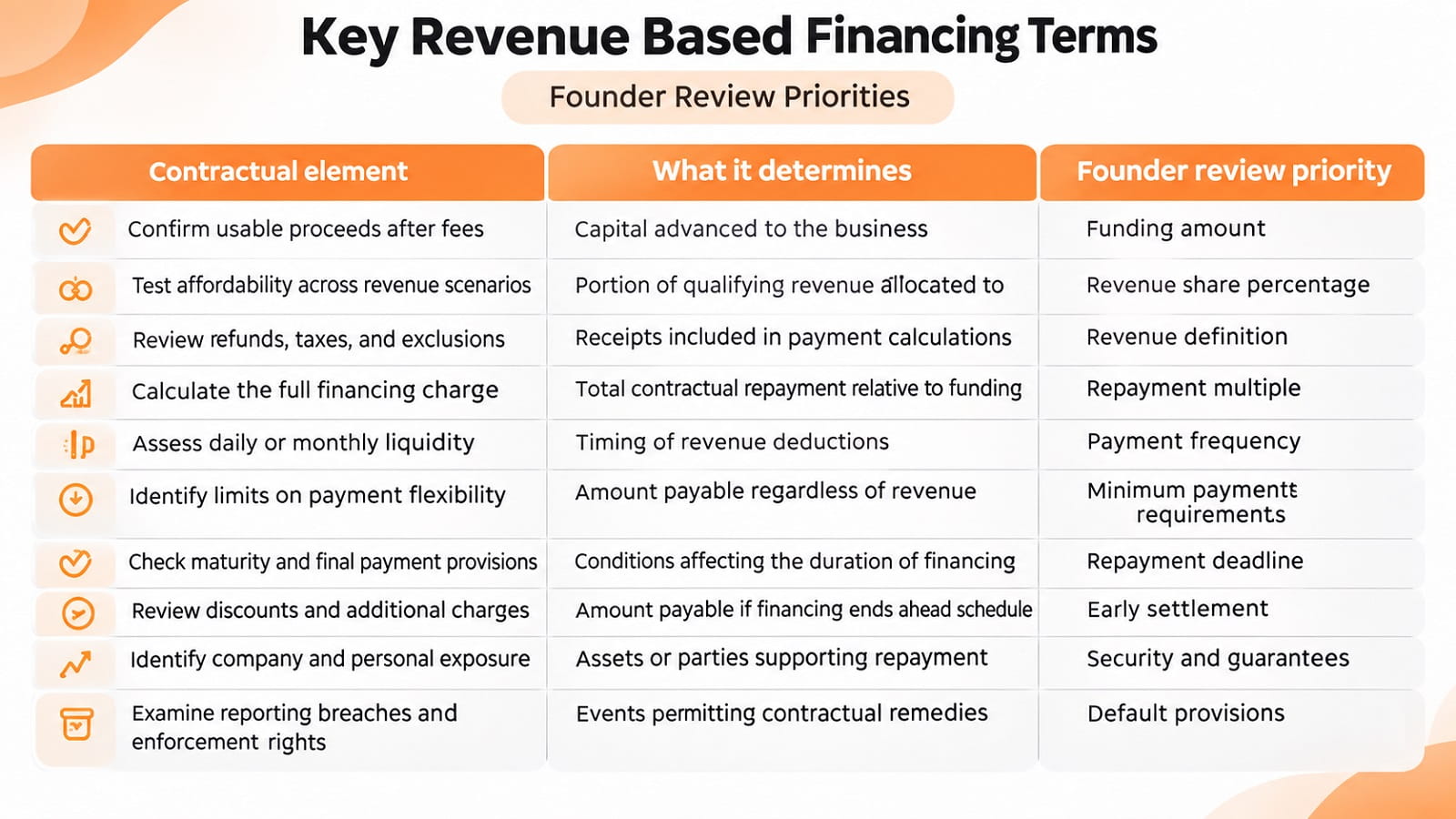
The economic effect of these provisions becomes clearer when they are reviewed together. A lower revenue share can reduce immediate payment pressure but extend the repayment period, while a lower repayment multiple may still represent expensive financing if the obligation is settled quickly. Minimum payments and contractual deadlines can also change how flexible an arrangement remains during weak trading periods. Founders should model the agreement using its complete terms rather than relying on the headline repayment percentage.
How Much Does Revenue Based Financing Cost?
The cost of revenue based financing is commonly described using a repayment multiple or fixed financing charge. However, founders should distinguish the amount they ultimately pay from the annualized cost of receiving capital.
Suppose a startup obtains $180,000 with a repayment multiple of 1.35. The total contractual payment would be $243,000, producing a financing charge of $63,000 before additional fees.
The nominal charge represents 35% of the original advance. It does not mean the annual percentage rate is 35%, because the company gradually returns capital throughout the repayment period.
Why Repayment Speed Changes the Effective Cost
When revenue grows quickly, payments calculated as a percentage of revenue become larger. The financing provider receives the contracted amount sooner, which can increase the effective annualized cost even though the nominal repayment cap stays unchanged.
Slower revenue growth generally extends repayment under a purely variable arrangement. This may reduce the annualized financing cost, but the business remains subject to the revenue sharing obligation for longer.
To compare financing offers accurately, founders should model the dates and amounts of expected payments. An appropriate annualized return calculation, reflecting the actual cash flows, provides more information than dividing the financing charge by the original advance.
Additional fees, minimum remittances, and contractual settlement requirements must also be included. Otherwise, the estimated financing cost may understate what the business will actually pay.
The Impact of Gross Revenue on Affordability
Revenue based payments can be particularly demanding when they are calculated using gross receipts instead of profit.
Consider a company generating $100,000 in monthly revenue with a gross margin of 65%. Its gross profit is $65,000 before additional operating expenses.
A 6% revenue share produces a $6,000 payment. Although this represents a modest proportion of sales, it consumes approximately 9.2% of the company's gross profit.
If operating expenses are already high, the financing payment may absorb much of the remaining cash. Founders should therefore evaluate the percentage relative to available operating cash, not only total revenue.
A Practical Revenue Based Financing Example
Consider BrightPath Software, a fictional subscription software company that wants to expand its sales operations and improve customer onboarding.
The company currently generates $100,000 in monthly customer receipts. Its gross margin is approximately 65%, and it spends $52,000 per month on operating expenses beyond direct service delivery costs.
BrightPath receives an illustrative financing offer with the following conditions: an advance of $180,000, a revenue share of 6%, and a repayment multiple of 1.35. Assume payments are calculated from monthly customer receipts and that there are no additional fees, minimum payments, or fixed repayment deadlines.
Under these assumptions, BrightPath must remit a cumulative $243,000 before its revenue sharing obligation ends.
Comparing Different Revenue Scenarios
Management wants to understand how the financing affects cash flow if revenue declines, remains stable, or increases.
The following table compares three hypothetical monthly revenue levels. It assumes that the gross margin remains at 65% and fixed operating expenses stay at $52,000 across all scenarios.
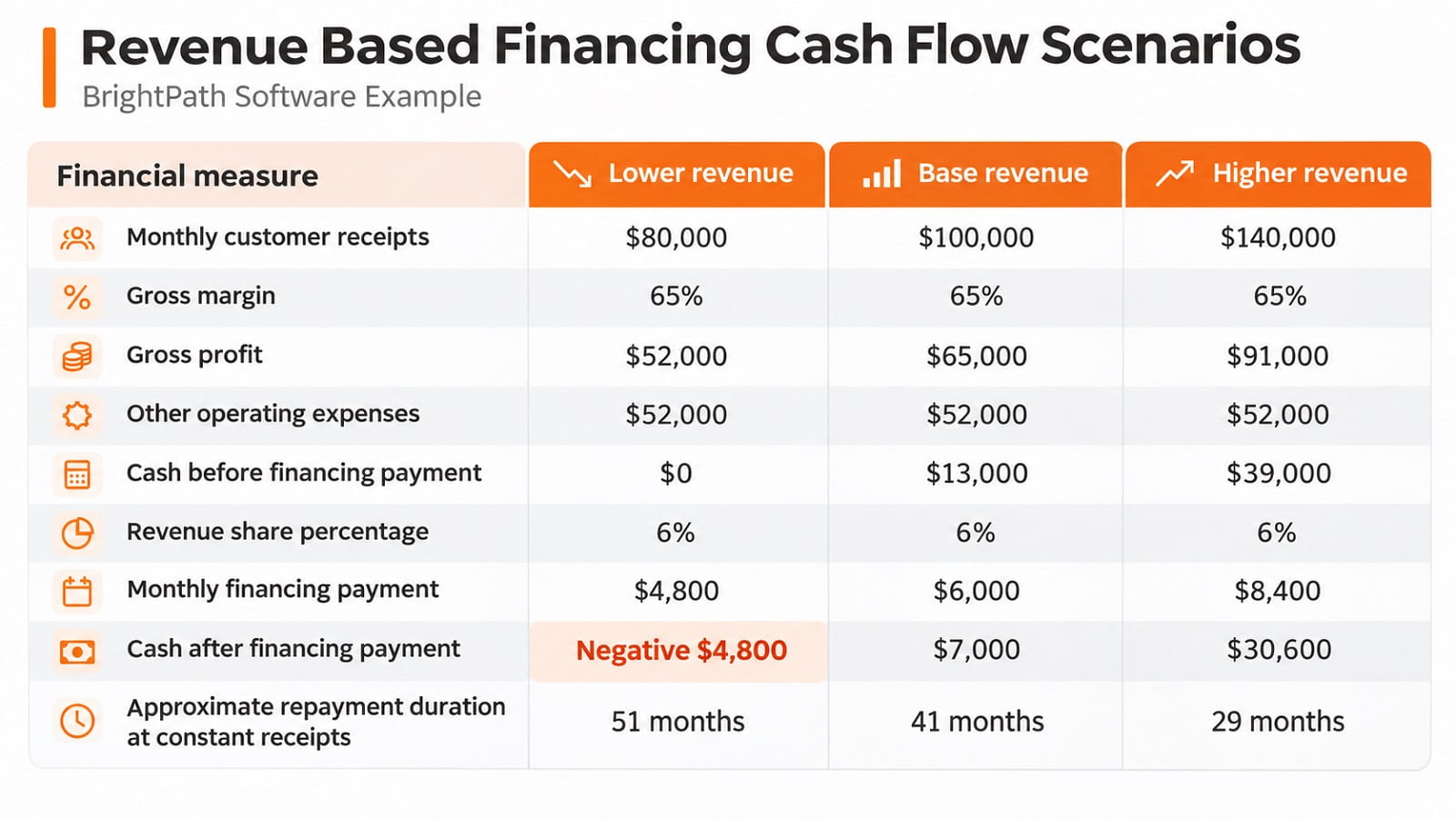
The comparison demonstrates that payment flexibility does not guarantee financial sustainability. At the lower revenue level, BrightPath's financing payment declines to $4,800, but operating expenses already consume its entire gross profit. The company would therefore experience a monthly cash shortfall despite the smaller payment. In the higher revenue scenario, the company can support a larger financing payment while retaining substantially more cash. Repayment duration estimates assume constant receipts throughout each scenario and a smaller final payment when the contractual cap is reached.
What Happens if Revenue Falls?
Suppose BrightPath experiences a prolonged reduction in customer renewals and monthly receipts decline from $100,000 to $80,000.
The financing payment falls from $6,000 to $4,800 under the assumed contractual formula. However, the company's gross profit also falls, while fixed operating expenses remain unchanged.
This illustrates a central risk of revenue based financing: the provider's payment may adjust to revenue, but the company's other expenses may not.
Management would need to reduce costs, improve collections, or use existing reserves to cover the shortfall. A lower financing payment does not eliminate the underlying operating problem.
What Happens if Revenue Grows Quickly?
Now assume BrightPath increases monthly receipts to $140,000 while preserving its gross margin and operating expense structure.
Its financing payment rises to $8,400, but monthly cash remaining after the payment increases to $30,600. Under the constant revenue assumption, the company would complete repayment in approximately 29 months.
Faster repayment ends the revenue sharing obligation earlier. However, it also means the provider receives the agreed financing charge over a shorter period.
BrightPath should compare that outcome with other available financing offers using their full projected cash flows. The repayment multiple alone does not establish which option is cheaper on an annualized basis.
Revenue Based Financing vs Traditional Business Loans
A conventional business loan generally includes a defined principal balance, interest charges, and an agreed repayment schedule. Revenue based financing instead links payments to qualifying business receipts, although some contracts add minimum payments or deadlines.
The difference matters when revenue fluctuates. Fixed loan installments can create pressure during weaker trading periods, while a variable revenue share can reduce the required payment under the agreed formula.
However, conventional lending may provide a lower overall financing cost for a business with strong creditworthiness and reliable cash generation. Revenue based financing can be more accessible for some growing companies, but that advantage should not be assumed for every applicant.
The appropriate choice depends on affordability, repayment timing, guarantees, security, and the company's anticipated revenue pattern. Founders should compare actual offers instead of assuming one financing category is inherently superior.
Revenue Based Financing vs Equity Investment
Revenue based financing generally does not require founders to issue ordinary equity ownership to the provider. This can be attractive when management wants to preserve its capitalization structure and avoid introducing additional shareholders.
Equity investment operates differently. Investors receive an ownership interest and typically accept uncertainty about when or whether the company will generate a return.
The difference is particularly important for businesses with limited operating cash. Equity financing does not ordinarily require the company to allocate a contractual percentage of monthly revenue to investor repayment.
Revenue based financing may therefore be suitable for commercial expansion supported by reliable receipts, while equity can be more appropriate for uncertain development activities that will not generate revenue for an extended period.
These are financial considerations rather than universal rules. The company should compare ownership consequences with cash obligations and assess whether its business model can support the proposed arrangement.
When Revenue Based Financing Makes Sense
Revenue based financing can be appropriate when a startup has demonstrated demand, measurable revenue, healthy margins, and a defined investment opportunity.
A subscription software business with stable customer retention may use financing to expand an established sales channel. An online business with predictable customer purchases may use it to support inventory or marketing expenditure when expected returns can be measured.
The strongest situations are those in which the financed activity is expected to produce additional revenue without requiring a disproportionate increase in operating expenses.
This approach is less suitable when a company has no meaningful revenue, consistently negative unit economics, or uncertain customer demand. In those circumstances, financing obligations based on gross receipts can create additional pressure before the business has established a sustainable operating model.
Founders should also consider whether the investment is expected to generate results quickly enough to justify allocating future revenue toward repayment.
Negotiating a Revenue Based Financing Agreement
A founder should begin negotiations by understanding the exact amount of usable capital provided after any fees. The repayment cap must then be evaluated alongside the revenue share percentage and expected payment schedule.
The revenue definition deserves particular attention because it controls the calculation. The agreement should clearly address refunds, disputed payments, taxes, delayed collections, and receipts that may not represent ordinary operating revenue.
Management should also review whether the provider requires minimum remittances or payment acceleration if revenue falls below a defined threshold. These provisions can substantially reduce the flexibility that makes revenue based financing attractive.
Early settlement terms can create additional consequences. Some providers may allow a reduced repayment amount when the obligation is discharged early, while others may continue to require the full contracted cap.
Finally, founders should examine information access, security, guarantees, default events, and restrictions on additional financing. These obligations determine how much operating and financial flexibility the company retains after receiving the funds.
Common Revenue Based Financing Mistakes
One common mistake is interpreting a repayment multiple as an annual interest rate. The total contractual financing charge and its annualized cost are different measures, particularly when payment timing depends on revenue.
Another is assessing repayment affordability using total sales without considering gross margins and operating expenses. A business may experience strong revenue growth while having limited cash available for financing commitments.
Founders may also overlook contractual exceptions to variable payments. Minimum payment requirements, reporting breaches, or early settlement provisions can produce obligations that differ from the simplified percentage calculation.
A further mistake is using financing to support customer acquisition without understanding whether customers generate enough economic value to justify the spending. Increasing revenue through activities with poor margins may accelerate financing payments without improving overall financial health.
Effective evaluation requires a forecast that connects revenue, costs, payment timing, and remaining liquidity under multiple operating scenarios.
Final Thoughts
Revenue based financing provides startups with a way to obtain capital while linking payments to business performance. Its appeal lies in flexible payment calculations and the possibility of raising funds without issuing additional equity.
However, flexibility should not be confused with affordability. Payments based on gross revenue can reduce available cash even when a company is not profitable, and a fixed repayment multiple can produce a high annualized financing cost when repayment occurs quickly.
Founders should evaluate the complete agreement, model realistic revenue scenarios, and confirm that the proposed financing supports measurable commercial progress. The most suitable arrangement is one that helps the company grow while leaving enough financial flexibility to manage weaker periods.
FAQ
What Is Revenue Based Financing for Startups?
Revenue based financing provides capital in exchange for a contractual percentage of future business revenue or receipts. Payments commonly continue until a specified cumulative amount has been paid.
Does Revenue Based Financing Require Equity?
Many arrangements do not require founders to issue equity. However, founders should examine the actual financing contract because providers may offer different structures and additional contractual rights.
How Are Revenue Based Financing Payments Calculated?
Payments are generally calculated by multiplying qualifying revenue for the agreed period by the contractual revenue share percentage. The contract determines which receipts are included and whether minimum payments apply.
Is Revenue Based Financing More Expensive Than a Bank Loan?
It can be, but the comparison depends on the specific offers and repayment timing. Founders should evaluate fees, total payments, effective annualized cost, security, and contractual conditions.
Can a Startup Without Revenue Qualify?
Revenue based providers generally prefer businesses with established collections because repayment depends on future revenue. Companies without meaningful revenue may need other financing structures.
What Happens When Revenue Declines?
Under a purely variable arrangement, the payment declines as qualifying revenue falls. However, minimum payment provisions, deadlines, or other contractual obligations may change that result.
Does Revenue Based Financing Have a Fixed Repayment Date?
Not always. Some agreements continue until a repayment cap is reached, while others establish time limits or additional settlement conditions. The contract determines when payment obligations end.
Is Revenue Based Financing Suitable for SaaS Companies?
It can be suitable for SaaS companies with predictable subscriptions, strong customer retention, and adequate operating margins. The decision should depend on financial performance rather than the business category alone.

Mobina Khanki
Venture & Funding Writer at PinerookMobina Khanki covers venture capital, startup funding, fundraising, and startup finance for Pinerook, focusing on founders and investors.
 Seen first.