Choosing between angel investors and venture capital can shape how a startup grows, how much ownership founders retain, and what investors expect in return. Both funding sources help businesses access capital, but they operate differently. Angel investors typically invest their own money, while venture capital firms manage funds raised from other investors.
For founders comparing angel investors vs venture capital, the decision goes beyond who can provide the largest investment. It involves the startup's development stage, funding requirements, growth potential, and the type of support needed. Understanding how Venture Capital differs from angel investment helps founders choose a financing approach that fits their business rather than pursuing funding simply because it is available.
What Are Angel Investors and Venture Capital Firms?
Angel investors are individuals who invest their personal wealth in private companies. Many are experienced entrepreneurs, executives, or industry professionals who recognize opportunities in businesses that are still developing their products or validating customer demand. Some provide capital without becoming involved in daily operations, while others actively mentor founders and introduce them to customers, employees, and potential partners.
Angel investment is particularly common during the earliest stages of startup development. A company may have a prototype, a promising founding team, or encouraging customer feedback without substantial revenue. An angel who understands the industry may be willing to invest based on these early signals, although investment decisions and risk tolerance vary from person to person.
Venture capital firms, by contrast, invest money from professionally managed funds. These funds typically receive capital commitments from institutional investors, family offices, and other limited partners. Fund managers select startups based on an investment strategy that considers market opportunity, growth potential, competitive positioning, and possible financial returns.
Because venture funds are accountable to their investors, they often seek companies capable of achieving substantial growth. This does not mean every venture backed startup must already have significant revenue. Many firms specialize in pre seed and seed investments, while others focus on businesses that have demonstrated repeatable growth and require more capital to expand.
Angel Investors vs Venture Capital: Main Differences
The distinction between angel investors and venture capital becomes clearer when examining investment size, decision-making, founder support, and future financing. Both can purchase equity in a startup, but the relationship surrounding that investment may differ considerably.
Angel investors generally have greater freedom to make independent decisions because they invest their own money. Venture firms usually operate within a defined investment strategy and may require approval from partners or an investment committee before committing capital.
Key Differences Between Angel Investors and Venture Capital
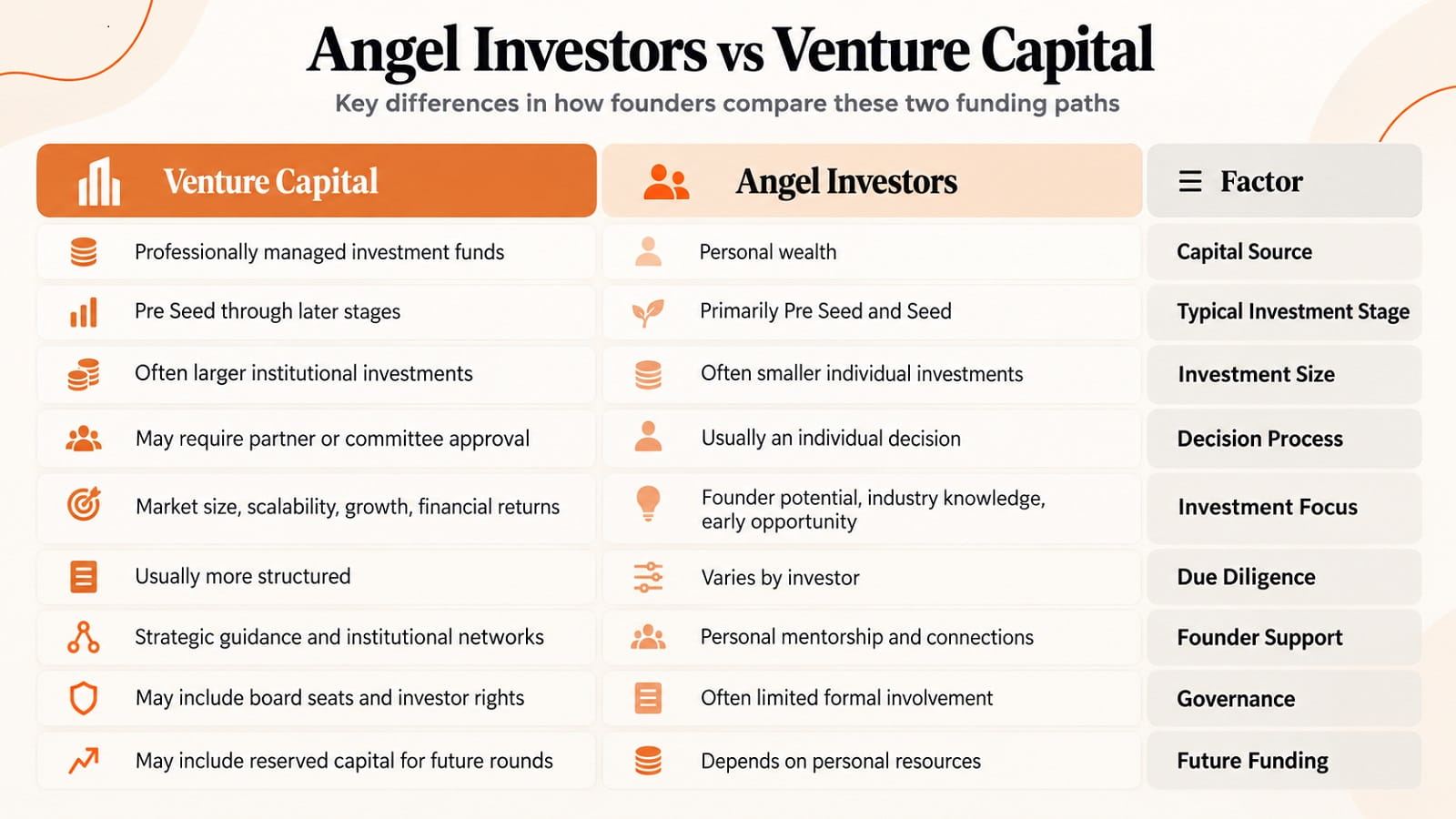
These are common patterns rather than fixed rules. An experienced angel may invest substantial amounts and negotiate formal governance rights, while a specialized venture fund may write relatively small checks to very early stage companies.
The practical question for founders is whether an investor can meet the company's financial needs while offering a relationship that supports its next stage of development.
Investment Stages and Funding Requirements
The amount of capital a startup needs often changes as the business develops. Early funding may support product development, customer research, and initial hiring. Later rounds may finance sales expansion, infrastructure, international growth, or more complex operational requirements.
Angel investors frequently support companies during the period when uncertainty is highest and operating evidence is limited. Their industry experience and personal conviction can help them evaluate businesses before traditional performance metrics become meaningful.
Venture firms may become more relevant as capital requirements increase, but institutional investment is not limited to mature startups. Specialized funds can invest before a product launches, particularly when founders have relevant experience or the business operates in a large, promising market.
Investor Suitability by Startup Stage
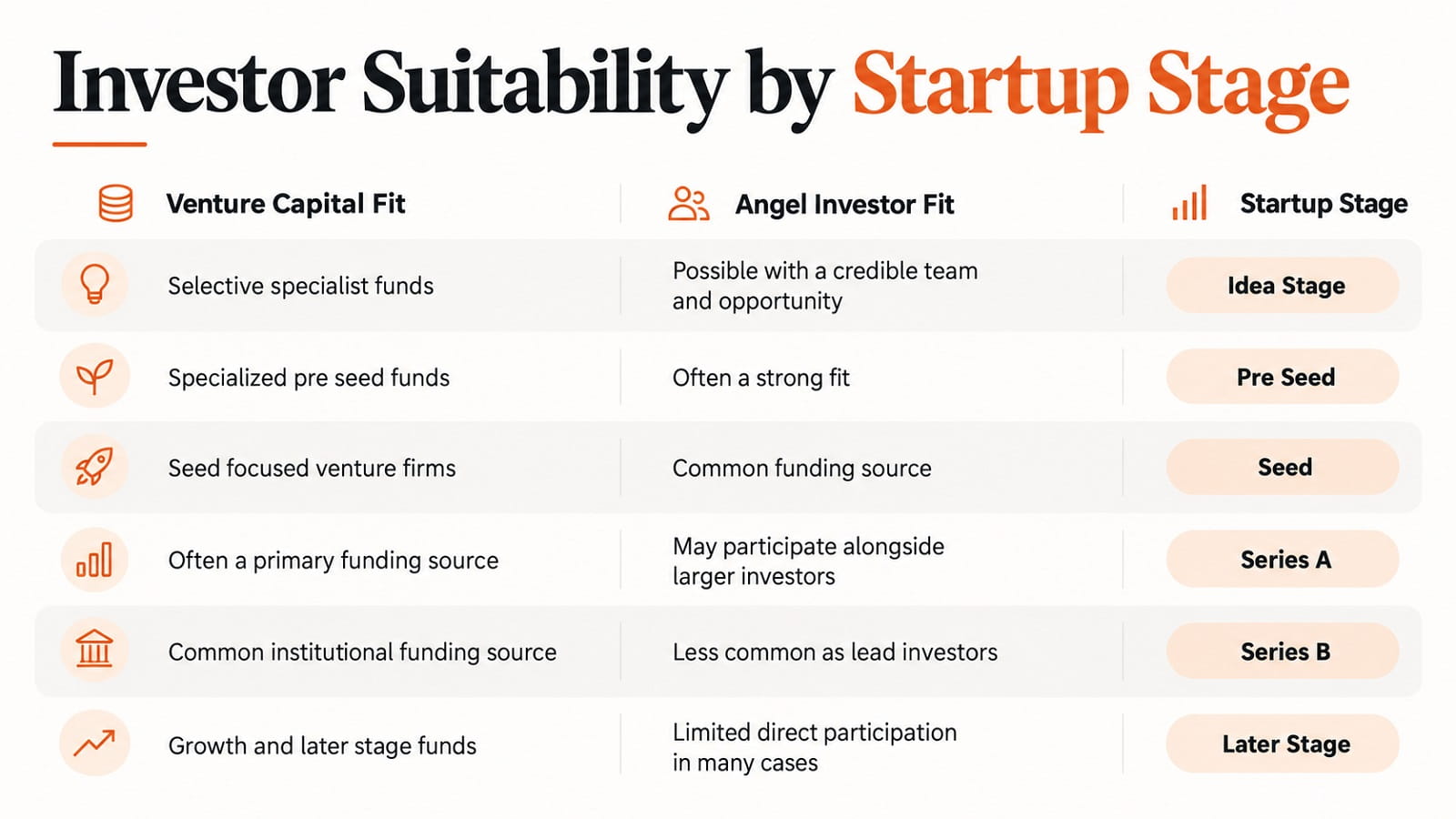
Startup stage alone should not determine the choice. Capital intensive industries, such as biotechnology or advanced manufacturing, may require institutional financing earlier because product development is expensive. In contrast, a software startup with modest operating costs may reach meaningful customer traction through smaller investments or revenue generated by the business itself.
Founders should calculate the funding required to achieve their next measurable milestone before approaching investors. Raising capital without a clear purpose can create unnecessary dilution and pressure, regardless of the investor category.
How Investment Decisions and Expectations Differ
Angel investors may make investment decisions based on a combination of founder experience, market understanding, personal relationships, and commercial potential. An investor who previously built a business in the same industry might recognize an opportunity before the startup has enough financial information to attract broader institutional attention.
The decision process can be relatively direct when one angel controls the investment. However, this does not guarantee fast fundraising. Experienced angels may still examine financial assumptions, customer evidence, legal documents, and the ownership structure before committing money.
Venture capital firms typically follow a more formal evaluation process. Investment teams may assess the market, competitors, product differentiation, customer behavior, financial performance, and the founders' ability to execute. A startup may meet several team members before the opportunity reaches a final investment decision.
The expectations after funding can differ as well. Venture firms generally need investments with the potential to generate meaningful returns for the fund. This encourages interest in businesses capable of expanding significantly, rather than companies whose growth potential is limited to a relatively small market.
Angel investors have individual financial objectives and may be more flexible about the type of business outcome they consider attractive. Nevertheless, some angels pursue the same high-growth opportunities as venture firms. Founders should discuss growth targets, future financing, and possible exits directly instead of making assumptions about either investor type.
Equity, Dilution, and Founder Control
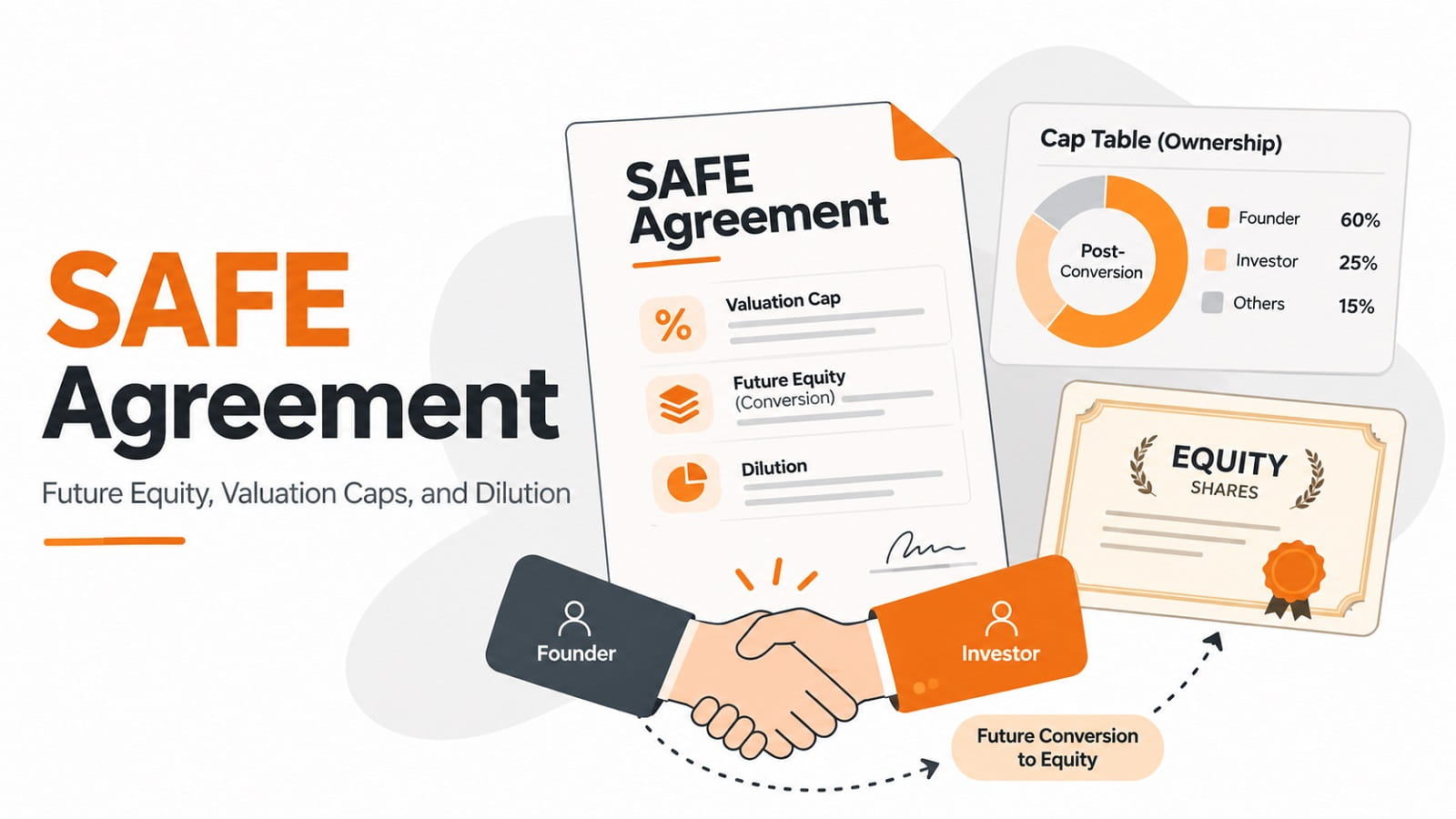
Both angel investment and venture capital commonly involve giving investors an ownership interest in the company. This ownership can be issued through a priced equity round or arise later through instruments such as SAFEs and convertible notes.
Dilution occurs when new shares are issued and existing shareholders own a smaller percentage of the company. For example, if a startup has a $4 million pre-money valuation and raises $1 million in a straightforward priced equity round, the new investor receives 20% of the company's post-money equity. Existing shareholders collectively retain 80%, assuming there are no other capitalization changes.
The investor's identity does not determine dilution. What matters is the valuation, investment amount, financing structure, and any additional provisions affecting ownership. A large angel investment at a low valuation could create more dilution than a smaller venture investment at a higher valuation.
Governance is another important consideration. Some angels invest without requesting a board seat or extensive approval rights. Venture firms leading institutional rounds may negotiate board representation, information rights, or approval requirements for major corporate decisions.
However, neither investor category automatically gives founders more or less control. A financing agreement with an angel can contain restrictive provisions, while a venture firm may accept terms that preserve substantial founder independence. Reviewing the actual agreement is more useful than relying on general assumptions about the funding source.
Founders should consider the effect of investment terms on future rounds as well. A financing decision that appears attractive today may complicate fundraising later if the capitalization structure becomes difficult for new investors to understand or accept.
Mentorship, Networks, and Future Funding
The value of an investor is not limited to the amount of money provided. A well-matched investor can help founders recruit experienced employees, reach potential customers, evaluate strategic decisions, and prepare for subsequent financing rounds.
Angel investors with relevant operating experience may offer particularly practical support. A former software founder, for example, could help a startup understand enterprise purchasing decisions or avoid common problems in its initial sales strategy. Because the relationship is often direct, founders may receive advice from someone who has personally managed similar challenges.
However, angel support varies widely. Some investors are actively involved, while others prefer to receive occasional updates. Founders should establish expectations before accepting an investment, especially when mentorship or industry access is a major reason for choosing a particular angel.
Venture firms may offer access to broader professional networks and specialized resources. Depending on the firm, portfolio companies might receive assistance with executive recruitment, partnerships, financial planning, or preparation for future funding rounds. These resources can become valuable as a startup expands and its organizational requirements grow.
Institutional investors may also reserve capital for follow-on investments, giving them the ability to support selected companies during later rounds. However, future participation is never guaranteed. Investment decisions depend on available capital, portfolio performance, fund strategy, and the startup's progress.
Founders should evaluate what an investor has actually done for other portfolio companies rather than relying solely on promised support. Conversations with founders who have previously worked with the investor can provide useful insight into responsiveness, practical involvement, and behavior during difficult periods.
Advantages and Limitations of Each Funding Source
Angel investment can be attractive when a startup needs relatively modest capital, early industry validation, and direct guidance from an experienced individual. Angels may consider opportunities that are not yet ready for institutional fundraising, especially when they understand the founding team or the market.
The limitation is that individual investors may not have sufficient capital to support larger expansion plans. If several angels are required to complete a round, coordinating their commitments and managing shareholder relationships can also become more complicated.
Venture capital offers the potential for larger investments, professional networks, and continued institutional backing. These advantages are particularly relevant when a company has a credible opportunity to expand rapidly and requires significant financial resources to pursue it.
At the same time, venture financing may involve more extensive due diligence, formal governance arrangements, and expectations for substantial growth. These conditions can be appropriate for a scalable startup but less suitable for a business that intends to grow gradually or prioritize early profitability.
Neither funding source is automatically better. A supportive venture partner may be more valuable than an angel with limited expertise, while an experienced angel may provide stronger guidance than a fund unfamiliar with the startup's industry. The quality of the investor and the alignment of expectations matter more than the category alone.
How Founders Should Choose the Right Investor
The most effective approach begins with the startup's current needs rather than the investor's reputation. Founders should identify the milestones they want to achieve, estimate the capital required, and determine what kind of strategic support would materially improve their chances of success.
A startup developing its first product may benefit from angels who understand its market and can help validate customer demand. A company with established traction and significant expansion opportunities may benefit more from venture investors capable of financing growth and supporting future rounds.
Investor selection should also consider experience, financial capacity, reputation, and working style. Founders should understand who makes investment decisions, how long the process is likely to take, and whether the investor's expectations match the company's realistic growth potential.
A high valuation should not be the only deciding factor. Two funding offers with similar financial terms may create different long-term outcomes because of governance provisions, investor involvement, and future financing expectations. Founders should review those details carefully and seek qualified legal advice before finalizing an agreement.
Can a Startup Raise Funding From Both?
Angel investors and venture capital firms are not mutually exclusive funding sources. Many startups raise their first external capital from angels and later approach venture firms after developing stronger evidence of product demand and commercial traction.
Both investor types can also participate in the same round. Experienced angels may contribute specialized knowledge and introductions, while venture firms provide larger amounts of capital and institutional relationships.
Combining investors requires careful management of ownership records and financing terms. Founders should ensure that early agreements do not create unnecessary complications for future investment, particularly when several angels participate through different structures.
Final Thoughts
The choice between angel investors and venture capital should reflect what a startup needs to achieve and the kind of business its founders intend to build. Angel investors may be well suited to early validation, specialized mentorship, and smaller financing requirements. Venture firms may be more appropriate when substantial capital and institutional resources are needed to pursue significant growth.
The strongest funding decision is not necessarily the one that produces the largest investment or highest valuation. It is the one that provides appropriate capital, reasonable terms, relevant expertise, and shared expectations about the company's future.
Founders who evaluate these factors carefully are better positioned to establish productive investor relationships and finance growth without creating unnecessary pressure or compromising their long-term objectives.
FAQ
What is the main difference between angel investors and venture capital?
Angel investors generally invest their personal money, while venture capital firms invest through professionally managed funds. They may also differ in investment size, decision-making processes, governance requirements, and growth expectations.
Are angel investors better for early stage startups?
Angel investors are often suitable for startups with limited revenue or early customer validation. However, specialized pre seed venture firms also invest at very early stages, so the best choice depends on the startup's capital needs and the investor's experience.
Do angel investors take equity in a startup?
Many angel investors receive equity directly or invest through agreements that may convert into equity later. The ownership percentage depends on the investment amount, valuation, and financing terms.
Can a startup raise angel investment and venture capital together?
Yes. Angels and venture firms can participate in the same financing round, and many startups begin with angel funding before securing institutional investment. Founders should maintain clear ownership records and consistent financing documentation.
How should founders decide between angel investors and venture capital?
Founders should compare funding requirements, development stage, growth potential, dilution, governance terms, and investor support. The best option is the investor whose resources and expectations align with the company's next milestones and long-term strategy.

Mobina Khanki
Venture & Funding Writer at PinerookMobina Khanki covers venture capital, startup funding, fundraising, and startup finance for Pinerook, focusing on founders and investors.
 Seen first.