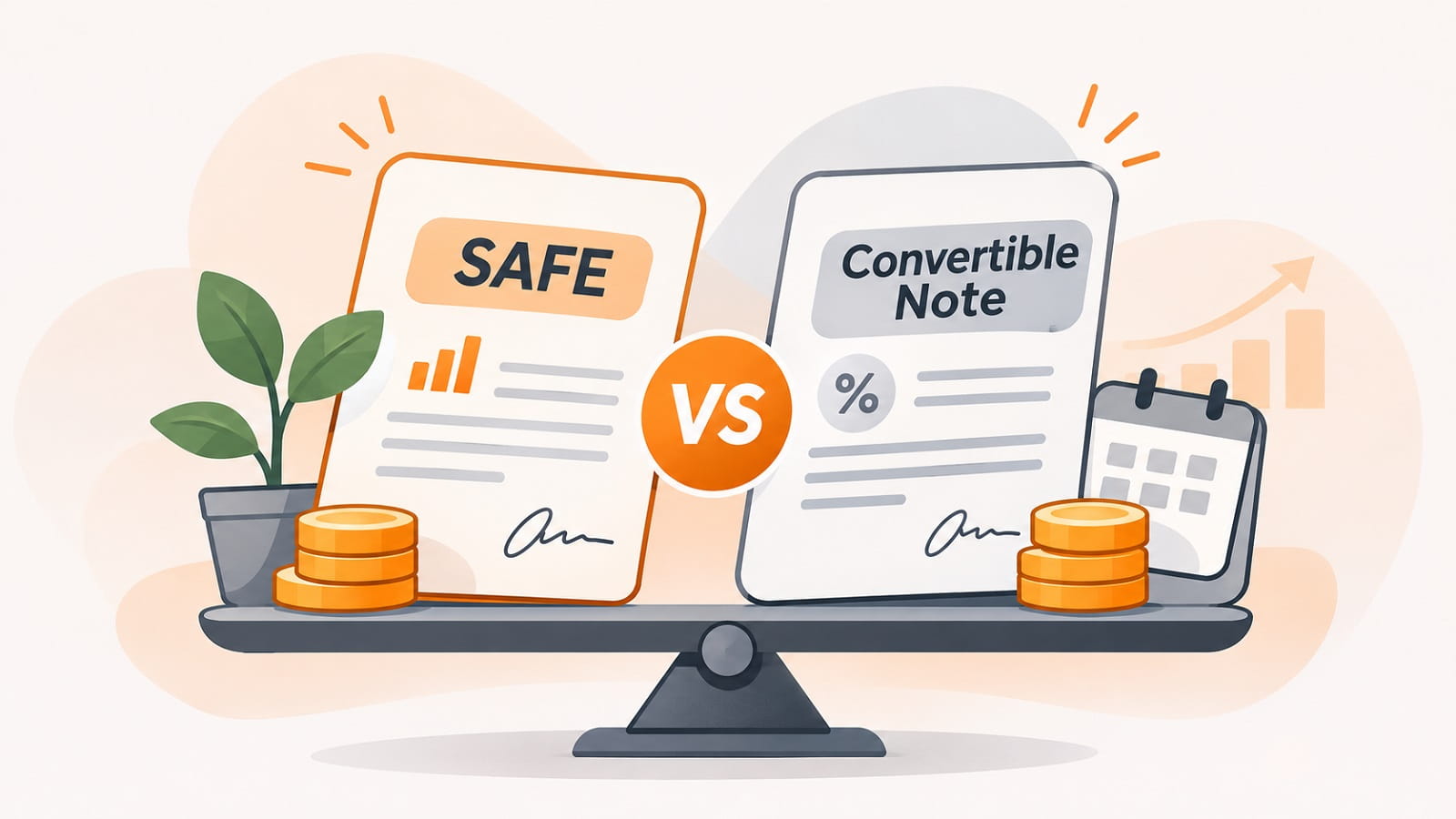
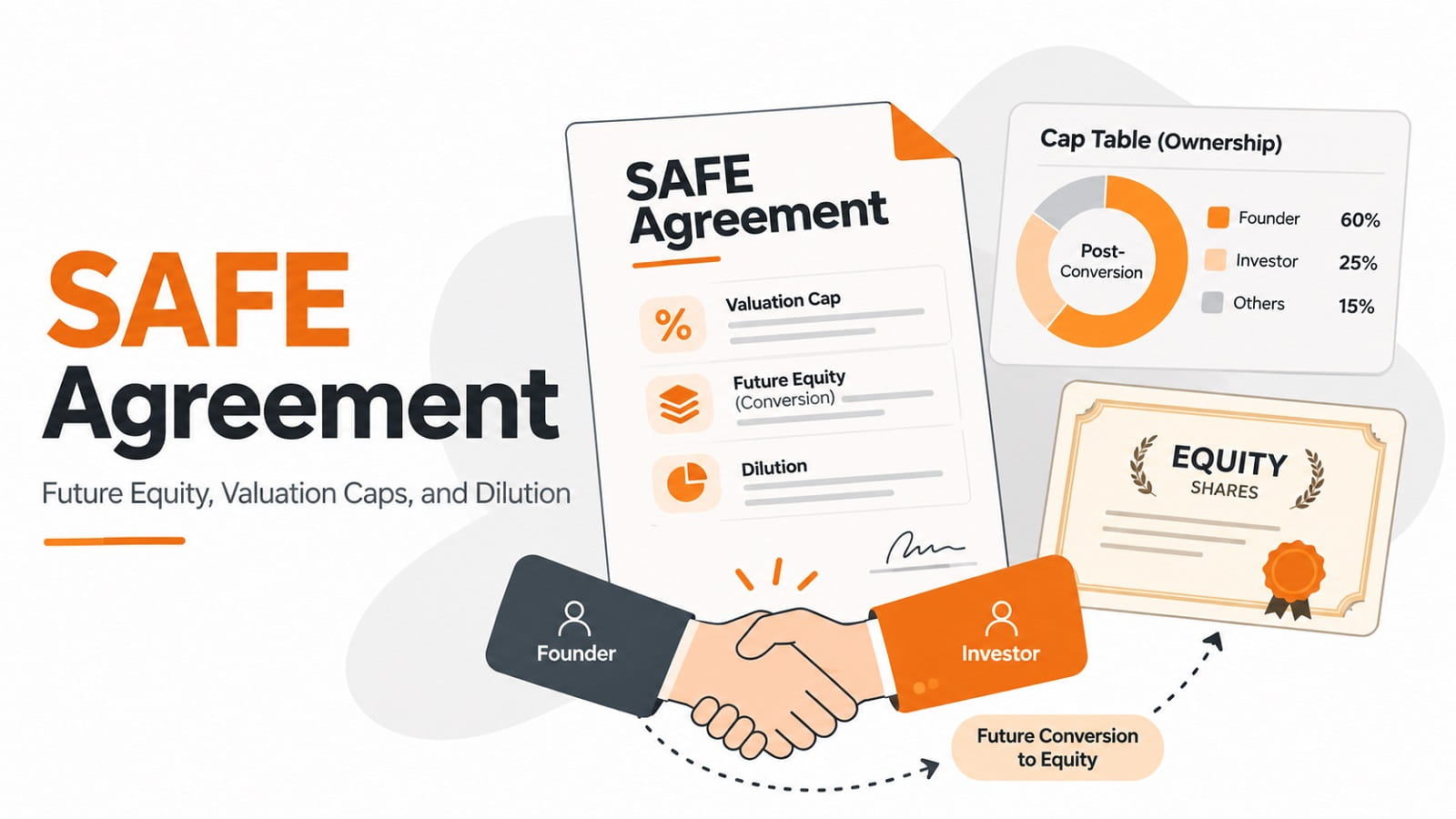
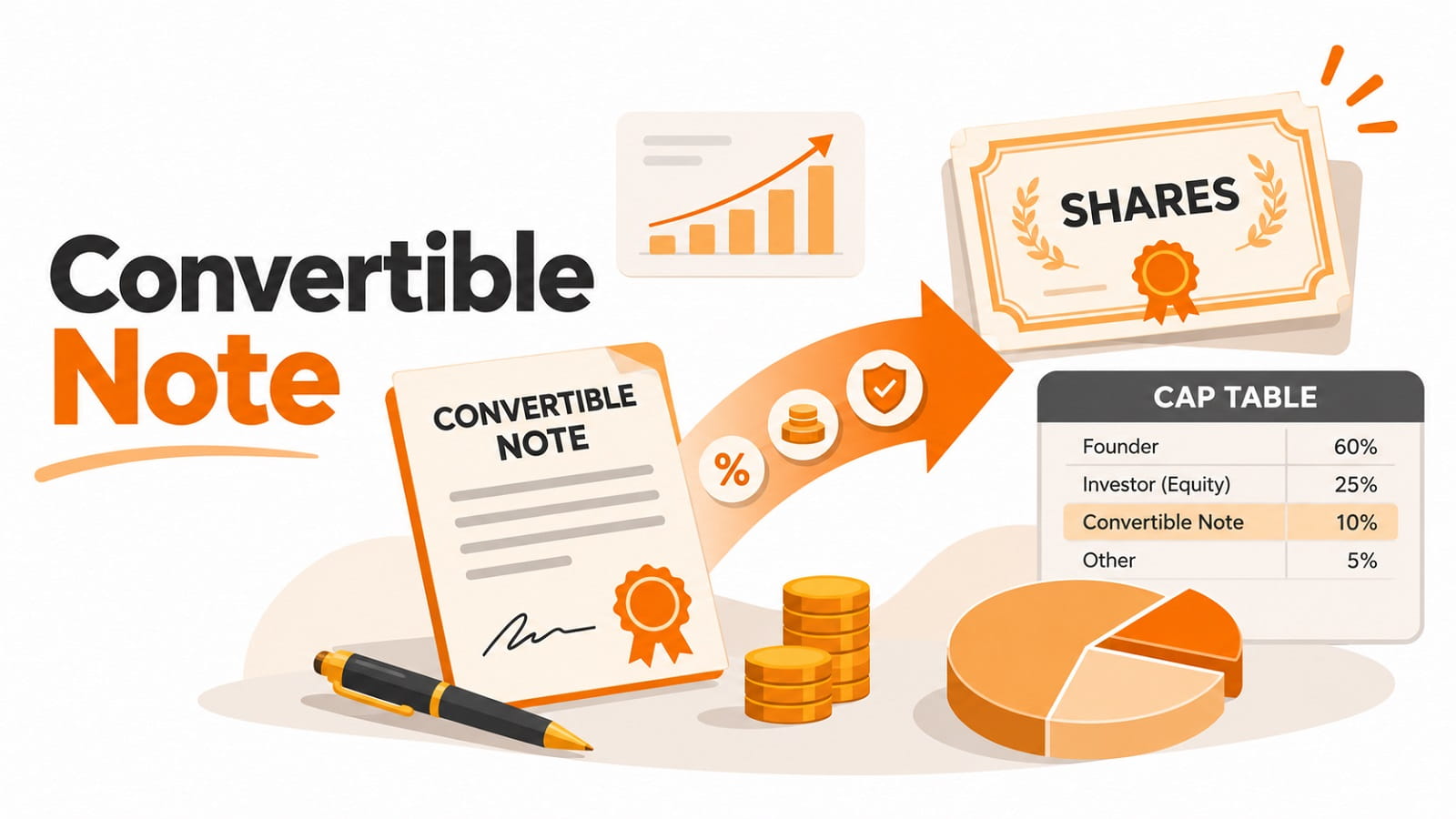
Business loans for startups can help newly established companies finance commercial operations, equipment, inventory, and expansion without immediately issuing additional equity. However, obtaining a loan in the company's name can be difficult when it has limited financial history, inconsistent revenue, or insufficient assets to support borrowing. Lenders must evaluate how the business will repay its obligations, and founders need to understand how the loan structure affects both company finances and personal exposure.
Within Startup Debt and Alternative Funding, commercial borrowing deserves particular attention because the legal borrower, collateral arrangements, financial covenants, and repayment conditions can materially affect business flexibility. A financing agreement may provide access to capital while restricting further borrowing or requiring personal guarantees from the company's owners. These details matter as much as the interest rate, especially when a startup expects to raise additional capital or make significant operational investments.
This guide examines how lenders evaluate startup businesses, the differences between secured and unsecured borrowing, and the documents founders need to prepare. It also compares two hypothetical commercial loan offers to demonstrate why lower monthly installments do not necessarily mean cheaper financing.
How Business Loans for Startups Work
A business loan is a financing arrangement in which a company borrows capital from a lender and agrees to repay it according to specified contractual terms. Those terms generally establish the amount available, interest charges, repayment schedule, fees, security requirements, and circumstances under which the lender may demand repayment.
For incorporated startups, the borrower may be the legal business entity rather than its individual founders. This distinction matters because a company can incur obligations separately from its owners, subject to the business structure and applicable law. Nevertheless, lenders may require shareholders or directors to provide personal guarantees, creating additional responsibilities beyond the company's own commitments.
A commercial lender normally evaluates the company's ability to generate sufficient cash to repay the debt. Financial statements, customer contracts, bank account activity, outstanding liabilities, and projected operating performance can all influence that assessment. The lender may also review management experience and the assets available to secure the facility.
For newly established businesses, the challenge is demonstrating repayment capacity without a substantial operating history. A convincing growth forecast can support an application, but projections alone may not satisfy a lender that requires evidence of reliable collections or additional credit support.
Business Loans vs Personal Startup Financing
The distinction between commercial borrowing and personal financing is especially important for founders considering early business funding.
A loan issued directly to a company generally creates a repayment obligation for that company. A personal loan used to finance a business instead makes the individual borrower directly responsible, even if the funds are subsequently invested in the company.
However, the distinction becomes less straightforward when a commercial lender requires a personal guarantee. The business remains the primary borrower, but the guarantor may become liable if specified contractual conditions are met.
Founders should identify the legal borrower, the parties providing guarantees, and the assets supporting the loan before signing. These details determine how repayment and enforcement may affect the company and its owners.
The United Kingdom's government backed Start Up Loans program illustrates another important distinction: it provides eligible individuals with personal loans intended for business purposes rather than conventional loans made directly to a company. Founders should therefore examine the actual financing structure instead of relying on the product's name.
Secured and Unsecured Business Loans
Commercial business borrowing is commonly divided into secured and unsecured arrangements. The main difference concerns whether the borrower grants a lender rights over specified assets as collateral.
Secured Business Loans
A secured loan gives the lender a security interest over eligible assets according to the financing documents and applicable law. Those assets might include equipment, inventory, receivables, property, or other business resources.
Security can reduce the lender's potential loss if the company fails to repay. As a result, secured financing may support larger borrowing amounts or more favorable terms than otherwise comparable unsecured lending.
However, collateral introduces operational consequences. The company may need lender approval before selling or transferring certain assets, granting additional security, or undertaking other transactions.
Founders should understand the scope of the security agreement and whether it covers specifically identified assets or a broader portion of the company's property.
Unsecured Business Loans
An unsecured business loan does not require a security interest over specified company assets. Lenders may instead place greater emphasis on financial strength, credit history, cash generation, and other evidence of repayment capacity.
Unsecured facilities can be attractive to startups that have not accumulated substantial physical assets. Nevertheless, they may involve higher borrowing costs, smaller available amounts, or stricter underwriting requirements.
Unsecured does not necessarily mean that the founder has no personal liability. Some lenders request a personal guarantee even when no business assets are formally pledged as collateral.
The distinction should be confirmed in the contractual documentation rather than inferred from marketing descriptions.
How Lenders Assess Startup Businesses
Commercial lenders generally evaluate whether the company can repay the proposed debt under reasonable operating assumptions. Their assessment may cover several areas, with different weight assigned to each depending on the lender and financing product.
Trading History and Revenue Quality
A lender may examine how long the startup has operated, whether its revenues are recurring, and how consistently customers pay.
Revenue generated through repeat contracts may provide stronger evidence of future collections than an isolated large sale. Customer concentration also matters because reliance on a small number of buyers can expose the company to significant financial disruption.
Founders should distinguish invoiced revenue from cash actually received. A profitable contract may create a temporary liquidity requirement if the customer pays substantially later than the company incurs its associated expenses.
Business Credit and Existing Liabilities
Credit records help lenders assess the company's previous borrowing and payment behavior. Where business credit history is limited, the financial circumstances of owners and guarantors may receive additional scrutiny.
Outstanding loans, credit facilities, leases, and other obligations influence the amount of additional debt the company may reasonably support.
A lender may also review existing security interests to determine whether important assets are already pledged to another creditor.
Management Experience and Business Model
Lenders may consider whether the founding team has relevant operational experience and understands the company's commercial risks.
A business plan should demonstrate how products or services generate revenue, how the company manages expenses, and which assumptions support future financial performance.
The plan is most useful when its projections are connected to identifiable customers, contracts, market conditions, and operating capacity rather than unsupported growth expectations.
Cash Available for Debt Service
Repayment capacity is central to commercial lending. The company must demonstrate that sufficient cash can remain available after operating expenses and other necessary commitments.
Lenders may use a debt service coverage ratio, or DSCR, to assess the relationship between an applicable measure of cash available for debt service and scheduled principal and interest payments.
A simple illustrative calculation divides annual cash available for debt service by annual debt service. For example, $150,000 in cash available against $120,000 in scheduled payments produces a ratio of 1.25.
That calculation does not establish a universal lending threshold. Actual definitions, minimum ratios, and adjustments depend on the lender and the loan documents.
Commercial Loan Structures and Their Business Uses
Different business loan structures are designed to address different financing requirements. A company purchasing long lasting equipment may benefit from a different facility than one managing recurring delays between paying suppliers and collecting customer invoices.
The following table connects common commercial financing structures with their operating purposes and highlights contractual considerations founders should review.
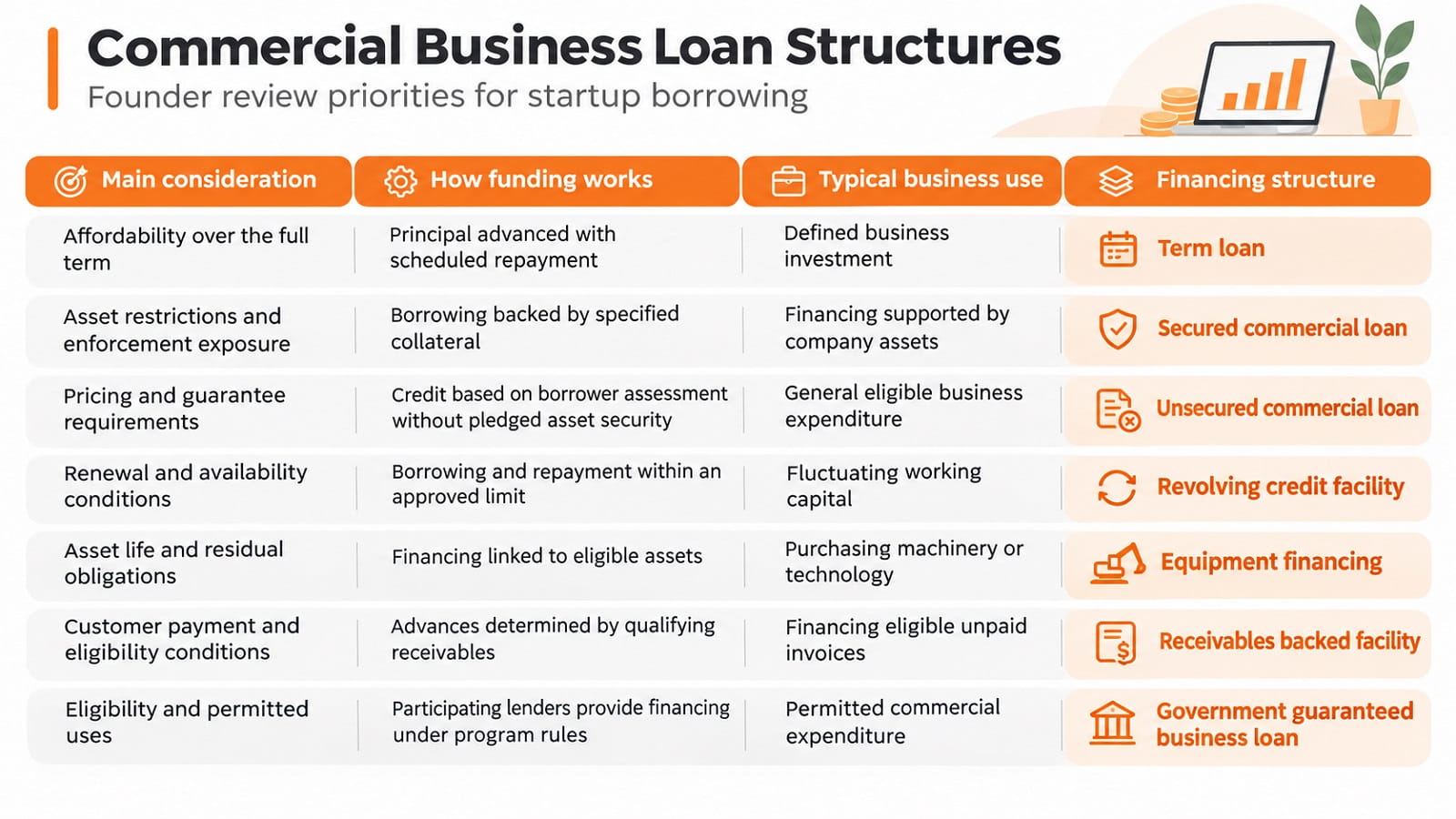
The structure should match the timing and commercial purpose of the expenditure. A term loan can support an investment with relatively predictable benefits, while revolving credit may be more appropriate for temporary working capital requirements. Asset backed arrangements can provide access to financing but may restrict how the company manages its collateral. Founders should compare the practical terms rather than assume that every product described as a business loan operates similarly.
Government Guaranteed Commercial Lending
Government supported financing can help eligible businesses obtain loans where conventional lenders might otherwise be unwilling to provide credit on reasonable terms.
In the United States, the Small Business Administration's 7(a) program supports qualifying lending through approved financial institutions. Depending on program requirements, proceeds may be used for eligible working capital, equipment, business acquisitions, and other permitted business purposes.
The SBA's 504 program serves a different function. It focuses principally on qualifying major fixed assets, such as commercial property and certain long lasting equipment. It is not a general working capital facility.
Founders should distinguish government guarantees from grants. A guarantee protects the participating lender against a defined portion of qualifying losses; it does not ordinarily eliminate the borrower's obligation to repay.
Program eligibility, permitted uses, guarantee rules, and financing limits may change. The relevant official requirements should be checked before submitting an application.
Preparing a Commercial Loan Application
A strong application gives the lender a consistent explanation of the company's financial position and the proposed use of borrowed funds.
For an existing business, the application package may include recent financial statements, bank statements, accounts receivable and payable records, tax documents, and information about outstanding liabilities.
Newer companies may also need a detailed operating forecast and evidence supporting expected customer demand. Contracts, purchase orders, and documentation of committed revenue can help demonstrate how the financing will support commercial activity.
Founders should explain why the requested amount is appropriate and how the expected financial benefits relate to repayment obligations. The projections should distinguish revenue from cash collections and clearly identify expenses that must be paid before customers settle invoices.
Where collateral is involved, lenders may request asset valuations, ownership records, and details of existing security interests. Personal guarantees can create separate documentation and financial disclosure requirements.
A complete application should give the lender enough information to assess the business without relying on inconsistent assumptions across different documents.
A Practical Comparison of Two Business Loan Offers
Consider Meridian Supply, a fictional B2B technology distributor seeking $120,000 to expand inventory capacity and support larger customer orders. The company has an established trading history and expects the additional inventory to generate cash over the following years.
Management receives two hypothetical commercial loan offers. Both provide the same principal amount, but their interest rates, repayment periods, and upfront fees differ.
Offer A provides a four year loan with an annual fixed interest rate of 11% and an upfront fee of $3,000. Offer B provides a five year loan with an annual fixed interest rate of 13% and an upfront fee of $1,500.
For comparison, assume both loans use equal monthly principal and interest installments, with interest calculated monthly. The fees are deducted from the proceeds at closing, and neither facility involves warrants, additional charges, or variable interest.
Comparing Monthly Payments and Total Borrowing Costs
Offer B has a longer repayment period, so its monthly installment is lower despite its higher interest rate. However, the longer term also produces more scheduled interest payments.
The following table compares the cash received, repayment obligations, and total financing costs under the assumed terms.
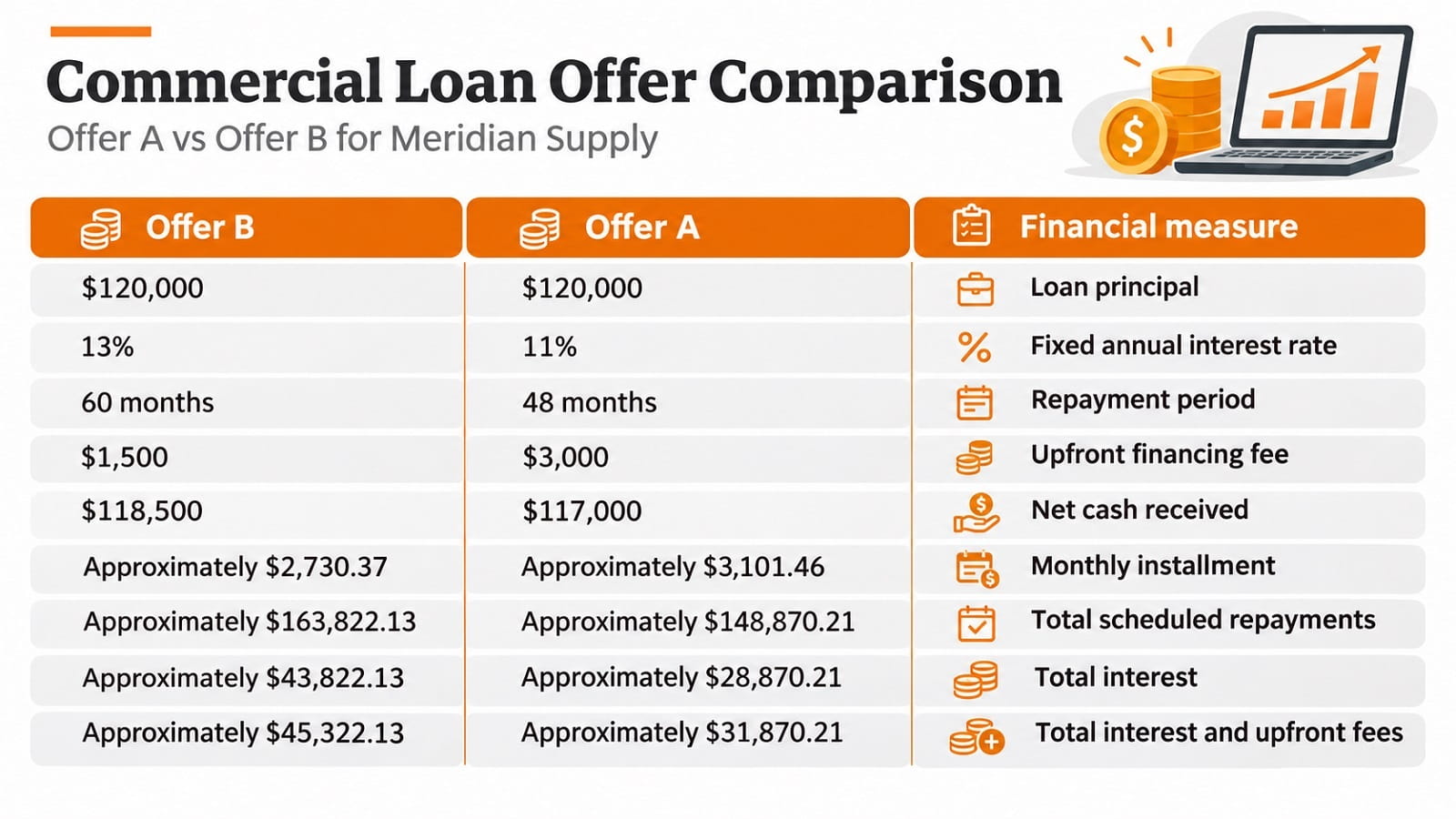
The second offer reduces the monthly installment by approximately $371 but results in around $13,452 more combined interest and upfront fees over the full contractual term. Offer A provides less net cash at closing because its upfront fee is larger, yet it is less expensive over the assumed repayment period. These figures illustrate why founders should compare both monthly affordability and total borrowing costs rather than relying on one measure. Actual offers may differ in additional charges, collateral, guarantees, or early repayment conditions.
Evaluating Debt Service Against Operating Cash
Assume Meridian expects to generate $5,000 per month in cash available for debt service after its essential operating requirements.
Under Offer A, the monthly installment would consume approximately 62% of that amount. Offer B would consume about 55%, leaving greater monthly flexibility despite its higher overall cost.
If available cash declined to $3,000 per month, Offer A would create a shortfall of approximately $101 before any other unexpected commitments. Offer B would remain covered under that simplified assumption, but its remaining margin would be relatively small.
These scenarios demonstrate that the financially cheaper offer is not automatically the safest. Management must consider the timing of customer collections, the consequences of delayed payments, and the capacity to absorb unexpected costs.
Choosing the Appropriate Offer
Meridian might prefer Offer A if its cash generation is sufficiently predictable and it wants to reduce total borrowing costs. The shorter repayment period could also help the company eliminate debt sooner.
Offer B may provide greater flexibility during periods of weaker cash collections, but Meridian would accept higher cumulative interest charges and a longer period of indebtedness.
The final decision should also consider security, guarantees, lender covenants, and the possibility of repaying the loan early. Those provisions may change the overall comparison even when the advertised financial terms appear straightforward.
Personal Guarantees and Founder Liability
One of the most important questions in commercial borrowing is whether the lender requires a founder to guarantee the company's debt personally.
A personal guarantee creates a separate contractual obligation under which the guarantor may become responsible for specified liabilities if the borrower fails to meet its commitments.
The guarantee can be limited to a defined amount or extend more broadly, depending on its terms. Some agreements also establish continuing obligations that remain relevant after particular changes to the business.
Founders should examine the guaranteed amount, triggering conditions, duration, enforcement procedures, and any circumstances in which the guarantee can be released.
An unsecured business loan does not automatically eliminate this risk. Even where no company asset is pledged as collateral, a lender may request personal support.
The implications are particularly significant when multiple founders provide guarantees. The agreement should make clear how liability is allocated and whether one guarantor may face claims beyond an expected individual share.
Financial Covenants and Operational Restrictions
Commercial loan agreements may contain covenants requiring the company to maintain specified financial conditions or obtain lender approval before taking particular actions.
Financial covenants can relate to liquidity, leverage, debt service coverage, or other measures. Their purpose is to help the lender monitor whether the borrower's risk profile remains within agreed boundaries.
Other restrictions may address additional indebtedness, dividend distributions, asset transfers, major acquisitions, or changes affecting pledged collateral.
A startup should assess these provisions against its operating plans. For example, a company expecting another financing round should understand whether the existing lender's consent will be required for new borrowing or additional security.
Management should also test whether covenant compliance remains possible under a realistic downside forecast.
A company can encounter contractual difficulties before missing a scheduled payment if an applicable covenant is breached. The consequences depend on the agreement, including any permitted remedies or opportunities to cure the breach.
How to Compare Commercial Business Loan Offers
Founders should use a consistent evaluation method when reviewing competing financing proposals.
The comparison should begin with the amount of usable cash the company will receive. An offer with substantial fees deducted at closing may provide less working capital than its headline principal suggests.
The next consideration is the complete repayment schedule. Monthly installments, maturity dates, variable rate exposure, and final payments should be incorporated into the company's cash forecast.
Security and guarantees must be evaluated separately from pricing. A lower interest rate may not justify accepting collateral restrictions or personal liability that the founder considers disproportionate.
The agreement's operational provisions also matter. Reporting requirements, lender consent conditions, and borrowing restrictions can influence future business decisions.
Finally, management should consider how the facility will interact with expected growth. A loan that supports a well defined commercial project may be useful, but borrowing should not depend entirely on unconfirmed future revenue or investment.
Common Mistakes in Commercial Startup Borrowing
A frequent mistake is applying for a commercial loan before establishing the company's repayment capacity. A business plan may describe an attractive opportunity, but lenders also need evidence that the borrower can meet contractual payments.
Another mistake is confusing an unsecured facility with the absence of personal liability. Founders may accept guarantees without fully understanding the circumstances in which enforcement becomes possible.
Companies can also underestimate the significance of collateral restrictions. Pledging essential operating assets may affect future financing options and complicate important commercial transactions.
Focusing only on the monthly installment creates another problem. Longer repayment periods may improve short term affordability while increasing total interest expenses.
Finally, founders sometimes accept borrowing conditions that conflict with anticipated financing or expansion plans. Existing investor agreements, security interests, and future capital requirements should be reviewed before committing to additional debt.
Final Thoughts
Business loans can provide startups with capital for commercial investment, inventory, equipment, and working capital without necessarily requiring immediate equity dilution. Their suitability depends on the company's financial history, cash generation, and ability to satisfy ongoing obligations.
For founders, the most important distinction is between obtaining approval and accepting financing that the business can manage responsibly. Interest rates and monthly installments matter, but collateral, personal guarantees, covenants, and total borrowing costs can have equally significant consequences.
A sound commercial borrowing decision should connect capital to an identifiable business need, preserve sufficient operating liquidity, and remain manageable under realistic downside conditions. Careful evaluation of lender requirements and contractual terms can help a startup finance its growth without unnecessarily restricting future decisions.
FAQ
Can a New Company Obtain a Business Loan?
Some lenders consider newly established businesses, but eligibility depends on financial evidence, creditworthiness, repayment capacity, and the financing product. Companies with limited trading history may face stricter requirements or need additional credit support.
What Is the Difference Between a Business Loan and a Personal Startup Loan?
A business loan generally makes the company the legal borrower, while a personal startup loan makes the individual responsible for repayment. However, business borrowing may also involve personal guarantees that create separate liability for founders.
Are Secured Business Loans Easier to Obtain?
Collateral can improve a lender's ability to manage potential losses and may support financing approval. However, security alone does not establish sufficient repayment capacity, and lenders retain their own underwriting requirements.
Can a Business Loan Be Used for Working Capital?
Many commercial facilities permit eligible working capital expenditure. The specific uses depend on the agreement and financing program. Some asset focused programs restrict borrowing to qualifying long term investments.
Do Unsecured Business Loans Require Personal Guarantees?
They may. Unsecured borrowing does not involve pledged business collateral in the same way as a secured facility, but lenders can still request guarantees from owners or other parties.
What Do Lenders Look for in a Startup Business?
Lenders commonly consider financial performance, cash flow, credit history, existing liabilities, management experience, and the proposed use of funds. Requirements vary according to the financing provider and product.
Can a Startup Have Multiple Business Loans?
It may be possible, but existing financing agreements can restrict additional debt or security arrangements. The company must also demonstrate that it can support the combined repayment obligations.
Is a Lower Monthly Payment Always Better?
No. A lower payment may result from a longer repayment period and lead to greater total interest expense. Founders should compare affordability, total costs, collateral obligations, and contractual flexibility.

Mobina Khanki
Venture & Funding Writer at PinerookMobina Khanki covers venture capital, startup funding, fundraising, and startup finance for Pinerook, focusing on founders and investors.
 Seen first.