Climate technology startups face a financing challenge that many conventional software businesses never encounter. A promising invention may work in a laboratory but still require expensive testing, manufacturing equipment, permits, and customer installations before it earns reliable revenue. Even when buyers are interested, the company may need to spend substantial cash months before a commercial project produces payments. Raising money therefore depends on showing not only that the technology matters, but also how it can become a repeatable business.
Climate tech funding covers the capital required to develop, demonstrate, and deploy technologies that reduce emissions, improve resource efficiency, or help society adapt to physical climate risks. Within the broader context of Investment Trends, these companies illustrate why investor enthusiasm and real financing availability are different questions. Venture equity can support technical uncertainty, but commercial installations may also need grants, customer commitments, strategic investors, or debt designed around assets and contracted cash flows.
This guide explains what financing is available in 2026, why investors distinguish laboratory progress from commercial readiness, and how founders can match funding sources to technical milestones. A practical example also shows how the timing of a grant and a customer payment can change the cash position of an otherwise promising climate startup.
What Is Climate Tech Funding?
Climate tech funding is financial support for companies developing technologies related to climate mitigation, adaptation, or resource efficiency. It can finance software that helps businesses manage electricity demand, batteries and storage systems, industrial heat technologies, agricultural resilience tools, low emissions materials, or equipment that measures and removes carbon dioxide. These businesses differ considerably in both technical maturity and capital requirements, so the same fundraising strategy will not work for every company.
The Climate Tech Funding Market in 2026
Recent data show substantial climate investment, but the composition of that funding matters more than a single headline. Net Zero Insights reported that private climate technology companies received $19.6 billion in disclosed equity, debt, and grants during the third quarter of 2026. Equity accounted for $15.8 billion, an increase of 17% from the previous quarter, while asset backed debt fell to approximately $3.1 billion. The provider recorded 686 deals, its lowest quarterly count since 2021, illustrating how larger commitments can coexist with reduced deal activity.
The same report identified approximately $6.3 billion raised across 17 financings connected with firm power, including fusion, fission, geothermal, and storage. That concentration reflects increasing investor interest in reliable electricity supply and energy infrastructure, but it does not establish that every climate technology company has easier access to capital. Founders should compare financing rounds from businesses with similar technical readiness, geography, and deployment requirements rather than treating the largest transactions as typical examples.
Broader energy investment statistics measure something different. The International Energy Agency expects approximately $2.2 trillion of investment during 2026 across renewables, nuclear, grids, storage, low emissions fuels, efficiency, and electrification. Those expenditures include major energy projects and established companies, not simply investments in climate startups. Similarly, climate funding research firms may classify sectors and financing instruments differently, so their totals should be attributed to the correct methodology and reporting period.
Why Climate Technology Needs a Different Funding Approach
Many software startups can release a product, gather customer feedback, and improve it without building substantial physical infrastructure. A climate hardware startup may need a demonstration facility before customers can verify whether the equipment delivers the promised efficiency, reliability, or emissions reduction. A successful demonstration can then lead to another expensive stage: producing equipment at commercial scale and installing it in customer facilities. Each stage creates risks that different investors may be willing to finance.
This creates a financing gap between technical feasibility and the first commercially operating project. Early investors may support engineering and prototypes, but lenders often need contracted revenue, usable collateral, proven performance, or other protections before advancing money. Customers may want evidence from an operating installation before signing a major purchase agreement. Founders must therefore build financing plans that connect technical proof, customer commitments, and access to capital in a realistic sequence.
Types of Funding Available to Climate Tech Startups
Climate companies can combine different funding sources as their technologies mature. Equity can absorb substantial development risk, while certain grants can support defined research or demonstration work. Debt and project finance may be appropriate later, but usually require stronger evidence that cash flows or assets can support repayment. Customer contracts can improve commercial credibility, although a future purchase commitment does not always provide immediate cash.
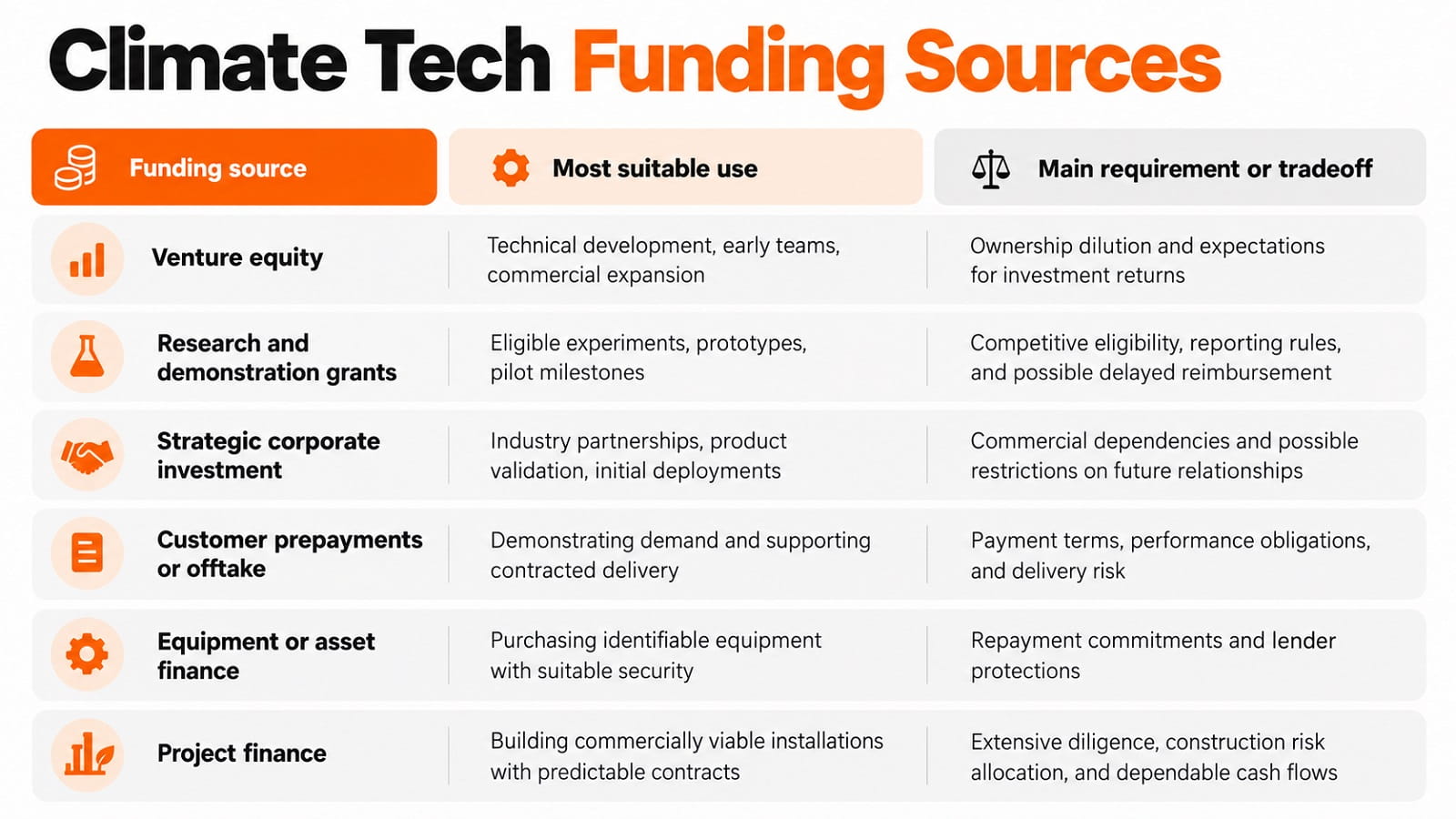
Public programs also differ by country and change over time. For example, Innovate UK opened a Climate Tech First of a Kind Builder competition in October 2026 to support eligible companies developing initial commercial projects. Such opportunities illustrate the value of milestone focused public support, but founders should verify current deadlines, eligibility, contribution requirements, and award conditions rather than include an unapproved grant as guaranteed cash.
How Funding Requirements Change From Research to Commercial Scale
Technical Validation and Prototype Development
At the earliest stage, founders must show that a proposed technology can perform a useful function under credible testing conditions. Laboratory measurements, independent technical assessments, intellectual property arrangements, and a realistic development schedule may matter more than immediate revenue. Investors also need to understand which assumptions remain uncertain, including manufacturing feasibility, materials availability, and safety requirements. The purpose of the first financing is usually to reduce a defined technical risk, not to claim that commercial deployment has already been proven.
Pilot Projects and First Commercial Demonstrations
A pilot should answer questions that laboratory experiments cannot settle. Customers and investors want to know whether the technology works in real operating conditions, how much installation costs, whether maintenance is manageable, and whether performance remains stable. Founders need a detailed deployment budget that identifies equipment, engineering, site preparation, monitoring, insurance, and contingencies. Commercial partners may provide access to test sites or agree to milestone payments, but the financing model should distinguish committed cash from expressions of interest.
Replication, Manufacturing, and Expansion
After successful demonstration, a company may need capital to reproduce the technology across multiple customer locations or manufacture it at higher volume. At this stage, the commercial case should include installed cost per unit, operating expenses, reliability data, customer purchasing economics, and the expected time between ordering equipment and collecting revenue. Suitable businesses may add equipment loans or project financing to equity, but those options depend on actual lender requirements and project risk. Scaling too early can create expensive fixed commitments before demand is sufficiently established.
What Climate Tech Investors Examine
Climate impact can establish why a technology matters, but investors also need to understand why customers would purchase it and how the company will earn money. A startup reducing industrial energy consumption, for example, should explain the customer's installation expense, expected savings, maintenance requirements, and realistic payback period. A carbon removal company may need independently verifiable measurement procedures and customers willing to pay for actual deliveries. Climate benefits and commercial benefits often reinforce one another, but they should be demonstrated separately rather than assumed to be identical.
Technical readiness is another major consideration. Founders should show which claims have been established through laboratory testing, pilot operation, or independent evaluation. They should also explain what remains unproven at larger capacity or under different environmental conditions. If equipment reliability or production yield is uncertain, optimistic unit costs may not survive the transition from prototype to commercial production. Independent evidence is especially useful when investors do not possess deep expertise in the technology.
Investors also examine the quality of demand. A letter of interest does not have the same economic value as an executed purchase contract, and a future offtake agreement may still include conditions that must be fulfilled before delivery or payment. A credible sales pipeline identifies the decision maker, procurement process, expected price, deployment timetable, and obligations of each party. When the business requires several interdependent partners, founders should show how delays at one stage could affect the others.
Measuring Climate Impact and Business Economics
A climate technology business should report impact using a defensible method appropriate to the product. For emissions reduction technologies, this means defining the comparison baseline, the operational boundary, and the assumptions used to estimate avoided emissions. For adaptation technologies, relevant outcomes might concern reduced losses, improved resilience, or service continuity rather than an emissions figure. Investors should be able to distinguish measured performance from projections and understand important tradeoffs in materials, energy use, or deployment.
A Practical Climate Tech Funding Example
Consider ThermalForge, a fictional startup developing an industrial heat recovery system. It has completed laboratory testing and plans a first commercial pilot with a manufacturing customer. The business begins the next six months with $2.4 million in unrestricted cash and expects to spend $150,000 each month on its team, engineering, and general operations. The pilot requires a separate $900,000 equipment and installation payment in month four, which is not included in recurring operating spending.
Management expects a $400,000 public grant payment during month five if all eligibility and milestone conditions are satisfied. A separate signed commercial arrangement provides for a $300,000 customer milestone payment in month six once the agreed work is accepted. These receipts are conditional and their timing is uncertain, so the finance team must not treat them as available cash before they arrive. For simplicity, the example excludes taxes, other working capital changes, additional revenue, and borrowing.
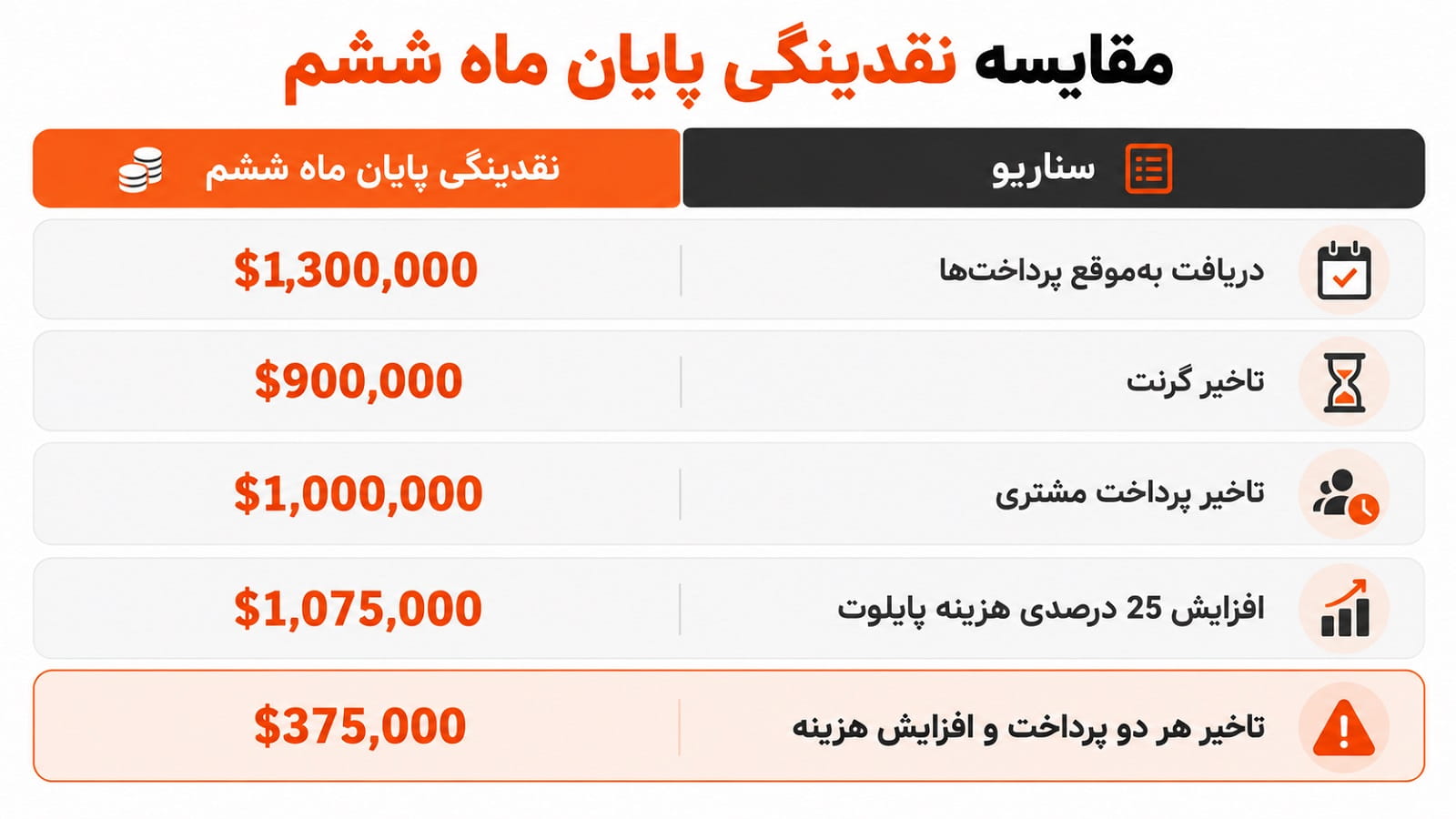
The base calculation starts with $2.4 million, subtracts $900,000 in six months of recurring operating payments and $900,000 for the pilot, then adds the $400,000 grant and $300,000 customer payment. Closing cash is therefore $1.3 million. If the grant arrives after month six, closing cash falls to $900,000 even though the planned demonstration spending has not changed. Under the combined downside case, closing cash falls to just $375,000.
This example shows why a climate startup can have a credible technology, a grant award, and a commercial customer but still experience a funding gap. The critical risks are not limited to the final project cost. They also include payment conditions, the order in which money must be spent, and whether the company can continue operating while it waits for reimbursement or customer acceptance. An updated forecast should model the exact monthly payment dates instead of relying only on the six month totals.
How to Build a Credible Climate Tech Funding Plan
The first step is to define the next milestone precisely. Rather than requesting a general amount for growth, founders can estimate the cost of achieving a specific objective such as an independently verified pilot, first customer deployment, or reliable manufacturing output. That estimate should include a detailed spending schedule, technical contingencies, and the expected time required for permits, procurement, and installation. The plan should also distinguish essential spending from activities that can be delayed without compromising safety or contracted obligations.
Next, founders should match each source of capital to a suitable use. Research grants might support eligible testing, venture equity might pay for staff and development uncertainty, and a customer payment might finance part of a contracted installation if its timing is sufficiently dependable. Equipment financing should be considered only when the company can meet the relevant security and repayment conditions. A prospective grant should appear in an upside or conditional case until an award and payment requirements have been confirmed.
Finally, management should create a cash forecast that accounts for the timing of every major receipt and payment. A signed contract does not eliminate the possibility of delayed acceptance, and an announced project financing facility may require conditions to be satisfied before funds can be drawn. Testing scenarios with higher construction costs, slower procurement, or deferred customer payments helps identify the minimum liquidity reserve needed to complete the next milestone. Founders should present these uncertainties openly rather than conceal them behind a single optimistic forecast.
Policy, Geography, and Commercial Risk
Climate financing is influenced by regulation, electricity prices, grid access, industrial demand, and the structure of public support. These conditions vary by country, and their effects differ among energy software, battery manufacturing, agriculture, and carbon removal projects. An incentive that makes one technology attractive in a particular market may be unavailable or less valuable elsewhere. Founders should demonstrate that they understand the rules and commercial conditions applying to their first intended customers.
Policy support can improve project economics, but it should not be treated as permanent or guaranteed. The International Energy Agency has highlighted difficulties obtaining offtake agreements and reaching final investment decisions in some carbon capture, utilization, and storage projects. Those challenges illustrate how technical promise can fail to translate into financed deployment when buyers, infrastructure partners, or risk allocation remain uncertain. A robust business plan explains what happens if an incentive changes or a critical commercial partner delays its commitment.
Common Climate Tech Fundraising Mistakes
A frequent error is using broad clean energy investment totals as if they represent venture capital available to startups. Another is presenting projected emissions reductions without credible technical validation or customer economics. Investors may also question forecasts that assume prototype manufacturing costs will remain unchanged at industrial scale or that every demonstration will lead immediately to repeat orders. A convincing financing plan should identify where evidence exists and where assumptions still need testing.
Climate Tech Funding Outlook Beyond 2026
Demand for reliable power, industrial efficiency, storage, and climate resilience may continue to create commercial opportunities, but financing conditions will vary by technology and region. Capital could move toward companies able to demonstrate operating installations and repeatable customer economics, while less mature technologies may remain dependent on patient equity and targeted public support. The distinction between developing an invention and financing many commercial deployments is likely to remain essential.
Final Thoughts
Climate tech funding requires more than an appealing environmental mission or a promising laboratory result. Founders must connect technical validation with customer value, deployment economics, and financing structures that fit the risks at each development stage. Venture capital can finance uncertainty, but pilot grants, commercial commitments, and suitable project finance may become equally important as the technology approaches deployment.
The ThermalForge example shows how delayed receipts and construction overruns can reshape liquidity even when a pilot has a plausible commercial case. A strong funding strategy identifies those risks early and gives founders enough financial flexibility to complete meaningful milestones. The aim is not simply to secure a large round, but to finance a credible path from invention to repeatable commercial delivery.
FAQ
What Is Climate Tech Funding?
Climate tech funding is financing provided to businesses developing technologies related to climate mitigation, adaptation, and resource efficiency. It can include venture capital, grants, corporate investment, customer payments, equipment finance, and project finance depending on the company's stage and commercial structure.
How Do Climate Tech Startups Raise Funding?
They typically begin by identifying the technical or commercial milestone that funding must achieve and selecting investors or programs suited to that risk. Strong applications connect credible performance evidence with a spending plan, customer demand, and realistic assumptions about when money will be received.
Can a Climate Startup Get Funding Without Revenue?
Yes. Early research and prototype companies may attract grants or equity investment before earning commercial revenue. Investors will still expect a credible path to technical validation, an identifiable customer need, and a realistic estimate of the capital required for subsequent stages.
What Is the Difference Between Climate Venture Capital and Project Finance?
Venture capital generally invests in company ownership and accepts significant development uncertainty. Project finance is arranged around a defined project and its expected cash flows, contracts, assets, and allocation of risk. It is usually more suitable when commercial performance and repayment capacity can be supported by evidence.
Are Climate Tech Grants Free Money?
Grants typically do not require equity dilution or ordinary loan repayment, but they are not unrestricted cash. Programs may set eligibility rules, approved uses, reporting obligations, matching requirements, and conditions under which payments can be withheld or recovered.
Why Are Offtake Agreements Important?
An offtake agreement can demonstrate that a customer intends to purchase future output under defined terms, which may support investment or lending discussions. However, its value depends on enforceability, buyer credit quality, delivery conditions, and whether cash is paid in advance or only after successful performance.

Mobina Khanki
Venture & Funding Writer at PinerookMobina Khanki covers venture capital, startup funding, fundraising, and startup finance for Pinerook, focusing on founders and investors.
 Seen first.