Acquiring customers is essential for startup growth, but the number of new customers alone does not reveal whether the company is growing efficiently. A startup might double its customer base while spending disproportionately more on advertising, salespeople, and marketing activities. If acquisition expenses increase faster than the financial value customers create, growth can place additional pressure on the business rather than strengthen it.
Customer acquisition cost, commonly known as CAC, helps founders measure the resources required to gain each new paying customer. Within the broader framework of Startup Finance, this metric connects sales and marketing investment with revenue quality, capital efficiency, and sustainable growth. Calculating it accurately requires more than dividing advertising expenditure by conversions because customer acquisition often involves several teams, tools, and stages.
This guide explains how to calculate customer acquisition cost for startups, identify the expenses that belong in the calculation, evaluate acquisition performance across channels, and reduce unnecessary spending. It also includes a complete financial example, a channel comparison, and practical methods for determining whether additional acquisition investment is justified.
What Is Customer Acquisition Cost?
Customer acquisition cost is the average amount a business spends to acquire one new paying customer during a defined period.
The calculation includes relevant sales and marketing expenses incurred to attract potential customers and convert them into paying customers.
For example, if a startup spends $30,000 on customer acquisition activities and gains 60 new paying customers, its average CAC is $500.
However, the reliability of this number depends on how accurately the company measures acquisition spending and identifies genuinely new customers.
A business may pay for advertising, sales compensation, marketing software, content production, and outside contractors. Excluding substantial acquisition expenses can make customer growth appear more efficient than it actually is.
The purpose of CAC is not simply to find the cheapest customers. It is to understand whether the resources invested in attracting customers can generate an acceptable financial return.
Why Customer Acquisition Cost Matters for Startups
Startups frequently invest in marketing and sales before receiving enough customer revenue to recover those costs.
A business may spend heavily on advertising to enter a new market or hire salespeople months before contracts are completed. These investments can support future growth, but they create financial commitments that founders need to evaluate.
CAC provides a common measurement for understanding acquisition efficiency.
When calculated consistently, it allows management to compare spending across periods, investigate changes in marketing performance, and evaluate whether customer growth is becoming more expensive.
The metric is also useful for financial forecasting. If a startup plans to acquire 200 new customers at an expected CAC of $400, it may need approximately $80,000 in acquisition spending under that assumption.
However, scaling an acquisition strategy can change the cost of reaching additional customers. Historical averages should therefore be treated as planning inputs rather than guaranteed future results.
Customer Acquisition Cost Formula
The standard customer acquisition cost formula is:
CAC = Total sales and marketing acquisition costs ÷ Number of new paying customers acquired
Both figures should represent an appropriately matched measurement period.
Suppose a startup spends $48,000 on relevant sales and marketing activities during a quarter and acquires 80 new paying customers.
CAC = $48,000 ÷ 80 = $600
The result means the business spent an average of $600 to acquire each new customer under the selected cost definition.
The formula is simple, but calculating the underlying figures correctly requires a consistent process.
How to Calculate Customer Acquisition Cost Step by Step
Select a Relevant Measurement Period
Start by deciding whether to calculate CAC monthly, quarterly, or over a longer period.
A monthly calculation may be appropriate for businesses where customers convert quickly. Startups with lengthy sales cycles may find quarterly or cohort based measurements more informative.
For example, a company selling enterprise software may spend money generating leads in January while customers complete contracts in April.
Dividing January spending by January conversions could provide a misleading estimate if those conversions resulted from previous acquisition activity.
Founders should understand their typical conversion timeline and use consistent methods when comparing results.
Identify Acquisition Related Expenses
Review the spending required to attract and convert new customers.
This often includes paid advertising, sales compensation, acquisition focused content, agency fees, commissions, and software used by sales and marketing teams.
Shared expenses should be allocated using a reasonable and documented method.
For example, if an employee spends 60% of their working time acquiring new customers and the remaining time supporting existing accounts, assigning the entire compensation expense to acquisition would distort CAC.
The same principle applies to software tools and outside contractors that support multiple business functions.
Count New Paying Customers
The denominator should represent the number of genuinely new customers acquired under a consistent definition.
A lead is not necessarily a customer. Someone downloading a report, registering for a free trial, or subscribing to a newsletter should not automatically be counted as a new paying customer.
For a subscription startup, the company might count accounts that begin their first paid subscription.
For an ecommerce business, the relevant measurement may be customers completing their first purchase.
Returning customers and existing customers upgrading their plans generally require separate treatment.
If the startup acquires no paying customers during a reporting period, the basic CAC formula cannot produce a meaningful finite result for that period.
Calculate and Verify the Result
After establishing the acquisition expenditure and customer count, divide total costs by the number of new customers.
Management should verify the result against accounting records, advertising reports, and customer transaction data.
A sudden decline in CAC may be genuine, but it could also result from omitted expenses or customers being counted more than once.
Documenting the calculation makes future comparisons more reliable.
Which Costs Should Be Included in CAC?
A comprehensive CAC calculation should capture the resources used to acquire customers, not merely the amount spent purchasing advertisements.
Paid advertising commonly includes search advertising, social campaigns, and other promotional placements.
Sales and marketing compensation may include salaries, commissions, bonuses, and relevant employment costs.
Acquisition focused content production, landing pages, webinars, creative assets, and outside marketing services may also contribute to the acquisition process.
Software expenses can include customer relationship management platforms, marketing automation, analytics, and lead generation tools to the extent that they support acquisition.
Founder involvement deserves attention as well. During the earliest stages, founders often conduct sales activities without receiving a separate sales salary. A cash spending calculation may exclude unpaid work, but an economic analysis can estimate its value separately to avoid understating the resources required when the business eventually hires a sales team.
The important requirement is consistency. Each expense should have a clear relationship to customer acquisition and a documented method of allocation.
Expenses That Should Not Automatically Be Included
Not every business expense belongs in customer acquisition cost.
Core product development, general infrastructure, routine customer support, and ordinary service delivery costs should generally be evaluated separately unless a specific portion genuinely supports acquisition.
Spending dedicated to retaining existing customers also needs separate treatment.
For example, a loyalty campaign intended to encourage existing customers to purchase again is not equivalent to a campaign acquiring first time customers.
Similarly, customer onboarding may contain both acquisition and postpurchase service activities. Founders should identify the purpose of the spending before assigning it to CAC.
A consistent distinction between acquisition, retention, and delivery costs helps prevent the same expense from being counted in multiple financial measures.
Customer Acquisition Cost Calculation Example
Consider Northstar Cloud, a fictional software startup selling monthly subscriptions to small businesses.
During one quarter, the company acquires 120 new paying customers through paid advertising, content marketing, sales outreach, and partnerships.
Its finance team reviews spending across all acquisition activities, including shared personnel and software expenses allocated to customer acquisition.
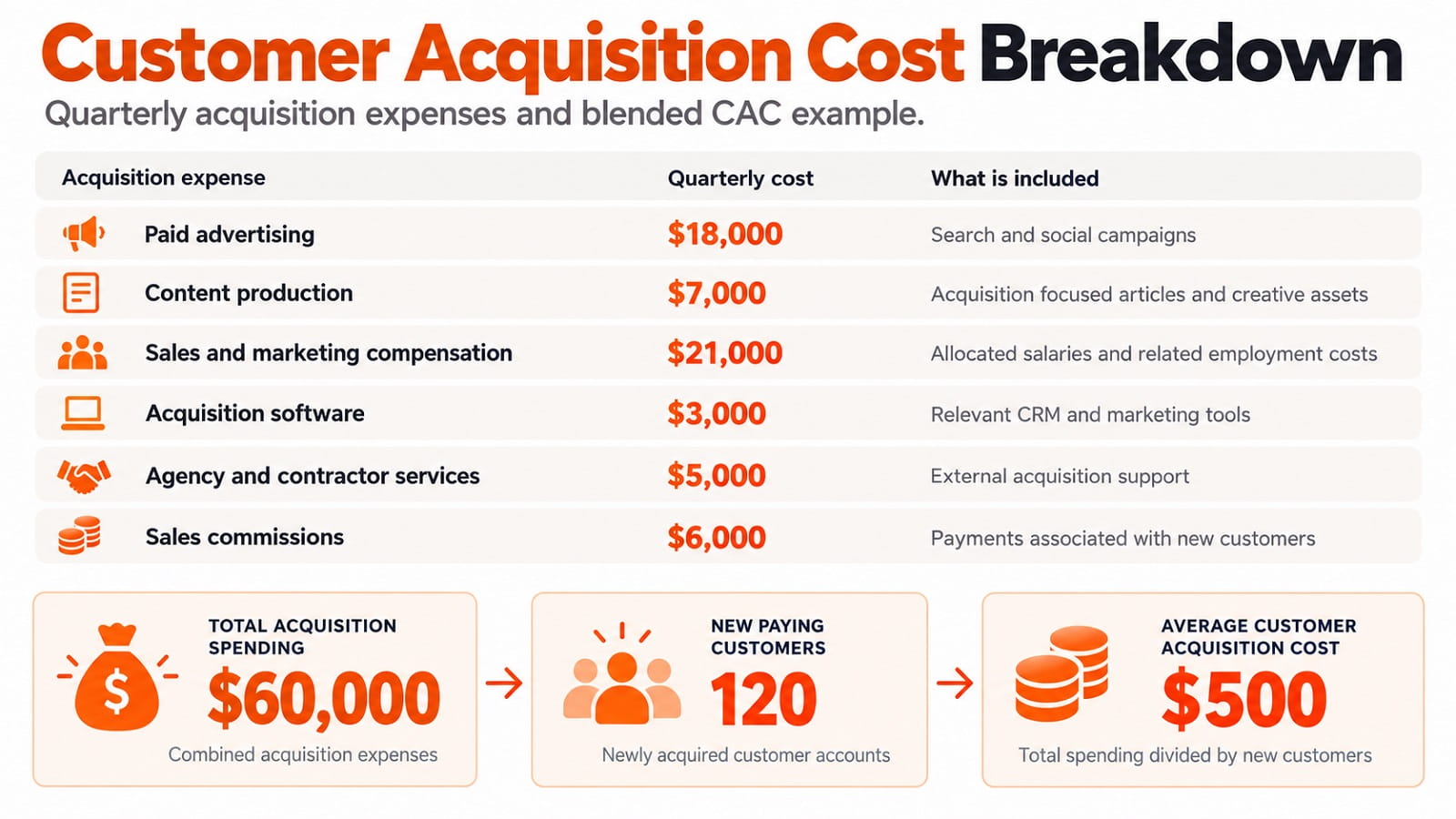
Northstar's quarterly CAC is:
CAC = $60,000 ÷ 120 = $500
If management had counted only the $18,000 advertising expense, the calculation would have produced $150 per customer.
That result would substantially understate the resources required to generate the company's overall customer growth.
The difference demonstrates why founders need a complete view of sales and marketing costs.
However, the $500 figure is a blended average. It does not reveal whether individual acquisition channels perform equally well.
Blended CAC vs. Paid CAC
Blended CAC measures acquisition spending across the defined business acquisition activities divided by the total number of new customers acquired.
It gives founders an overall view of the financial cost of customer growth.
Paid CAC focuses on customers acquired through paid channels and the costs assigned to those channels.
The result depends on the selected definition. An advertising platform may report advertising spend divided by attributed conversions, while a more comprehensive paid channel calculation also includes relevant creative, personnel, and software costs.
These figures are not interchangeable.
An advertising campaign may appear inexpensive when evaluated using media spending alone, while the fully allocated customer acquisition cost is considerably higher.
Founders should label each calculation clearly and avoid comparing measurements based on different expense definitions.
Both company wide and channel specific measurements are useful when calculated consistently.
Comparing Customer Acquisition Cost by Channel
Northstar Cloud receives customers through four acquisition channels.
Management allocates acquisition expenses across channels using relevant campaign spending, employee time, software usage, and attributable commissions.
The allocations reconcile to the company's total quarterly acquisition spending of $60,000. Each newly acquired customer is assigned to one channel for this management report.
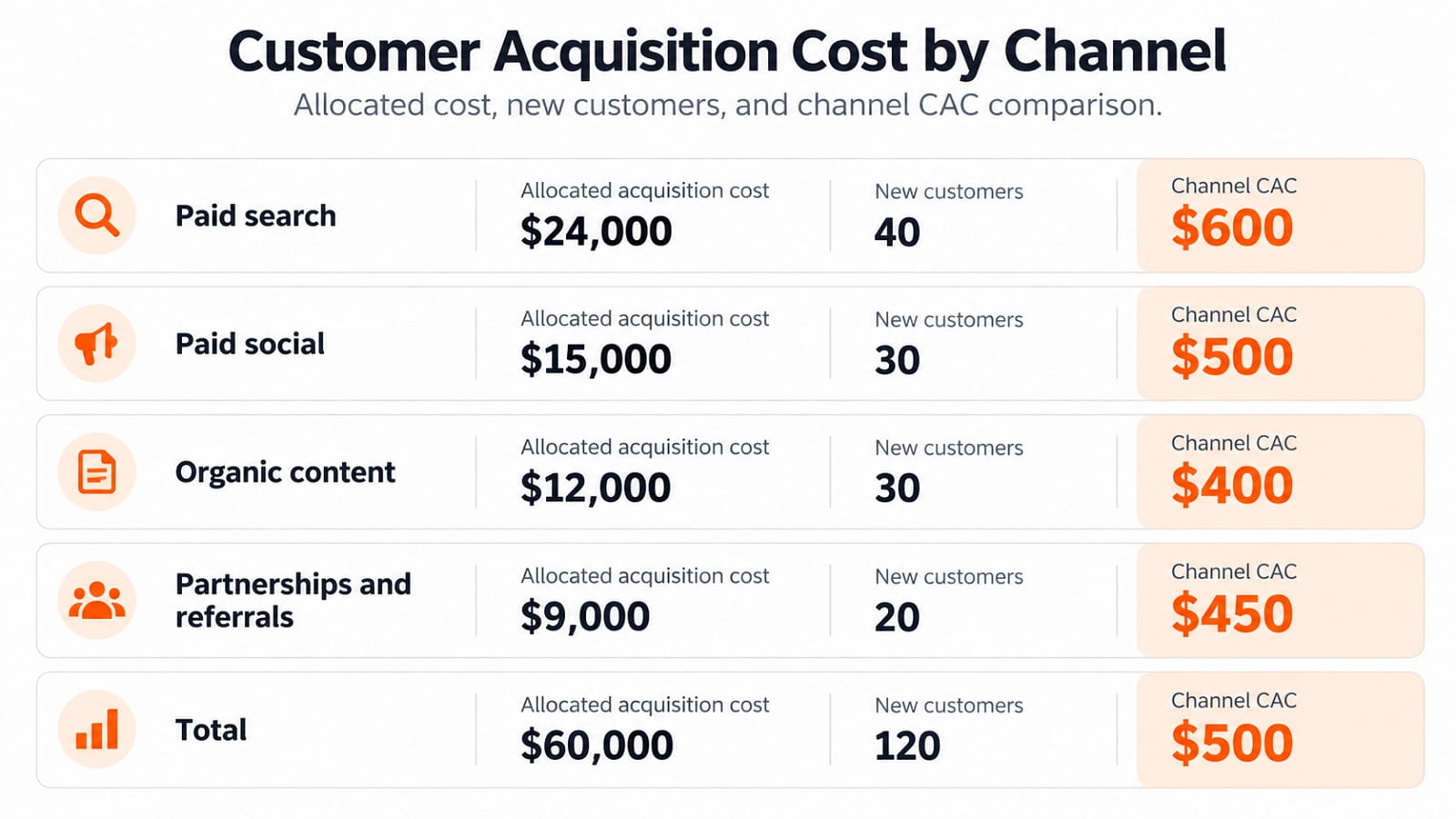
Organic content produces the lowest reported CAC at $400, while paid search has the highest at $600.
However, this does not automatically mean that organic content is the best source of customers.
Paid search might attract larger accounts with higher recurring revenue or stronger retention. Organic content may also depend on investments made during earlier periods that are not fully represented in the current quarter.
The table is a management allocation, not proof that each channel independently caused every assigned acquisition.
Founders should consider customer quality, acquisition volume, conversion timing, and the reliability of attribution before changing budgets.
Understanding Customer Acquisition Attribution
Customers rarely interact with only one marketing activity before purchasing.
A potential customer might discover the business through an article, later see a social advertisement, attend a webinar, and finally complete a purchase after speaking with a salesperson.
Attributing the entire conversion to the final interaction can overstate one channel's contribution while understating others.
Different attribution methods distribute credit differently. These include assigning credit to the first interaction, the final interaction, or multiple interactions during the buying process.
No attribution model can perfectly establish what would have happened without each marketing activity.
Founders should use a consistent model, reconcile customers against actual purchases, and avoid treating platform reported conversions as automatically equal to unique new customers.
Where possible, controlled experiments and changes in overall acquisition performance can provide additional evidence about the incremental value of marketing expenditure.
CAC vs. Cost per Lead and Cost per Acquisition
Several marketing metrics use similar terminology but measure different outcomes.
Cost per lead measures the spending required to generate a lead, which may or may not become a customer.
Cost per acquisition is a broader advertising term that can describe the cost of generating a defined action, such as a registration, app installation, or purchase.
Customer acquisition cost specifically focuses on the cost of acquiring a new customer using the selected customer definition and relevant spending.
Consider a campaign generating 200 leads for $10,000.
Its cost per lead is $50.
If 20 of those leads become paying customers, the campaign's direct spending per new paying customer is $500.
The company's fully allocated CAC could be higher after including relevant sales, software, and personnel expenses.
Founders should therefore avoid using lead generation results as a substitute for actual customer acquisition efficiency.
CAC Payback Period and Customer Value
A lower acquisition cost is generally helpful when customer quality remains comparable, but CAC cannot be evaluated through spending alone.
Founders also need to understand how much financial contribution acquired customers generate and how quickly acquisition spending may be recovered.
Consider Northstar's blended CAC of $500.
Suppose an average newly acquired account generates $125 in monthly recurring revenue and has an 80% gross margin.
Monthly gross profit per customer = $125 × 80% = $100
Estimated CAC payback = $500 ÷ $100 = 5 months
Under constant revenue, margin, and retention assumptions, approximately five months of gross profit would recover the initial acquisition expense.
This simplified calculation does not account for changes in customer spending, collection delays, or every operating expense.
Customer lifetime value provides another perspective by estimating financial contribution across the customer relationship.
However, an optimistic lifetime value estimate should not be used to justify high acquisition spending without dependable retention evidence.
Payback period, customer contribution, and retention provide essential context for evaluating CAC.
What Is a Good Customer Acquisition Cost for a Startup?
There is no universal CAC amount that every startup should target.
A $500 acquisition cost could be excessive for a business earning only $30 in contribution from a customer. The same amount may be reasonable for a subscription company generating substantial recurring gross profit over several years.
The appropriate level depends on customer revenue, gross contribution, retention, payment timing, and the capital required to support growth.
Business models also differ. Enterprise software companies may spend substantial amounts on sales processes, while consumer ecommerce businesses often rely on faster purchasing decisions.
Rather than selecting an arbitrary industry average, founders should establish a target using their own customer economics and financial capacity.
A useful question is whether the company can recover acquisition spending within a period consistent with its financial resources and growth objectives.
How CAC Changes as a Startup Scales
Customer acquisition cost does not necessarily remain constant as spending increases.
Early customers may be easier to acquire because they have an immediate need for the product or already know the founders.
Reaching a broader market may require additional advertising, more salespeople, or longer customer education.
For example, Northstar currently spends $24,000 through its paid search channel and acquires 40 customers, producing a channel CAC of $600.
Suppose it increases allocated paid search spending to $32,000 but gains only 10 additional customers.
The incremental acquisition cost for those additional customers would be:
Incremental CAC = $8,000 ÷ 10 = $800
The channel's new average CAC would be $32,000 divided by 50 customers, or $640.
This distinction matters because the cost of acquiring the next customer can be higher than the historical average.
Founders should evaluate incremental acquisition performance before assuming that a successful channel can absorb unlimited additional spending.
How to Reduce Customer Acquisition Cost
Reducing CAC should involve improving the efficiency of customer acquisition rather than indiscriminately cutting marketing budgets.
Improve Conversion Rates
Increasing the proportion of qualified prospects who become paying customers can reduce acquisition cost without requiring lower spending.
A startup can examine landing page performance, trial activation, sales communication, and the purchasing process.
For example, simplifying an unnecessarily complicated checkout process may increase completed purchases from existing traffic.
However, higher conversion rates should be evaluated alongside customer quality and refund behavior.
Refine Customer Targeting
Broad campaigns may attract large numbers of visitors who have little intention of purchasing.
Clearer customer segmentation helps marketing teams focus spending on audiences more likely to need the product.
Founders can compare acquisition costs and customer outcomes across industries, company sizes, geographic markets, and other relevant segments.
The objective is to reach customers whose needs match the product rather than simply generate inexpensive traffic.
Improve Sales Process Efficiency
Sales teams can consume substantial resources through repeated meetings, lengthy qualification processes, and manual administrative work.
Clear qualification criteria, useful product information, and appropriate automation may help reduce unnecessary effort.
A more efficient process allows employees to spend more time on qualified opportunities without compromising customer experience.
Develop Sustainable Organic Acquisition
Educational content, search visibility, referrals, and partnerships can support customer acquisition without relying entirely on advertising expenditure.
However, these channels are not free.
Content production, technical maintenance, partnership management, and staff time still require resources.
Their financial advantage should be assessed through actual acquisition cost and customer contribution rather than assuming that unpaid traffic has no associated expense.
Improve Retention and Customer Experience
Retention improvements do not directly reduce historical CAC, because the amount originally spent acquiring a customer remains unchanged.
However, stronger retention may increase the contribution generated by acquired customers, allowing the business to support acquisition spending more sustainably.
Satisfied customers may also generate referrals that improve future acquisition efficiency.
Founders should distinguish these benefits rather than reporting improved retention as an automatic reduction in the original acquisition cost.
Customer Acquisition Cost at Different Startup Stages
An early stage startup may acquire its first customers through founder relationships, manual outreach, or a limited number of small campaigns.
At this stage, the sample size may be too small to produce a stable CAC estimate. Founder time also needs careful consideration if the business expects to replace manual selling with paid employees.
As the startup establishes repeatable acquisition processes, management can begin comparing spending across channels and customer segments.
During expansion, the focus shifts toward incremental CAC, acquisition capacity, payback periods, and the effect of spending decisions on available financial resources.
A mature acquisition dashboard may also compare customer cohorts to determine whether newer customers remain economically attractive.
The appropriate reporting system should become more sophisticated as the business gains reliable transaction data and faces more complex investment decisions.
Where CAC Calculations Become Misleading
Several reporting practices can distort acquisition efficiency.
Counting leads, registrations, or free trial users as paying customers can substantially understate CAC when many prospects never purchase.
Excluding relevant sales salaries, agency costs, or marketing software creates a similar problem.
Another issue occurs when spending and customers belong to different acquisition periods. This is particularly important for businesses with lengthy sales cycles.
Founders may also count the same customer in multiple channels or classify an existing customer's repeat purchase as a new acquisition.
Using only advertising platform reports can produce misleading results when attribution definitions differ from actual customer records.
Finally, a low CAC should not automatically be interpreted as evidence of a successful growth strategy. Customers acquired inexpensively may contribute little value or leave shortly after purchasing.
The metric should be calculated consistently and interpreted alongside customer quality and financial contribution.
How Often Should Founders Review CAC?
Review frequency should reflect transaction volume, sales cycle length, and the company's financial position.
Startups running substantial advertising campaigns may benefit from weekly operational monitoring of spending, leads, and conversions.
However, fully allocated CAC may be more meaningful when calculated monthly or quarterly, particularly when sales and marketing expenses require reconciliation.
Management should compare results with earlier periods and investigate material differences.
A useful review examines total acquisition spending, new paying customers, blended CAC, channel CAC, and changes in customer quality.
The purpose is to identify whether changes reflect genuine efficiency improvements, temporary timing differences, or shifts in customer behavior.
Financial decisions should rely on a sufficiently consistent period of evidence rather than one unusually successful or unsuccessful campaign.
Final Thoughts
Customer acquisition cost helps founders understand the financial resources required to turn prospects into paying customers. Its value depends on accurately measuring acquisition spending, consistently identifying new customers, and recognizing the limitations of simple averages.
The Northstar example demonstrates why advertising expenditure alone does not provide a complete picture of acquisition efficiency. A comprehensive calculation produces a more reliable understanding of customer growth, while channel comparisons reveal where additional investigation may be necessary.
Founders should evaluate CAC alongside customer contribution, payback timing, acquisition volume, and financial capacity. They should also examine the incremental cost of expansion because the next customers acquired may be more expensive than previous ones.
The objective is not to minimize acquisition spending at every opportunity. It is to invest in customer growth that creates sufficient economic value to support a sustainable business.
FAQ
What Is Customer Acquisition Cost for Startups?
Customer acquisition cost is the average amount a startup spends to gain one new paying customer. It includes relevant sales and marketing expenses divided by the number of new customers acquired under a consistent measurement method.
How Do You Calculate CAC?
Divide total sales and marketing acquisition spending by the number of new paying customers. For example, spending $20,000 to acquire 50 customers produces an average CAC of $400.
Does Customer Acquisition Cost Include Salaries?
Yes, salaries and related employment expenses associated with acquiring customers should generally be included. When employees divide their time between acquisition and other activities, the relevant portion should be allocated consistently.
Is CAC the Same as Cost per Lead?
No. Cost per lead measures the cost of generating potential customer interest. CAC measures the cost of acquiring paying customers. Because not every lead converts, the two measurements can differ considerably.
What Is the Difference Between Paid and Blended CAC?
Blended CAC measures acquisition expenses across the defined company acquisition activities and divides them by total new customers. Paid CAC focuses on spending and customers associated with paid acquisition channels, using a clearly specified cost definition.
What Is a Good CAC for a SaaS Startup?
There is no universally appropriate amount. SaaS founders should compare CAC with customer gross contribution, expected retention, acquisition payback, and available financial resources. Higher acquisition costs may be sustainable when customers generate sufficient recurring contribution.
Can Customer Acquisition Cost Increase as a Startup Grows?
Yes. Reaching additional customers may require more expensive advertising, greater sales capacity, or entry into competitive markets. Founders should monitor the cost of acquiring additional customers rather than relying entirely on historical averages.
How Can Startups Reduce Customer Acquisition Cost?
Startups can improve acquisition efficiency through better targeting, stronger conversion rates, more efficient sales processes, and economically effective acquisition channels. The impact of these actions should be evaluated alongside customer quality and retention.

Mobina Khanki
Venture & Funding Writer at PinerookMobina Khanki covers venture capital, startup funding, fundraising, and startup finance for Pinerook, focusing on founders and investors.
 Seen first.