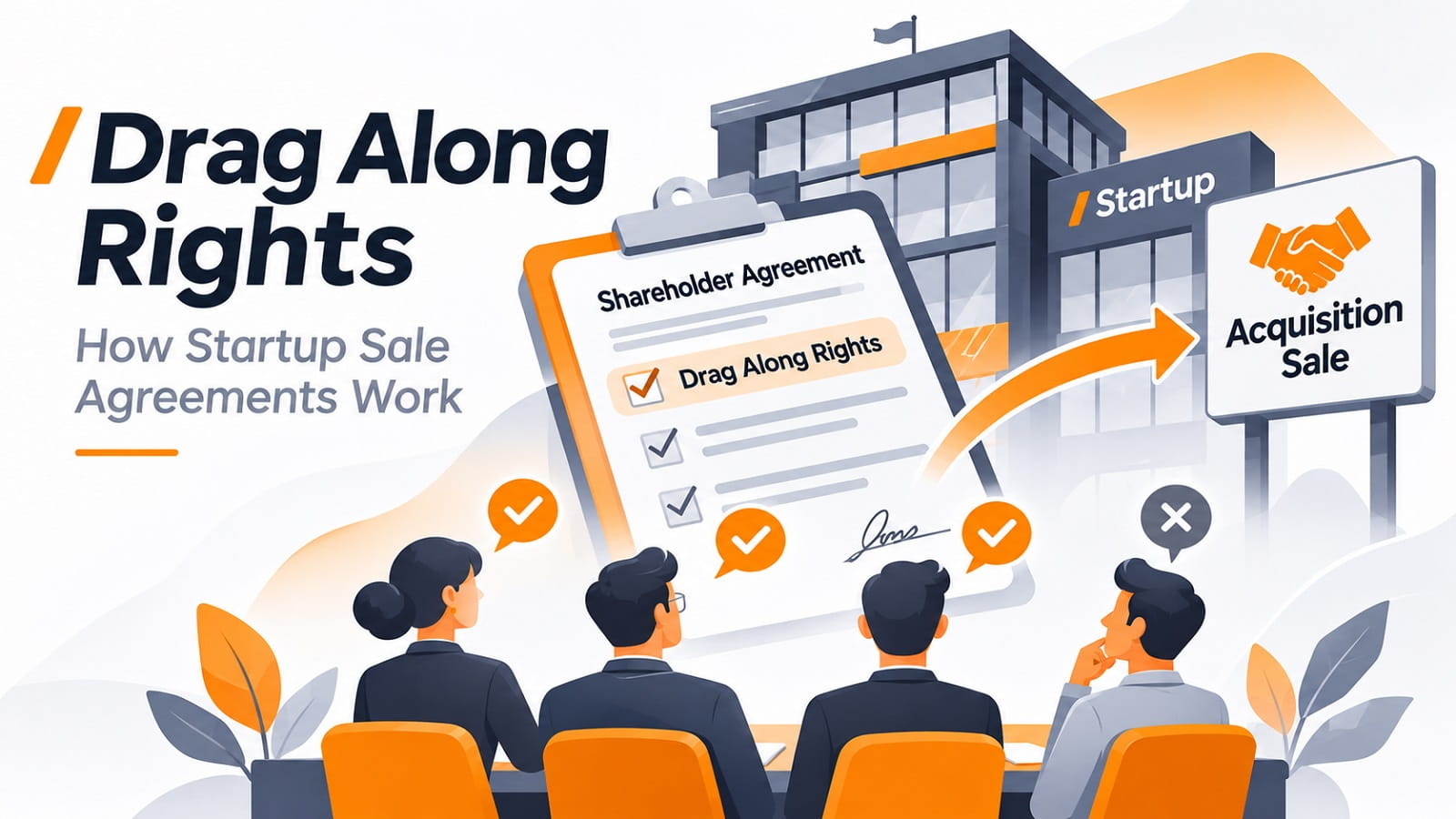
A startup may receive an acquisition offer supported by its board and major investors while some shareholders refuse to approve the transaction. Those shareholders may disagree with the sale price, prefer to keep building the company, or object to particular terms offered by the buyer. When an acquisition requires broad shareholder cooperation, these disagreements can create delays or even prevent the company from completing an otherwise acceptable sale. Drag along rights provide a contractual mechanism for addressing that risk.
Within Term Sheets and Investment Deals, drag along rights establish when specified approvals can require other shareholders to support a proposed sale. They are particularly important for venture backed companies with multiple founders, several investor groups, and a growing shareholder base. However, the existence of a drag along provision does not mean any single shareholder can automatically force the company to sell. The agreement must establish who can activate the provision, which transactions are covered, and what conditions protect participating shareholders.
Understanding these rights requires separating the commercial decision to sell a company from the contractual obligations imposed on its shareholders. The approval thresholds, required notices, financial protections, and legal documents all influence how the arrangement operates. This guide explains those elements and uses a practical voting example to show when a drag along provision may become effective.
Understanding Drag Along Rights in Startups
Drag along rights are contractual rights that can require certain shareholders to support or participate in a qualifying company sale once the approvals specified in an agreement have been obtained. The mechanism is designed to facilitate transactions that might otherwise be delayed by shareholders who refuse to cooperate.
In a typical venture backed company, the obligation may appear in a voting agreement signed by founders, investors, and other specified shareholders. The agreement can require covered shareholders to vote in favor of an approved transaction, execute necessary documents, or take other actions associated with completing the sale.
The right does not independently establish that a proposed transaction is lawful or properly approved. Applicable corporate law, governing documents, director responsibilities, and other contractual requirements must still be satisfied.
It is also important to distinguish a contractual obligation from automatic transfer of ownership. Depending on the transaction structure, the provision may require shareholders to provide votes, deliver shares, or complete specified documentation. The practical steps depend on how the sale is structured and how the agreement is drafted.
Why Drag Along Rights Matter During an Acquisition
A company preparing for acquisition may have shareholders with very different interests. Founders might want to accept an offer that provides substantial liquidity, while some investors may prefer to wait for a higher valuation. Alternatively, investors may favor a sale that founders believe undervalues the company's long term potential.
The buyer may also have its own requirements. Some buyers want to acquire all outstanding shares, obtain broad shareholder support, or reduce the risk of disputes after the transaction closes.
Without a contractual mechanism addressing shareholder cooperation, a minority holder may complicate a transaction by refusing to sign documents or provide approvals that the buyer expects.
Drag along provisions can make the transaction process more predictable by establishing obligations before an acquisition opportunity arises. Rather than negotiating shareholder cooperation individually during a time sensitive sale process, the company can rely on an agreed framework when its conditions are satisfied.
However, the commercial benefit depends on whether the provision is balanced. A right that can be activated without meaningful founder participation or appropriate shareholder protections may create substantial risks for the people required to support the sale.
Transactions Covered by Drag Along Provisions
Not every transfer of company shares necessarily activates a drag along right. The agreement normally defines the type of transaction that qualifies as a sale of the company.
A qualifying transaction may include a merger, acquisition of a specified percentage of voting securities, or another event covered by the applicable definition. Some agreements refer to deemed liquidation events described in the company's certificate of incorporation.
The scope matters because different acquisitions involve different legal mechanics. A merger may require formal board and shareholder approvals, while a stock purchase can involve selling shareholders transferring their securities directly to a buyer.
An asset sale introduces additional considerations because the company may receive the purchase proceeds before any distributions are made to shareholders.
Founders should therefore confirm precisely which transactions are included. A broad reference to any transfer of shares can create a different obligation from a provision limited to an approved sale of the entire company.
Who Can Trigger Drag Along Rights?
The central negotiation question is which parties must approve a sale before the drag along mechanism can be activated.
Some agreements require approval from a specified percentage of preferred shareholders. Others also require approval from founders or qualifying common shareholders, either as a separate group or through another defined voting threshold.
Board approval may form an additional condition. When several approval groups are required, the drag along provision ordinarily becomes available only when every specified condition is met.
For example, an agreement might require approval from the board, a majority of specified founder common shares, and a majority of outstanding preferred shares. Under that structure, preferred investors cannot activate the right without obtaining the necessary common shareholder and board approvals.
A different agreement might permit a qualifying preferred investor majority to initiate the provision without separate founder consent. This can create a more investor favorable arrangement, particularly when the investors' preferred economic rights make an acquisition attractive to them but less favorable to common shareholders.
The approval structure should reflect the company's circumstances rather than being accepted solely because a particular formulation appears in a model agreement.
The Contractual Terms Founders Should Review
A drag along provision should explain more than the percentage of shareholders required to approve a transaction. It should also identify the affected holders, their obligations, and the conditions under which those obligations apply.
The following table summarizes the principal contractual elements and the questions founders should examine during negotiation.
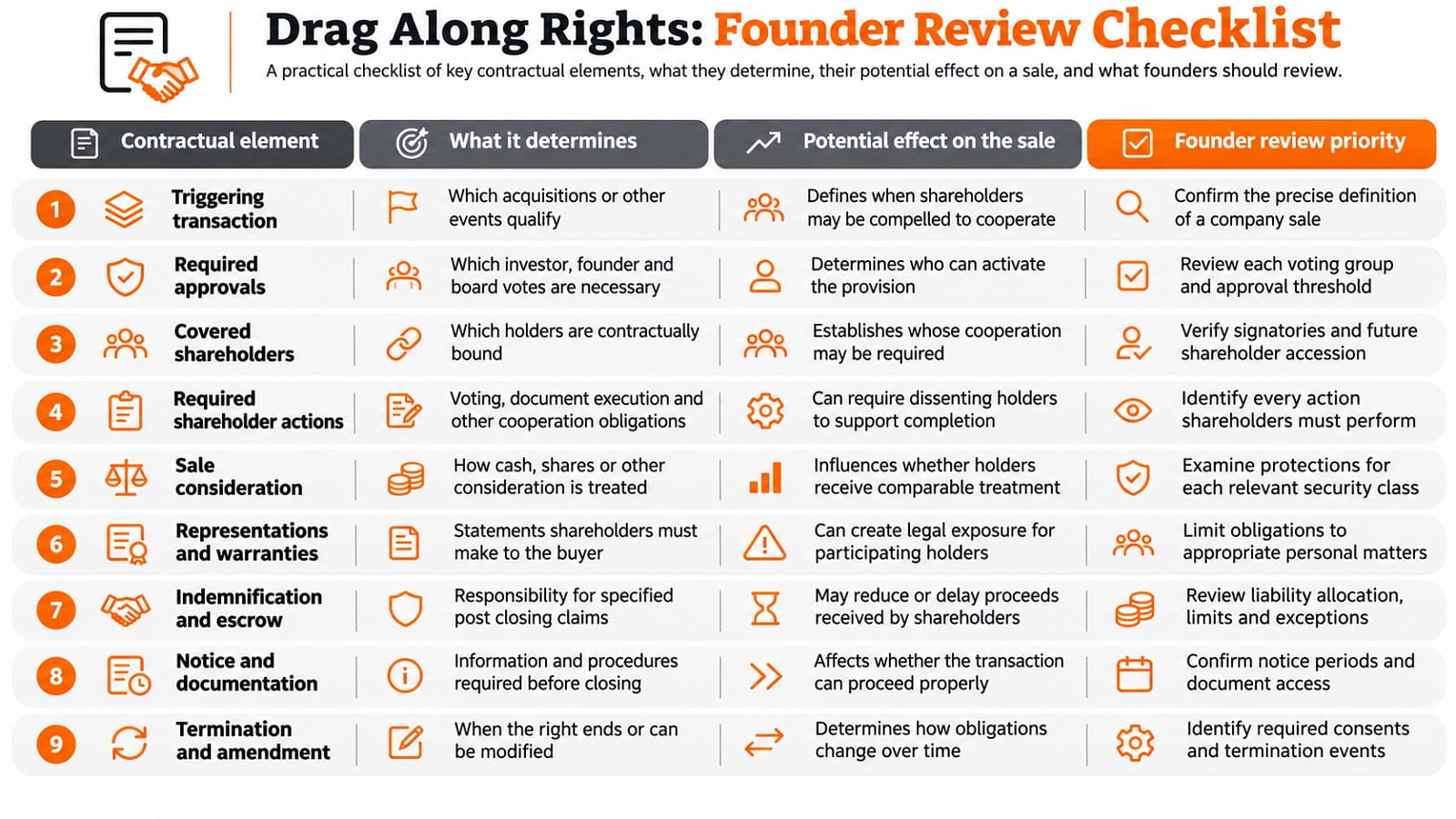
These provisions operate together. Even if a transaction obtains the necessary voting approvals, a shareholder may not be required to comply under the contract unless the additional conditions specified in the agreement are satisfied.
The wording of those conditions matters. For example, limiting a dragged shareholder's liability can prevent that person from being required to assume disproportionate responsibility for representations made by the company or another shareholder.
Founders should review the complete provision rather than relying on the general assumption that all drag along arrangements contain identical protections.
Understanding Multiple Approval Thresholds
A drag along agreement may contain several separate voting requirements. Those requirements should be interpreted according to the shareholder groups and security classes specified in the contract.
For example, a company might require a majority of designated common shareholders and a separate majority of preferred shareholders to support an acquisition. Approval from one group does not substitute for approval from the other.
A board approval requirement adds another condition. The number of directors supporting the sale must satisfy the relevant board voting rules and any contractual threshold.
The agreement should also clarify whether the approving shareholders must expressly invoke the drag along provision. Approval of a sale and approval to activate the contractual obligation may be distinct requirements.
Founders should avoid treating the combined votes of all shareholders as sufficient when the agreement requires separate class or group approvals. A proposal supported by 80% of the company's overall voting power can still fail to activate the mechanism if one required group has not approved it.
A Practical Drag Along Rights Voting Example
Consider Meridian Cloud, a fictional software startup with 10 million outstanding shares on an equivalent voting basis. Two founders hold common stock, while two investor groups hold preferred stock.
The ownership structure is as follows. Founder A holds 4 million common shares, representing 40% of the company. Founder B holds 2 million common shares, representing 20%. The Seed investor holds 1.5 million preferred shares, or 15%, while the Series A investor holds 2.5 million preferred shares, or 25%.
The company therefore has 6 million common shares and 4 million preferred shares. For the example, assume the preferred shares count equally on an as converted basis where relevant.
Meridian Cloud has a five member board. Its voting agreement provides that a qualifying sale can activate the drag along obligation only if the following three approvals are obtained: at least three of the five directors, holders of more than 50% of the founders' outstanding common shares, and holders of more than 50% of outstanding preferred shares.
The agreement also requires valid written approvals expressly invoking the provision, compliance with shareholder protection conditions, and satisfaction of all independently applicable legal requirements.
The following table compares five hypothetical approval scenarios.
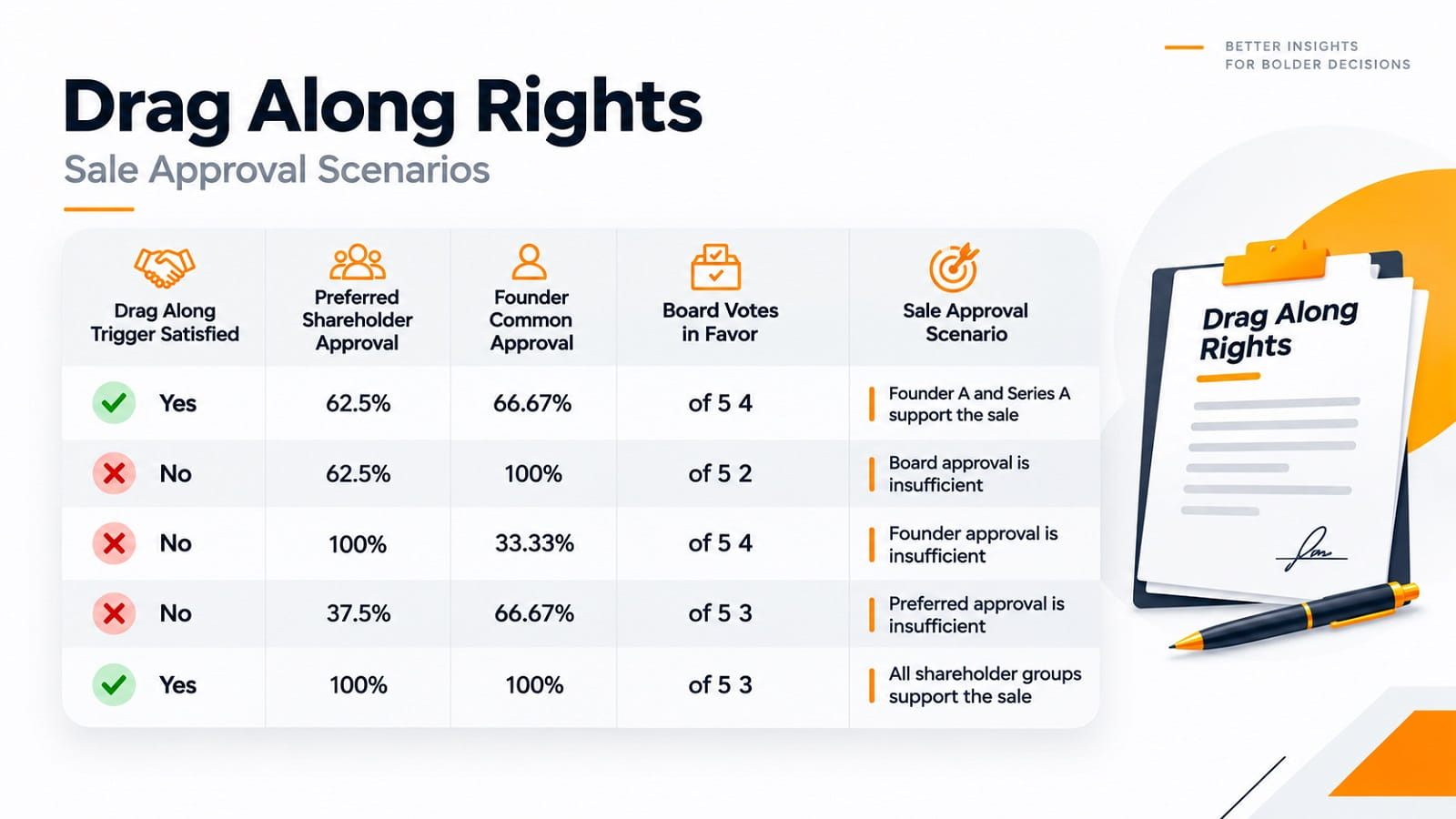
In the first scenario, Founder A controls 4 million of the 6 million common shares. This represents approximately 66.67% of the eligible common voting group, satisfying the required majority.
The Series A investor controls 2.5 million of the 4 million preferred shares, or 62.5% of the preferred group. With four directors also approving the transaction, all three numerical approval thresholds are satisfied.
Assuming the additional contractual and legal conditions are met, the agreement can require Founder B and the Seed investor to support the sale even though they did not participate in the initial approval.
The second scenario demonstrates that shareholder support does not replace a required board approval. With only two of five directors supporting the proposed sale, the contractual board threshold is not satisfied.
In the third scenario, Founder B alone controls approximately 33.33% of the founder common shares. Even unanimous preferred approval cannot substitute for the missing common shareholder majority.
The fourth scenario fails because the Seed investor holds only 37.5% of outstanding preferred shares. Although the board and qualifying founder majority support the sale, the required preferred approval is missing.
The final scenario satisfies all three numerical thresholds because both founders and both preferred investor groups support the transaction.
The calculation illustrates the approval mechanism, not whether any particular acquisition is fair or legally permissible. The company's actual governing documents and applicable law may impose additional requirements that cannot be replaced by the contractual formula.
Obligations After a Drag Along Trigger
Once the provision has been validly activated, covered shareholders may become contractually obligated to take specified actions supporting the approved sale.
These obligations can include voting in favor of the transaction, providing written consents, signing relevant transfer documents, and cooperating with reasonable closing procedures.
Depending on the agreement, shareholders may also be required to refrain from taking actions intended to obstruct a qualifying transaction or to accept an appointed shareholder representative for certain post closing matters.
The scope of these obligations should be clearly defined. A requirement to execute necessary transaction documents is different from agreeing to unlimited contractual liability for the company's historical operations.
Shareholders should understand the obligations they are accepting before a sale is proposed. Waiting until an acquisition is underway can leave little opportunity to negotiate the terms of participation.
Protections for Shareholders Required to Sell
A balanced drag along agreement should consider the interests of shareholders who do not control the decision to sell.
One important protection concerns the consideration received. Shareholders holding the same class of securities may seek comparable treatment, subject to the company's capital structure and applicable transaction terms.
However, equal participation in a sale does not necessarily mean identical proceeds per share across all classes. Preferred shareholders may have economic rights that affect distributions differently from the common shares held by founders and employees.
Another important safeguard concerns representations and warranties. A shareholder who is required to participate should not automatically be expected to make broad statements about the company's entire business.
Instead, contractual protections may limit that shareholder's representations to matters within the shareholder's knowledge or control, such as ownership of the shares, authority to enter into the transaction, and ability to transfer valid title.
The allocation of liability also matters. A dragged shareholder should examine whether indemnification obligations are separate for each holder and whether there is an appropriate limit based on the proceeds the holder receives.
The NVCA model voting agreement includes protective conditions addressing these matters, although the precise terms used in a completed transaction depend on negotiation and the selected contractual provisions.
Indemnification, Escrow and Post Closing Liability
Acquisition agreements often contain provisions addressing claims that arise after closing. Buyers may require sellers to make representations about the transaction and provide contractual remedies if specified statements prove inaccurate.
Some transactions also establish an escrow or holdback. Part of the purchase consideration may be withheld temporarily to cover specified claims or adjustments.
A shareholder required to participate in the sale should understand how these arrangements affect the timing and amount of the proceeds received.
The agreement should identify whether responsibility is allocated individually or collectively. Several liability generally means that each holder is responsible for its own allocated obligations rather than automatically becoming responsible for the entire amount owed by other shareholders.
A contractual liability cap may limit a shareholder's exposure by reference to the consideration payable to that holder. Exceptions for the shareholder's own fraud or other specifically negotiated circumstances may still apply.
These provisions are financially important even when the drag along approval thresholds are satisfied. The ability to compel cooperation should not be confused with an unrestricted right to impose liabilities unrelated to the shareholder's own conduct.
Drag Along Rights and Liquidation Preferences
A drag along provision determines when shareholders may be required to support a sale. It does not, by itself, determine how the sale proceeds are distributed.
Those distributions depend on the transaction terms, the rights of outstanding securities, applicable obligations, and the company's governing documents.
This distinction becomes especially important when preferred investors have priority distribution rights. An acquisition price that appears attractive at the company level may produce substantially different outcomes for preferred and common shareholders.
For example, a preferred investor may support an acquisition because its contractual preference provides a meaningful recovery, while founders holding common shares expect to receive much less.
If the preferred shareholders can activate the drag along provision without meaningful founder approval, this difference in economic incentives may become a serious negotiating concern.
Founders should therefore evaluate proposed approval thresholds alongside the company's economic capital structure. The question is not only who has enough votes to support a sale, but also whether different shareholder groups have incentives that could lead to conflicting decisions.
Drag Along Rights vs Tag Along Rights
Drag along and tag along provisions address different situations involving shareholder transfers.
A drag along right can require specified shareholders to support a qualifying sale once the necessary approvals are satisfied. Its central purpose is to help complete a transaction that could otherwise be obstructed by dissenting holders.
A tag along right generally allows eligible minority shareholders to participate when another shareholder proposes to sell securities under covered circumstances.
The first mechanism concerns the ability to require cooperation in a sale. The second concerns the opportunity to join a sale initiated by another shareholder.
A startup may include both arrangements in its financing documents. The provisions should be drafted consistently so that the operation of one does not create uncertainty about rights established by the other.
Board Duties and Corporate Approval Requirements
A drag along agreement does not remove the legal responsibilities associated with approving a company sale.
Directors must act in accordance with their applicable duties, and the company must satisfy relevant statutory and corporate requirements. The precise standards depend on the jurisdiction, transaction structure, and circumstances.
For a Delaware corporation, a merger may require approvals established under the Delaware General Corporation Law. A contractual obligation to vote in favor of a transaction does not eliminate those requirements.
The agreement may assist the company in obtaining shareholder support, but it does not replace proper corporate authorization or resolve every possible challenge concerning director conduct.
Conflicts of interest can be particularly relevant when investors and common shareholders expect materially different financial outcomes. The board may need to consider whether the process and transaction comply with the legal duties applicable in those circumstances.
Founders should therefore separate three questions: whether the sale has been properly authorized, whether the drag along provision has been validly activated, and whether covered shareholders have complied with their contractual obligations.
Appraisal Rights and Contractual Waivers
Some acquisition transactions may give shareholders statutory rights to seek a judicial determination of share value. In Delaware, these are commonly described as appraisal rights.
A drag along agreement may contain provisions requiring shareholders not to exercise certain appraisal rights in connection with a qualifying transaction.
The enforceability of such a waiver depends on applicable law and the particular contractual circumstances.
In the Delaware Supreme Court's 2021 decision involving Manti Holdings and Authentix Acquisition Company, the court upheld an appraisal rights waiver agreed to by sophisticated and informed shareholders under the circumstances presented.
That decision should not be interpreted as establishing that every appraisal waiver is automatically enforceable against every shareholder.
The wording of the waiver, the parties involved, and the governing legal standards remain important. Founders should understand any proposed restriction on statutory remedies before signing a voting or shareholder agreement.
Employee Shareholders and Unexercised Equity Awards
Startup employees may hold common shares, stock options, restricted stock units, or other equity related rights. These instruments do not necessarily create identical obligations under a drag along agreement.
An employee who owns issued shares and has signed the relevant voting agreement may be subject to its obligations.
By contrast, an employee holding unexercised options does not automatically become the owner of the underlying common shares. The treatment of those options during an acquisition depends on the equity plan, award documents, transaction agreements, and applicable law.
The company may need to determine whether awards will be exercised, assumed by the buyer, cancelled for consideration, or handled through another permitted mechanism.
Founders should ensure that the drag along provision is coordinated with the company's equity incentive arrangements. The presence of employee awards in a fully diluted capitalization table does not necessarily mean every award holder is already a shareholder bound by the same voting agreement.
Negotiating Drag Along Rights as a Founder
Founders should begin negotiations by examining who can activate the right and whether the proposed approval thresholds are appropriate.
A structure requiring founder, investor, and board approval can provide a different balance of influence from one that permits a single investor group to activate the provision independently.
The agreement should also specify which shareholders are covered and how future shareholders become bound. This becomes more important as the company completes additional financing rounds and issues equity to new participants.
Founders should pay attention to shareholder protections concerning consideration, documentation, personal representations, indemnification, and liability limitations.
Additional safeguards may be negotiated where appropriate, such as specific sale conditions or approval requirements for transactions involving materially different treatment of shareholder groups.
A minimum sale valuation may appear attractive as a protective measure, but rigid price thresholds can also prevent a necessary transaction when market conditions change. The commercial advantages and limitations should be considered carefully.
The objective is to establish a workable sale process while avoiding an arrangement that exposes founders or minority shareholders to disproportionate obligations.
Sale Notices and Transaction Documentation
A properly structured sale process should provide covered shareholders with the information needed to perform their contractual obligations.
The relevant agreement may establish procedures for delivering notices, identifying the proposed transaction, and communicating the approvals obtained.
Shareholders may need access to documents describing the buyer, consideration, transaction structure, and obligations expected from participating holders.
The agreement should clarify when notices must be delivered and whether shareholders receive sufficient information before signing binding transaction documents.
The company must also coordinate the sale with its capitalization records and any other agreements governing shareholder approvals or transfers.
A clear process reduces the risk that disagreements about notice or documentation interfere with the completion of the transaction.
Common Mistakes When Reviewing Drag Along Rights
One common mistake is assuming that the right belongs automatically to whoever owns more than half of the company. The relevant agreement may require separate investor, founder, or board approvals rather than a simple overall shareholder majority.
Another mistake is overlooking who is actually bound by the agreement. A shareholder who has not become a party may not have the same contractual obligations as those who signed the relevant documents.
Founders may also focus entirely on the approval threshold while neglecting the terms shareholders must accept after the right is activated.
Broad representations, uncapped liability, or unclear escrow obligations can create significant financial exposure for people who did not negotiate the acquisition.
A further risk is treating activation of the provision as proof that the company has satisfied every legal requirement for the sale. Contractual approval conditions and statutory transaction requirements must be considered separately.
Finally, founders sometimes review the voting rights without considering how preferred shareholder economics can influence the decision to sell. A reasonable assessment requires both an approval analysis and an understanding of the likely financial outcomes for the affected shareholder groups.
Frequently Asked Questions About Drag Along Rights
What Are Drag Along Rights in a Startup?
Drag along rights are contractual provisions that can require specified shareholders to support a qualifying company sale after the required approvals and contractual conditions have been satisfied.
Can Majority Shareholders Force Minority Shareholders to Sell?
They may be able to require participation when an enforceable agreement provides that right and its conditions are met. A simple majority ownership position does not automatically create a universal right to force a sale.
Who Can Activate Drag Along Rights?
The agreement defines the required approving parties. These may include a specified preferred investor majority, qualifying common shareholders, the board, or a combination of groups.
Are Drag Along Rights Legally Binding?
They can create enforceable contractual obligations, subject to applicable law and the agreement's terms. Their existence does not override statutory requirements or eliminate every potential legal challenge.
What Is the Difference Between Drag Along and Tag Along Rights?
Drag along rights can require shareholder cooperation in an approved sale. Tag along rights generally allow eligible minority shareholders to participate in certain sales initiated by other shareholders.
Can Founders Refuse a Sale Supported by Investors?
The answer depends on the approval conditions and contractual obligations. If separate founder approval is required and has not been obtained, the drag along mechanism may not activate. Other legal and contractual circumstances can also affect the outcome.
Do Dragged Shareholders Receive the Same Sale Price?
Their treatment depends on the securities held and the transaction terms. Comparable protections may apply within a security class, but preferred and common shareholders can receive different economic distributions under their governing rights.
Can Drag Along Rights Apply to Employees?
Employees who hold shares and are bound by the relevant agreement may be covered. Unexercised options and other equity awards require separate analysis under the applicable plan and transaction documents.
Can Drag Along Rights Waive Appraisal Rights?
Some agreements contain appraisal waivers, and enforceability depends on applicable law and the circumstances. Delaware case law recognizes that certain informed shareholders may validly agree to such waivers.
Should Founders Negotiate Drag Along Provisions?
Yes. Approval thresholds, covered transactions, shareholder obligations, liability limits, and procedural safeguards can have important consequences during an acquisition. Appropriate legal review is advisable before accepting the terms.
Final Thoughts
Drag along rights help startups establish a predictable process for completing qualifying acquisitions when some shareholders do not support the proposed sale. Their commercial purpose is to reduce uncertainty, but their operation depends on carefully defined contractual conditions.
The Meridian Cloud example demonstrates how separate board, common shareholder, and preferred shareholder approvals can determine whether the provision is activated. A shareholder group that controls a substantial percentage of the company may still be unable to trigger the obligation without satisfying the other required thresholds.
For founders, the most important task is to understand both who can require shareholder cooperation and what obligations follow. A balanced agreement should support legitimate company sale opportunities while providing appropriate protections for shareholders who are required to participate.

Mobina Khanki
Venture & Funding Writer at PinerookMobina Khanki covers venture capital, startup funding, fundraising, and startup finance for Pinerook, focusing on founders and investors.
 Seen first.