
A startup job offer may include more than a salary, bonus, and conventional benefits. Companies often offer employees an opportunity to participate in future business value through shares, stock options, or other awards linked to ownership. These arrangements can become financially meaningful if the company performs well, but they can also create costs, tax obligations, and uncertainty that are easy to overlook when evaluating an offer.
Equity compensation is closely connected to Cap Table and Startup Equity because employee awards can affect a company's ownership structure and the interests of existing shareholders. An employee may receive a grant representing a small percentage of the business, but that percentage can change as new shares are issued. The potential financial benefit also depends on the type of award, the price paid to acquire shares, and whether those shares can eventually be sold.
This guide explains the main types of equity compensation, how companies structure employee awards, and what determines their potential value. It also examines the financial implications of accepting shares instead of additional cash compensation, using a practical example to illustrate the difference between a promising equity grant and money an employee can actually receive.
Understanding Equity Compensation in Startups
Equity compensation is a form of payment in which a company provides employees or other eligible service providers with shares, rights to acquire shares, or financial benefits connected to the company's stock value. Instead of receiving the entire compensation package in cash, the recipient may receive an opportunity to benefit from future business growth.
The arrangement serves different purposes for employees and employers. Employees may gain exposure to the value they help create, while companies can use equity awards to attract talent, encourage retention, and manage immediate cash expenditure. However, providing equity does not eliminate compensation costs or guarantee that the recipient will earn a financial return.
An important distinction is that not every equity compensation arrangement creates immediate share ownership. Some awards provide actual shares, while others represent contractual rights that may result in shares or cash at a later date. Understanding this difference is essential before assigning a financial value to any grant.
Why Startups Use Equity Compensation
Early stage startups often operate with limited cash reserves while competing for employees against established businesses. Equity awards can help create a compensation package that combines current income with the possibility of additional financial value if the business succeeds.
For founders, offering equity can preserve some cash that would otherwise be used for higher salaries. This may allow the company to invest more resources in product development, customer acquisition, or other operating priorities. Nevertheless, equity awards have economic costs and can reduce the ownership percentages of existing shareholders.
Employees may view the arrangement differently. A person joining an early stage business accepts uncertainty about its future while potentially receiving exposure to an increase in its value. The opportunity may be attractive, but it should not be confused with guaranteed income.
The most effective compensation arrangements make the relationship between salary, potential ownership, and risk clear. Employees should understand what they are receiving and what conditions must be satisfied before the award produces a financial benefit.
The Main Types of Equity Compensation
Companies can structure equity awards in several ways. The appropriate instrument depends on the company's legal structure, development stage, employee eligibility, and applicable tax regulations.
Some awards give employees the opportunity to purchase shares. Others provide shares subject to restrictions, promise shares after conditions are met, or deliver cash based on changes in company value.
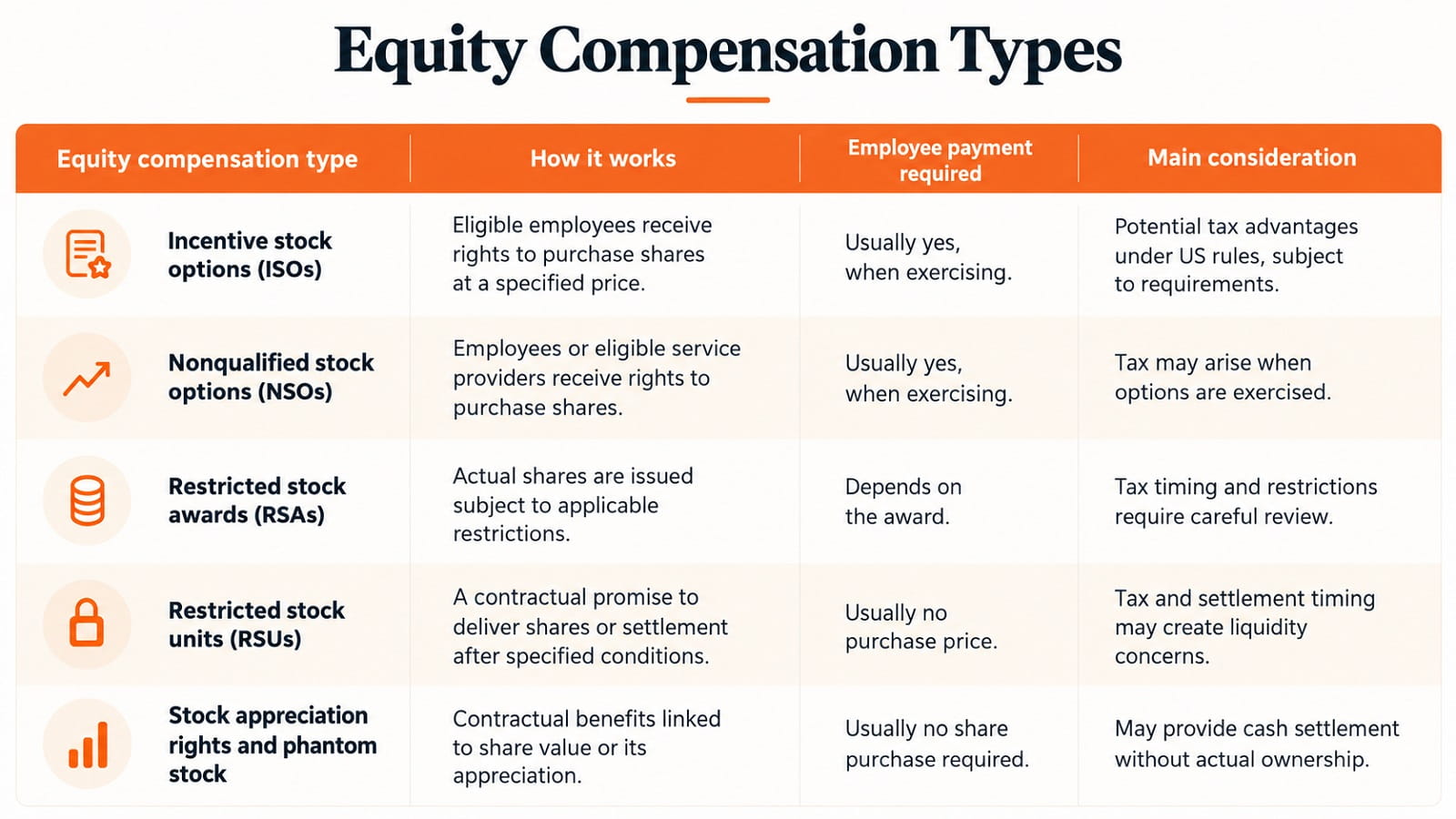
These instruments can produce substantially different outcomes even when their estimated grant values appear similar. Stock options generally require the recipient to acquire shares at an exercise price, while RSUs usually do not require a share purchase. Restricted stock awards may involve immediate ownership subject to restrictions, and phantom arrangements may provide economic exposure without shareholder rights.
The treatment of each award depends on its governing documents. Employees should review the exact instrument rather than assuming that all stock based compensation follows the same rules.
How Stock Options Create Potential Employee Value
Stock options provide the right to purchase a defined number of shares at an agreed exercise price, often called the strike price. An employee may benefit when the value of the underlying shares increases above that price, provided the options become exercisable and the shares can eventually be sold at a favorable value.
For example, an employee receiving an option with a $2 exercise price could potentially benefit if the relevant shares later become worth $8 each. The difference between the share value and the exercise price represents an illustrative gross spread of $6 per share.
However, the employee may need to spend money to exercise the options before any sale is possible. Taxes, transaction costs, transfer restrictions, and the company's share structure can further influence the financial outcome.
In the United States, incentive stock options and nonqualified stock options may receive different tax treatment. The classification of the award, its contractual terms, and the employee's circumstances matter, particularly when considering exercise timing or the eventual sale of acquired shares.
Restricted Stock Units and Restricted Stock Awards
Restricted stock units are contractual promises to deliver shares or another settlement after specified conditions have been satisfied. An employee generally does not need to pay an exercise price to receive the shares, but the timing of delivery and taxation depends on the award terms and applicable law.
Some private companies use arrangements that require both a service condition and a liquidity related condition before settlement. This can help address the problem of employees owing tax on compensation while holding shares they cannot readily sell.
Restricted stock awards operate differently because shares may be transferred to the recipient earlier, subject to restrictions or repurchase provisions. The employee's economic rights and tax obligations can therefore begin at a different point.
These differences are particularly important when comparing job offers. A grant described as 10,000 RSUs is not financially equivalent to 10,000 stock options simply because the quantities match. The exercise price, conditions for receiving shares, tax consequences, and potential resale opportunities must all be considered.
How to Evaluate an Equity Compensation Offer
Employees frequently receive grant information expressed as a number of options or shares. That quantity alone does not establish how much of the company the award represents, how much it could be worth, or whether it is likely to produce cash.
A useful evaluation begins with the total fully diluted share count. This figure provides a basis for estimating the percentage represented by the award, using the capitalization definition supplied by the company.
The next consideration is the instrument itself. Stock options have exercise prices and expiration dates, while other awards may involve different settlement conditions. Employees should also understand the vesting provisions, any restrictions after employment ends, and whether the company has provided opportunities for shareholders to sell shares.
An employer may describe an award using the price paid by preferred investors during a recent financing round. That price should not automatically be treated as the value of common shares received or acquired by employees. Preferred securities may have rights that ordinary common shares do not possess.
For this reason, an employee should distinguish the number of securities granted, the percentage of the company's capitalization they represent, and the amount that could realistically become available in cash.
A Practical Example of Employee Equity Value
Consider Northbridge, a fictional private software company offering a senior employee a salary of $130,000 and an option grant covering 20,000 common shares. The company has 10 million shares on its fully diluted capitalization model, and the options carry an exercise price of $2 per share.
At the time of the grant, the options represent 0.20% of the modeled fully diluted share count. This percentage describes the size of the award relative to the current capitalization, not a guaranteed percentage of future exit proceeds.
Assume all 20,000 options eventually vest and become exercisable. Exercising the full grant would require $40,000, excluding taxes or transaction costs. The employee's potential financial benefit would then depend on the value and marketability of the acquired shares.
The following scenarios show the illustrative gross spread at different hypothetical common share prices. They do not predict Northbridge's future valuation or guarantee that a sale could occur at any of these prices.
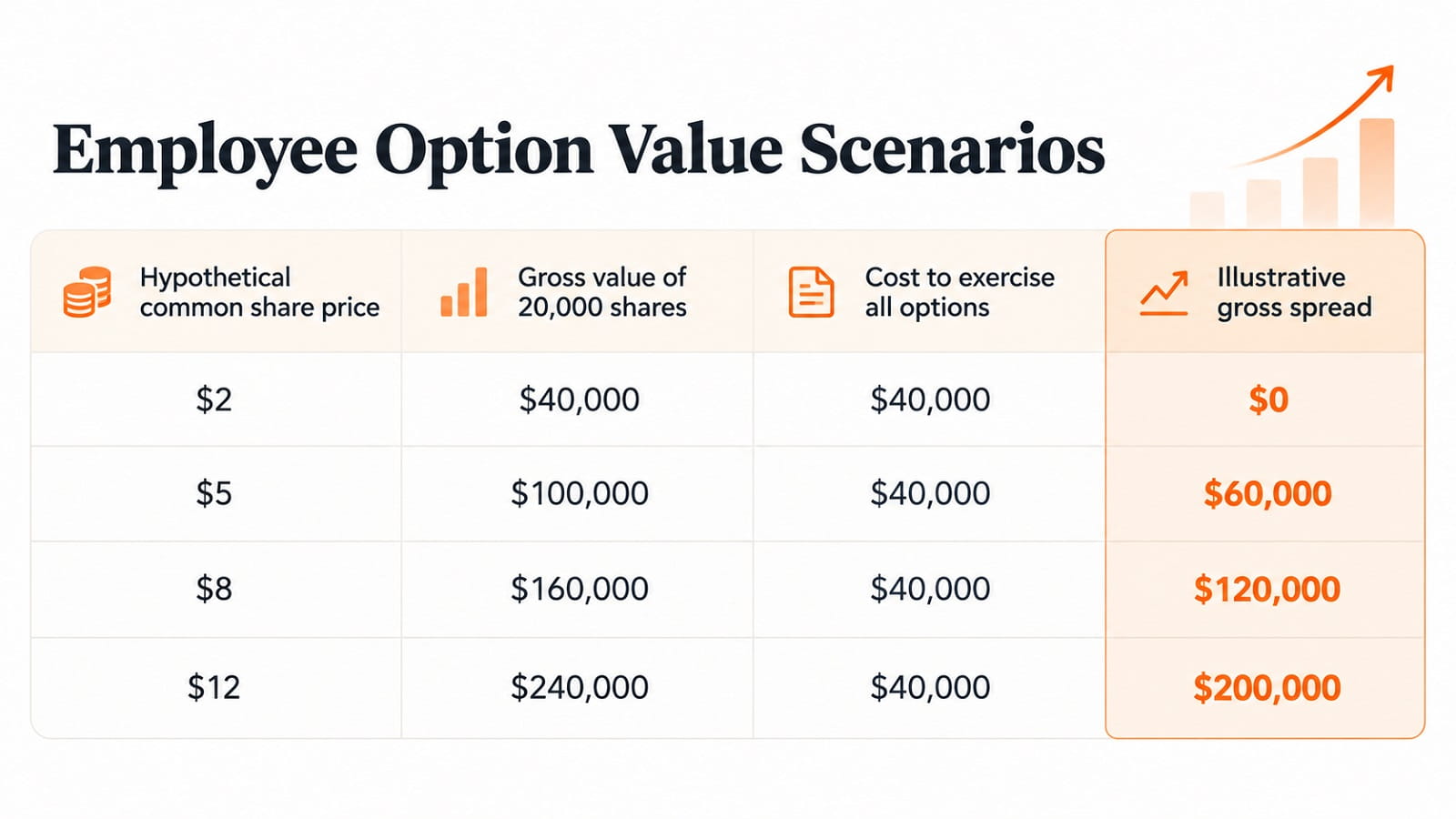
The calculations use the difference between the assumed share price and the $2 exercise price, multiplied by 20,000 options. At a hypothetical share price of $8, the gross spread is $120,000. That amount is not necessarily money the employee could immediately receive.
The employee might be unable to sell shares because the company remains private, imposes transfer restrictions, or has no available buyer. Exercise and sale may also generate tax liabilities, while an acquisition could distribute proceeds according to investor preferences and other contractual rights.
If the company subsequently issues 2.5 million additional shares without adjusting the employee's award, the grant would represent approximately 0.16% of a 12.5 million share fully diluted capitalization. The employee would still hold the same number of options, but their percentage would have decreased.
The distinction between estimated value and realizable cash is central to evaluating any startup compensation offer. A promising scenario can help illustrate potential upside, but the employee should not treat it as equivalent to salary already received.
Comparing Equity Compensation With a Higher Salary
Consider an employee choosing between two fictional offers. One established business offers a salary of $145,000 without any equity award, while Northbridge offers $130,000 and the option grant described above.
The immediate salary difference is $15,000 per year. Over four years, that represents $60,000 in gross salary before considering bonuses, salary changes, taxes, or the time value of money.
Northbridge's options could potentially become worth more than that difference, but the outcome remains uncertain. The employee may also need to pay $40,000 to exercise the entire grant, and the eventual opportunity to sell shares is not guaranteed.
The employee should therefore consider how much guaranteed income they are comfortable giving up, whether they can afford the exercise costs, and how the uncertainty fits their broader financial circumstances.
A high equity percentage does not automatically make an offer superior. The comparison depends on the employee's needs, the company's prospects, the rights attached to the securities, and the likelihood of receiving realizable value.
Vesting Conditions and the Timing of Ownership Benefits
Most startup equity awards include vesting conditions intended to encourage continued service. Under a typical service based arrangement, an employee earns the contractual right to retain or exercise portions of the award over time rather than receiving the entire economic benefit immediately.
One commonly used structure involves four years of vesting with a one year cliff. Under a conventional arrangement, 25% of the award becomes vested after the first year, followed by additional vesting over the remaining period. Actual schedules differ, and the grant agreement determines the precise outcome.
Some awards also involve acceleration provisions connected to acquisitions or employment termination. These provisions may determine whether additional portions of an award become vested after particular events.
Vesting should not be confused with liquidity. An employee can hold fully vested options or shares while having no practical opportunity to sell the underlying stock. Depending on the award, additional exercise or settlement requirements may remain even after service conditions are satisfied.
The Financial Consequences of Leaving a Startup
Employment termination can materially change the value of an equity award. Unvested portions may be forfeited, while vested options may remain exercisable only for a period specified in the relevant documents.
If that period is short, an employee may need to decide whether to spend money exercising options without knowing when the resulting shares can be sold. An exercise can also create tax consequences even when the employee receives no immediate sale proceeds.
Some employers provide longer exercise periods or alternative arrangements, but these terms are not universal. An employee should verify the applicable deadline and understand whether extending the exercise period affects the option's classification or tax treatment.
The consequences can be especially important for someone leaving a company before a financing round, acquisition, or public listing. Employees should review their equity documents before accepting a new job or making decisions based on expected future share value.
Tax Treatment and Equity Compensation
Taxation is one of the most important differences between equity instruments. In the United States, the Internal Revenue Service generally distinguishes statutory stock options from nonstatutory options, and the timing of taxable income can differ between them.
For typical nonqualified stock options without a readily determinable value when granted, an employee generally recognizes compensation income on exercise based on the difference between the fair market value of the acquired shares and the exercise price. Other consequences may arise when the shares are subsequently sold.
Incentive stock options may receive more favorable federal income tax treatment if the required conditions are satisfied. However, exercising an ISO can create alternative minimum tax considerations, and selling the shares before the required holding periods have been met can change the tax outcome.
Restricted stock awards may involve a Section 83(b) election when eligible property is transferred subject to applicable restrictions. Under US law, the election generally must be made no later than 30 days after the property transfer. An ordinary unexercised stock option does not itself qualify for this election, while certain arrangements involving early exercise and transferred restricted shares may require separate consideration.
Restricted stock units can create different timing issues because taxable compensation may arise when shares are delivered, depending on the structure and relevant rules. Private company employees may face particular difficulties when taxation and liquidity do not occur at the same time.
These principles describe US tax concepts and should not be applied automatically to international awards. Cross border employment, local securities regulations, residence, and the type of security can substantially affect the treatment. Employees should obtain qualified advice before exercising options, making elections, or selling shares.
Equity Compensation and Company Ownership Records
An employee equity program affects more than individual compensation packages. Awards must also be reflected appropriately in the company's capitalization records so that founders, investors, and management can understand current share ownership and potential future issuance.
For example, a company may maintain a reserve of shares for employee grants. Granting awards from that reserve creates contractual obligations, while subsequent exercises or settlements may result in issued shares. The exact impact depends on whether the reserve was already included in the relevant fully diluted capitalization calculation.
Companies should avoid assuming that every new grant immediately produces the same dilution effect. Issuing shares, granting options, increasing a reserve, and settling share based awards are distinct events with different accounting and capitalization consequences.
Accurate records also support employee communications. A company should be able to explain the securities granted, the relevant share count, the award's conditions, and the assumptions used when presenting estimated ownership percentages.
Designing a Sustainable Employee Equity Program
For founders, a sustainable equity compensation program begins with a clear view of hiring requirements and the company's financial resources. The business should determine which roles are eligible for awards, how grants will be approved, and how compensation decisions fit its longer term financing strategy.
The company must also consider the economic cost of the program. Equity awards can reduce the need for immediate cash compensation, but they still represent value transferred to service providers and may require recognition of compensation expense under the applicable accounting standards.
Grant decisions should be supported by consistent documentation and appropriate valuation procedures. For US companies, the fair market value of common stock is particularly relevant when setting option exercise prices and considering the requirements associated with Section 409A.
Private companies must also assess the securities laws governing their awards. In the United States, SEC Rule 701 provides an exemption for certain qualifying compensatory securities transactions, subject to conditions and disclosure obligations. This is not a universal exemption for every company or recipient.
A carefully administered program helps employees understand their awards while providing founders with a more reliable view of future ownership commitments. The goal is to create meaningful incentives without making promises that the company cannot support.
Evaluating the Real Value of an Equity Award
The most useful approach to equity compensation separates contractual rights from financial expectations. An employee should first establish what has actually been granted, including the number of securities, exercise or settlement terms, and applicable conditions.
The next step is to understand the capitalization denominator behind any stated ownership percentage. A percentage calculated before future financing may not remain unchanged as the company raises additional capital or expands its equity program.
Financial value should then be assessed using realistic assumptions about exercise costs, potential taxes, shareholder rights, and liquidity. A company valuation provides context, but it is not a guarantee of the amount available to common shareholders or option holders.
Finally, employees should consider the compensation package as a whole. Reliable salary, benefits, career opportunities, and personal financial flexibility remain relevant even when an equity award offers substantial potential upside.
FAQ
What Is Equity Compensation?
Equity compensation is payment provided through company shares, rights to acquire shares, or benefits linked to stock value. It can supplement salary and may allow employees to participate financially in the company's future performance.
Is Equity Compensation Better Than a Higher Salary?
Not necessarily. Salary provides more predictable current income, while equity compensation offers uncertain potential future value. The better choice depends on the grant terms, company prospects, financial needs, and employee risk tolerance.
Do Employees Have to Pay for Equity Compensation?
It depends on the instrument. Stock options generally require payment of an exercise price to acquire shares, while RSUs typically do not require a share purchase. Other costs and taxes may still apply.
Are Stock Options and RSUs the Same?
No. Stock options provide rights to purchase shares at an exercise price, while RSUs generally represent contractual rights to receive shares or settlement after specified conditions are met. Their risks, costs, and tax treatment can differ.
Can Equity Compensation Become Worthless?
Yes. Stock options may have no economic exercise value if the underlying shares never exceed the exercise price. Other awards may also produce little or no benefit if the company loses value or contractual conditions are not satisfied.
How Is Equity Compensation Value Calculated?
The calculation depends on the award. For stock options, an illustrative gross spread equals the positive difference between the share value and the exercise price multiplied by the number of exercisable options. Realized proceeds may differ because of taxes, fees, restrictions, and transaction terms.
What Happens to Equity Compensation When an Employee Leaves?
The outcome depends on the award agreement. Unvested awards may be forfeited, and vested options can be subject to exercise deadlines. Employees should review these terms before leaving.
Is Equity Compensation Taxable?
It can be. Taxation depends on the instrument, the country, and events such as exercise, vesting, settlement, or sale. Employees should seek professional advice about their specific situation.
Can Employees Sell Startup Shares Immediately?
Often they cannot. Private company shares may be subject to transfer restrictions, and there may be no available market. Selling may depend on a permitted secondary transaction, acquisition, public listing, or another liquidity event.

Mobina Khanki
Venture & Funding Writer at PinerookMobina Khanki covers venture capital, startup funding, fundraising, and startup finance for Pinerook, focusing on founders and investors.
 Seen first.