
A founder can own 60% of a startup at incorporation and hold considerably less after several financing rounds, even without selling a single share. The change happens because new shares are issued to investors, employees, or other stakeholders, increasing the company's total capitalization. Although this reduction in ownership percentage is a normal part of financing a growing business, its consequences are often misunderstood. Founders need to understand what they are giving up, how much capital the company receives, and whether the transaction improves their long term economic position.
Within Cap Table and Startup Equity, equity dilution explains how ownership changes as a startup raises capital and expands its shareholder base. Every financing decision can affect the percentage held by founders, early investors, and employees. The calculation is not simply a matter of subtracting one investment round from another because each new issuance changes the ownership base used for subsequent calculations.
Understanding dilution is particularly important when a company is preparing to raise its first institutional round or evaluating multiple financing offers. A high valuation may reduce the percentage issued to new investors, but employee reserves, convertible securities, and contractual investor rights can change the final outcome. This guide explains how to calculate dilution, model multiple financing rounds, and assess the difference between a smaller ownership percentage and the potential value of the shares retained.
Understanding Equity Dilution in Startups
Equity dilution occurs when a shareholder's percentage ownership decreases because the company issues additional shares or because other securities are included in the relevant ownership calculation. The shareholder may retain exactly the same number of shares while those shares represent a smaller percentage of the company.
Consider a startup with one million outstanding shares, all held by its founder. If the company issues 250,000 additional shares to an investor, the total increases to 1.25 million shares. The founder still owns one million shares, but the ownership percentage falls from 100% to 80%.
The investor owns the remaining 20%, assuming all shares are counted on the same basis. The founder has not transferred existing shares to the investor. Instead, the company has created new shares in exchange for capital.
This distinction separates dilution from a secondary share sale. When a founder sells existing shares to another person, ownership changes between shareholders, but the total number of outstanding shares ordinarily remains unchanged. In a primary financing round, the company issues new shares and receives the investment proceeds.
How to Calculate Equity Dilution
The basic ownership calculation divides the number of shares held by an individual by the total shares included in the capitalization calculation.
Ownership percentage = Shareholder shares ÷ Total shares × 100
When new shares are issued, the total share count increases. Assuming the shareholder does not acquire additional shares, the new percentage can be calculated by dividing the original share count by the expanded capitalization.
For a straightforward financing round, the percentage acquired by new investors can also be calculated using the amount invested and the agreed valuation.
New investor ownership = New investment ÷ Post investment valuation × 100
The post investment valuation is the sum of the pre investment valuation and the new primary investment, assuming no additional adjustments.
For example, a company raising $2 million at an $8 million pre investment valuation has a $10 million post investment valuation. Under the simplified model, the incoming investor acquires 20%, while existing shareholders collectively retain 80%.
If an existing shareholder held 40% before that financing, the shareholder would hold 32% afterward, assuming no participation in the round and no other capitalization changes.
New ownership percentage = 40% × 80% = 32%
The 8 percentage point reduction is different from the 20% proportional dilution applied to the shareholder's existing stake. Distinguishing percentage points from proportional percentage changes helps avoid confusion when comparing financing outcomes.
A Practical Example of Dilution Across Two Funding Rounds
Consider a fictional software startup called Meridian Labs. The company begins with two founders and 10 million outstanding shares. Founder A holds 6 million shares, representing 60% ownership, while Founder B holds 4 million shares, representing 40%.
Meridian Labs subsequently raises $2.5 million in a seed round at a pre investment valuation of $10 million. The implied share price is $1, and the new investors receive 2.5 million shares. The post investment capitalization increases to 12.5 million shares, giving the seed investors 20% ownership.
After demonstrating commercial progress, Meridian Labs raises another $5 million in a Series A round at a $20 million pre investment valuation. The company has 12.5 million shares before the new issuance, so the share price is $1.60. The Series A investors receive 3.125 million shares, bringing the total capitalization to 15.625 million shares.
The following table illustrates the ownership changes across both rounds.
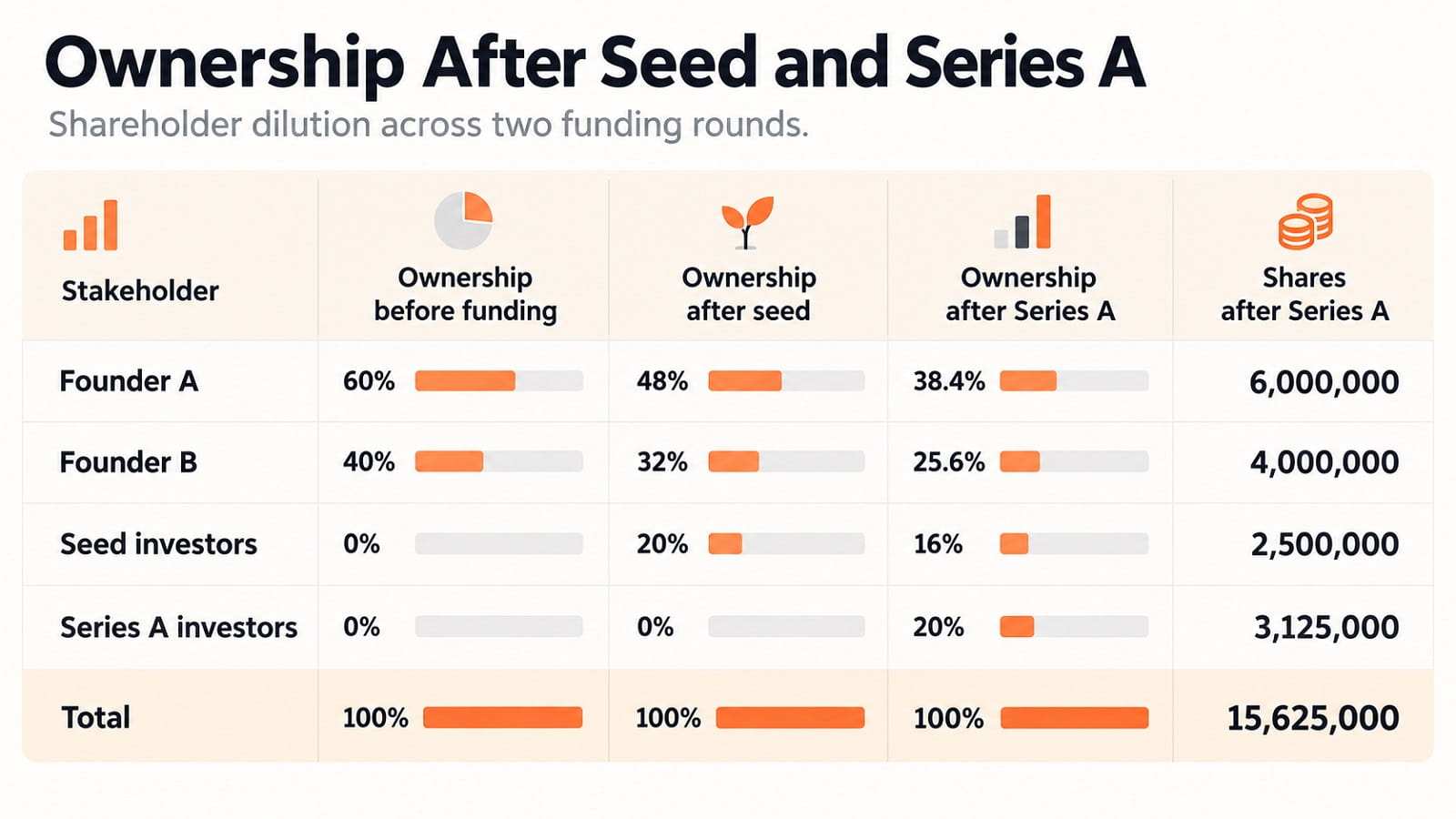
The founders collectively own 80% immediately after the seed round and 64% after Series A. Neither founder has sold any existing shares, but their percentages have declined as the company issued additional equity.
The seed investors also experience dilution. Their original 20% position becomes 16% following Series A because they do not participate in that financing.
This illustration assumes that all securities are counted on an equivalent share basis. It excludes employee share reserves, outstanding options, convertible notes, SAFEs, warrants, transaction expenses, and adjustments to preferred share conversion rights. Actual financing models need to incorporate these elements when applicable.
The example also does not reflect differences in voting rights or distributions between common and preferred stock. Those distinctions can matter even when the percentage ownership calculation is mathematically correct.
Why Dilution Compounds Across Funding Rounds
A common misunderstanding is that selling 20% of a startup in one round and another 20% in the following round means the original shareholders have lost 40% of their starting ownership.
In fact, the second round affects the ownership structure after the first round. When existing shareholders retain 80% following the first investment, another 20% proportional reduction leaves them with 64%.
The calculation is:
Remaining ownership = 100% × 0.80 × 0.80 = 64%
The original shareholders have therefore experienced a cumulative reduction of 36 percentage points, not 40.
This compounding effect becomes more important as a startup completes additional funding rounds. Each round changes the capitalization that forms the basis of the next ownership calculation.
Founders should therefore model the cumulative consequences of their financing strategy rather than evaluating each round independently. A seemingly modest reduction in ownership can have a substantial effect when repeated over several transactions.
How Valuation and Investment Size Affect Dilution
Two important drivers of dilution are the company's negotiated valuation and the amount of new capital raised.
For a fixed investment amount, a higher pre investment valuation generally results in a smaller ownership percentage being issued to new investors. Conversely, raising more money at the same valuation generally requires the company to issue a larger percentage of its equity.
However, a higher valuation is not automatically the best outcome. A company that raises capital at an ambitious valuation may face difficulties in a later round if its operating performance does not support a further increase.
Similarly, accepting a smaller investment solely to preserve ownership may leave the business without sufficient resources to achieve important commercial milestones.
The relevant decision is how much capital the company needs to finance a credible operating plan and what percentage of ownership it must exchange to obtain that capital.
In practice, valuation should be considered alongside investor rights, the amount of funding received, future financing needs, and the commercial progress expected from the new investment.
Does Dilution Reduce the Financial Value of Founder Shares?
A lower ownership percentage does not automatically mean that the shares retained by a founder have become less valuable. The company's value may increase as new financing supports product development, recruitment, distribution, and revenue growth.
Return to Meridian Labs, where the two founders begin with 100% ownership. The company raises a seed round and later completes Series A, leaving the founders with a combined 64% stake.
The following table uses the negotiated financing valuations to estimate the notional value of the founders' combined stake. It assumes the same economic value per equivalent share and does not adjust for preferred investor rights, restrictions, or the absence of liquidity.
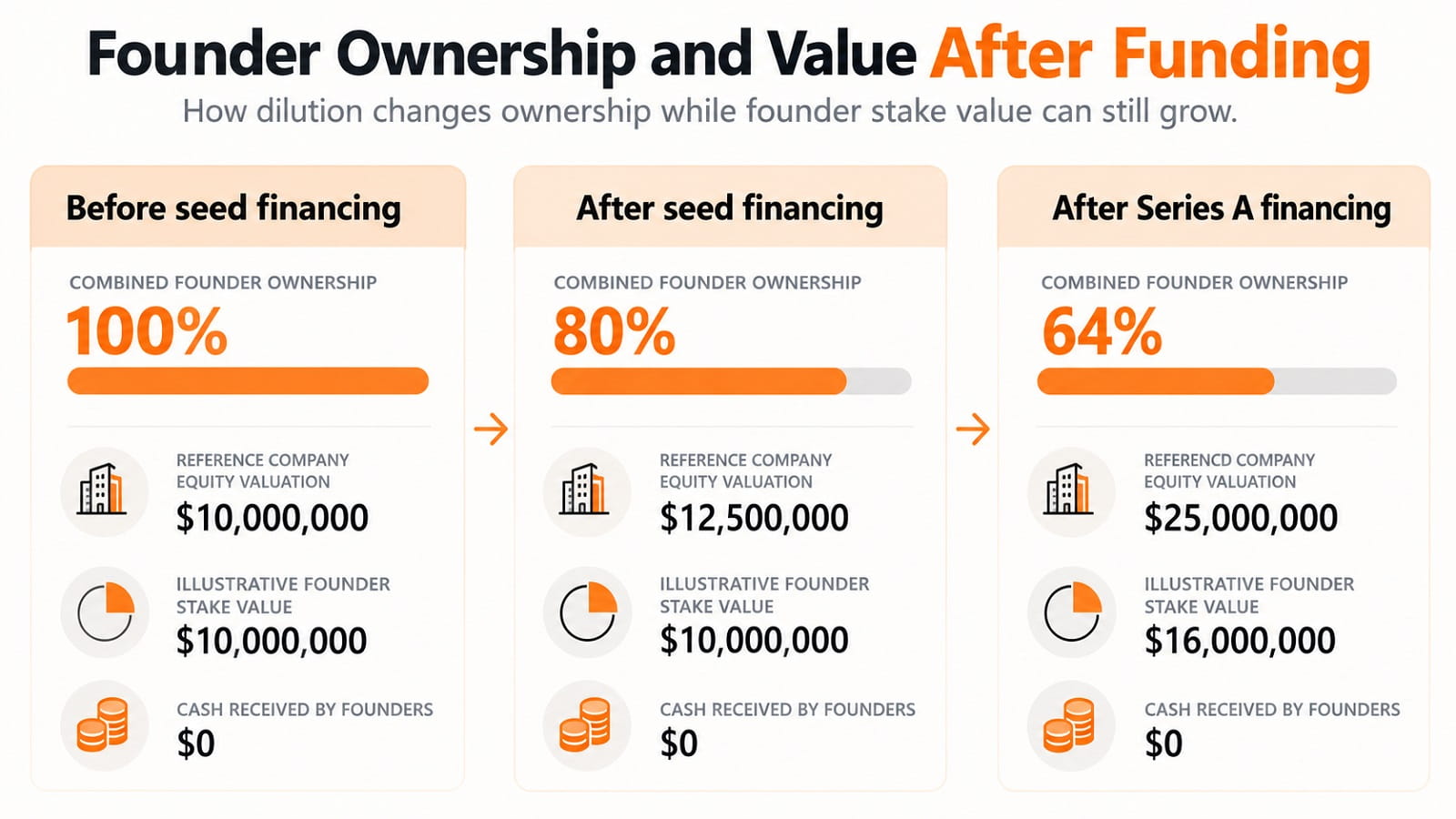
Although the founders own a smaller percentage after each financing round, the illustrative value of their combined position increases from $10 million before seed funding to $16 million after Series A.
Founder A's 38.4% stake would represent an illustrative value of $9.6 million at the Series A post investment valuation, while Founder B's 25.6% stake would represent $6.4 million.
These amounts are not realized gains or guaranteed sale proceeds. The funding rounds described are primary share issuances, meaning the company receives the capital while the founders receive no cash from those transactions.
Preferred share rights, future dilution, operating performance, and the availability of buyers can also affect what founders eventually receive. A financing valuation is a reference point for assessing economic value, not proof that a shareholder can sell a private company stake for the calculated amount.
The Impact of SAFEs and Convertible Notes on Dilution
Some startups raise capital through instruments that convert into shares during a later financing round. SAFEs and convertible notes can create potential dilution even before the company has issued the shares associated with those agreements.
A SAFE generally provides a contractual right to future equity under specified conditions. Under a standard post money SAFE with a valuation cap, the investment amount divided by the post money cap can indicate the ownership associated with the agreement before a subsequent priced round, assuming the cap applies and the standard capitalization rules are satisfied.
For example, a $500,000 investment under a post money SAFE with a $5 million cap can represent 10% ownership on the relevant pre round basis. That position can subsequently be diluted by new money invested in the priced round and by certain increases to the employee equity reserve.
Multiple agreements can produce substantial combined dilution. Founders may focus on the cash received from each SAFE individually without fully understanding the ownership collectively committed through the financing documents.
Convertible notes involve additional considerations because they are debt instruments that may carry interest, maturity provisions, conversion discounts, and valuation caps. Accrued interest can increase the amount converting into shares, depending on the note's terms.
The conversion mechanics should be modeled before a priced round is completed. A simple calculation based only on the amount of new equity funding may understate the resulting change in ownership when outstanding instruments also convert.
Employee Equity Awards and Ownership Dilution
Employee equity programs can affect the ownership percentages of founders and existing investors. When a company creates or increases a reserve for future employee awards, the additional potential shares may increase its fully diluted capitalization.
However, granting options from a reserve already included in the fully diluted share count does not necessarily create additional dilution at the time of the grant. The company may simply be allocating existing reserved capacity to a particular employee.
A new reserve increase can have a different effect because it introduces additional potential shares into the ownership model.
The treatment becomes particularly important during fundraising. Investors may require a specified amount of unallocated equity to remain available for recruitment after the financing closes.
If the required increase is included in the pre investment capitalization used to establish the share price, existing shareholders may bear the dilution associated with that adjustment. If additional shares are reserved after financing, the resulting dilution can be shared with the new investor, depending on the agreed terms.
Founders should distinguish an existing reserve from an increase required by a new financing. The total reserve, outstanding awards, and remaining unallocated capacity all affect the calculation.
Pro Rata Rights and Maintaining Investor Ownership
Pro rata rights can allow an existing investor to participate in future financing rounds to maintain a specified ownership percentage. These rights do not automatically prevent dilution. The investor generally needs to contribute additional capital under the applicable financing terms.
Consider the Meridian Labs seed investors, who hold 20% before Series A. The company is raising $5 million in that round.
If the seed investors have an applicable right to purchase 20% of the new financing, they could invest $1 million as part of the $5 million round. At the assumed price of $1.60 per share, that investment would purchase an additional 625,000 shares.
Their combined holding would increase from 2.5 million to 3.125 million shares. Against the resulting total of 15.625 million shares, their ownership would remain 20%.
The remaining $4 million of the financing would come from other investors, who would collectively acquire 16% of the company.
This example demonstrates that maintaining ownership generally requires an additional financial commitment. The ability to participate depends on the investor's contractual rights, eligibility, and the terms of the financing.
Founders should consider these rights when planning future rounds because existing investors may have the opportunity to purchase part of the available allocation before it is offered to new investors.
Down Rounds and Additional Dilution Risk
A down round occurs when a company raises equity financing at a valuation or share price lower than that associated with an earlier financing round, according to the relevant transaction terms.
A lower share price means the company generally needs to issue more shares to raise the same amount of money. This can increase the ownership reduction experienced by existing shareholders.
Down rounds may occur when a startup has failed to meet growth expectations, requires additional capital, or faces weaker financing conditions. The business may still benefit from receiving necessary funding, but the ownership consequences can be more substantial than those of a financing completed at a higher price.
Preferred investors may also have contractual anti dilution protections that become relevant when shares are issued below specified prices. Those provisions can change the number of common shares into which existing preferred shares convert.
Consequently, the dilution experienced by common shareholders may exceed the percentage attributable to the new money alone.
A realistic down round model should account for the new issuance, existing preferred securities, applicable conversion adjustments, and any changes to employee equity arrangements.
Understanding Anti Dilution Protection
Anti dilution provisions are contractual protections that may adjust the conversion rights of preferred shareholders when a company issues shares at lower prices. They are not a universal guarantee that investors will maintain the same ownership percentage.
Two important structures are broad based weighted average protection and full ratchet protection.
Broad based weighted average provisions generally adjust the conversion price using a formula that considers the existing capitalization, the number of new shares issued, and their issuance price. The effect depends on the actual financing terms and the definitions used in the agreement.
Full ratchet protection can produce a more substantial adjustment because it generally resets the relevant conversion price according to the lower financing price without proportionally accounting for the size of the new issuance.
These adjustments can increase the number of common shares represented by preferred investors' holdings on an as converted basis. The resulting increase may reduce the ownership percentages of founders and other common shareholders.
The exact consequences depend on contractual exclusions, adjustment formulas, and the structure of the transaction. Founders should not assume that all preferred financing agreements contain identical protections.
Dilution and Founder Voting Control
Ownership dilution can affect more than economic value. It may also influence voting power and the ability to approve important corporate decisions.
In a company where each common share carries one vote, a reduction in the founder's percentage of voting shares can reduce that person's influence over shareholder decisions.
However, economic ownership and voting control are not necessarily identical. Some companies issue different classes of shares with distinct voting rights, while financing documents may provide investors with contractual approval rights over specified matters.
Board composition can also influence governance independently of percentage ownership. A founder might retain a substantial economic interest while having limited control over certain decisions because of board representation or protective provisions.
Founders should therefore evaluate voting rights, board structure, and contractual restrictions alongside the dilution of their ownership percentage.
A capitalization model that shows only percentages cannot explain every element of corporate control.
Fully Diluted Ownership and Outstanding Shares
Dilution calculations are meaningful only when the capitalization basis is clearly defined. Outstanding shares represent shares that have already been issued and remain outstanding, while fully diluted capitalization includes specified additional potential shares.
These may include outstanding options, reserved employee equity, warrants, and convertible securities under the assumptions applicable to the model.
For example, a founder might hold 4 million shares out of 8 million outstanding shares, giving the founder 50% outstanding ownership.
If the relevant fully diluted capitalization includes another 2 million potential shares, the same founder holds 40% on that basis.
Neither calculation is necessarily incorrect. They describe different definitions of the ownership denominator.
During fundraising, founders should confirm which definition is used in the term sheet and ensure that the share counts reflect any conversions or reserve increases required by the proposed transaction.
Managing Dilution Without Avoiding Necessary Investment
The goal of financing strategy should not be to eliminate dilution at all costs. A startup may need external capital to build its product, recruit employees, establish distribution, or reach commercial scale.
Refusing necessary financing simply to preserve a larger percentage can create significant operating risk. Conversely, raising far more capital than the company can deploy effectively may cause unnecessary ownership reduction.
Founders should evaluate how much funding is needed to achieve specific milestones and how those milestones might improve the company's prospects before its next financing round.
A smaller round can sometimes preserve ownership if the company can reach meaningful progress with less capital. However, that decision should also account for the risk of running out of money before the next financing becomes available.
Alternative funding arrangements may reduce immediate equity issuance, but debt and other financial obligations introduce separate costs and risks. They should not be treated as universally superior substitutes for equity funding.
The relevant question is whether the resources received justify the ownership and contractual rights exchanged.
Modeling Dilution Before Signing a Term Sheet
A company preparing to raise capital should create a capitalization model that reflects its ownership immediately before the financing and the expected structure afterward.
The model should include the proposed investment amount, agreed valuation, existing share classes, outstanding options, employee reserves, and any instruments expected to convert.
It should also reflect contractual rights that can alter ownership, such as applicable anti dilution provisions or arrangements governing participation in new financing.
When multiple financing offers are available, founders should compare the final percentages and economic rights rather than relying exclusively on headline valuations.
Scenario analysis can also help management understand how ownership might evolve if the company needs another round sooner than expected or raises capital at a lower valuation.
These calculations should be reconciled with the company's actual securities and legal documents. A spreadsheet can illustrate the consequences of a financing proposal, but it cannot replace the governing agreements that establish shareholders' rights.
Final Thoughts
Equity dilution is a normal consequence of financing and expanding a startup, but its impact depends on more than the percentage of newly issued shares. Founders need to understand how each transaction changes ownership, how successive rounds compound, and what additional rights may be granted to investors.
The Meridian Labs example demonstrates that founders can move from 100% ownership to 64% after two financing rounds while the notional value of their retained shares increases. It also illustrates why a smaller percentage should not automatically be interpreted as a financial loss, particularly when new capital enables business development.
The most effective approach is to model the ownership structure before completing each transaction, understand the assumptions behind the calculations, and evaluate whether the financing supports meaningful progress. Dilution should be a deliberate part of a startup's funding strategy rather than an unexpected consequence discovered after the agreements have been signed.
FAQ
What Is Equity Dilution?
Equity dilution occurs when a shareholder's percentage ownership decreases because the number of shares or potential shares included in the relevant capitalization calculation increases. It commonly happens during financing rounds and changes to employee equity reserves.
Does Dilution Mean Founders Lose Shares?
Not necessarily. Founders can retain their original number of shares while owning a smaller percentage of the company because new shares have been issued to others.
How Is Equity Dilution Calculated?
Divide the shareholder's existing shares by the total capitalization after the new issuance. For a simple financing round, the new investor's percentage can also be calculated by dividing the investment amount by the post investment valuation.
How Much Dilution Is Normal in a Startup Funding Round?
There is no universal percentage. The amount depends on the funding required, valuation, financing stage, and negotiated terms. Market benchmarks can provide context, but they do not establish what is appropriate for an individual company.
Can Equity Dilution Increase the Value of Founder Shares?
Yes. A founder may retain a smaller percentage of a company whose overall value has increased substantially. However, a higher financing valuation does not guarantee that the founder can sell the shares for the implied amount.
Do SAFEs Cause Equity Dilution?
SAFEs can create potential dilution because they generally convert into shares under specified conditions. The result depends on the agreement's valuation cap, discount, and capitalization definitions.
Can Employees Cause Founder Dilution?
Employee equity awards and increases to employee share reserves can affect fully diluted ownership. However, granting awards from an existing reserve does not necessarily increase the fully diluted denominator.
Can Investors Prevent Dilution?
Investors may negotiate pro rata participation rights that allow them to purchase additional shares in later rounds. Some preferred investors also receive contractual anti dilution protections, but those provisions work differently.
Is a Down Round Always Bad for Founders?
A down round can increase dilution and introduce difficult financing terms, but it may also provide capital needed for the company to continue operating. The overall outcome depends on the business situation and the transaction terms.
Does Equity Dilution Affect Voting Rights?
It can. Issuing additional voting shares may reduce a founder's percentage of shareholder voting power. Actual governance also depends on share classes, board composition, and contractual rights.

Mobina Khanki
Venture & Funding Writer at PinerookMobina Khanki covers venture capital, startup funding, fundraising, and startup finance for Pinerook, focusing on founders and investors.
 Seen first.