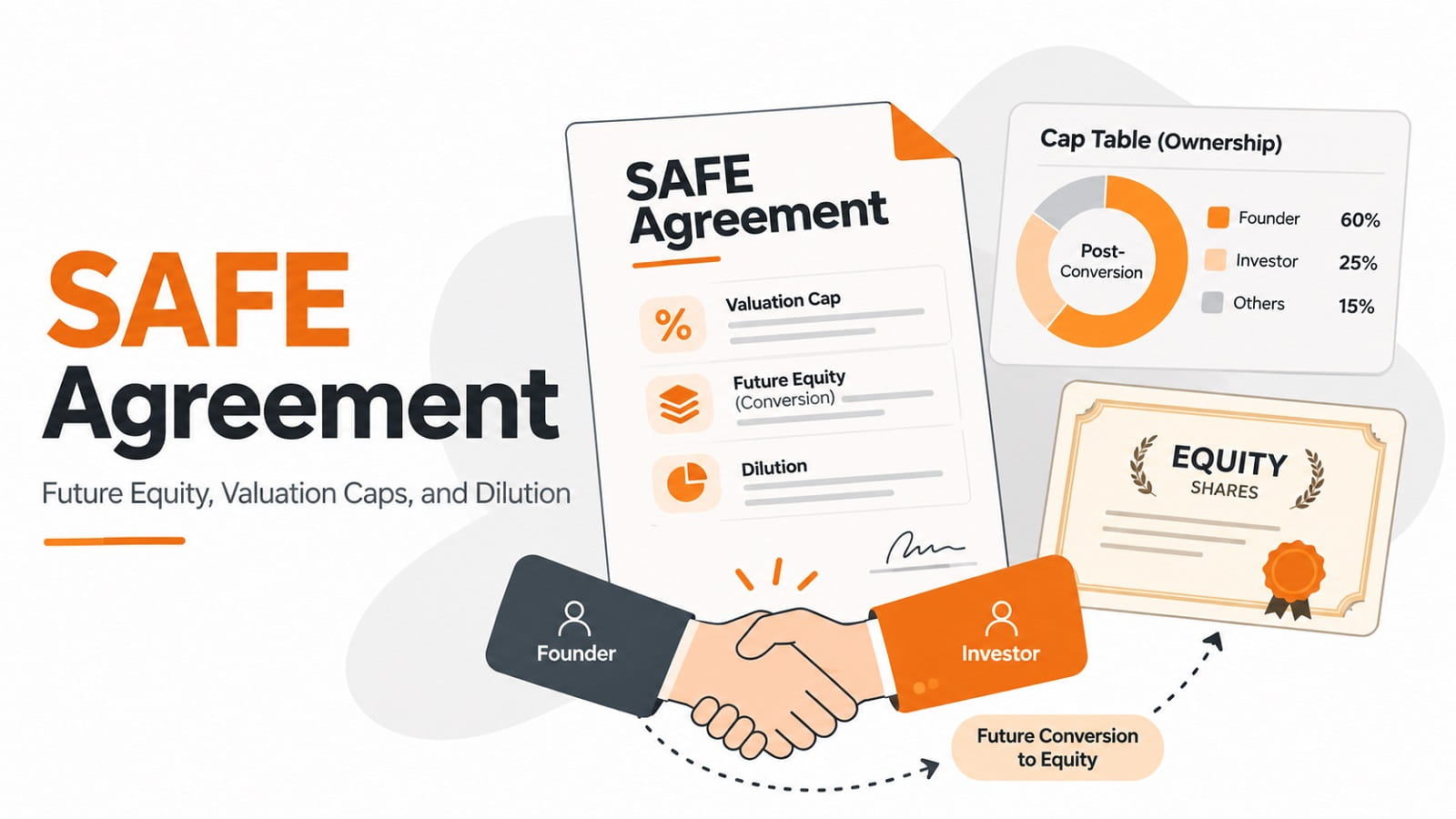
Fintech startups are transforming payments, lending, banking infrastructure, insurance, and financial operations, but investor enthusiasm does not guarantee access to funding. Companies operating in financial services must demonstrate more than product innovation and customer growth. They also need dependable revenue, appropriate risk controls, and a clear understanding of the obligations that come with handling sensitive financial activities. These requirements make fintech fundraising different from investment in many conventional software businesses.
Fintech startup investment reflects how investors evaluate technological innovation alongside financial regulation, customer trust, and commercial sustainability. Within the broader context of Investment Trends, the fintech sector shows why growing transaction volumes and attractive market opportunities do not always translate into successful funding rounds. Investors increasingly need to understand how a company earns revenue, manages financial exposure, and creates value without taking risks that could undermine its business.
This guide examines fintech funding conditions in 2026, the business models attracting investor attention, and the evidence founders need to raise capital. It also explains the importance of regulatory readiness, financial partnerships, transaction economics, and cash forecasting, with practical examples for evaluating investment decisions.
What Is Fintech Startup Investment?
Fintech startup investment refers to capital provided to businesses developing technology for financial products, services, and infrastructure. These companies may serve consumers, merchants, banks, insurers, investment firms, or other financial institutions. Their products can include payment systems, financial management software, lending platforms, fraud detection, digital banking services, and tools that support regulatory compliance.
Funding may come from angel investors, venture capital firms, corporate investors, growth equity providers, or other financing arrangements. The appropriate source depends on the company's maturity, business model, and financial needs. A startup building software for bank compliance teams may require a different investment strategy from a company directly providing credit or operating payment infrastructure.
The central objective of fintech investment is to finance a business capable of generating lasting economic value. Investors therefore examine not only technological performance and customer demand but also financial risk, operating resilience, and the cost of meeting relevant regulatory obligations.
The Fintech Investment Market in 2026
Fintech financing in 2026 presents a mixed picture. According to Crunchbase, fintech startups raised approximately $10.6 billion globally during the third quarter, representing a 21.4% decline from the corresponding quarter in 2025. Funding also fell 28.4% from the previous quarter, while the number of financing rounds declined substantially. These figures suggest that many founders are operating in a selective venture market despite continuing interest in financial technology.
CB Insights reported approximately $11 billion in fintech funding during the same quarter, with 650 deals. Its report also found that financing rounds of at least $100 million accounted for 61% of quarterly investment despite representing only 4% of transactions. The figures differ from Crunchbase because research providers use different databases and classifications, but both identify concentrated capital and reduced deal activity.
KPMG presents another perspective. Its report for the first half of 2026 recorded $103.1 billion in global fintech investment across venture capital, private equity, mergers, and acquisitions. Of that amount, approximately $31.5 billion represented venture investment. The broader $103.1 billion figure should not be interpreted as funding raised by startups through venture rounds alone.
These differences matter because investment reports can appear contradictory when their measurement methods are ignored. Founders should examine financing activity relevant to their own market, industry, and stage rather than assuming that a large global investment figure reflects their fundraising opportunities.
Which Fintech Sectors Are Attracting Investment?
Investor attention is distributed unevenly across financial technology. Some segments benefit from growing demand for financial infrastructure and automation, while others face intense competition, significant compliance costs, or uncertain revenue models. The attractiveness of an individual company depends on its execution and financial characteristics rather than its sector classification alone.
Payments and Financial Infrastructure
Payments remain an important area of fintech investment because businesses continually need reliable methods to move money, accept transactions, and manage financial operations. Opportunities include payment orchestration, merchant services, transaction monitoring, and software connecting financial institutions with commercial platforms. However, the commercial opportunity must be distinguished from the overall value of transactions passing through a system.
KPMG recorded $44.2 billion in payments investment during the first half of 2026, but a major acquisition accounted for a substantial portion of that total. The figure includes transaction types beyond startup venture financing. Investors evaluating a new payments company should therefore focus on customer relationships, retained fees, processing costs, and the ability to maintain reliable services rather than using sector totals as proof of strong fundraising conditions.
Financial Compliance and Risk Technology
Technology that helps financial institutions monitor transactions, investigate suspicious activity, verify identities, and manage regulatory reporting can address continuing operational needs. These businesses may attract customers seeking more efficient and reliable compliance processes, particularly when financial organizations face significant manual workloads.
However, regulatory demand does not guarantee adoption. Investors need evidence that the product performs accurately, integrates with customer systems, and can withstand security and operational reviews. A compliance startup must demonstrate that its technology reduces work or improves outcomes without creating unacceptable new risks.
Artificial Intelligence in Financial Services
Artificial intelligence is influencing underwriting, fraud detection, financial analysis, customer support, and administrative operations. KPMG reported $21.4 billion in AI related fintech investment activity during the first half of 2026 across several investment and transaction categories. The opportunity extends beyond businesses creating general AI models to companies developing specialized financial workflows.
Financial AI products face particularly demanding expectations because inaccurate decisions may affect money, customers, or legal obligations. Investors may examine model reliability, auditability, human oversight, data permissions, and operating costs. Commercial differentiation also matters because using widely available AI technology does not automatically establish a lasting competitive advantage.
Digital Assets, Lending, and Insurance Technology
Digital asset infrastructure continues attracting investor attention in selected markets, particularly where companies provide settlement, custody, compliance, or institutional services. However, legal requirements, market volatility, and dependence on external providers can create substantial uncertainty. Investors need to assess the actual service being offered and the applicable legal framework rather than treating every digital asset business as economically identical.
Lending and insurance technology present additional challenges because financial losses can be influenced by customer behavior and economic conditions. A lending company may generate attractive fee or interest income while experiencing losses that undermine profitability. Insurance technology companies must similarly account for their role in underwriting, distribution, or software provision, since these activities produce different risk and capital requirements.
What Fintech Investors Examine Before Funding a Startup
Fintech investors generally need evidence that a company's commercial performance can coexist with reliable financial operations. Customer acquisition is important, but a business handling payments, lending decisions, or sensitive customer information may also depend on licensed partners, risk management systems, and operational controls. These responsibilities can materially affect its ability to grow.
The following table summarizes the areas founders should prepare for investment discussions.
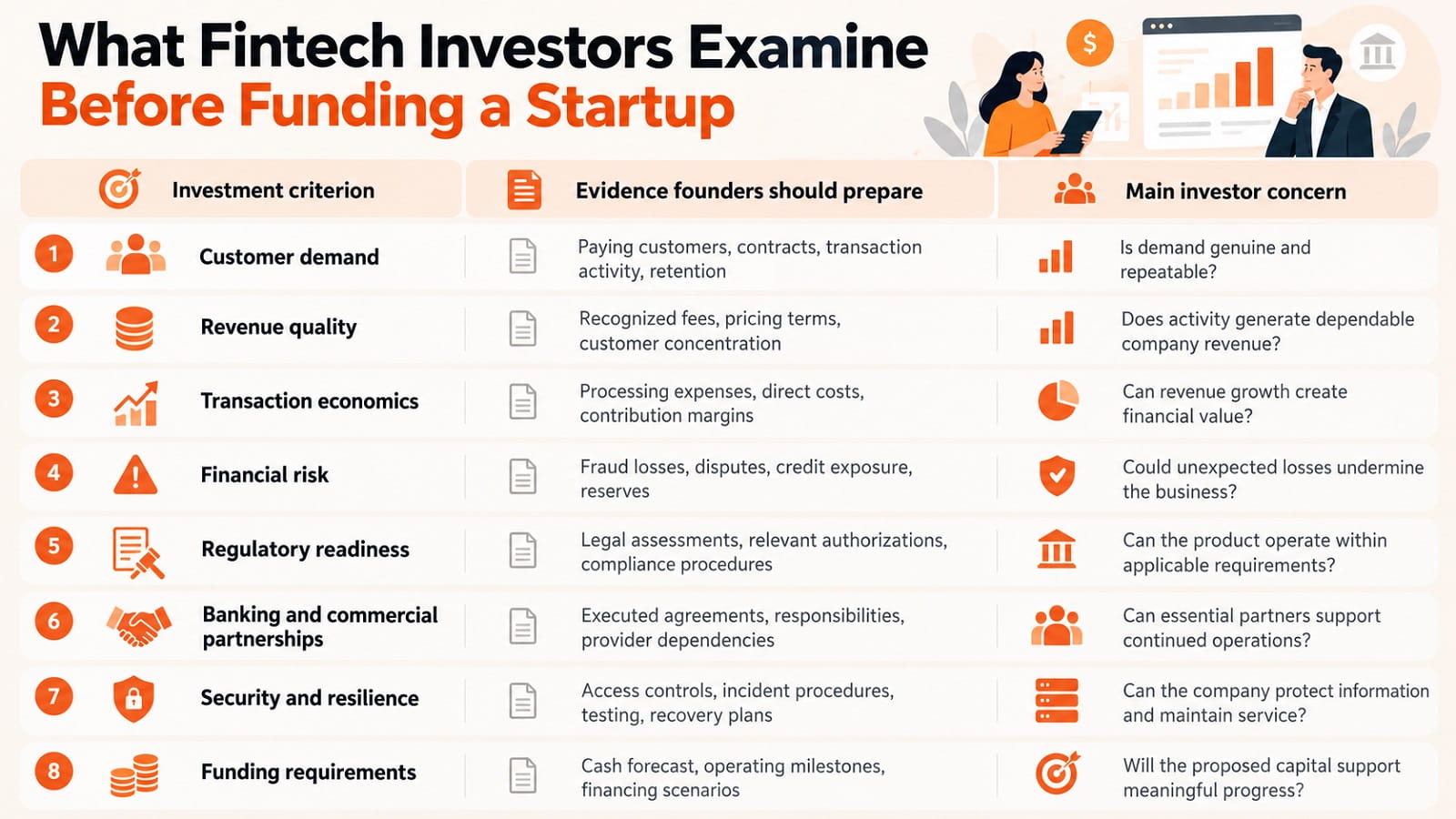
The relevance of each criterion depends on the company's activities. A business selling accounting software may face different obligations from a company transmitting funds or making lending decisions. Investors should understand those differences instead of applying identical regulatory assumptions across the entire sector.
Founders benefit from preparing evidence before starting fundraising discussions. Clear documentation makes it easier to distinguish manageable business risks from unresolved problems that could delay investment or prevent commercial expansion.
Understanding Fintech Revenue and Transaction Economics
One of the most important distinctions in fintech financial analysis is the difference between transaction volume and revenue. A payment company may facilitate millions of dollars in transactions without earning anything close to that amount. The business may retain a relatively small fee while the remaining funds belong to merchants, financial institutions, or other transaction participants.
For example, suppose a platform facilitates $20 million in monthly payment volume and earns a fee equal to 0.30% of that amount. Under an arrangement where the platform recognizes only its fee, monthly revenue would be $60,000. The $20 million represents transaction activity, not company revenue.
The company must then account for processing charges, technology infrastructure, fraud related losses, and other expenses for which it is responsible. These amounts determine how much financial contribution remains to support employees, product development, and other operating activities.
Accounting treatment depends on contracts and whether a company acts as principal or agent in providing a service. Investors should therefore inspect how reported revenue is calculated rather than assuming every fintech business recognizes transactions in the same way.
This distinction also affects valuation comparisons. Two payment companies may process similar transaction volumes but generate very different revenue and profit because of pricing, customer mix, risk exposure, and contractual responsibilities.
Why Regulation and Banking Partnerships Influence Investment
Regulation is a central consideration in fintech because some financial activities require specific authorizations, oversight, customer protections, or operational controls. The requirements depend on jurisdiction, product design, the identity of the regulated entity, and the precise services being provided. Founders should obtain appropriate legal and regulatory advice before determining whether their company can operate independently or through a financial institution.
Some fintech businesses provide technology to banks or other licensed companies rather than directly offering regulated financial services. Such arrangements can support market entry, but they also introduce contractual dependencies. The financial institution may require extensive due diligence, ongoing monitoring, security controls, and clarity about which party performs each activity.
In the United States, federal banking agencies have issued guidance addressing risk management in relationships between banks and third parties, including fintech companies. The guidance illustrates why a banking partner must understand risks across the relationship rather than treating outsourcing as a transfer of regulatory responsibility. Requirements in other countries differ, and founders should not assume that the same framework applies internationally.
For investors, partner relationships can become a significant commercial risk. Losing a critical banking or payment provider may interrupt services, increase operating costs, or delay customer onboarding. A credible investment case should therefore identify important dependencies and explain how the company monitors them.
How Fintech Funding Expectations Change as Startups Grow
Early fintech investors may support a company with a promising product, experienced founders, and preliminary evidence of customer demand. However, financial services can require substantial groundwork before a product reaches the market. A business may need to establish partner relationships, validate its compliance approach, or complete technical integration before launching commercial operations.
At the seed stage, investors commonly look for evidence that the company can deliver a functioning service and attract customers willing to pay. Paid pilots and contracts may provide useful signals, although they should be distinguished from recurring revenue. Founders should explain whether pilot customers are expected to continue purchasing and what must happen before broader deployment.
For later financing rounds, operating evidence becomes increasingly important. Investors may review revenue quality, customer retention, financial contribution, fraud rates, and the scalability of compliance and service operations. Growing transaction volume is valuable only when the associated economics and risks remain manageable.
Fintech founders should also plan for longer implementation periods where banking partnerships, enterprise procurement, or regulatory reviews are involved. Financial forecasts that ignore these delays can significantly underestimate the amount of capital required.
A Practical Fintech Startup Investment Example
Consider LedgerBridge, a fictional company providing payment orchestration and reconciliation services to online merchants. It uses appropriately authorized financial partners to process transactions and earns a contractual platform fee. For this simplified illustration, LedgerBridge acts in a role where its recognized revenue consists of those fees rather than the full value of merchant payments.
The platform supports $20 million in monthly payment volume and earns an average fee of 0.30%, producing $60,000 in monthly revenue. Processing partners and other variable service costs total $26,000, while the company bears $6,000 in fraud and dispute related expenses under its assumed contracts. Additional operating cash expenses, including payroll, administration, and ongoing compliance activities, total $90,000 per month.
LedgerBridge begins with $1.24 million in unrestricted cash. Management wants to evaluate whether increasing transaction volume, reducing service costs, or investing in additional compliance staff would improve its financial position. The scenarios assume that recognized fees are collected and expenses are paid during the same month, with no other cash movements.

If transaction volume increases by 25% while revenue and variable costs increase proportionally, monthly net cash burn falls to $55,000. The improvement extends estimated runway to approximately 22.5 months, provided fixed operating expenses remain unchanged.
However, increased fraud losses reduce runway to approximately 17.5 months even though transaction volume and fee revenue do not change. Additional compliance staffing also increases near term spending, although those investments could be necessary to maintain operations or support future expansion.
The simplified calculations assume constant monthly conditions. Actual fintech forecasts must also consider settlement delays, customer payment terms, restricted reserves, chargeback timing, provider obligations, and any regulatory capital or safeguarding requirements that apply. Available operating cash should never be confused with customer funds or balances held for other parties.
How Much Capital Should a Fintech Startup Raise?
A fintech funding target should reflect the resources required to reach the next credible commercial milestone. Founders need to consider product development, technical integration, compliance work, staffing, and the financial commitments associated with major service providers. The appropriate amount may differ significantly from a similar software business that does not operate in a sensitive financial environment.
For LedgerBridge, the baseline model suggests monthly net cash consumption of $62,000. Maintaining that level for 24 months would require $1.488 million, exceeding its current unrestricted cash by $248,000. That difference is not automatically the correct fundraising target because future spending, revenue, contingencies, and financing transaction costs may change.
A practical financing plan should include a reasonable period for fundraising delays and distinguish required operational resources from cash that cannot legally or contractually be used for general expenses. It should also explain what evidence the company expects to produce with the additional investment.
Preparing a Fintech Startup for Investor Due Diligence
A fintech fundraising process should begin with accurate and consistent documentation. Founders need to explain the service offered, the company's role in handling financial activity, and how revenue and costs arise. Business projections should connect customer activity with recognized income, risk exposure, and the resources necessary to operate safely.
Financial documentation may include historical income statements, cash flow reports, revenue reconciliation, customer concentration, and transaction economics. Investors may also examine significant partner agreements, relevant legal assessments, ownership records, security reviews, and policies governing financial risk. The required information should reflect the actual product and company stage.
A credible investor presentation should also distinguish completed achievements from future assumptions. An agreement to explore a banking relationship is not equivalent to an executed operational partnership, just as a pilot project is not equivalent to a committed recurring customer contract. Clear definitions reduce uncertainty and improve the quality of investment discussions.
Choosing the Right Fintech Investors
Fintech investors differ in the industries, company stages, and levels of regulatory complexity they are willing to support. Some venture firms concentrate on enterprise financial software, while others have expertise in payments, lending, insurance, or digital asset infrastructure. A technically impressive business may still be unsuitable for an investor whose mandate focuses on a different part of financial services.
Corporate investors can offer additional opportunities through strategic relationships and commercial expertise. However, founders should evaluate whether those arrangements create conflicts, commercial restrictions, or dependence on a particular institution. A strategic investment should support the company's long term interests rather than limit access to future partners or customers.
Investor selection should also account for financing capacity. A company facing substantial future capital requirements may benefit from investors capable of participating in later rounds, although no investor can guarantee continued support. Reviewing investment history, typical financing amounts, and relevant industry knowledge can make fundraising more efficient.
Common Fintech Fundraising Mistakes
One frequent mistake is presenting payment volume or assets associated with customers as though they represent company revenue. Another is emphasizing user growth without showing the revenue retained after processing expenses, losses, and service costs. These errors can distort the financial picture and weaken investor confidence.
Founders may also underestimate compliance expenses, partner integration timelines, and the financial impact of fraud or disputed transactions. In some cases, the company relies heavily on a single provider without understanding what happens if commercial terms change or the relationship ends. These risks should be incorporated into planning rather than treated as unlikely events outside the financial model.
A further mistake is assuming that positive industry investment headlines guarantee favorable financing conditions. The 2026 market demonstrates that capital can remain concentrated even when major financial technology transactions attract substantial attention. Founders need a financing strategy appropriate to their actual stage and commercial evidence.
The Outlook for Fintech Startup Investment Beyond 2026
Future fintech investment will depend on customer adoption, economic conditions, regulatory developments, and the ability of funded businesses to generate sustainable returns. Payment infrastructure, financial automation, fraud prevention, and specialized software may continue offering opportunities, but competitive pressure can change which companies capture the greatest value.
The integration of AI and digital asset technology could also alter financial services. However, technical innovation will need to coexist with reliability, legal compliance, and customer trust. Investors may become more selective when businesses compete for the same infrastructure customers without demonstrating meaningful differentiation.
Rather than assuming that every popular fintech category will experience stronger funding, founders should test different financial conditions. A company that can explain how it manages revenue, risks, costs, and financing delays is better positioned to evaluate opportunities as the market changes.
Final Thoughts
Fintech startup investment in 2026 reflects an industry with meaningful technological opportunities but increasingly demanding expectations. Payments, financial infrastructure, and specialized financial software can attract capital, yet successful fundraising depends on more than transaction volume or enthusiasm for innovation.
The LedgerBridge example demonstrates why investors need to examine retained revenue, processing expenses, operational losses, and financial runway together. A company can increase transaction activity without achieving financial sustainability if costs and risk exposure rise too quickly.
For founders, the strongest investment case combines customer evidence, realistic economics, operational reliability, and financial discipline. Those qualities remain important regardless of whether the wider fintech funding market expands or contracts.
FAQ
What Is Fintech Startup Investment?
Fintech startup investment involves providing capital to young businesses developing financial products, services, or infrastructure. Investors assess commercial opportunities alongside operational, financial, and regulatory risks.
Is Fintech Funding Growing in 2026?
Results differ by investment category and reporting period. Crunchbase recorded a decline in fintech venture funding during the third quarter of 2026, while KPMG reported substantial investment activity across venture capital, acquisitions, and private equity during the first half of the year.
Which Fintech Sectors Attract Investors?
Payments, financial infrastructure, regulatory technology, fraud prevention, financial AI, and selected digital asset services attract attention. Investment opportunities depend on business quality, customer demand, and the risks associated with each product.
What Do Investors Look for in a Fintech Startup?
Investors commonly examine revenue quality, customer demand, transaction economics, risk management, regulatory readiness, commercial partnerships, and financial forecasts. The importance of each factor depends on the company's actual activities.
Can a Fintech Startup Raise Funding Without Revenue?
Yes, some early stage companies can attract investment through credible product development and technical or commercial validation. However, founders should clearly identify what remains unproven and how the proposed investment will reduce those uncertainties.
Why Do Fintech Startups Need Compliance Planning?
Financial products can involve specific legal obligations and material customer risks. Appropriate compliance planning helps founders identify operational requirements, potential restrictions, and the costs necessary to support their business model.
Is Payment Volume the Same as Fintech Revenue?
No. Payment volume represents the value of transactions facilitated through a platform. Revenue depends on the company's fees, contractual role, and applicable accounting treatment.
How Can Fintech Startups Improve Their Fundraising Prospects?
Founders can strengthen fundraising preparation by demonstrating real customer demand, reliable financial records, controlled risk exposure, appropriate partnerships, and a credible plan for using capital to reach measurable milestones.

Mobina Khanki
Venture & Funding Writer at PinerookMobina Khanki covers venture capital, startup funding, fundraising, and startup finance for Pinerook, focusing on founders and investors.
 Seen first.