Founder equity determines how much of a startup belongs to the people who build it. Choosing those percentages is one of the earliest financial decisions a founding team makes, and it can shape relationships for years. A division that seems reasonable when the company is little more than an idea may become difficult to defend when responsibilities change, one founder contributes less than expected, or the business prepares to raise investment. The goal is not simply to distribute shares, but to create an ownership arrangement that supports the company's long term development.
Within Cap Table and Startup Equity, founder ownership is the starting point for later decisions involving recruitment, financing, and shareholder rights. The initial allocation influences how each person participates in the company's potential value, but ownership percentages alone do not determine control or financial returns. Agreements concerning responsibilities, departures, intellectual property, and voting rights can be equally important.
This guide explains how founding teams can evaluate equal and unequal ownership splits, determine what a new cofounder should receive, and document their decisions. It also presents practical calculations for adding a founder to an existing company without confusing new share issuance with transfers of shares already owned by the original founders.
Understanding Founder Equity in Startups
Founder equity is the ownership interest allocated to people who establish and develop a company. In a typical US startup corporation, founders usually acquire common stock at or near incorporation. The shares may be purchased for a relatively small amount when the company has limited value, but the transaction still requires appropriate corporate authorization and documentation.
A founder's ownership percentage is calculated by dividing that person's shares by the total shares included in the relevant capitalization measure. If two founders each hold 5 million shares and no other shares are outstanding, each owns 50% of the company on an outstanding share basis.
However, the economic rights associated with ownership can vary. Share classes, voting provisions, transfer restrictions, and investor agreements may influence what a founder can do with their shares and what proceeds they might receive from a future sale.
The initial ownership division should therefore be considered part of a broader agreement about building and managing the business. A percentage by itself cannot resolve disagreements about performance, leadership, departures, or future funding.
Equal and Unequal Founder Equity Splits
An equal ownership split gives each member of the founding team the same percentage. In a business established by two people, this typically means 50% each. With three founders, an equal allocation would represent approximately one third of the company for each person, subject to the number of shares actually issued and rounding.
Equal ownership can be appropriate when founders make comparable long term commitments, accept similar financial risks, and contribute capabilities that are equally important to the company's success. It also communicates that every founder is expected to play a meaningful role in developing the business.
Y Combinator has long advocated equal or nearly equal allocations among committed cofounders. Its reasoning emphasizes that most of the work required to create a successful company occurs after the founding team comes together. Giving one person a disproportionately large share solely because they proposed the original idea may underestimate the contributions required during execution.
Equal ownership is becoming more common, although it is not the majority arrangement among every group of founders. Carta's June 2026 analysis found that 44.6% of two founder teams formed on its platform in 2025 adopted equal splits. The median division among those teams was 51% to 49%, indicating that many unequal arrangements were still relatively close to equal.
These figures provide useful context rather than a prescribed allocation. They reflect companies represented in Carta's dataset and do not establish what any particular team should choose.
An unequal split may be justified when founders have substantially different commitments or contributions. One person may already have developed commercially valuable technology, secured customers, or committed to full time operation while another expects to participate only part time.
The important distinction is between a difference that meaningfully affects the company's future and a temporary imbalance that has little long term significance. A few additional months spent developing an idea should not automatically outweigh several years of essential work by another founder.
Factors That Should Influence Founder Ownership
A fair ownership discussion should begin with the responsibilities and commitments that each person will assume. Rather than assigning a percentage immediately, the team should identify the work required to reach important business milestones and determine who will be accountable for delivering it.
Time commitment is particularly relevant. A founder leaving another job to work full time may accept different financial risks from someone contributing a few hours per week. However, hours alone are an incomplete measure because the difficulty and importance of different responsibilities can vary.
Existing intellectual property, customer relationships, and prior commercial achievements may also influence the agreement. These contributions should be evaluated carefully, particularly when the company depends on technology or research that one founder developed before incorporation.
Financial contributions deserve separate attention. A founder investing cash into the business is providing financing, which does not necessarily need to be compensated through a larger permanent ownership allocation. Depending on the circumstances, a documented loan or investment arrangement may provide a clearer solution.
The following table compares approaches that founding teams can consider. It is a decision framework, not a list of recommended equity percentages.
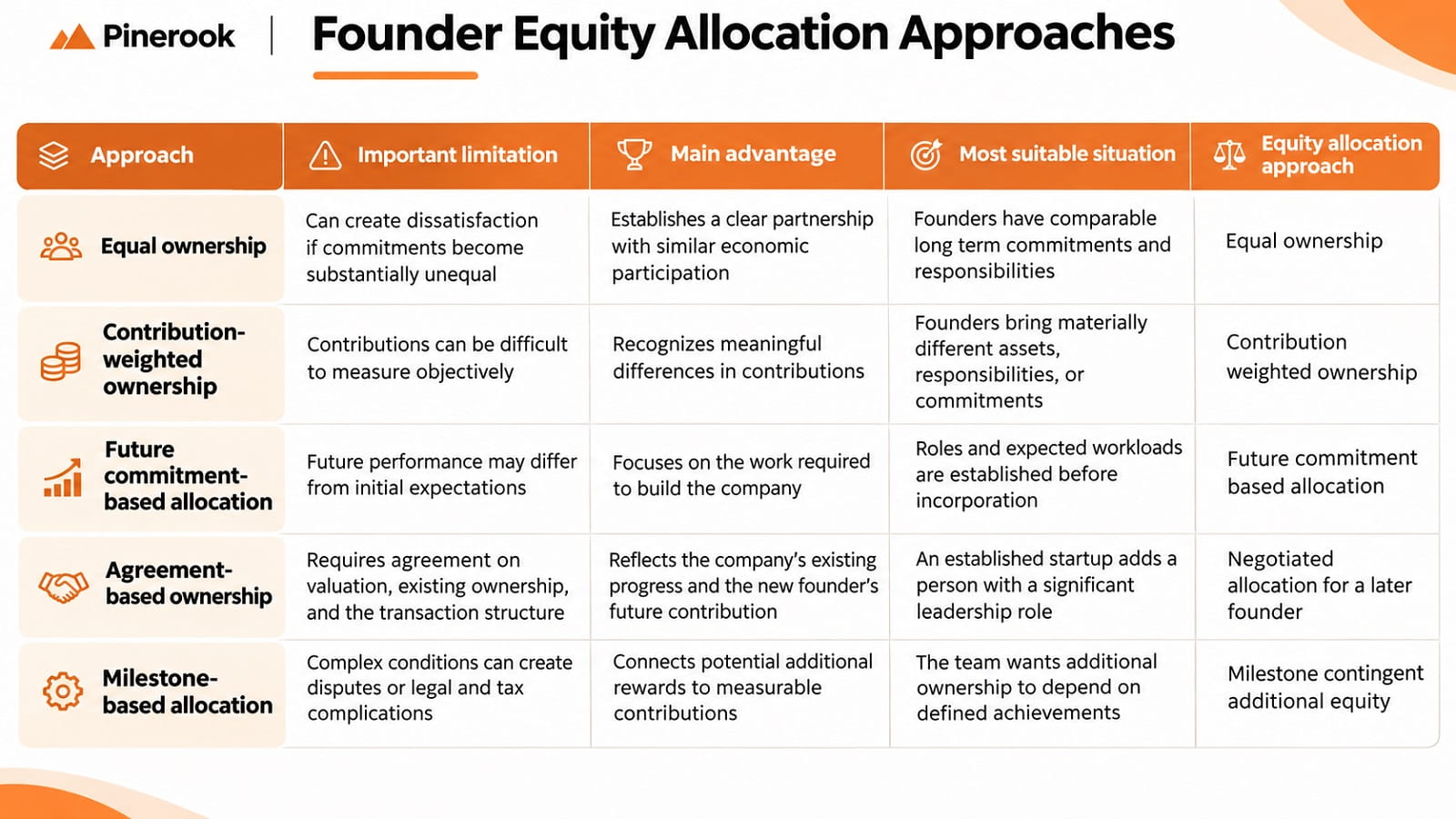
Equity allocation approachMost suitable situationMain advantageImportant limitationEqual ownershipFounders have comparable long term commitments and responsibilitiesEstablishes a clear partnership with similar economic participationCan create dissatisfaction if commitments become substantially unequalContribution weighted ownershipFounders bring materially different assets, responsibilities, or commitmentsRecognizes meaningful differences in contributionsContributions can be difficult to measure objectivelyFuture commitment based allocationRoles and expected workloads are established before incorporationFocuses on the work required to build the companyFuture performance may differ from initial expectationsNegotiated allocation for a later founderAn established startup adds a person with a significant leadership roleReflects the company's existing progress and the new founder's future contributionRequires agreement on valuation, existing ownership, and the transaction structureMilestone contingent additional equityThe team wants additional ownership to depend on defined achievementsConnects potential additional rewards to measurable contributionsComplex conditions can create disputes or legal and tax complications
No single approach eliminates the risk of disagreement. An equal split can be inappropriate when one person has a substantially smaller role, while a weighted split can create resentment if its assumptions are poorly documented.
The strongest arrangement is one that the founding team can explain through its expected contributions and responsibilities. The agreement should also remain practical under difficult scenarios, including delayed product development, reduced participation, or a founder leaving earlier than planned.
A Practical Framework for Dividing Founder Equity
Before agreeing on ownership percentages, founders should define their responsibilities in specific terms. A technical founder might be responsible for product architecture and engineering recruitment, while a commercial founder manages sales, customer relationships, and financing discussions.
The team should then discuss the amount of time each person will contribute over the next several years. A founder planning to work full time immediately may face different opportunity costs from someone who will remain employed elsewhere for an extended period.
Next, the founders should distinguish resources already contributed from future promises. Intellectual property that can legally be transferred to the business is different from an intention to develop technology later. Similarly, an existing customer contract represents a more tangible contribution than a general expectation of future commercial relationships.
The discussion should also cover whether founders will receive salaries and when those salaries might begin. Temporary differences in cash compensation can sometimes be addressed directly rather than converted into permanent differences in equity.
Finally, the team should test the proposed allocation against realistic challenges. A useful agreement should remain understandable if a founder leaves, the company needs another executive, or additional investment changes the ownership structure.
This process does not produce a mathematically perfect percentage. Its purpose is to create a decision that reflects the business's requirements and reduces ambiguity before the company becomes more valuable.
Founder Roles, Leadership and Decision Making
Ownership and leadership are related, but they are not identical. A person can serve as chief executive without holding the largest ownership percentage, and a founder with a substantial equity position may have limited involvement in daily operations.
The team should agree on who is responsible for major operational functions and how disagreements will be resolved. This is especially important for two founder teams that choose an equal ownership split.
A 50% ownership position for each founder does not automatically provide a workable decision making process. If shareholder approval requires a majority and the founders disagree, the company may face a deadlock, depending on its governing documents and voting arrangements.
The solution is not necessarily to give one person a dramatically larger share. Founders can consider an appropriate board structure, defined management authority, reserved decisions, and lawful mechanisms for resolving disagreements.
Corporate governance arrangements should be documented separately from the economic allocation of shares. Founders should not assume that naming someone CEO automatically gives that person unrestricted authority over shareholder or board decisions.
A clear division between ownership and operational responsibility helps reduce the risk that disagreements about management become disputes about the fairness of the original equity split.
Adding a New Cofounder to an Existing Startup
A company may begin with one or two founders and later identify someone whose contribution is important enough to justify joining the founding team. This can happen when a business needs an experienced technical leader, commercial partner, or executive capable of leading a major stage of development.
The new person's allocation should reflect the company's circumstances when they join. A startup with a working product, paying customers, and completed financing has already created value and reduced certain risks that the original founders accepted.
However, the person's future contribution still matters. A leader expected to spend several years building a core business function may deserve meaningful ownership even when the company has already achieved initial traction.
There is no universal percentage for a founder joining later. The appropriate allocation depends on the company's existing value, the responsibilities involved, the person's financial commitment, and the structure of the proposed arrangement.
A particularly important issue is whether the new founder receives newly issued shares from the company or existing shares transferred by the original founders. Both approaches can produce the same ownership percentages, but they are different legal transactions with potentially different tax and financial consequences.
Calculating Equity for a New Cofounder
Consider AtlasWorks, a fictional software company founded by two entrepreneurs. Founder A owns 6 million common shares, while Founder B owns 4 million. The company has 10 million outstanding shares, no employee reserve, and no outstanding convertible securities.
Founder A initially owns 60% and Founder B owns 40%. The business now wants to add Founder C, who will take responsibility for developing and commercializing an important product division.
The three founders agree that Founder C should hold 20% immediately after the proposed transaction, assuming all shares carry equivalent ownership rights.
One approach is for the company to issue new shares. Because the original founders collectively hold 10 million shares and should retain 80%, the required total capitalization is calculated as follows:
Total shares after issuance = 10,000,000 ÷ 0.80 = 12,500,000
New shares issued to Founder C = 12,500,000 − 10,000,000 = 2,500,000
A different approach is for the original founders to transfer some of their existing shares. Founder C could receive 2 million shares, representing 20% of the original 10 million share capitalization.
The table compares three illustrative arrangements.
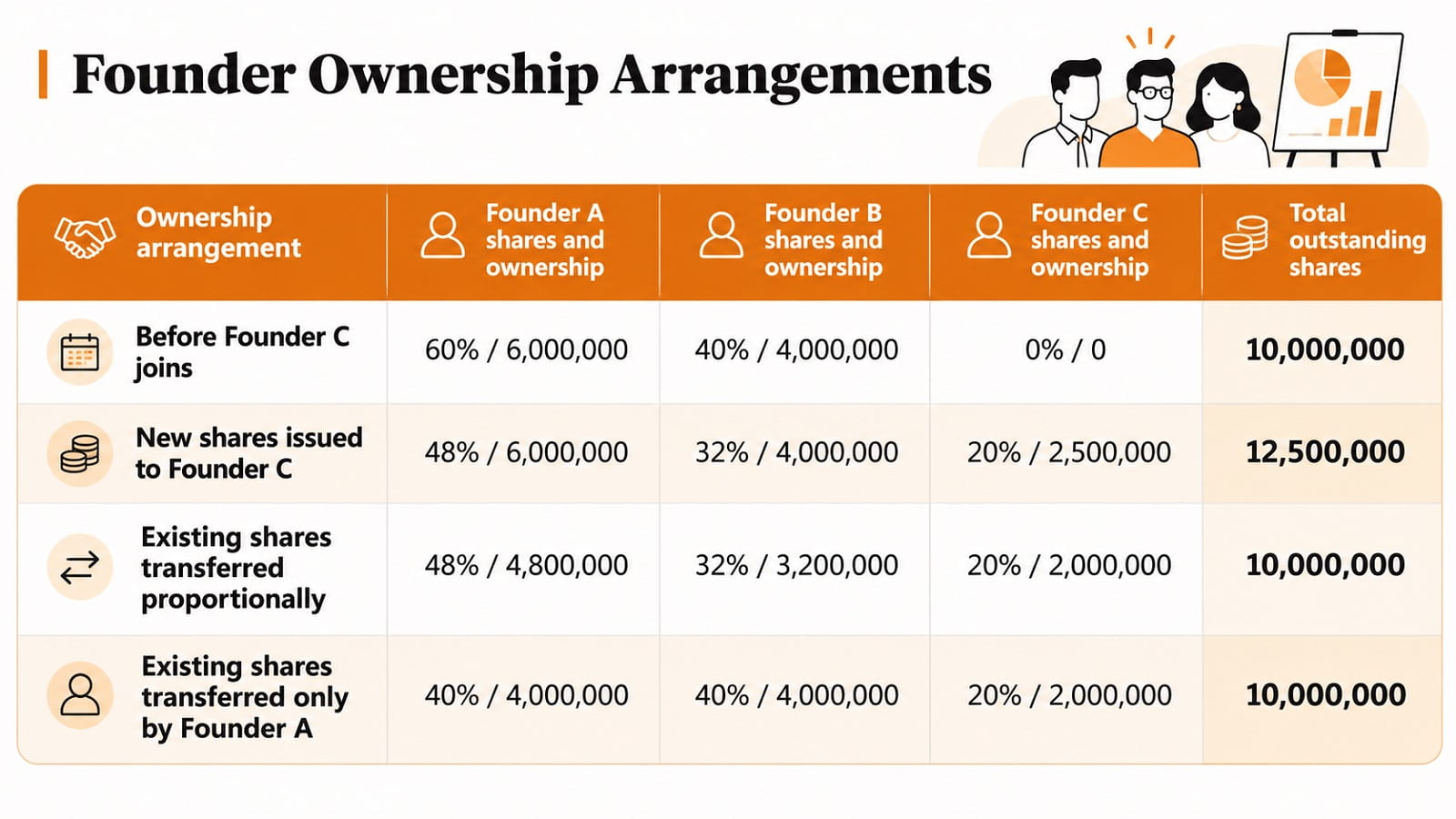
In the new issuance arrangement, the company creates 2.5 million shares for Founder C. Founders A and B retain their original share counts, but their ownership percentages decrease to 48% and 32%.
The proportional transfer produces the same final percentages, but no additional shares are issued. Instead, Founder A transfers 1.2 million existing shares and Founder B transfers 800,000 shares to Founder C.
The final arrangement places the entire transfer on Founder A. Founder B retains 40%, while Founder A decreases to 40%, leaving Founder C with 20%.
All three arrangements result in Founder C holding 20%, but they do not impose the same consequences on the original founders. They can also create different obligations relating to consideration, authorization, taxation, and transfer restrictions.
The example deliberately excludes employee equity reserves, preferences, convertible securities, and other capitalization changes. It illustrates ownership arithmetic rather than establishing an appropriate price or legal structure for the transaction.
New Share Issuance Versus Founder Share Transfers
When a company issues new shares to a founder, the business becomes responsible for the issuance and must comply with applicable corporate, securities, and tax requirements. The recipient may acquire the shares through payment, eligible services, or another properly structured arrangement.
A transfer between existing shareholders is different because the company does not ordinarily create additional shares. Ownership moves from the transferring shareholder to the recipient, and the underlying financial and tax consequences depend on the terms of the transfer.
In AtlasWorks, issuing only 2 million new shares would not give Founder C a 20% stake. The company would then have 12 million outstanding shares, meaning Founder C would own approximately 16.67%.
This distinction is especially important when founders negotiate using percentages without calculating the exact number of shares required. A commitment to provide 20% of the company should identify the relevant capitalization basis and whether the percentage is measured before or after issuance.
The arrangement should also explain whether the recipient must purchase the shares, whether restrictions apply, and what happens if the new founder leaves.
A new founder receiving equity for services may face tax consequences, potentially including compensation income, even if no cash changes hands. The transaction should therefore be reviewed by qualified advisers before ownership documents are executed.
Founder Vesting and Departure Protections
A fair equity allocation does not guarantee that every founder will contribute as expected. One person may leave for another opportunity, become unable to continue working, or disagree with the company's direction.
Founders can address this risk through contractual restrictions that determine what happens to shares when someone departs before completing agreed service commitments.
In US startup corporations, founder common shares are often issued at an early stage and made subject to repurchase rights. The company's right to repurchase a portion of those shares may decline as the founder completes qualifying service.
A commonly used arrangement involves four years of service with a one year cliff. However, the appropriate terms depend on the founders' circumstances and agreements. Prior contributions, earlier service, and differences in responsibilities may justify negotiated variations.
The important point for an ownership allocation is that vesting and repurchase terms can address future participation without requiring an excessively unequal initial split.
Founders should also specify the consequences of resignation, removal, disability, death, and an acquisition where relevant. These events can produce different outcomes, and broad informal promises are not substitutes for clear contractual terms.
Intellectual Property and Founder Contributions
A founder's equity allocation should be considered alongside the ownership of the company's intellectual property. A startup may depend on software, designs, patents, research, branding, or other assets created before incorporation.
Founders should establish which assets the company needs and whether the individuals contributing them have the legal authority to transfer the relevant rights.
This is particularly important when someone developed technology while employed by another organization or working under a university research agreement. A founder's belief that they created an invention personally does not always establish that they own all the associated intellectual property rights.
The relevant assignments, licenses, permissions, and restrictions should be reviewed before the business relies on the assets. Investors may examine these records during due diligence to determine whether the company controls the technology required for its operations.
An equity allocation cannot resolve an intellectual property ownership problem by itself. Even a founder holding a majority stake does not necessarily have the authority to transfer rights owned by a third party.
Proper documentation protects the company and gives every founder greater certainty about what each person has contributed.
Founder Salaries and Cash Contributions
Equity is not the only way to recognize the economic contributions of founders. A person investing cash, accepting reduced compensation, or providing essential resources may deserve consideration through an arrangement separate from their permanent ownership percentage.
For example, one founder might contribute $100,000 while another contributes full time work and technical expertise. The team could incorporate those contributions into its negotiated share allocation, but it could also consider documenting the cash as a loan or investment, subject to appropriate legal and financial treatment.
The appropriate arrangement depends on the company's resources and the intentions of the parties. A contribution made as a loan creates different rights from a contribution made in exchange for equity.
Salary differences create similar questions. One founder may need a modest salary to work full time while another can temporarily operate without compensation. The team should discuss whether those differences are expected to be temporary and how they fit the overall agreement.
A useful ownership discussion distinguishes capital, compensation, and long term participation rather than treating them as interchangeable.
Founder Equity and Future Fundraising
The initial ownership split affects how founders experience future financing, but it does not determine the final ownership structure after investors and employees are added.
When a startup issues new shares, existing shareholders generally represent a smaller percentage of the expanded capitalization unless they participate proportionately or other adjustments apply.
A founder owning 60% before a financing round may hold 48% afterward if the round results in a 20% proportional reduction and no other changes occur.
However, the founder's absolute number of shares may remain unchanged, and the company may receive capital that supports meaningful business growth.
Carta's 2026 Founder Ownership Report found that the median founding team retained approximately 56% of fully diluted equity after seed financing and approximately 36% after Series A in its sample of rounds raised between 2021 and 2025.
These are observed figures from a particular dataset, not targets that every startup should adopt. Ownership patterns can vary considerably by sector, business model, financing requirements, and the rights granted to investors.
Founders should consider future financing needs when negotiating their initial arrangement, but they should not assume that preserving the largest possible percentage always produces the best financial outcome.
Founder Equity, Voting Rights and Control
Economic ownership and corporate control can diverge as a startup grows. A founder may own more shares than any other individual but lack unilateral authority to approve major transactions.
Voting rights depend on the share classes, governing documents, applicable law, and contractual agreements. Board representation and investor consent rights can also influence important business decisions.
For founding teams, this distinction matters even before outside investment. Two people holding equal ownership may need a defined mechanism for resolving disagreements about management appointments, financing, or major strategic changes.
A founder with a larger ownership stake may still be restricted from taking certain actions without approval from the board or other shareholders.
The team should therefore document management responsibilities and decision making procedures separately from its economic share allocations.
Strong governance arrangements reduce the risk that disagreements about strategy become conflicts over ownership percentages.
Legal and Tax Considerations for Founder Shares
Founder shares are subject to the laws and tax rules of the company's jurisdiction. In the United States, founders often acquire common stock at or near incorporation, sometimes while the shares remain subject to restrictions.
When eligible restricted property is transferred in connection with services, a Section 83(b) election may be relevant. Under US federal law, an eligible election generally must be filed no later than 30 days after the property is transferred.
The deadline is measured from the relevant property transfer rather than from the date the shares become fully vested. Founders should not assume that the election is appropriate or available for every form of equity.
The treatment may be different for founders who receive options, join later when the company has substantial value, or hold interests in an entity that is not a corporation.
International founding teams also face issues involving tax residence, company location, and different legal definitions of ownership interests.
Professional legal and tax advice is particularly important when founders are transferring intellectual property, issuing restricted shares, or changing ownership after the company has developed meaningful value.
Common Mistakes in Founder Equity Agreements
One recurring mistake is assigning ownership solely according to who first suggested the business idea. An idea may be important, but building a sustainable company requires continuing work in technology, operations, recruitment, and commercial execution.
Another mistake is delaying the agreement until the startup begins attracting investors. By that point, expectations may have become entrenched, and an informal understanding can be more difficult to reconcile with the company's actual share records.
Founders can also create problems by promising a percentage without defining whether it applies to outstanding or fully diluted capitalization. The difference becomes important when new equity awards or financing instruments are introduced.
A further risk is failing to document what happens when a founder leaves. Without clear terms, someone who makes only a brief contribution may retain rights that the remaining team had assumed would be conditional on longer service.
Finally, founders sometimes confuse ownership percentages with legal authority. A larger economic stake does not necessarily resolve disagreements over board decisions, intellectual property, or shareholder rights.
Avoiding these mistakes requires clear agreements, consistent capitalization records, and a realistic understanding of the responsibilities every founder has accepted.
A Practical Founder Equity Decision Process
Founding teams can approach ownership discussions as a sequence of business decisions rather than a negotiation over percentages alone.
The first stage is to define the roles required to build the company and identify which people will be responsible for delivering them. The team should then establish expected working commitments, financial contributions, and ownership of any intellectual property being brought into the business.
Next, founders can compare an equal allocation with a contribution weighted alternative. Both should be assessed against the same anticipated responsibilities and risks.
The proposed arrangement should then be tested under difficult circumstances. These include a founder leaving earlier than expected, the business adding another executive, a financing round changing ownership, or the team disagreeing about major strategic decisions.
Once an allocation is agreed, the company should document the relevant share transactions, restrictions, governance arrangements, and required approvals.
The most effective decision is one that remains understandable after the company has grown beyond its initial founding assumptions.
Final Thoughts
Founder equity is more than the division of a company's first shares. It is an agreement about responsibility, financial participation, and the relationships that will shape the startup's development.
The most appropriate allocation depends on the people involved and the contributions the business needs. Equal ownership can support committed partnerships, while justified differences may be appropriate when roles, existing assets, or long term commitments vary materially.
The AtlasWorks example demonstrates why a percentage agreement must be translated into a specific share transaction. Issuing new shares and transferring existing shares can produce similar percentages while creating different consequences for the company and its founders.
A well considered ownership agreement should be fair, clearly documented, and compatible with the company's long term plans. When founders establish those terms early, they can devote more attention to building the business and less to resolving preventable ownership disputes.
FAQ
What Is Founder Equity?
Founder equity is the ownership interest allocated to people who establish and develop a startup. It is commonly represented by common shares in a startup corporation, although the form of ownership depends on the company's legal structure.
How Should Two Cofounders Split Equity?
A 50% allocation for each founder can be appropriate when both make comparable long term commitments and contribute essential capabilities. Unequal arrangements can also be reasonable when meaningful differences exist, but the decision should be supported by clear expectations.
Is a 50/50 Founder Equity Split a Good Idea?
It can be. However, equal ownership does not eliminate the need for defined management responsibilities and procedures for resolving disagreements. Governance should be considered alongside the economic split.
Does the Founder Who Had the Idea Deserve More Equity?
Not automatically. The original idea is one contribution among many. Future responsibility, execution, relevant expertise, and long term commitment can be equally or more important.
How Much Equity Should a New Cofounder Receive?
There is no universal percentage. The allocation depends on the company's existing development, the new founder's responsibilities, the risks being accepted, and the terms of the proposed ownership arrangement.
Can a Founder Receive Equity Without Investing Cash?
Depending on the applicable law and transaction structure, founders may receive shares in connection with services, intellectual property, or other qualifying consideration. The issuance still requires appropriate documentation and may create tax obligations.
Can a Founder Lose Shares After Leaving?
Potentially. Restricted founder shares may be subject to contractual repurchase rights or other conditions. The outcome depends on the governing agreements and applicable law.
Is Founder Equity the Same as Voting Control?
No. Economic ownership and voting authority can differ because of share classes, board arrangements, and contractual rights. Holding the largest percentage does not necessarily provide unrestricted control.
Can Founders Change Their Equity Split Later?
They may be able to, subject to corporate approvals, contractual restrictions, and legal and tax requirements. Changes involving transfers or new issuances should be documented and evaluated carefully.
Does Raising Investment Reduce Founder Equity?
Issuing additional shares commonly reduces existing shareholders' percentage ownership. However, founders may retain the same number of shares, and the new capital can support business growth.

Mobina Khanki
Venture & Funding Writer at PinerookMobina Khanki covers venture capital, startup funding, fundraising, and startup finance for Pinerook, focusing on founders and investors.
 Seen first.