Raising capital can help a startup develop its product, recruit employees, and pursue opportunities that would otherwise be difficult to finance. However, a funding round can also expose weaknesses in financial planning, customer validation, investor selection, and management judgment. When founders overlook these issues, fundraising may consume substantial time without delivering the capital or investment relationship the company needs.
Many fundraising mistakes begin with decisions that seem reasonable at the time. A founder may approach investors because competitors have recently announced large financing rounds, prepare optimistic revenue projections to communicate ambition, or increase spending after receiving encouraging investor feedback. None of these actions necessarily appears disastrous in isolation, but together they can create serious problems when the company needs to complete a financing transaction.
Avoiding such errors requires understanding the difference between building investor interest and establishing a credible investment opportunity. Founders need reliable business evidence, realistic capital requirements, accurate company records, and enough financial flexibility to respond when an anticipated investment does not materialize.
A clear Fundraising Strategy connects the decision to seek capital with specific business objectives. Recognizing common mistakes helps founders protect those objectives and avoid financing decisions that could weaken the company rather than support its development.
Why Startups Make Fundraising Mistakes
Fundraising introduces responsibilities that are different from building and operating a startup. Founders who understand their product and customers may have limited experience with investor evaluation, equity financing, legal documentation, or the expectations associated with venture capital. This lack of experience can become especially important when negotiations involve unfamiliar financial and governance provisions.
Financial pressure makes the situation more complicated. A company with limited runway may feel compelled to accept uncertain commitments, approach investors outside its target market, or agree to conditions that management would otherwise question. When cash becomes scarce, decisions intended to solve an immediate problem can create obligations that affect the business for years.
Another common issue is confusing activity with progress. A startup may contact hundreds of investors, attend numerous meetings, and receive positive feedback without advancing toward an actual financing commitment. Founders who measure success primarily through activity may fail to recognize that their campaign is not producing meaningful results.
The most effective way to prevent these errors is to establish clear expectations before fundraising begins. Management should understand which information supports the investment opportunity, what resources the company requires, and which developments would indicate that its financing approach needs to change.
Raising Capital Without a Clear Business Objective
One of the most important fundraising mistakes is seeking investment without establishing what the company intends to accomplish with the money. Founders may decide to raise capital because other startups in their industry are doing so, because investors appear interested in a particular technology, or because obtaining venture financing seems like a necessary milestone.
Investment should serve a business purpose rather than become an objective in itself. A startup may need financing to complete a product, demonstrate customer demand, expand a proven sales channel, or strengthen its operational capacity. Each objective requires different resources and carries different uncertainties.
For example, a software company that has not yet established whether customers will pay for its product may need to prioritize validation over aggressive commercial expansion. Raising a large amount to build a sales organization before confirming demand could increase expenses without resolving the company's most important business risk.
A stronger approach begins by identifying the next meaningful milestones and determining which activities are required to reach them. Founders can then explain why external capital is necessary, how the funds would be allocated, and what evidence of progress investors should expect.
The financing request becomes more credible when it reflects an operating plan rather than an arbitrary target.
Asking for Too Much or Too Little Funding
Choosing an inappropriate financing amount can create problems even when investors are willing to provide capital. Raising too little may leave the startup unable to complete its planned milestones, while raising significantly more than it can use responsibly may result in unnecessary dilution or pressure to pursue expansion before the business is ready.
A founder might estimate the cost of hiring additional engineers without accounting for infrastructure, customer support, administrative obligations, and the time required for the new employees to produce meaningful results. The company may then discover that the investment cannot support the development period originally presented to investors.
The opposite problem occurs when founders select a financing target based on the size of other companies' funding announcements. Businesses with different customer acquisition costs, product requirements, and development stages cannot automatically justify equivalent financing amounts.
A realistic request should be supported by a detailed forecast of operating expenses, expected receipts, planned investments, and reasonable allowances for uncertainty. Management should understand what the company could accomplish with the proposed capital and which decisions would need to change if the available amount were smaller.
The appropriate round size is the one that supports a credible business plan, not necessarily the largest amount investors might be willing to provide.
Starting Fundraising Too Late
A promising startup can enter a difficult position when it begins fundraising without enough financial runway to accommodate investor evaluation and possible delays. Even interested investors may need time for additional meetings, internal approvals, document reviews, negotiations, and closing arrangements.
The problem becomes more severe when founders assume that a financing round will close within a particular period and organize their expenses around that expectation. If the company has only a short period of cash remaining, a delayed decision may leave few practical alternatives.
Founders should distinguish preparation from active investor outreach. Financial planning, investor research, and organization of company information can begin before the business officially launches a fundraising campaign. Completing this work early can reduce avoidable delays when financing becomes necessary.
Management should also maintain a cash forecast that reflects actual payment dates and operating commitments. An estimate based on average monthly spending may not capture upcoming obligations or changes in customer receipts.
The central mistake is not failing to predict the exact closing date. It is treating an uncertain financing outcome as though it were sufficiently reliable to replace responsible cash planning.
Approaching Investors Before Demonstrating Relevant Progress
Startups do not need substantial revenue to raise investment, but they should understand what evidence is appropriate for their stage. A company developing an early prototype will be assessed differently from a business seeking financing after establishing paying customers and repeatable commercial activity.
Problems arise when founders present ambitious growth plans without showing that the underlying customer problem, product assumptions, or commercial opportunity have been investigated.
Consider an early software startup serving independent retailers. If management claims that thousands of businesses will purchase its product but has conducted little customer research, investors may reasonably question how those expectations were developed.
A more credible presentation would explain what the company has established through interviews, product testing, pilot programs, or actual purchases. It should also identify the assumptions that remain uncertain and describe the next validation milestones.
Founders should not interpret this requirement as a reason to delay fundraising indefinitely. Early investors accept considerable uncertainty. What matters is whether the evidence available is relevant to the proposed financing and whether management can explain the risks honestly.
Targeting the Wrong Startup Investors
A large investor contact list can create the appearance of a comprehensive fundraising campaign while containing relatively few realistic opportunities.
Investors differ in their preferred sectors, company stages, geographic markets, typical commitments, and investment models. An established venture capital firm may be a poor match for an early startup if it primarily invests in companies with substantial revenue or operates outside the company's location.
Founders sometimes prioritize reputation over suitability. A recognizable investor may seem more desirable than a smaller firm with relevant industry experience, even when the smaller firm is more likely to consider the business.
A better approach is to research investor preferences before making contact. Relevant portfolio companies, recent investments, published investment criteria, and professional introductions can help determine whether a potential investor deserves attention.
Investor compatibility also includes expectations after financing. Management should consider whether an investor's governance preferences, level of involvement, and growth expectations align with the company's circumstances.
The goal is not to contact every investor who might have available capital. It is to identify people and organizations with a credible reason to evaluate the startup.
Presenting Unsupported Claims and Financial Forecasts
Investors expect founders to communicate ambition, but ambitious statements must be distinguished from verified results.
One recurring fundraising mistake is presenting expressions of customer interest as established demand. A product registration, trial account, pilot agreement, paying customer, and recurring subscription each represent different levels of commercial evidence. Combining these categories can exaggerate the company's progress.
Market estimates create similar risks. Founders sometimes present the total value of an industry without explaining which customers the startup can realistically serve or how those customers could be acquired.
Financial forecasts should also reflect defensible assumptions. Revenue projections need to connect customer acquisition, pricing, retention, and commercial capacity. Operating expenses should reflect the resources required to deliver the expected growth.
Precision does not automatically make a forecast credible. A detailed financial model based on unsupported customer assumptions may provide less useful information than a simpler model that identifies its uncertainties clearly.
Founders should explain which figures represent historical performance, which are projections, and what evidence supports their expectations. Investors can evaluate uncertainty more effectively when management communicates it accurately.
Fundraising Mistakes and Their Early Warning Signs
Many financing problems become visible before they result in a rejected investment or an unsuccessful round. Recognizing these signals allows founders to correct their approach while the company still has flexibility.
Common Fundraising Mistakes and Prevention Framework
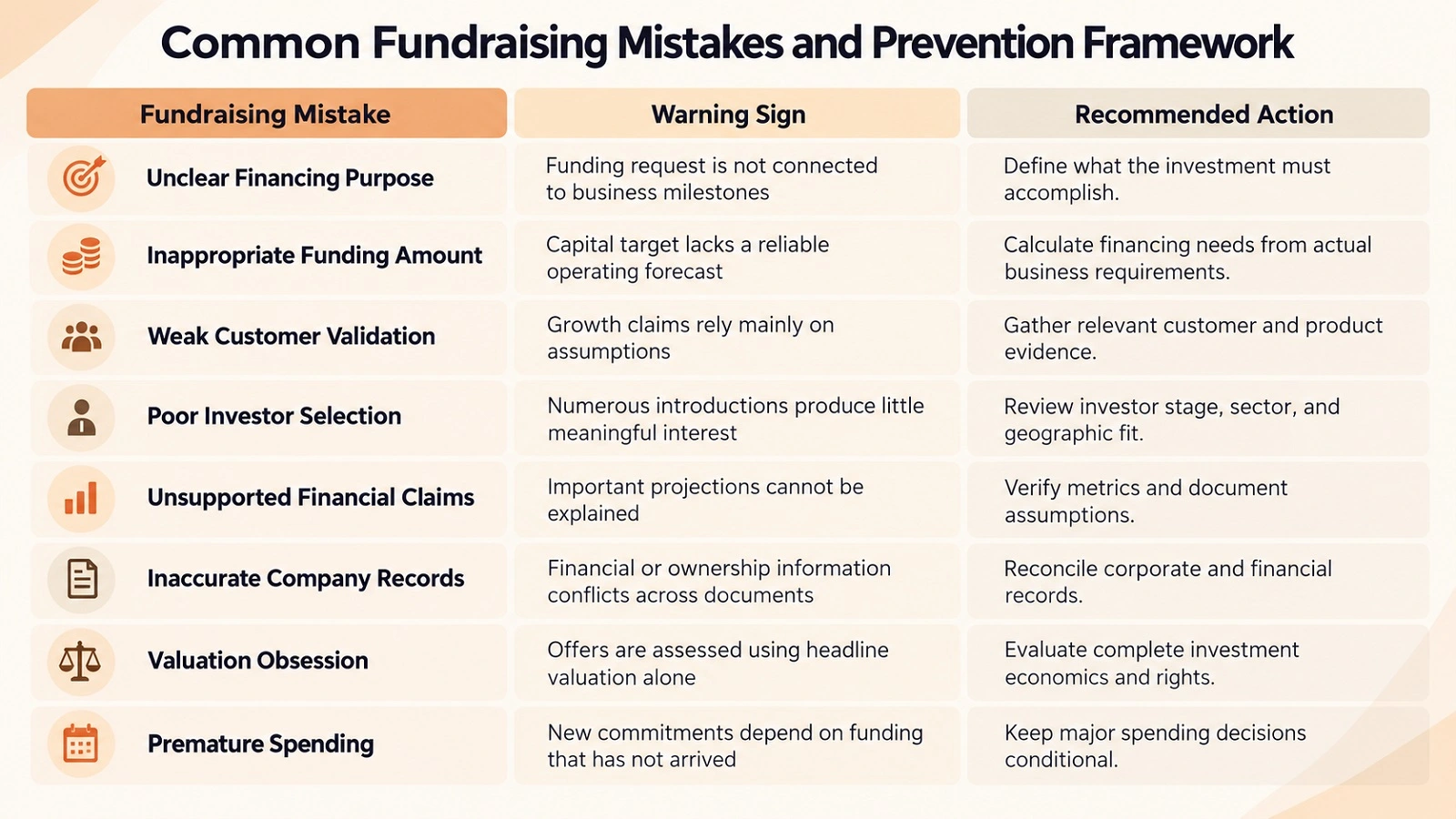
These warning signs are not automatic evidence that a financing round will fail. An early stage startup may legitimately have limited customer data, while an investor may decline for reasons unrelated to the company's quality.
Their value lies in helping management examine whether the business is making decisions based on reliable information. A founder who identifies recurring concerns early has more opportunity to improve the investment case than one who waits until financial pressure becomes urgent.
Poor Financial Records and Capitalization Problems
Company documentation can become a significant obstacle when investors begin detailed evaluation. A startup may have issued shares to founders, established employee equity arrangements, or accepted earlier funding through SAFEs or convertible notes. If these transactions are not accurately recorded, management may struggle to explain who owns the company and how new financing would affect existing shareholders.
Financial reporting can create similar problems. Revenue figures may differ across presentations and accounting records, expenses may be categorized inconsistently, or the assumptions behind forecasts may no longer reflect current operations.
Such discrepancies can lead to additional questions, delayed transactions, and concerns about management reliability. Some ownership issues may also require formal corporate action or professional legal assistance before a financing can proceed.
Founders should maintain accurate capitalization records, preserve relevant company approvals, and reconcile financial information before presenting it to investors. Important figures should remain consistent across investor materials and supporting documentation.
Reliable records do not guarantee funding, but they reduce the risk that preventable administrative problems will interfere with an otherwise promising investment opportunity.
Focusing Only on Startup Valuation
A higher valuation may allow a startup to raise a fixed amount of equity capital while issuing a smaller ownership percentage. However, choosing an offer based solely on valuation can overlook terms that materially change its financial consequences.
Liquidation preferences may affect how proceeds are distributed in certain exit events. Employee option pool requirements can influence dilution, while governance provisions may establish investor approval rights over important corporate actions.
Two offers with similar valuations can therefore produce different economic and operational outcomes. A company that focuses exclusively on the headline number may accept conditions that complicate future financing or reduce management flexibility.
Founders should understand the complete proposed transaction, including the actual capitalization after investment, the rights attached to securities, and the responsibilities established by the agreement.
The objective is not always to achieve the highest possible valuation. It is to obtain sufficient financing under conditions the company can reasonably sustain as it develops.
Important legal and financial provisions should be reviewed with qualified professionals before founders make binding commitments.
Confusing Investor Interest With Committed Capital
Positive investor feedback can be encouraging, but it should not be treated as a completed financing transaction.
An investor may praise the product, request additional information, introduce a colleague, or discuss possible investment terms without making a final commitment. Even a preliminary agreement may leave due diligence, approvals, definitive documentation, or closing conditions unresolved.
The mistake occurs when management treats these developments as though the investment proceeds were already available.
A startup might approve additional hiring or expand its spending because several investors have expressed interest. If those conversations do not result in financing, the new obligations can place unnecessary pressure on the company's cash position.
Founders should track meaningful developments and understand which decisions remain outstanding. A substantive evaluation is more significant than a positive introductory conversation, but neither should be confused with receipt of funds.
Financial decisions should be based on the company's actual available resources and credible operating alternatives rather than assumptions about investor enthusiasm.
Letting Fundraising Distract From the Business
Fundraising can demand considerable attention from founders. Researching investors, attending meetings, answering questions, preparing documentation, and managing negotiations may gradually displace the work required to improve the product and serve customers.
This creates a contradiction. The financing campaign is intended to strengthen the business, but the time spent pursuing capital can weaken the commercial progress that makes the company attractive.
Customer relationships may receive less attention, product development may slow, and important operational decisions may be postponed while management concentrates on meetings.
Founders should coordinate fundraising responsibilities without allowing the campaign to consume the entire leadership team's capacity. Where possible, investor communication can be managed by designated individuals while other team members maintain responsibility for essential operations.
The company should continue monitoring customer activity, product milestones, and financial performance throughout the fundraising period.
Maintaining progress benefits the business regardless of whether investors ultimately provide capital. Fundraising is a means of supporting company development, not a substitute for it.
Accepting Investment From the Wrong Partner
Obtaining financing does not automatically mean the company has secured a suitable investor relationship.
Investors can hold different expectations about growth, board involvement, reporting, future financing, and the direction of the business. A mismatch may become particularly difficult after the investment closes because shareholders can remain involved for many years.
An investor may expect rapid geographic expansion while founders believe the product requires further validation. Another may seek extensive operational influence that management did not anticipate during initial conversations.
Founders should investigate these expectations before accepting capital. Conversations with relevant portfolio founders can provide useful insight into an investor's working style, particularly during difficult periods.
However, informal assurances should not replace a review of the actual investment agreement. Governance arrangements, approval rights, and economic provisions ultimately influence what each party can require.
A suitable investor should bring capital under terms compatible with the company's needs. A financing commitment that creates persistent disagreement over essential business priorities may be less valuable than it initially appears.
Ignoring Legal Requirements and Confidentiality Risks
Fundraising involves financial transactions that may be subject to securities laws, corporate approvals, disclosure requirements, and other legal obligations. The applicable rules depend on where the company operates, the investors involved, and the proposed financing structure.
Founders should not assume that an approach used by another startup is automatically appropriate for their own transaction. Publicly promoting an investment opportunity, using intermediaries, or accepting capital from particular investors may create requirements that need to be considered in advance.
Confidentiality also matters during investor evaluation. Startups may hold sensitive customer information, proprietary technology, or commercial agreements that should not be distributed indiscriminately.
Founders should determine which information is appropriate for introductory conversations and which materials require additional verification of the recipient or controlled access.
Qualified legal advice is particularly important when a financing arrangement involves unfamiliar jurisdictions, complex securities, or unusual contractual provisions. A failure to address these issues can create risks that extend beyond the immediate fundraising campaign.
A Practical Example of Fundraising Mistakes
Consider a hypothetical startup called StockBridge, which provides inventory management software for independent retailers. The company has developed a functioning product and is testing it with several businesses, but it has not yet demonstrated a repeatable process for converting prospective customers into paying subscribers.
The founders decide to raise $3 million after reading announcements about similar technology companies obtaining substantial financing. They prepare ambitious revenue forecasts but have not connected the proposed investment amount to a detailed operating plan.
StockBridge approaches a large number of venture capital firms without verifying whether those investors support companies at its development stage. Initial meetings generate some interest, but investors repeatedly ask about customer conversion, pricing validation, and the resources required to acquire additional retailers.
Instead of investigating those questions, the founders spend more time revising their pitch presentation and expanding their contact list. They also begin recruiting additional employees because they expect an investment commitment to arrive soon.
As fundraising continues, cash consumption increases while commercial validation remains limited. Several investors request more information, but none has committed funds.
The problem is not simply a lack of investor interest. StockBridge has combined several avoidable mistakes: an unsupported financing target, incomplete evidence of demand, poor investor selection, and spending decisions based on uncertain capital.
A more disciplined approach would involve reassessing the cash forecast, identifying the most important customer validation questions, and determining which operating milestones justify external financing. The founders could then refine their investor research and present a more credible explanation of the company's current position.
StockBridge is a fictional example. Its purpose is to show how individually manageable mistakes can reinforce one another when they are not recognized early.
How to Recover When Fundraising Is Not Working
An unsuccessful investor conversation does not always indicate a problem with the startup. Investors may decline because of portfolio priorities, available capital, industry preferences, or market conditions. Founders should therefore avoid changing their entire business plan in response to one rejection.
Repeated patterns across suitable investors can be more informative. If several investors question customer demand, management may need stronger evidence of purchasing behavior. If discussions repeatedly stall during financial review, company records or assumptions may require attention.
The critical task is distinguishing a problem with the financing presentation from a more fundamental uncertainty about the business.
Fundraising Problems and Corrective Decisions
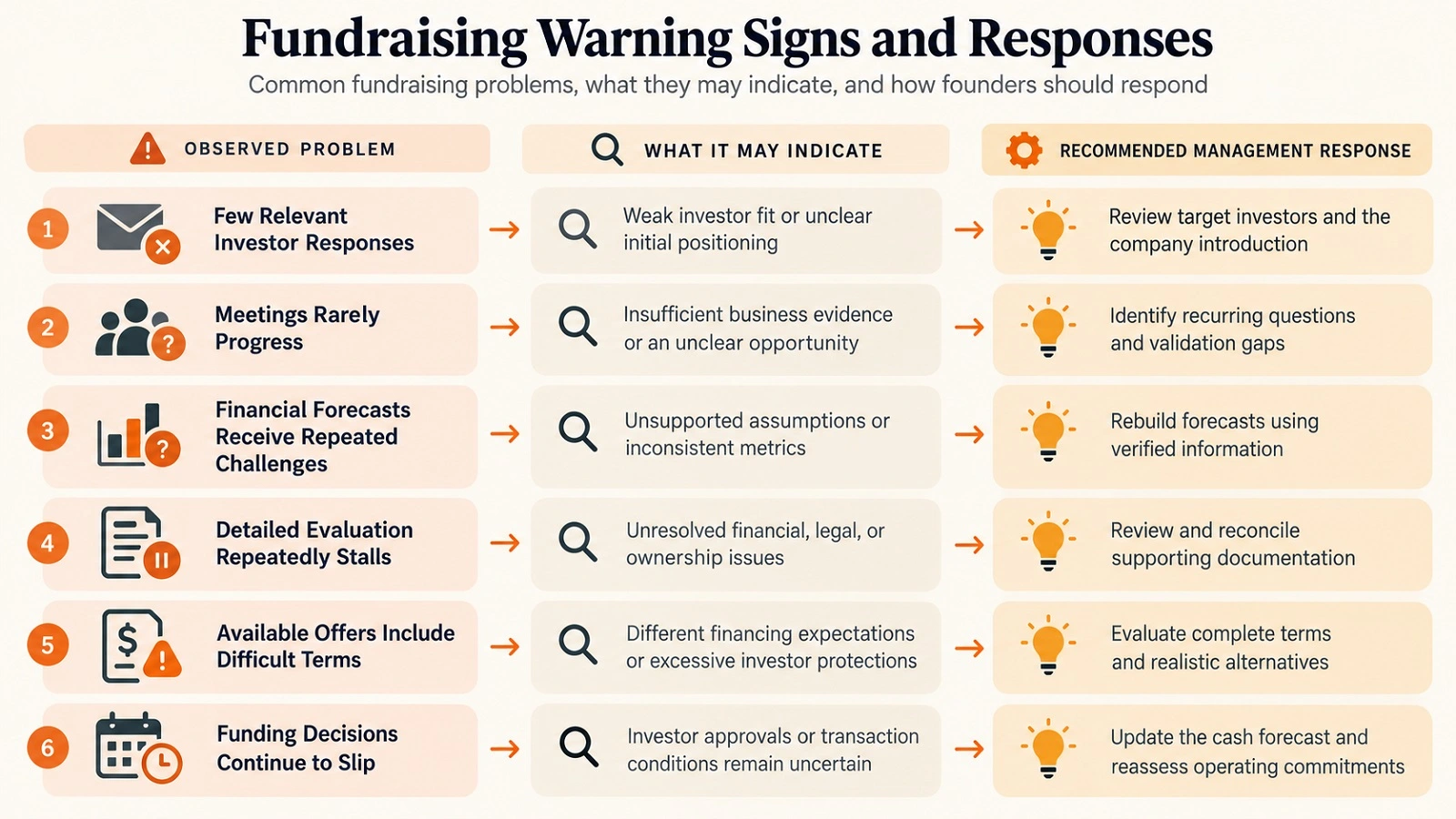
These responses should be treated as diagnostic actions rather than automatic solutions. A startup may need several adjustments before its financing case improves, and external factors can still prevent investment.
The important distinction is that founders should respond to evidence. Sending more generic investor messages will not necessarily solve weak customer validation, just as redesigning a presentation will not correct inaccurate financial records.
When the underlying problem is understood, management can make a more informed decision about whether to continue the campaign, adjust its approach, or concentrate temporarily on developing the business.
Know When to Reconsider the Fundraising Campaign
Continuing to pursue investment is not always the best response when a financing campaign encounters difficulties.
If the company has limited evidence of customer demand and investors consistently identify that uncertainty, additional product or commercial validation may improve its position. If the startup has insufficient runway, however, management must also consider whether it can afford the time required to make that progress.
Founders should examine available cash, upcoming obligations, customer revenue, and realistic financing alternatives. Depending on the business, options may include revising discretionary spending, adjusting growth plans, or considering financing structures more appropriate for its circumstances.
These choices can involve difficult tradeoffs. Reducing costs may preserve liquidity but also slow product development. Alternative financing may provide flexibility while introducing repayment obligations or other expenses.
The decision should reflect the company's actual position rather than the assumption that completing a funding round is necessary at any cost.
Pausing an unsuccessful campaign is not automatically a failure. A business that improves its customer evidence and financial readiness may become a stronger financing candidate later. The objective is to preserve the company while making decisions that support sustainable development.
Avoiding Fundraising Mistakes Through Better Decisions
Fundraising mistakes cannot be eliminated entirely because startup investment involves uncertainty. Founders must make decisions about future performance, market opportunities, and financing requirements without knowing exactly how events will unfold.
What they can control is the quality of the information supporting those decisions.
A reliable cash forecast helps management understand how long the company can operate without new capital. Meaningful customer evidence provides a stronger basis for commercial projections. Accurate ownership records make financing consequences easier to evaluate, while carefully selected investors create more relevant opportunities for discussion.
Founders should also understand the complete economic and governance consequences of accepting investment rather than focusing on valuation or the prestige of an investor's name.
Successful fundraising is not measured solely by receiving capital. The financing should provide resources on appropriate terms and support the company's ability to achieve meaningful business progress.
Avoiding preventable mistakes helps founders pursue that outcome without compromising the financial discipline, operational focus, and judgment required to build a durable startup.
FAQ
What are the most common startup fundraising mistakes?
Common startup fundraising mistakes include raising capital without clear business objectives, selecting an inappropriate financing amount, contacting unsuitable investors, presenting unsupported financial projections, and misunderstanding investment terms. Poor cash planning, inaccurate ownership records, and spending based on uncertain investor commitments can create additional risks.
Why do startups fail to raise funding?
Startups may struggle to raise funding because investors do not see sufficient evidence of customer demand, the business does not match their investment criteria, or financial assumptions remain uncertain. Market conditions, investor capacity, and transaction requirements can also affect the outcome. An unsuccessful financing campaign does not automatically mean the business cannot succeed.
How can founders avoid fundraising mistakes?
Founders can reduce preventable errors by validating important business assumptions, maintaining accurate financial and ownership records, identifying suitable investors, and connecting capital requirements to realistic operating milestones. They should also review complete investment terms and maintain contingency plans for delayed or unsuccessful financing.
Is raising too much capital a fundraising mistake?
Raising more capital than the business reasonably needs can result in unnecessary dilution or pressure to expand spending before the company has established a suitable commercial foundation. However, the appropriate financing amount depends on development requirements, uncertainty, and available opportunities. The important question is whether the capital supports a credible operating plan.
What should founders do after an unsuccessful fundraising attempt?
Founders should review recurring investor feedback, identify where discussions stopped progressing, update the company's cash forecast, and assess whether the main issue involves investor fit, customer validation, financial information, or financing expectations. They can then decide whether to revise the campaign, strengthen the business evidence, adjust spending, or consider appropriate alternatives.

Mobina Khanki
Venture & Funding Writer at PinerookMobina Khanki covers venture capital, startup funding, fundraising, and startup finance for Pinerook, focusing on founders and investors.
 Seen first.