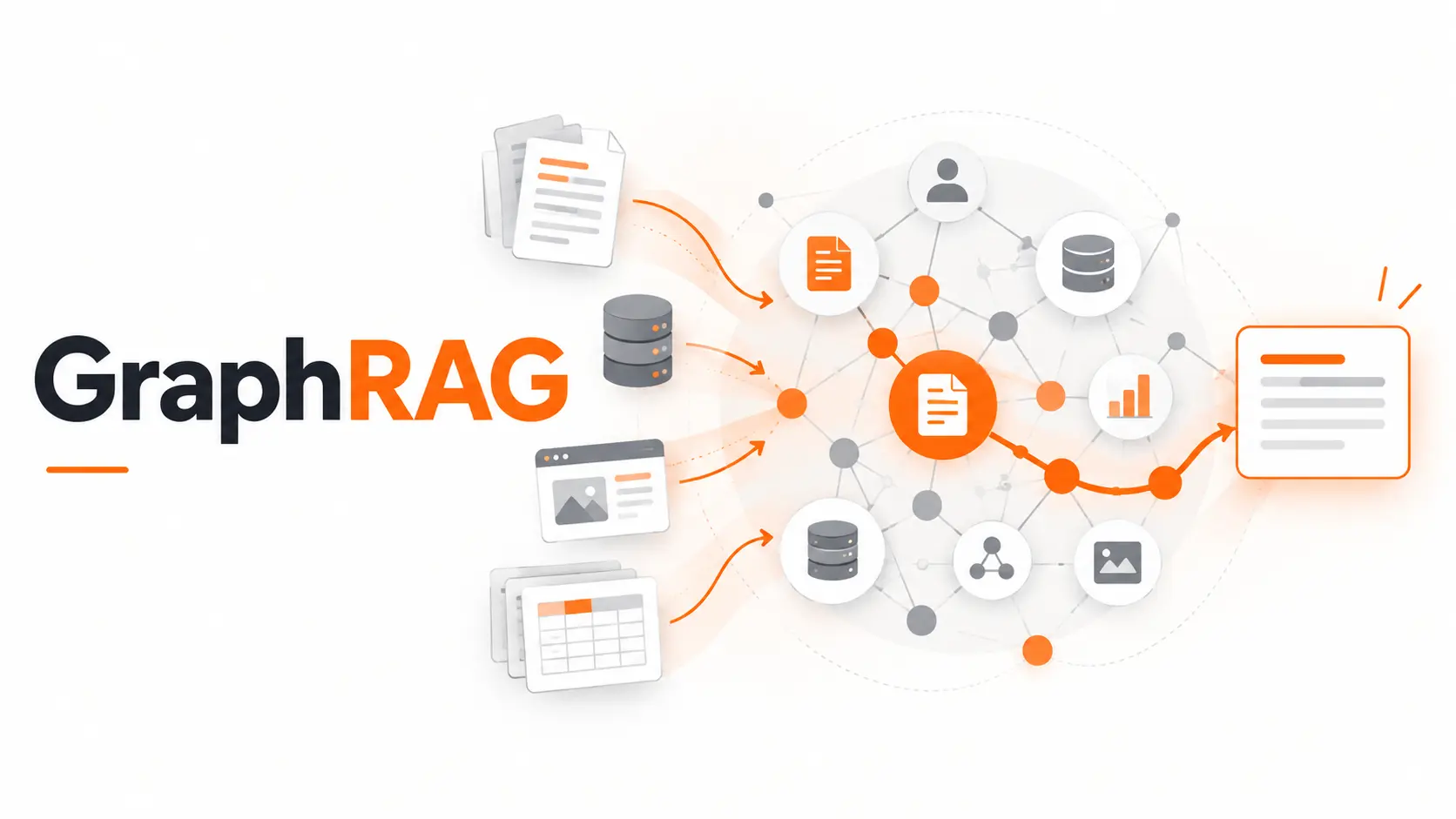
GraphRAG is a retrieval approach that uses knowledge graphs to connect information across documents before supplying relevant evidence to a language model. Instead of finding passages based only on similarity, it can follow relationships between people, companies, events, products, and other entities.
This matters when an answer depends on several connected facts. A vector search might find a document describing a service outage, while GraphRAG can connect that outage to affected services, customer accounts, and related incidents.
I wouldn't introduce GraphRAG into every AI application. Its value depends on the questions users ask, the relationships within the data, and whether those connections justify the additional processing and maintenance.
How GraphRAG Works
GraphRAG organizes information into connected entities and relationships, then uses those connections to retrieve evidence for a user's question.
The process begins before anyone submits a query. Source documents need to be processed, important entities identified, and relationships represented in a graph.
At search time, the system can use that structure to find information that is related through explicit connections rather than text similarity alone.
1. Extracting Entities and Relationships
Consider a set of documents describing software services, customer accounts, incidents, and external providers.
A document might contain this statement:
"Northstar uses IdentityBridge to authenticate enterprise customers."
Another document states:
"IdentityBridge experienced an authentication outage on Tuesday."
The first statement connects Northstar to IdentityBridge through an authentication dependency. The second connects IdentityBridge to an outage.
An extraction process can identify those entities and relationships and represent them as structured records.
This process can use language models, named entity recognition, structured data, and extraction rules.
The important requirement is preserving what each relationship actually means.
A document mentioning two companies doesn't establish that one depends on the other. That relationship must be supported by the source information.
2. Building the Knowledge Graph
A knowledge graph represents entities as nodes and connections as edges.
For a SaaS application, nodes might represent customers, applications, integrations, incidents, and employees.
Edges describe relationships such as:
Customer A uses Integration B.
Integration B depends on Service C.
Service C was affected by Incident D.
Employee E manages Customer A.
The graph allows these relationships to be followed across multiple records.
I would preserve the source reference and relevant timestamps for each important relationship.
Without source information, a graph can show a connection but cannot establish whether that connection remains valid or where it came from.
3. Connecting the Graph to Original Documents
A graph is useful for discovering relationships, but it shouldn't replace the supporting evidence.
An entity such as an external provider might appear in incident reports, customer contracts, and technical documentation.
The system needs a way to retrieve the original passages associated with that entity.
This allows the language model to receive both the relationship structure and the evidence supporting it.
Vector search can participate in this stage by identifying relevant documents or entities before the application follows their graph connections.
GraphRAG and vector retrieval are therefore compatible approaches rather than competing technologies that cannot coexist.
4. Retrieving Connected Evidence
When a user submits a question, a GraphRAG system identifies a relevant starting point.
That starting point could be an entity found through semantic search, an exact identifier, or a structured graph query.
The retrieval process can then follow selected relationships to collect additional evidence.
For example, starting from an authentication provider, the system can identify dependent applications and the customer accounts connected to those applications.
This is called multi-hop retrieval because the system follows more than one relationship to reach relevant information.
The application selects the evidence needed for the answer and passes it to the language model.
The model generates the response from that context.
A connected graph makes relevant information easier to retrieve. It does not independently guarantee that the final answer is accurate.
GraphRAG Architecture and Search Methods
GraphRAG is a broader retrieval approach, not one fixed algorithm.
Different implementations organize and query graph information in different ways.
Microsoft's GraphRAG project provides a useful example because it distinguishes between questions about specific entities and questions requiring an understanding of an entire document collection.
Local Search
Local Search focuses on particular entities and their surrounding relationships.
Suppose a user asks:
"Which customer accounts depend on IdentityBridge?"
The system can identify IdentityBridge in the knowledge graph and retrieve its connections to integrations, services, and customer accounts.
Microsoft's Local Search combines structured graph information with relevant passages from the original documents.
This approach is appropriate when the user needs specific facts about a known entity or its immediate network.
The quality of the result depends on whether the relevant relationships were captured and whether the retrieval process selects the correct connected evidence.
Global Search
Global Search addresses questions about broader patterns across a collection of documents.
Consider a company with hundreds of incident reports.
A manager asks:
"What were the main causes of enterprise service disruptions this quarter?"
A vector search retrieves passages similar to the question, but answering it properly requires examining information across the collection.
Microsoft's GraphRAG approach organizes connected entities into communities and generates summaries describing those groups.
Global Search uses these community reports to assemble a broader answer.
This method is valuable for identifying themes, recurring relationships, and patterns that span multiple documents.
However, a community summary is a generated representation of source information. It can omit details that matter to a particular question.
I would validate important findings against the original documents rather than treating a summary as the final authority.
DRIFT Search
Microsoft also provides DRIFT Search, which combines characteristics of local and global retrieval.
DRIFT stands for Dynamic Reasoning and Inference with Flexible Traversal.
It uses broader community information to help guide more detailed exploration of specific entities and related evidence.
Consider a question about a particular service failure that also requires understanding related incident patterns.
A local search can identify the immediate connections. Community information can help the system explore additional relevant areas of the knowledge graph.
DRIFT brings these approaches together.
These names describe search methods in Microsoft's implementation. They are not universal requirements for every GraphRAG system.
GraphRAG vs Vector RAG
The fundamental difference is the information used to select evidence.
In Retrieval Augmented Generation, the retrieval strategy determines which evidence reaches the language model and how effectively the system can answer questions using that information.
Vector RAG retrieves content through semantic similarity. GraphRAG incorporates explicit relationships between entities and can use those connections during retrieval.
Neither method is inherently superior for every question.
I would start by examining the structure of the information the application needs to retrieve.
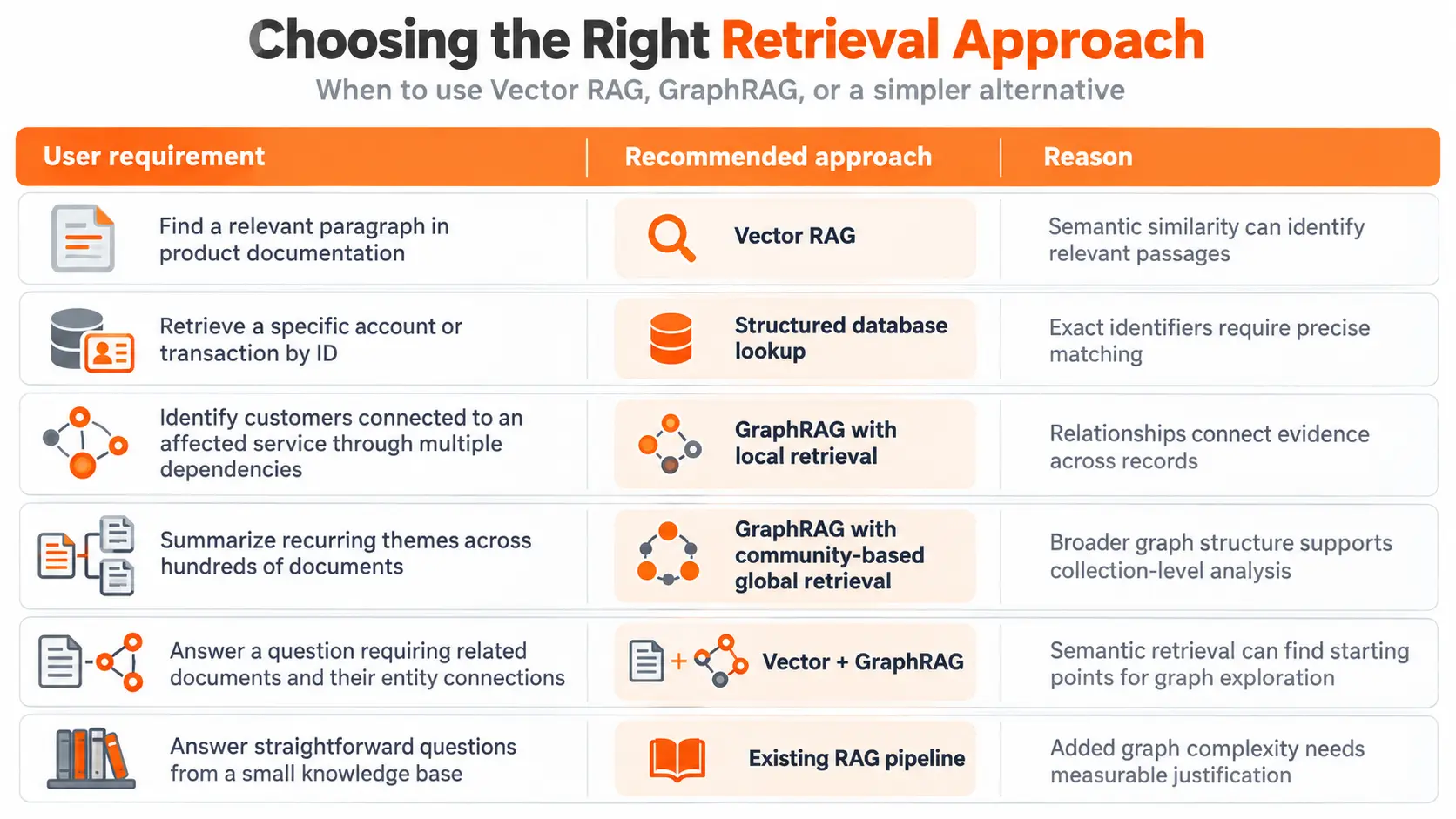
A useful distinction is that a vector search ranks content by similarity, while a graph traversal follows defined connections.
A vector-based system can still answer questions involving multiple documents if it retrieves all the required evidence.
GraphRAG provides another retrieval mechanism for finding that connected evidence.
For this reason, I wouldn't describe GraphRAG as a replacement for conventional RAG. I would treat it as an additional capability for workloads where relationships are essential.
GraphRAG Example in a SaaS Application
Consider a fictional B2B SaaS company called Northstar.
Northstar provides workflow automation software used by enterprise customers. Its platform integrates with authentication providers, billing services, and external business applications.
The company stores information across several systems:
Customer account records, integration configurations, incident reports, service documentation, and account ownership details.
A support manager asks:
"Which enterprise customers were affected by the authentication provider outage, and who should contact them?"
The answer requires connecting information from different sources.
Retrieving the Outage Information
The incident report identifies IdentityBridge as the affected authentication provider.
A vector search can retrieve that report because it contains information about the outage.
However, the report doesn't contain the complete list of Northstar customers that depend on IdentityBridge.
Answering the manager's question requires more than summarizing the incident.
Following Customer Dependencies
Northstar's knowledge graph represents relationships between authentication providers, integrations, workspaces, and customer accounts.
The retrieval process begins with IdentityBridge.
It follows the connections to integrations that depend on the provider, then identifies the workspaces using those integrations.
From those workspaces, it identifies the associated enterprise customer accounts.
This relationship chain supplies information that was not present in the original incident report.
The system still needs to verify that the dependencies were active during the outage.
A historical connection shouldn't be treated as evidence of current impact.
Identifying Account Owners
The application then follows the relationship between each affected customer and its assigned account manager.
The final evidence includes the incident report, affected customer records, relevant service dependencies, and account ownership information.
The language model can use that evidence to prepare a structured response for the support manager.
I would require the response to distinguish confirmed affected accounts from accounts whose impact remains unverified.
That distinction is more important than producing the longest possible customer list.
GraphRAG adds value here because the question depends on relationships distributed across multiple information sources.
GraphRAG Use Cases
The strongest use cases involve connected information that is difficult to retrieve through isolated document matches.
Enterprise Knowledge Management
Large organizations store information across departments, documents, systems, and teams.
GraphRAG can connect projects, employees, departments, policies, and business processes.
An internal assistant can then retrieve information that depends on relationships across those sources.
For example, answering which policies apply to a particular project might require linking the project to its department, operating region, and applicable regulations.
Incident and Dependency Analysis
Technology companies maintain records describing infrastructure dependencies, outages, changes, and customer impact.
A knowledge graph can connect services to their providers, dependent applications, and affected customers.
This creates a useful foundation for answering questions about failure propagation and operational impact.
The underlying dependency records must be accurate for the retrieved conclusions to be reliable.
Research and Investigative Analysis
Research teams need to connect information about organizations, people, publications, events, and decisions.
GraphRAG supports this by representing those relationships explicitly.
For example, an analyst investigating partnerships between startups can retrieve organizations connected through investments, executives, and documented agreements.
This does not establish that every discovered connection is meaningful. The evidence and nature of each relationship still require examination.
Contract and Compliance Analysis
Contracts contain relationships between parties, obligations, products, dates, and conditions.
Graph-based retrieval can connect those elements across documents.
For example, an assistant could identify agreements affected by a particular service change and retrieve the relevant contractual clauses.
For legal or compliance decisions, the system should provide traceable source evidence and support expert review rather than present generated interpretations as definitive judgments.
GraphRAG Implementation Options
There are multiple ways to build GraphRAG, and the term should not be confused with a single software package.
Microsoft GraphRAG
Microsoft GraphRAG is an open-source research project designed to extract structured information from unstructured documents and support graph-based retrieval.
Its indexing process can extract entities and relationships, identify graph communities, generate community reports, and create vector representations.
Its query engine supports Local Search, Global Search, DRIFT Search, and basic vector search.
One point matters for teams evaluating it in 2026: the official Microsoft GraphRAG repository is largely in maintenance mode.
The project states that its focus is on necessary fixes and dependency updates rather than developing new features.
I would consider this maintenance status when evaluating its long-term suitability for a production application.
It does not mean that GraphRAG as a broader technology has stopped developing.
Neo4j GraphRAG
Neo4j provides graph database technology and tooling for graph-based AI retrieval.
Its GraphRAG ecosystem supports knowledge graph construction, vector retrieval, relationship traversal, and graph queries.
This approach is useful when an application needs a persistent graph database that can be queried and updated as business relationships change.
I would evaluate it for systems with established entity models and requirements for structured graph traversal.
It is distinct from the Microsoft research implementation, although both support graph-based retrieval concepts.
Custom Graph Retrieval
A team can also build graph-based retrieval using an existing graph database, document processing tools, embedding models, and its preferred language model.
This provides control over the data model, retrieval logic, and infrastructure.
However, it places responsibility for graph construction, updates, query design, and evaluation on the development team.
I would reserve this approach for requirements that existing libraries or managed services cannot meet satisfactorily.
GraphRAG Costs and Operational Requirements
The main cost difference between GraphRAG and a simple vector-based pipeline appears during knowledge preparation and ongoing maintenance.
A vector-based system requires document processing, embedding generation, and indexing.
A GraphRAG implementation can add entity extraction, relationship discovery, entity resolution, community detection, and summary generation.
Each additional stage introduces processing work and opportunities for incorrect or incomplete information.
Graph Construction Costs
Extracting entities and relationships with a language model consumes model resources.
For a large document collection, this can become a substantial indexing expense.
Microsoft's GraphRAG documentation explicitly warns that indexing can consume significant language model resources.
Its tooling also includes a faster graph-construction method that reduces extraction cost, with a trade-off in the richness and quality of the resulting graph.
I would estimate indexing costs using a representative sample of the actual documents before committing to processing the full collection.
Updating the Knowledge Graph
Business data changes.
A customer switches providers, an employee changes responsibilities, or a service dependency is removed.
The graph needs to reflect those changes.
Updating source documents without updating the corresponding nodes and relationships can leave the retrieval system working with obsolete connections.
Community summaries also need attention when the underlying information changes.
I would establish a clear update process before treating the graph as a reliable production knowledge source.
Query Latency and Infrastructure
Graph traversal introduces retrieval work beyond basic similarity search.
Community-based global retrieval can also require additional language model processing to synthesize information across summaries.
The total response time depends on the graph structure, retrieval strategy, amount of evidence, and generation process.
For a customer-facing application, I would measure end-to-end latency rather than evaluating graph queries in isolation.
GraphRAG should improve the application's ability to answer important questions without exceeding its operational requirements.
Evaluating GraphRAG Quality
A successful graph query is not proof that the retrieved answer is correct.
The evaluation needs to examine both the relationships selected and the final response.
I would build a dataset containing questions that require connecting information across multiple sources.
For Northstar, that dataset could include questions about customer dependencies, service outages, account ownership, and changes to integration configurations.
Each question should have a verified expected answer and supporting source records.
Relationship Accuracy
The first concern is whether the knowledge graph represents the correct entities and relationships.
An incorrectly connected customer account can cause the system to report an impact that never occurred.
I would review the extracted relationships against source records and test whether the graph contains the connections required to answer each question.
Entity names alone are not enough. The relationship type and relevant time period matter.
Multi-Hop Retrieval Quality
Next, I would measure whether the system retrieves the full chain of evidence required for the answer.
For example, finding an authentication provider and an incident report is insufficient if the application fails to identify the affected customer workspaces.
Evaluation should check whether the necessary entities, relationships, and supporting passages are present in the retrieved context.
A graph-based system should also be compared with a vector-only baseline on the same questions.
Without that comparison, it is difficult to establish whether the added architecture improves retrieval quality.
Answer Accuracy and Source Support
Finally, the generated response must be checked against verified facts.
A graph can contain correct relationships while the language model misinterprets their significance.
For example, a workspace configured to use a provider is not automatically proof that every user experienced the outage.
The evaluation should distinguish relationships supported by data from conclusions that require additional evidence.
I would assess answer correctness, completeness, and whether the cited sources support the claims made in the response.
For a production SaaS application, the strongest evidence of GraphRAG's value is better performance on real customer questions, not the presence of a more complex retrieval architecture.
Choosing GraphRAG for a Startup
For an early-stage startup, I would begin with the questions the existing search system cannot answer.
If users mainly ask for documentation, feature explanations, and straightforward factual lookups, a conventional vector-based retrieval pipeline is a more practical starting point.
If users need to investigate dependencies, connect information across several systems, or understand relationships between organizations and events, graph-based retrieval deserves closer evaluation.
The decision also depends on how much structured data already exists.
A product with well-defined customer, integration, and service relationships has a clearer starting point for constructing a knowledge graph than a product whose information is scattered across poorly maintained documents.
Before introducing GraphRAG, I would confirm that the team can maintain entity identities, source references, access permissions, and relationship updates.
I would then compare a small graph-based implementation with the current retrieval method using the same test questions.
If the improvement is substantial for the product's most important questions, additional infrastructure becomes easier to justify.
If the results are similar, the simpler architecture remains the better choice.
Final Thoughts
GraphRAG makes relationships part of the retrieval process.
That allows AI applications to find evidence connected across documents, business records, and knowledge domains rather than depending entirely on semantic similarity.
Its strongest applications involve multi-step questions, entity relationships, operational dependencies, and broader analysis of connected information.
I would choose GraphRAG when those capabilities solve a measurable retrieval problem, not simply because graph-based architectures offer more features.
For startups, the practical goal is to retrieve reliable evidence, answer the questions users actually ask, and maintain a system whose complexity is justified by its results.
FAQ
Can I build GraphRAG from my existing SQL database?
Yes. Relational data can be transformed into graph structures by mapping records to entities and foreign-key relationships to graph connections. The mapping must preserve identifiers, relationship meanings, and data integrity. A document-based extraction pipeline is not required when the necessary relationships are already available in structured form.
Do I need to train my own AI model to build a knowledge graph?
No. Existing language models and information extraction tools can identify entities and relationships without training a new model. The extraction process still requires appropriate instructions, validation, and a defined data model. Fine-tuning is a separate option when the available models do not meet the application's accuracy requirements.
Can GraphRAG handle documents written in different languages?
Yes. Multilingual GraphRAG requires extraction models that support the source languages and an entity-resolution strategy that recognizes equivalent names across languages. Language-specific terminology and translated entity names should be validated to prevent duplicate or incorrect relationships.
How do I undo a bad update to my knowledge graph?
A reliable rollback process requires versioned graph records, update logs, or recoverable snapshots. The application should identify the affected nodes and relationships, restore the previous valid state, and rebuild dependent indexes or summaries where necessary. The exact recovery procedure depends on the graph storage system and update architecture.
Can GraphRAG extract relationships from scanned PDFs and diagrams?
Yes, provided an appropriate document-processing system extracts the required information first. Scanned PDFs require text recognition, while diagrams need a vision-capable or structure-aware extraction process. Relationships inferred from visual layouts should be validated against the source material before they are added to the knowledge graph.

Fatemeh Jahangard
Technology & AI Writer at PinerookFatemeh Jahangard covers AI, emerging technologies, and digital innovation for Pinerook, focusing on how technology shapes startups and industries.
 Seen first.