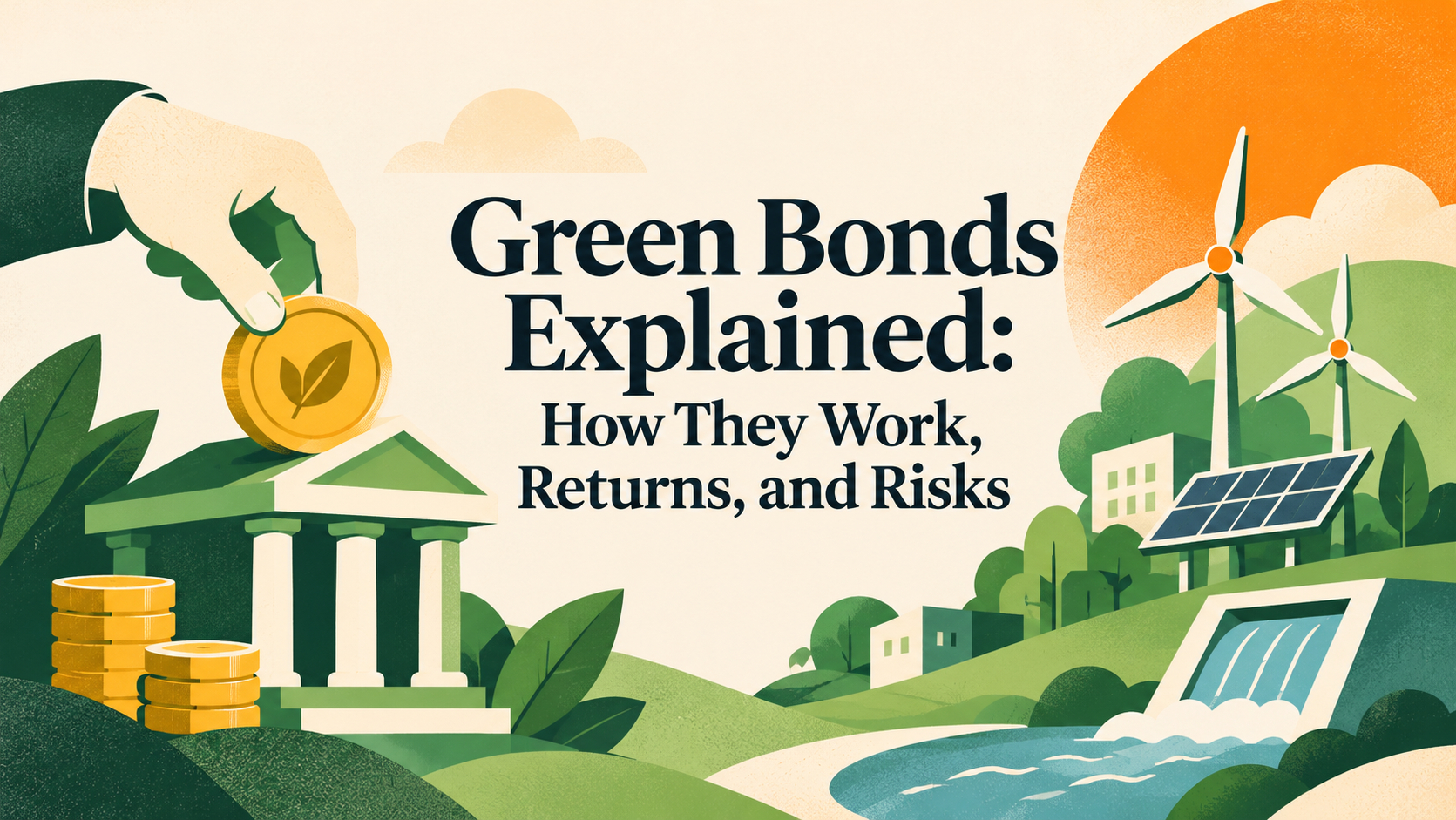
Green bonds are debt securities issued to finance or refinance eligible environmental projects. Governments, companies, banks, and development institutions can use them to raise money for activities such as renewable power, efficient buildings, cleaner transport, and water infrastructure. Investors lend money to the issuer and receive payments according to the bond terms. The green designation describes the intended use of the money, not a guaranteed return or a promise that the investment is safe.
Within the broader Climate Finance system, green bonds connect environmental investment needs with capital markets. They are particularly useful when an organization has eligible assets and a credible way to service debt. Understanding how they work requires examining both the financial obligation and the environmental commitment. A security can be financially sound without delivering the environmental benefits investors expect, just as a useful environmental project can be financed by a financially risky borrower.
How Green Bonds Work
A green bond begins with an issuer that needs to raise capital. A utility might want to build a solar facility, a municipality might need to improve flood protection, or a bank might plan to finance a portfolio of efficient buildings. The issuer defines which expenditures qualify, determines the amount of capital it needs, and establishes the terms of the borrowing.
Investors buy the security at issuance. In a typical fixed rate bond, the issuer pays periodic interest and returns the principal at maturity, provided it meets its obligations. The coupon determines interest payments relative to face value, while the purchase price and remaining term affect the yield available to the investor. A floating rate or zero coupon structure can work differently, but the environmental label does not change the underlying mathematics of debt.
The issuer subsequently allocates an equivalent amount of the proceeds to eligible expenditures and reports on that allocation. It can finance new projects or refinance qualifying investments made in the past, subject to its framework. This distinction matters: a bond that refinances a completed wind farm may support continued access to capital, but its issuance does not necessarily cause new generating capacity to be built.
Most standard green bonds are obligations of the issuer rather than investments directly secured by a particular environmental asset. For example, the World Bank explains that investors in its green bonds depend on the creditworthiness of the issuing institution, not the performance of specific financed projects. Other instruments, including project bonds and asset backed securities, can have different repayment arrangements. Investors should therefore examine the prospectus to establish precisely who owes them money and what happens if payments are missed (World Bank, Green Bonds).
Green Bonds vs Conventional Bonds and Other Sustainable Debt
The principal difference between a standard green bond and conventional borrowing is the restriction on eligible spending and the accompanying disclosure process. The green instrument can otherwise have the same currency, maturity, seniority and coupon structure as an ordinary bond from the same issuer.
A sustainability bond finances a combination of environmental and social purposes. A social bond targets eligible social activities. A sustainability linked bond, by contrast, generally allows the borrower to use the money for general purposes, while specific financing terms may change if agreed performance objectives are not met. Those objectives could relate to emissions, but the mechanism differs from earmarking proceeds for eligible investments.
Comparing Sustainable Debt Instruments
The following comparison separates the environmental promise from the financial mechanism. This is important because two securities described as sustainable can impose very different obligations on the borrower.
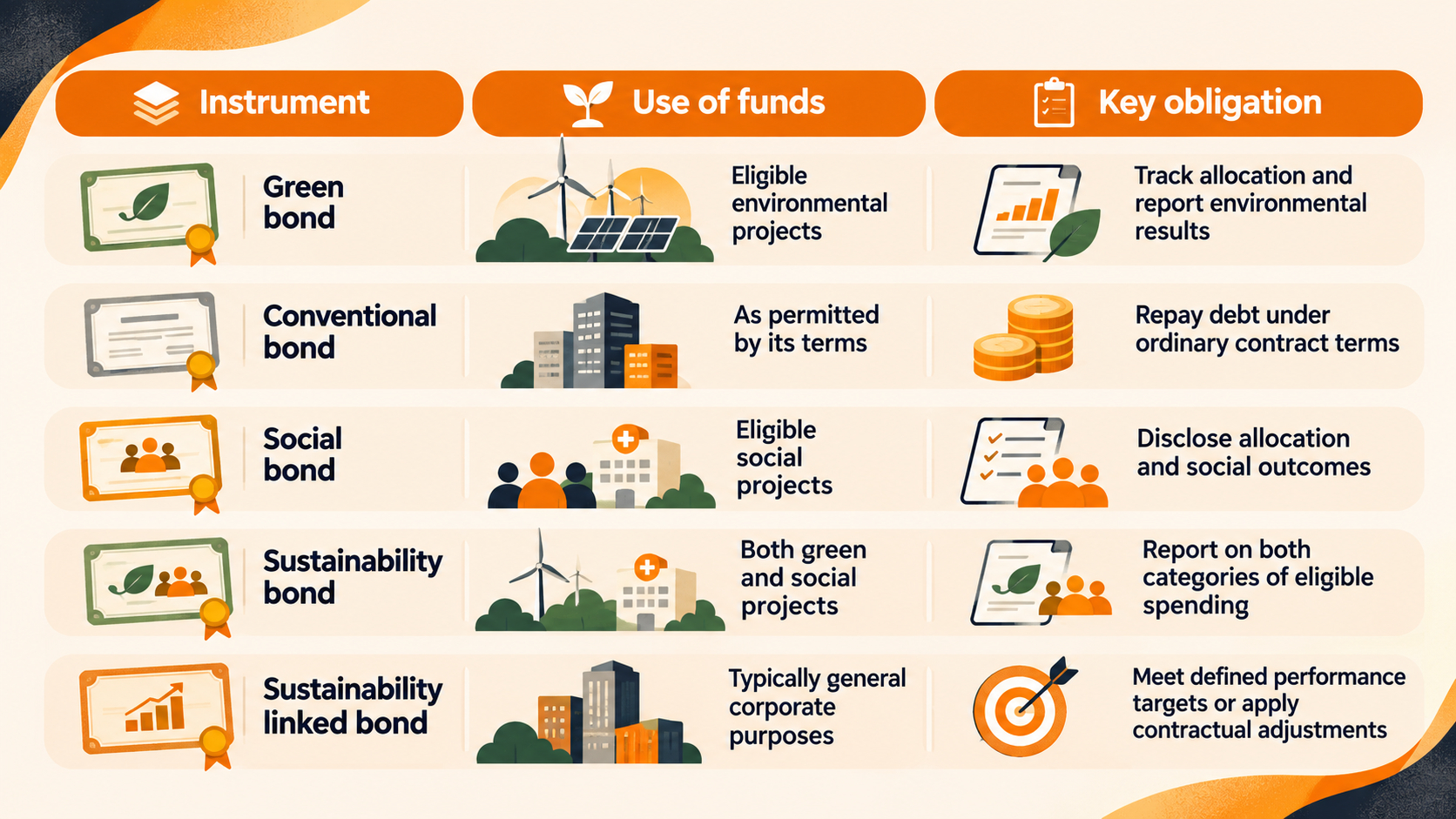
The distinction is especially relevant when an issuer has an ambitious environmental strategy but a limited pool of eligible assets. It might be able to issue a bond tied to corporate performance targets, yet lack enough qualifying expenditures for a green bond of the same size. Investors should evaluate the actual terms instead of assuming all sustainable securities work in the same way.
Green Bond Principles and Environmental Eligibility
The International Capital Market Association (ICMA) maintains widely used voluntary Green Bond Principles, updated in June 2025. Their purpose is to improve the transparency of the issuance process. Four core areas provide a useful way to evaluate the environmental commitment: the spending categories, how projects are assessed and chosen, how financing is recorded and allocated, and what information is disclosed after issuance (ICMA, Green Bond Principles).
Use of Proceeds and Project Selection
An issuer should describe eligible activities precisely enough for investors to understand what the money will support. A broad commitment to sustainable infrastructure offers little insight unless it specifies the technical or environmental thresholds that investments must satisfy. A building project, for instance, may need to satisfy stated energy performance criteria rather than merely include efficient lighting.
Potential activities extend beyond emissions reduction. They can include water conservation, biodiversity protection, pollution prevention, and investments that improve resilience to climate hazards. The issuer must explain how its own criteria apply. National taxonomies, market standards and the requirements of a particular label may differ, so a project accepted under one framework might not qualify under another.
Management of Proceeds and Reporting
The borrower needs an accounting process that connects eligible assets and expenditures with the proceeds allocated to them. Depending on the framework, temporary unallocated balances may be held in permitted investments. The important point is that reported allocation can be reconciled with the underlying portfolio and that the same expenditure is not repeatedly attributed without an appropriate accounting basis.
Allocation reporting demonstrates where the capital has been assigned. Impact reporting describes the environmental results associated with those investments, often using estimated or observed indicators. A report might identify annual electricity generated, expected emissions avoided, or additional water treatment capacity. Those indicators need definitions, boundaries and a stated methodology. An allocation report alone cannot demonstrate that a project is operating successfully.
An independent assessment before issuance can help investors evaluate the credibility of the framework. Independent checks after issuance can provide further assurance about allocation. Neither service guarantees the borrower will repay the debt, and investors should understand the scope of the review before treating it as evidence of environmental performance.
Green Bond Returns and the Greenium
A green bond can earn a financial return through interest payments and changes in its market price. An investor who buys it above face value may receive a lower yield than its coupon suggests. An investor who sells it before maturity can experience a gain or a loss, even if the issuer has made every scheduled payment. Rising market interest rates generally reduce the price of existing fixed rate bonds, with longer duration securities typically more sensitive to such movements.
The term greenium describes a pricing difference associated with a green bond compared with a comparable conventional bond. When investors accept a lower yield for the green security, the issuer may benefit from a lower borrowing cost. Demand from investors with environmental mandates can contribute to that difference, but the premium is not uniform across markets.
An OECD review in its Global Debt Report 2024 discusses studies that reach different conclusions depending on issuer characteristics, market and measurement method. A Federal Reserve staff paper published in 2022 estimated an average issuance spread advantage of eight basis points in its corporate bond sample. That historical result is not a forecast or a promised saving for a new issuer. Comparisons should control for currency, maturity, seniority, creditworthiness, liquidity and the date of pricing.
A Practical Example of Issuer Costs and Investor Returns
Consider a hypothetical utility raising $100 million for five years. It can issue a conventional fixed rate bond at par with a 5.00 percent annual coupon, or a green bond with the same maturity and repayment structure at a 4.90 percent annual coupon. Assume both pay interest once per year, principal is repaid in full at maturity, and there are no embedded options.
The conventional bond requires $5 million in annual interest. The green bond requires $4.9 million, saving the issuer $100,000 per year, or $500,000 across five years before discounting. If additional setup and review cost $180,000 at issuance and additional reporting costs $30,000 annually, total extra costs are $330,000 in nominal terms. The nominal net saving is $170,000. Actual financing decisions should also account for timing, taxes, common issuance expenses and the present value of those cash flows.
An investor who buys $10,000 of the green bond at face value would receive $490 per year under the stated assumptions, compared with $500 from the conventional alternative. The investor accepts $10 less annual interest per $10,000 invested. Whether that difference is justified depends on the investor's objectives and the relative financial and environmental quality of the securities.
This example also shows why an issuer cannot rely on the green label alone to reduce its funding cost. If the market offers no yield advantage, the extra administration could increase the overall cost of borrowing. The issuer may still value access to a broader investor base, but it should evaluate that benefit separately.
Green Bond Risks and Greenwashing
Credit risk is the possibility that the issuer fails to pay interest or principal. Market risk affects the price at which a bond can be sold. Liquidity risk concerns the ability to find a buyer at a reasonable price, while currency risk matters when payments are denominated in a currency different from the investor's financial needs. None disappears because the proceeds are used for environmental purposes.
Greenwashing creates an additional dimension of risk. A project may be described as environmentally beneficial without clear evidence, or the issuer might report attractive projected outcomes while omitting assumptions or important adverse effects. A bond may comply with the stated conditions for financing a particular asset even when other parts of the issuer's business remain environmentally intensive. Investors with broader sustainability requirements should therefore examine both the designated projects and the issuer's wider activities.
An assessment should also distinguish a failure to achieve environmental targets from a payment default. Unless the legal documentation links the missed commitment to a financial remedy, the bond may continue to pay exactly as promised. Reputational damage, a change in eligibility for certain funds, or reduced demand may nevertheless affect the security's trading value. The legal consequences depend on the contract and applicable rules.
A practical review begins with the prospectus and green bond framework, followed by the latest allocation report, impact report, and relevant external opinion. Check whether eligible assets are sufficiently specific, whether estimates have a credible baseline, and whether projected and realized results are clearly distinguished. For a refinancing transaction, examine the age of the assets and the nature of the expenditure. A large financing amount should not be treated as evidence of equally large environmental impact.
Green Bond Standards and Market Developments in 2026
The European Green Bond Standard introduces a more specific regulatory framework for issuers choosing to use the European Green Bond designation. It has applied since December 2024 and is voluntary in the sense that issuers can choose whether to use that designation. Its requirements draw on the EU taxonomy and include disclosure and external review arrangements. Not every green bond sold in Europe carries this designation, and ICMA alignment alone is not equivalent to compliance with the European standard (European Commission, March 2026).
Market growth also deserves careful interpretation. Climate Bonds Initiative reported $210.8 billion in aligned green bond issuance during the second quarter of 2026, a quarterly record in its dataset. That is the volume of eligible new securities issued during the period. It is not the amount of new environmental infrastructure constructed, the outstanding value of all green debt, or the measured reduction in global emissions (Climate Bonds, September 2026).
This market can help channel substantial financing into investments with long operating lives. Yet smaller borrowers may find public issuance expensive, particularly when they must assemble a sufficiently large pool of assets and maintain reporting systems. In those cases, a green loan or another structure can be more practical. The appropriate financing mechanism depends on the borrower and the economics of the project rather than the popularity of the instrument.
Evaluating a Green Bond Before Issuance or Investment
For an issuer, the decision begins with ordinary financing questions: how much capital is needed, whether projected cash flows can support repayment, and whether the proposed term matches the assets being financed. It then requires a credible portfolio of eligible projects and the internal ability to maintain environmental disclosures. Compare the full cost of the transaction with alternative financing and establish responsibility for ongoing reporting.
For investors, the first question is whether the debt belongs in the portfolio on conventional financial grounds. Examine the issuer, yield, maturity, credit rating where available, currency and liquidity. The second question is whether the specific environmental framework meets the investor's objectives. An environmental benefit is not a substitute for credit analysis, and a strong credit rating is not a substitute for environmental due diligence.
Green bonds can help connect financial markets with credible environmental investment. Their effectiveness depends on the quality of assets, the affordability of borrowing and the transparency of results. The best assessment considers the financial promise and the environmental promise independently, then determines whether both are supported by the available evidence.
FAQ
Are green bonds safe investments?
No bond is inherently safe because it carries a green label. Credit quality, repayment terms, interest rate sensitivity, liquidity and other financial risks determine the suitability of the investment.
Do green bonds pay interest?
Many pay a fixed coupon at regular intervals. Some use floating rates or different payment structures. The amount and timing of payments are specified in the security's terms.
Who can issue green bonds?
Governments, municipalities, development banks, commercial banks and companies can issue them if they have access to debt markets and can meet the relevant financial and environmental requirements.
Do green bonds offer higher returns than regular bonds?
Not necessarily. A green bond may have a lower yield than comparable ordinary debt, but pricing varies. Compare securities with similar credit risk, maturity, currency and other terms.
Can green bonds finance existing projects?
Yes. Many frameworks permit refinancing of eligible existing assets or expenditures. Investors should examine the issuer's allocation rules and any applicable limits on the age of qualifying expenditure.
How can investors verify that a green bond is genuinely green?
Review the eligibility framework, external assessment, allocation disclosures and impact reporting. Check the methods used to estimate results and the legal terms governing the environmental commitment.

Masoumeh Jahangard
Markets & Economy Writer at PinerookMasoumeh Jahangard covers markets, economic trends, and business conditions for Pinerook, focusing on how they affect startups and growing companies.
 Seen first.