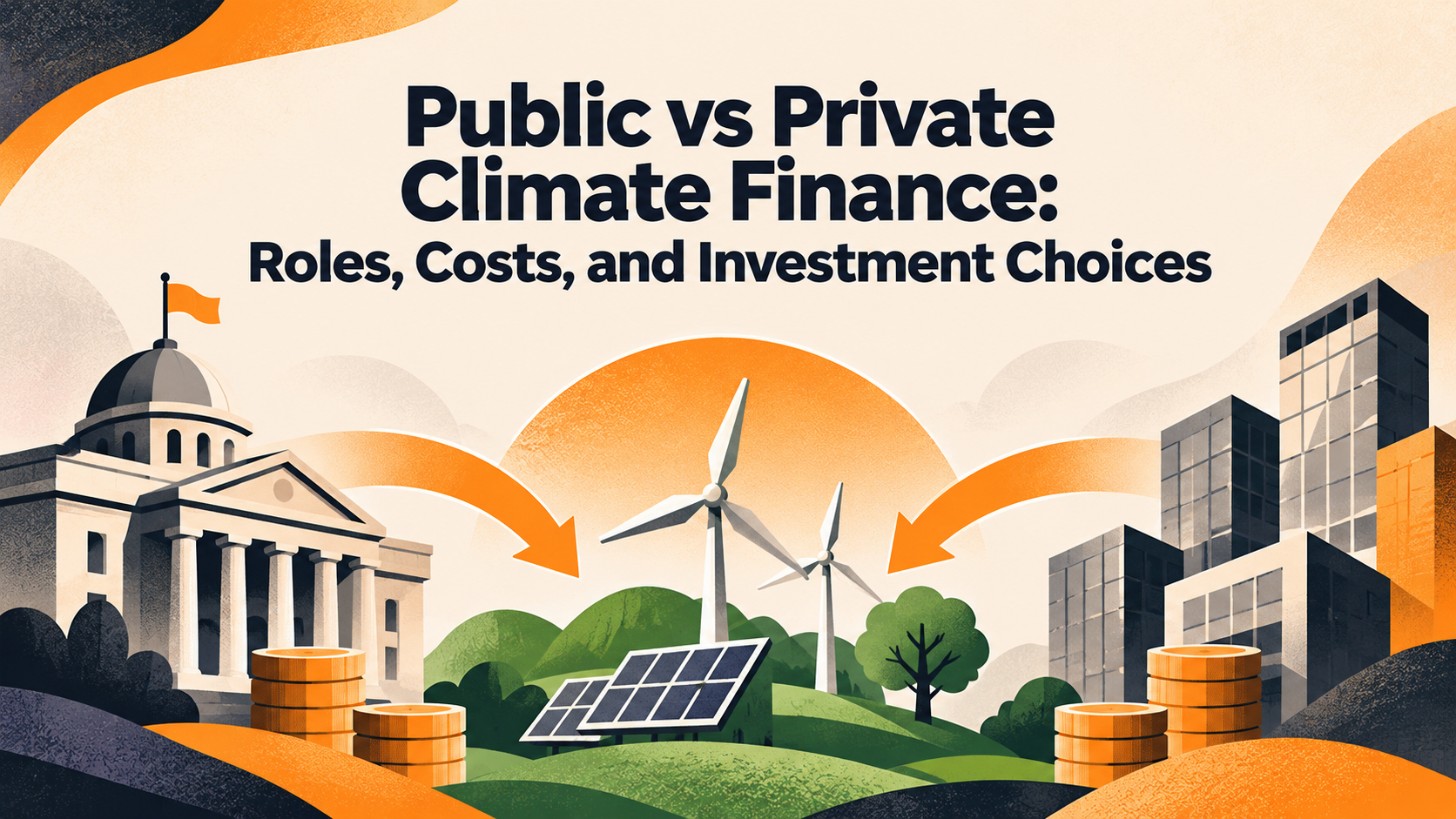
Public vs private climate finance describes where money for climate action originates and why different providers are willing to supply it. Public finance comes primarily from governments and publicly controlled development institutions. Private finance comes from companies, banks, investors, households, and other nongovernment actors. Public providers may prioritize public benefits and affordability, while private providers usually need credible cash flows or financial returns. Neither category is automatically cheaper, greener, or better suited to every project.
This distinction matters within the broader Climate Finance system because the source of capital affects who absorbs risk, who receives returns, and which projects can proceed. A renewable electricity facility may attract commercial loans and investor equity. A municipal heat alert system can protect lives without producing revenue that repays a loan. Understanding how public and private funding differ helps policymakers, businesses, and investors choose structures that fit the benefits a project creates.
What Is Public Climate Finance?
Public climate finance is money committed or invested by public authorities and institutions they control for climate objectives. National and local budgets, public development banks, multilateral development banks, and public climate funds can finance investments through grants, loans, equity, and guarantees. Public finance can be domestic or international. A city paying for drainage upgrades from tax revenue and a development bank lending to a clean transport project are different examples of publicly sourced finance.
A grant does not normally have to be repaid, but public climate finance is not synonymous with free money. A development bank may provide a loan that must be serviced from tariffs, operating revenues, or government budgets. A guarantee may promise to cover specified losses if an agreed event occurs, yet it is not the same as disbursing cash for construction. Government support can also include project preparation, technical assistance, and policy measures that make investment feasible without paying the entire project cost.
Public institutions may support projects with widespread benefits that no single investor can collect as revenue. Cleaner air, protection against flood losses, improved public health, or reliable transport can benefit thousands of people even when there is no direct customer willing to pay the full economic value. In these cases, public finance addresses a gap between the value to society and the cash available to repay private investors. The use of public resources still requires scrutiny of affordability, governance, effectiveness, and who ultimately benefits.
What Is Private Climate Finance?
Private climate finance is capital supplied by commercial banks, institutional investors, private funds, corporate balance sheets, project developers, and households for investments with climate objectives. Commercial debt expects repayment and interest. Equity investors generally accept more uncertainty in exchange for a claim on future profits or asset value. A company replacing equipment to save energy, a household purchasing an electric vehicle, and a pension fund investing in renewable infrastructure may all appear as private sources in climate finance tracking, depending on the measurement framework.
For private investment to scale, expected revenue or savings must justify the cost and risk of supplying capital. Electricity sales, regulated utility payments, energy savings, subscriptions, or other contractual payments can provide an economic basis for an investment. Some investors also pursue climate objectives, but those objectives do not eliminate the need to manage liquidity, repayment, inflation, currency exposure, political risk, or possible project failure.
Private finance is not limited to wealthy institutional investors. Household spending on low carbon technology can represent a large part of domestic investment. However, access is unequal: a homeowner with affordable credit can finance an efficiency upgrade more easily than a low income household facing high borrowing costs. The presence of profitable green opportunities does not ensure that funding reaches people or locations where climate needs are most urgent.
Public vs Private Climate Finance: The Main Differences
The essential difference is not simply who writes the check. It is the combination of funding mandate, expected return, tolerance for risk, and the ability to recover costs from the people who benefit. These distinctions help determine the appropriate role for each provider.
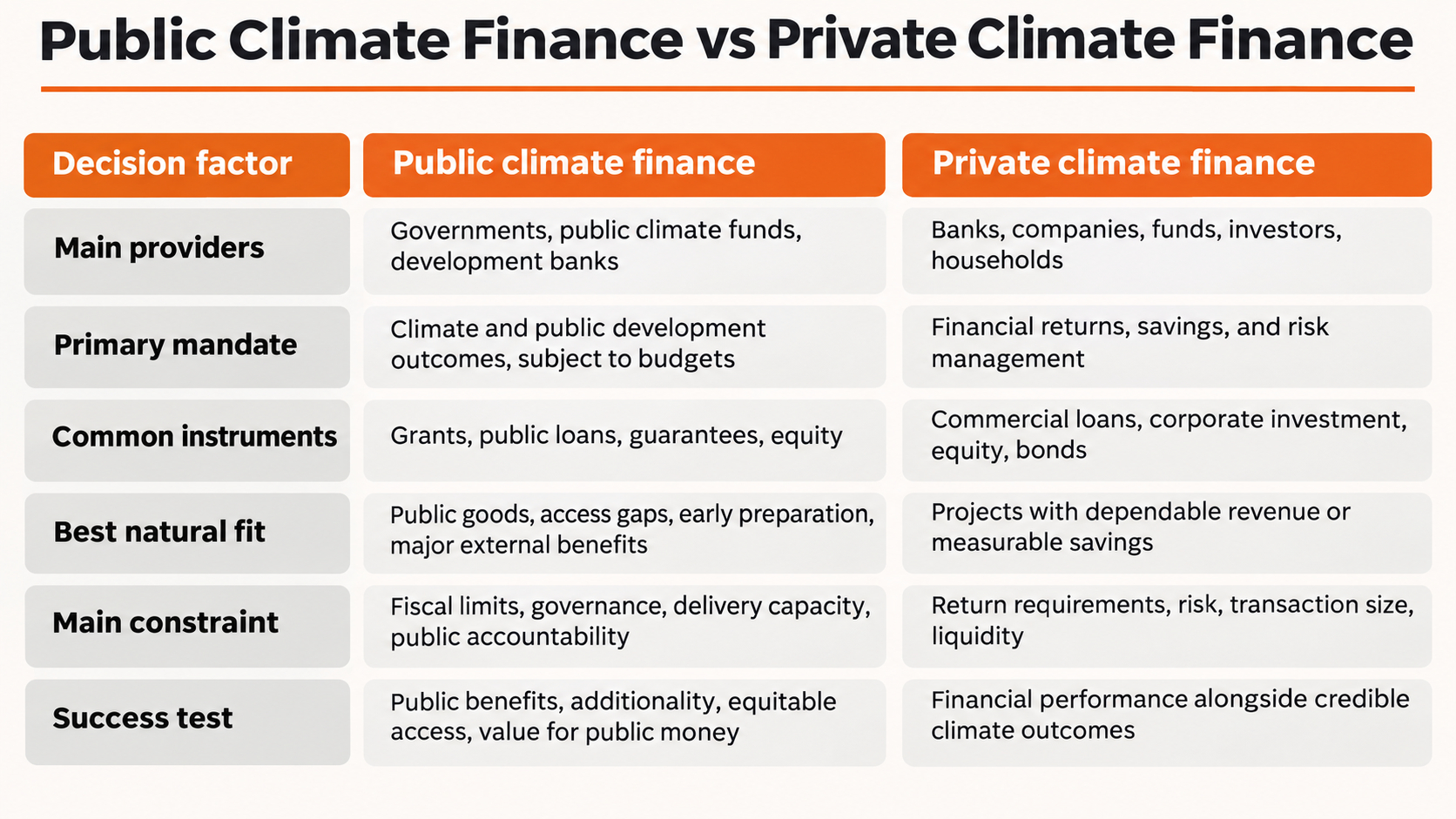
These categories overlap. A publicly owned bank can lend on commercial terms, and a private investor can accept a lower return for impact goals. Ownership and control of the funding institution generally determine public or private classification in official reporting, though methodologies identify special cases. The terms of a loan alone do not decide whether its source is public or private.
Why Climate Projects Need Different Kinds of Capital
The strongest financing choice begins with the economics of the project. A solar plant with a credible electricity buyer may have predictable revenues and attract commercial lenders once construction and contract risks are understood. A flood protection system that safeguards homes and businesses creates real economic value, but the prevented damage does not automatically appear as income on the balance sheet of the entity building the barrier. Public funds may therefore have to pay for the protection, or create a realistic repayment mechanism.
Some projects sit between these cases. A municipal water system may collect regulated fees but cannot raise prices enough to cover all the investment without making essential services unaffordable. Commercial debt can still contribute, while grants or patient public loans cover the gap. A more efficient public building may deliver savings, but a small town can lack the credit quality or borrowing authority needed to finance the upgrade alone. Selecting the financier involves more than classifying a project as climate friendly.
The practical test is whether the project generates private cash flow, public benefits, or a combination, and whether each funding source is rewarded or protected in a way that matches its mandate. A project that appears highly beneficial in economic analysis can remain unfinanceable until someone identifies a dependable payer.
How Public Money Can Attract Private Investment
Public capital can make private participation possible by resolving barriers that markets cannot easily overcome. A grant may fund environmental studies and engineering design. A public institution may provide a guarantee for a narrowly defined political or payment risk. A development bank may take a longer repayment period than local lenders can offer. None of these approaches guarantees success, but each can improve the financial case for a project when it addresses a genuine obstacle.
The detailed structuring of blended finance for climate projects is a separate topic. The relevant point here is that public and private capital can complement each other without having identical terms. Public investors may prioritize access, resilience, or demonstration effects. Private lenders and equity providers may emphasize repayment capacity and a return that reflects remaining risks.
There is also a danger that public resources subsidize investments which private markets would have financed anyway. Officials should ask whether support changes the decision, reduces a real financing constraint, or expands access that would otherwise be absent. A large headline ratio of private capital to public support is not proof of economic additionality if the supposed extra investment was already likely to happen.
A Practical Example of Shared Climate Financing
Consider an illustrative water system upgrade with a total capital requirement of USD 40 million. The investment replaces leaking pipes, improves pumping efficiency, and reinforces essential facilities against storms. The municipality commits a USD 12 million grant because part of the benefit is public and cannot be recovered through tariffs. A public development bank supplies an USD 8 million loan with repayment terms matched to the utility. A commercial bank provides USD 15 million in debt, and a private operator contributes USD 5 million in equity. The four cash commitments total USD 40 million.
Suppose a public institution separately offers a guarantee covering part of the commercial bank exposure. That guarantee may help the bank proceed, but its face value is not an additional payment for the water system and should not be added to the USD 40 million investment total. The actual costs of the guarantee, the risks retained by taxpayers, and any fees paid by the borrower should be assessed independently.
This arrangement would still require a credible utility revenue forecast, affordable customer payments, transparent procurement, and evidence that the climate related upgrades are necessary. Investors should test how the structure performs if electricity prices rise, customer collections fall, or the asset is delayed. Public officials must determine whether the subsidy delivers benefits that justify its opportunity cost relative to other spending priorities.
How to Choose Between Public and Private Climate Funding
A borrower should first define the climate purpose and the total investment required. The next question is what will pay the financier back, if repayment is expected. A project with secure customers, stable contracts, and manageable risks may be suitable for private debt or equity. A project whose benefits are mainly shared by the public may need budget finance, grants, or another form of public support. A mixed project may require different instruments for different components.
The second decision concerns which risk each party can bear most efficiently. A commercial bank can evaluate construction or borrower credit risk, but it may be unable to absorb changes in law that are outside the project sponsor’s control. A government might reduce certain policy uncertainties through clear regulations, not necessarily by offering an open ended financial guarantee. Where a project can be improved through better design or procurement, preparation may be more valuable than a permanent subsidy.
The third decision is distributional. Financing that is technically available but pushes water prices beyond household budgets or adds unsustainable public debt may not be economically sound. Public policy and private investment both have to consider affordability, financial sustainability, and whose risks are transferred to whom. The cheapest apparent source of capital may not be the lowest cost option once guarantees, contingent liabilities, and social impacts are counted.
What Recent Data Say About the Public and Private Split
Climate Policy Initiative reported in June 2026 that tracked global climate finance exceeded USD 2 trillion in 2024, including more than USD 1.2 trillion from private sources. The report also found that 85 percent of tracked investment was mobilized domestically. These figures cover a broad global landscape that includes many forms of household, corporate, and financial institution spending. They are not limited to development assistance or cross border support.
The OECD reported a different, narrower picture for climate finance provided and mobilised by developed countries for developing countries in 2024. Within that reporting scope, public finance amounted to USD 101.6 billion and private finance directly mobilised through qualifying public interventions reached USD 30.5 billion. These figures cannot be subtracted from, or compared as matching categories with, the global CPI totals. The reporting populations, attribution rules, and types of flows differ.
A useful further distinction comes from OECD research on private finance mobilisation over 2021 to 2024. It found that climate related activity accounted for around 40 percent of the private finance mobilised by official development finance interventions during that period. Of the climate related portion, mitigation received a much larger share than adaptation. That finding describes a specific mobilisation dataset, not the proportions of all global private climate investment.
Why Capital Still Fails to Reach Some Projects
Capital tends to follow bankable opportunities, not automatically the areas with the greatest need. Investors may find established renewable technologies in markets with reliable contracts easier to finance than resilience programs in places with uncertain land rights, high borrowing costs, small project sizes, or weak public institutions. For countries with limited fiscal capacity, even projects with substantial social returns may be delayed because preparation funding is unavailable.
The OECD Africa Capital Markets Report 2026 identifies the shortage of investment ready projects as a major obstacle in several markets. The report describes how project preparation, standard documents, predictable rules, and aggregation of small investments can help reduce financing costs. Public intervention is therefore not just about supplying more money. It can also make projects understandable, comparable, and legally workable for potential financiers.
The financing challenge differs by objective. Revenue generating mitigation investments can sometimes support conventional commercial structures. Climate adaptation projects often produce dispersed benefits such as avoided damage, better health, or continued public service, which are harder to turn into private revenue. Climate adaptation finance examines those economics in detail. For the public versus private decision, the central lesson is to match funding obligations to actual capacity to repay.
How to Evaluate a Financing Package Without Misreading the Numbers
Climate finance reporting can mix commitments, disbursements, outstanding loan balances, guarantees, and spending by the final project owner. These are not interchangeable quantities. A commitment is a promise to provide financing under specified conditions. A disbursement is money that has actually been transferred. A guarantee represents a contingent obligation rather than cash paid to build the asset. Reports should state the measurement basis and time period before presenting a total.
Analysts should also distinguish public climate finance from private finance mobilised by a public intervention. The same investment cannot be counted twice as two new units of climate spending merely because it appears in a joint financing agreement. If multiple public institutions contribute to a transaction, attribution methods must prevent each party from claiming the full amount of private finance as its own achievement.
A strong review asks whether the funded activity produces a credible climate result, whether financing is additional to what would have happened, and whether the allocation of risks is transparent. A loan can be financially successful without delivering a measurable climate benefit. Conversely, a program can create valuable public outcomes without generating a commercial return. Good reporting makes these outcomes distinct rather than collapsing them into one success claim.
A Decision Framework for Businesses and Policymakers
For a business, the first action is to establish a project budget, expected operating cash flows, and the specific climate benefit to be financed. Then identify which risks can be mitigated through design, insurance, contracts, or procurement. Only after that should the company explore public incentives, development bank programs, commercial borrowing, and equity capital. Applying for the most concessional funding before establishing the financial case can waste time and create a proposal that fails basic due diligence.
For a public agency, the sequence begins with the expected public benefit and the availability of fiscal resources. It should identify which part of the project private investors can finance without support and which barriers require a targeted public response. Public procurement, affordability, environmental safeguards, and transparency remain essential even when the private sector provides most of the funding.
In both settings, the choice is rarely a simple contest between public and private capital. The better question is what each source can contribute, at what cost, and with which obligations. Where private returns are strong and risks manageable, public funds may be more valuable elsewhere. Where society receives major benefits that cannot become investor revenue, public money may be indispensable.
Public and private climate finance serve different economic purposes. Public institutions can fund social benefits, share risks, and create conditions for investment that commercial markets cannot provide alone. Private capital can help scale projects that offer credible returns, stable savings, or secure cash flows. The strongest financing structures use both sources selectively, rather than assuming one is universally superior.
The real measure of success is not the largest funding announcement or the highest ratio of private money to public money. It is whether the investment reaches an appropriate project, assigns risks fairly, remains affordable, and produces climate results that can be independently evaluated.
FAQ
What is the main difference between public and private climate finance?
Public climate finance originates from governments and publicly controlled institutions, while private climate finance comes from nongovernment investors, companies, banks, and households. Their financing goals, repayment expectations, and risk tolerance often differ.
Is public climate finance always a grant?
No. Public providers can offer grants, repayable loans, equity, and guarantees. Some public loans are priced close to market terms, while grants generally do not require repayment.
Can private investors finance climate adaptation?
Yes, especially when projects protect a commercial asset, reduce a firm’s operating risks, or have dependable payments. Many adaptation investments produce broad public benefits without a revenue stream, so public support remains important.
What does it mean to mobilise private climate finance?
It refers to private investment that can be credibly linked to a public intervention, such as a guarantee or participating loan, under a defined reporting methodology. It is not equivalent to all private climate investment.
Does a public guarantee count as new climate investment?
Not automatically. A guarantee may reduce lender risk, but it is a contingent commitment rather than a construction cash payment. The report must distinguish guarantee exposure from disbursed financing.
Which source is better for a climate project?
It depends on the project’s ability to generate revenue, the public value it creates, the risks involved, and the affordability of repayment. Some investments suit commercial finance, others need public funding, and many require a carefully designed combination.

Masoumeh Jahangard
Markets & Economy Writer at PinerookMasoumeh Jahangard covers markets, economic trends, and business conditions for Pinerook, focusing on how they affect startups and growing companies.
 Seen first.