
An investor pitch deck is often the first serious introduction a startup makes to potential investors. Before reviewing detailed financial statements, examining company documents, or meeting the wider team, investors need to understand what the business does, why its product matters, and whether the opportunity deserves further consideration. A clear presentation can create that understanding, while a confusing one can make even a promising company difficult to evaluate.
Building an effective investor pitch deck requires more than arranging attractive slides. Founders need to explain the problem they are solving, demonstrate that customers have a reason to care, and connect their commercial ambitions to evidence. Every important claim should contribute to a coherent explanation of how the business works and what it could become. An impressive market estimate means little if the startup cannot explain how it will reach customers, just as ambitious revenue projections carry limited weight without reasonable assumptions.
A well developed Fundraising Strategy establishes the purpose of raising capital and the milestones that investment should support. The pitch deck translates that plan into a presentation investors can understand. Its purpose is not to answer every question or guarantee funding, but to establish enough clarity and credibility for investors to pursue a more detailed conversation.
What Is an Investor Pitch Deck and Why Does It Matter?
An investor pitch deck is a concise presentation that introduces a startup and its investment opportunity to prospective investors. It normally explains the customer problem, the proposed solution, the available market, the business model, commercial progress, competitive positioning, founding team, financial expectations, and financing requirements. Together, these elements help an investor assess whether the company fits their investment interests and whether further investigation is justified.
The deck is different from a complete business plan. While a business plan may explore operational processes and financial assumptions in considerable detail, the presentation concentrates on information that investors need during an initial evaluation. Supporting financial models, contracts, ownership records, and technical documentation can be provided later when appropriate. Trying to include all of those materials in the first presentation usually makes the investment argument harder to follow.
The most useful way to approach the deck is to consider what an investor should understand after reading it. They should know what the company sells, who buys it, why customers might choose it over existing alternatives, and what evidence supports the opportunity. They should also understand why the team is capable of executing its plans and what the proposed investment is intended to accomplish. When these questions are answered consistently, the presentation becomes more than a collection of business facts. It becomes a reasoned case for further evaluation.
How to Structure an Investor Pitch Deck
There is no universal slide count that guarantees investor interest. For many startups, approximately ten to fifteen main slides offer enough space to communicate the opportunity without overwhelming the reader. The appropriate length depends on the company's maturity, the complexity of its product, and the audience receiving the presentation. A business developing specialized medical technology may need more technical explanation than a software company with a straightforward subscription model.
Rather than treating the deck as a fixed template, founders should arrange information in an order that supports the central investment argument. Investors first need to understand the business and its customer problem. They can then evaluate the solution, market opportunity, and revenue model before examining commercial evidence, execution capabilities, and financing requirements. Companies with particularly strong traction may choose to introduce that evidence earlier, provided the presentation remains understandable.
Essential Investor Pitch Deck Slides
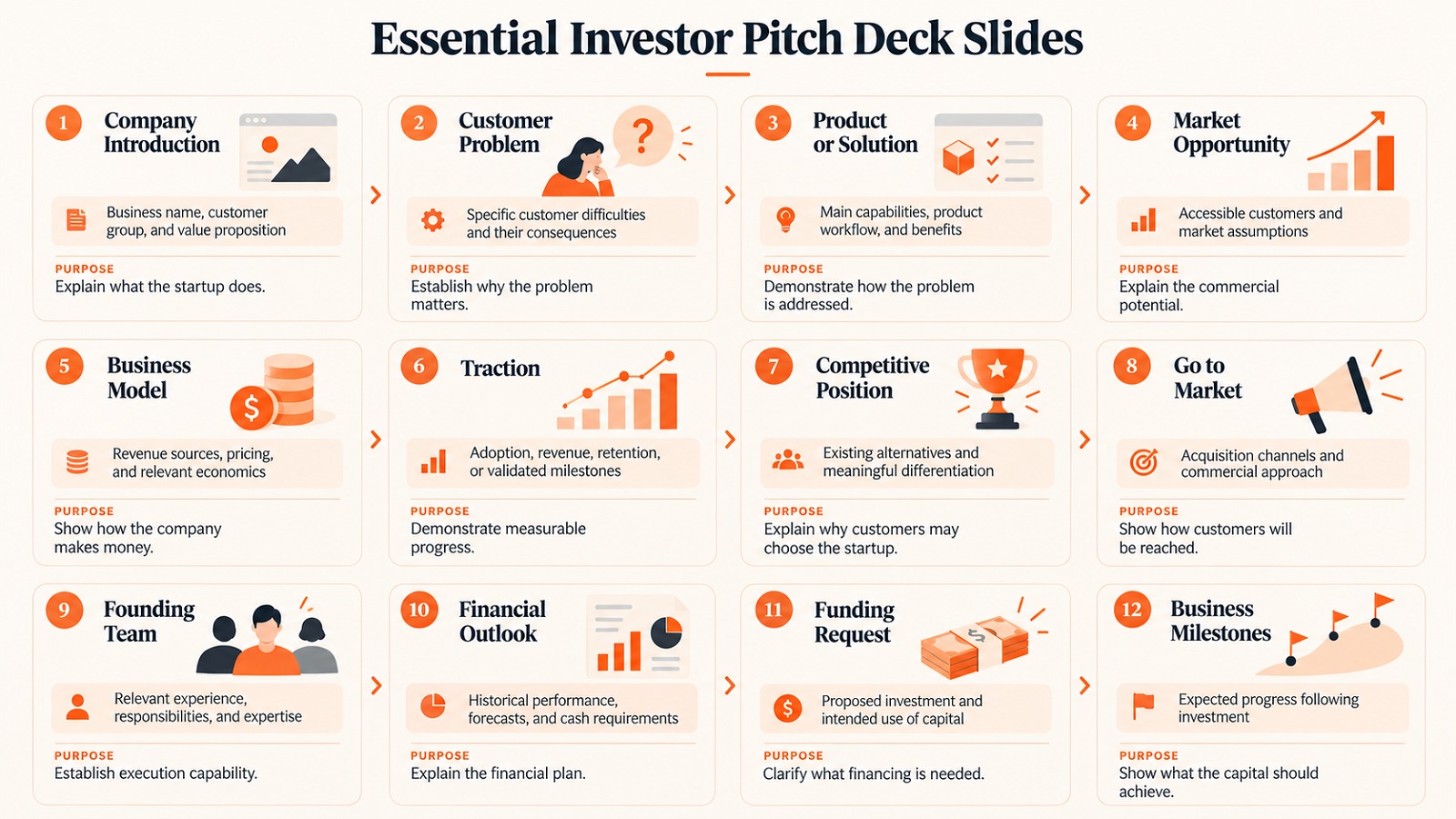
These twelve subjects provide a practical foundation, but they do not all require the same amount of attention. An early startup with limited revenue may need to emphasize customer research and product validation, while a growing company may devote more space to retention, acquisition efficiency, and financial performance. The structure should reflect the evidence available rather than imitate the presentation of a business at a different stage.
Introduce the Company Through Its Customer Problem and Solution
The opening section of an investor pitch deck needs to establish what the startup does without requiring investors to interpret abstract language. Statements about revolutionizing an industry or transforming the future often reveal little about the actual business. A more useful introduction identifies the target customer, the product category, and the benefit the company intends to provide. This gives investors a clear starting point for understanding the remaining slides.
Consider a hypothetical startup called ClearClinic, which develops appointment management software for independent healthcare practices. Instead of introducing itself as a revolutionary healthcare technology platform, the company could explain that it helps smaller clinics manage scheduling and patient communication through one integrated system. This description immediately establishes who the product serves and what it is designed to accomplish.
The next part of the presentation should explain the customer problem in practical terms. In ClearClinic's case, independent practices might rely on separate tools for appointment scheduling, reminders, and administrative communication. Staff could spend time transferring information between systems or repeating tasks that would be easier to manage through an integrated workflow. However, identifying a plausible problem is not sufficient. The startup would still need evidence that customers experience these difficulties and consider them important enough to justify changing their current processes.
Customer interviews, documented workflows, pilot observations, and other forms of research can help establish that evidence. The company should explain what it has learned without treating a handful of conversations as proof of widespread market demand. If it claims that the existing process creates measurable financial losses, it should be able to explain where that calculation came from.
Once the problem is clear, the product slide can demonstrate how the proposed solution addresses it. ClearClinic might use a simple screenshot or workflow diagram to show how appointments, confirmations, and patient communication operate within the same interface. Investors should understand the customer benefit without needing an extensive demonstration of every technical feature. Founders must also distinguish functionality that already exists from capabilities planned for future development. An accurate description of a limited but functioning product is more credible than presenting unfinished features as established achievements.
Explain the Market Opportunity, Business Model, and Competition
After understanding the product, investors need to assess whether enough customers might purchase it to support a meaningful business. The market opportunity slide should therefore move beyond broad industry statistics and identify the customers the startup can realistically serve. Total addressable market, serviceable available market, and serviceable obtainable market estimates can be helpful, but their usefulness depends on clearly defined customer segments and reasonable assumptions.
For ClearClinic, the relevant opportunity would not automatically include the entire healthcare industry. The startup might initially focus on independently operated clinics within particular geographic markets that have suitable technical requirements and a practical reason to purchase its software. Management could estimate the number of potential customer organizations and expected contract values, while making clear that theoretical demand is different from achievable sales. Investors should be able to understand how the company developed its market estimate and which assumptions still require validation.
The business model slide should then explain how customer interest becomes revenue. A software startup may charge monthly or annual subscriptions, while other companies might rely on transactions, product sales, licensing, or service contracts. ClearClinic could propose subscription plans based on the number of practitioners using the system. If it already has paying customers, the presentation should show relevant commercial results. If pricing is still being tested, management should describe it as a proposed model rather than evidence of established willingness to pay.
Competition completes this part of the investment argument because customers rarely make purchasing decisions without alternatives. Even when no company offers an identical product, potential buyers may already rely on established software, manual workflows, internal systems, or a combination of existing tools. ClearClinic would need to explain how its approach compares with those alternatives and why certain practices might prefer it. Relevant differences could include implementation complexity, workflow integration, pricing, or suitability for smaller organizations.
The strongest competitive explanations acknowledge where existing products perform well rather than presenting every rival as inadequate. Investors generally expect founders to understand the choices customers already have. A balanced assessment of the market, revenue model, and competition demonstrates that management is evaluating a commercial opportunity rather than relying entirely on optimism.
Demonstrate Traction and a Credible Customer Acquisition Plan
Traction is often among the most persuasive parts of a startup presentation because it provides evidence that the business is progressing beyond its original concept. The appropriate measures depend on the company's development stage. A business with paying customers may present revenue, retention, product usage, and commercial expansion, while a startup still developing its product may focus on technical milestones, pilot results, or validated customer interest.
Founders should choose evidence that directly supports their investment argument. For ClearClinic, the number of clinics paying for the software and the extent to which those customers continue using it may reveal more than general website traffic. At the same time, the company should explain how its metrics are defined. Registered users are different from active users, trial customers are different from paying customers, and preliminary expressions of interest are not equivalent to signed commercial agreements.
Context is equally important when presenting growth. A substantial percentage increase may sound impressive, but it can be misleading when it begins from a very small base. Investors need enough information to interpret the result accurately. If a company has limited traction, acknowledging that limitation and describing the next validation objective is preferable to overstating the available evidence.
The go to market section should explain how the startup intends to acquire customers and build a repeatable commercial process. ClearClinic might investigate direct sales to practice managers, product demonstrations, partnerships with industry service providers, or referrals from existing customers. The presentation should distinguish channels that have already produced measurable results from approaches that remain experimental.
Customer acquisition plans must also be consistent with the financial resources available. A company proposing a labor intensive sales model should recognize the cost of hiring, training, and supporting the employees needed to operate it. If the product requires a long purchasing process, management should explain how that affects revenue timing and cash requirements. A credible acquisition plan connects market demand to the practical activities required to convert that demand into sales.
Present the Team, Financial Outlook, and Funding Request
The founding team slide should explain why the people building the company are capable of executing its plan. Investors may examine industry knowledge, technical expertise, commercial experience, product development skills, and the founders' ability to manage uncertainty. The most useful qualifications are those directly related to the company's challenges. A lengthy biography filled with unrelated achievements is usually less persuasive than a clear explanation of relevant responsibilities and experience.
In ClearClinic's case, experience with healthcare administration, software engineering, and selling technology to professional organizations could strengthen the investment case. If the founders lack expertise in an important area, they can explain how they intend to address the gap through hiring, advisors, or external support. Investors do not necessarily expect an early team to possess every capability, but they need confidence that management understands what successful execution requires.
The financial outlook should connect the company's commercial plans to revenue, expenses, and cash requirements. Depending on maturity, founders may present historical financial performance, operating forecasts, customer acquisition assumptions, and expected spending. A projected increase in subscription revenue should correspond to assumptions about new customers, pricing, and retention. The operating budget should also account for the personnel and infrastructure required to support that growth.
Financial projections are planning tools, not guarantees. Founders should distinguish historical results from forecasts and be prepared to explain the assumptions behind important figures. A model that acknowledges uncertainty can be more useful than one that displays highly precise numbers without supporting evidence.
The funding request should bring these financial considerations together. Investors need to know how much capital the startup is seeking, how the money is expected to be allocated, and what business progress the investment should support. ClearClinic might plan to improve its software, strengthen customer support, and test additional acquisition channels. The presentation should explain how those activities connect to specific milestones rather than describing the investment as money needed to scale.
Business milestones should represent meaningful progress, not simply spending decisions. Hiring additional employees is an activity; demonstrating improved customer acquisition or delivering a validated product capability is a business outcome. Founders should help investors understand what the company hopes to establish before another financing decision becomes necessary.
Investor Pitch Deck Example: Connecting the Business Story
The hypothetical ClearClinic example illustrates why a successful deck depends on consistency between its slides. The presentation begins by identifying a customer group and a specific administrative problem. It then introduces a software solution intended to simplify those workflows and explains why the target market may contain a meaningful number of potential customers.
The business model describes how subscriptions could generate revenue, while the traction slide presents whatever adoption or commercial evidence the company has genuinely achieved. Competition is examined through existing software and alternative workflows rather than ignored, and the customer acquisition plan explains how the company intends to reach additional practices. The team section establishes relevant expertise, while the financial outlook connects commercial assumptions to expected operating costs.
Finally, the funding request explains what resources are needed, and the milestone slide describes the progress those resources are intended to support. Every part of the presentation reinforces the same business argument. This is what makes the deck coherent: the customer problem, market estimate, financial model, and funding requirements are connected rather than presented as independent claims.
ClearClinic is an illustrative company, not a verified startup with established financial results. Founders preparing real presentations should replace hypothetical claims with their own documented evidence. The lesson is not to copy the example's business model, but to adopt its underlying discipline of connecting each important statement to the broader investment case.
Replace Promotional Claims With Evidence Investors Can Evaluate
One of the most common weaknesses in investor presentations is the use of confident statements that offer little information. A founder may describe a market as enormous, a product as revolutionary, or a team as exceptional without explaining why an investor should accept those claims. These expressions can attract attention briefly, but they are difficult to evaluate and may invite skepticism when the discussion becomes more detailed.
A stronger approach is to make claims specific and support them with relevant information. This does not require overwhelming investors with data. It means selecting evidence that directly addresses the question behind a statement and explaining its limitations where necessary.
Investor Pitch Deck Claims and Supporting Evidence
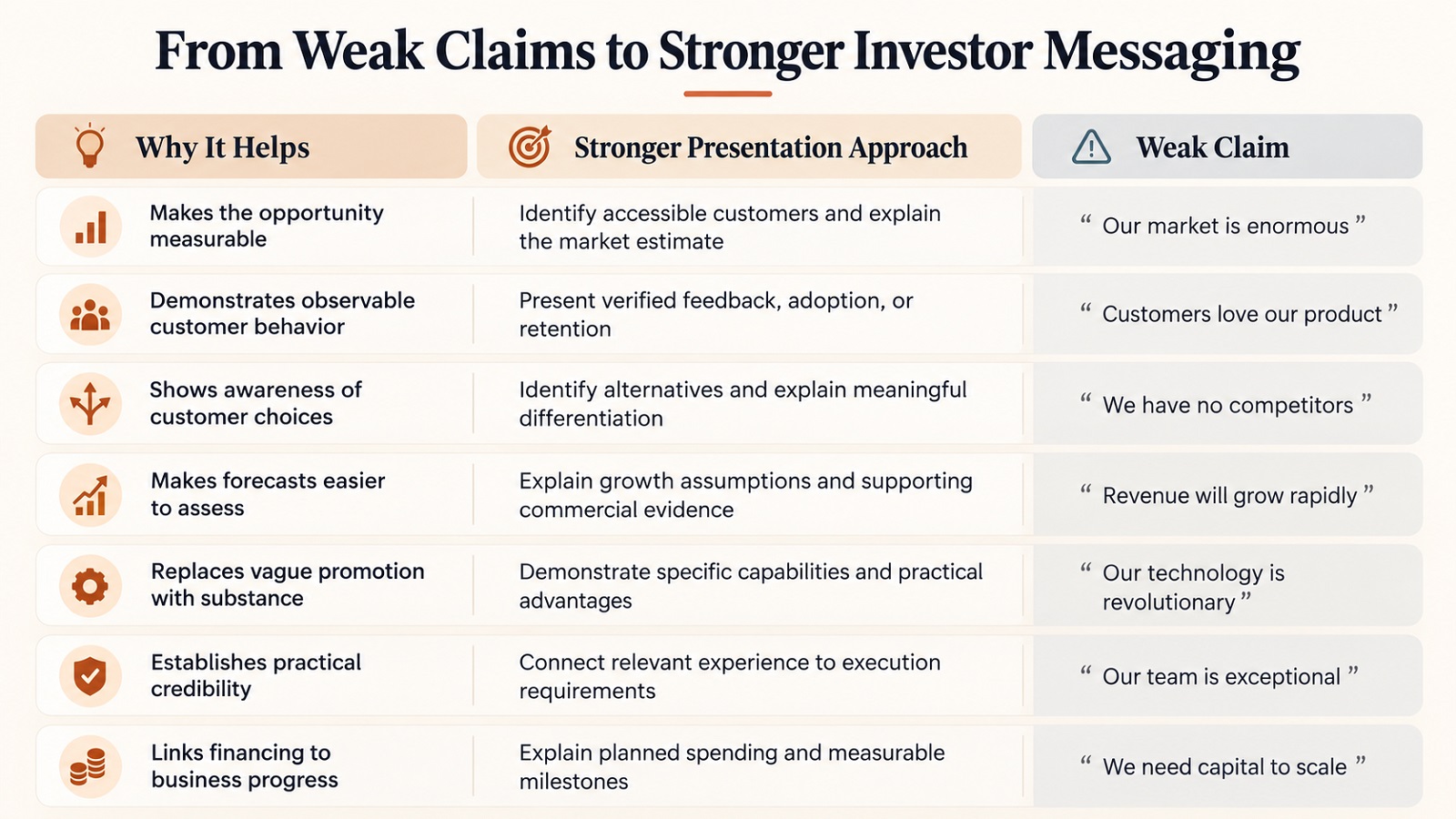
The purpose is not to remove ambition from the deck. Startups often pursue opportunities that involve considerable uncertainty, and investors understand that early businesses cannot prove every future outcome. What matters is whether founders distinguish what they know from what they believe and what they still need to test. Clear explanations of these differences make the opportunity more credible and support productive investor conversations.
Adapt the Pitch Deck to the Company's Stage and Investor Audience
A presentation should reflect where the company stands today. Early concept businesses may have little revenue or commercial activity, so their strongest material could include customer research, founder insight, technical validation, and an explanation of how they intend to test demand. Once a product has been launched, investors may expect evidence of actual usage, pilot results, and customer feedback. Companies with paying customers can place greater emphasis on revenue, retention, acquisition efficiency, and the repeatability of their commercial model.
Industry requirements can also change the emphasis. A company developing complex medical or industrial technology may need to explain product feasibility, technical development, intellectual property, or regulatory considerations. A conventional software company may be better served by emphasizing customer behavior and the economics of distribution. Founders should not imitate the metrics of mature companies when those measures do not yet provide meaningful information about their own business.
Different investors may also evaluate the opportunity through different priorities. An angel investor with direct industry experience may concentrate on founder capabilities and customer insight, while a venture capital firm may examine scalability, market opportunity, and the potential returns associated with its investment model. A corporate investor may additionally consider strategic relevance and opportunities for commercial collaboration.
Adapting the deck does not mean changing the facts. Historical revenue, customer numbers, financing requirements, and company achievements should remain consistent across presentations. What can change is the order of information, the level of technical explanation, and the evidence emphasized for a particular audience.
Design and Review the Pitch Deck Before Sending It
Presentation design should support understanding rather than compete with the information being presented. Each slide needs a clear purpose, readable typography, and enough visual hierarchy to help investors recognize its main point. Charts should identify the measures they display, use appropriate scales, and provide sufficient context to interpret changes over time. Product screenshots and diagrams are valuable when they clarify a workflow or demonstrate functionality, but decorative graphics should not crowd out meaningful information.
Founders should also consider how the presentation will be used. A deck sent before a meeting must make sense without a speaker, while a live presentation can contain less supporting text because the founder provides additional explanation. Maintaining separate versions can be useful, provided the underlying facts remain consistent. Sensitive customer information, proprietary technical details, and confidential agreements should be reserved for appropriately controlled discussions rather than included automatically in materials shared broadly.
Before distributing the deck, management should review the accuracy and consistency of every important claim. The market figures should reflect the customers described elsewhere in the presentation. Commercial metrics should have clear definitions, and financial projections should correspond to the company's actual operating assumptions. Claims about customers, partnerships, intellectual property, or product functionality must reflect the current position of the business.
An independent reader can help identify gaps that founders have overlooked. Someone unfamiliar with the startup should be able to explain what the company does, why its customers might need the product, what evidence supports its commercial opportunity, and why it is seeking investment. If those points remain unclear, further editing is likely to be more valuable than adding new slides.
The review should also extend to investor questions. Founders need to understand the information behind every significant chart and statement so they can explain the assumptions, limitations, and risks during subsequent discussions. A presentation becomes more credible when the people delivering it can discuss the business in depth without relying on memorized promotional language.
Common Mistakes That Weaken Investor Pitch Decks
Many pitch deck problems originate from a mismatch between what founders want to emphasize and what investors need to understand. A presentation may spend considerable time explaining product features before establishing that customers experience a meaningful problem. Alternatively, it may highlight a large market figure without showing how the company could realistically reach that market. Both approaches leave important questions unanswered.
Another recurring mistake is confusing activity with commercial validation. Website visits, product registrations, trials, paying customers, and recurring revenue each represent different types of evidence. Presenting them as though they demonstrate the same level of progress can distort an investor's understanding of the company. The same problem arises when forecasts are presented with excessive certainty or when growth charts omit the underlying starting values.
Some founders also avoid acknowledging competitors or business limitations. Investors may interpret these omissions as a lack of market understanding rather than a sign of exceptional opportunity. A more credible presentation recognizes relevant alternatives, identifies important risks, and explains how the company intends to address them.
Finally, a deck can lose its impact through unnecessary length or an unclear funding request. Investors should not need to work through extensive background material to understand the central business argument. Nor should they finish the presentation uncertain about the proposed financing and the progress it is intended to support. A focused deck communicates the essential information and leaves detailed supporting material available for later evaluation.
Build an Investor Pitch Deck That Moves the Conversation Forward
An effective investor pitch deck brings together a clear business explanation, meaningful evidence, and realistic financial planning. It helps investors understand the relationship between the customer problem, proposed solution, commercial opportunity, and resources required for growth.
The strongest presentations do not attempt to eliminate uncertainty through confident language. They demonstrate that founders understand their market, recognize the limits of their information, and can explain how the company intends to make progress. Clear design supports that argument, but credible business information gives it substance.
A pitch deck does not need to secure an investment decision during the first conversation. Its immediate purpose is to help suitable investors recognize the opportunity and decide whether it deserves deeper evaluation. When it accomplishes that, the presentation becomes a practical tool for moving from an introduction toward a serious financing discussion.
FAQ
What is an investor pitch deck?
An investor pitch deck is a presentation that introduces a startup and its investment opportunity to potential investors. It explains the company's product, customer problem, market opportunity, business model, traction, team, and financing requirements. The presentation is intended to establish investor understanding and encourage more detailed evaluation rather than replace the documentation required to complete an investment.
How many slides should an investor pitch deck contain?
There is no mandatory slide count. Approximately ten to fifteen main slides can provide a useful starting point for many startups, although the appropriate length depends on the business and investor audience. Founders should focus on presenting relevant information clearly instead of adding slides simply to satisfy a template.
What is the most important part of a startup pitch deck?
The most important element is a coherent investment argument supported by relevant evidence. Investors need to understand the customer problem, why the solution matters, whether there is a credible commercial opportunity, and what the company has demonstrated. The relative importance of individual slides depends on the startup's stage and the investor's priorities.
Should an investor pitch deck include financial projections?
Financial projections are generally useful because they help investors understand expected revenue, expenses, capital requirements, and future milestones. Founders should explain the assumptions behind their forecasts and distinguish projected results from verified historical performance. Detailed financial models may be requested during subsequent investment evaluation.
Can a startup secure investment using only a pitch deck?
A pitch deck can initiate investor conversations and help generate interest, but completing a financing round often involves additional work. Investors may request financial records, ownership information, customer evidence, legal documents, and other materials. The financing itself may also require negotiated agreements, approvals, and completion of applicable closing conditions.

Mobina Khanki
Venture & Funding Writer at PinerookMobina Khanki covers venture capital, startup funding, fundraising, and startup finance for Pinerook, focusing on founders and investors.
 Seen first.