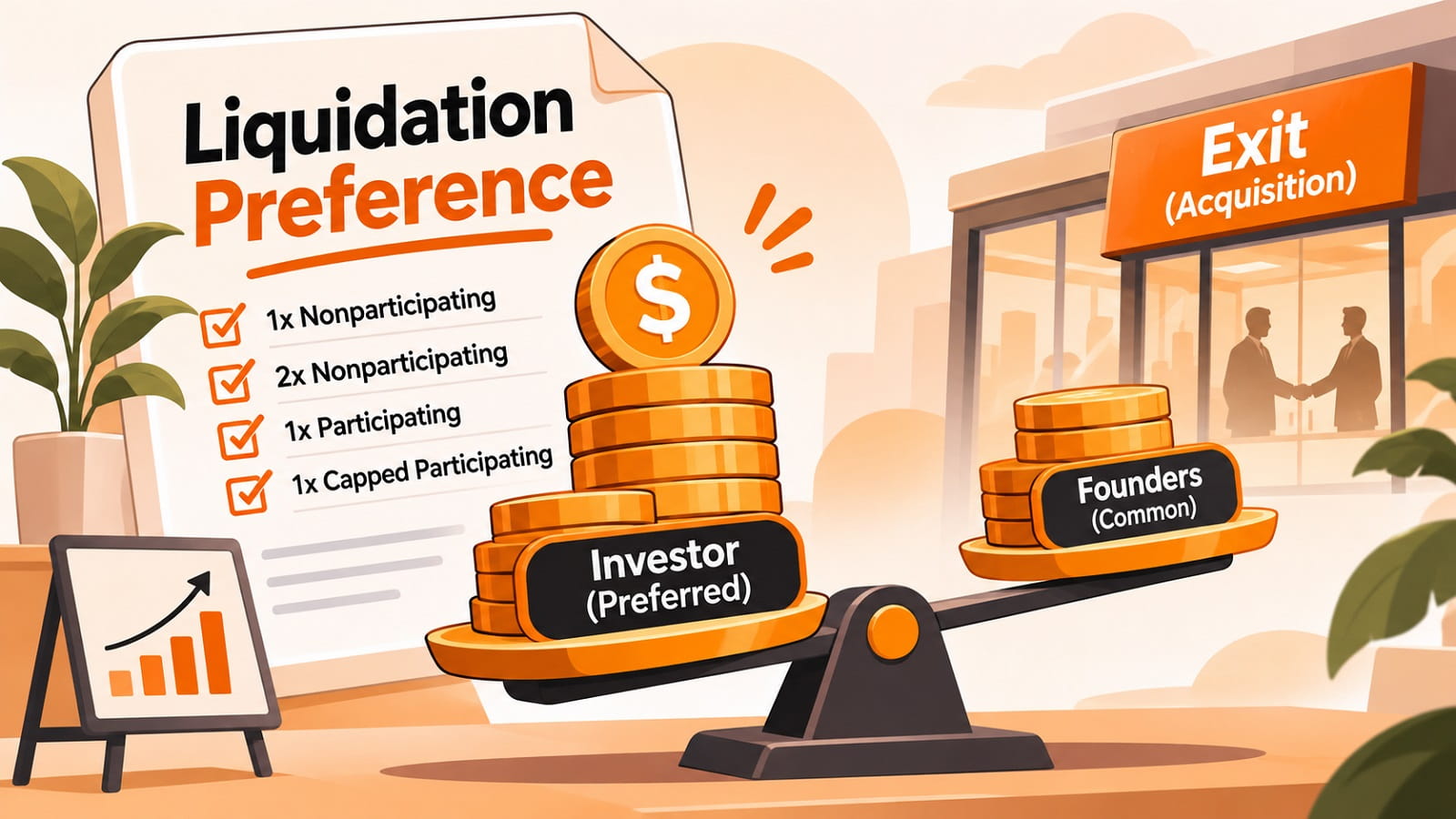
A startup can sell for millions of dollars and still leave its founders with far less money than their ownership percentages suggest. This happens because not every shareholder has the same right to receive proceeds from an acquisition or company liquidation. Venture investors frequently negotiate preferential payment rights that allow them to recover a specified amount before common shareholders receive distributions. These rights can substantially influence the financial outcome of a successful sale, particularly when the proceeds are modest relative to the amount of capital the business has raised.
A liquidation preference is an important economic provision within Term Sheets and Investment Deals because it determines how certain preferred shareholders participate in the distribution of company value. An investor holding 25% of a startup may receive more than 25% of available proceeds under some contractual arrangements, while other structures require the investor to choose between a priority payment and ordinary ownership participation. Understanding this distinction helps founders evaluate the economic substance of a financing proposal rather than focusing exclusively on valuation and ownership percentages.
The most useful way to understand liquidation preferences is to follow the money through an exit. This guide explains the main preference structures, how their multiples and participation rights work, and what happens when several investors have different priorities. It also provides a financial model showing how four preference arrangements produce different investor payouts from the same company sale.
Understanding Liquidation Preference in Venture Capital
A liquidation preference is a contractual right associated with certain preferred shares that establishes priority in the distribution of proceeds from specified corporate events. In a typical venture financing, the investor receives preferred stock with economic rights that differ from the common shares held by founders and many employees.
The preference generally provides the investor with a defined priority claim on proceeds available for distribution to shareholders. This claim is usually expressed as a multiple of the original investment, such as one times or two times the amount invested.
For example, an investor providing $4 million in exchange for preferred shares with a one times preference may have a contractual priority amount of $4 million. If the company is later sold, the distribution mechanism determines whether that investor takes the preference or receives a different amount based on conversion and participation rights.
The preference does not mean the investor is guaranteed repayment. If insufficient value remains after obligations senior to equity are satisfied, the preferred shareholder may receive less than the stated amount. The company's actual financial condition and contractual distribution rules determine the outcome.
Why Investors Negotiate Liquidation Preferences
Venture investments involve substantial uncertainty. Investors provide capital to businesses that may not yet be profitable, may require additional funding, and may never achieve the growth originally expected.
A preference can provide a degree of economic protection when the company is sold for less than the valuation anticipated at the time of investment. Instead of receiving only the percentage associated with the investor's common equivalent ownership, the investor may recover a specified amount before common shareholders participate.
From the investor's perspective, this protection can make a financing proposal more acceptable without requiring the company to issue a larger percentage of ownership.
For founders, the arrangement creates a tradeoff. The company receives capital that may support growth, but the investor gains a priority that can reduce the amount available to common shareholders during an exit.
The practical significance depends on the entire capital structure. A modest preference may have little effect when a business is sold for a large amount, while the same preference may determine nearly the entire distribution in a smaller acquisition.
The Meaning of 1x and 2x Liquidation Preferences
The preference multiple determines the investor's contractual priority amount relative to the original investment or another amount specified in the governing documents.
A one times preference generally represents the original investment amount. If an investor contributes $4 million, the corresponding priority amount is $4 million, subject to the contractual terms and the proceeds available for distribution.
A two times preference increases that amount to $8 million. Under a nonparticipating arrangement, the investor may have the right to receive up to that amount before common shareholders receive proceeds, or convert into common shares when conversion provides a better result.
A higher multiple can therefore affect distributions substantially, especially when the sale value is insufficient to cover all preferred claims. The economic consequences become even more complicated when different financing rounds have separate preferences.
Founders should not evaluate the multiple in isolation. A one times participating preference can produce a different payout from a two times nonparticipating preference, depending on the company's sale value.
Nonparticipating Preferred Shares
Nonparticipating preferred shares generally require the investor to choose between receiving the applicable liquidation preference and converting into common shares to participate according to the resulting ownership percentage.
The investor does not ordinarily receive both payments. Instead, the preferred shareholder compares the proceeds available under the preference with the amount available through conversion.
Suppose an investor contributes $4 million for a 25% common equivalent ownership position and receives a one times nonparticipating preference. If the company sells for $12 million, the investor's 25% share would equal $3 million. Taking the $4 million preference produces the greater amount, assuming sufficient proceeds are available.
If the company sells for $40 million, the equivalent common ownership represents $10 million. Conversion therefore produces a better economic outcome than receiving the $4 million preference.
This conversion mechanism is central to understanding why nonparticipating preferred shares can provide downside protection without permanently limiting the investor's participation in a highly successful exit.
Participating Preferred Shares
Participating preferred shares allow an investor to receive the applicable priority amount and then participate in the remaining proceeds according to the relevant contractual ownership calculation.
Consider the same investor contributing $4 million for 25% ownership. Under a one times participating preference without a cap, the investor first receives $4 million from the available proceeds.
If the company sells for $12 million, the remaining amount is $8 million. The investor then receives 25% of that remainder, or another $2 million, producing a total distribution of $6 million.
The common shareholders collectively receive the other $6 million. Under a one times nonparticipating arrangement, they would have received $8 million at the same sale value.
Participation therefore changes the distribution even though the investor's original investment and ownership percentage are identical. The difference becomes more significant as the amount available for distribution increases.
Capped Participating Preferred Shares
A capped participating preference allows the investor to participate in remaining proceeds up to a specified total distribution limit. The cap is commonly expressed as a multiple of the investment amount and generally includes both the initial preference and subsequent participation proceeds.
For example, an investor contributing $4 million with a three times total return cap would have a $12 million limit on proceeds received while retaining the capped participating preferred structure.
The investor first receives the preference amount and then participates in the remaining proceeds until the specified limit is reached. After that, additional proceeds generally become available to other eligible shareholders according to the governing terms.
Importantly, a cap does not necessarily prevent the investor from receiving more than the capped amount through conversion into common shares. When the value of the investor's common equivalent ownership exceeds the cap, the investor may elect to convert and receive that larger amount.
This distinction makes capped participation different from a permanent ceiling on investment returns. The restriction ordinarily applies to the participating preferred distribution, not necessarily the amount available through conversion.
The Contractual Terms Founders Should Review
The economic effect of a preference depends on several connected provisions. A founder should confirm how each provision operates before relying on an ownership percentage or projected acquisition valuation.
The following table summarizes the main contractual elements and their practical consequences.
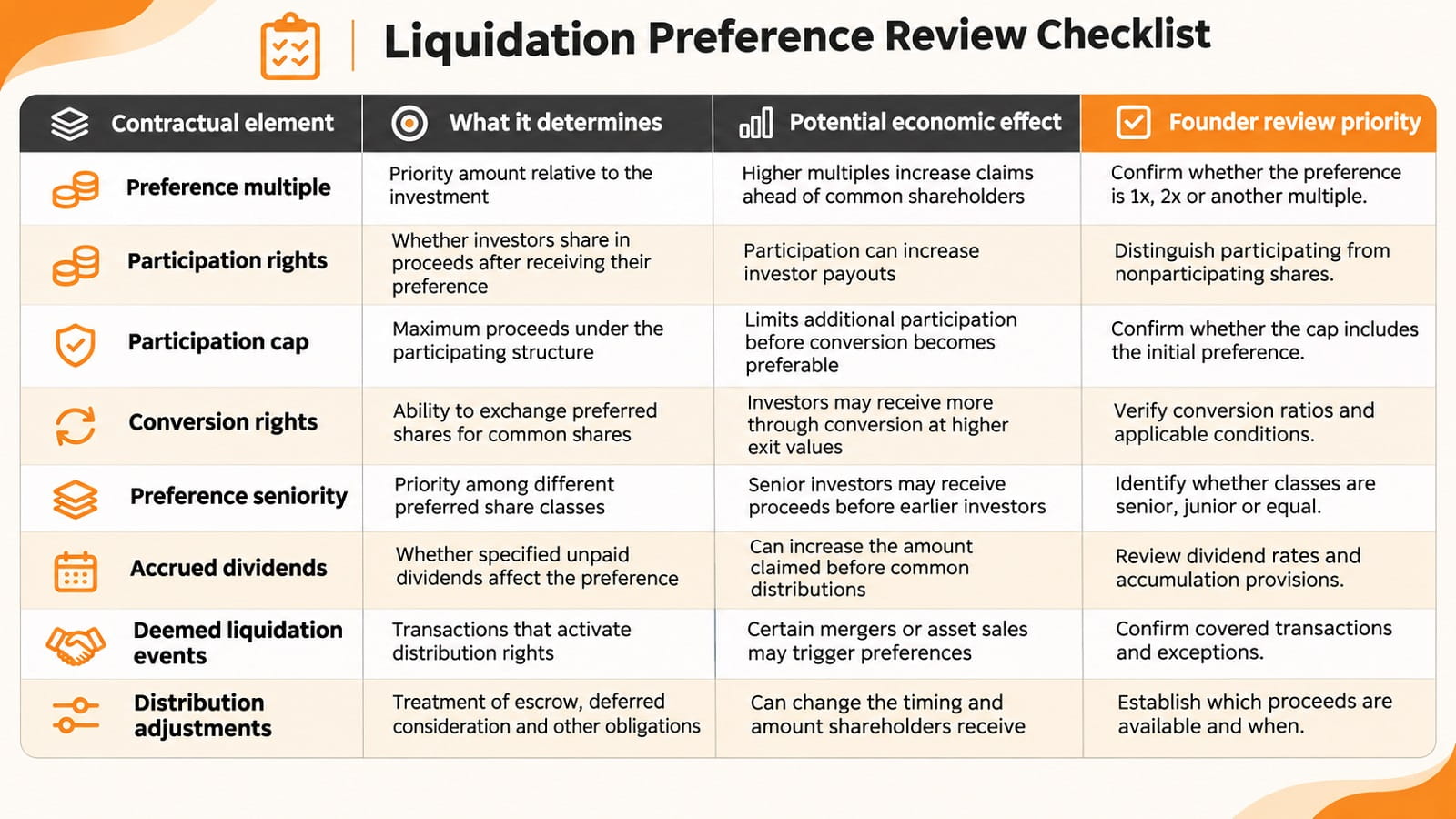
These provisions interact with one another. A financing agreement might provide a conventional one times preference while also introducing seniority over earlier investors or dividends that increase the effective amount payable.
The relevant document should be evaluated as a complete economic arrangement. A short description of the preference multiple does not establish the final distribution.
A Practical Liquidation Preference Example
Consider Westhaven Technologies, a fictional private software company that raises $4 million from an investor. The financing gives the investor a 25% ownership position on a fully converted basis, while founders and other common shareholders collectively hold 75%.
Assume the company is later sold and all stated sale proceeds are available for shareholder distributions. There is only one preferred investor, with no additional share classes or investors holding separate preferences.
For this example, there is no debt, transaction expense, accrued dividend, escrow, or other claim reducing the available proceeds. The investor can convert preferred shares into common shares when conversion provides a more favorable result.
We will compare four alternative contractual structures applied to the same investment: a one times nonparticipating preference, a two times nonparticipating preference, a one times participating preference without a cap, and a one times participating preference with a three times total return cap.
The following table reports the investor's total distribution under five hypothetical company sale values. The amount available to common shareholders in each scenario equals the stated sale proceeds minus the investor's distribution.
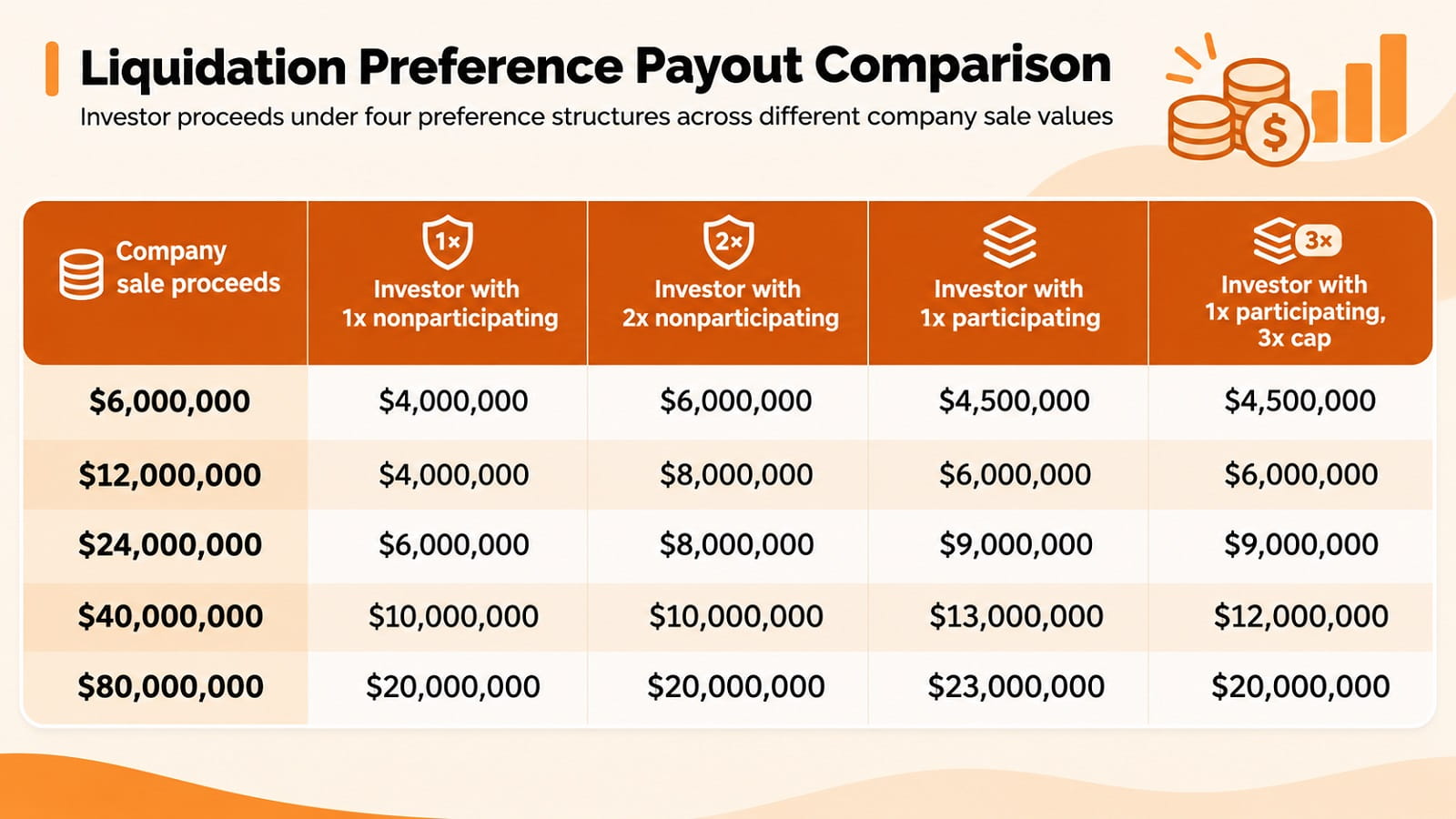
At a $6 million sale value, the investor with a two times nonparticipating preference receives all available proceeds because the stated $8 million priority exceeds the value available. Common shareholders receive nothing under that arrangement.
At a $12 million exit, the same investor receives $8 million, leaving $4 million for common shareholders. Under a one times nonparticipating preference, the investor receives only $4 million, leaving $8 million for common shareholders.
At a $24 million exit, converting a one times nonparticipating investment into a 25% common ownership position produces $6 million. The two times nonparticipating investor still receives the larger $8 million preference, while an uncapped participating investor receives $9 million.
At a $40 million exit, the uncapped participating investor receives $13 million. The capped participating investor receives $12 million because the agreed total preference and participation limit has been reached.
Finally, at an $80 million exit, conversion into common shares provides $20 million, exceeding the capped participating limit. The capped investor can therefore receive $20 million through conversion under the assumed terms, while the uncapped participating investor receives $23 million.
These outcomes demonstrate how a single preference clause can materially change shareholder distributions without changing the initial capitalization percentages.
Calculating the Exit Waterfall Step by Step
An exit waterfall is a financial calculation showing how proceeds are allocated among claimants and security holders according to their contractual rights.
The process begins by determining the amount actually available for equity distributions. A headline acquisition price may not equal the amount available to shareholders because liabilities, transaction expenses, adjustments, and other claims can reduce the proceeds.
Once the relevant amount is established, the model identifies the applicable preferred share rights and their priority. For a simple one times nonparticipating preference, the investor generally receives the greater of the preference amount and the value available through conversion.
In the Westhaven example, the investor contributes $4 million and owns 25% on a converted basis. The investor becomes economically indifferent between the $4 million preference and conversion when the available proceeds reach $16 million, because 25% of $16 million equals $4 million.
Below that threshold, the one times preference is generally more favorable. Above it, conversion produces a larger distribution under the simplified model.
A two times nonparticipating preference changes the threshold. The $8 million preference and the 25% conversion value become equal when available proceeds reach $32 million.
Participation introduces a separate calculation. For the one times uncapped participating structure, the investor receives $4 million plus 25% of the proceeds remaining after that payment, whenever at least $4 million is available.
At a $24 million exit, this produces $4 million plus 25% of $20 million, or $9 million. The amount available to common shareholders is therefore $15 million.
These formulas are straightforward for a single investor but may not apply directly when several preferred classes have different seniority, participation rights, or conversion decisions.
How the Participation Cap Changes the Investor's Return
The capped participation example deserves additional attention because the result changes at different company sale values.
Westhaven's investor has a $4 million initial preference, a 25% participation rate, and a cap of three times the original investment. The maximum distribution while participating under that structure is therefore $12 million.
The participating calculation reaches $12 million when company sale proceeds equal $36 million. At that point, the investor receives the $4 million priority amount plus 25% of the remaining $32 million.
From that point, additional participation is limited by the cap. However, the investor's option to convert into common shares still needs to be considered.
At a $48 million sale, the investor's 25% common ownership would also be worth $12 million. Above $48 million, conversion becomes more favorable than retaining the capped participating distribution.
At an $80 million sale, conversion produces $20 million. This explains why the final table shows a $20 million distribution rather than a permanent $12 million ceiling.
The precise calculations depend on how the cap and conversion rights are defined in the governing documents. Founders should not assume that every capped preference follows an identical formula.
Seniority Across Multiple Funding Rounds
A startup may complete several financing rounds, each creating a different series of preferred shares. When the company is eventually sold, those classes may have different priorities.
Seniority determines which investors receive their applicable preferences first. Some agreements make later preferred shares senior to earlier classes, while others allow different series to share available proceeds at the same priority.
An equal priority arrangement is often described as pari passu. Where proceeds are insufficient to satisfy the relevant preference claims in full, holders at the same level may share the available amount proportionally according to the governing documents.
For example, suppose a company has $3 million of Seed preference claims and $7 million of Series A preference claims. If only $8 million is available for those claims and Series A is senior, the Series A investors might receive $7 million, leaving $1 million for the Seed investors.
If both classes instead share equally in priority and the agreement requires proportional allocation by preference amounts, the Series A investors would receive $5.6 million and the Seed investors $2.4 million.
These simplified outcomes exclude conversion choices and participation rights. They illustrate why the same acquisition proceeds can be distributed differently depending on seniority.
Founders should examine each existing financing agreement before introducing a new class of preferred stock. Adding a senior preference may alter the expected returns of both earlier investors and common shareholders.
Liquidation Preference Versus Debt Repayment
A preferred investor's liquidation preference is not the same as a lender's right to repayment. Debt holders generally have creditor claims, while preferred investors hold equity securities with contractual distribution priorities.
In a company sale or liquidation, applicable debts and other obligations senior to equity typically need to be satisfied before the remaining proceeds can be distributed to preferred and common shareholders.
A company might therefore announce a $30 million acquisition while having a significantly smaller amount available for equity holders after relevant obligations and expenses.
The preference multiple is applied within the contractual equity distribution structure, not automatically against the entire announced purchase price.
This is especially important for businesses that have substantial venture debt, deferred payments, or other financial obligations. A realistic model begins with distributable proceeds rather than assuming that the headline transaction value will be paid entirely to shareholders.
Transactions That Can Trigger Liquidation Preferences
The name liquidation preference can suggest that the provision applies only when a company closes and sells its assets. In venture financing, the relevant rights may also apply to specified mergers, acquisitions, or other events defined in the corporate documents.
These are often described as deemed liquidation events. Their definition determines which transactions are treated as distributions requiring the application of the preferred shareholder rights.
A merger in which the company is acquired may fall within the provision, but the details depend on the transaction structure and the applicable documents.
An initial public offering typically involves separate conversion provisions, and preferred shares may convert into common shares under specified conditions. Founders should not assume that a public listing follows the same distribution calculation as a cash acquisition.
The agreement should also address situations where the purchase price includes stock, deferred consideration, contingent payments, or funds held in escrow. These arrangements may affect both the timing and amount of distributions.
Understanding the event definition is therefore as important as knowing the preference multiple.
Dividends and Additional Preferred Share Claims
Some preferred shares include contractual dividend rights. These provisions may entitle investors to specified dividends before ordinary common shareholders receive distributions.
The agreement may distinguish cumulative dividends from noncumulative dividends. Cumulative arrangements can allow unpaid amounts to accumulate according to the relevant terms, potentially increasing the economic claims associated with the preferred securities.
For example, a preference arrangement that includes accrued unpaid dividends may produce a larger distribution than a simple one times investment multiple would suggest.
This effect depends on whether the dividends accrue automatically, require declaration, are included in the preference calculation, or are treated separately.
Founders should confirm whether the preference amount is limited to the original purchase price or includes additional contractual amounts. A clause described informally as a one times preference may not provide the complete economic picture if other rights are attached.
The Impact on Founders and Employees
Founders and many startup employees commonly hold common shares or rights to acquire common shares. Their economic outcomes can depend on the amounts remaining after applicable preferred claims have been satisfied.
An employee who holds stock options may also need to exercise those options or satisfy transaction specific settlement requirements before receiving proceeds.
The number of options granted or the percentage represented by a fully diluted capitalization model does not guarantee a corresponding percentage of acquisition proceeds.
If a company has raised substantial preferred capital and is sold at a relatively modest value, preferred claims may absorb much of the amount available for distribution.
This can create a situation in which a business achieves a sale that appears significant but common shareholders receive little or nothing.
Founders should therefore understand the preference structure when communicating potential equity value to employees. A financing valuation and a theoretical ownership percentage are not substitutes for an exit distribution model.
Modeling a Liquidation Preference Before Fundraising
A useful financing review should include a model of how proposed preference rights would affect shareholder distributions across different acquisition values.
The company should begin with its existing capitalization, identifying each preferred series, common share class, relevant option awards, and securities that may convert before or during the transaction.
The model should then incorporate the proposed financing, including the new investment amount, preference multiple, participation rights, seniority, dividends, and conversion conditions.
Several exit values should be tested rather than relying on a single optimistic acquisition scenario. Lower outcomes may reveal the importance of priority claims, while larger outcomes can demonstrate when preferred investors would benefit from conversion.
The results should identify the amounts received by each relevant shareholder group and reconcile the total distributions to the proceeds available.
For complex capital structures, a professional waterfall model may be necessary. Simple percentage calculations can produce misleading results when multiple preferred classes interact.
Negotiating Liquidation Preference Terms
A founder negotiating preferred share economics should begin by understanding which provisions provide reasonable investor protection and which introduce additional participation or priority claims.
The preference multiple is an important starting point. A one times nonparticipating structure is widely used in venture financing, but the specific terms remain subject to negotiation.
Founders should also review whether participation is requested, whether a cap applies, and how existing investor preferences rank relative to the new shares.
The relationship between valuation and preference structure matters. A higher valuation accompanied by stronger preferred rights may not produce a better overall financial outcome for common shareholders.
Scenario analysis can make the negotiation more concrete. Rather than debating whether a provision is favorable in abstract terms, the parties can compare distributions at realistic acquisition values.
The goal is to understand the financial rights exchanged for the capital received and ensure that the final structure is consistent with the company's financing needs.
Common Mistakes When Evaluating Liquidation Preferences
One common mistake is assuming that a one times preference guarantees repayment of the investor's original capital. A preference establishes priority within the applicable distribution structure, but it cannot create additional proceeds when the company has insufficient assets.
Another is treating the investor's common equivalent ownership percentage as the final payout percentage. Participation and preference multiples can produce distributions that differ substantially from ordinary proportional ownership.
Founders may also overlook seniority between different preferred classes. A new financing can alter which investors receive proceeds first, particularly when an exit produces less value than the combined preference claims.
A further mistake is interpreting capped participation as a permanent maximum investment return. Investors may have conversion rights that produce greater proceeds than the participation cap at higher exit values.
Finally, using the headline acquisition price without accounting for obligations, transaction expenses, and deferred payments can overstate the amount available to shareholders.
Avoiding these problems requires accurate capitalization records, careful review of financing documents, and calculations that reflect the company's actual contractual obligations.
Final Thoughts
Liquidation preferences can determine how much money founders, employees, and investors receive when a startup is sold. Their effect depends on the investment amount, preference multiple, participation rights, conversion options, seniority, and the proceeds actually available for distribution.
The Westhaven Technologies example demonstrates why investors holding the same 25% ownership can receive different payouts under four alternative contractual structures. The differences are most important when an exit produces limited proceeds or when participation rights allow preferred shareholders to receive additional value.
For founders, the essential task is to understand the distribution waterfall before agreeing to financing terms. A properly modeled preference structure makes it easier to compare investment offers, assess the economic consequences of future funding rounds, and avoid unexpected outcomes during an acquisition.
FAQ
What Is a Liquidation Preference?
A liquidation preference is a contractual right that gives specified preferred shareholders priority when proceeds from certain company transactions are distributed. The amount and priority depend on the company's governing documents and the terms of the preferred securities.
What Does a 1x Liquidation Preference Mean?
A one times preference generally establishes a priority amount equal to the relevant original investment. However, the amount actually received depends on available proceeds, senior claims, conversion provisions, and other contractual rights.
What Is the Difference Between Participating and Nonparticipating Preferred Stock?
Nonparticipating preferred investors generally choose between their preference and converting into common shares. Participating preferred investors may receive the preference first and then share in remaining proceeds, subject to the applicable terms.
What Is a 2x Liquidation Preference?
A two times preference generally provides a priority amount equal to twice the relevant investment. If an investor contributes $4 million, the stated priority amount would be $8 million, subject to available proceeds and the governing agreements.
Can Founders Receive Nothing When a Startup Is Sold?
Yes. If proceeds available for equity distributions are insufficient to satisfy applicable preferred claims, common shareholders may receive no distribution even though the company has been acquired.
Does a Liquidation Preference Guarantee Investor Returns?
No. It provides contractual priority, not guaranteed repayment. Investors may still lose money if the company has insufficient value remaining after obligations and senior claims are addressed.
What Is a Capped Participating Liquidation Preference?
It allows a preferred investor to receive priority proceeds and additional participation up to a specified total amount. The investor may still receive more by converting into common shares if conversion rights permit and that calculation is more favorable.
What Happens When Multiple Investors Have Liquidation Preferences?
Their relative priorities depend on the financing documents. Some preferred classes rank ahead of others, while classes with equal priority may share insufficient proceeds according to specified allocation rules.
Does a Liquidation Preference Apply During an IPO?
Not necessarily in the same way as a company sale. Preferred shares often have provisions governing conversion into common shares in connection with a qualifying public offering, and the actual treatment depends on the documents.
Can Founders Negotiate Liquidation Preferences?
Yes. The multiple, participation rights, cap, seniority, and related economic provisions may be negotiated as part of the financing transaction. Founders should evaluate their combined effect rather than focusing on one clause alone.

Mobina Khanki
Venture & Funding Writer at PinerookMobina Khanki covers venture capital, startup funding, fundraising, and startup finance for Pinerook, focusing on founders and investors.
 Seen first.