Training a machine learning model is only part of the job. Once several versions exist, keeping track of which model was tested, approved, and released becomes a challenge.
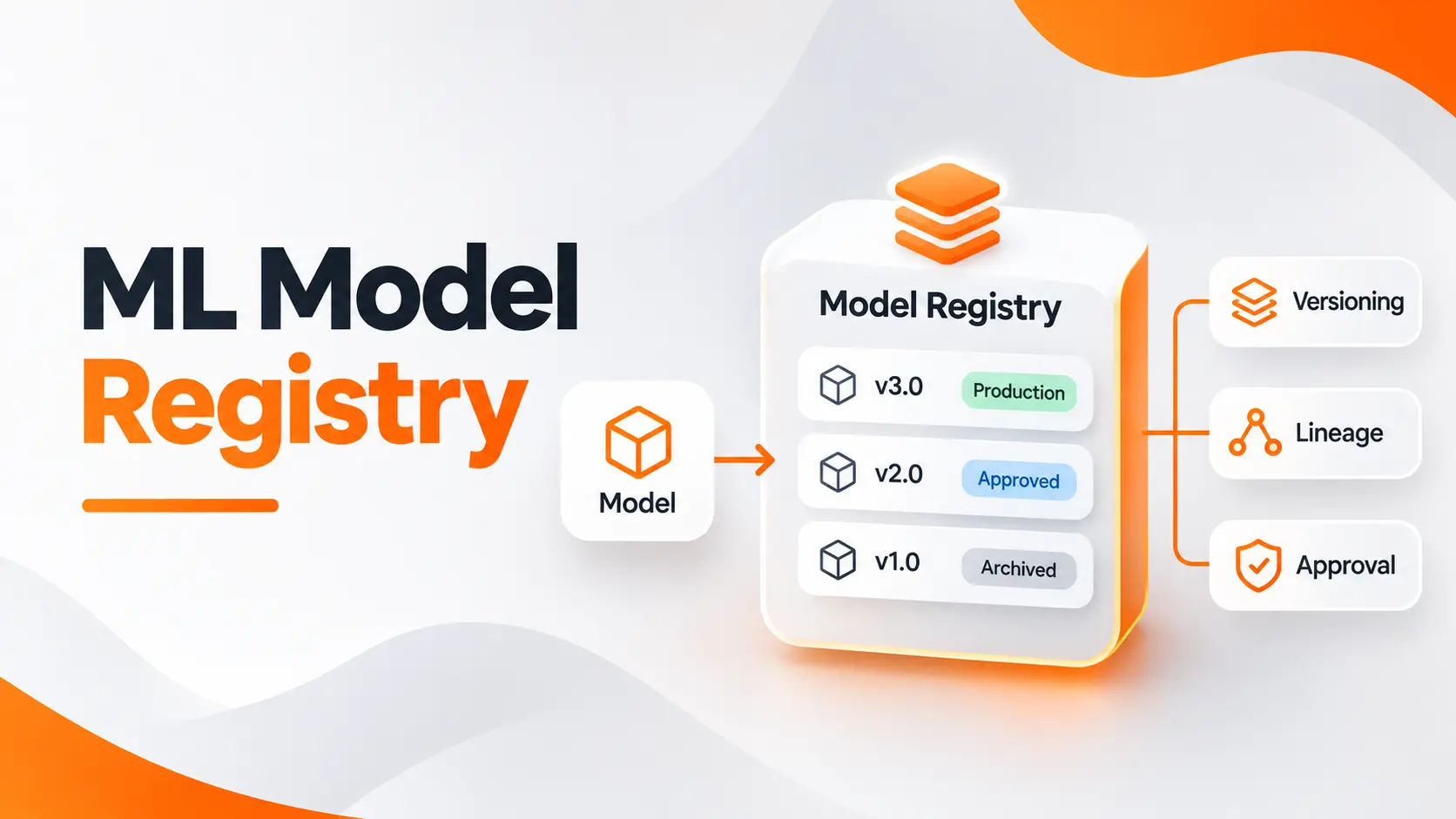
An ML Model Registry is a centralized system for registering, versioning, and managing trained machine learning models. It keeps model artifacts or their references, evaluation results, training history, and lifecycle information organized so teams can identify the correct model version for each task.
For me, the real value of a model registry is knowing exactly which version can be trusted, what evidence supports it, and how to recover an earlier version when necessary.
How a Model Registry Works
A model registry connects model development with the decisions required to manage trained models. Instead of storing model files under unrelated names, it gives each registered model a consistent identity and maintains a record of its versions.
Within MLOps, this creates a controlled way to move models from experimentation into operational use without losing their development history.
The process follows a clear sequence.
Model Registration
Registration begins when a training process produces a model worth preserving for further evaluation or operational use.
The model artifact is stored or referenced in the registry, along with information identifying the training run and its associated configuration.
For example, a team developing a fraud detection model can register its first candidate under the name Fraud Detection. Each new candidate registered under that identity receives a distinct version identifier.
Registration does not mean the model has passed evaluation or is ready for production. It establishes a traceable record of a trained model.
Model Evaluation and Version Review
Once a candidate is registered, the team examines its evaluation results and compares them with the requirements established for the application.
A new fraud detection model might achieve higher recall than the current version while producing more false positives. The registry allows both candidates to remain identifiable while the team determines whether that tradeoff is acceptable.
The comparison must use compatible evaluation conditions. A higher accuracy score cannot establish an improvement if the versions were evaluated on different datasets or under different decision thresholds.
Model Approval and Selection
After evaluation, an authorized reviewer determines whether the candidate satisfies the requirements for release.
The registry records the approval information through the mechanisms supported by the selected platform, including metadata tags, approval states, or associated review records.
An approved version becomes eligible for deployment. It does not automatically replace the model running in production.
That distinction matters because model approval and production release are separate operational decisions.
Model Versioning and Metadata
Model versioning allows teams to preserve multiple trained instances under a single registered model identity.
I consider this one of the most useful registry capabilities because model development does not stop after the first successful release.
A model can be retrained with new data, adjusted with different parameters, or developed using an improved feature set. Each resulting artifact needs its own identifiable version.
Registered Model vs. Model Version
A registered model represents the logical identity of a machine learning model. A model version represents a specific trained artifact associated with that identity.
For example, Fraud Detection can be the registered model name, while versions 1, 2, and 3 identify different trained candidates.
The registered model name remains stable as new versions are introduced. The version identifier provides a precise reference to an individual candidate.
This structure makes it possible to compare newer models against earlier releases without overwriting the previous artifacts.
Essential Model Registry Metadata
A model version number is not enough to understand how a model was produced or whether it can be used safely.
When reviewing a registry, I want the following information to be accessible.
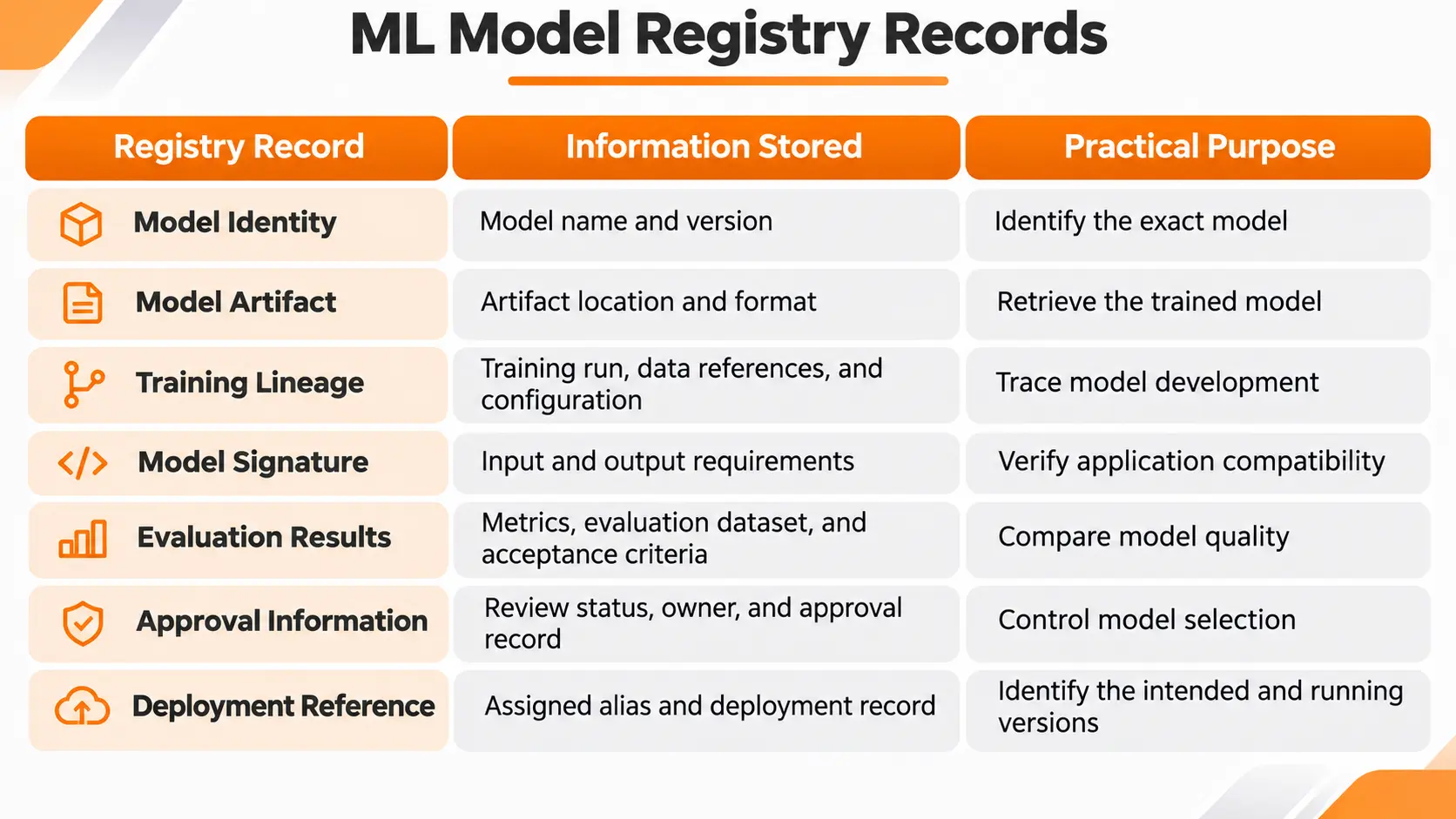
The registry does not need to store every piece of information directly. It must preserve reliable references to the systems where that information is maintained.
A model artifact can reside in object storage while the registry manages its identity, metadata, and lifecycle relationships.
Model Lineage and Traceability
Model Lineage describes the connection between a trained model and the resources used to produce it.
That includes training datasets, feature definitions, source code, software dependencies, configuration values, and experiment records.
I consider lineage essential when investigating why two model versions produce different results.
Suppose a customer churn model performs worse after a new version is introduced. The team discovers that the new version uses an updated customer activity feature.
Without lineage, engineers must reconstruct which training process introduced that feature and which dataset supplied its values.
With a reliable lineage record, they can identify the relevant training run, feature definition, and data reference directly.
Reproducing Previous Model Versions
Reproducing a model requires more than retrieving its saved weights or serialized file.
The team also needs the training code, data references, preprocessing logic, dependencies, and configuration that produced the artifact.
A registry supports this process by linking the model version to those resources. Actual reproducibility still depends on whether the referenced resources remain accessible and whether the training process supports reproduction under the recorded conditions.
This is particularly important when a model must be investigated months after its original release.
Model Registration and Promotion
Model Promotion is the process of selecting a registered model version for a defined operational role after completing the required evaluation and approval steps.
The registry provides a record of that selection, while the surrounding release process determines when and how the selected model is used.
Model Aliases and Version References
An alias is a named reference that points to a particular model version.
For example, an alias called champion can identify the version selected for production use.
If version 4 is the current approved model, the alias can point to version 4. After version 5 passes the required reviews, the alias can be reassigned to version 5.
The underlying version numbers do not change. Only the reference identifying the selected version is updated.
MLflow and Google Cloud provide mechanisms for assigning aliases to model versions.
An important distinction is that changing an alias does not guarantee that every running prediction service immediately loads the new artifact. The serving system must be designed to resolve that reference and apply the change through the appropriate release procedure.
Model Approval vs. Deployment
Approval records establish whether a model has satisfied the organization's requirements for release.
Deployment records establish which artifact is actually running in an operational environment.
These records must remain consistent, but they represent different facts.
An approved model can remain unused while an older version continues serving production requests.
Likewise, changing a registry status does not physically replace an active model unless the deployment infrastructure acts on that change.
I would keep both records accessible so the team can distinguish the intended production version from the version confirmed to be running.
Model Registry vs. Experiment Tracking
Model registries and experiment tracking systems serve connected but different responsibilities.
An experiment tracker records the training runs performed during development. It captures parameters, metrics, and artifacts that help researchers compare different approaches.
A model registry manages the trained versions selected for continued evaluation, approval, or operational use.
Consider a data scientist who trains 40 candidates while testing algorithms and feature combinations.
The experiment tracker can preserve the results of all 40 runs. The team then selects two promising candidates for additional validation and registers them as versions under the same model identity.
The registry becomes responsible for maintaining the operational history of those selected versions.
The two systems work together, with the registry retaining references to the experiments that produced the registered artifacts.
Model Registry vs. Model Repository
A Model Repository stores model files and related artifacts. A Model Registry adds model specific management capabilities around those artifacts.
For example, an object storage service can preserve several trained model files. However, storing those files does not establish which one passed evaluation, who approved it, or which version should be used by an application.
A registry organizes those relationships through structured model records.
It also provides ways to retrieve individual versions and manage metadata associated with their operational status.
A model catalog serves another purpose: helping users discover available models and understand information about their ownership or intended applications.
These capabilities can exist within the same platform, but their responsibilities remain distinct.
ML Model Registry in Practice
Consider a subscription company using a machine learning model to predict customer cancellations.
The company has an existing production model and has trained a new version using updated customer information.
The registered model is named Customer Churn, with version 11 currently serving production requests.
The team registers version 12 as a new candidate. Its record includes the model artifact, training run reference, evaluation dataset, performance metrics, and input signature.
During evaluation, version 12 demonstrates better recall but also produces more false positives than the existing model.
Because the increase exceeds the company's accepted limit, the reviewer does not approve version 12 for production use.
Version 11 remains the approved production model, and the registry preserves version 12 for further investigation.
After adjusting the training process, the team produces version 13. This version satisfies the defined evaluation requirements and receives approval.
The authorized release process then selects version 13 for production deployment.
The registry records the new selection while preserving the complete history of versions 11, 12, and 13.
If the application needs to return to version 11, the earlier artifact and its supporting records remain identifiable.
The practical benefit is clear: the team can explain which version was selected, why it was approved, and how it differs from previous candidates.
Model Registry Tools and Platforms
Different platforms provide model registry capabilities alongside broader machine learning services.
The right choice depends on the existing training environment, required integrations, governance controls, and the team's deployment infrastructure.
MLflow Model Registry
MLflow provides a model registry with model versioning, aliases, metadata tags, descriptions, and references to training runs.
Its interface and APIs allow teams to register models, inspect their versions, and retrieve selected artifacts.
For current implementations, I would use model aliases and tags to represent operational roles and validation information. MLflow's older fixed Model Stages functionality has been deprecated in favor of more flexible mechanisms.
Amazon SageMaker Model Registry
Amazon SageMaker AI organizes registered models into Model Groups containing versioned model packages.
Each package represents a registered model version. The platform supports model approval information, version comparisons, and integration with AWS machine learning workflows.
This structure is relevant for teams already managing their training and model operations within AWS.
Google Cloud Model Registry
Google Cloud provides centralized management of model versions and associated information.
Model aliases allow users to reference specific versions through names that can be reassigned as model selection changes.
The registry also connects with the platform's model deployment capabilities.
Azure Machine Learning
Azure Machine Learning supports model registration, version management, and associated metadata.
Models can be registered from local files, managed data locations, or training job outputs.
The platform maintains identifiable model assets that can be retrieved and used by supported deployment workflows.
I would evaluate these services based on their integration requirements rather than the number of registry features listed in their documentation.
Model Registry Governance
A model registry becomes more valuable when multiple teams contribute to the same machine learning environment.
At that point, the organization needs clear rules governing who can register models, approve versions, change operational references, and retire older artifacts.
Model Ownership and Access Control
Every registered model should have a designated owner responsible for its operational record.
Registration permissions and production approval permissions should be separated according to the organization's release requirements.
A data scientist can create a new candidate without receiving permission to replace the model serving customers.
That separation supports independent review and reduces the risk of unauthorized releases.
Audit History and Version Retention
A registry should preserve enough information to explain significant lifecycle decisions.
That includes identifying the model version involved, the evaluation evidence used, and the individual or process responsible for approval.
Retention policies must also account for models that are no longer active but remain necessary for investigation, reproducibility, or regulatory requirements.
Deleting a retired artifact without checking its dependencies can make previous model results impossible to reproduce.
Registry Consistency
One issue I would examine closely is whether production applications are required to use registered versions.
If an application loads a model directly from an unrelated storage location, the registry can identify one version as approved while the application runs another.
The registry then becomes an incomplete account of the production environment.
A reliable process connects model registration, approval, and deployment records so the version identified by the registry can be verified against the artifact actually running.
Choosing a Model Registry for an ML Project
The need for a dedicated registry depends on the number of models, frequency of updates, contributors, and operational requirements.
A small project with one model and infrequent releases can maintain an adequate record through versioned artifacts, documented evaluations, and controlled deployment procedures.
As the number of model versions and contributors increases, centralized version management becomes more valuable.
I would prioritize a registry when the team needs consistent model identification, reliable lineage, formal approval records, and integration with deployment workflows.
The value comes from maintaining a trustworthy operational history, not from adding another platform to the technology stack.
A well managed registry allows teams to understand which model version they are using, how it was produced, and what evidence supports its continued use.
FAQ
Can I use one registry for models running on different cloud platforms?
Yes. A shared registry can maintain model metadata and artifact references for workloads operating across different environments. The deployment systems must have compatible artifact access, credentials, and runtime support. Network access and security permissions must also be configured for each environment.
What happens if two people register a new version at the same time?
A registry supporting concurrent registration assigns separate version identifiers through its backend. The team should use the identifiers returned by completed registration operations rather than assume which version number will be assigned next. Approval and alias updates also require appropriate controls to prevent conflicting changes.
Can I register an AI model if I only have access to its API?
Yes, provided the selected registry supports external model records or references. The record can identify the provider, model identifier, API configuration, and associated evaluation results without storing model weights. Reproducing behavior also requires tracking relevant application configuration and provider version information.
What if someone accidentally deletes a model version that's still being used?
The outcome depends on the platform and its deletion safeguards. Some systems block deletion of assets referenced by active deployments. Others require separate controls to prevent removal. Production workflows should restrict deletion permissions and preserve recoverable artifacts before allowing model retirement.
Can a model registry help track licensing and usage restrictions?
Yes. Licensing terms, permitted use, ownership information, and relevant approval records can be stored as metadata or linked documentation. The registry does not independently enforce every licensing restriction. Enforcement requires organizational policies and controls in the systems that access or deploy the model.

Fatemeh Jahangard
Technology & AI Writer at PinerookFatemeh Jahangard covers AI, emerging technologies, and digital innovation for Pinerook, focusing on how technology shapes startups and industries.
 Seen first.