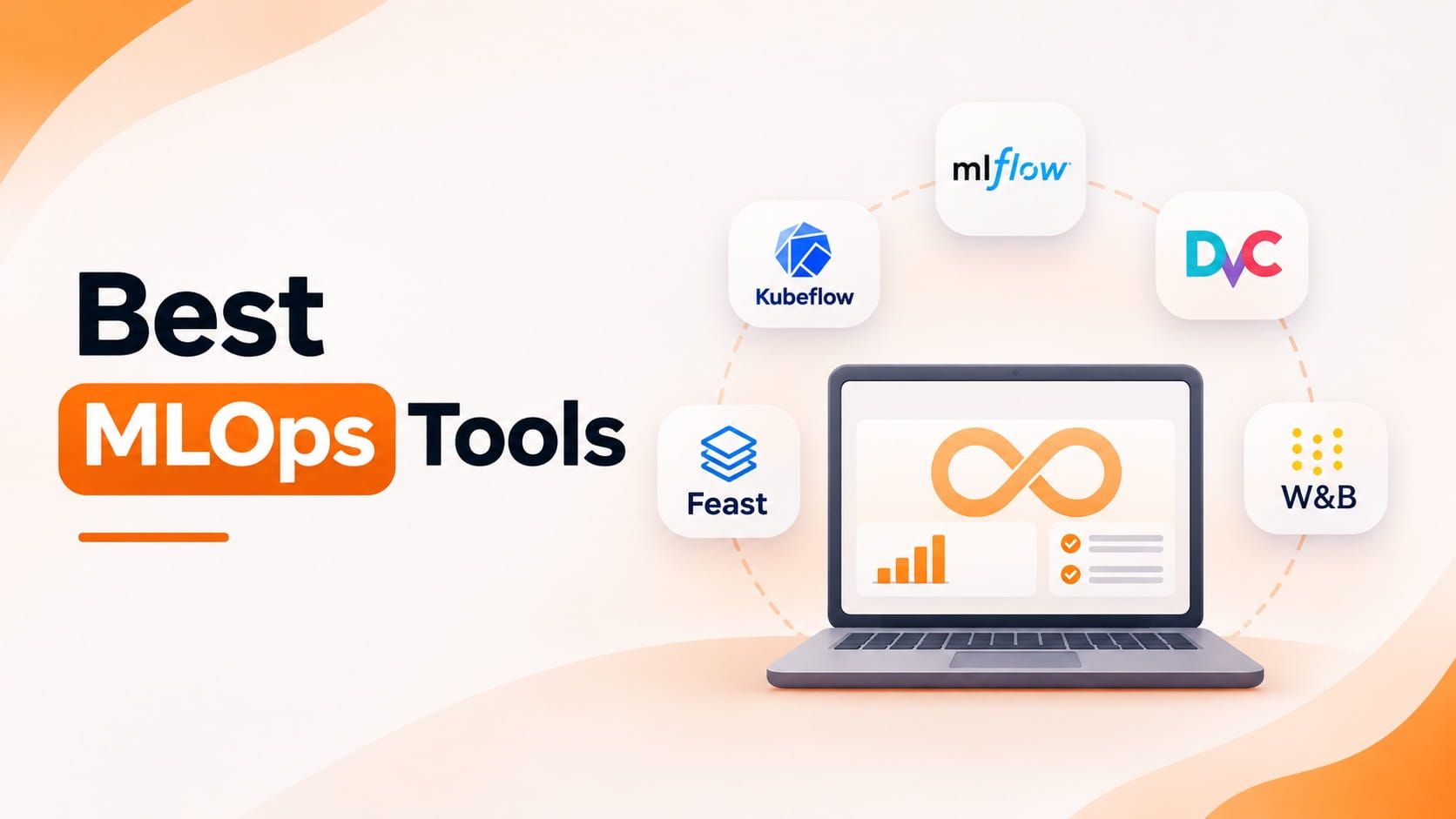
The best MLOps tools depend on what a machine learning team needs to manage. MLflow is a strong choice for experiment tracking and model versioning, Kubeflow handles complex ML pipelines, DVC manages data versions, and Evidently helps evaluate and monitor model quality. Teams looking for broader managed infrastructure can consider Amazon SageMaker AI, Databricks, or Google Cloud's Gemini Enterprise Agent Platform.
The challenge is choosing tools that solve different problems without introducing unnecessary complexity. A reliable MLOps workflow needs clear ownership of experiments, datasets, pipelines, models, and production operations. The right combination depends on the existing infrastructure, the number of models, and the resources available to maintain it.
Best MLOps Tools by Use Case
The most useful way to compare MLOps tools is by the work they perform. Experiment tracking, data versioning, pipeline orchestration, model serving, and monitoring are different responsibilities. A tool that performs one exceptionally well does not need to replace every other component.
MLflow for Experiment Tracking and Model Management
Best for: Teams that need a central place to track experiments, compare model performance, and manage model versions.
MLflow records training parameters, metrics, artifacts, and experiment details. Its Model Registry adds version management, model aliases, metadata, and traceability between a model and the experiment that produced it.
For teams moving beyond notebooks and manually named model files, MLflow provides a practical starting point. It allows engineers to identify which configuration produced a model and retrieve the corresponding artifact without searching through individual development environments.
The open source version gives teams control over where their tracking infrastructure runs. That flexibility also means they must configure persistent storage, access controls, and the tracking server.
Our assessment: MLflow is a sensible first addition when experiment management is the main problem. It does not eliminate the need for separate workflow orchestration or production monitoring.
Weights & Biases for Experiment Analysis and Collaboration
Best for: Research teams running frequent experiments and comparing detailed training behavior.
Weights & Biases, also known as W&B, provides experiment tracking, interactive visualizations, artifact management, and collaboration features.
Its visual analysis capabilities are particularly useful when engineers need to compare training runs, inspect learning curves, or evaluate how parameter changes affect results.
W&B also supports model and dataset artifacts, version tracking, and a registry for organizing approved assets.
Compared with MLflow, the decision comes down to the team's workflow. MLflow offers a flexible open source tracking foundation, while W&B places greater emphasis on collaborative experiment analysis and visualization.
Our assessment: Choose W&B when interpreting and sharing experiment results is a significant part of the development process. Review its deployment options, pricing, and data access requirements before adoption.
DVC and lakeFS for Data Versioning
Best for: Projects where training datasets change and reproducibility depends on knowing exactly which data version produced a model.
DVC integrates data and model artifact tracking with Git based development workflows. It allows teams to reference dataset versions without placing large data files directly inside their source code repository.
It also supports reproducible pipelines and experiment management, making it useful for projects that need to connect data changes with training results.
lakeFS addresses a related problem from a different direction. It provides version control for data stored in object storage, with branching, commits, and controlled changes to datasets.
The distinction matters when selecting between them.
DVC fits projects where engineers want data dependencies and experiments connected to their existing development workflow. lakeFS is better suited to teams managing shared datasets in object storage, especially when multiple pipelines need isolated versions of the same data.
Our assessment: We would choose DVC for repository centered machine learning workflows and lakeFS for managing versioned datasets across a shared data lake. Both require appropriate underlying storage infrastructure.
Kubeflow Pipelines and ZenML for Workflow Orchestration
Best for: Teams automating data preparation, training, evaluation, and other connected ML tasks.
Kubeflow Pipelines allows engineers to define machine learning workflows as components executed through Kubernetes infrastructure.
It supports pipeline dependencies, execution history, artifact tracking, caching, and parallel processing. This makes it relevant for organizations already operating Kubernetes clusters.
The tradeoff is infrastructure complexity. Running Kubeflow requires operational knowledge of containerized workloads, computing resources, and cluster management.
ZenML offers a different approach. It allows teams to define pipelines in Python and connect them to different execution environments through configurable stacks.
This separation helps teams manage workflow definitions without tightly coupling their application logic to a single orchestration backend.
Our assessment: Kubeflow Pipelines is appropriate when Kubernetes is already a core part of the organization's infrastructure. ZenML provides a more approachable route for teams that want portable pipeline definitions and integration with existing services.
Feast for Feature Management
Best for: Machine learning systems that need shared feature definitions and consistent access to training and inference data.
Feast is an open source Feature Store that manages feature definitions and provides access to historical and current feature values.
Its offline retrieval capabilities support training datasets, while online serving enables low latency access to feature values for production predictions.
For example, a fraud detection system can use Feast to retrieve historical customer transaction features during training and current values during live prediction requests.
Feast is not a complete data processing or transformation platform. Teams must provide suitable data sources, feature pipelines, and storage backends.
Our assessment: Feast becomes valuable when multiple models share features or when consistent historical and online feature access is a defined requirement. A project with simple batch features already managed reliably in a warehouse does not need another storage and serving layer.
BentoML and KServe for Model Serving
Best for: Teams that need to make trained models available to production applications.
BentoML provides a Python framework for creating model inference services. It supports API development, model packaging, dependency management, and containerized deployment.
This makes it useful for engineers who want direct control over how predictions are exposed to applications.
KServe focuses on model serving through Kubernetes. It provides infrastructure capabilities for managing inference services, including scaling and supported deployment strategies.
The difference is the level at which each tool operates.
BentoML emphasizes building and packaging model serving applications. KServe provides a serving infrastructure layer for Kubernetes environments.
Our assessment: BentoML is a strong option when the team needs flexible inference APIs. KServe deserves consideration when model serving must integrate with an established Kubernetes platform.
These tools are not restricted to a single model architecture, but resource requirements and supported inference runtimes still determine the appropriate implementation.
Evidently for Model Monitoring
Best for: Teams that need to evaluate data quality, identify distribution changes, and investigate model performance.
Evidently provides tools for evaluating datasets and model outputs. It supports data quality checks, drift analysis, and prediction quality evaluation.
Its reports help engineers compare reference and current data, identify changing feature distributions, and investigate whether model inputs differ from the data used during development.
The open source Python library supports local evaluation and integration with existing workflows. Evidently also offers commercial monitoring and collaboration capabilities.
Our assessment: Evidently is useful when teams want configurable evaluation logic without committing to an entire managed ML platform. Continuous production monitoring still requires reliable data collection, execution schedules, and a system for responding to detected issues.
Amazon SageMaker AI for Managed ML Infrastructure
Best for: Teams using AWS that want managed infrastructure for training, pipelines, model registration, and inference.
Amazon SageMaker AI provides services for building and operating machine learning workflows within AWS.
SageMaker Pipelines supports automated processing and training workflows, while the Model Registry manages model versions, approval states, and associated metadata.
The main advantage is integration with AWS infrastructure, including storage, identity management, and computing services.
This reduces the need to operate every infrastructure component independently.
However, managed infrastructure does not eliminate configuration work or operational costs. Teams still need to control resource usage, access permissions, and the relationships between different AWS services.
An important consideration for new customers is that Amazon SageMaker Model Monitor is no longer available to new customers. AWS continues to support existing customers, but new implementations should plan their monitoring requirements using currently available alternatives.
Our assessment: SageMaker AI is a practical choice for AWS centered teams, provided the required services are available and the total operating cost fits the project.
Google Cloud Gemini Enterprise Agent Platform
Best for: Teams operating on Google Cloud that need managed machine learning pipelines, experiment management, and model operations.
Google Cloud's Gemini Enterprise Agent Platform incorporates services previously known under the Vertex AI name.
Its machine learning capabilities include pipeline execution, experiment management, model registration, and monitoring services.
For organizations already using BigQuery, Google Cloud storage, and related services, this platform provides a managed environment for connecting data processing with model development and production workflows.
The advantage is infrastructure integration. The tradeoff is greater dependence on the Google Cloud ecosystem and its pricing structure.
Our assessment: This platform is worth considering when the organization already relies on Google Cloud and wants managed orchestration rather than maintaining a separate Kubernetes based ML platform.
Databricks for Unified Data and Model Management
Best for: Organizations using Databricks for data engineering and analytics that want model operations integrated into the same environment.
Databricks provides managed MLflow capabilities, model management through Unity Catalog, workflow automation, and model serving.
Unity Catalog adds centralized governance, access controls, lineage, and model discovery.
The strongest reason to choose Databricks is its connection between data infrastructure and model operations. Teams can manage analytical datasets, model artifacts, and governed access without moving every stage to a separate platform.
The tradeoff is platform dependence and ongoing compute and service costs.
Our assessment: Databricks fits organizations where machine learning already depends on the Databricks data environment. Introducing it solely to track a few experiments would add unnecessary complexity.
MLOps Tools Comparison
The most useful comparison is not the total number of features each product advertises. It is the problem each tool solves and the responsibility the team accepts when adopting it.
MLOps Tools Comparison at a Glance
The table below summarizes the leading options by their primary use case and the most important consideration before selecting them.
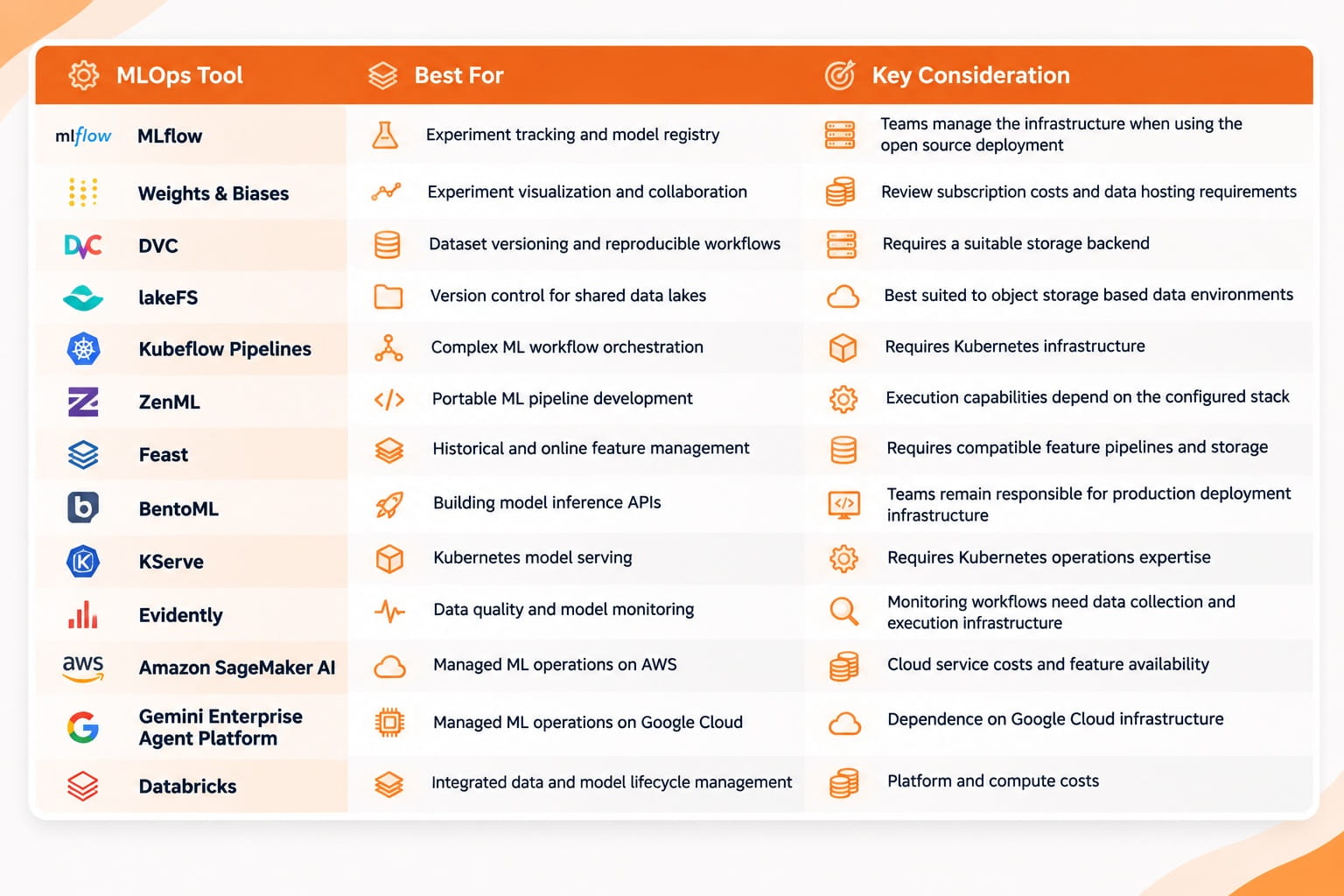
The comparison highlights a fundamental distinction: these products do not all compete in the same category.
MLflow and Weights & Biases overlap in experiment management. Kubeflow Pipelines and ZenML address workflow orchestration. Feast solves a different problem involving feature access.
A team can combine tools from these categories, but it should avoid adding multiple products to perform the same responsibility without a clear technical reason.
Open Source vs. Managed MLOps Tools
Open source MLOps tools provide access to software that teams can deploy and maintain within their own infrastructure.
MLflow, DVC, Kubeflow, Feast, and BentoML are examples of tools with open source components.
Their main advantage is control over deployment architecture, integrations, and infrastructure choices.
However, open source does not mean zero operating cost.
The organization remains responsible for computing resources, storage, upgrades, security, availability, and system maintenance.
Managed MLOps platforms shift part of that infrastructure responsibility to a service provider.
SageMaker AI, Gemini Enterprise Agent Platform, and Databricks provide managed capabilities that reduce the need to operate individual platform components.
The tradeoff is service pricing, platform specific configurations, and dependence on the provider's infrastructure.
For teams without dedicated platform engineers, the cost of maintaining an open source stack can exceed the cost of a managed solution.
We would compare the two approaches based on total operating requirements rather than software licensing alone.
Choosing the Right MLOps Stack
An MLOps stack is the combination of tools responsible for managing a machine learning system.
The strongest stack is not the one containing the most products. It is the one where each component has a clear purpose and integrates with the existing workflow.
Small Teams and Early ML Projects
A small team developing its first production model does not need a complex collection of platforms.
A practical starting point is MLflow for experiment tracking, Git for source control, DVC when dataset versioning is required, and an established CI/CD service for automated validation.
BentoML can be added when the model needs a dedicated inference API.
This approach keeps infrastructure manageable and gives the team room to introduce additional tools when a specific requirement appears.
For teams already using a managed cloud environment, the corresponding managed services offer another route with fewer independently maintained components.
Growing Machine Learning Teams
As the number of models increases, shared infrastructure becomes more valuable.
A growing team can use MLflow or W&B for experiment management and introduce ZenML to coordinate repeatable training workflows.
Evidently can support evaluation and monitoring when production data and model behavior need regular inspection.
Feast becomes relevant if multiple models depend on shared features requiring historical retrieval or rapid online access.
These additions should follow measurable operational needs. Introducing a Feature Store before the team has a feature consistency problem creates an extra component without a corresponding benefit.
Teams Using Kubernetes
For organizations already operating Kubernetes, Kubeflow Pipelines provides a way to coordinate containerized ML workflows.
KServe can manage model inference services within the same infrastructure environment.
MLflow can provide experiment tracking and model registration, while separate data management and monitoring tools fill the remaining requirements.
This combination offers infrastructure control but requires engineers capable of maintaining Kubernetes workloads, storage, networking, and access permissions.
It is a poor starting point for a team that does not already have the required operational expertise.
Enterprise Teams with Existing Cloud Platforms
Organizations that already depend on AWS, Google Cloud, or Databricks should first evaluate the ML capabilities available within their existing environment.
Using the same cloud ecosystem can simplify identity management, data access, logging, and operational governance.
A separate specialist tool is justified when the managed platform does not meet a specific requirement.
For example, an organization can use a managed training platform while adopting a dedicated experiment analysis or monitoring tool.
The final architecture should document which system owns each model artifact, approval record, and production service.
MLOps Tools Pricing and Total Cost
MLOps software costs extend beyond subscriptions and infrastructure licenses.
For open source deployments, the main expenses include computing resources, storage, engineering maintenance, security, and backups.
For managed platforms, costs can include training jobs, inference endpoints, pipeline execution, storage, data transfer, and commercial subscription charges.
Some tools also charge according to users, usage volume, or advanced collaboration features.
Pricing models differ between vendors and change over time, so a fixed price comparison cannot replace an estimate based on the actual workload.
A useful cost evaluation should account for:
Training frequency: How many models are trained and how frequently jobs run.
Compute requirements: CPU, GPU, memory, and execution duration.
Data storage: Dataset versions, model artifacts, logs, and retention periods.
Production inference: Request volume, latency requirements, and infrastructure availability.
Engineering maintenance: Time spent managing integrations, upgrades, and operational incidents.
A tool with no licensing fee can still be the more expensive choice if maintaining it requires substantial engineering resources.
The cost comparison should use the same workload assumptions for every candidate platform.
Building a Practical MLOps Stack
Consider a subscription business operating a customer churn prediction model.
The team needs to maintain training datasets, compare experiments, automate model training, publish approved model versions, and identify changes in production data.
A suitable stack could combine DVC, MLflow, ZenML, BentoML, and Evidently.
DVC tracks the training dataset references and their relationship with the source code.
MLflow records training experiments and manages the approved model artifacts.
ZenML coordinates the processing, training, and evaluation steps.
BentoML packages the selected model as an inference service.
Evidently evaluates data quality and monitors changes in production inputs and model outputs.
This architecture gives each tool a defined responsibility.
However, it is not a requirement to deploy all five products.
If the model runs only through scheduled batch predictions, a dedicated online serving framework can be unnecessary. If training data is already versioned reliably within a managed data platform, introducing DVC can duplicate an existing function.
The selection process should begin with the requirements of the application and the capabilities already available.
Evaluating MLOps Tool Integrations
Before committing to a stack, the team should confirm that its components can exchange the required data and metadata.
A training pipeline must identify the dataset used for execution. The experiment tracker must preserve the resulting metrics and artifacts. The release system must retrieve the exact model version approved for production.
These relationships matter more than whether two products appear together on an integration list.
A proof of concept should verify the complete workflow using a representative model:
Run a training job with a controlled dataset.
Record the parameters, evaluation results, and model artifact.
Register the approved model version.
Deliver that exact artifact to the target environment.
Capture production information needed for evaluation and investigation.
The workflow should also be tested when a stage fails.
If the training job succeeds but artifact registration fails, the system needs a defined recovery process. If deployment validation rejects a model, the current production version must remain available.
These tests reveal whether the selected tools form a reliable operational system rather than a collection of disconnected services.
Selecting MLOps Tools for Long Term Use
The best MLOps tools solve the problems that already exist in a team's machine learning workflow.
MLflow and W&B address experiment management. DVC and lakeFS manage data versions. Kubeflow and ZenML coordinate pipelines. Feast provides feature management, while BentoML and KServe support inference.
Managed platforms such as SageMaker AI, Gemini Enterprise Agent Platform, and Databricks provide broader environments for organizations that want integrated infrastructure.
The selection should be based on technical requirements, integration quality, operating costs, and team expertise.
A smaller stack with well defined responsibilities is more valuable than a larger collection of tools that duplicates work and makes model operations difficult to maintain.
FAQ
Can we move from one experiment tracking tool to another without losing our results?
Yes, provided the source platform allows the required records and artifacts to be exported. The migration must preserve model identifiers, parameters, metrics, artifact locations, and relevant metadata. Historical experiment relationships should be verified before the original system is retired. Export support does not guarantee that every visualization or platform specific feature will transfer.
Do we need GPUs to run MLOps tools?
No. Experiment trackers, registries, workflow controllers, and data validation services can operate on CPU infrastructure. GPUs are required only when the training or inference workload needs GPU acceleration. The orchestration tool itself does not determine whether GPU resources are necessary.
Can we keep our training data on private servers?
Yes. Tools that support local or private infrastructure deployments can operate within an organization's approved network. The team must verify where artifacts, metadata, logs, and telemetry are stored. Some commercial services offer private deployment options, while others require data or metadata to be transmitted to vendor managed infrastructure.
Can the same MLOps tools handle traditional ML and large language models?
Several tools support both workloads, including MLflow, Weights & Biases, and ZenML. Large language model applications also introduce requirements such as prompt evaluation, tracing, token usage analysis, and response quality assessment. These capabilities must be evaluated separately because traditional classification or regression metrics do not cover the full behavior of generative applications.
Who should control access to model releases in an MLOps platform?
Release permissions should follow defined engineering and governance responsibilities. Developers can submit model candidates, automated systems can execute validation checks, and authorized reviewers can approve production releases. The platform should retain records showing who approved a version, which checks passed, and which artifact was deployed. Production credentials should remain separate from general development access.

Fatemeh Jahangard
Technology & AI Writer at PinerookFatemeh Jahangard covers AI, emerging technologies, and digital innovation for Pinerook, focusing on how technology shapes startups and industries.
 Seen first.