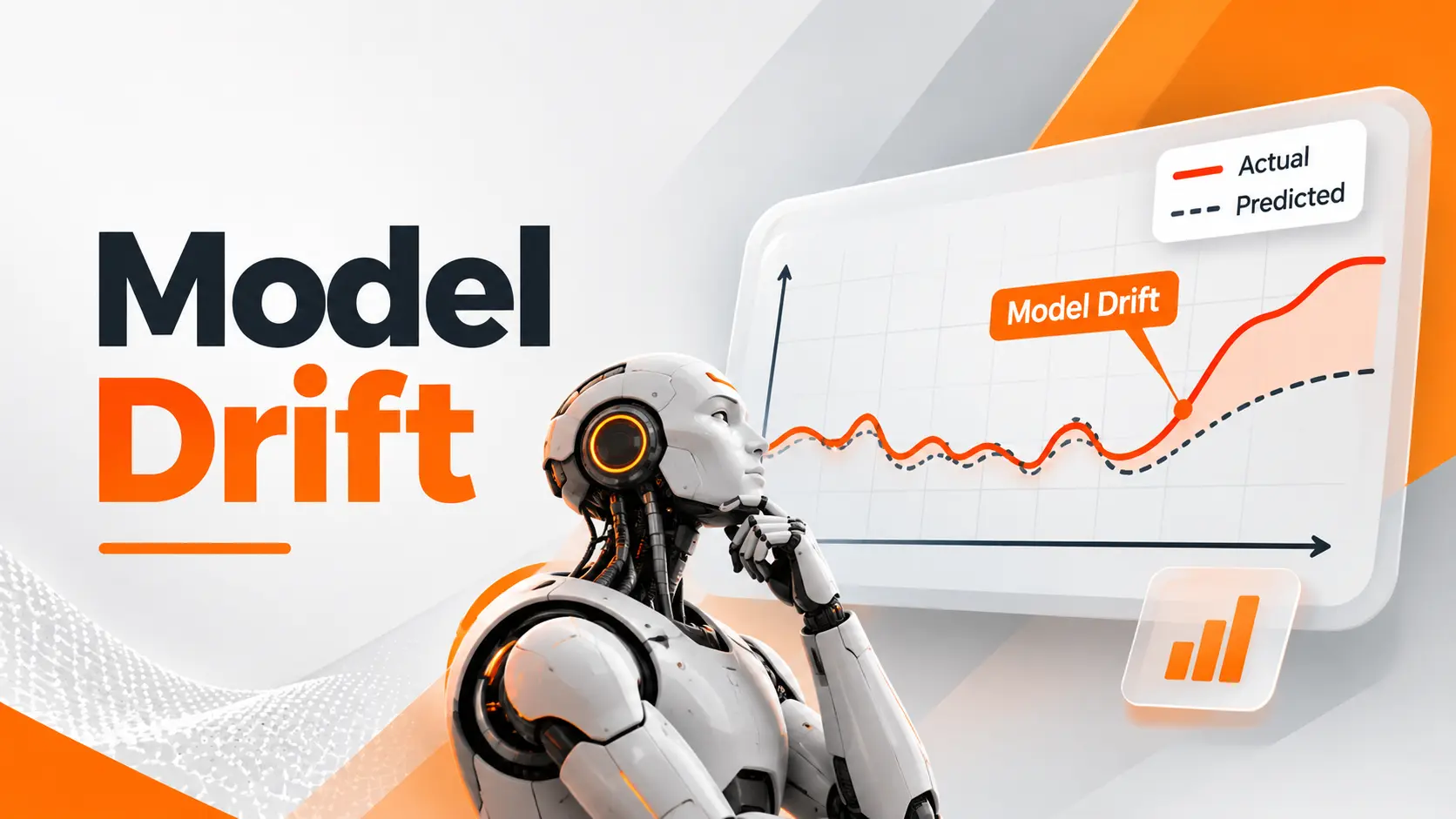
A machine learning model can deliver accurate predictions today and become unreliable months later, even when its code remains unchanged. Model Drift describes changes in production data, prediction patterns, or learned relationships that affect how a model behaves over time. When those changes reduce predictive performance, the result is also known as model decay.
The key is understanding what has changed before attempting to fix the model. Within MLOps, I approach drift as a diagnostic problem: identify the change, verify its effect on predictions, and determine whether the solution belongs in the data pipeline, the model, or the business rules.
A shift in production data is not automatically a decline in model accuracy. That distinction is essential when deciding whether a model needs to be updated.
Causes of Model Drift
Machine learning models learn patterns from historical data. Their predictions depend on how closely those learned patterns represent the conditions they encounter after deployment.
When the environment changes, the relationships captured during training can become less relevant to current predictions.
Changes in Customer Behavior
Consider a model trained to predict customer purchases using browsing activity, purchase history, and product preferences.
If a retailer changes its pricing strategy, customers can respond differently to the same recommendations. The model continues applying relationships learned from previous behavior, even though those relationships no longer describe current purchasing decisions.
Changes in customer preferences, economic conditions, and product demand can all alter the information a model needs to make accurate predictions.
Changes in Production Data
New data sources, customer segments, or business processes can change the distribution of model inputs.
A credit risk model trained on one customer population, for example, faces a different prediction environment when a lender expands into a new market.
The important question is whether the model has learned patterns that remain valid for the new population. A distribution change provides evidence of a different input environment, but the effect on accuracy must be evaluated separately.
Changes in Data Processing
A model can also appear to drift because the production data pipeline no longer produces the same features used during training.
Imagine a financial model that receives monthly income values in dollars during training. A later system update changes the incoming values to another currency without applying the required conversion.
The model has not forgotten its original patterns. Its inputs have become inconsistent with its training conditions.
I would investigate data transformations and feature definitions before treating this situation as evidence that the model needs retraining.
Types of Model Drift
Understanding the different types of drift makes it easier to distinguish a change in data from a change in the model's actual predictive ability.
The terminology is not completely standardized across machine learning platforms. I separate the main concepts by identifying which distribution or relationship has changed.
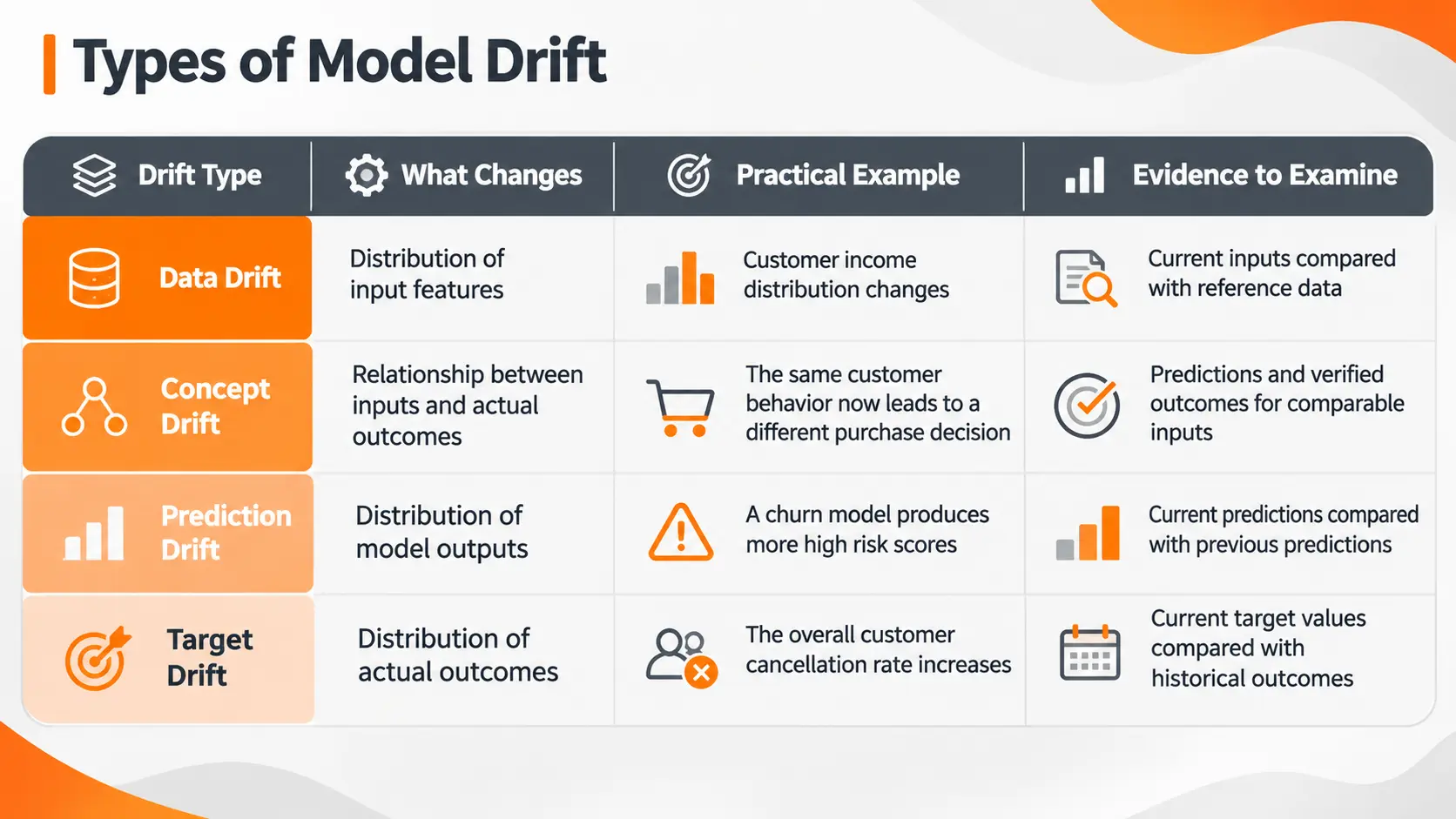
Data Drift vs. Model Drift
Data Drift refers specifically to changes in the distribution of input features. It is one possible source of model performance problems, but it does not prove that a model has become inaccurate.
For example, a demand forecasting model might receive higher transaction volumes during a holiday season. If the model was trained to handle those conditions and its predictions remain accurate, the input distribution has changed without causing model decay.
Model Drift is used more broadly to describe changes affecting model behavior or predictive reliability.
The distinction matters because retraining a model in response to every detected input shift introduces unnecessary work without establishing that the existing model has failed.
Concept Drift
Concept Drift occurs when the relationship between input features and the correct prediction changes.
A fraud detection model provides a useful example. Fraudsters change their behavior to avoid previously effective detection methods. Transactions that once appeared legitimate under the learned patterns can now require a different classification.
Even if the distributions of individual input features remain stable, the relationship between those features and fraudulent activity can change.
This makes Concept Drift particularly important to investigate when prediction accuracy declines without an obvious shift in incoming data.
Prediction Drift and Model Decay
Prediction Drift identifies changes in the model's output distribution.
A customer churn model that previously classified 10% of customers as high risk might begin classifying 20% as high risk. This is a measurable change in predictions, but it does not establish that the predictions are incorrect.
The underlying customer population might have changed, or the model might be responding to unreliable inputs.
Model Decay refers to deterioration in predictive performance. Establishing that deterioration requires comparing predictions with trustworthy outcomes using appropriate evaluation metrics.
Model Drift Detection Methods
I begin drift detection by comparing the current model environment with a reliable reference period. The comparison should use consistent feature definitions, compatible data processing, and records identifying the relevant model version.
Different statistical methods answer different questions. No single test establishes every form of drift.
Kolmogorov Smirnov Test
The Kolmogorov Smirnov test compares the distributions of two numerical samples.
It measures the maximum difference between their empirical cumulative distribution functions. This makes it useful for detecting changes in numerical features such as transaction amounts, customer ages, or account balances.
A statistically significant result provides evidence of a distribution difference. It does not measure the business impact of that difference or prove that model accuracy has declined.
Population Stability Index
Population Stability Index, or PSI, measures changes between two distributions using values grouped into bins.
It is widely used in credit risk and model monitoring applications to compare feature distributions or model scores across different periods.
A larger PSI indicates a greater distribution difference. However, the interpretation depends on the binning method, sample characteristics, and the feature being evaluated.
I would not use a universal PSI threshold as an automatic instruction to retrain a model.
Wasserstein Distance
Wasserstein Distance measures the distance between probability distributions.
For numerical features, it provides a way to quantify how far the distribution has shifted, rather than relying only on whether a statistical test identifies a difference.
Its value depends on the scale of the measured feature. Comparing Wasserstein scores across features with different units requires appropriate normalization or separate interpretation.
Detecting Changes in Model Accuracy
Statistical distribution tests cannot establish Concept Drift on their own.
When verified outcomes are available, I compare current model performance with an appropriate historical reference. For classification, this includes metrics such as precision, recall, and calibration. For regression, prediction error provides direct evidence of changes in quality.
I also examine performance within relevant customer groups and operating conditions. A stable aggregate metric can conceal deterioration in a segment that matters to the business.
A decline in performance is evidence that the system needs investigation. Identifying Concept Drift requires further analysis of whether the underlying relationship between inputs and outcomes has changed.
Detecting Model Drift Without Ground Truth
Production systems do not always receive the correct outcome immediately after generating a prediction.
A customer churn model, for example, might predict whether someone will cancel a subscription within the next 30 days. Until that observation period ends, the actual outcome remains unknown.
During that period, drift analysis can examine changes in feature distributions, prediction scores, missing values, and relationships among available inputs.
These measurements help identify unfamiliar production conditions. They do not prove a loss of predictive accuracy.
For decisions involving delayed outcomes, I would preserve the information needed to match each prediction with its eventual result. Once those outcomes are available, the team can evaluate actual performance for the corresponding prediction period.
This prevents a change in model outputs from being mistaken for evidence that the model itself has failed.
Model Drift in Practice: Customer Churn Prediction
Consider a subscription business using a machine learning model to predict customer cancellations.
The model was trained before the company introduced a new pricing structure. Its historical features include account age, monthly spending, product usage, and customer support activity.
After the pricing change, the company notices that its cancellation predictions no longer reflect actual customer behavior.
Assume the model continues predicting an 8% cancellation rate, while the observed cancellation rate reaches 13% after the full evaluation period.
That difference indicates a prediction problem, but it does not yet explain the cause.
I would investigate the situation in three stages.
First, examine the input data. The new pricing structure can change monthly spending, customer segments, and usage patterns. Comparing these features with the training data identifies the changes the model is encountering.
Second, investigate the relationship between inputs and cancellations. If customers with comparable usage and account characteristics now cancel at higher rates, the relationship the model learned has changed. This supports a Concept Drift diagnosis.
Third, evaluate the model against verified outcomes. Matching predictions with actual cancellations reveals whether the model's error, ranking ability, or probability calibration has deteriorated.
At this point, the team has enough evidence to select a response based on the cause rather than the initial change in cancellation rates.
This is the distinction I consider most important: observing Model Drift is the beginning of an investigation, not the final diagnosis.
Managing Model Drift
Once the cause has been established, the next decision is whether the existing model can remain in production or needs an update.
The response should address the specific failure identified during evaluation.
Correcting Data Problems
If the change originates from missing features, inconsistent transformations, or incorrect source data, the first action is to repair the data pipeline.
Retraining with corrupted data would reproduce the problem rather than solve it.
After correcting the inputs, the model should be evaluated again under the restored production conditions.
Model Recalibration
A classification model can continue ranking observations effectively while producing probability estimates that no longer match observed frequencies.
In that situation, recalibration can improve probability estimates without requiring a complete redesign of the underlying prediction model.
The recalibration method must be validated using representative, labeled data. It should not be assumed to correct a loss of the model's ability to distinguish between classes.
Model Retraining
Retraining becomes appropriate when verified evidence shows that the existing model no longer captures the relationships required for accurate predictions and suitable updated training data is available.
New training data should represent the conditions the model is expected to encounter.
The resulting model must then be compared with the existing version using independent evaluation data and relevant business requirements. Better performance on recent training records is not sufficient evidence for release.
Model Replacement
A substantial change in the prediction problem can require more than updating an existing model.
New features, a revised target definition, or a different model architecture can be necessary when the original design no longer supports the business requirements.
I would treat this as a new model development decision rather than forcing the existing architecture to address a fundamentally different problem.
Model Drift Patterns Over Time
Drift does not follow a single timeline. The speed and pattern of change provide information about its possible cause.
Sudden Drift occurs when a distribution or relationship changes sharply. A major pricing update, regulatory change, or data processing failure can create this pattern.
Gradual Drift develops as the production environment changes over time. Customer preferences and market conditions can evolve without a single event explaining the transition.
Recurring Drift appears when previously observed conditions return. Seasonal demand patterns provide an example, as customer behavior during holiday periods differs from other parts of the year.
Incremental Drift describes a continuing movement from one relationship or distribution toward another.
Recognizing these patterns helps determine whether the appropriate response involves a permanent model update, improved data processing, or a strategy for handling recurring operating conditions.
Model Drift Detection Tools
Several machine learning platforms provide statistical methods and operational features for investigating drift.
Evidently AI supports distribution comparisons, drift reports, and data quality evaluations. It provides a practical way to examine changes between reference and production datasets.
Arize AI offers capabilities for investigating changes in model inputs, predictions, and production performance. It supports analysis across different features and model behavior.
Azure Machine Learning provides model monitoring capabilities that include data drift and prediction drift signals. These features compare production information with configured reference data.
I would choose a tool based on the available data, model architecture, supported statistical methods, and the investigation requirements.
A drift score alone is not enough to justify replacing a model. The tool must provide evidence that supports a technically sound decision.
Maintaining Reliable Models as Conditions Change
Model Drift becomes a problem when changes in production conditions make learned patterns less useful for current predictions.
The most important decision is not how quickly a team can retrain a model, but whether it has identified what changed and established how that change affects predictive quality.
I would prioritize reliable reference data, appropriate statistical tests, verified outcomes, and a clear evaluation process before introducing a new model version.
A model should be updated because the evidence supports a better solution, not simply because its inputs or predictions look different from the past.
FAQ A
Can my model drift even if I haven't changed its code at all?
Yes. A model can experience drift without changes to its code, weights, or configuration. The production environment and the relationship between inputs and outcomes can change independently of the model. The system continues applying its learned patterns to conditions that differ from those represented during training.
Can I check drift when my dataset is really small?
Yes, but statistical conclusions become less reliable when the available sample is insufficient. Small datasets reduce the ability of statistical tests to detect meaningful changes and can produce unstable estimates. The analysis should account for sample size, statistical uncertainty, and the practical significance of the observed difference.
What if my model's predictions actually change how users behave?
This creates a feedback loop in which model predictions influence the data collected for future evaluation. For example, a recommendation system changes which products customers see, affecting subsequent interactions. Evaluating these systems requires accounting for the influence of previous model decisions on observed outcomes.
Can I check Model Drift if I'm using an external AI API?
Yes. An application can compare the inputs it sends, the outputs it receives, and verified outcomes without access to the provider's internal model parameters. The analysis should also record available model version information because provider updates can change behavior independently of changes in the application's data.
Do I have to store all my old customer data to compare drift?
No. Historical distribution summaries, approved reference samples, and aggregate statistics can support certain forms of drift analysis without retaining every original record. The required information depends on the selected detection method. Data retention must also comply with applicable privacy and security requirements.

Fatemeh Jahangard
Technology & AI Writer at PinerookFatemeh Jahangard covers AI, emerging technologies, and digital innovation for Pinerook, focusing on how technology shapes startups and industries.
 Seen first.