
At an early-stage startup, architecture is not an abstract engineering preference. It determines whether a small team can release a fix today, whether a routine incident consumes its week, and how much money remains for learning what customers need. The monolith vs microservices for startups debate belongs inside a broader technology strategy for startups discussion: decide what the business needs to change quickly, then choose the system the current team can actually operate. For many startups still testing demand, that points toward a well-structured monolith rather than a network of services built for growth that has not yet arrived.
Microservices can be the right choice when independently scaled workloads, frequent releases across multiple teams, or strong isolation requirements justify the extra coordination. The decision is less about which design is more modern and more about what problem the company can name, measure, and afford to solve.
Two Architectures, Two Kinds of Complexity
A monolith packages an application into one deployable system. It may contain separate modules for accounts, billing, reporting, and other features, but those modules are normally released together. A good monolith is not one enormous function or an excuse for tangled code. It can have clear boundaries, tests, and ownership while keeping communication within the application instead of moving it across a network.
Microservices split business capabilities into independently deployed services, typically communicating through APIs or messages. A team might update its billing service without redeploying the customer dashboard. Some workloads can be scaled without scaling the rest of the application. That independence is valuable, but it shifts complexity from the codebase into coordination between services, deployments, databases, and teams.
How the Trade-offs Look for a Startup
The comparison changes with company size. The same architecture that helps four engineering teams avoid stepping on one another can distract four engineers who are still reshaping the product every week. The table below focuses on the questions a founder can use during an actual planning discussion rather than architectural preferences.
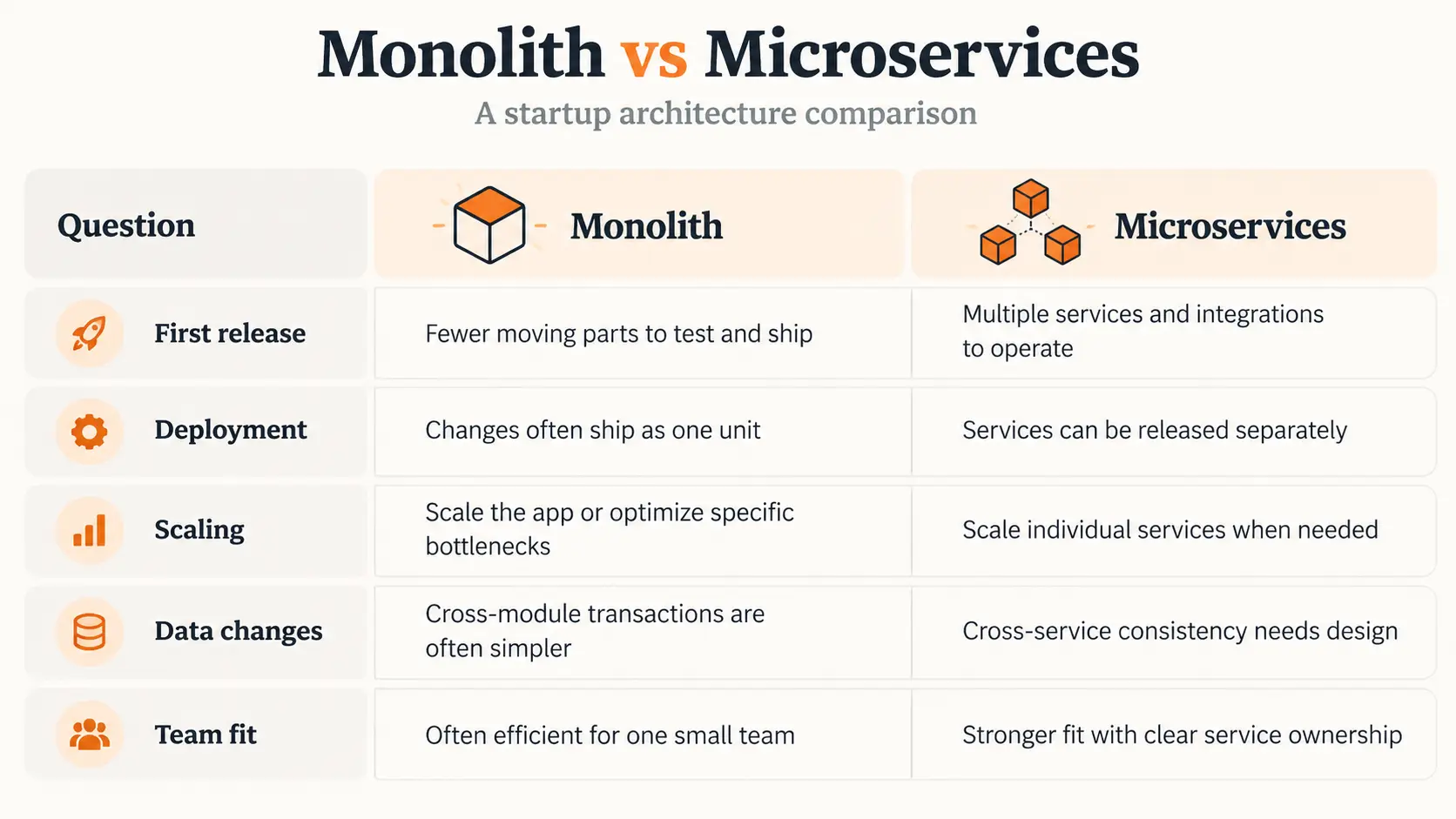
A monolith can still serve heavy traffic, and microservices are not automatically faster. Where performance is the concern, profile the actual bottleneck before choosing a structural rewrite.
The Operating Cost Beyond the Cloud Bill
A microservices design can appear inexpensive when each service is small. The real cost is the work required to make them behave like one dependable product. A user request might cross authentication, subscriptions, and notifications. Engineers then need to trace failures across several components, manage API changes, control permissions between services, and understand why one database has updated while another has not.
Those are manageable engineering problems, but they require skills and routines: reliable deployment pipelines, monitoring, alerting, logging, clear service ownership, and incident response. If the same two developers build features, answer support tickets, and operate the platform, that overhead competes directly with product work. More services also create more integration points where a seemingly small change can break an unrelated workflow.
The monolith has costs of its own. A careless one can develop tight coupling, long test cycles, and risky releases. However, founders should compare an organized monolith with an organized microservices system, not a neglected monolith with an idealized distributed architecture.
A Subscription Product at Two Different Stages
Consider a startup selling subscription software to independent retailers. At launch, its account settings, invoicing, customer reports, and email notifications change together as the founders learn what stores will pay for. One deployable application lets a small team ship a revised onboarding flow, fix billing logic, and inspect related data without coordinating three releases. A modular monolith is a reasonable starting point.
Two years later, imagine the company has thousands of retailers, a dedicated billing team, and a reporting workload that spikes at month-end. The reporting jobs consume resources that affect core checkout activity, while billing changes now have a separate release schedule. Splitting reporting into a background worker or service may relieve the actual bottleneck; isolating billing might make sense once its ownership and data boundaries are stable.
Neither growth nor a larger customer count automatically requires converting the whole application. Database indexing, caching, queues, and scaling the existing application can often extend a monolith substantially. The important point is to isolate the function creating the constraint, rather than turning every feature into a service.
When a Service Split Earns Its Complexity
A migration becomes more defensible when the team repeatedly faces a measurable problem that simpler changes have failed to resolve. Strong signals include a workload with fundamentally different scaling needs, teams blocked by a shared release process, or a business capability that needs a distinct security or reliability boundary. A service with clear inputs, outputs, and accountable ownership is a safer candidate than functionality whose rules change together with everything around it.
Before splitting a component, estimate the work beyond the first deployment. Who will own the new service at 2 a.m.? How will data remain correct if another service is unavailable? Can the team test an end-to-end customer journey and roll back a release safely? If those answers are vague, the architecture may be moving faster than the organization.
A limited extraction is usually easier to evaluate than a full rewrite. Pick a boundary, define a measurable goal such as reduced deployment interference or lower resource contention, and check whether the operational costs remain acceptable after release.
Build for Change Without Premature Distribution
Starting with a monolith does not require ignoring the future. Organize code around business capabilities instead of generic technical layers, keep module interfaces explicit, and prevent unrelated parts of the application from writing directly into one another’s data. Automated tests, useful logs, documented dependencies, and a repeatable deployment process pay off whichever architecture follows.
Founders should also preserve the ability to change the decision. A modular system can support a later service extraction, although separation is not effortless when data and workflows have become tightly intertwined. The goal is to keep those dependencies visible while the business learns where its boundaries really are.
For a small startup, the default is usually simple: choose the architecture the current team can maintain while it discovers a viable business. Revisit that decision when release delays, reliability incidents, or resource limits show that the cost of staying together now exceeds the cost of separating. Architecture should follow evidence from the product and the team.
FAQ
Should an MVP use microservices?
Usually not unless its requirements clearly demand independent services from the outset. An MVP benefits from short feedback cycles, simple deployments, and fewer operational dependencies.
Can a monolith scale to many users?
Yes. A well-designed monolith can scale through better database queries, caching, background jobs, and additional application instances. User count alone does not determine the right architecture.
Is a modular monolith the same as microservices?
No. A modular monolith has clear internal boundaries but is generally deployed as one application. Microservices place those boundaries across separately deployed components, adding network and operational responsibilities.

Mohsen Avid
Founder & Editor, PinerookMohsen Avid is the founder of Pinerook, covering entrepreneurship, startup strategy, digital business, and the decisions behind building new ventures.
 Seen first.