
Negotiating with investors can shape a startup's future long after a funding round closes. The capital may help founders expand their team, improve their product, or reach new customers, but the agreement also determines how ownership, financial returns, and important business decisions will be handled. A financing offer that looks attractive at first can create complications if its terms are not properly understood.
Many founders concentrate on obtaining the highest possible valuation. Although valuation matters, it represents only one part of an investment agreement. Liquidation preferences, board representation, employee option pools, and investor approval rights can influence the actual financial and operational consequences of accepting capital. Two investors may offer similar amounts of money while proposing substantially different arrangements.
Successful negotiating with investors therefore requires preparation, commercial judgment, and a clear understanding of the company's priorities. Founders need to recognize which conditions are reasonable, which terms deserve closer examination, and when a proposed investment may create more problems than it solves.
A well developed Fundraising Strategy establishes how much capital the business needs and what that investment should accomplish. Negotiation determines whether the available financing supports those objectives under terms that remain appropriate as the company develops.
What Does Negotiating With Investors Mean?
Investor negotiation is the process of discussing and agreeing on the financial, contractual, and governance conditions attached to a proposed investment. It normally becomes more detailed once an investor has developed serious interest in a startup and is considering how to structure a financing commitment.
The discussion may involve company valuation, investment amount, shareholder rights, liquidation preferences, board composition, information requirements, and conditions that must be satisfied before the transaction closes. Not every investment involves all these provisions, and their significance depends on the financing instrument and the company's existing ownership structure.
A startup raising capital through a SAFE may face a different set of negotiations from one completing a priced equity round with preferred shares. Convertible notes can introduce additional considerations involving interest, maturity, and conversion conditions.
Founders should not approach these discussions as an attempt to win every contractual point. Investors provide capital while accepting significant business risks, so some protections may be commercially reasonable. The challenge is determining whether those protections are proportionate and whether their consequences are compatible with the startup's future plans.
The strongest outcome is an agreement that provides useful capital, establishes understandable expectations, and allows the company to operate without unnecessary restrictions.
How Founders Should Prepare for Investor Negotiations
Preparation begins with understanding the company's financial position. Founders should know how much capital the business needs, how long its existing cash will support operations, and which milestones the proposed investment is intended to finance. These details provide a practical basis for evaluating whether an offer meets the company's requirements.
Financial information must also be accurate and consistent. Investors may examine revenue, operating expenses, customer concentration, existing liabilities, and future spending assumptions. If management cannot explain important figures, negotiations may become dominated by questions about the reliability of the business information.
The capitalization table deserves particular attention. Founders should understand the ownership held by existing shareholders, outstanding SAFEs or convertible notes, employee equity commitments, and any rights granted in earlier financing rounds. These arrangements can affect both the ownership created by a new investment and the terms that existing investors must approve.
Preparation also involves identifying negotiating priorities. A startup may place particular importance on preserving operational authority, maintaining flexibility for future financing, or limiting dilution. Another company may need to secure a larger amount of capital even if doing so requires accepting a lower valuation.
Founders should distinguish terms they consider essential from those where compromise is possible. This helps prevent minor disagreements from consuming attention that would be better spent on provisions with significant financial or governance consequences.
Understand What Investors Want From the Agreement
Investment negotiations become more productive when founders understand why an investor is requesting particular terms. Most provisions reflect some combination of financial return expectations, risk management, governance requirements, and the investor's responsibilities to the capital providers they represent.
For example, a venture capital firm may request information rights because it needs reliable updates about the performance of its portfolio companies. It may also require approval rights over certain major corporate actions to protect against decisions that could materially change its investment.
These requests are not automatically unreasonable. However, their scope matters. Requiring investor approval before selling the company is different from requiring consent for routine hiring decisions or ordinary operating expenses.
Similarly, an investor requesting a larger employee option pool may be concerned about the startup's ability to recruit employees. Instead of accepting the proposed increase without discussion, founders can examine the company's actual hiring plan and determine whether the requested pool is justified.
Understanding the concern behind a proposed term creates room for alternatives. The investor may be willing to accept a narrower approval right, a different economic structure, or a condition that addresses a specific risk without placing unnecessary restrictions on the company.
A productive negotiation focuses on the substance of the disagreement rather than assuming that every investor request must be rejected or accepted in full.
Investment Terms Every Startup Founder Should Understand
Investment agreements contain several provisions that can influence the company's economics and governance. Some determine how ownership is allocated, while others affect decision making or the distribution of proceeds if the business is eventually sold.
Founders should understand the purpose of these provisions before evaluating a term sheet. The following framework identifies important considerations without suggesting that every financing requires the same contractual structure.
Key Investment Terms Founders Should Evaluate
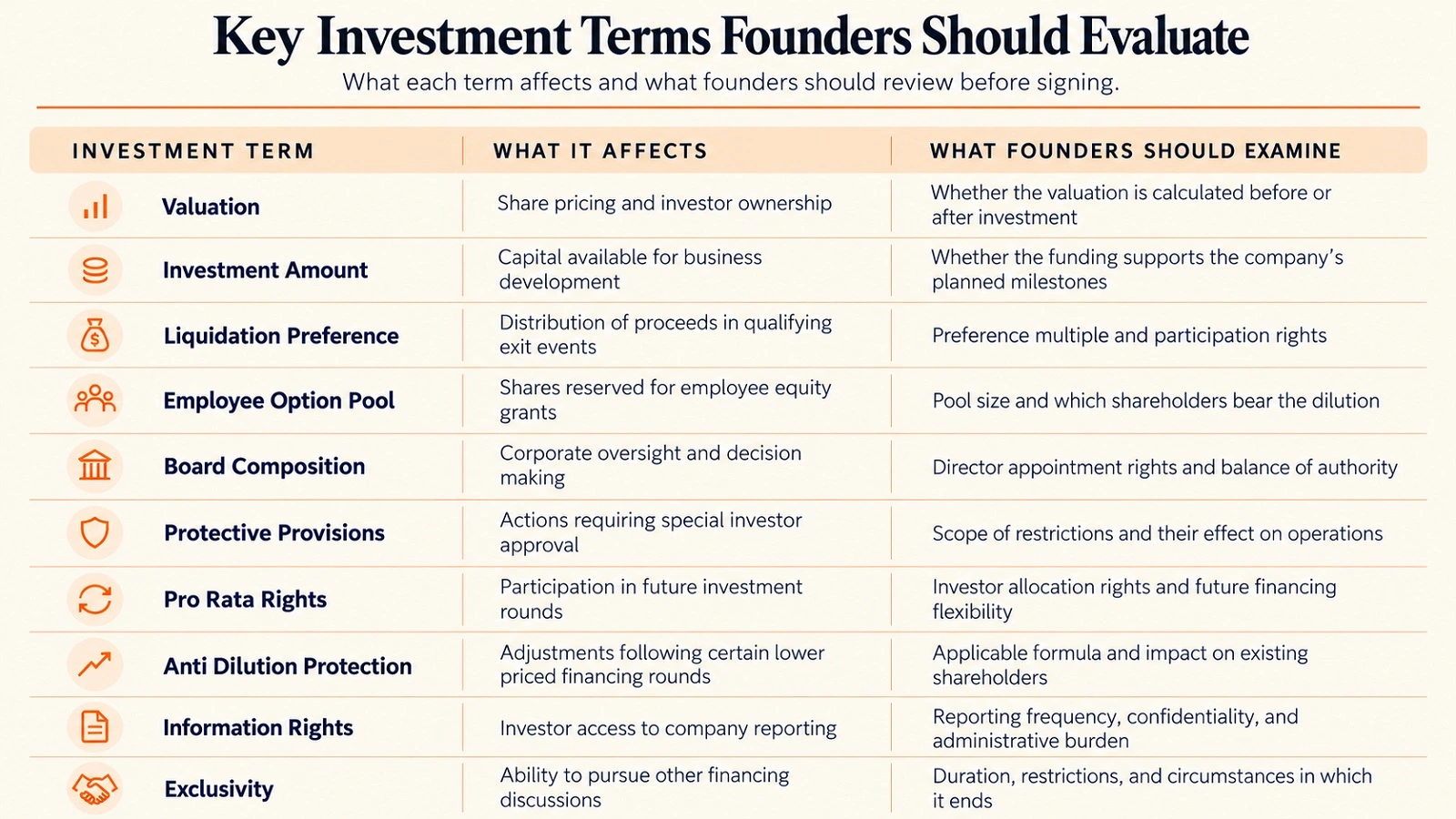
The importance of these provisions depends on how they interact. A favorable valuation may be less attractive if the transaction includes significant economic preferences or extensive restrictions on future decisions.
Founders should also recognize that the same contractual term may have different consequences depending on the company's existing agreements. For this reason, important provisions should be evaluated using the actual capitalization structure and qualified legal advice.
Negotiating Valuation Without Focusing Only on Price
Valuation directly influences how much equity a startup issues in exchange for investment, making it one of the most visible subjects in financing negotiations. In a straightforward priced equity round, a higher pre money valuation generally allows the company to raise a fixed amount of capital while issuing a smaller ownership percentage.
Suppose a startup plans to raise $2 million. At an $8 million pre money valuation, the post money valuation would be $10 million, giving the new investor 20% ownership under simplified assumptions. If the pre money valuation were $10 million instead, the investor would receive approximately 16.67%.
The difference is meaningful, but founders should not assume that the second proposal is automatically better. Other contractual provisions may influence the proceeds available to shareholders, the company's ability to make important decisions, and the dilution associated with future financing.
A defensible valuation argument should be supported by the startup's business performance, customer evidence, market opportunity, and financial assumptions. Founders can explain why a proposed price better reflects their commercial progress rather than relying only on comparisons with unrelated funding announcements.
It is also important to consider the amount being raised. Accepting less capital to preserve ownership may create financial problems if the startup cannot fund the milestones needed to support its next stage of development.
The objective is to negotiate an appropriate relationship between valuation, capital requirements, and the company's realistic growth prospects.
Why Liquidation Preferences Matter
Liquidation preferences determine how certain shareholders receive proceeds when a qualifying sale or other specified event occurs. They can create financial outcomes that differ from what simple ownership percentages suggest.
A common distinction is between participating and nonparticipating preferred shares.
Under a 1x nonparticipating liquidation preference, an investor generally receives either the applicable preference amount or the proceeds available through conversion into common shares, whichever is more favorable under the agreement.
Participating preferred shares may allow the investor to receive the preference amount and then share in the remaining proceeds. The exact result depends on whether participation is capped and how the relevant documents define distributions.
Consider a simplified example involving a startup with one investor who contributed $2 million and owns 20% on an as converted basis. Assume the company is sold for $6 million, with no debt, transaction expenses, or other securities affecting distribution.
With a 1x nonparticipating preference, the investor would receive $2 million because that exceeds the $1.2 million associated with holding 20% of the proceeds as common equity. The remaining $4 million would be distributed to the other shareholders.
With an uncapped 1x participating preference, the investor could receive the initial $2 million and then participate in 20% of the remaining $4 million. This would produce $2.8 million for the investor and leave $3.2 million for the other shareholders.
Both arrangements can begin with the same investment amount and ownership percentage, yet produce different results.
Founders should examine several possible exit values before accepting a preference structure. The actual distribution depends on the complete capitalization table and contractual provisions, so simplified examples should not replace a transaction specific financial model.
Protecting Governance and Founder Decision Making
An investment agreement can affect how important corporate decisions are made, even when founders continue to own a substantial percentage of the business.
Board composition is particularly important. Investors may request the right to appoint a director or participate in selecting independent board members. These arrangements influence oversight and can affect decisions involving company leadership, strategy, financing, and major transactions.
Founders should understand not only how many directors each party appoints, but also how decisions are approved and whether particular rights depend on continued employment or ownership.
Protective provisions introduce another layer of control. They may require specified investor approval for issuing certain securities, changing corporate documents, selling the company, or taking on substantial debt.
Such protections can serve legitimate purposes, but overly broad provisions may interfere with routine operations or complicate later fundraising.
If an investor requests approval over business activities that management considers ordinary operating decisions, founders should ask which risk the restriction is intended to address. A narrower provision may provide appropriate protection without creating unnecessary administrative barriers.
The goal is not to eliminate investor oversight. It is to establish clear responsibilities and decision making arrangements that allow the company to function effectively while protecting legitimate shareholder interests.
Employee Option Pools and Future Investment Rights
Employee option pools can significantly influence the economic result of an investment agreement. A startup may reserve equity to recruit employees, retain important team members, and support long term compensation arrangements.
Investors sometimes require the company to create or expand this reserve before completing financing. When the increase is included in the pre money capitalization, existing shareholders generally bear the dilution associated with the expansion before the new investor's ownership is calculated.
That means two offers with the same headline valuation can produce different ownership outcomes if they treat the option pool differently.
Founders should connect the proposed pool size to a realistic hiring plan. An appropriate reserve can help the business grow, but an unnecessarily large expansion may create additional dilution without reflecting actual recruitment requirements.
Future participation rights also deserve attention. Pro rata provisions may allow certain investors to acquire additional shares in later financing rounds to maintain a specified ownership position, subject to the agreement.
These rights can support continuing investor relationships, but founders should understand how they might affect the allocation of shares to future investors.
Anti dilution provisions may create additional adjustments following certain future financing transactions. Their effects depend on the specific formula and circumstances.
A complete capitalization model should reflect these arrangements before founders compare the economic consequences of different offers.
Comparing Two Investor Offers
A practical way to evaluate financing proposals is to compare the terms together rather than rank investors solely by valuation.
Consider a hypothetical startup receiving two offers for a $2 million priced equity investment. The simplified ownership calculations below exclude the effects of any option pool expansion or other capitalization adjustments.
Comparing Investor Offers and Their Tradeoffs
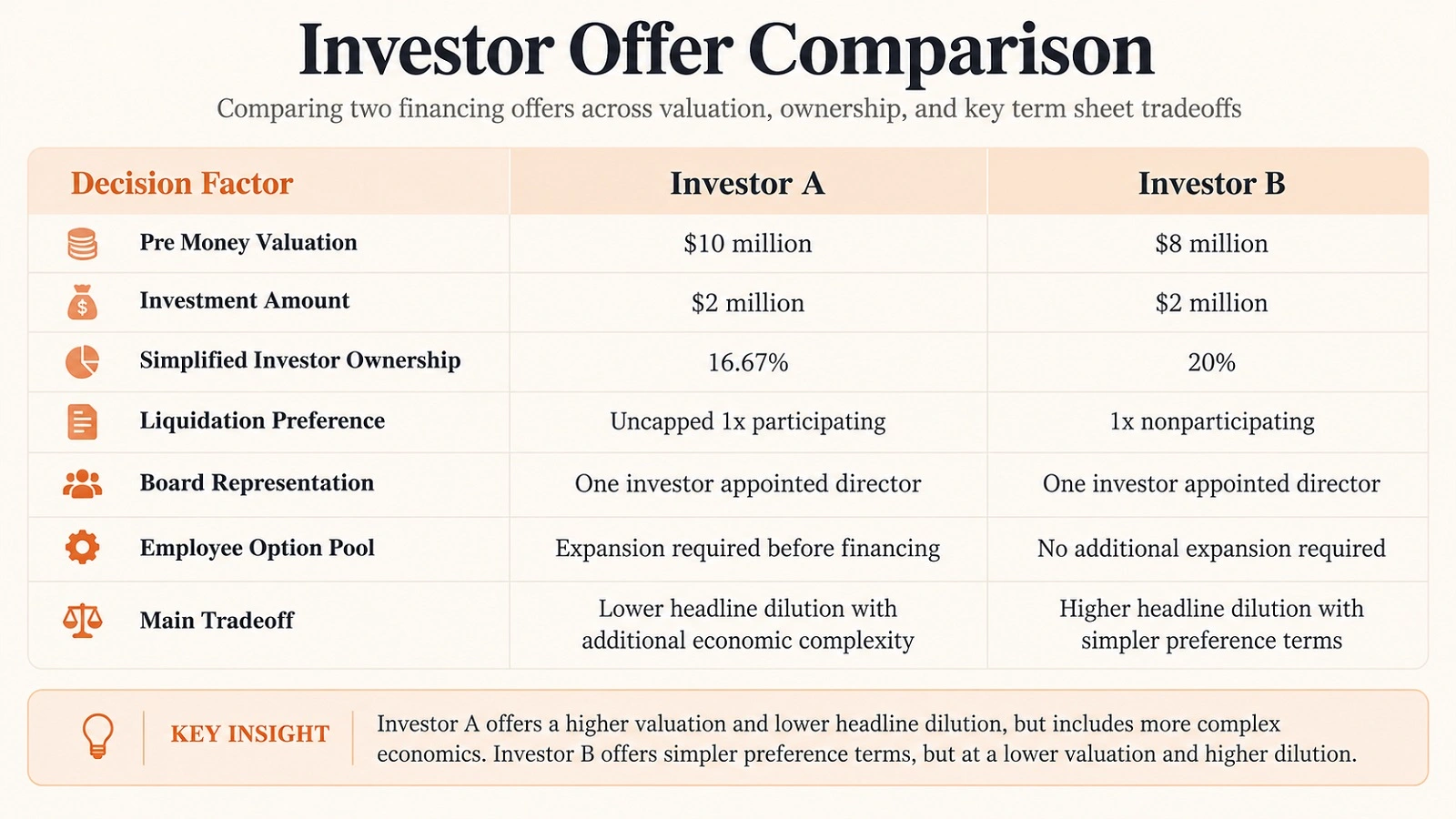
Investor A offers a higher valuation, which initially appears attractive to existing shareholders. However, the participating liquidation preference could increase that investor's proceeds in certain exit scenarios. The required option pool expansion could also change the ownership percentages shown in the simplified calculation.
Investor B offers a lower valuation but proposes a nonparticipating preference and no additional pool expansion. Depending on the company's circumstances, these terms may be preferable despite the higher initial dilution.
Neither proposal can be declared superior using this information alone. The founders would also need to assess governance arrangements, investor credibility, closing conditions, the company's financing requirements, and the full economic consequences of each offer.
The important lesson is that investment proposals must be evaluated as complete arrangements. Valuation provides useful information, but it does not determine the quality of the transaction by itself.
How to Respond to an Investor's First Offer
Founders should avoid treating the first term sheet as something that must be accepted or rejected immediately. A better response begins with understanding the proposal and identifying the terms that require clarification.
If an offer includes an unfamiliar liquidation preference, the founder should ask how it would affect proceeds under different transaction outcomes. If the option pool requirement appears excessive, management can explain its planned hiring needs and request a more appropriate reserve.
A constructive negotiation focuses on a limited number of material concerns and explains why changing them would support a more workable financing relationship.
For example, a founder might respond:
"We appreciate your interest in the company and believe there is a strong fit with your investment approach. Before moving forward, we would like to discuss the liquidation preference and proposed option pool expansion. Our priority is to establish a structure that supports future hiring while keeping the economics clear for all shareholders. Could we review those terms together?"
This response does not accuse the investor of proposing an unfair arrangement. It identifies specific issues, explains the business rationale, and creates a basis for further discussion.
Founders should also avoid making commitments during a meeting before understanding their implications. It is reasonable to request time to review an unfamiliar provision with legal or financial advisors.
Good negotiation depends on responding deliberately, not on having an immediate answer to every proposed term.
Building Negotiating Leverage Without Misleading Investors
A startup's negotiating position depends partly on its available alternatives. Founders with strong commercial evidence, sufficient runway, and genuine interest from several suitable investors may have greater flexibility to consider competing proposals.
That flexibility can help the company decline restrictive conditions or continue discussions until an appropriate arrangement becomes available.
However, founders should never invent competing offers or imply that financing commitments exist when they do not. Misrepresenting investor interest can damage credibility and introduce serious problems during later evaluation.
Business performance provides a more reliable foundation for negotiation. Verified customer growth, strong retention, technical progress, or clear commercial milestones may help investors understand why the company deserves favorable consideration.
Maintaining adequate runway is also important. A business facing an immediate cash shortage may find it difficult to reject unsuitable terms, even when management recognizes the problems they could create.
Founders should evaluate investor relationships beyond financial capacity. Relevant industry experience, a constructive working style, and realistic expectations can contribute significant value to the business.
Negotiating leverage is most useful when it provides the freedom to make informed choices rather than pressure another party into an immediate decision.
Term Sheets, Exclusivity, and Closing Conditions
A term sheet summarizes the principal conditions of a proposed investment. It provides a framework for preparing definitive financing documents and helps both parties identify material points of agreement.
Many provisions in a venture financing term sheet are intended to be nonbinding until final agreements are completed. However, certain sections, such as confidentiality, exclusivity, and expenses, may create binding obligations depending on their wording and applicable law.
Founders should therefore read the entire document carefully rather than assume that a term sheet has no legal consequences.
Exclusivity provisions deserve particular attention because they may restrict the startup from pursuing alternative financing discussions for a specified period. Founders should understand the duration, scope, and consequences of these restrictions before agreeing.
A lengthy exclusivity period can create pressure if an investor delays its decision while the company continues consuming cash. The appropriate arrangement depends on the transaction, the investor's requirements, and the company's financial circumstances.
A signed term sheet also does not mean financing has been completed. Detailed due diligence, corporate approvals, legal documentation, and satisfaction of closing conditions may still be necessary.
Founders should distinguish proposed financing from capital that is actually available for operations. Until the transaction has closed and the funds have been received according to the agreement, the startup may still face financing uncertainty.
When Should Founders Push Back or Decline an Offer?
Founders should be willing to question provisions that create material financial consequences or interfere unnecessarily with business operations. The objective is to understand the investor's concern and determine whether an alternative structure could address it.
A broad approval right over routine management decisions, for example, may deserve reconsideration if narrower restrictions would adequately protect the investor. Similarly, an unusually complex liquidation preference may justify a discussion about simpler economic terms.
Not every disagreement requires rejecting an investment. Some provisions can be clarified, narrowed, or balanced through changes elsewhere in the agreement.
However, founders should recognize when material conflicts remain unresolved. An investor may have expectations about governance, growth, or future financing that are fundamentally inconsistent with the company's plans.
Declining an offer can be difficult when the startup has limited financial runway. That is why negotiation preparation should begin before the business faces an immediate liquidity problem.
The decision to proceed should consider the financing amount, ownership effects, contractual obligations, investor relationship, and available alternatives. Qualified legal and financial advice is especially important when the proposed provisions are unfamiliar or unusually restrictive.
The purpose is to reach an agreement the company can operate under, not simply close a financing round as quickly as possible.
Common Mistakes Founders Make During Investor Negotiations
One common mistake is concentrating entirely on valuation. Founders may negotiate extensively over a relatively small change in ownership while overlooking liquidation preferences, governance rights, or option pool requirements with greater long term consequences.
Another is entering negotiations without an accurate capitalization table. Outstanding convertible instruments, earlier investment agreements, and employee equity commitments can change how a new financing affects existing shareholders.
Unsupported claims can also weaken a founder's negotiating position. Exaggerating revenue, overstating customer demand, or inventing competing offers creates unnecessary credibility risks.
Some founders accept unfamiliar contractual provisions because they assume those provisions are standard. Others reject legitimate investor protections without trying to understand their purpose. Both approaches can prevent constructive negotiation.
Delaying legal review is another avoidable problem. If qualified counsel becomes involved only after the principal terms appear settled, the company may discover important concerns at a point when changes are more difficult to discuss.
Finally, founders may approach the negotiation as an adversarial contest rather than the beginning of a long term relationship. A financing agreement establishes responsibilities that can continue for years, so clear communication and realistic expectations matter beyond the closing date.
The strongest approach combines preparation, careful review, and an understanding of which terms genuinely affect the company's future.
Securing Investment Terms That Support Startup Growth
Negotiating with investors is not simply about obtaining the highest valuation or minimizing immediate dilution. It is about reaching an agreement that provides sufficient capital while establishing appropriate financial and governance arrangements.
Founders should understand how the proposed investment affects existing shareholders, what economic protections investors will receive, and which corporate decisions may require additional approval.
They should also consider the relationship itself. A suitable investor can provide capital while maintaining expectations that support the company's development and allow management to make necessary operating decisions.
A productive negotiation begins with accurate company information, continues through clear questions and reasonable counterproposals, and concludes only when the founders understand the agreement's material consequences.
The best financing outcome is one that supports meaningful business progress without creating restrictions or financial obligations that the startup cannot reasonably sustain.
FAQ
How should startup founders negotiate with investors?
Founders should begin by understanding their capital requirements, ownership structure, financial position, and negotiating priorities. They should evaluate valuation alongside liquidation preferences, governance rights, option pool provisions, and other material terms. Clear communication, reasoned counterproposals, and qualified legal advice help founders assess whether an investment supports the company's interests.
Which investment terms are most important to negotiate?
Important terms can include valuation, liquidation preferences, employee option pool treatment, board composition, protective provisions, future financing rights, and exclusivity. Their significance depends on the transaction structure and existing company agreements. Founders should assess how the provisions work together rather than negotiate each one without considering the others.
Is a higher valuation always better for startup founders?
No. A higher valuation generally reduces immediate dilution for a fixed equity investment under otherwise equivalent terms, but liquidation preferences, governance rights, and option pool adjustments can change the overall outcome. Founders should compare the complete economic and contractual consequences of competing offers.
Can founders negotiate the terms of a term sheet?
Yes. Proposed term sheet provisions can often be discussed before the parties reach a final agreement. However, the flexibility available depends on the investor, financing structure, and negotiating circumstances. Founders should understand whether any provisions are binding and obtain appropriate legal advice before signing.
When should a startup founder reject an investment offer?
A founder may decide not to proceed when the agreement creates unacceptable economic consequences, excessive governance restrictions, unresolved legal risks, or a substantial mismatch between the investor's expectations and the company's needs. The decision should consider the startup's financial runway, available alternatives, and the long term effects of accepting the investment.

Mobina Khanki
Venture & Funding Writer at PinerookMobina Khanki covers venture capital, startup funding, fundraising, and startup finance for Pinerook, focusing on founders and investors.
 Seen first.