
An option pool is a reserve of company shares set aside for future equity awards to employees and other eligible service providers. For startups, it creates room to recruit people without negotiating a new share allocation every time someone joins. However, setting aside these shares also affects ownership calculations, and the size of the reserve can become an important negotiating point during fundraising.
Within Cap Table and Startup Equity, the option pool connects a company's hiring plans with its ownership structure. Founders may begin with a clear division of shares between themselves, but creating a reserve for future employees changes their percentages on a fully diluted basis. When investors require that reserve to be expanded before a financing round, the effect can be larger than founders initially expect.
The central question is not simply how much equity a startup should reserve. It is how much the business realistically needs, when those shares should be included in the ownership calculation, and who absorbs the resulting dilution. This guide explains those decisions through practical hiring budgets and a financing example that compares different ways of structuring the reserve.
Understanding an Employee Option Pool
An employee option pool is a portion of a company's capitalization reserved for equity awards. Although its name refers to stock options, the underlying equity incentive plan may also support other permitted awards, including restricted stock or restricted stock units.
The reserve helps a startup plan future compensation. A founder preparing to hire engineers, product specialists, and commercial leaders can estimate the equity required for those positions and establish sufficient capacity before making individual grants.
Importantly, shares reserved for employees are not necessarily shares that employees already own. A company might reserve one million shares but have issued no awards from that reserve. The reserved amount can still appear in its fully diluted capitalization model even though it does not represent an existing shareholder.
An option pool therefore serves two purposes. Operationally, it supports recruitment and retention. Financially, it creates potential future ownership that must be considered when evaluating the interests of founders, employees, and investors.
How the Option Pool Works
A startup generally establishes an equity incentive plan and allocates a specified number of shares for eligible awards. The required approvals depend on the company's legal structure, governing documents, and applicable law. In a typical US venture backed corporation, creating the plan or increasing its share reserve may require board and shareholder approval.
Once the plan is established, the company can grant awards according to its terms. Each grant should identify the relevant security, number of shares, exercise price where applicable, and conditions governing the award.
The distinction between reserved, granted, vested, and issued shares matters. Reserving shares creates capacity for future grants. Granting stock options gives a recipient contractual rights, while vesting and exercise determine when those rights can be exercised and when actual shares may be issued.
For example, assume a company reserves 1,000,000 shares and subsequently grants options covering 200,000 shares. If those options come from the existing reserve, the company would have 800,000 shares remaining for future grants, assuming no other awards or adjustments. The 200,000 options are outstanding awards, while the remaining 800,000 shares are unallocated.
In a fully diluted calculation that already included the entire original reserve, moving shares from the unallocated portion into outstanding option grants does not by itself increase the total denominator. The company has changed the allocation of existing capacity rather than creating additional capacity.
Why Startups Create an Equity Reserve
Young companies often compete for experienced employees while managing limited cash resources. Offering a potential ownership interest can help attract candidates who might otherwise prefer the higher immediate salaries available at established businesses.
An equity reserve can also support retention. Employees who receive awards subject to service conditions may have an incentive to remain with the company as it develops. However, the effectiveness of those incentives depends on the terms of the award and whether employees believe the company has a credible opportunity to create value.
For management, establishing a reserve creates a clearer framework for compensation decisions. Instead of negotiating ownership separately for every role without considering the combined effect, founders can develop a budget for future grants.
The reserve also gives investors a better understanding of the company's hiring strategy. A funding proposal that includes plans to expand the engineering and sales teams should account for the equity those hires are expected to receive.
A larger pool is not automatically better. Reserving more shares than the company needs can unnecessarily reduce founders' modeled ownership, particularly if investors require the additional reserve to be included before their financing is priced.
How Large an Option Pool Should Be
Many early stage startups use employee equity reserves representing approximately 10% to 15% of fully diluted capitalization. These percentages are useful reference points, but they are not universal requirements. A company with an established team and limited hiring needs may require less capacity than a business planning substantial recruitment.
The appropriate size depends on the number of expected hires, the seniority of the positions, the company's compensation strategy, and the period the reserve is intended to cover. Founders should also consider whether existing employees may receive additional awards and whether advisers or other eligible service providers will participate.
A practical starting point is a hiring plan covering approximately 12 to 18 months. This period can be adjusted to reflect the company's expected financing timeline and operating plans.
The company should estimate potential equity grants for each planned role, add reasonable capacity for retention awards, and consider a buffer for changes in hiring requirements. This produces a more defensible reserve than selecting a percentage solely because it is frequently mentioned in financing discussions.
Calculating an Option Pool From the Hiring Plan
Consider Orion Analytics, a fictional software startup preparing to raise capital and expand its team. Management expects to recruit a senior engineering leader, several engineers, product specialists, and commercial employees during the next 18 months.
The company wants an unallocated reserve equal to 10% of fully diluted capitalization immediately after its financing round. Rather than assuming that every share will be awarded, it prepares a proposed hiring budget to determine how that reserve could be used.
The percentages below are illustrative allocations measured against the company's fully diluted capitalization immediately after financing. They are not industry compensation benchmarks or recommendations for actual employee grants.
The proposed grants and retention allocation account for 7.8 percentage points of the company's fully diluted capitalization. The remaining 2.2 percentage points provide additional capacity if hiring needs change or the company decides to increase selected awards.
This approach connects the reserve to specific business requirements. The company can explain why shares are needed and demonstrate which portions are intended for recruitment, retention, and future flexibility.
The budget also shows why simply applying the same percentage to every startup can be misleading. Orion Analytics has relatively substantial technical hiring needs. A company that already employs a complete engineering team may arrive at a smaller required reserve using the same method.
Because the percentages are expressed relative to capitalization immediately after financing, a subsequent funding round could change their equivalent percentages if the company issues additional shares. Individual grant approvals and the actual number of securities awarded would need to reflect the capitalization and terms in effect at the relevant time.
Option Pool Size and Fully Diluted Ownership
The impact of an equity reserve becomes clearer when founders compare outstanding shares with fully diluted capitalization.
Suppose a startup has 9 million outstanding shares, all held by its founders, and reserves another 1 million shares for employee awards. The company has not yet issued any employee options or shares from that reserve.
The founders own 100% of outstanding shares. However, their combined ownership represents 90% of a simplified fully diluted capitalization containing 10 million shares, including the unallocated reserve.
This difference does not mean that employees already hold the remaining 10%. It means the ownership model has accounted for the potential issuance of shares from the reserve.
The distinction becomes especially important during fundraising because investors commonly evaluate their proposed ownership against a defined fully diluted capitalization. Founders need to understand exactly which options, warrants, reserved shares, and convertible securities are included in that definition.
The Difference Between Pre Money and Post Money Option Pools
The timing of an equity reserve increase affects who bears the dilution associated with it.
When an investor requires the reserve to be created or expanded within the capitalization used to calculate the pre investment share price, existing shareholders generally bear the dilution associated with that increase. The incoming investor purchases shares using a price that already reflects the expanded reserve.
A different arrangement is to price the financing first and create or increase the reserve afterward. In that case, the subsequent addition of reserve shares can dilute the new investor alongside existing shareholders.
Both arrangements may be possible, but their economic outcomes differ. The definitions in the term sheet determine how the reserve is treated, not simply the order in which documents are signed.
Founders should pay particular attention to requirements that specify a target unallocated reserve as a percentage of fully diluted capitalization immediately after the financing. Such provisions can require more shares to be created before closing than the requested percentage initially suggests.
A Practical Example of Founder Dilution
Return to Orion Analytics and assume its two founders currently own all 10 million outstanding shares. Founder A holds 6 million shares, representing 60%, while Founder B holds 4 million shares, representing 40%.
The company is negotiating a $2 million investment at an agreed pre investment valuation of $8 million. The financing therefore implies a $10 million post investment valuation before considering any separate adjustments. The new investor would receive 20% under a standard primary financing model without a subsequent reserve increase.
Now assume Orion Analytics wants an unallocated reserve equal to 10% of fully diluted capitalization after financing. There are two different ways to negotiate the timing of the reserve.
Under the first arrangement, the required reserve is included before the investment is priced. Under the second arrangement, the investment is priced using the existing 10 million shares, and the reserve is added afterward.
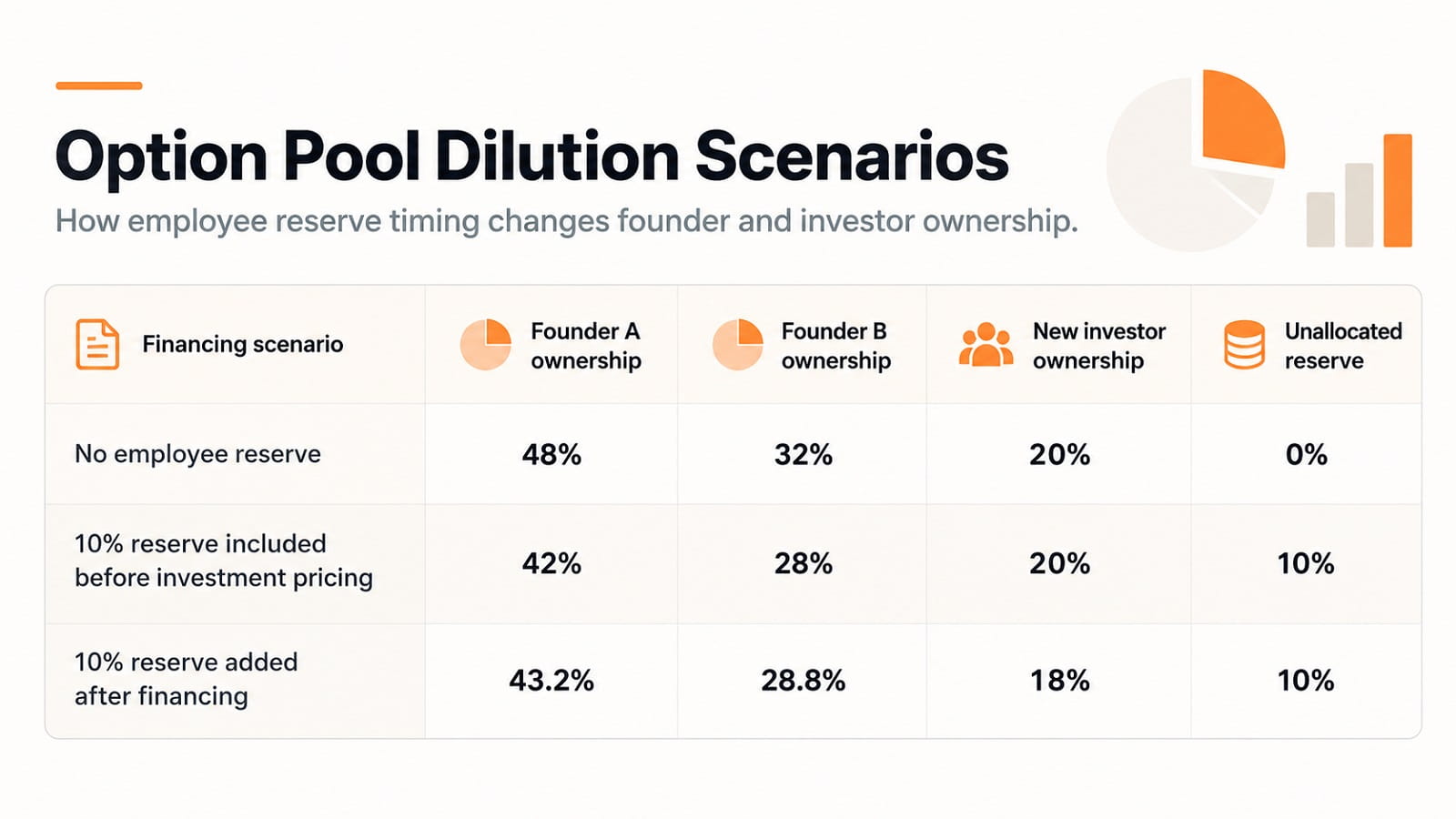
The following table compares these arrangements with a third scenario in which no reserve is created.
The difference is significant even though the company raises the same amount of cash in every scenario. When the reserve is included before investment pricing, the founders retain 70% collectively and the investor receives 20%. When the reserve is added after financing, the founders retain 72% collectively and the investor's ownership decreases to 18%.
In both reserve scenarios, the company ends with 10% allocated to future employee awards. The difference is how the ownership reduction is distributed between the founders and the incoming investor.
The third scenario assumes the investor agrees to share the dilution from the reserve created after financing. An investor who requires a final ownership stake of 20% would generally negotiate different terms rather than accept the 18% outcome.
The example illustrates why the percentage allocated to employees cannot be evaluated independently from the financing structure. A term sheet that specifies an attractive valuation but requires a substantial reserve increase can produce a less favorable ownership outcome for founders than the headline valuation suggests.
Calculating the Shares Required for the Reserve
The Orion Analytics example can also be examined through actual share counts. Before financing, the founders collectively hold 10 million shares, and the company has no unallocated employee reserve.
In the scenario where the investor receives 20% and the unallocated reserve must represent 10% of the post financing capitalization, the founders collectively retain 70%.
The implied fully diluted capitalization is calculated by dividing the founders' existing 10 million shares by 70%.
Total fully diluted shares = 10,000,000 ÷ 0.70 ≈ 14,285,714
Unallocated reserve shares = 14,285,714 × 0.10 ≈ 1,428,571
Investor shares = 14,285,714 × 0.20 ≈ 2,857,143
These figures are rounded to whole shares for illustration. Exact legal share counts and pricing adjustments would be determined in the financing documents.
With an $8 million pre investment valuation applied to approximately 11,428,571 fully diluted shares before the investor's purchase, the illustrative price per share is approximately $0.70.
The investor contributes $2 million and acquires approximately 2,857,143 shares at that price.
If the financing were instead priced before creating the reserve, the initial price would be $0.80 per share. The investor would acquire 2.5 million shares, and the company would subsequently add approximately 1,388,889 reserved shares to bring the unallocated reserve to 10% of the expanded capitalization.
That second calculation produces approximately 13,888,889 fully diluted shares after the reserve addition. The founders collectively hold 72%, the investor holds 18%, and the reserve represents 10%.
The two arrangements use the same headline valuation and financing amount, but the investor's effective ownership and the founders' remaining percentages are different. This is why comparing financing offers requires a modeled capitalization table rather than relying on valuation figures alone.
Understanding the Option Pool Shuffle
The term option pool shuffle describes a common financing negotiation in which investors require a new or expanded employee reserve to be included in the pre investment capitalization used to determine their share price.
The reserve is intended to support future recruitment, but including it in the pre investment share count places the associated dilution on existing shareholders. The new investor's ownership is calculated after accounting for the reserve.
This can make a financing offer economically less attractive to founders than the headline valuation suggests. The company might agree to a substantial valuation while also accepting an employee reserve large enough to reduce the effective value attributed to its existing shares.
However, an increase is not inherently unreasonable. A company preparing for rapid hiring may genuinely need additional equity capacity. The relevant question is whether the requested reserve matches the actual operating plan and whether its treatment in the financing terms is understood.
Founders should evaluate valuation and reserve size together. Negotiating a somewhat smaller reserve supported by credible hiring projections can sometimes preserve more ownership than increasing the headline valuation while accepting an unnecessarily large pool.
Negotiating the Option Pool During Fundraising
A well supported hiring budget is one of the most useful documents founders can bring to an equity reserve negotiation. It provides a business explanation for the requested percentage instead of relying on assumptions about what is standard.
The budget should identify likely hires, expected responsibilities, approximate timing, and proposed equity ranges. Founders can also explain which positions are essential before the next financing event and which can reasonably be delayed.
Existing unallocated capacity should be considered before requesting additional shares. If a company already has enough reserved equity to cover its hiring plan, an investor's proposed increase may deserve further discussion.
Another important consideration is whether the target refers to the total equity incentive plan reserve, including outstanding grants, or only the shares still available for future grants. These definitions can lead to significantly different share counts.
The company should also model the effects of convertible securities and other outstanding rights where relevant. A simplified financing model may not accurately reflect a real transaction when SAFEs, convertible notes, warrants, or existing preferred shares are involved.
Managing Unallocated and Granted Shares
An equity reserve should be maintained as part of the company's ongoing capitalization records. Management needs to distinguish the total capacity approved under the incentive plan from the portion already committed through individual awards.
When an award is granted from the existing reserve, the amount available for future grants generally decreases. Depending on the plan terms, options that expire or are forfeited without being exercised may become available for reallocation.
Other events can affect the reserve differently. Exercising options can result in actual share issuance, while repurchases, cancellations, and certain settlements may receive different treatment under the governing documents.
These distinctions matter when management prepares for another financing round. A company may have substantial historical grant activity but a much smaller amount of unallocated capacity remaining for future hires.
Regular reconciliation helps ensure that the capitalization records reflect approved awards, exercises, cancellations, and changes in share availability. It also reduces the risk of offering equity that the company has not properly authorized or reserved.
Expanding the Option Pool After Hiring Growth
A startup may eventually use most of its available reserve. This can happen when recruitment exceeds the original plan, new executives receive substantial grants, or management introduces additional retention awards.
Expanding the reserve is often described as a pool top up. The company authorizes additional capacity under its equity incentive arrangements, subject to applicable approvals and legal requirements.
The size of the increase should reflect remaining capacity rather than the percentage originally reserved. If the company already has unallocated shares available, those shares may count toward the target reserve specified in a future financing agreement.
A new financing round can complicate the calculation because additional investor shares increase the fully diluted denominator. The percentage represented by the existing reserve may decline even when the company has not granted additional awards.
Founders should evaluate the expected reserve after financing, rather than assuming that the pre financing percentage will remain unchanged. This helps avoid unexpected additional dilution during negotiations.
Equity Reserve Administration and Legal Requirements
Establishing an equity incentive reserve involves more than selecting a percentage. The company needs appropriate corporate authorization, governing plan documents, grant agreements, and accurate ownership records.
In US corporations, option exercise prices and the valuation of common stock may raise issues under Section 409A. Companies commonly rely on appropriate valuation processes when granting stock options, but the legal and tax requirements depend on the circumstances.
Securities laws may also apply to employee equity awards. Certain qualifying US compensatory transactions can fall within the exemption provided by SEC Rule 701, subject to its conditions. International employee arrangements may require additional consideration because local regulations and tax treatment can differ.
Founders should therefore coordinate financing and equity incentive decisions with qualified legal and tax advisers. A properly structured reserve supports operational flexibility while reducing the risk of disputes over ownership or award terms.
Building an Option Pool That Supports Long Term Growth
The most useful option pool is one that reflects the company's actual plans rather than the largest percentage management can justify. A reserve should provide adequate capacity for foreseeable recruitment and retention without unnecessarily transferring ownership away from existing shareholders.
The decision also needs to remain flexible. Changes in hiring strategy, business performance, financing conditions, and employee expectations may alter future equity requirements.
Maintaining a clear hiring budget makes those changes easier to evaluate. Management can compare planned grants with actual commitments and determine whether the remaining capacity is adequate for the period ahead.
For founders, the goal is not to avoid giving employees meaningful ownership opportunities. It is to understand the economic cost of those opportunities and make informed decisions about when new shares should enter the capitalization model.
Final Thoughts
An option pool gives startups a structured way to reserve shares for future employees, but it also affects how company ownership is measured and negotiated. Its size should reflect realistic recruitment needs, retention priorities, and the timing of future financing.
The Orion Analytics example shows that a 10% employee reserve can produce different ownership outcomes depending on whether it is included before investment pricing or created afterward. Even when the investment amount and headline valuation remain unchanged, founders and investors can end up with different percentages.
A carefully planned reserve can support hiring without creating unnecessary dilution. Founders who understand the share calculations, maintain accurate records, and connect equity allocations to their operating plans are better positioned to negotiate financing terms and manage ownership as the company grows.
FAQ
What Is an Option Pool in a Startup?
An option pool is a reserve of company shares designated for future equity awards to employees and other eligible service providers. It provides the company with capacity to make grants as its team develops.
How Big Should a Startup Option Pool Be?
Many early stage startups use reserves of approximately 10% to 15% of fully diluted capitalization. However, the appropriate size should depend on hiring plans, existing equity commitments, and anticipated financing requirements.
Does Creating an Option Pool Dilute Founders?
Creating or expanding an unallocated reserve can reduce founders' percentages on a fully diluted basis. The effect on actual outstanding ownership and the allocation of dilution depend on the securities issued and the financing structure.
Do Employees Own Shares in the Option Pool?
Not automatically. Shares in an unallocated reserve have not necessarily been granted or issued to employees. Employees receive contractual rights or actual shares only through properly authorized awards under the applicable arrangements.
What Is the Difference Between an Option Pool and Stock Options?
An option pool is the capacity reserved for future equity grants. Stock options are individual awards providing recipients with rights to purchase shares under specified conditions.
What Happens When an Option Pool Runs Out?
The company may need to increase its reserve through the required corporate approval process. It should first evaluate outstanding commitments, remaining capacity, and the equity required for future hiring.
What Is a Pre Money Option Pool?
In fundraising, a pre money pool arrangement generally means the reserve increase is included in the capitalization used to price the investment. This commonly places the dilution associated with the increase on existing shareholders rather than the new investor.
What Is a Post Money Option Pool?
A post money pool arrangement generally means the additional reserve is created after the financing has been priced. This can distribute the resulting dilution among both existing shareholders and the incoming investor.
Can Founders Negotiate the Size of an Option Pool?
Yes. Founders can support their proposed reserve with a detailed hiring budget, existing equity commitments, and a credible operating plan. The investor and company must ultimately agree on the relevant financing terms.

Mobina Khanki
Venture & Funding Writer at PinerookMobina Khanki covers venture capital, startup funding, fundraising, and startup finance for Pinerook, focusing on founders and investors.
 Seen first.