Raising capital is an important decision for a startup, but the quality of that decision depends on work completed long before the first investor meeting. Founders need more than an attractive presentation and ambitious growth projections. They need reliable financial information, evidence of business progress, an accurate ownership structure, and a clear explanation of what additional capital will accomplish.
Preparing for a funding round means examining the company as a potential investor would. It requires founders to test their assumptions, organize important documents, evaluate financial requirements, and identify issues that could complicate an investment decision.
A startup may have a promising product and enthusiastic customers yet remain poorly prepared for outside investment. Revenue figures may be inconsistent, equity agreements may be incomplete, or financial projections may not reflect the company's actual operating costs. These problems can delay financing discussions and make it difficult for investors to assess the business.
Effective preparation does not eliminate uncertainty. Early stage companies are expected to face commercial, technical, and financial risks. What matters is whether management understands those risks and can provide credible information about the company's current position.
Within a broader Fundraising Strategy, preparation establishes the foundation for informed financing decisions. This guide explains how founders can assess startup readiness, organize essential records, build an investor data room, and complete the practical work required before entering serious funding discussions.
What Does Preparing for a Funding Round Involve?
Funding round preparation is the process of making a company ready for external investment and the evaluation that accompanies it. The work typically includes business planning, financial analysis, corporate recordkeeping, investor documentation, and internal coordination.
The required level of preparation depends on the business and its development stage. A startup seeking initial seed funding may have limited operating history but meaningful customer research, a working prototype, and a credible product development plan. A company approaching a Series A round may need more extensive evidence of revenue growth, customer retention, financial controls, and repeatable commercial performance.
Founders should therefore avoid treating funding readiness as a universal administrative checklist. The relevant question is whether the company can support the claims it intends to make to investors.
Preparation also requires a distinction between information that is already established and assumptions that remain uncertain. A founder who can explain what has been validated, what is still being tested, and how the proposed financing will address important uncertainties is generally in a stronger position than one relying entirely on optimistic forecasts.
The objective is to create a consistent picture of the business across its presentation, financial model, customer evidence, corporate records, and investment requirements.
Establish a Clear Purpose for the Funding Round
Before estimating how much capital to raise, founders should determine what the investment is expected to achieve.
A startup might need financing to complete product development, validate a commercial model, increase manufacturing capacity, recruit essential employees, or expand into an established market. Each objective introduces different financial requirements and business risks.
For example, a software company that has not yet confirmed customers will pay for its product should not automatically describe the proposed investment as growth capital. Much of the funding may actually be required to establish product demand and identify a workable pricing model.
That distinction matters because investors will evaluate the company according to the progress it has already made and the milestones it intends to achieve next.
Founders should identify specific outcomes rather than relying on broad statements about expansion. A business might aim to complete a commercial product, establish a reliable customer acquisition process, or demonstrate that existing customers continue purchasing over time.
These milestones should be achievable within a realistic operating plan. They should also be meaningful enough to improve the company's commercial position or provide evidence for future financing decisions.
A clearly defined purpose gives the round a practical foundation and helps management distinguish necessary spending from activities that can wait.
Assess the Startup's Current Business Readiness
Investors need to understand what the company has accomplished and what remains uncertain. Preparing for a funding round therefore begins with an objective examination of the startup's progress.
The appropriate evidence depends on the business model. An early software company may demonstrate customer interviews, product usage, paid pilots, or initial subscription revenue. A hardware startup may emphasize prototype testing, manufacturing feasibility, production costs, and technical performance.
A regulated business may need to show progress toward required approvals, while a research focused company may rely on experimental results and evidence that its underlying technology works.
Founders should distinguish between signals of interest and confirmed commercial results. A waiting list is not equivalent to paying customers, and a successful demonstration does not automatically establish repeatable demand.
This distinction should be reflected in the company's investor materials. If the business has completed a pilot with several customers, the presentation should explain what the pilot demonstrated rather than implying that a broader market has already been validated.
An honest readiness assessment should also identify weaknesses. These may include limited retention data, uncertain pricing, reliance on a small number of customers, or an incomplete product.
Recognizing these gaps before investor meetings gives founders an opportunity to gather stronger evidence or explain how the proposed capital will address them.
Prepare Reliable Business Metrics
Performance metrics help investors evaluate whether a startup is progressing toward a sustainable business. However, the metrics must reflect how the company actually operates.
For a subscription software company, investors may examine recurring revenue, customer acquisition costs, churn, retention, gross margin, and changes in customer spending. A marketplace may require information about transaction volume, active participants, repeat transactions, and the revenue earned from each transaction.
Founders should select metrics relevant to their business model rather than collecting impressive figures that provide little insight into commercial performance.
Definitions are particularly important. A company reporting active users should explain what qualifies a user as active. A startup presenting annual recurring revenue should distinguish recurring subscription commitments from temporary services or irregular payments.
The reporting period should also remain consistent. Comparing different customer groups or using changing definitions can create misleading growth trends.
Management should maintain supporting records for important claims. If customer retention has improved, the company should be able to identify the relevant customer cohort, measurement period, and calculation method.
Metrics do not need to present an entirely positive picture. A business may still be developing an effective acquisition strategy or experiencing customer churn. What matters is whether its information is accurate and whether management understands the underlying causes.
Clear reporting demonstrates that founders can evaluate business performance rather than merely describe ambition.
Build an Investor Ready Financial Model
A financial model is one of the most important documents founders should prepare before raising capital. It connects the startup's operating assumptions with expected revenue, expenses, cash consumption, and financing requirements.
The model should begin with reliable historical information where available. Actual revenue, payroll expenses, operating costs, and cash balances provide a more credible foundation than projections developed independently of the company's current position.
Revenue assumptions should reflect how customers are acquired, how much they pay, and whether they continue purchasing. Cost assumptions should include the resources required to deliver the product, support customers, and operate the business.
Hiring plans deserve particular attention. A financial forecast that assumes additional employees will immediately increase revenue may overlook recruitment delays, onboarding costs, and the time needed for new employees to become productive.
Founders should prepare scenarios that test important assumptions. A base case might reflect management's current expectations, while a slower growth case could examine the effect of weaker sales or delayed product delivery.
The model should also explain how changes in spending affect available cash. A company may report increasing revenue while facing liquidity pressure if customer payments arrive later than expenses.
A useful financial model allows founders to answer practical questions. How long can the company operate with its existing resources? What happens if customer acquisition is slower than expected? Which planned expenses can be postponed without undermining essential operations?
The purpose is not to create a precise prediction of the future. It is to make the company's financial assumptions visible and provide a credible basis for decision making.
Calculate How Much Funding the Business Needs
A financing target should follow from the company's planned milestones and financial requirements.
Founders can begin by identifying the activities needed to achieve the next important stage of development. They should estimate the associated costs, consider expected revenue and available cash, and account for reasonable uncertainty.
Suppose a startup currently spends $70,000 more each month than it receives. Management plans to hire additional employees and expects monthly net cash consumption to increase as the team expands.
A funding requirement based only on the current $70,000 figure could underestimate future expenses. The financial model should instead reflect the timing of recruitment, infrastructure costs, product work, and any expected improvements in revenue.
The calculation should also consider the time required to reach meaningful business milestones. If those milestones depend on completing a product and demonstrating customer adoption, the funding plan should support both activities rather than financing only the development phase.
Founders should avoid selecting an investment amount merely because similarly positioned startups have announced comparable rounds.
Different businesses have different cost structures, cash needs, and commercial risks. A capital request becomes more credible when management can explain exactly how the money will be used and why the amount is appropriate.
Review the Capitalization Table and Existing Equity Agreements
A startup's capitalization table provides an overview of its ownership structure. Before seeking investment, founders should confirm that it accurately reflects the company's shareholders, equity holdings, and relevant financing instruments.
This review becomes particularly important when a startup has previously issued employee options, accepted convertible financing, or entered into agreements that may affect future ownership.
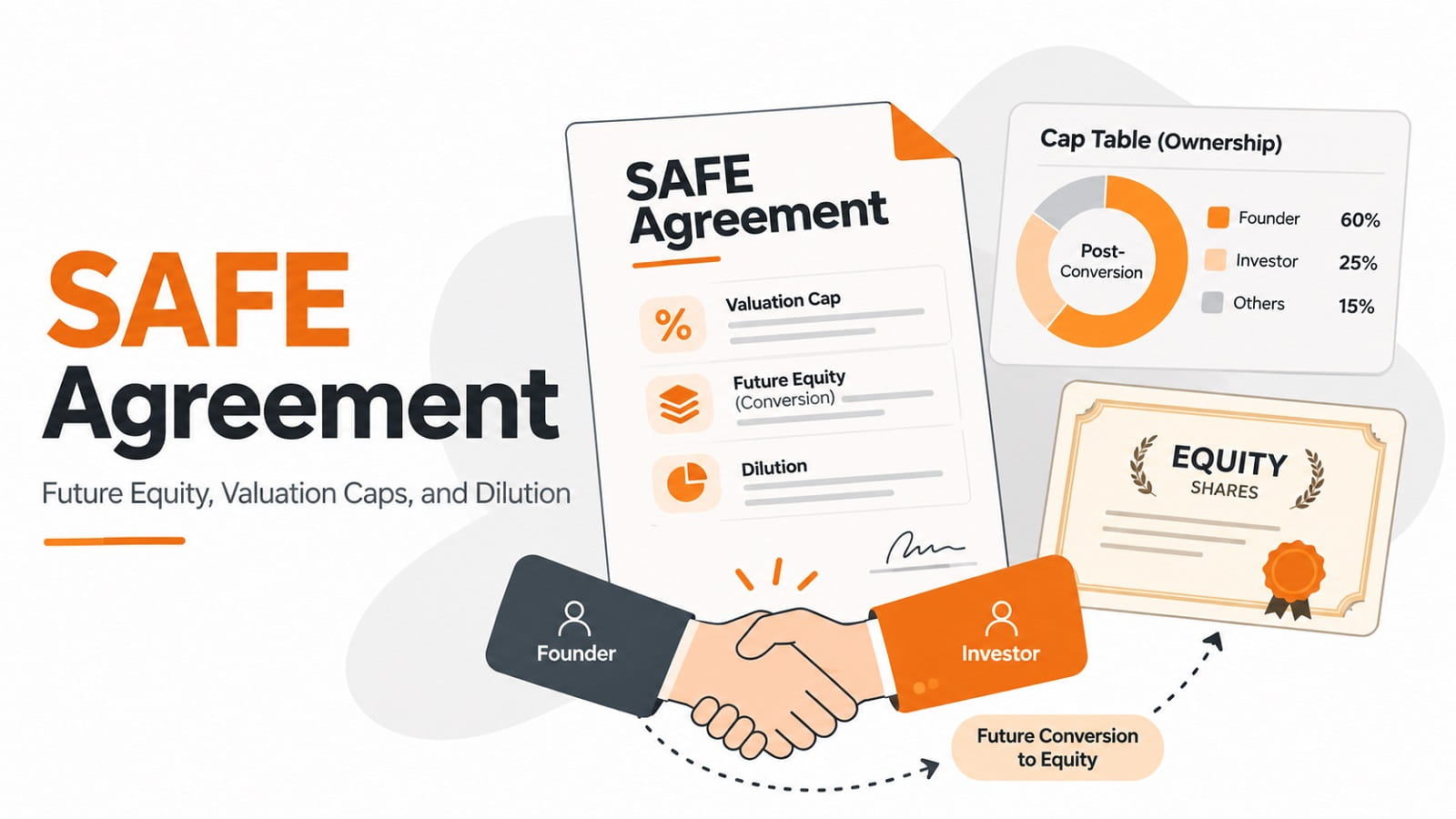
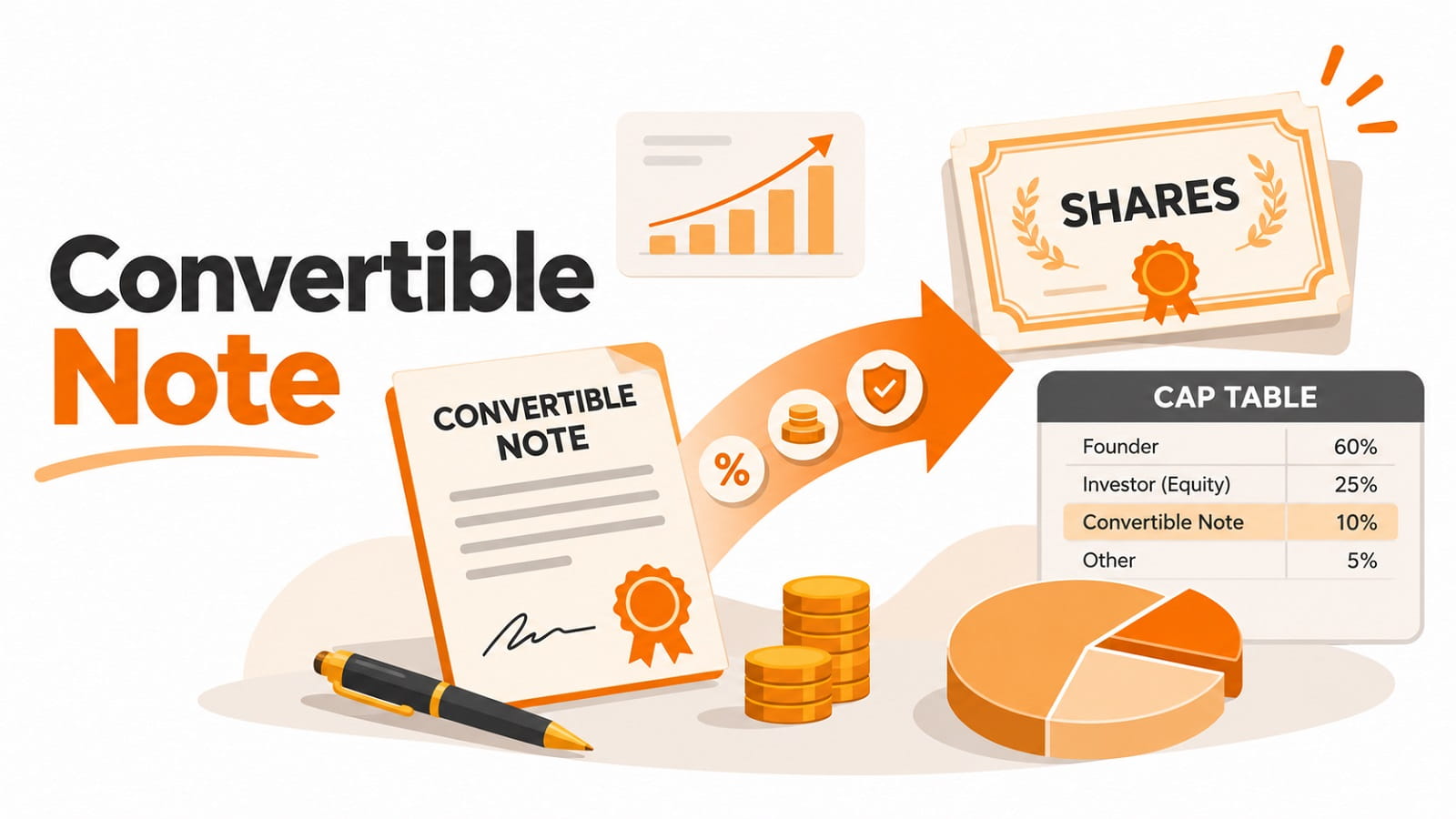
SAFEs, convertible notes, warrants, and employee equity arrangements can influence dilution when a new financing round occurs. If these instruments are missing from the company's records or modeled incorrectly, founders may misunderstand the ownership consequences of the proposed investment.
The capitalization table should be consistent with signed documents and corporate approvals. Any discrepancies need to be investigated before they become issues during investor due diligence.
Management may also prepare financing scenarios showing how new investment and existing conversion obligations could affect the ownership structure.
These scenarios should be based on the actual contractual terms and should not be treated as substitutes for legal review.
Accurate equity information allows founders to evaluate financing proposals more effectively while giving investors a clearer understanding of the company's existing commitments.
Organize Corporate and Legal Records
Corporate documentation is another central part of startup funding preparation.
Investors may need to verify that the company was properly formed, that relevant shares were authorized and issued, and that important business agreements are legally documented.
Founders should review incorporation documents, shareholder agreements, governance records, relevant approvals, employment contracts, and prior investment agreements.
Intellectual property requires particular attention. If essential software, designs, research, or other technology was created by founders, employees, or contractors, the company should establish whether the relevant rights have been properly assigned or otherwise secured.
Unclear intellectual property ownership can create significant uncertainty during investment evaluation because the company's commercial value may depend on assets it does not fully control.
Material commercial agreements should also be organized. These may include customer contracts, supplier arrangements, licensing agreements, and documents establishing significant obligations.
Any existing disputes, unusual contractual restrictions, or unresolved governance matters should be assessed with appropriate professional assistance.
The objective is not to produce unnecessary legal paperwork. It is to confirm that the company's structure and important rights are accurately documented before external investors begin detailed review.
Create a Fundraising Data Room
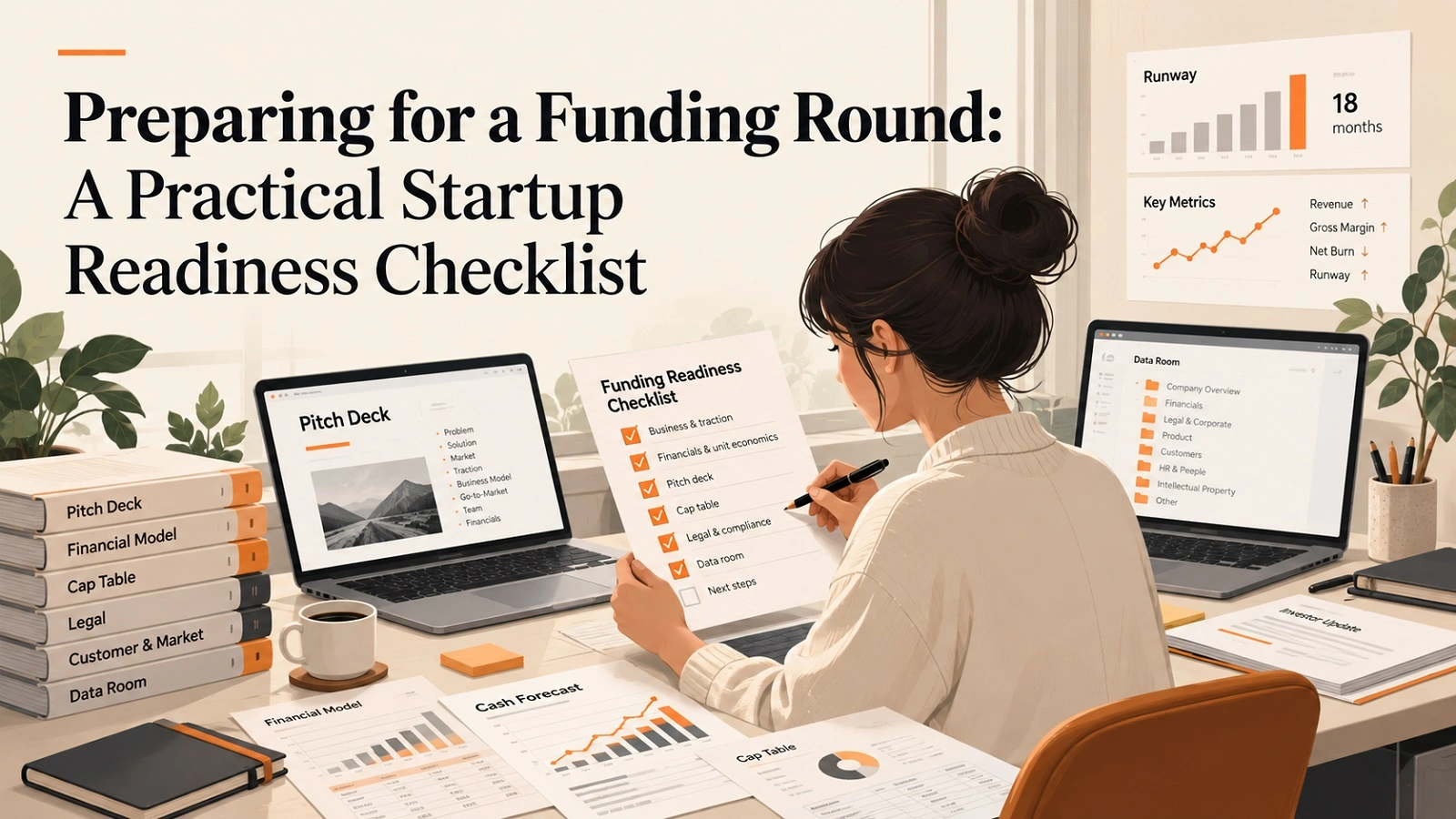
A fundraising data room is an organized collection of documents that investors may examine while evaluating the company.
Preparing these materials in advance can reduce delays and make the evaluation process more efficient. It also helps founders identify missing records before they are requested by an investor.
The data room may be maintained through a secure document sharing platform or a specialized service. Its effectiveness depends more on the accuracy, organization, and accessibility of the information than on the particular software used.
Founders should organize materials by category and ensure that important documents are current. Multiple conflicting versions of the same financial forecast or capitalization table can create confusion and undermine confidence in the company's information.
Access should be managed appropriately, particularly when documents contain sensitive financial, technical, customer, or employee information.
Startup Funding Round Data Room Checklist
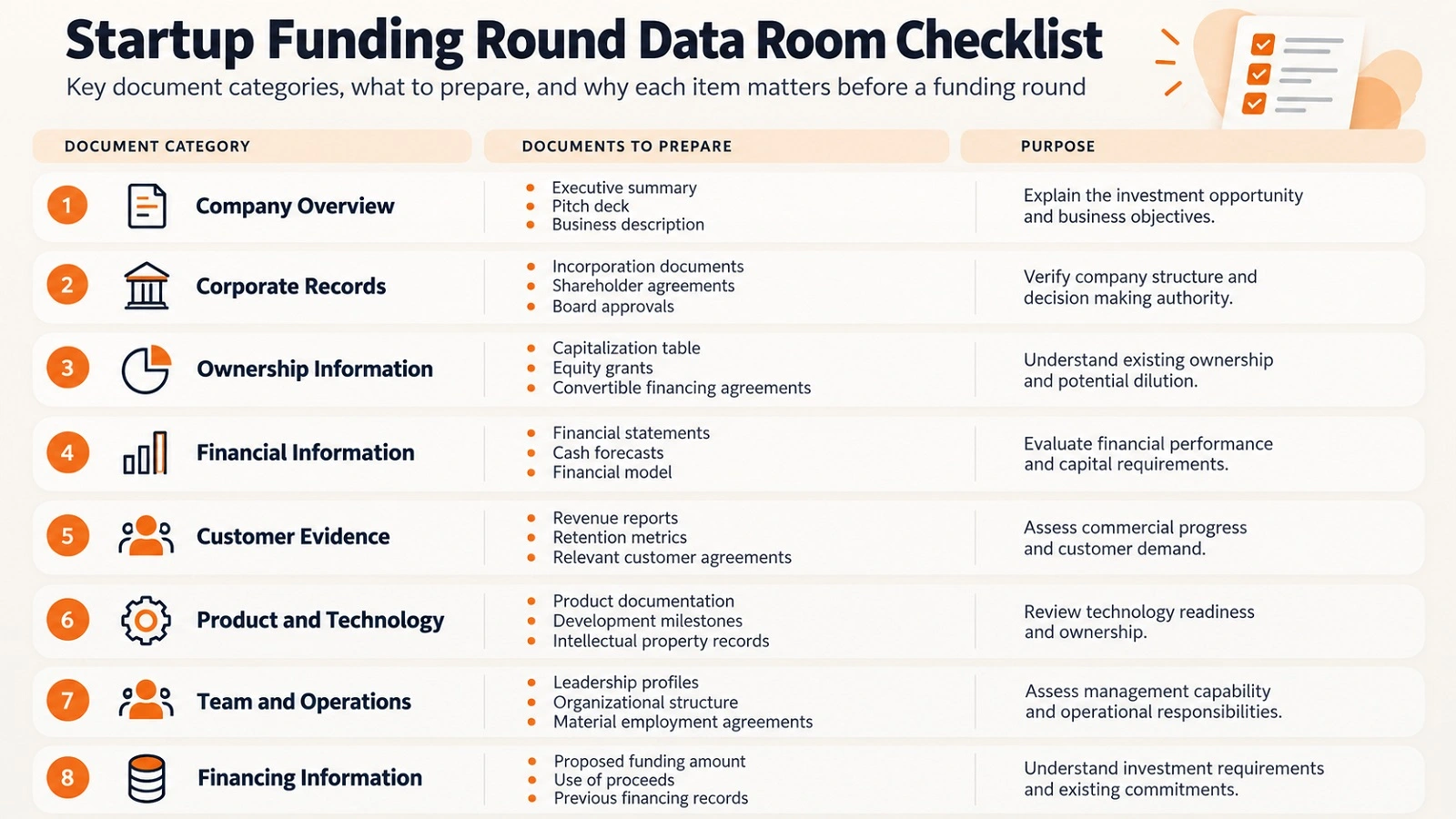
Not every startup needs every document listed. The appropriate contents depend on the company's stage, business model, jurisdiction, and the scope of investor evaluation.
A seed stage company may have a limited financial history, while a more mature business could require detailed reporting across multiple periods.
Founders should prioritize complete, accurate, and relevant information rather than filling the data room with unnecessary documents.
Prepare for Investor Due Diligence
Due diligence allows investors to investigate a company and verify information relevant to an investment decision.
Preparation involves anticipating the questions investors are likely to ask and ensuring that supporting records can be provided efficiently.
Financial due diligence may focus on cash balances, revenue recognition, operating expenses, outstanding obligations, and the assumptions behind future projections.
Commercial due diligence may examine customer demand, retention, market position, sales performance, and potential sources of competitive advantage.
Legal review may involve corporate records, shareholder arrangements, contracts, intellectual property ownership, and regulatory obligations.
Founders should understand who within the company is responsible for answering questions in each area. Financial information may require input from management or accountants, while legal issues should be handled with appropriately qualified advisers.
Consistency is essential. Figures presented during meetings should agree with the corresponding documents, and the company should be able to explain any legitimate differences in accounting treatment or reporting periods.
When a requested document is unavailable, management should communicate that fact accurately rather than attempting to conceal the gap.
Due diligence preparation is not about anticipating every possible question. It is about ensuring that important information is reliable and that the company can respond to scrutiny without substantial confusion.
Make the Pitch Deck Consistent With Company Records
Although the pitch deck is the primary introduction to the company, its content should be supported by the information prepared for investor review.
Founders should examine the presentation alongside financial statements, customer reports, the capitalization table, and the proposed use of funds.
Revenue figures should use consistent definitions and reporting periods. Statements about customers should distinguish trials, signed agreements, active accounts, and paying relationships.
Market opportunity estimates should also be presented accurately. A broad industry estimate does not automatically represent the revenue a startup can realistically capture.
The proposed funding amount should correspond to the company's financial model, while the growth milestones described in the deck should reflect the resources and assumptions underlying that model.
Inconsistencies can emerge when investor presentations are revised frequently but the supporting documents remain outdated.
A final content review should verify major metrics, financial assumptions, ownership statements, and the status of important commercial milestones.
The goal is to ensure that investors encounter one coherent explanation of the business rather than several competing versions of its performance and prospects.
Align the Founding Team Before Fundraising
Funding preparation also requires agreement among the people responsible for the company.
Founders should discuss the financing objective, expected capital requirements, acceptable ownership consequences, and the business priorities the investment is intended to support.
Different members of the founding team may have different preferences. One founder may favor rapid expansion, while another may prefer preserving cash and validating additional customer demand before hiring.
These differences are legitimate, but unresolved disagreements can complicate investor conversations and important financing decisions.
The team should also establish responsibilities for preparing documents, maintaining financial information, answering investor questions, and coordinating legal review.
Clear responsibilities help prevent situations in which different founders provide inconsistent figures or make commitments without the necessary internal approval.
Management should determine which decisions can be handled by individual team members and which require broader authorization.
Internal alignment does not mean eliminating debate. It means establishing a clear process for evaluating financing opportunities and maintaining operational continuity while the company seeks investment.
Protect Confidential Information During Investor Review
Funding preparation often involves gathering documents that contain information the company would not normally distribute outside its organization.
Financial forecasts, customer agreements, intellectual property records, product development plans, and employee information may be commercially sensitive.
Founders should consider which materials are suitable for introductory discussions and which should be shared only after an investor has progressed to a more substantive evaluation.
Document access can be managed through permissions, designated recipients, and appropriate confidentiality arrangements where relevant.
Personal information should be handled according to applicable privacy requirements. The fact that an investor requests information does not automatically mean that unrestricted disclosure is appropriate.
Founders should also avoid assuming that every investor will sign a confidentiality agreement at the beginning of the process. Practices vary, and information disclosure should be managed with that reality in mind.
Preparing a data room therefore involves more than organizing files. It also requires deciding how the company will protect sensitive information while allowing legitimate investment evaluation to proceed.
Complete a Funding Round Readiness Assessment
Before beginning active investor outreach, founders should conduct a final readiness review.
This assessment should identify whether the essential elements of the financing proposal are supported by accurate information and whether unresolved issues could interfere with investor evaluation.
A company does not need to eliminate every uncertainty. However, it should understand which matters are incomplete and whether those gaps are appropriate for its stage.
Funding Round Readiness Assessment
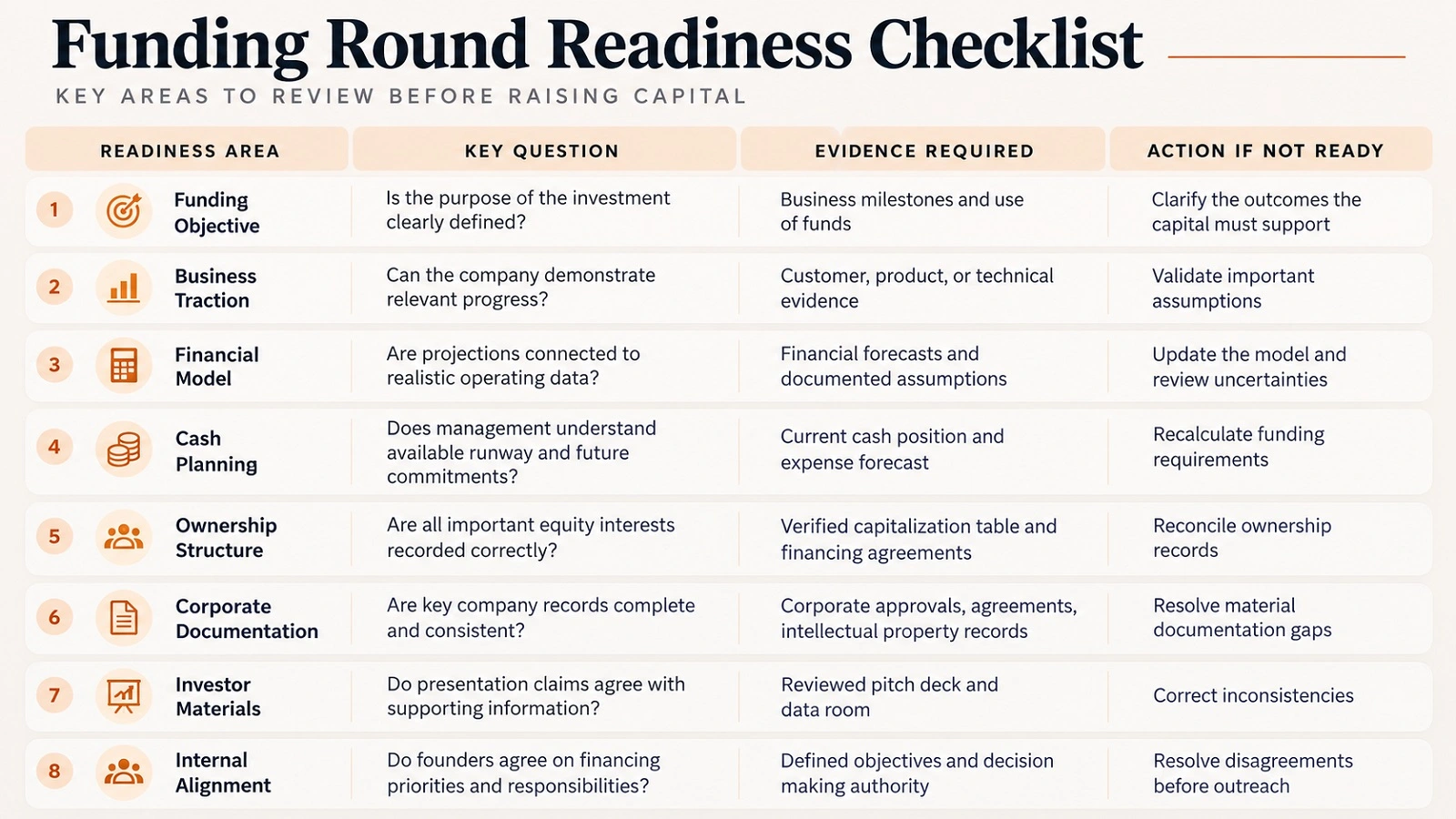
Readiness AreaKey QuestionEvidence RequiredAction if Not ReadyFunding ObjectiveIs the purpose of the investment clearly defined?Business milestones and use of fundsClarify the outcomes the capital must supportBusiness TractionCan the company demonstrate relevant progress?Customer, product, or technical evidenceValidate important assumptionsFinancial ModelAre projections connected to realistic operating data?Financial forecasts and documented assumptionsUpdate the model and review uncertaintiesCash PlanningDoes management understand available runway and future commitments?Current cash position and expense forecastRecalculate funding requirementsOwnership StructureAre all important equity interests recorded correctly?Verified capitalization table and financing agreementsReconcile ownership recordsCorporate DocumentationAre key company records complete and consistent?Corporate approvals, agreements, intellectual property recordsResolve material documentation gapsInvestor MaterialsDo presentation claims agree with supporting information?Reviewed pitch deck and data roomCorrect inconsistenciesInternal AlignmentDo founders agree on financing priorities and responsibilities?Defined objectives and decision making authorityResolve disagreements before outreach
The assessment provides a practical basis for deciding whether the startup is ready to approach investors.
A missing administrative document may be easy to resolve, while unclear intellectual property ownership or unreliable financial information could require substantial additional work.
Founders should prioritize issues according to their potential effect on the financing rather than attempting to complete every possible task with equal urgency.
Example: Preparing a SaaS Startup for Its First Funding Round
Consider a hypothetical startup called ClearDesk, which provides workflow software for small professional service businesses.
The company has developed a functioning product and acquired several paying customers. Its founders want to raise capital to improve the software and develop a more consistent sales process.
Initially, the team assumes that preparation will mainly involve creating a presentation and identifying potential investors.
During an internal review, however, the founders discover several problems.
The company's revenue reports use inconsistent definitions. Some customers are paying monthly subscriptions, while others have purchased temporary implementation services. These amounts have been combined in a way that makes recurring revenue appear stronger than it is.
The financial model also assumes that new sales employees will generate revenue immediately after being hired. This overlooks recruitment time, training, and the period required to build a sales pipeline.
Meanwhile, an earlier convertible financing agreement has not been fully reflected in the capitalization table.
These issues do not necessarily mean ClearDesk is a poor investment opportunity. They do mean that its current information could lead investors to misunderstand the business.
The founders first establish consistent definitions for recurring revenue and customer activity. They revise the financial model to include realistic recruitment and sales development assumptions.
They then reconcile the ownership records with the company's signed financing documents and organize relevant corporate information in a secure data room.
With those records corrected, the team develops a financing objective tied to specific product and commercial milestones.
When ClearDesk begins meeting investors, the founders can explain the difference between current performance and expected growth. They can also provide supporting information without needing to reconstruct their financial records during the evaluation.
The example is fictional, but it illustrates an important principle: funding preparation improves the reliability of the investment case before investors are asked to rely on it.
How Preparation Differs Between Seed and Series A Funding
Not every startup faces the same expectations when preparing for investment.
At the seed stage, investors may place considerable emphasis on the founding team, the problem being addressed, product feasibility, and early evidence of customer demand.
A startup at this stage may have limited historical financial information. Its preparation should focus on presenting the available evidence accurately and establishing a credible plan for the capital it seeks.
For a Series A round, investors may place greater weight on commercial performance, operational maturity, and the company's ability to expand an already demonstrated business model.
They may examine customer retention, revenue quality, acquisition economics, financial controls, management capacity, and the scalability of existing operations.
These distinctions are not universal. A biotechnology company may need extensive technical and regulatory documentation before generating revenue, while a software business may establish commercial traction with a comparatively simple product.
Founders should adapt their preparation to the expectations relevant to their industry, business model, and financing stage.
The underlying principle remains consistent: the company must be able to explain what has been achieved and provide credible evidence for its next development objectives.
Final Checks Before Approaching Investors
The final preparation stage should focus on consistency, accessibility, and decision readiness.
Founders should verify that the financial model uses current information and that the investment request matches the proposed use of capital. The capitalization table should reflect relevant ownership commitments, and important corporate documents should be accurate and accessible.
Customer and product metrics should use consistent definitions across the presentation and supporting records.
The company should also identify who will coordinate investor questions, maintain the data room, and manage requests for additional financial or legal information.
Management should review its cash position and operating commitments without assuming that investment will arrive by a particular date.
Finally, founders need to determine whether unresolved issues are material enough to justify completing additional work before outreach begins.
The purpose of these checks is not to delay fundraising unnecessarily. It is to reduce preventable problems that could weaken the company's credibility or interfere with a financing decision.
Final Thoughts on Preparing for a Funding Round
Preparing for a funding round requires founders to understand both the opportunity they intend to present and the evidence supporting it.
A clear financing objective establishes what the company needs to accomplish. Reliable financial forecasts explain how capital will be used. Accurate ownership and legal records reduce uncertainty, while an organized data room allows investors to examine the business more efficiently.
Strong preparation also requires realistic business metrics, internal alignment, and an understanding of the risks that remain unresolved.
No amount of preparation can guarantee investment. Market conditions, investor preferences, and business uncertainty will continue to influence financing outcomes.
However, a startup with credible information and clearly defined objectives can make more informed financing decisions and reduce the likelihood that avoidable documentation or planning problems will interfere with its growth.
Frequently Asked Questions
What should a startup prepare before a funding round?
A startup should prepare a clear financing objective, evidence of business progress, a reliable financial model, cash forecasts, an accurate capitalization table, and relevant corporate documentation. Founders should also organize investor materials and ensure that important financial and commercial claims can be supported by consistent records.
What documents are needed for startup fundraising?
Common documents include an investor pitch deck, financial statements, financial projections, capitalization table, incorporation records, relevant shareholder and financing agreements, customer information, and intellectual property documentation. The exact requirements depend on the company's stage, financing structure, industry, and investor expectations.
How do you know when a startup is ready for funding?
A startup is better prepared for funding when it can explain why capital is required, what milestones the investment will support, and which evidence demonstrates its current progress. Financial and ownership information should be accurate, material risks should be understood, and management should be able to respond to reasonable investor questions.
Do startups need a data room before raising capital?
A comprehensive data room is not always necessary before an introductory investor meeting. However, organizing essential documents before serious discussions can reduce delays during investor evaluation. The data room should contain relevant records, use appropriate access controls, and reflect the company's actual stage of development.
How long does it take to prepare for a funding round?
Preparation time varies according to the company's maturity and the condition of its existing records. A startup with organized financial information, accurate ownership records, and a clear investment objective may require relatively little additional work. Companies facing documentation gaps, complex financing instruments, or unresolved commercial assumptions may need more extensive preparation.

Mobina Khanki
Venture & Funding Writer at PinerookMobina Khanki covers venture capital, startup funding, fundraising, and startup finance for Pinerook, focusing on founders and investors.
 Seen first.