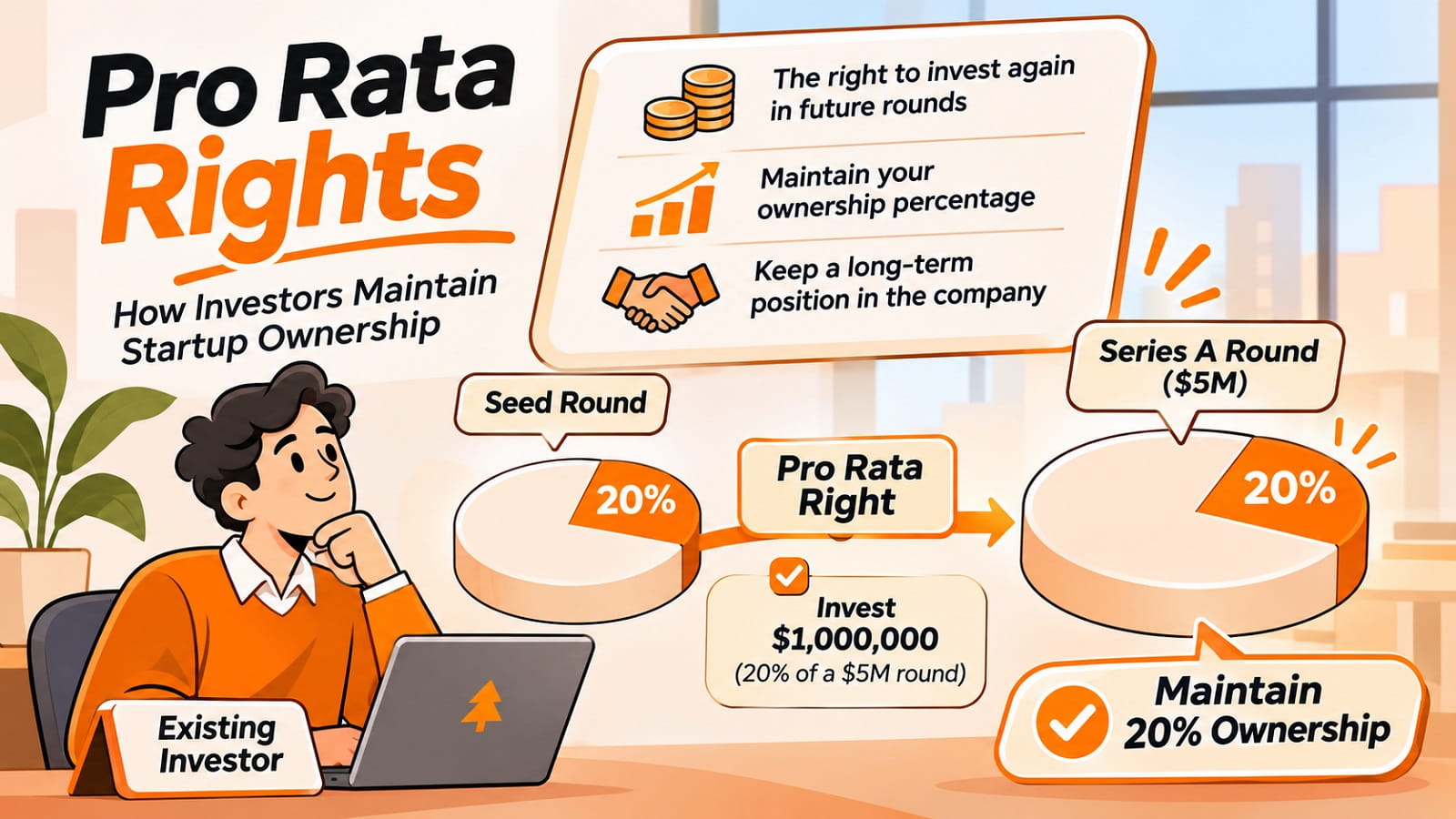
A startup can raise a successful financing round and still leave its earliest investors with a smaller ownership percentage. When a company issues new shares, existing investors who do not participate generally own a smaller proportion of the expanded capitalization. For investors who want to maintain a long term position in a promising business, this creates an important decision: contribute more money or accept a reduced ownership percentage. Pro rata rights provide a contractual framework for making that decision.
Within Term Sheets and Investment Deals, pro rata rights determine whether qualifying investors can purchase part of a future financing round to maintain their ownership. These rights are particularly relevant when a company moves from seed financing to Series A and begins attracting larger institutional investors. Although the concept appears straightforward, the actual entitlement depends on the agreement's ownership definition, eligible investors, covered securities, and participation procedures.
For founders, the issue is not simply whether an existing investor deserves access to the next round. Every allocation reserved for an existing investor may reduce the amount available to a new lead investor when the total financing size is fixed. This guide explains how pro rata rights work, calculates the investment required to maintain ownership, and examines the contractual terms that can affect future fundraising flexibility.
Understanding Pro Rata Rights in Venture Capital
Pro rata rights are contractual rights that allow an existing investor to purchase a proportionate amount of securities in a future financing. The proportion is generally based on the investor's ownership immediately before the relevant transaction, calculated using the capitalization definition established in the agreement.
Suppose an investor owns 10% of a company and the business raises $6 million in a new equity financing. Under a straightforward pro rata arrangement, that investor may have the right to purchase $600,000 of the new financing.
The investor is not normally required to contribute the money. The right provides an opportunity to invest, and the investor must decide whether to exercise it under the applicable terms.
If the investor participates fully and the financing follows the assumptions used in the calculation, its ownership percentage can remain unchanged. If the investor declines, new share issuance will generally reduce its percentage.
The agreement establishes whether the right applies to the next financing, multiple future rounds, or a defined category of new securities. It should not be assumed that every existing investor automatically has the same participation entitlement.
Why Investors Negotiate Pro Rata Rights
Early stage investors accept substantial uncertainty when they provide capital to young companies. They may fund a startup before it has established stable revenue, a mature product, or a proven commercial model.
If the company performs well, later investors may become interested in purchasing significant ownership positions. Earlier investors may want the opportunity to invest again rather than see their percentage decline as new capital enters the company.
Pro rata rights help preserve that opportunity. An investor that originally acquired 8% of a company may seek to maintain approximately 8% as the business grows, provided it has sufficient capital and the contractual right applies.
This can also benefit a startup. Existing investors who understand the business may contribute additional financing and help establish confidence among new investors.
However, a commitment to make room for existing shareholders can limit how much of a funding round remains available to new investors. Founders should understand the cumulative effect of all outstanding participation rights before promising allocations in later transactions.
How to Calculate a Pro Rata Investment
Under a simple priced financing with no other capitalization adjustments, the amount an existing investor needs to contribute can be calculated using its ownership percentage before the round.
Pro rata investment = Ownership percentage before financing × Total new financing
For example, if a shareholder owns 12% and the company raises $5 million, its proportionate allocation would be:
Pro rata investment = 12% × $5,000,000 = $600,000
This calculation assumes the investor's contractual entitlement is based on that 12% ownership figure and that the financing is completed at a single share price.
The number of shares purchased is calculated separately:
New shares purchased = Pro rata investment ÷ New financing price per share
Both calculations matter. The dollar allocation tells an investor how much additional money is required, while the share calculation shows how the investment changes the capitalization table.
A simple formula may not be sufficient when a financing includes conversions of outstanding instruments, an employee reserve increase, or several classes of securities with different rights. In those situations, the agreement's ownership definition and the complete financing model determine the actual entitlement.
A Practical Example of Pro Rata Rights
Consider Northstar Analytics, a fictional enterprise software company preparing for a Series A financing. Before the round, the company has 10 million shares outstanding on an as converted basis.
An existing seed investor holds 2 million shares, representing 20% ownership. Founders and other existing shareholders collectively hold the remaining 8 million shares, or 80%.
Northstar Analytics negotiates a $5 million Series A financing at a $15 million pre investment valuation. For this example, there are no employee reserve increases, outstanding convertible instruments, or other capitalization adjustments.
The financing price is calculated by dividing the pre investment valuation by the 10 million existing shares.
Series A share price = $15,000,000 ÷ 10,000,000 = $1.50
The new financing issues approximately 3,333,333 additional shares at that price. Total capitalization after financing is therefore approximately 13,333,333 shares.
The post investment valuation is:
Post investment valuation = $15,000,000 + $5,000,000 = $20,000,000
Under the assumed participation right, the seed investor can purchase 20% of the new financing.
Pro rata investment = 20% × $5,000,000 = $1,000,000
That investment purchases approximately 666,667 additional shares at $1.50 per share.
The seed investor's total holdings increase from 2 million shares to approximately 2,666,667 shares. Against the expanded capitalization of approximately 13,333,333 shares, the investor continues to own 20%.
The investor has preserved its percentage ownership by contributing additional capital, rather than through an automatic adjustment to its existing shares.
Comparing Investor Participation Scenarios
The same financing can produce different ownership distributions depending on how much of the round the seed investor purchases.
Assume that Northstar Analytics will raise exactly $5 million under every scenario and that the new lead investor purchases all shares not allocated to the existing seed investor. Founders and other existing shareholders do not invest additional capital.
The following table compares four possible participation levels. The final scenario represents an additional allocation negotiated separately, not an entitlement automatically provided by an ordinary pro rata right.
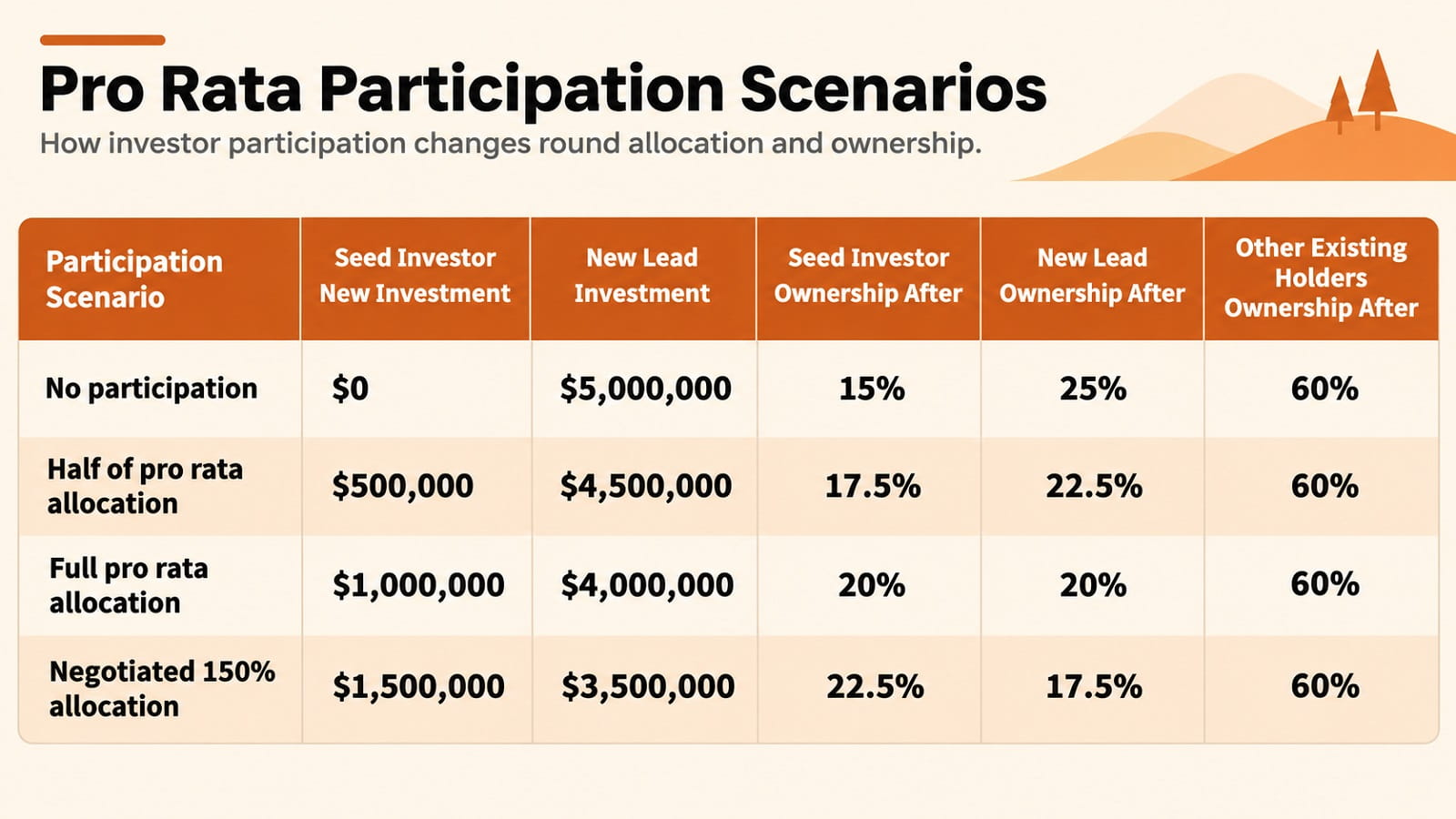
Without participating, the seed investor's 2 million shares represent 15% of the expanded company. The new lead investor receives the entire $5 million allocation and acquires 25% ownership.
With a $500,000 follow on investment, the seed investor purchases approximately 333,333 additional shares and increases its final position to 17.5%. The new lead purchases the remaining $4.5 million of the financing and receives 22.5%.
Full participation allows the seed investor to maintain its original 20%. The new lead investor acquires the other 20% issued in the financing, while founders and other nonparticipating shareholders collectively retain 60%.
The final scenario illustrates an investor receiving an allocation above its ordinary pro rata amount. Contributing $1.5 million allows the seed investor to increase ownership to 22.5%, but obtaining that additional allocation would require an applicable contractual entitlement or separate agreement.
An important detail is that founders and other nonparticipating shareholders retain 60% in every scenario. When the company raises the same total amount at the same price, changing which investors purchase the newly issued shares does not by itself create additional shares.
The practical challenge is therefore one of financing allocation. If a new lead investor requires more ownership than is available after existing rights are honored, the company may need to renegotiate allocations, change the total round size, or reconsider other transaction terms.
All figures are illustrative and rounded. Actual share quantities and final percentages should be reconciled using the definitive capitalization model.
The Difference Between Pro Rata and Super Pro Rata Rights
An ordinary pro rata right generally allows an investor to purchase the proportion of a new financing needed to maintain a specified ownership position.
Super pro rata describes an arrangement that allows an investor to purchase more than that ordinary proportional allocation. The investor may use the larger allocation to increase its ownership percentage.
In the Northstar Analytics example, the seed investor's standard allocation is $1 million. Purchasing $1.5 million of the $5 million financing would represent 150% of that allocation.
However, an existing investor cannot assume it is entitled to the additional $500,000 merely because it holds ordinary participation rights. The extra allocation must be available under the governing documents or separately agreed with the company and relevant parties.
A company should consider these arrangements carefully when it expects to attract substantial future investment. Promising large additional allocations to early investors can restrict the percentage of a later financing available to new institutional investors.
The Contractual Terms Founders Should Review
The phrase pro rata rights describes a general commercial concept, but the operative agreement determines how the right works. Different documents may use different definitions of eligible investors, covered securities, and participation percentages.
The following table identifies the principal terms that founders should confirm when reviewing or granting participation rights.
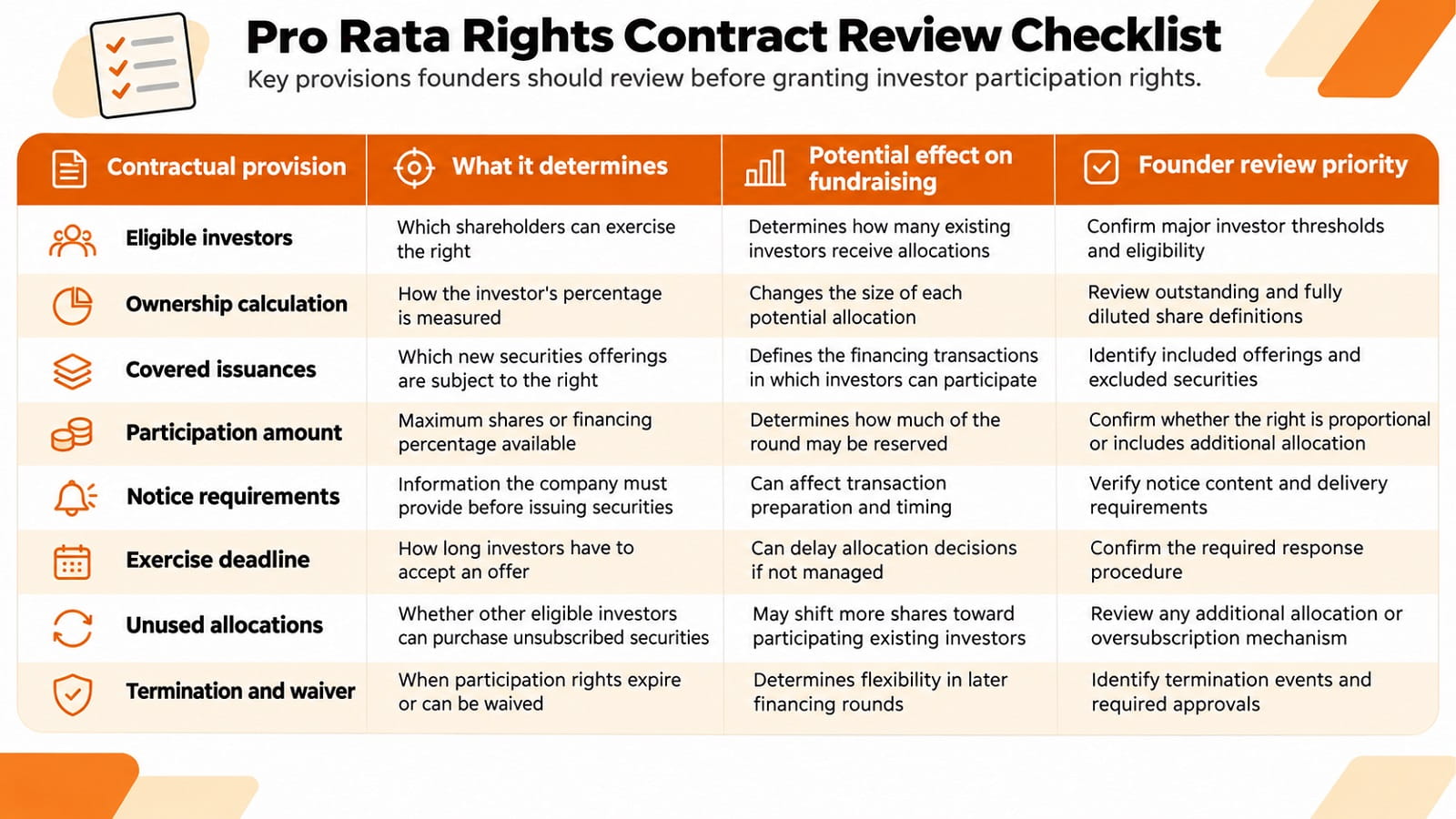
These conditions should be evaluated together. An entitlement granted only to a small group of qualifying investors may be manageable, while broad rights granted to numerous shareholders can create administrative difficulties during fundraising.
The size of the entitlement also matters. A participation right based on a relatively small ownership position may have limited consequences in one round, but several investors exercising their rights simultaneously can reserve a substantial portion of the available financing.
Founders should understand the maximum potential allocation before signing documents that create these obligations.
Major Investor Requirements and Eligibility
Participation rights are frequently limited to investors who satisfy a specified eligibility threshold. In US venture financing documents, the term major investor may be used to distinguish investors who receive additional contractual rights from those holding smaller positions.
The threshold can be defined by the number of shares held, an investment amount, a percentage of ownership, or another contractual measure. There is no single universal definition that applies to every financing.
A company may choose to grant rights only to investors whose financial commitments or strategic involvement justify the additional obligations.
This approach can make subsequent fundraising easier to manage. If many small shareholders each receive individual notice and participation rights, the company may need to coordinate numerous decisions before finalizing allocations.
However, eligibility rules should be negotiated and documented clearly. Founders should not assume that a shareholder automatically loses rights simply because the company's capitalization changes, unless the relevant agreement provides for that result.
Pro Rata Rights in SAFE Financing
Pro rata rights can also arise when a startup raises money through a Simple Agreement for Future Equity, commonly known as a SAFE.
A SAFE provides contractual rights to future equity under specified circumstances, but it does not necessarily grant the holder a right to participate in subsequent financing rounds.
Y Combinator's standard post money SAFE documentation addresses this distinction through an optional pro rata side letter. The right is not automatically included in the standard SAFE itself.
Where the side letter applies, the investor can obtain a contractual opportunity to purchase a portion of the new equity financing in which the SAFE converts, according to the applicable terms.
This is different from receiving shares through SAFE conversion. The conversion results from the original SAFE investment, while exercising a participation right requires the investor to provide additional capital.
The two transactions should be modeled separately to avoid confusing conversion ownership with newly purchased shares.
Founders should also consider the total participation rights granted across all SAFE holders. Multiple side letters may collectively reserve more of a future priced round than the company initially expects.
Pro Rata Rights Versus Anti Dilution Protection
Pro rata rights and price based investor protections address different issues, even though both can affect ownership after financing.
A participation right provides an investor with an opportunity to purchase new securities. Maintaining the original ownership percentage generally requires an additional investment.
Price based anti dilution protection, by contrast, may adjust the conversion terms of existing preferred securities following specified lower priced issuances. That adjustment does not ordinarily require the protected investor to contribute new money.
The distinction also concerns when the rights apply. Participation rights may be relevant during qualifying financing rounds regardless of whether the new share price is higher or lower than the earlier financing price.
Price based protections commonly focus on issuances below an established reference price and depend on the specific adjustment formula.
An investor may hold both types of rights. Founders should model their effects separately because an investor benefiting from a conversion adjustment may also be entitled to purchase securities in the new financing.
How Pro Rata Rights Affect a New Lead Investor
A new lead investor may be interested in acquiring a particular ownership percentage rather than simply contributing a fixed amount of capital.
Suppose a lead investor wants to purchase the entire $5 million Series A financing in the Northstar Analytics example. That investment would provide 25% ownership under the original financing assumptions.
If the existing seed investor exercises its full $1 million allocation and the company still raises only $5 million, the new lead can invest only $4 million. Its resulting ownership falls to 20%.
The company may need to negotiate whether the lead is comfortable with the smaller position. If not, the parties could consider a larger financing, different allocations, or a voluntary waiver of certain rights where permitted.
These alternatives are not economically equivalent. Increasing the size of the round can increase the number of shares issued and change dilution for all existing holders.
A waiver may instead change the distribution of the same number of new shares without increasing the financing amount.
This distinction is essential when comparing term sheets. A company should determine whether participation rights will change the identity of the incoming shareholders or require a different transaction structure altogether.
Notice, Exercise and Closing Procedures
The practical value of a participation right depends on whether the investor receives the required opportunity to exercise it.
The governing agreement may require the company to provide written notice identifying the proposed securities, purchase price, principal terms, and amount available to the eligible investor.
The investor must then respond within the applicable period and follow the agreement's procedure for subscribing. Missing a contractual deadline may result in losing the opportunity to participate in that particular issuance.
There is no universal response period applicable to every startup financing. The deadlines, exceptions, and consequences of failing to respond depend on the signed agreement.
Founders should establish a clear process for tracking notices and responses. Uncertainty about investor participation can delay the preparation of the final capitalization table and complicate negotiations with the new lead investor.
Once allocations are confirmed, the relevant securities purchases can be included in the financing documentation and completed according to the closing requirements.
Unused Pro Rata Allocations and Additional Purchases
Not every eligible investor will exercise the full amount available. Some investors may lack sufficient capital, prefer to preserve liquidity for other investments, or decide that the new financing valuation is unattractive.
The treatment of unused allocations depends on the relevant agreement. In some structures, other eligible investors may receive an opportunity to purchase part of the unsubscribed securities.
This arrangement is sometimes described as an oversubscription right or an additional participation mechanism.
For example, a company might initially reserve $2 million of a financing for several existing investors. If those investors collectively subscribe for only $1.2 million, the remaining $800,000 must be allocated according to the governing terms and the company's agreed financing arrangements.
The documents may permit eligible investors to purchase additional securities, or the company may be able to allocate the amount to new investors. Founders should establish the applicable sequence before commitments are finalized.
Unused allocations should not automatically be treated as available for unrestricted redistribution without considering any contractual obligations.
When Pro Rata Rights Expire or Can Be Waived
Participation rights are not necessarily permanent. Their duration depends on the agreements that created them.
Some rights apply only to a particular future financing, while others continue across several transactions until specified termination conditions occur.
Rights may end after an investor no longer satisfies an ownership threshold, following a qualifying public offering, or under other events established in the documents.
An investor may also agree to waive a right in a particular transaction, subject to the relevant contractual requirements.
A waiver can be useful when the company needs to reserve a larger allocation for a new strategic investor. However, the required approvals and the effect on other holders must be considered.
Founders should not assume that an investor's informal willingness to participate less is sufficient to resolve every contractual obligation. Where appropriate, the agreed arrangement should be documented clearly.
Negotiating Pro Rata Rights as a Founder
The decision to grant participation rights should be based on the investor's contribution and the company's expected financing needs.
A large early investor may reasonably seek an opportunity to maintain ownership if the business performs well. Granting that right can help strengthen the relationship and encourage continued financial support.
However, founders should avoid creating obligations that are broader than necessary. Rights can be limited by eligibility thresholds, financing categories, duration, and the maximum amount available for purchase.
A realistic financing model can help management assess the consequences before committing. The company can estimate how much of its next round may need to be reserved for existing investors if all eligible holders exercise their rights.
Founders should also consider whether the proposed rights are proportionate to the investment being made. An investor contributing a small amount may not justify the same long term allocation privileges as a major financing partner.
The objective is to provide reasonable opportunities for existing investors while preserving sufficient flexibility to attract new capital when the company needs it.
Common Mistakes in Pro Rata Rights Calculations
A common mistake is calculating the investor's allocation using the ownership percentage after the new financing rather than the relevant percentage established before the issuance.
Another is assuming that a shareholder can preserve ownership without investing additional capital. Ordinary pro rata participation generally requires purchasing additional securities at the applicable financing terms.
Founders may also overlook the effect of convertible instruments and employee reserve changes. These can alter the capitalization denominator and the investor's actual participation entitlement.
A further problem is treating super pro rata allocations as though they are included automatically in ordinary participation rights. Additional purchases beyond the contractual maximum require an available entitlement or separate agreement.
Finally, a company may promise the full round to a new lead investor without first accounting for existing participation rights. Resolving that conflict late in the financing process can create delays or require revised terms.
Avoiding these mistakes requires consistent capitalization definitions, careful contract review, and a financing model that includes all qualifying investors.
Final Thoughts
Pro rata rights provide qualifying investors with an opportunity to maintain their ownership in a startup as additional equity financing takes place. Their value depends on the investor's willingness and ability to provide follow on capital, as well as the specific rights established in the governing agreement.
The Northstar Analytics example demonstrates how a seed investor holding 20% can retain that percentage by contributing $1 million to a $5 million Series A financing. It also shows that participation changes the allocation of newly issued shares among investors, while a fixed round size and price produce the same dilution for other nonparticipating shareholders.
For founders, the most important consideration is how these contractual commitments affect future financing flexibility. Clearly defined eligibility rules, realistic allocation limits, accurate capitalization calculations, and timely investor communications can help companies honor existing rights without creating unnecessary obstacles to raising additional capital.
FAQ
What Are Pro Rata Rights in Startup Funding?
Pro rata rights are contractual rights allowing eligible existing investors to purchase a proportionate amount of securities in certain future financing rounds. They can help investors maintain their ownership percentage by making additional investments.
How Are Pro Rata Rights Calculated?
Under a simple financing structure, multiply the investor's eligible ownership percentage by the total amount of the new financing. The actual calculation must follow the definitions and conditions in the governing agreement.
Do Investors Have to Exercise Pro Rata Rights?
No. These rights generally provide an investment opportunity rather than an obligation. Investors may participate fully, invest a smaller amount where permitted, or decline the opportunity.
What Happens if an Investor Does Not Participate?
If new shares are issued and the investor does not acquire additional securities, its percentage ownership will generally decrease. The precise result depends on the capitalization and any other contractual adjustments.
Are Pro Rata Rights Automatically Included in SAFEs?
No. Y Combinator's standard post money SAFE does not automatically include the right. An optional pro rata side letter can establish participation rights when the parties agree.
What Is the Difference Between Pro Rata and Super Pro Rata Rights?
An ordinary pro rata right generally allows an investor to maintain a specified ownership percentage. Super pro rata arrangements can permit additional purchases that increase the investor's ownership position.
Do All Startup Investors Receive Pro Rata Rights?
Not necessarily. Eligibility can depend on ownership thresholds, investment size, contractual classifications, and the terms negotiated between the company and its investors.
Are Pro Rata Rights the Same as Anti Dilution Protection?
No. Pro rata rights generally require additional investment to maintain ownership. Price based anti dilution provisions may adjust the conversion terms of existing preferred shares following qualifying lower priced issuances.
Can Founders Negotiate or Limit Pro Rata Rights?
Yes. Parties may negotiate eligibility, covered issuances, participation amounts, notice procedures, termination conditions, and other provisions, subject to applicable law and existing contractual obligations.
Can Pro Rata Rights Affect Future Fundraising?
Yes. Existing investors exercising their rights can reduce the amount of a fixed financing round available to new investors. If a larger round is required to accommodate all participants, the ownership and dilution consequences may also change.

Mobina Khanki
Venture & Funding Writer at PinerookMobina Khanki covers venture capital, startup funding, fundraising, and startup finance for Pinerook, focusing on founders and investors.
 Seen first.