Product led growth, or PLG, is a business growth approach in which people discover, experience, adopt, and often purchase a product largely through the product experience itself. Instead of requiring a sales conversation before someone can understand the value, a startup designs a path that helps the right user accomplish something meaningful, return for that benefit, and eventually pay or bring others into the product. Marketing and sales can still matter. The distinguishing feature is that actual product use becomes an important source of growth and commercial evidence.
For a startup, this approach is not simply a free trial, a beautiful interface, or the absence of salespeople. It requires a valuable outcome that users can reach without excessive help, a clear way to observe that outcome, and a business model that can support wider adoption. The practical question is whether letting users experience the product earlier makes discovery, conversion, retention, or expansion more reliable than relying on explanations and demonstrations alone.
A startup does not need to make every part of its business self service to benefit. The most useful PLG strategy often combines direct customer conversations, focused acquisition, a product that proves its value, and timely human assistance where a buying decision becomes complex. That makes PLG an operating choice about the customer journey, rather than a fashionable label for a software company.
Why Product Led Growth Matters in 2026
Software teams can ship features and experiments with fewer resources than in the past, partly because development and research tools have become more capable. But faster production does not automatically make it easier to attract customers or earn continued usage. As the cost of building digital experiences falls, a startup must prove that people encounter a worthwhile outcome, understand it, and willingly return.
The State of Startups 2026 survey published by Supabase reported that roughly half of participating builders used a product led growth motion, a share that increased by four percentage points from the preceding survey. That is a useful signal from a specific community of respondents, not a population wide estimate for all startups. Mixpanel also updated its product led growth guidance in June 2026, emphasizing product behavior, activation, retention, and the need to distinguish product activity from durable customer progress.
For founders, the underlying trend matters more than any single adoption figure. Buyers can increasingly compare products before meeting a sales representative. Teams can also measure what users actually do instead of assuming that a download, a sign up, or a meeting means the product worked. PLG is attractive precisely because it can shorten the distance between the promise of a product and evidence that the promise has been fulfilled.
Decide Whether Your Product Can Carry Growth
Before committing to PLG, founders should test the conditions that make it viable. A promising product solves a problem that users recognize, provides meaningful initial value in a manageable amount of time, and does not become financially unsustainable as free usage increases. The person experiencing value should also be able to influence a purchase or bring the eventual buyer into the decision.
Some products are poor candidates for broad self service. A regulated product with substantial security prerequisites, a platform requiring months of integration, or a tool whose value depends on a consulting engagement may need a more guided experience. A narrow sandbox or assisted proof of concept may still make sense, but it should not be confused with an entirely independent growth motion.
Product Led Growth Readiness Assessment
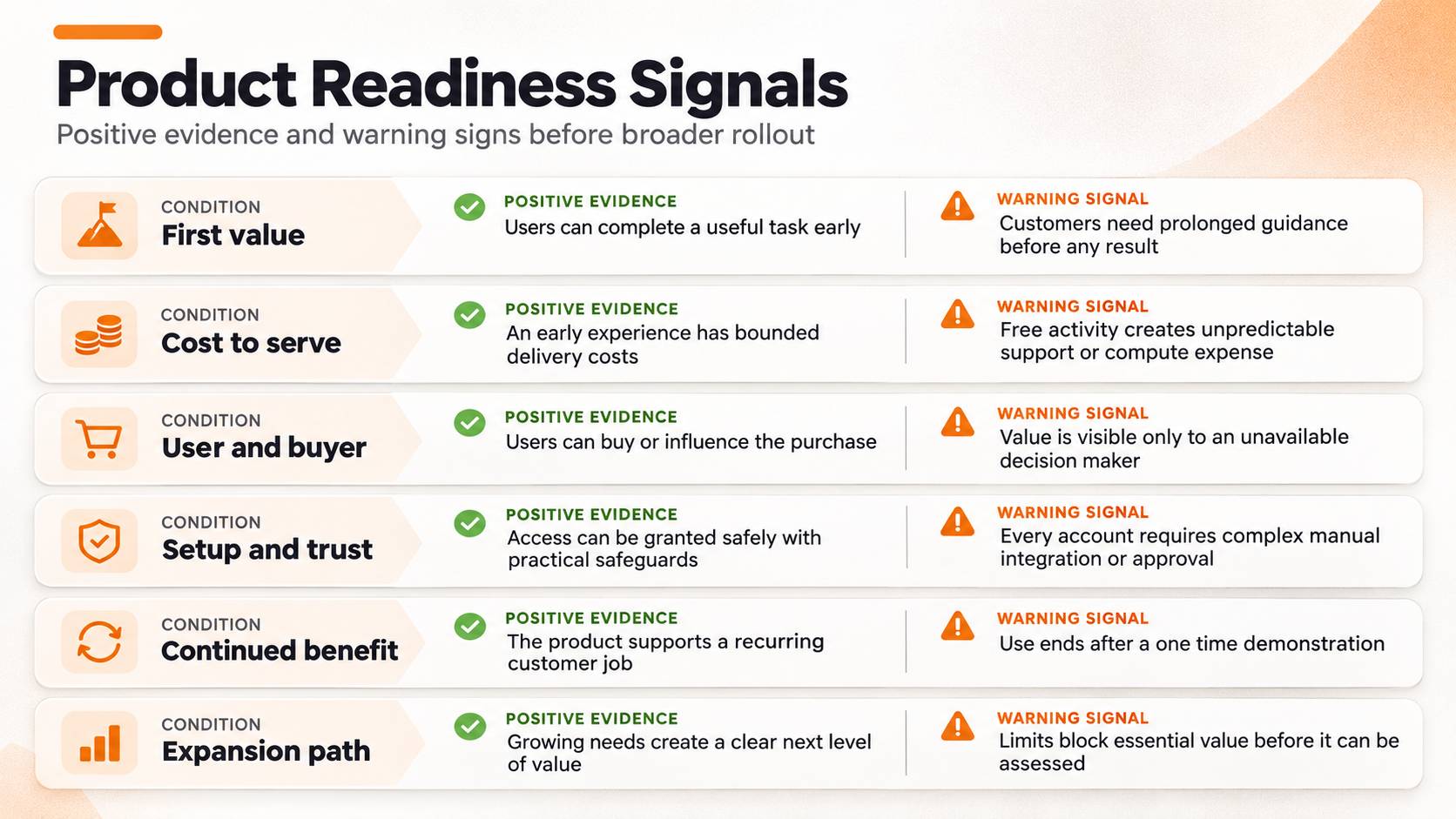
A positive result in one area does not cancel a serious problem in another. Fast signup means little when configuration consumes weeks, and attractive free usage can be destructive when infrastructure or support costs rise faster than the chance of conversion. A startup should begin with a contained experiment that tests real customer value and service economics before promising unlimited access.
Design the Journey Around a Real Customer Outcome
A product led journey starts with a person trying to complete a task, not with a funnel diagram. The startup should define the job the user wants done, the obstacles between arrival and completion, and the first moment when the product produces an observable benefit. That benefit may be a generated report used in a meeting, a shared design reviewed by a colleague, or an operational alert that prevented a mistake.
This is where Product Led Onboarding becomes more important than a collection of welcome screens. The onboarding experience should help a user complete a useful job with the fewest necessary steps. A checklist may help, but each item must serve the customer's goal. If the user needs to invite a teammate, connect a data source, or import a file, explain the immediate value of that request rather than treating it as a requirement to fill an empty dashboard.
A useful first session removes avoidable friction while keeping the steps that create trust and accuracy. Asking permission to connect sensitive data can be necessary. Demanding a long company profile before showing any value may not be. Early user interviews and session observations are often better at revealing this distinction than a generic onboarding benchmark.
Measure Activation as Evidence of Value
The goal of User Activation Metrics is to identify actions that predict a customer has experienced the core benefit of the product. Activation is not the same as registration, opening an email, or clicking a tutorial. It should describe a behavior that plausibly indicates value, ideally one that is associated with meaningful future use.
A reporting startup might initially count everyone who creates a workspace. That event is easy to observe, but it says little about the product promise. A stronger activation definition might require the user to connect a real data source, generate a first report, and view or share its findings. These actions better reflect the task the customer hired the product to perform.
Founders should validate the definition against retention and customer feedback instead of assuming that a complicated event is automatically a good metric. If activated users do not return, the milestone may be measuring effort rather than value. Segment the analysis by customer type and acquisition path so that very different usage patterns are not averaged into a misleading result.
Shorten the Time Until Customers Experience Value
The concept behind Time to Value in SaaS helps founders measure the delay between a user's meaningful entry into the product and the first verified customer outcome. The start and finish events must be explicit. Merely reducing the number of clicks is insufficient if the promised outcome remains out of reach.
For one product, time to value may be measured from account creation to sending a working invoice. For another, it might start after a customer connects a data source and end when a report reveals an actionable pattern. Teams should record why some users reach this point quickly while others abandon the process, separating technical obstacles from confusing instructions and mismatched expectations.
Reducing the delay can involve better defaults, sample content that clearly leads into real usage, progressive setup, or assistance at the point where a person is stuck. However, a superficial demonstration should not be recorded as real success. A product that shows a fictional result instantly but cannot deliver a useful result with a customer's own information has not solved the onboarding problem.
Build Retention Before Expanding Acquisition
Activation is only an early signal. A customer must continue to have a reason to return. A startup should identify the repeatable job its product supports and the natural frequency of that job. Daily use is not a universal standard. Quarterly planning software may be highly valuable even when it is not opened every morning.
Analyze retention by the cohort of users who began in the same period and had a comparable opportunity to return. Observe whether they repeatedly complete important workflows rather than simply leave browser tabs open. Combine the patterns with customer conversations to distinguish a product that has become useful from one that is temporarily interesting.
If the cohort does not return, buying more traffic usually amplifies the problem. Fix the missing value, unclear expectations, or unreliable experience before increasing acquisition spend. A product led business grows sustainably when new users reach value and existing users continue to experience it.
Choose a Free Experience That Supports the Business
The decision addressed by Freemium vs Free Trial is not simply whether to let customers use software without paying. It concerns how much value a prospective buyer can experience, when payment becomes appropriate, and what the startup can afford to provide. Freemium allows ongoing access within limits, while a free trial offers access for a defined period. Neither is universally superior.
A useful free tier should be complete enough to prove the central benefit but limited in a way that aligns with expanding customer value. Limits might concern collaboration, storage, advanced administration, or usage volume. Arbitrary restrictions that prevent the first meaningful outcome undermine the very reason to offer product access. Trials can work well when the value is discoverable within a realistic evaluation period and when users understand what changes after the trial ends.
Pricing, packaging, service cost, and customer expectations must be evaluated together. AI features can make the economics especially sensitive because a small number of heavy users may consume substantial compute resources. Clear usage limits, fair billing explanations, and accessible upgrade choices protect trust. PLG does not mean offering an unlimited service at a loss or delaying every conversation about commercial sustainability.
Introduce Human Sales When the Product Shows Readiness
A self service product can identify promising accounts before a sales representative ever reaches out. The idea behind Product Qualified Leads is to use meaningful product behavior, combined with customer fit, to determine when a human conversation might help. The signals should be relevant to the buying process, not simply evidence that a person clicked frequently.
For example, a team that has invited several colleagues, repeated a valuable workflow, and requested an administrative feature may be ready to discuss a larger plan. An individual experimenting with every page for a few minutes may not be. Account context, stated goals, and explicit requests can matter as much as usage events.
Make Customer Value Create More Customer Value
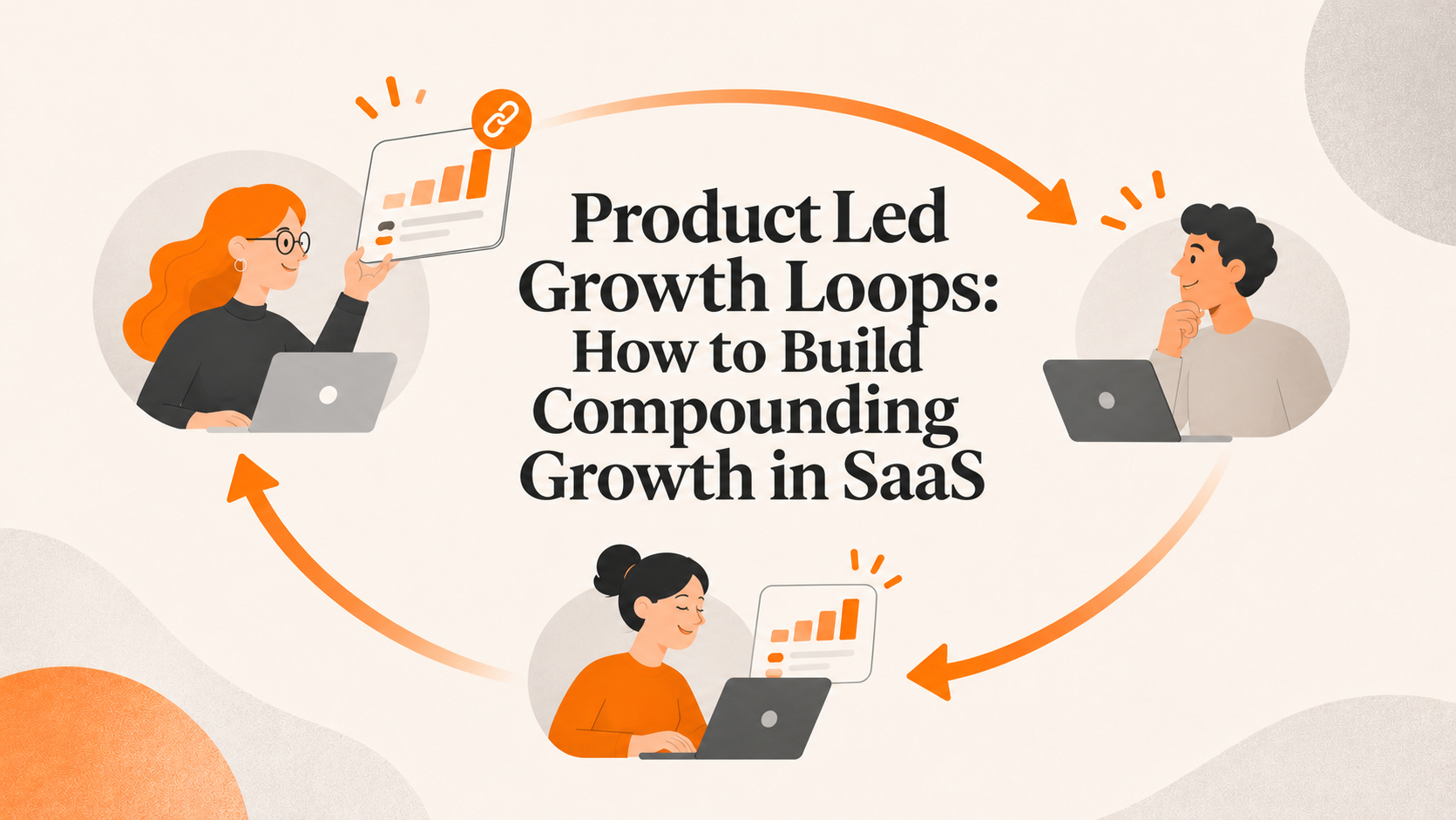
A growth mechanism becomes durable when completing the customer's job naturally introduces another person, workflow, or reason to return. The question explored by Product Led Growth Loops is how usage can create useful exposure or engagement that brings additional users into the product without relying only on repeated paid acquisition.
A collaborative document may become more valuable when colleagues review it. A useful public report may lead readers to create their own reports. An integration may make one team's workflow easier and create a practical reason for another team to adopt the same tool. In each example, growth follows the customer outcome rather than being imposed through excessive invitations or forced sharing.
Not every product has a viral loop, and forcing one can damage trust. A secure personal finance product, for instance, should not require public sharing to unlock basic value. Founders should seek mechanisms that are appropriate to the product, understandable to the user, and supported by observed behavior.
Track a Few Metrics That Lead to Decisions
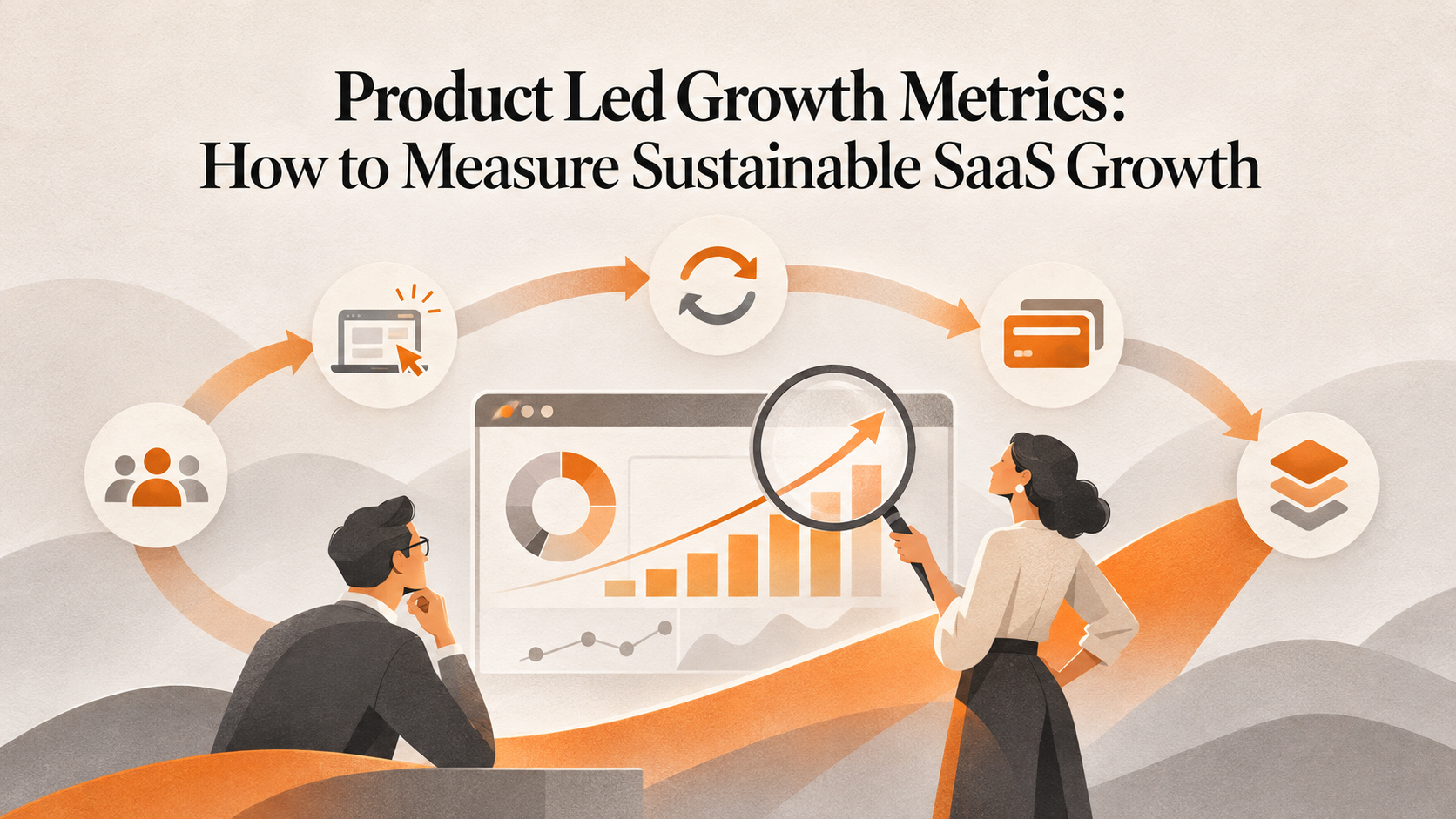
A useful framework for Product Led Growth Metrics connects customer actions to business decisions across the journey. It should separate acquisition from activation, initial value from repeat value, and expansion from simple account creation. The right metrics depend on how the product is used and purchased.
The Product Led Growth Decision Scorecard
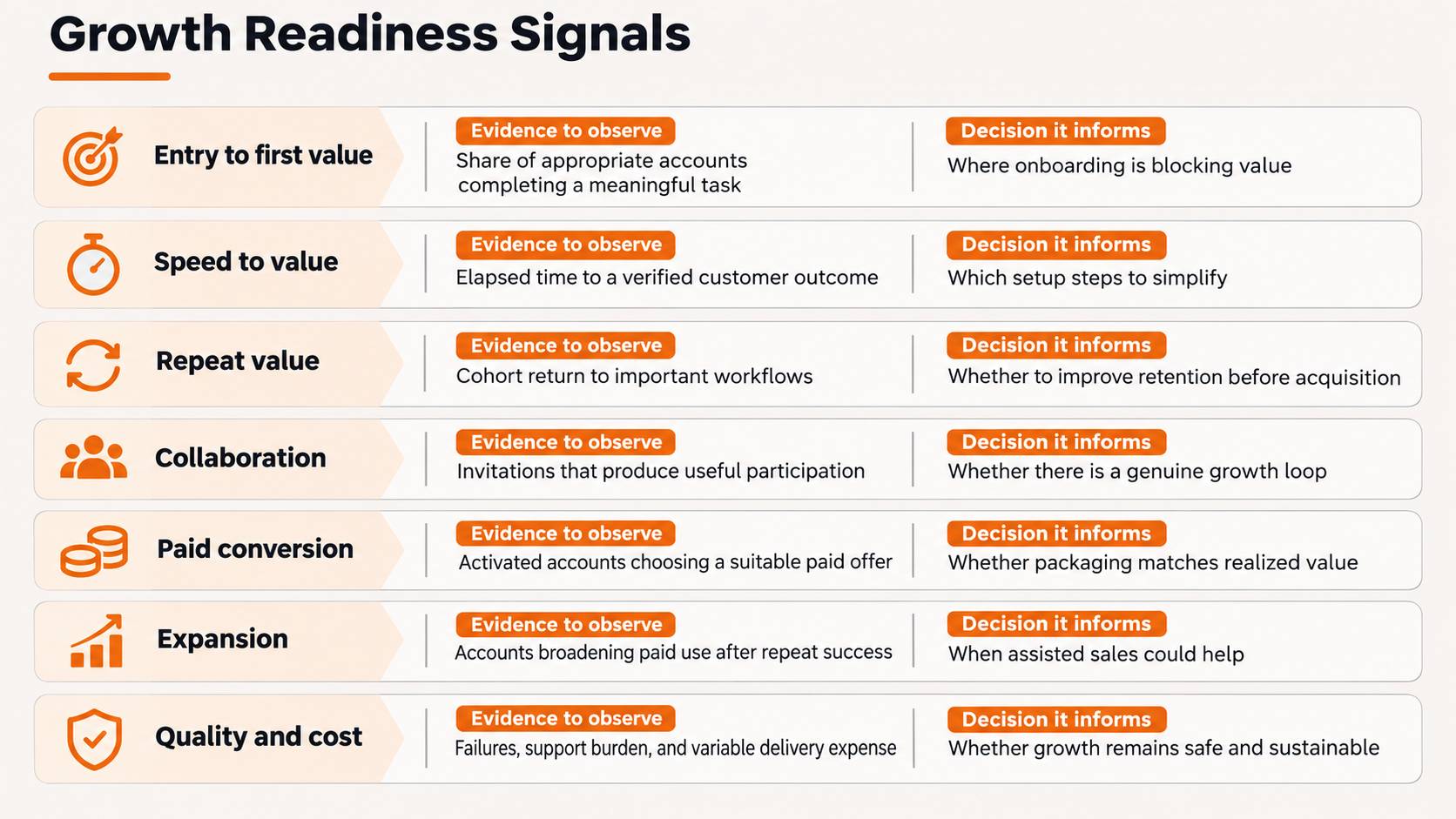
Every rate needs a clear denominator and time window. The percentage of accounts that activate is not the same as the percentage of individual users, and retention for customers acquired last week should not be compared directly with retention for accounts that have had a year to mature. A small startup may initially have too little data to interpret minor percentage changes; observed sessions and customer interviews can then explain why people do or do not progress.
A good dashboard is small enough that the founder can describe what action follows an unexpected result. If signup rises while first value falls, examine onboarding and expectation mismatch. If activation rises but repeat usage remains weak, focus on the ongoing job. If existing customers return but few are willing to pay, revisit who receives value, how packaging works, and whether the purchase opportunity appears at the right moment.
A Practical 90 Day Implementation Path
During the first 30 days, map the journey with real users and agree on one activation milestone. Watch customers attempt the core task, record the reasons for abandonment, and verify that the product can produce the promised result without excessive intervention. Establish a baseline for time to value and repeat behavior. Avoid expanding the free offer before its delivery cost is understood.
During days 31 through 60, remove the most consequential obstacles and test one meaningful change at a time. This may involve a faster setup, better defaults, a clearer invitation step, or a more appropriate first use case. Observe comparable groups where practical, and keep qualitative notes when the sample is too small for confident statistical conclusions.
During days 61 through 90, connect the customer journey to monetization and an appropriate growth mechanism. Test whether a meaningful free experience can lead to paid value, whether human assistance helps complex accounts, and whether use creates legitimate referrals or collaboration. Expand only when repeat value is visible and the associated support and delivery costs can be sustained.
Ninety days is a planning device, not a guarantee of product market fit. A product with a long deployment cycle may need a longer observation period. What matters is that each stage has a decision rule grounded in evidence, not simply a date on a calendar.
A Hypothetical Startup Example
Consider a fictional startup called SessionMap that helps small consulting teams build shared project status reports. Before testing a product led model, the founder required prospective customers to request a demonstration. Most conversations covered the same basic questions, but the team did not know whether independent use would produce a valuable outcome.
SessionMap introduces a limited workspace that lets a new user import a sample project, connect a real project, generate a shareable report, and invite a colleague. The team defines its first value event as creating and sharing a report based on real project information. In a hypothetical trial cohort of 120 signup accounts, 54 complete that event, 24 invite a colleague, and 15 repeat the reporting workflow in the following week. These are illustrative numbers, not company results or industry benchmarks.
The founder learns more from the gaps between stages than from the 120 signup total. Some users are confused by import requirements, while others complete a report but do not have a recurring reporting need. The first problem calls for onboarding improvement. The second may require a different target use case or more accurate expectations at signup. A paid plan is tested only after the team can articulate the ongoing benefit that justifies payment.
This example also shows why PLG does not eliminate direct sales. A larger consulting firm may want to negotiate organization controls and data retention commitments. The product can establish value before that conversation while a person remains responsible for resolving the contractual and operational requirements.
Common Mistakes That Weaken Product Led Growth
One mistake is treating free accounts as customers who have already received value. Another is designing the free offer primarily to generate traffic, then discovering that most users never reach the core outcome. A third is using a generic activation benchmark from another product category as though it applied to every customer journey.
Founders can also confuse retention with lock in, growth loops with unwanted invitations, and automation with the absence of human responsibility. These shortcuts can create attractive dashboards without producing a sustainable business. The stronger discipline is to make the product's value observable, preserve customer trust, and keep financial and operational limits visible.
Finally, teams often scale acquisition before understanding why successful users succeed. The most useful early question is not how to generate more signups. It is how to help the next appropriate customer reach an outcome that existing customers genuinely value and willingly repeat.
Product led growth can give a startup a powerful way to connect its promise directly to the customer's experience. It works when users can reach useful results, return for continued value, and progress toward a purchase or broader adoption without unnecessary friction. It is weaker when the product is difficult to evaluate independently or when the cost of free usage outweighs the business opportunity.
The founder's responsibility is to choose the right motion, observe real customer behavior, and improve the steps that separate curiosity from value. A product does not become a growth engine just because it has a signup form. It becomes one when the experience helps the right people succeed and gives the company reliable evidence about what to improve next.
FAQ
What is product led growth in simple terms?
Product led growth is a strategy in which people can discover a product's value through actual use, helping the product support customer acquisition, adoption, retention, and revenue.
Is product led growth only for SaaS startups?
It is most commonly associated with software and digital services that can deliver value with limited intervention. Other businesses can adopt product led elements, but fully independent evaluation is not practical for every product.
Does PLG mean a startup should not have a sales team?
No. Many startups combine independent product use with sales assistance for procurement, larger deployments, security reviews, and complex purchasing decisions.
What is the first metric a startup should track?
Start with a meaningful first value event that shows the user completed the core job. Confirm that it corresponds to continued value rather than simply counting signups or clicks.
Is a free trial better than a freemium plan?
The right choice depends on how quickly users can experience value, how often the product is needed, and what it costs to serve users. Neither model produces reliable growth automatically.
When is a startup ready to scale product led acquisition?
It should have credible evidence that suitable new users reach value, a meaningful share return, and the resulting commercial model remains sustainable. Small cohorts require cautious interpretation.

Mohsen Avid
Founder & Editor, PinerookMohsen Avid is the founder of Pinerook, covering entrepreneurship, startup strategy, digital business, and the decisions behind building new ventures.
 Seen first.