
What Is a Product Positioning Strategy?
A product positioning strategy defines the competitive context in which customers should understand a product and the specific reason they should choose it over available alternatives. It is not a tagline, a list of features, or an attempt to sound different. Effective positioning helps a buyer recognize what the product does, who benefits most, and why its strengths matter in a particular buying situation.
For startups, positioning is one of the practical decisions within a broader Go to Market Strategy for Startups. A team might identify a promising audience and still struggle to sell because buyers compare its product with the wrong category, expect capabilities it does not offer, or fail to see a compelling reason to abandon the status quo. Positioning brings those assumptions into the open before the company spends heavily on promotion.
Why Positioning Matters Before a Startup Scales
New products rarely compete in a vacuum. A founder may view another startup as the main rival while a buyer is actually choosing between a spreadsheet, an employee, an agency, an established platform, and doing nothing. These alternatives shape expectations about cost, risk, implementation, and results. A good position makes the comparison understandable on terms that reflect what customers genuinely value.
Poor positioning creates expensive confusion. Sales conversations start with explanations of the category instead of the problem, marketing attracts buyers with incompatible needs, and product teams receive contradictory feature requests. Strong positioning cannot rescue a product that lacks useful capabilities, but it can help the right prospects understand existing value more quickly and help the team learn why others decline.
Product Positioning Versus Branding, Messaging, and Value Proposition
Positioning is the strategic choice of where a product belongs in the customer’s mental map and what makes it preferable in that context. Messaging translates that choice into language used on pages, demonstrations, and sales materials. Branding shapes the broader identity and associations around a business. These activities reinforce one another, but an appealing name or memorable phrase does not establish credible positioning.
A value proposition describes the benefit a customer can expect. Positioning adds the comparison and context that make this benefit distinctive. The dedicated Value Proposition for Startups guide can explore how to express customer value in detail; this article focuses on choosing and defending the competitive frame in which that value becomes meaningful.
Start With the Alternatives Customers Actually Consider
The most useful first question is not which company looks similar on a competitor list. Ask a qualified buyer what they would do if your product disappeared tomorrow. Interview recent customers, prospects who declined, and people who solved the problem without buying software. Capture the substitute they would use, the decision criteria they mention without prompting, and what would make changing their current approach worthwhile.
Separate actual alternatives from hypothetical competitors. If five buyers compare you with a manual process and none mentions the largest enterprise platform, the manual process deserves more attention in early positioning. Record the circumstances around each decision, because an alternative that matters to a small operations team may differ from the one that matters to a regulated enterprise.
Identify Differentiated Capabilities and Prove Their Value
List the capabilities that truly differ from the alternatives buyers named. Consider workflow design, integration depth, implementation effort, service quality, access to unique data, or a specialized operating model. Generic claims such as easy, innovative, and powerful are weak unless a team can show what those qualities mean and why competitors or manual solutions cannot deliver the same outcome.
Translate each real difference into a consequence the buyer cares about. Faster setup might allow an operations manager to test a process before the next reporting cycle. A built in approval history might reduce reconciliation effort for a regulated team. Keep the supporting evidence beside the claim: a repeatable demonstration, verified customer observation, product log, or documented pilot result. Evidence from a small pilot is useful, but it should not be presented as a universal outcome.
Positioning evidence map
The table below shows how to move from an alternative and an observable capability to a claim worth testing. The examples are hypothetical and illustrate the reasoning rather than verified performance results.
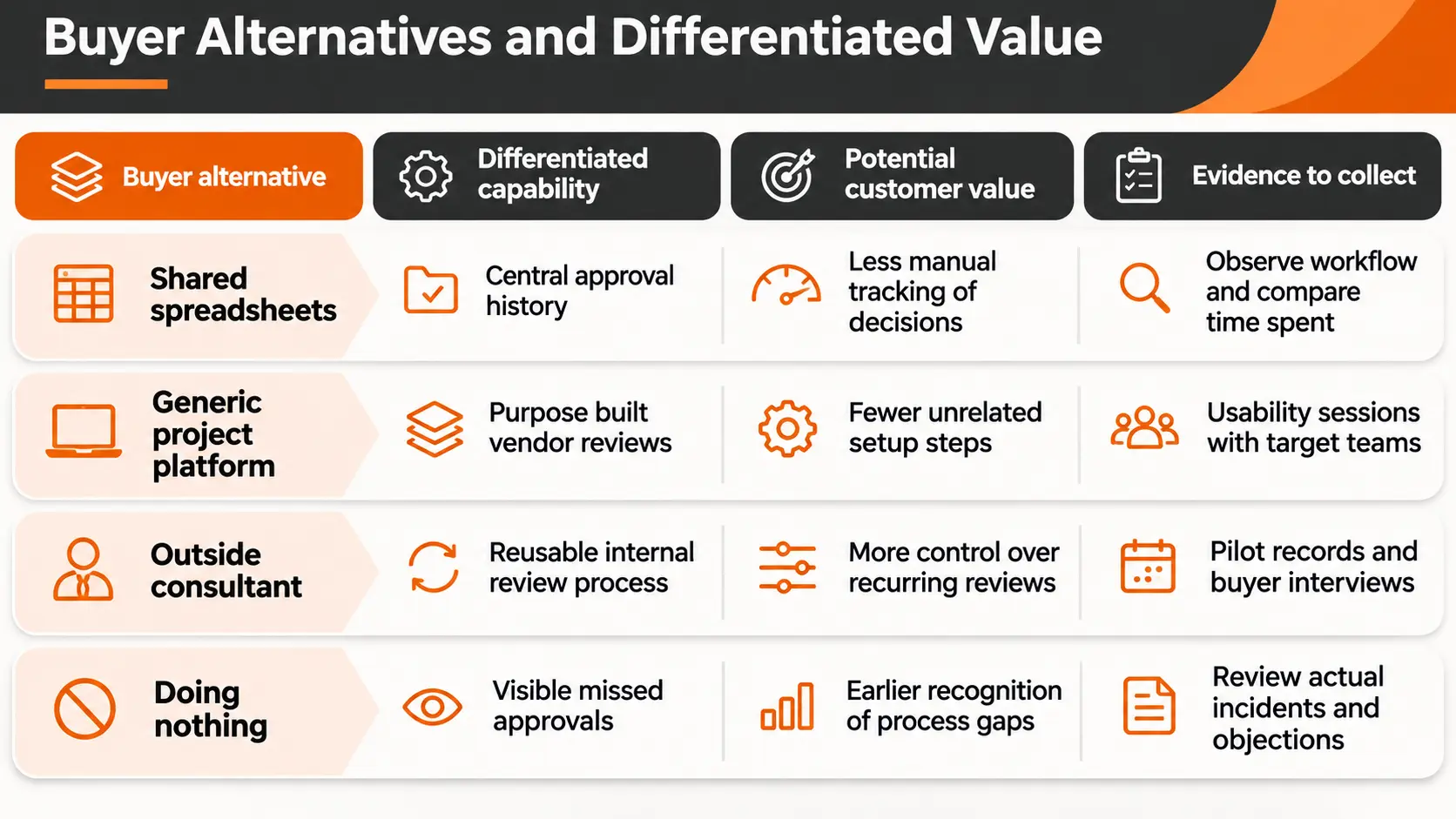
An evidence map prevents a product team from treating feature differences as self evident benefits. It also reveals where a promise is untested. When buyers do not value a capability, the right response is not necessarily more persuasive copy. The startup may need a different customer group, a different comparison, or a stronger product advantage.
Choose a Market Category That Clarifies the Product
A category gives buyers a shortcut for understanding what a product is and what questions to ask about it. Entering an established category can reduce education costs because customers already know why they might need a solution. The tradeoff is that the product will be compared with incumbent offerings on familiar criteria. A narrow category may make a specific strength more obvious, but it must still use terms buyers recognize.
Creating a completely new category is more demanding. A startup must explain not only why it is different but why a new comparison framework is necessary. Unless customer research shows that the established category makes the product misleading or invisible, a clear existing category with a defensible specialization is often a useful initial hypothesis. Evaluate category language by asking prospects what they think the product does before giving them a demonstration.
Connect Positioning to a Specific Buying Situation
Positioning becomes stronger when it reflects the moment a customer decides to change. A team hiring its first compliance manager, replacing a manual monthly report, or opening a new facility may be more receptive than a broadly similar team with no immediate trigger. This does not require redefining the whole market. It requires recognizing the situations in which a product advantage becomes unusually valuable.
Use evidence from the existing ideal customer profile rather than rebuilding an ICP in this article. In the same way, market segmentation determines which part of a market to prioritize; positioning explains how the chosen buyers should understand the product against their alternatives. Keeping these decisions separate helps each article and each commercial decision serve a distinct purpose.
A Practical Product Positioning Example
Imagine a fictional startup named Clearpath that helps regional manufacturers manage supplier approval workflows. The founders initially describe it as an artificial intelligence productivity platform. Buyers respond with questions about chat assistants, general automation, and content generation. The category invites comparisons that conceal the product’s actual strengths.
Customer conversations reveal that buyers mainly use shared files and email chains. The product offers an approval record, role specific reminders, and a focused vendor review workflow. The startup revises its position to supplier approval software for regional manufacturing teams that need a clear record of who approved what. This description does not claim the product is better at every task. It makes its particular use case and relevant alternatives more legible.
The team still needs to test whether that positioning reflects real purchase behavior. If buyers care much more about integration with their enterprise resource planning software than approval visibility, the message and perhaps the target category must change. Positioning is a working hypothesis supported by observed decisions, not a sentence declared permanent by the founder.
Validate the Position Before Rewriting Every Channel
A focused positioning test can use a small number of qualified prospects and recent lost deals. Show two alternative product descriptions without revealing which the founding team prefers. Ask what the product does, what they would compare it with, who should buy it, and what they would need to believe before evaluating it. Then observe whether the revised explanation improves the relevance of questions and the quality of follow up conversations.
Avoid treating clicks or favorable comments as proof of willingness to buy. Track whether the right prospects recognize the intended category, understand the advantage, request a relevant demonstration, and move through an actual evaluation. Sample sizes in early startups are often small, so document individual objections and context rather than presenting a few positive responses as statistically conclusive.
Validation should start with a simple comprehension exercise. Show the description to qualified prospects without presenting a sales pitch, then ask them to explain what the product does, what they would use instead, and who would benefit most. If they name an unexpected category or cannot distinguish the product from an alternative, revise the competitive frame before distributing the same message across every channel.
Next, test whether the stated advantage matters in a real evaluation. Review conversations with recent buyers and lost prospects, observe which benefits lead to relevant demonstrations, and record objections that persist even after the product is explained. Compare patterns across purchasing situations rather than interpreting one positive response as proof. If the category is clear but prospects still prefer their current process, investigate whether the claimed difference is meaningful or sufficiently supported by evidence.
Turn Positioning Into a Usable Internal Brief
Once the evidence is coherent, write a short internal positioning brief that names the buying situation, actual alternatives, differentiated capabilities, resulting value, and chosen category. Add the specific proof available for each important assertion and any audience that should not be targeted. A sales representative should be able to use the document to explain tradeoffs honestly, and a product manager should be able to see which customer needs matter most.
A simple draft can follow this logic: For teams facing a particular problem, the product belongs in a recognizable category and delivers a distinctive outcome compared with the alternatives they use today, because it has a capability the team can demonstrate. This is an internal reasoning aid, not necessarily the exact sentence that belongs on a homepage. External messaging should be shorter and adapted to the channel.
Common Product Positioning Mistakes
The first mistake is positioning against a famous rival instead of a buyer’s actual fallback. The second is leading with a feature that customers do not prioritize. The third is choosing an exciting category that creates expectations the product cannot meet. Another common error is trying to serve every possible buyer at once, which dilutes the comparison and weakens proof.
Teams also mistake a messaging refresh for a change in positioning. Replacing a headline may improve clarity, but it does not solve uncertainty about who buys, which alternatives matter, or what the product can prove. Finally, a successful position can lose relevance as the product, competitors, and buyer behavior change. Schedule a review when evidence changes, not merely because the marketing calendar calls for a new campaign.
FAQ
What is product positioning in simple terms?
Product positioning is the way a company helps the right buyers understand what its product is, which alternatives it competes against, and why it is useful for their specific situation.
How is product positioning different from a value proposition?
A value proposition expresses the benefit customers receive. Positioning establishes the competitive alternatives and market context that explain why that benefit is distinctive and credible.
Should a startup position against its biggest competitor?
Not automatically. It should begin with the alternatives buyers genuinely consider, which may include manual work, a service provider, an existing tool, or choosing not to act.
Can a startup position a product without paying customers?
Yes, as a testable hypothesis. Interviews, workflow observation, and early demonstrations can reveal likely alternatives and priorities, although real purchase evidence is needed to strengthen the conclusion.
When should product positioning change?
Review it when the product develops a meaningful new capability, the strongest buyers change, competitor alternatives shift, or customer conversations repeatedly contradict the current position.
Does positioning determine a startup pricing strategy?
Positioning influences which alternatives and benefits buyers compare, but pricing still requires separate research into willingness to pay, costs, packaging, and commercial constraints.

Mohsen Avid
Founder & Editor, PinerookMohsen Avid is the founder of Pinerook, covering entrepreneurship, startup strategy, digital business, and the decisions behind building new ventures.
 Seen first.