Startup market segmentation is the process of dividing a broad potential market into groups with meaningfully different problems, purchase conditions, or adoption behavior. For an early startup, its immediate purpose is to identify a specific group that can be reached, served, and studied before scarce resources are spread across a larger market.
Within a Go to Market Strategy for Startups, segmentation determines which opportunity deserves the first concentrated test. The strategy then addresses positioning, channels, launch execution, and measurement. A useful segmentation exercise does not end with a colorful chart of industries or demographics. It ends with a defensible choice, evidence that could disprove that choice, and a plan for learning from real customers.
What Market Segmentation Means for an Early Startup
Established companies often segment large customer databases to personalize campaigns or improve retention. A young company usually faces a different problem: there may be almost no customers to analyze and several plausible markets competing for the same limited budget. Its segmentation work must therefore rely on a combination of observable market characteristics, customer conversations, purchase evidence, and carefully labeled assumptions. The objective is not statistical precision before launch, but disciplined comparison between viable entry points.
A segment should contain customers facing a similar problem in a similar buying situation. Two businesses in the same industry may belong to different segments if one has an urgent compliance deadline and the other sees the problem as optional. Conversely, businesses across different industries may share a meaningful segment if they use the same workflow, have the same buyer, and can adopt the same product without extensive customization. Segment boundaries are useful only when they change a decision about whom to serve and how.
Distinguish Segments From Customer Profiles and Personas
Market segmentation groups the addressable opportunity into alternatives. An ideal customer profile describes the observable characteristics of a particularly suitable account or customer within a chosen opportunity. A buyer persona then helps a team understand the motivations and responsibilities of particular people involved in a purchase. These tools work together, but they answer different questions. A startup should not mistake a detailed description of one hypothetical buyer for evidence that an entire market segment is commercially attractive.
For example, a software company may consider independent clinics, regional medical networks, and large hospital systems as separate segments. Within independent clinics, its ideal customer might have multiple practitioners, frequent appointment changes, and an administrator who can approve a subscription. The administrator and the clinic owner may then represent different buyer roles. The market choice comes first; account qualification and individual messaging become more specific afterward.
Choose Segmentation Variables That Affect Buying Behavior
Classic frameworks distinguish demographic, geographic, psychographic, and behavioral segmentation, while company markets often add firmographic and technology characteristics. These categories are useful starting points, not a checklist to complete. The strongest variable is one that helps explain why a customer has a problem now, how difficult the sale will be, or whether the startup can reliably deliver the promised outcome. Several variables can be combined, but excessive complexity makes segments impossible to identify or test.
The table below connects common segmentation approaches with an actual startup decision. It also shows why a basic attribute alone rarely provides enough evidence to select an initial market.
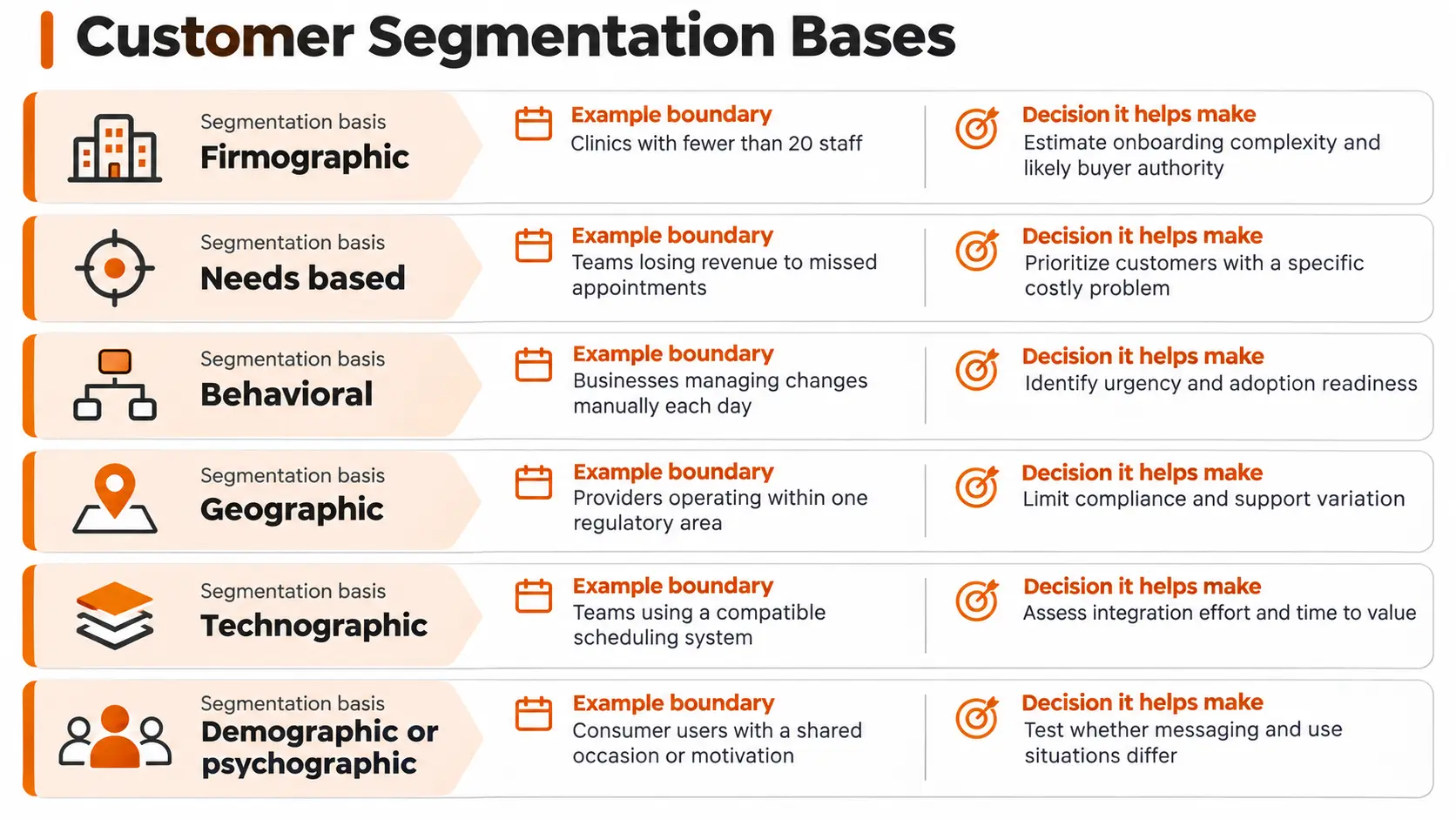
A segment built only from organization size is usually too broad. Combining a visible company attribute with a specific need and an observable trigger creates a stronger working definition. A founder might therefore target small clinics that still handle appointment changes manually and have recently expanded their practitioner count. That definition suggests both how to find prospects and what evidence to gather in interviews.
Build a Shortlist From Problems, Not Just Market Size
Begin with the problem a customer is already trying to solve. List three or four plausible groups in which the problem appears, then record the existing workaround, the person who feels the cost, and what would make buying urgent. Useful starting evidence includes support requests, professional communities, publicly visible job postings, customer interviews, or direct observation of a workflow. Third party market reports can establish context, but they rarely reveal which people will buy a new product next month.
The initial shortlist should contain groups that a small team can actually contact. A vast industry can look appealing in a presentation while offering no practical route to decision makers. Reachability matters because segmentation is an experiment as much as an analysis. If a startup cannot find prospects, understand their buying process, or observe their present behavior, it cannot test whether that segment is better than another one.
Compare Segments Using a Transparent Decision Score
A practical evaluation should look beyond theoretical revenue potential. Consider problem severity, access to the relevant buyer, ability to deliver value with the current product, friction in the purchase process, and speed of collecting evidence. Assign a simple score from one to five for each factor, using the same definitions across candidate groups. Scores are decision aids rather than measurements of market truth, and assumptions should be clearly distinguished from observations.
Consider a fictional startup that reduces scheduling failures for healthcare providers. The values in the following table are illustrative judgments, not industry benchmarks or research findings. Equal weighting makes the example easy to inspect; in practice, a founder can give greater weight to constraints such as implementation capacity or buyer access.
Validate Segment Boundaries Before Committing
Interview people in each leading segment about recent behavior rather than hypothetical interest. Ask what happened the last time the problem occurred, what workaround they used, who approved the existing solution, and what the problem cost in time or money. Look for differences that could change the product or route to market. When all candidate groups describe the same need, buyer, and adoption process, a complicated segmentation model may be artificial.
Then test a small commercial action. That might be a narrowly written offer to qualified accounts, a working prototype with a defined success criterion, or a paid pilot where appropriate. Track evidence by segment rather than combining results into one average. Reply rates, qualified conversations, completed trials, and actual commitments can expose differences that interviews miss. Avoid declaring one segment superior when sample sizes are tiny or outreach conditions differ substantially.
Document what would change the decision. A founder might choose independent clinics only if administrators can authorize a pilot within a manageable time and the integration works with existing systems. If those conditions fail, the next segment should already be defined rather than invented under pressure. The goal is a reversible market entry decision supported by explicit assumptions.
Translate the Chosen Segment Into Product and Sales Constraints
Once a first segment is selected, translate its shared needs into requirements. Define the minimum workflow the product must support, the buying roles the team must reach, the evidence needed to prove a useful outcome, and the support burden the startup can tolerate. The segment should also influence messaging, but detailed positioning and channel selection deserve separate work. Segmentation is successful when it narrows scope and helps the founder refuse attractive but distracting opportunities.
This discipline also limits premature expansion. A customer outside the selected segment may be worth serving if the product fits naturally, but a handful of exceptions should not force a new product direction. Record such demand as a possible adjacent segment and review it alongside the original evidence. Expansion becomes a deliberate second decision, not a series of unrelated feature requests.
Common Segmentation Errors That Distort the Decision
One recurring mistake is treating market size as proof of market accessibility. Another is segmenting by demographics or industry labels that do not explain differences in buying behavior. Teams also create too many segments, choose variables with no reliable data source, and confuse customer enthusiasm with purchase authority. These errors create polished charts but weak commercial hypotheses. A better segmentation model is smaller, observable, and connected to an action the company can test.
Founders should also resist changing segment definitions after seeing disappointing results. If the target was defined as clinics with a particular workflow, do not quietly expand it to every healthcare provider when the first outreach campaign fails. Investigate whether the message, product, timing, or original segment choice was wrong. Keeping definitions stable during a test makes the learning interpretable.
A Practical Decision Checklist
Before choosing an initial segment, confirm that its members can be identified through observable criteria, share a meaningful problem, and have a workable path to purchase or adoption. Verify that the startup can deliver value without unsupported customization and can learn from a small test within its current resources. Finally, write down the strongest contrary evidence and the trigger for revisiting the decision. A segment is useful because it makes priorities clearer, not because it predicts the future perfectly.
FAQ
What is startup market segmentation?
It is the process of dividing a broad potential market into groups with distinct needs, buying conditions, or behaviors so a startup can choose a focused initial opportunity.
Which segmentation method is best for a new startup?
There is no universal best method. A combination of a specific customer need, observable characteristics, and a meaningful purchase trigger is often more actionable than demographics alone.
How many segments should a startup test?
A small shortlist of two to four plausible groups is often manageable. The right number depends on the team’s ability to reach customers and compare evidence without diluting effort.
Can a startup segment a market without customer data?
Yes. Interviews, workflow observation, public information, competitor research, and small controlled tests can support an initial hypothesis. The uncertainty should be documented.
How is segmentation different from an ideal customer profile?
Segmentation identifies distinct groups within a market. An ideal customer profile specifies which accounts or people are the best fit within a selected group.
When should market segments be revised?
Revisit them when repeated customer evidence shows a different need, buying process, adoption constraint, or economic opportunity than the original assumptions.

Mohsen Avid
Founder & Editor, PinerookMohsen Avid is the founder of Pinerook, covering entrepreneurship, startup strategy, digital business, and the decisions behind building new ventures.
 Seen first.