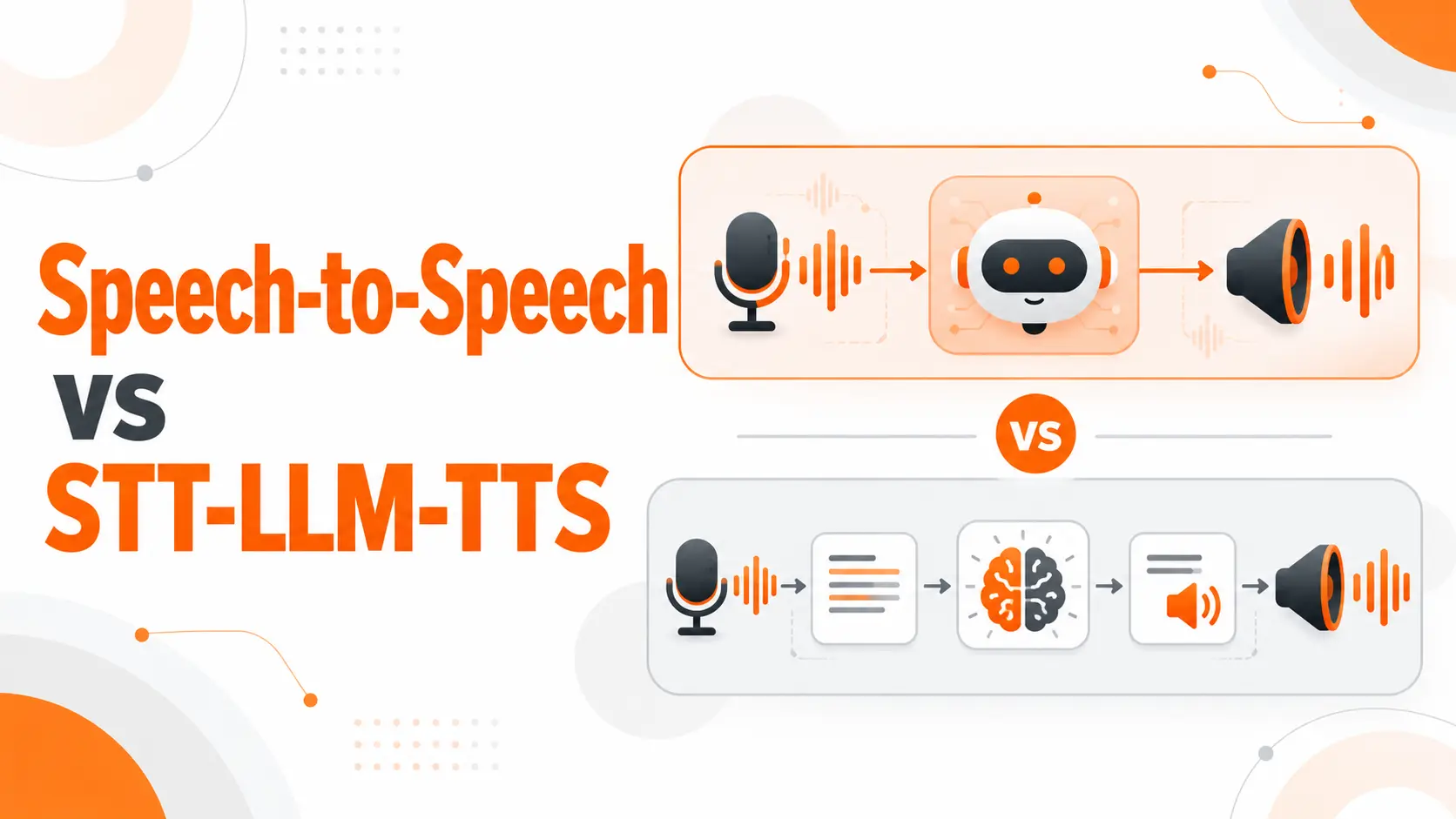
Native speech-to-speech and STT-LLM-TTS solve the same problem through different architectures. Speech-to-speech uses a realtime model to process incoming audio and generate spoken responses. STT-LLM-TTS converts speech into text, processes it with a language model, and turns the answer back into audio.
For AI Voice Agents that need reliable business integrations, detailed logs, and control over spoken responses, I would start with a streaming STT-LLM-TTS pipeline. For products built around expressive, natural conversation, native speech-to-speech deserves the first evaluation.
The right choice comes down to what your application must understand, what it needs to control, and how reliably it can complete a user's request.
Speech-to-Speech vs STT-LLM-TTS at a Glance
If I were choosing an architecture for a new voice product, I would start with its operational requirements rather than comparing model demonstrations.
A fast response means little if the agent cannot retrieve the correct account information. Likewise, a perfectly traceable system is not a strong fit for a conversation coach if its speech feels disconnected from the learner's tone.
Here's how the architectures compare.
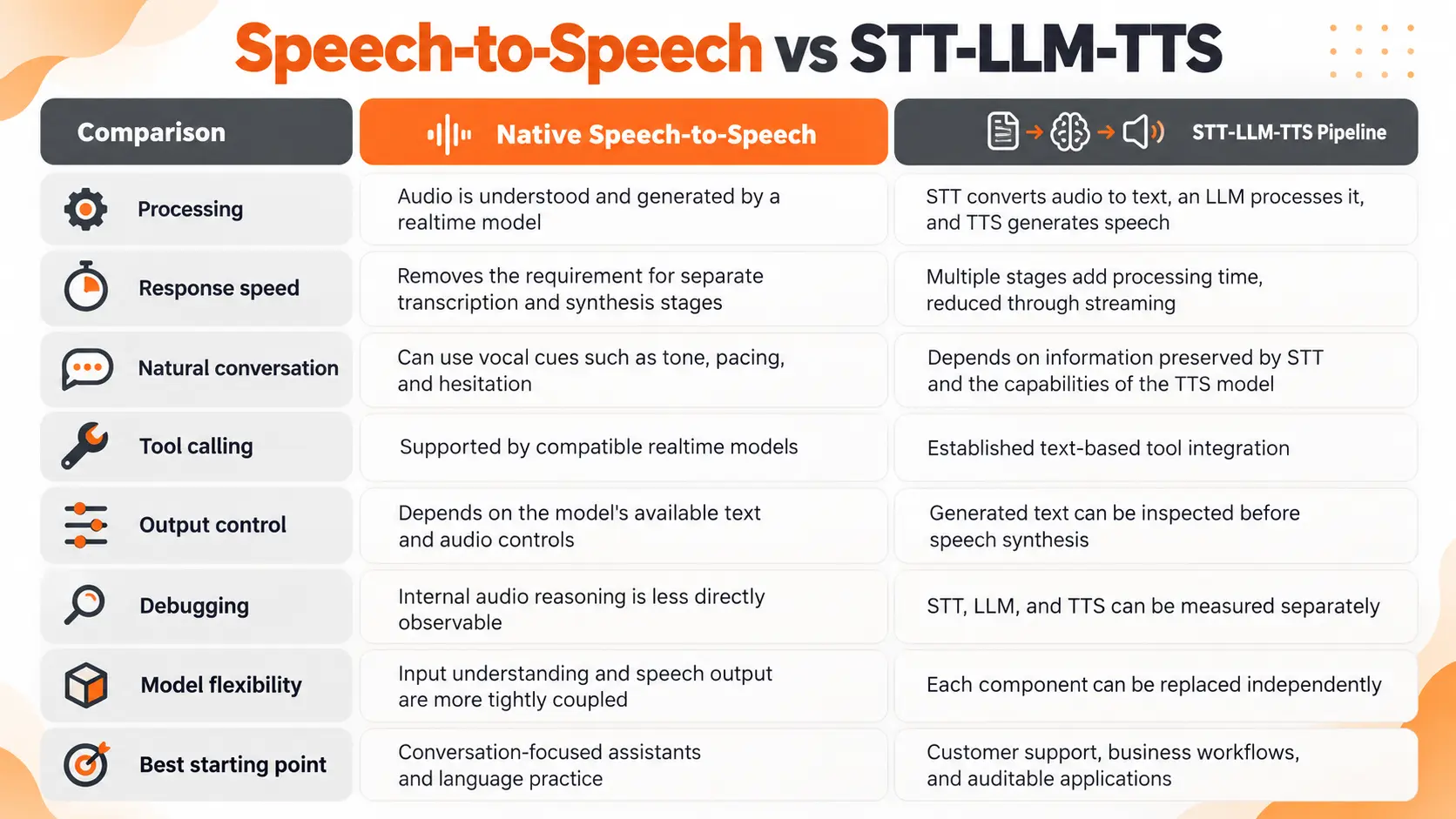
My decision rule is straightforward: choose STT-LLM-TTS when controlling and verifying the answer matters most. Evaluate native speech-to-speech first when understanding vocal expression and maintaining conversational flow are central to the product.
Neither architecture guarantees lower costs or better results across every workload. Those outcomes must be measured with the actual models and conversation scenarios.
How Both Voice AI Architectures Work
The biggest difference is not that one system speaks and the other doesn't. Both receive spoken input and deliver spoken output.
The difference lies in what happens between those two events.
Native Speech-to-Speech Architecture
A native speech-to-speech model processes audio directly and produces audio as its primary response.
Audio Input → Realtime Speech Model → Audio Output
The application does not need to connect three independent speech recognition, language generation, and speech synthesis services.
Because the model receives audio rather than only a transcript, it can use information contained in the speaker's delivery.
Consider someone saying:
"That's great."
The same words can express genuine satisfaction or disappointment depending on tone.
A native audio model has access to the acoustic signals needed to distinguish those possibilities, although the quality of its interpretation depends on the model.
This architecture can also reduce coordination between separate processing services.
That doesn't mean every native speech-to-speech system operates without text. Some realtime models generate transcripts, text responses, or tool calls alongside audio.
The defining difference is that a separate text-conversion pipeline is not required for the model to understand and answer spoken input.
STT-LLM-TTS Architecture
A cascaded pipeline divides the task into specialized components.
Audio Input → Speech-to-Text → LLM → Text-to-Speech → Audio Output
Speech-to-Text identifies the words spoken by the user.
The language model interprets the request, accesses connected tools when needed, and generates the response.
Text-to-Speech converts the resulting text into spoken audio.
I value this separation because every component has a defined responsibility.
If transcription quality declines, the team can investigate the STT model. If the answer is inaccurate, the language model and its supporting information can be examined separately.
A modern cascaded system also doesn't have to wait for every stage to finish before starting the next.
Streaming transcription, incremental language generation, and streaming TTS allow processing to overlap.
That makes the comparison more meaningful than simply describing native speech-to-speech as fast and pipelines as slow.
Latency and Conversation Quality
Response speed and conversational quality are closely connected, but they are not the same measurement.
I would assess both before making an architecture decision.
Response Latency
Native speech-to-speech avoids an obligatory chain of separate STT, LLM, and TTS services.
That architectural advantage can reduce the delay before an agent begins speaking.
A cascaded pipeline introduces multiple processing stages, but streaming can substantially reduce their combined waiting time.
For a fair comparison, I would measure two different outcomes.
Time to First Audible Response: The interval between the user finishing a turn and hearing the agent begin responding.
Time to Meaningful Answer: The interval until the agent provides the information or completes the action the user requested.
The distinction matters in business applications.
An agent can acknowledge a billing question immediately while still waiting for an external payment service to return the relevant information.
A faster acknowledgment does not establish faster task completion.
Vocal Expression
Speech carries more information than words alone.
Volume, timing, hesitation, emphasis, and speaking rhythm all contribute to the meaning of a conversation.
Native speech-to-speech models can process these acoustic cues directly.
In a text-based cascade, the central language model receives the transcription instead of the complete original audio signal. Vocal characteristics that are not represented in that text are unavailable to the LLM unless additional analysis passes them along.
This matters for applications such as language coaching, interactive storytelling, and expressive conversational assistants.
However, STT-LLM-TTS can still produce natural-sounding responses.
A high-quality TTS model can deliver expressive speech, and the application can supply speaking instructions or additional acoustic information when supported.
The difference is how the system obtains and uses those signals.
Interruptions and Turn-Taking
A conversational agent also needs to handle interruptions.
When a person starts speaking while the agent is responding, the system must decide whether to stop playback, continue listening, or treat the sound as a brief acknowledgment.
Neither architecture automatically solves this problem.
Native realtime models can support continuous audio interaction, while cascaded systems can use voice activity detection and turn-handling components.
The reliability of interruption handling depends on the model, audio transport, and conversation management.
I would test actual interruptions rather than assuming that an architecture with lower response latency also handles them better.
Tool Calling and Backend Integration
For customer support and SaaS products, this is one of the most important parts of the comparison.
A useful business voice agent needs to do more than generate an appropriate sentence.
It may need to retrieve an invoice, check a subscription, create a support ticket, or modify an account.
Tool Calling in Native Speech-to-Speech
Compatible realtime speech models support tool and function calling.
This means native speech-to-speech is not limited to conversation-only products.
The model can identify when an external action is required and request the application to perform it.
The key consideration is how the chosen API represents tool requests, manages conversation state, and resumes speech after receiving the result.
I would verify those capabilities against the exact provider and model before adopting the architecture.
Tool Calling in STT-LLM-TTS
In a cascaded system, the language model receives text and can use established tool-calling interfaces.
The application can validate arguments, apply business rules, execute authorized operations, and inspect the result before passing the final text to TTS.
This provides a clear point of control.
Consider a customer asking:
"Cancel my subscription at the end of this month."
The application needs to identify the account, verify the caller's authorization, interpret the requested effective date, and obtain any required confirmation.
I would not let the agent announce that cancellation is complete before the backend confirms the operation.
That rule applies to both architectures.
A cascaded pipeline gives the development team a direct text boundary at which to enforce the response policy before speech synthesis begins.
For workflows with financial consequences or account changes, that control is a significant advantage.
Transcripts, Debugging, and Output Control
A system that sounds impressive during a demonstration still needs to be maintainable after deployment.
When something goes wrong, the team needs evidence of what happened.
Component-Level Debugging
With STT-LLM-TTS, the processing stages are separately observable.
If the agent misunderstands a request, I would first inspect the transcript.
If the transcript is correct, I would examine the language model's response and any tool outputs.
If the text is correct but the customer hears the wrong pronunciation, I would investigate speech synthesis.
This separation reduces the number of possible causes for each issue.
Native speech-to-speech provides a different debugging challenge because audio understanding and generation are more tightly integrated.
Realtime services can expose conversation events, transcripts, tool calls, and audio outputs, but these do not necessarily reveal every internal processing step.
The available diagnostic information is specific to the provider.
Transcript Accuracy
A transcript is useful, but it is not a perfect record of what the model understood.
In an audio-native system, transcription can run as an additional process rather than as the mandatory input to the realtime model.
The resulting transcript is an interpretation of the audio. It does not prove exactly what the speech model perceived.
This distinction matters during investigations involving disputed information or inaccurate tool calls.
I would use authorized audio recordings alongside transcripts and execution logs when evaluating important failures.
A cascaded system also needs transcript verification because speech recognition itself can make errors.
Spoken Output Control
STT-LLM-TTS provides a clear opportunity to inspect generated text before converting it into speech.
That is useful when the application must follow an approved script or avoid stating unverified information.
Native speech-to-speech models provide different levels of control, depending on their APIs.
If exact wording is an essential requirement, I would verify that the architecture can reliably produce approved spoken content instead of relying solely on prompt instructions.
For regulated workflows, the architecture is only one part of compliance. Authorization, access control, retention policies, and operational safeguards still need to be implemented.
Cost and Scalability
I wouldn't choose an architecture based only on the advertised price of its primary model.
The relevant question is how much the system costs to complete a customer interaction successfully.
Speech-to-Speech Costs
Native speech-to-speech services can charge for incoming audio, outgoing audio, tokens, or other units defined by the provider.
Conversation length, retained context, and the selected model affect the bill.
The application can also incur costs for telephony, orchestration, tool execution, monitoring, and storage.
Using a single realtime model does not eliminate those expenses.
STT-LLM-TTS Costs
A cascaded pipeline has separate speech recognition, language model, and speech synthesis costs.
The team can optimize those stages independently.
For example, it can select a speech recognition model that performs well with telephone audio, a language model suited to the business task, and a TTS service that matches the required voice quality.
However, separate services also introduce integration and operational work.
The cheapest individual components do not necessarily produce the lowest total cost.
Comparing Costs Fairly
I would calculate cost using the same conversation workload for both architectures.
That includes the complete call duration, actual audio processed, model usage, external tool calls, infrastructure, and retries.
More importantly, I would track cost per successfully completed task.
Suppose one setup costs less per minute but requires more repeated questions to resolve an issue.
The additional conversation time and unsuccessful interactions can erase its apparent price advantage.
For a high-volume product, this comparison is more useful than choosing the provider with the lowest headline rate.
Half-Cascade and Managed Voice APIs
The choice is not restricted to two architectures.
Some applications benefit from combining their characteristics.
Half-Cascade Architecture
A half-cascade uses a realtime audio model for input understanding but delegates speech generation to a separate TTS system.
Audio Input → Realtime Model → Text Response → Separate TTS → Audio Output
This arrangement retains audio-native understanding while giving the application more control over the final voice.
I would evaluate it when a product needs to interpret tone and conversational signals but must also use a specific TTS voice or produce approved spoken text.
The realtime model must support a suitable text-output mode for this arrangement.
Half-cascade introduces an additional speech synthesis component, so its latency and operating cost need independent evaluation.
Managed Voice Agent APIs
Using one provider or API does not necessarily mean the application uses native speech-to-speech.
A managed service can expose a unified interface while running STT, LLM, and TTS as separate components internally.
That distinction matters when comparing features.
I would verify the underlying processing model and the controls available to the application before treating a unified API as equivalent to an end-to-end audio model.
Integration simplicity and architecture are separate decisions.
Choosing an Architecture for Real Products
The clearest way to make this decision is to examine what the application must accomplish.
Two fictional SaaS products illustrate the difference.
DeskFlow: SaaS Customer Support
DeskFlow operates a subscription management platform.
Its voice agent handles billing questions, account changes, and customer support requests.
A customer calls and asks:
"I was charged twice this month. Can you check my account?"
The agent must retrieve payment information, identify the relevant transactions, and explain the result accurately.
For this product, I would begin with STT-LLM-TTS.
The ability to inspect recognized text, validate tool calls, and control spoken responses directly supports the workflow.
DeskFlow also needs to investigate cases where an agent provides incorrect information.
A modular pipeline makes it easier to determine whether the problem originated in recognition, application logic, backend data, or speech generation.
Native speech-to-speech remains a viable option if the selected model meets the same functional and audit requirements.
But I would not make naturalness the primary selection criterion for an account-management workflow.
SpeakFlow: Language Learning Assistant
SpeakFlow is a fictional application designed for spoken English practice.
Users hold conversations with an AI tutor and receive feedback on their speaking skills.
A learner might say:
"I think the meeting went... pretty well."
Here, hesitation and vocal delivery provide information that the written sentence does not fully preserve.
I would evaluate native speech-to-speech first.
Its ability to process incoming audio directly makes it a strong candidate for conversational practice.
The evaluation would focus on natural response timing, pronunciation, interruption handling, and the model's ability to interpret spoken language accurately.
If SpeakFlow also needs precise phonetic assessments or structured corrections, specialized speech analysis components could still be added.
The application does not need to commit every feature to a single model simply because it uses native speech-to-speech for conversation.
Testing Both Architectures Before Launch
Architecture comparisons become useful when the test conditions are consistent.
I would prepare the same set of recorded conversation scenarios and evaluate each candidate with equivalent instructions, backend access, and business rules.
The test should include:
Response latency: Time to first audible response, measured from the caller's perspective.
Task completion: Whether the agent fulfills the request correctly.
Meaningful answer time: Time until the caller receives the required information.
Interruption handling: Whether the agent recognizes genuine interruptions without reacting to every background sound.
Tool reliability: Correct tool selection, valid arguments, and appropriate handling of failed API requests.
Cost: Total operating expense per successfully completed interaction.
I would also compare median and P95 response times under the expected number of concurrent conversations.
A system that performs well with one caller must still meet its requirements when traffic increases.
For voice quality, human listening tests remain important. Numerical latency measurements cannot establish whether speech sounds natural or whether conversational pauses feel appropriate.
Finally, I would test cases where the user changes their request, corrects the agent, or provides incomplete information.
Those situations expose how well the architecture supports recovery, not just successful scripted demonstrations.
Final Thoughts
Speech-to-speech and STT-LLM-TTS are different approaches to building voice applications, not competing answers to every problem.
Native speech-to-speech provides direct audio understanding and generation, making it a strong option for conversation-focused products.
STT-LLM-TTS provides clear processing boundaries, independent component selection, and greater control over text-based workflows.
I would choose the architecture that meets the application's hardest requirement, then evaluate response speed, user experience, and cost using realistic conversations.
For business workflows, that often means starting with a streaming cascade. For expressive spoken interaction, it means testing a realtime speech model first.
The final choice should be supported by reliable task completion, not architectural preference alone.
FAQ
Can I keep my current phone number if I switch architectures?
Yes, provided the telephony service supports routing calls to the new voice application. The phone number belongs to the telephony configuration rather than the AI processing architecture. Changing from a cascaded pipeline to speech-to-speech requires updating the media or application integration, not necessarily replacing the number.
Can the same voice agent handle callers who switch languages mid-conversation?
Yes, if the selected speech model or STT and TTS components support the required languages and code-switching behavior. The application should be tested using conversations that switch languages within a sentence, not just calls conducted entirely in one language.
Do I need a GPU to run either architecture?
Not when using cloud APIs that provide managed model inference. If the application runs models locally, hardware requirements depend on their size, implementation, and performance targets. A locally hosted realtime speech model can require substantially different resources from a lightweight speech recognition component.
What happens if my speech provider goes down during a call?
The application needs an explicit failure-handling strategy. A provider outage can interrupt audio processing or response generation. Depending on the available integrations, the system can reconnect, switch to a compatible backup service, or transfer the caller to another support channel. State preservation and avoiding duplicate actions are essential during recovery.
Can the agent read order numbers and email addresses back correctly?
Both architectures can produce spoken numbers and addresses, but accuracy must be tested. The application should verify critical identifiers against trusted data and use appropriate speech formatting or pronunciation controls. For transactions or account access, the caller should confirm important identifiers before the system performs the associated action.

Fatemeh Jahangard
Technology & AI Writer at PinerookFatemeh Jahangard covers AI, emerging technologies, and digital innovation for Pinerook, focusing on how technology shapes startups and industries.
 Seen first.