
Startup burn rate measures how quickly a company uses cash to finance its operations. For founders, it is one of the clearest ways to understand whether current spending can continue, how much financial flexibility remains, and whether growth is worth the money it consumes. Revenue can increase while cash falls, which is why monitoring sales alone cannot explain the financial position of a young business.
Spending more cash than the company collects is not necessarily a sign of failure. Some startups intentionally invest before their products generate enough revenue to support operations. Within the broader discipline of Startup Finance, burn rate connects those investments to available resources and business milestones. The relevant question is not simply how quickly money is leaving the company, but whether that spending is producing results and how long it can be supported.
This guide explains gross burn, net burn, the calculations behind them, and the difference between cash consumption and accounting losses. It uses a three month financial example and two alternative spending decisions to show how founders can interpret the numbers, protect liquidity, and avoid unnecessary cuts to activities that support growth.
What Is Startup Burn Rate?
Startup burn rate is the amount of cash a business spends or consumes over a defined period, commonly a month. The term is especially useful for companies whose operating payments exceed cash received from customers. These companies rely on existing cash reserves, previous financing, or other sources of liquidity to cover the difference. Burn rate helps quantify that reliance instead of leaving founders to judge it from the bank balance alone.
Burn should be reviewed alongside the company's stage and progress. A startup investing in product development before its first sale will have a different spending profile from a company with recurring subscription revenue. The same monthly cash consumption might be acceptable for a business with substantial reserves and validated demand but dangerous for a company approaching payroll with uncertain receipts.
Gross Burn Rate vs. Net Burn Rate
Gross Burn Rate
Gross burn is the total cash spent during a period under a consistently applied definition. For an operating burn calculation, founders typically include payments for employees, contractors, hosting, rent, marketing, support, and other normal operating activities. It describes the size of the company's operating cash commitments before customer receipts are considered.
Gross burn rate = Monthly operating cash outflows
Suppose a software startup pays $60,000 in payroll, $25,000 in marketing, $20,000 in infrastructure, and $15,000 in other operating costs during a month. Its gross operating burn is $120,000. This figure is useful for examining whether spending is increasing and which expense categories are responsible.
Net Burn Rate
Net burn is the cash shortfall after operating receipts are deducted from operating payments. It describes how much of the company's existing cash must be used to support its current operations when outflows exceed inflows.
Net burn rate = Operating cash outflows less operating cash inflows
If the same startup receives $50,000 in customer payments while spending $120,000, its net operating burn is $70,000. If receipts exceed payments, the calculation becomes negative, indicating positive operating cash generation under that definition. In that situation, founders should not use a negative burn figure in the usual cash runway division formula.
For clarity, funds raised from investors and new loans are financing inflows, not operating receipts. Recording a $1 million investment as customer cash would hide the company's underlying operating shortfall. Gross burn and net burn also should not be confused with the total change in the bank balance, which may include equipment purchases, debt repayments, or financing transactions.
How to Calculate Burn Rate From Actual Cash Activity
A reliable calculation begins with reconciled transactions and a clear reporting period. Review the cash flow statement or bank records, identify payments associated with ongoing operations, and apply the same classification each month.
Identify Operating Payments
Include cash actually paid for the operating activities covered by the metric. Payroll, contractors, marketing, rent, and software services are common categories, although the exact classifications depend on the company. Keep unusual investing and financing cash movements separately visible. An equipment purchase can reduce liquidity immediately without establishing a new recurring monthly operating cost. Ignoring that purchase entirely would also be a mistake when forecasting how much cash remains available.
Use Collected Cash, Not Invoiced Revenue
Count customer payments that actually reached the company during the period. A startup may recognize $90,000 in sales but collect only $65,000 before month end. The cash burn calculation uses the relevant $65,000 receipt, not the unpaid invoices. Likewise, customer payments received in advance can improve cash temporarily without establishing that all of the associated revenue has been earned.
Calculate the Monthly Results
Consider Harborline, a fictional software startup with $900,000 in unrestricted operating cash at the beginning of month one. Assume it has no investing, financing, or other cash movements during the three months shown. Under these conditions, changes in cash match net operating burn exactly.
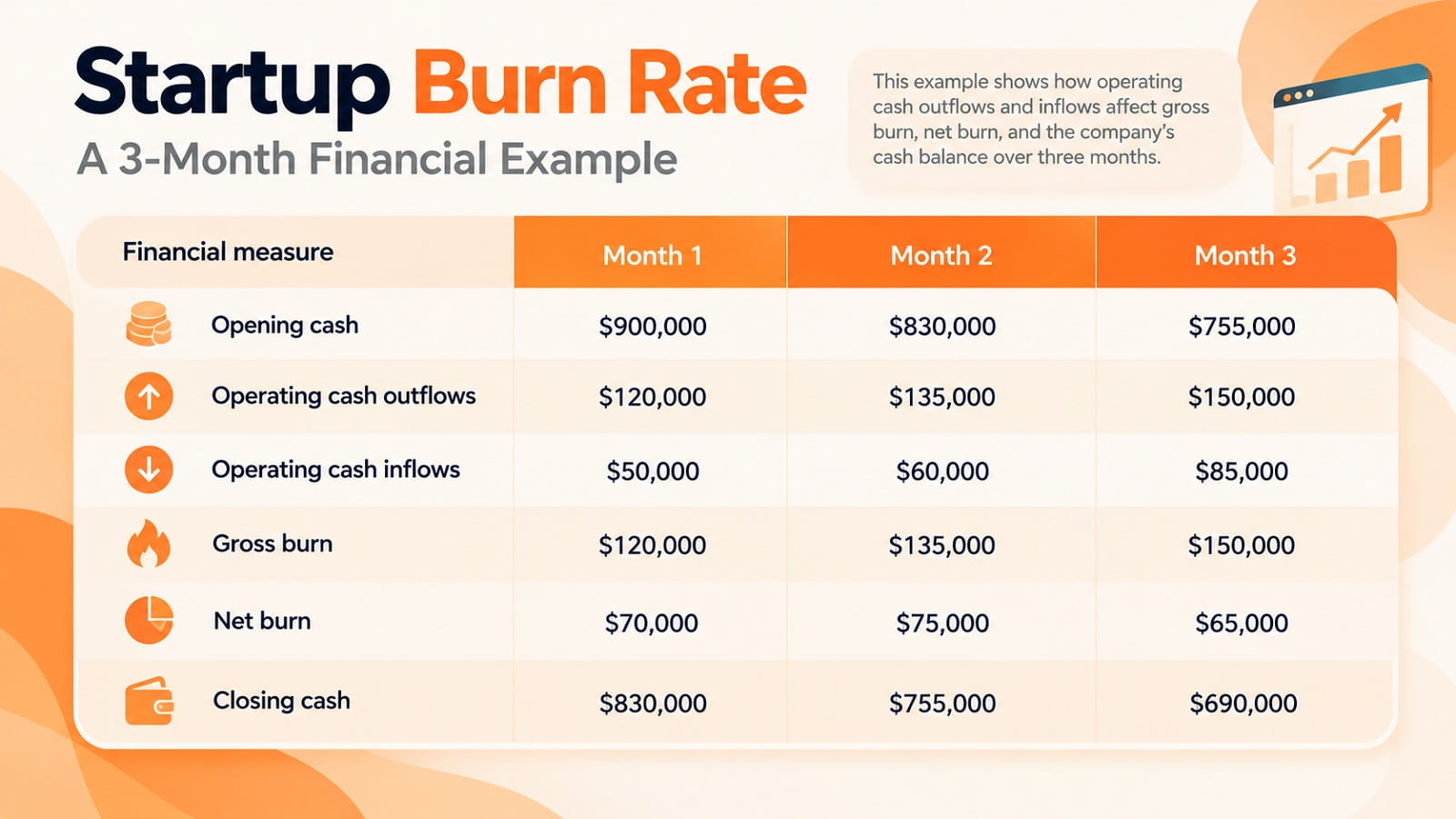
Harborline's gross burn rises each month, reaching $150,000 in month three. Its collections also grow, so net burn falls from $75,000 in month two to $65,000 in month three. This distinction matters: higher spending has not translated into a higher cash shortfall in the latest month, although management still needs to determine whether the improved collections can be sustained.
Across the three months, total operating payments are $405,000 and receipts are $195,000. The company therefore consumes $210,000 in cash. Dividing that amount by three produces average net burn of $70,000 per month; average gross burn is $135,000.
Why Burn Rate Is Different From Profit or Loss
Accounting profits and cash movements follow different rules. A company may recognize revenue when it earns it but receive payment weeks later. It may record depreciation as an expense without paying cash in the same period. Inventory purchases, equipment spending, and some debt payments can consume cash without creating an equivalent expense on that month's income statement.
For example, a startup might report an operating loss of $40,000 while consuming $65,000 of operating cash because customers have not yet settled their invoices. Another could receive a substantial annual subscription payment upfront and show better cash generation even though some revenue will be recognized in later months.
A further distinction is the difference between operating burn and total cash depletion. If Harborline spent an additional $80,000 on equipment in month three, its total bank balance would fall by another $80,000 even though its defined recurring operating burn might remain $65,000. Founders should reconcile the cash forecast to the actual closing balance and show exceptional outflows separately. Otherwise, the burn calculation could be accurate while the liquidity picture remains incomplete.
How Burn Rate Affects Cash Runway
Cash runway estimates how many months available funds might last if net cash consumption continued at an assumed pace. Its simple formula is:
Cash runway = Usable cash divided by monthly net burn
At the end of month three, Harborline has $690,000 of unrestricted cash. Using its average net burn of $70,000, the simple calculation gives approximately 9.9 months of runway. Using only the latest month's $65,000 burn would produce approximately 10.6 months. Neither estimate is a guaranteed survival date; each is the result of a different assumption about future spending and collections.
Runway calculations become less dependable when hiring, annual payments, seasonality, or customer collections are expected to change. A monthly forward cash forecast is more useful for decisions because it shows when payments occur and identifies the lowest expected balance. Founders should account for funds that are restricted or already committed and set a cash reserve appropriate to their obligations. A reported 10 months of runway may leave substantially less time to complete financing or reach an important commercial milestone.
When operating cash inflows consistently exceed outflows, simple runway based on net burn is no longer a meaningful finite figure. Even then, the startup still needs to forecast capital purchases, debt repayments, taxes, and future investment commitments.
What Is a Healthy Burn Rate for a Startup?
There is no universal monthly burn rate that signals a healthy company. Appropriate spending depends on its stage, business model, available capital, revenue reliability, and the milestones it is funding. Product research may require large payments before any sales occur. A services startup could collect customer revenue much earlier. Comparing the two using burn alone would ignore the reasons money is being spent.
Founders should instead ask whether spending is proportionate to progress and whether the forecast allows enough time to act if assumptions prove wrong. A higher burn rate may be justified if a company has evidence that additional capacity will improve customer delivery or generate durable revenue. The same spending may be difficult to defend when growth is slowing, customers are leaving, or the company depends on an unconfirmed financing round.
A useful discussion connects burn to measurable outcomes: product milestones achieved, customers acquired and retained, contribution generated, and cash required to reach the next decision point. Reducing burn is not always the best option. In some cases the better decision is to redirect spending away from weak experiments and toward work that has a credible economic return.
Measuring Spending Efficiency With Burn Multiple
For subscription companies with meaningful annual recurring revenue, burn multiple can help evaluate how efficiently cash consumption translates into recurring revenue growth. The common calculation compares net cash burn during a period with the increase in annual recurring revenue over the same period.
Burn multiple = Net cash burn divided by net new annual recurring revenue
Suppose a subscription startup consumes $210,000 over a quarter while adding $105,000 in net new annual recurring revenue. Its burn multiple is 2, meaning it used two dollars of net cash for each additional dollar of annual recurring revenue. That ratio can provide a useful comparison across periods when definitions remain consistent, but it does not establish the profitability or cash value of those customers.
The metric requires care when recurring revenue growth is zero, negative, or distorted by a small starting base. It is also less suitable for businesses that earn primarily transactional or project revenue. Founders should consider retention, margins, acquisition payback, and the quality of growth instead of treating a particular burn multiple as a universal target.
How to Control Burn Without Undermining Growth
Separate Essential Commitments From Optional Spending
Begin by examining what drives recurring operating cash outflows. Classify expenses by their business purpose, contractual flexibility, and relationship to important milestones. Unused subscriptions, duplicate tools, and capacity that is no longer required may be reduced with limited operational impact. Payroll, critical infrastructure, and obligations under signed contracts require more careful evaluation because their effects and termination conditions may be different.
Evaluate Hiring as a Cash Commitment
Hiring increases recurring payments before additional revenue or product results may appear. Model the fully loaded cost and the expected start date, then evaluate whether the role is essential to near term objectives. Delaying an optional position can preserve liquidity, but postponing a critical engineering or support hire may reduce product quality or slow commercial progress. The forecast should reflect both the cost and the likely consequences of the decision.
Improve Collection Timing
Review overdue invoices, contract payment terms, billing processes, and the customers responsible for large outstanding balances. Faster collections can relieve immediate pressure without changing prices or operating expenses. However, receiving an old invoice earlier is not the same as creating a permanent increase in monthly recurring collections. The cash forecast should distinguish one time timing improvements from durable changes in customer payment behavior.
Reallocate Growth Spending Based on Evidence
Marketing campaigns and sales programs should be examined against customers acquired, contribution margins, retention, and the time needed to recover acquisition costs. A channel that appears to produce many signups may still use too much cash if customers cancel quickly or require expensive support. Instead of cutting every growth budget equally, founders can reduce weak activities and maintain investment where the economics are supported by reliable evidence.
Compare Spending Decisions Before Approving Them
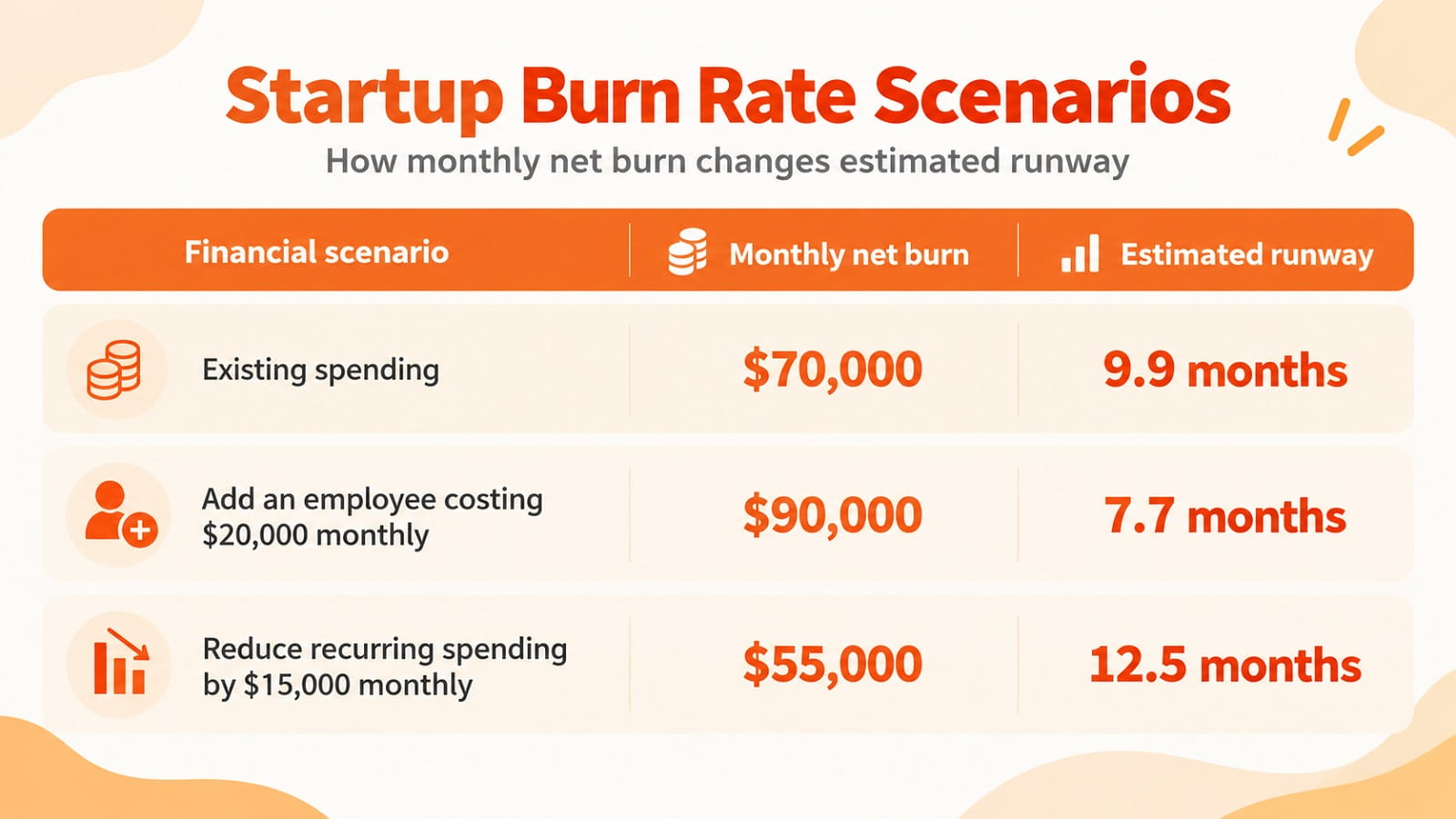
Under these assumptions, the new employee reduces estimated runway by about 2.2 months, while recurring savings extend it by about 2.6 months. But the direct comparison is incomplete until management estimates the impact of each change on revenue, product development, or customer service. If a hire makes the company capable of fulfilling valuable contracts, simply preserving cash may not be the stronger choice. If reducing an unused expense has no material operational impact, it may be a straightforward improvement.
For significant commitments, build a monthly forecast rather than relying only on the division formula. Show the planned decision, the milestone it should support, the date its benefit may appear, and what the company will do if that benefit arrives later than expected.
Common Burn Rate Mistakes to Avoid
One frequent error is using recognized revenue in place of cash collected. Another is allowing a new financing round to conceal the operating shortfall. Both make burn appear healthier than the cash generated by ordinary business activity supports. Inconsistent expense definitions also produce misleading trends, particularly when one month includes an unusual equipment purchase and the next does not.
Founders may also focus too heavily on the latest month's number. A delayed customer payment can create a temporary spike, while a large prepaid contract can make one month look unusually strong. Reviewing the underlying transactions and several consecutive periods helps distinguish timing effects from structural changes in the business. Likewise, a historical average should not override a forward forecast that already includes new employees or annual cash obligations.
Finally, the goal should not be to minimize burn at any cost. Eliminating spending that supports reliable customer demand could weaken the business and reduce its future ability to generate cash.
Establish a Regular Burn Review
Calculate gross and net operating burn monthly using reconciled records and consistent categories. Compare actual results with the previous forecast, explain material changes in costs and collections, and update the next several months of expected cash balances. When liquidity is tight, review available cash and upcoming obligations weekly rather than waiting for the monthly close.
Each review should finish with an action or a clear decision to maintain the existing plan. A spending increase may require a revised hiring forecast; slower collections may call for payment follow up; and weaker revenue could trigger a review of optional commitments. Assign responsibility for these actions and revisit the assumptions at the next review.
FAQ
How Do You Calculate Startup Burn Rate?
Add operating cash payments for the chosen period to calculate gross burn. Subtract operating cash receipts from those payments to calculate net burn. Use actual cash movements, consistent categories, and the same reporting period for both figures.
Does Burn Rate Include Investor Funding?
No. Equity financing and new borrowing should not be treated as operating cash receipts when measuring net operating burn. They increase available liquidity, but they do not improve the underlying cash result of business operations.
Can Net Burn Be Negative?
Yes. When operating cash receipts exceed operating cash payments, calculated net burn becomes negative, indicating positive operating cash generation. The company still needs to consider nonoperating cash needs before concluding that its overall cash position will increase.
Is Higher Burn Always Bad?
No. Spending can rise for legitimate reasons, including product development or serving validated demand. Its sustainability depends on available resources, forecast cash requirements, and evidence that the spending supports meaningful business outcomes.
How Often Should Founders Review Burn?
Monthly calculations are practical for many startups. Companies with limited liquidity should also monitor short term cash commitments more frequently. Burn should be evaluated alongside cash forecasts, customer collections, and planned investments.
Final Thoughts
Startup burn rate gives founders a practical view of how operating activities consume cash. Gross burn shows the scale of spending; net burn shows the shortfall after operating receipts. Neither number tells the entire financial story without a forecast of upcoming obligations and an assessment of what the spending is achieving.
A useful burn management process combines consistent calculations, realistic cash projections, and decisions linked to business milestones. By recognizing spending trends early and separating essential investments from avoidable costs, founders can protect financial flexibility while continuing to pursue growth supported by evidence.

Mobina Khanki
Venture & Funding Writer at PinerookMobina Khanki covers venture capital, startup funding, fundraising, and startup finance for Pinerook, focusing on founders and investors.
 Seen first.