A startup can generate strong sales, attract new customers, and develop a promising product while still struggling to pay its bills. The problem often comes down to timing. Revenue may be recorded before customers actually pay, while employee salaries, software subscriptions, supplier invoices, and other expenses require cash on specific dates. Without a reliable system for monitoring these movements, founders may discover a liquidity problem only when an important payment is approaching.
Effective startup cash flow management helps founders understand when money enters and leaves the business, anticipate potential shortages, and make financial decisions before those shortages disrupt operations. Within the broader framework of Startup Finance, managing cash flow connects everyday financial activity with a company's ability to operate, invest, and grow. It requires more than checking the bank balance or reviewing monthly revenue because neither provides a complete picture of future financial obligations.
This guide explains how to manage startup cash flow, build a reliable forecast, monitor actual financial performance, improve customer collections, and control outgoing payments. It also examines the warning signs of liquidity problems and uses practical financial examples to demonstrate how payment timing can affect a startup even when its overall financial position appears stable.
What Is Startup Cash Flow Management?
Startup cash flow management is the process of monitoring, forecasting, and controlling the movement of money into and out of a business. Its primary purpose is to ensure that sufficient cash is available when the company needs to meet its financial obligations.
Cash inflows commonly include customer payments, while cash outflows include payroll, contractors, software subscriptions, infrastructure expenses, taxes, and supplier payments. Other movements may result from purchasing equipment, receiving investment capital, or borrowing money.
Effective management requires understanding both the amounts and timing of these transactions. A company may expect to receive $100,000 from customers during a month, but if most payments arrive after payroll is due, it can still experience a temporary cash shortage.
Founders therefore need to look beyond the total money expected during a reporting period. They must understand when individual receipts are likely to arrive, which payments cannot be delayed, and how these movements affect the lowest available cash balance.
The objective is not simply to maintain a positive balance. It is to preserve enough liquidity to support essential operations while making informed decisions about growth and investment.
Why Cash Flow Management Matters for Startups
Startups frequently operate with unpredictable revenue, changing expenses, and limited access to additional financing. Customer acquisition may take longer than expected, product development can require unexpected investment, and new operating commitments may increase spending before additional revenue becomes available.
Cash flow management gives founders earlier visibility into these financial pressures. It helps determine whether the business can meet its next payroll, afford planned hiring, or withstand delays in customer collections.
Reliable cash information also improves decision making. A founder considering a major marketing campaign can examine whether the expected cash balance will remain sufficient after the campaign begins rather than relying exclusively on projected revenue.
Negative cash flow is not automatically evidence of a failing startup. Some businesses deliberately invest more cash than they collect while developing products or building customer demand. However, that spending must be supported by available financial resources and realistic expectations about future cash requirements.
A consistent management process helps founders distinguish planned investment from unexpected financial deterioration.
Understanding the Three Types of Cash Flow
Business cash movements are commonly classified as operating, investing, and financing activities. Separating these categories helps founders understand where cash originates and how it is being used.
Operating Cash Flow
Operating cash flow reflects receipts and payments associated with normal business activities. Customer collections are a typical inflow, while payroll, supplier payments, and many routine operating expenses are outflows.
This category reveals whether the company's everyday operations are generating or consuming cash. A startup may report growing revenue while operating cash flow remains negative because customer collections do not yet cover recurring payments.
Investing Cash Flow
Investing cash flow includes cash movements associated with acquiring or disposing of certain long term assets and investments.
For example, purchasing equipment or qualifying capital assets can create significant payments outside ordinary operating expenses. These transactions still affect available cash and must be incorporated into financial forecasts.
Financing Cash Flow
Financing cash flow includes money received from investors, borrowing, and payments associated with financing arrangements.
Receiving $500,000 from investors increases the available cash balance, but it does not demonstrate that the startup's normal business activities have become financially sustainable.
Founders should therefore distinguish customer generated cash from investment or borrowing proceeds when evaluating business performance.
Cash Flow vs. Profit: Why the Difference Matters
Profit and cash flow are related, but they measure different aspects of financial performance.
Profit reflects revenue and expenses recognized according to accounting rules. Cash flow reflects money actually received and paid during a period.
Suppose a startup provides $80,000 in services during April and records the related revenue. If the customer does not pay until June, the company can report April revenue without receiving the corresponding cash in April.
Meanwhile, employee salaries and other obligations still require payment.
The reverse can also occur. A customer may purchase an annual software subscription in advance, creating an immediate cash receipt while the company recognizes the corresponding revenue over the service period.
Such an arrangement improves immediate liquidity but creates an obligation to continue delivering the service.
This distinction explains why founders should evaluate cash movements separately from profitability. A profitable business can face serious financial pressure when customer payments arrive too late to cover essential commitments.
How to Build a Startup Cash Flow Management System
An effective cash management system does not necessarily require expensive software. At an early stage, a carefully maintained spreadsheet can provide useful financial visibility when the underlying information is accurate.
The system should connect reconciled cash balances, expected customer collections, upcoming obligations, and regularly updated forecasts.
Step 1: Establish the Available Cash Balance
Begin with the company's reconciled bank and cash account balances. Confirm which funds are genuinely available for normal business operations and identify any restricted amounts separately.
Outstanding transactions also matter. A payment that has already been initiated may not yet appear in the bank balance, even though the money has effectively been committed.
Founders should establish a consistent opening cash balance and ensure that future obligations are recorded in the periods when they are expected to be paid.
Step 2: Identify Expected Cash Receipts
Review outstanding customer invoices, recurring subscriptions, scheduled payments, and other anticipated cash receipts.
The expected collection date matters more than the date a sale was completed.
A customer with contractual payment terms of 30 days may consistently pay after 45 days. Forecasting the receipt on day 30 could overstate the cash available during the intervening period.
Confirmed or highly predictable receipts should be distinguished from uncertain sales opportunities. Potential customer contracts should not automatically be treated as money available to pay upcoming obligations.
Step 3: Record Upcoming Cash Payments
List payroll, taxes, supplier invoices, contractor payments, subscriptions, financing obligations, and planned investments according to their expected payment dates.
Pay particular attention to occasional expenses. Annual software renewals, insurance premiums, and large supplier payments may create temporary financial pressure that is hidden when expenses are averaged across several months.
A useful forecast reflects the actual timing of commitments rather than distributing all expenditure evenly.
Step 4: Calculate Net Cash Flow
Once receipts and payments have been identified, calculate the net movement during each period.
Net cash flow = Cash inflows less cash outflows.
Closing cash = Opening cash + Net cash flow.
A positive result means more cash entered the company than left during the period. A negative result means cash payments exceeded receipts.
The closing balance becomes the opening balance for the next forecast period, creating a continuous view of future liquidity.
Step 5: Establish a Minimum Operating Reserve
A cash forecast becomes more useful when management defines the minimum amount it wants to maintain for essential obligations.
This reserve should reflect payroll, supplier commitments, tax requirements, payment uncertainty, and the company's ability to access financing.
It is an internal management threshold rather than a universal requirement.
Once the threshold is established, founders can identify the first forecast period when available cash may fall below it and investigate the cause before immediate payment difficulties arise.
How to Create a 13 Week Cash Flow Forecast
A 13 week cash flow forecast projects expected receipts, payments, and closing cash balances across approximately one quarter.
Weekly forecasting is particularly useful because financial shortages can occur even when monthly totals appear healthy.
For example, a startup expecting $200,000 in customer receipts and $170,000 in payments during a month might appear to have a positive overall cash movement of $30,000. However, if payroll and supplier invoices are due before most customer payments arrive, the company could temporarily lack enough cash to meet its obligations.
A weekly forecast makes those timing differences visible.
Organize Receipts and Payments by Week
Start with the current reconciled cash balance and assign expected receipts and payments to the weeks when money is likely to move.
Payroll should appear in its scheduled payment week. Supplier obligations should reflect agreed terms, while customer collections should account for actual payment behavior.
Major investments and financing transactions should be identified separately to avoid confusing ordinary operating activity with exceptional movements.
Update the Forecast Every Week
At the end of each week, replace estimated receipts and payments with actual figures.
The actual closing balance becomes the opening position for the following week. Remaining forecasts should then be revised using the latest customer information, payment commitments, and operating plans.
Add a new week to the end of the forecast so the business continues to maintain a rolling 13 week view.
A forecast should not remain unchanged simply because it was approved at the beginning of a month. Its usefulness depends on reflecting new financial information.
Maintain Both Weekly and Monthly Views
A weekly forecast supports operational decisions, while a monthly forecast provides a broader view of future financial requirements.
Many startups can use weekly forecasts for immediate liquidity management alongside monthly projections for longer term financial planning.
Both should rely on compatible assumptions. If the weekly forecast shows that an important customer payment has been delayed, the monthly forecast should reflect the same change.
A Practical Six Week Startup Cash Flow Example
How Customer Payment Delays Affect Cash Flow
How to Compare Forecast Cash Flow With Actual Results
Preparing a forecast is only the beginning. Its value increases when management compares expected cash movements with actual transactions and investigates meaningful differences.
This process is often called cash flow variance analysis.
For every completed week, founders should compare forecast receipts with actual receipts, forecast payments with actual payments, and the resulting cash balance with the amount previously expected.
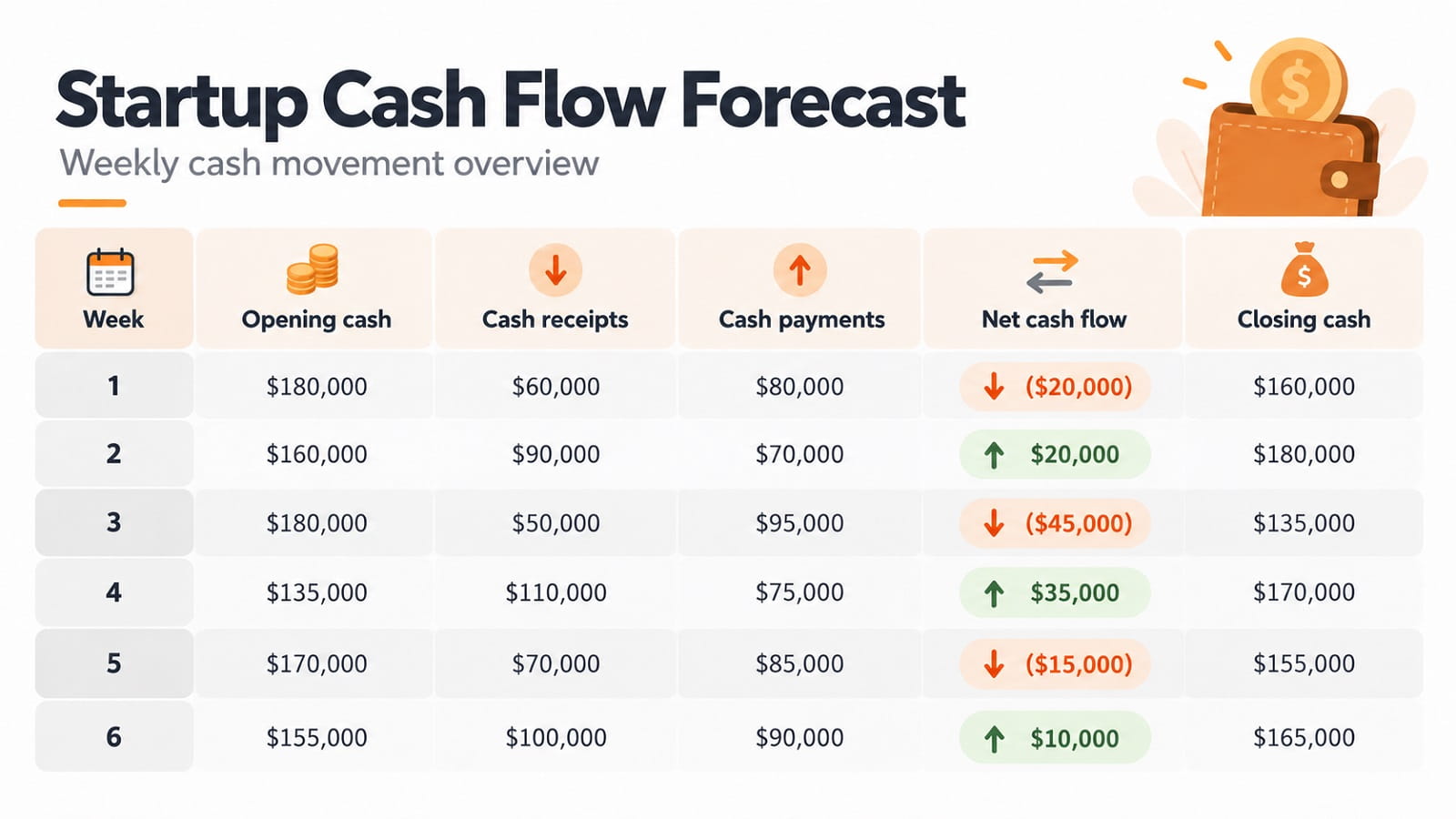
Consider Harborstone's original week three forecast. The company expects to begin with $180,000, collect $50,000, pay $95,000, and finish with $135,000.
Suppose only $25,000 is collected during that week because a customer delays payment. At the same time, an unexpected supplier expense increases cash payments to $100,000.
Actual closing cash would be $105,000 rather than $135,000, creating an unfavorable difference of $30,000.
The revised balance would also fall $15,000 below the company's minimum operating reserve.
Management should determine whether the missing $25,000 will arrive the following week and whether the additional $5,000 expense is an isolated event or part of a continuing increase in costs.
If the delayed payment arrives during week four, actual week three closing cash of $105,000 plus revised week four receipts of $135,000, less planned payments of $75,000, produces a revised week four closing balance of $165,000.
The forecast can therefore show both the immediate shortage and the expected recovery.
A useful variance review does not simply record that actual figures were different. It identifies why the difference occurred, whether it is temporary, and how it changes future financial decisions.
Warning Signs of Startup Cash Flow Problems
Liquidity problems often develop gradually. Recognizing early warning signs allows founders to make adjustments before essential payments are affected.
Cash Falls Below the Operating Reserve
A projected or actual balance below the minimum operating reserve indicates that the company has less financial flexibility than management considers necessary.
Founders should identify the obligations responsible for the decline and determine whether the problem can be addressed through improved collections, spending adjustments, or additional financing.
Customer Payments Become Less Predictable
A growing number of overdue invoices can indicate increasing financial pressure, particularly when a small number of customers account for a large share of expected receipts.
Management should monitor collection patterns rather than relying exclusively on contractual payment dates.
Operating Payments Grow Faster Than Collections
If recurring payments increase more quickly than customer cash receipts, the business may need additional financial resources to support normal operations.
This development should be evaluated against planned investments and expected future returns rather than automatically treated as evidence that all spending must be reduced.
Forecast Accuracy Continues to Deteriorate
Frequent and significant differences between actual receipts and forecast amounts may indicate that underlying assumptions are unrealistic.
Unexpected supplier payments, repeated collection delays, and missing financial commitments can make forecasts less dependable.
Management should improve the quality of transaction information and revise assumptions rather than continuing to use inaccurate projections.
Essential Payments Depend on Unconfirmed Financing
A startup may expect investment capital or a new loan, but anticipated financing cannot pay current obligations until the money becomes available.
When essential payments depend on transactions that have not been completed, the company faces additional liquidity risk.
How to Improve Startup Cash Flow
Improving cash flow requires identifying the sources of unnecessary delays, inefficient spending, and poorly timed commitments.
The most effective response depends on the company's business model and financial position.
Improve Invoicing and Customer Collections
Invoices should be issued promptly, payment terms should be clearly communicated, and overdue balances should be reviewed consistently.
Automated billing can reduce administrative delays for recurring customers.
Advance payments or deposits may improve liquidity when they are commercially appropriate, although the company must still account for its obligation to deliver future products or services.
Discounts offered for faster payment should also be evaluated carefully because improved collection timing may come at the cost of reduced revenue.
Manage Supplier Payment Terms
Supplier payment schedules should be incorporated into the cash forecast according to agreed obligations.
Where appropriate, founders can negotiate terms that better align outgoing payments with expected customer collections.
However, delaying payment beyond agreed dates without consent can damage supplier relationships, interrupt essential services, and create additional costs.
A sustainable approach protects liquidity while respecting contractual commitments.
Review Recurring Expenses
Software subscriptions, infrastructure services, outsourced work, and administrative expenses can accumulate as a company expands.
Management should regularly examine whether these commitments remain necessary and whether resources are being used effectively.
Eliminating unused services may preserve cash without materially affecting operations.
Larger spending reductions require more careful analysis because removing essential development or customer support resources could damage future business performance.
Plan Growth Investments Around Liquidity
Hiring, marketing campaigns, infrastructure expansion, and equipment purchases may require substantial cash before generating additional collections.
Before approving major commitments, founders should forecast their effect on future cash balances.
An investment may be commercially valuable but financially difficult to support if its payment schedule creates a shortage before the expected benefits arrive.
Management should evaluate both the economic value of an investment and the company's ability to finance it at the required time.
Working Capital and Cash Flow Management
Working capital is generally calculated as current assets less current liabilities.
For startups, managing customer receivables, supplier payables, and inventory can have a significant effect on liquidity.
Accounts receivable represents money customers owe the company. Accounts payable represents amounts owed to suppliers and other creditors.
A startup may report substantial receivables while holding relatively little cash because customers have not yet paid.
Businesses that maintain inventory face additional challenges because cash may be spent purchasing products long before those products are sold.
Software startups may be more affected by subscription payment schedules, customer invoices, and prepaid operating services.
Efficient working capital management reduces unnecessary delays between paying for operations and collecting money from customers.
Cash Flow Management at Different Startup Stages
Cash management priorities change as the company develops.
Early Stage Startups
Early stage businesses often have limited customer collections and relatively predictable essential expenses.
Their main priority is maintaining visibility over available cash and ensuring that product development and operating commitments can be supported.
A simple weekly forecast may be sufficient when transaction volume is low.
Growing Startups
As customer numbers and staffing increase, cash movements become more complex.
Growing startups need stronger collection procedures, spending controls, and regular reconciliation.
Revenue growth should not be assumed to eliminate liquidity pressure because operational spending may increase before additional sales are collected.
Startups Preparing for Expansion
More established startups may need to coordinate cash requirements across multiple products, teams, or markets.
At this stage, forecasting should support investment decisions, financial reporting, and financing discussions.
Clear responsibilities and consistent financial information become increasingly important as transaction volumes grow.
Establishing a Practical Cash Flow Review Routine
A reliable review routine helps ensure that financial decisions are based on current information rather than outdated forecasts.
At the beginning of each week, management should confirm available cash, review receipts expected during the coming days, and identify upcoming payment obligations.
The team should then compare the previous week's forecast with actual transactions and investigate significant differences.
Particular attention should be given to overdue customer invoices, major supplier payments, and projected balances approaching the operating reserve.
At the end of each month, founders can evaluate broader collection trends, recurring expenditure, and whether the business is maintaining sufficient financial capacity for planned investments.
One person should be responsible for maintaining the forecast, even when several team members provide financial information.
Clear ownership improves consistency and helps prevent important payment obligations from being overlooked.
The process should remain proportionate to the complexity of the startup. A small business may use a spreadsheet and a short weekly review, while a growing company may need accounting integrations and more formal financial controls.
Common Startup Cash Flow Management Mistakes
One frequent mistake is relying entirely on the bank balance. The current balance does not reveal which financial obligations are approaching or whether expected customer receipts will arrive in time.
Another is confusing revenue with collected cash. An unpaid invoice does not provide funds for payroll until the payment is received.
Founders may also overlook occasional expenses such as annual subscriptions, tax installments, insurance payments, or equipment purchases. These transactions can create substantial pressure when they are missing from forecasts.
Overly optimistic collection assumptions are another common problem. Expected receipts should reflect realistic customer payment behavior rather than ideal contractual terms.
A forecast can also become misleading when management fails to update it after significant hiring decisions, spending changes, or customer payment delays.
Finally, businesses sometimes focus on closing cash at the end of the month while ignoring temporary shortages during earlier weeks.
An effective process should identify the lowest expected cash balance during the forecast period and determine whether essential obligations can be met throughout that period.
Final Thoughts
Startup cash flow management is essential because financial obligations must be paid with available money, not projected revenue or accounting profits.
An effective system begins with accurate cash balances, realistic collection assumptions, and a complete schedule of upcoming payments. Regular forecasting then reveals periods when available cash may become insufficient.
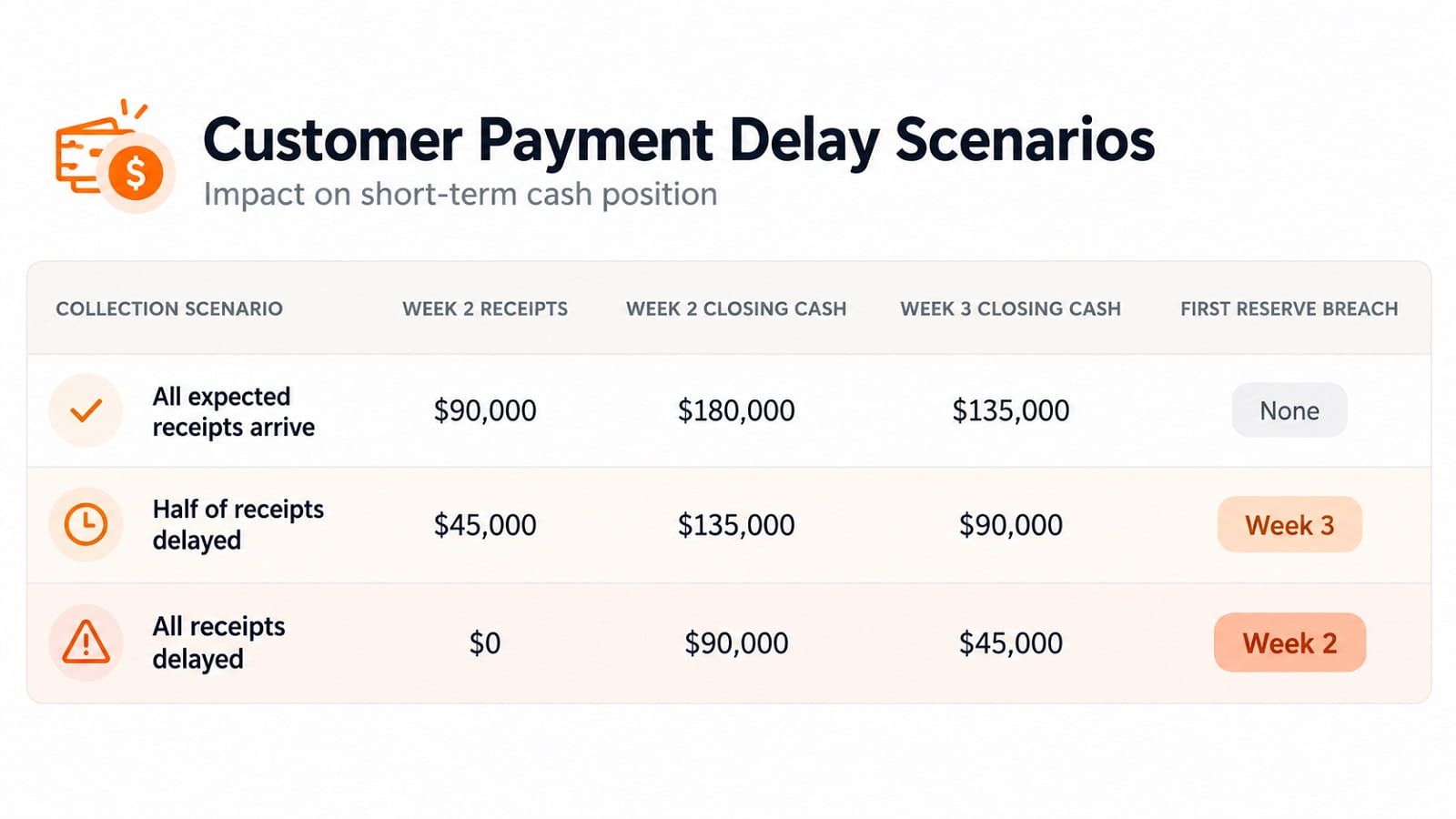
The Harborstone example demonstrates why timing matters. The company can finish a six week period with a relatively stable cash balance while experiencing serious liquidity pressure if customer payments arrive later than expected.
By reviewing actual cash movements, investigating forecast differences, monitoring financial warning signs, and making deliberate spending decisions, founders can maintain greater control over liquidity and preserve the flexibility needed to support sustainable growth.
FAQ
What Is Startup Cash Flow Management?
Startup cash flow management involves monitoring, forecasting, and controlling cash receipts and payments to ensure that a business has sufficient liquidity to meet its obligations. It focuses on both the amount of money moving through the company and the timing of those movements.
How Can a Startup Improve Its Cash Flow?
A startup can improve cash flow by collecting customer payments more efficiently, controlling unnecessary expenses, reviewing supplier payment terms, and planning major investments around available resources. Regular forecasting helps founders identify which actions are most relevant to their financial position.
Why Can a Profitable Startup Have Cash Flow Problems?
Profit and cash flow are measured differently. A business may recognize revenue before collecting the related payment, while salaries and supplier obligations require cash. This timing difference can create a liquidity shortage even when accounting profits are positive.
What Is a 13 Week Cash Flow Forecast?
A 13 week cash flow forecast projects cash receipts, payments, and closing balances for each week over approximately one quarter. It helps management identify specific periods when cash may become insufficient and adjust upcoming commitments accordingly.
Is Negative Cash Flow Always Bad for a Startup?
Not necessarily. Some startups deliberately consume cash while developing products or investing in growth. However, negative cash flow must be supported by sufficient financial resources and realistic plans for future obligations.
How Often Should Startups Review Cash Flow?
Many startups benefit from reviewing cash forecasts weekly and examining broader financial trends monthly. Companies with limited liquidity or unpredictable payments may need more frequent monitoring.
How Is Cash Flow Different From Burn Rate?
Cash flow describes money entering and leaving the company, including the timing of individual receipts and payments. Burn rate measures the pace at which the startup consumes cash. Cash flow management provides a broader operational view of liquidity and financial commitments.
Can Cash Flow Management Prevent a Startup From Running Out of Money?
Cash flow management cannot guarantee that a company will avoid financial difficulties. However, accurate forecasts and regular reviews can identify potential shortages earlier, allowing founders more time to adjust spending, improve collections, or evaluate financing alternatives.

Mobina Khanki
Venture & Funding Writer at PinerookMobina Khanki covers venture capital, startup funding, fundraising, and startup finance for Pinerook, focusing on founders and investors.
 Seen first.