
Startup financial planning turns business goals into realistic revenue forecasts, expense budgets, and cash projections. It helps founders understand how much money their company needs, whether planned investments are affordable, and how different operating outcomes may affect financial stability. For early stage startups, a well structured financial plan is especially valuable because customer demand, future revenue, and operating costs are often uncertain.
A startup can attract customers and demonstrate promising growth while still struggling to meet its financial obligations. This usually happens when spending commitments grow faster than available cash or when expected customer payments arrive later than planned. Within the broader discipline of Startup Finance, financial planning provides a framework for connecting business objectives with available resources. It allows founders to evaluate investments, identify financial constraints, and prepare for changes before they become serious problems.
This guide explains how to create a startup financial plan, from setting business milestones and forecasting revenue to estimating expenses, managing cash requirements, and testing alternative scenarios. It also includes a six month financial example demonstrating how revenue growth, customer payments, and hiring decisions affect a startup's financial position.
What Is Startup Financial Planning?
Startup financial planning is the process of forecasting a company's financial performance and determining how its resources should be allocated to support business objectives. It involves estimating revenue, expenses, investments, cash requirements, and the financial consequences of operating decisions.
Unlike financial reporting, which primarily describes past performance, financial planning focuses on future possibilities. It helps founders answer practical questions about what their business can afford and what needs to happen for planned growth to become financially sustainable.
A startup financial plan is not simply a document prepared for investors. It should function as an operating tool that management updates as the business develops. When customer acquisition improves, the forecast should reflect the expected additional revenue and delivery costs. When sales decline, it should reveal whether existing cash can support operations and which spending commitments may need adjustment.
Financial planning is particularly challenging for startups because historical information may be limited. Founders often need to make decisions using assumptions about customer behavior, pricing, development schedules, and future expenses. A useful financial plan makes these assumptions visible and shows how different outcomes would affect the company.
A practical financial plan should explain how the startup expects to generate revenue, what resources are required to operate, and whether available cash can support its planned activities. The components should remain connected so changes in customer growth, hiring, or spending are reflected consistently throughout the forecast.
Planning componentWhat it includesMain purposeBusiness milestonesCustomer, product, and operating goalsConnect spending with measurable outcomesRevenue forecastCustomer growth, pricing, and expected incomeEstimate future revenueExpense budgetPayroll, marketing, infrastructure, and administrationControl operating costsInvestment planHiring, equipment, and development commitmentsEstimate future capital needsCash flow forecastExpected receipts, payments, and balancesIdentify liquidity constraintsScenario analysisAlternative revenue and cost assumptionsPrepare for financial uncertainty
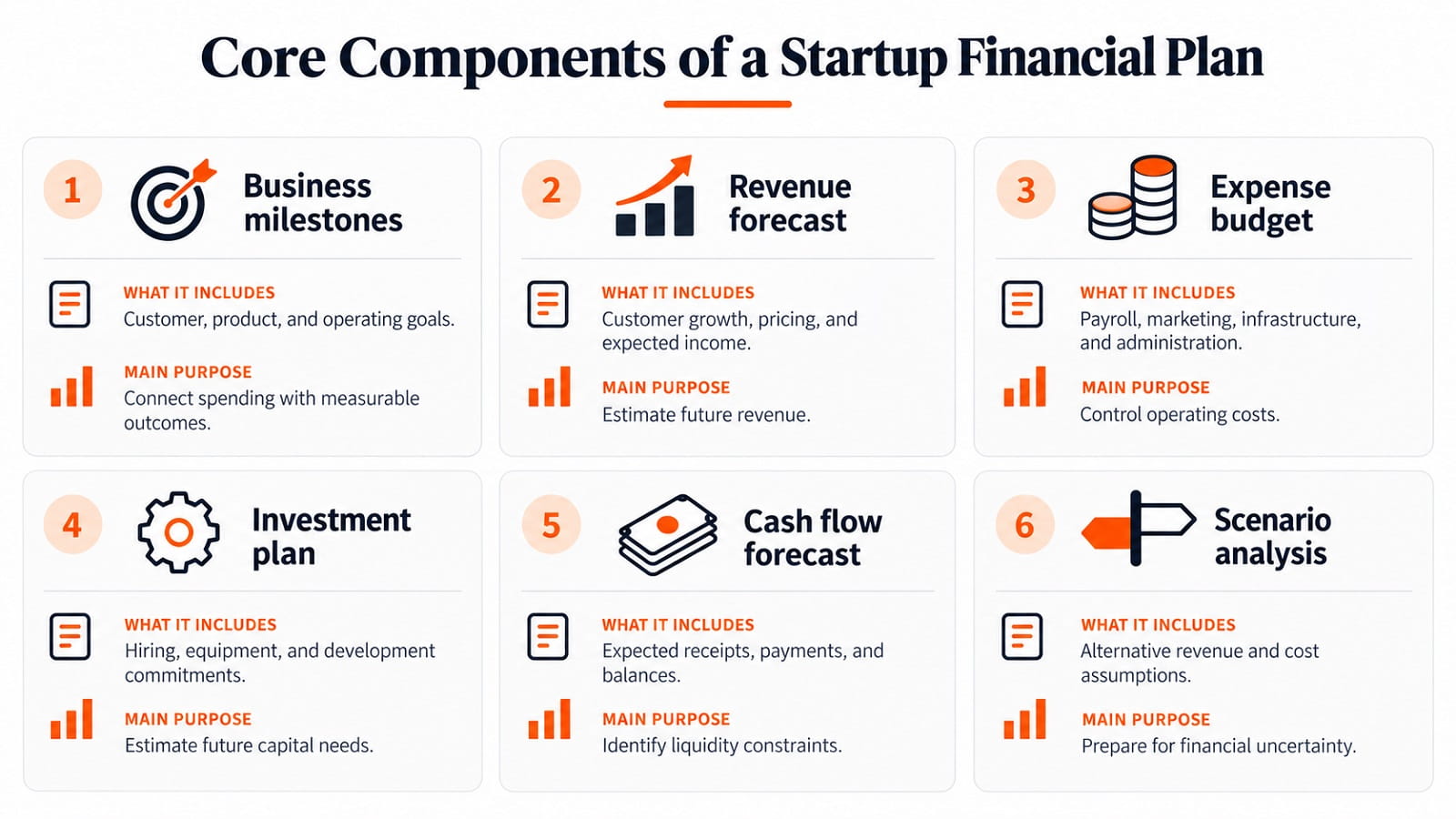
The purpose is not to create the most complicated financial model possible. It is to establish a reliable connection between operating assumptions and financial decisions.
How to Create a Startup Financial Plan Step by Step
Building a financial plan requires a logical process that begins with the company's current position and ends with a forecast of future financial outcomes. Founders should avoid starting with an ambitious revenue target and adjusting expenses simply to make the projection appear attractive. A more reliable approach uses measurable business activity to estimate income, spending, and cash requirements.
Step 1: Establish the Current Financial Position
Before forecasting future performance, founders need to understand how much money the company currently has and which financial obligations already exist. This includes available cash, unpaid customer invoices, supplier bills, payroll commitments, taxes, and financing obligations.
For an operating startup, recent bank statements and reconciled accounting records provide a useful starting point. A company that has not launched can establish its position by documenting founder contributions, development costs, and confirmed financial commitments.
Available cash should be distinguished from money that cannot be used freely. Some funds may already be needed for contractual obligations, future service delivery, or upcoming tax payments. Treating the entire bank balance as available for new investments can create misleading financial projections.
Founders should also distinguish confirmed information from assumptions. Existing salaries and signed agreements generally provide more reliable figures than estimated conversion rates or potential customer contracts.
Step 2: Define Business and Financial Milestones
A financial plan becomes more useful when it supports measurable business objectives. Instead of planning to increase revenue without a defined target, founders should identify specific outcomes such as acquiring 150 paying customers, launching a commercial product, or improving customer retention within a particular period.
Each milestone should be connected to the resources required to achieve it. A startup planning to acquire additional customers may need marketing expenditure, sales capacity, customer support, and infrastructure. These requirements should appear in the financial forecast.
Management should also distinguish essential milestones from optional expansion opportunities. Completing a critical product feature may be necessary before generating revenue, while entering another market could be delayed without threatening current operations.
This distinction helps founders allocate limited resources when financial conditions become less favorable.
Step 3: Build Realistic Revenue Forecasts
Revenue forecasting should begin with the activities that generate income rather than an unexplained growth percentage. For subscription businesses, these activities include acquiring customers, retaining existing accounts, determining subscription prices, and managing upgrades or cancellations.
A simplified subscription revenue calculation is:
Monthly revenue = Active paying customers × Average monthly revenue per customer
A startup expecting 100 paying customers at an average monthly price of $500 would project $50,000 in monthly revenue if all customers are active for the full period.
However, a more realistic forecast should account for new subscriptions, cancellations, partial month activity, discounts, and changes in pricing.
For a subscription business, ending customer count can be calculated by adding new customers to the opening customer base and subtracting customers who leave.
Different business models require different assumptions. Ecommerce companies may forecast units sold and average selling prices, while marketplaces may use expected transaction volume and take rates.
Founders should also distinguish recognized revenue from actual customer payments. A company may sign a contract worth $120,000 but recognize revenue over 12 months and collect payments according to separate contractual terms. The full contract value should not automatically be treated as immediately available cash.
Step 4: Estimate Direct and Operating Costs
After forecasting revenue, the startup needs to estimate the costs associated with delivering its products or services. These may include infrastructure, materials, inventory, shipping, payment processing, or direct labor, depending on the business model.
Gross profit represents revenue remaining after direct delivery costs have been deducted. Gross margin expresses the same relationship as a percentage of revenue.
Gross profit = Revenue less cost of revenue
Gross margin = Gross profit ÷ Revenue × 100
Suppose a software startup expects $50,000 in monthly revenue and $10,000 in direct service costs. Its gross profit would be $40,000, resulting in an 80% gross margin.
The company must still account for operating expenses such as marketing, administration, employee compensation, and product development. These costs determine whether gross profit is sufficient to support the business.
Expenses should be estimated using actual commitments and planned operating activity. Some remain relatively stable over time, while others increase as customer volume grows. A financial plan that assumes rising revenue without additional delivery costs may overstate future profitability.
Step 5: Create an Expense and Hiring Budget
A startup expense budget should reflect the resources required to operate and pursue business milestones. Payroll, contractors, marketing, software subscriptions, infrastructure, professional services, and administration should be included according to the company's needs.
Founders should distinguish expenses that are already committed from spending that can be adjusted. Signed supplier agreements and payroll obligations may be difficult to reduce immediately, while experimental advertising campaigns or optional projects may provide greater flexibility.
Hiring decisions deserve particular attention because employee expenses create recurring commitments. A realistic hiring plan should include expected start dates, compensation, employer taxes, benefits, recruitment costs, and equipment.
For example, hiring an employee with a total monthly cash cost of $8,000 three months earlier would create an additional $24,000 in spending during that period, assuming other factors remain unchanged.
The financial plan should show whether the company can support that cost and when the employee is expected to contribute to business objectives.
Step 6: Forecast Cash Receipts and Payments
Cash forecasting is essential because accounting revenue does not always become available cash immediately. Customers may pay after receiving services, while payroll and supplier obligations may need to be settled before those payments arrive.
A simplified cash calculation is:
Closing cash = Opening cash + Cash receipts less cash payments
Each period begins with the closing cash balance from the previous period. Expected customer payments increase available cash, while operating expenses, investments, taxes, and other obligations reduce it.
Suppose a startup recognizes $50,000 in revenue but expects customers to pay only $35,000 during the current month. Its cash forecast should reflect the $35,000 receipt rather than treating all recognized revenue as available cash.
The forecast should also include major payments in the periods when they are expected to occur. Annual software contracts, equipment purchases, supplier deposits, and debt repayments may produce significant cash movements that differ from accounting expenses.
A monthly forecast covering the next 12 months provides a useful starting point for many startups. Companies experiencing limited liquidity or unpredictable collections may also benefit from a shorter forecast examining the next 13 weeks.
Step 7: Calculate Future Capital Requirements
After forecasting cash movements, founders should examine whether the company has enough financial resources to execute its plan. The lowest projected cash balance is particularly important because a business may experience a shortage before expected customer payments arrive.
Management can establish a minimum cash reserve based on unavoidable obligations, operating uncertainty, and access to additional resources.
If the forecast shows that cash will fall below the chosen reserve, the company needs to evaluate the gap. Possible responses include delaying investments, adjusting hiring plans, improving collections, or seeking additional capital.
Potential financing should remain separate from confirmed available cash until the funding is sufficiently certain. A financial plan that depends entirely on receiving an investment by a particular date may become difficult to execute if the financing process takes longer than expected.
A Six Month Startup Financial Planning Example
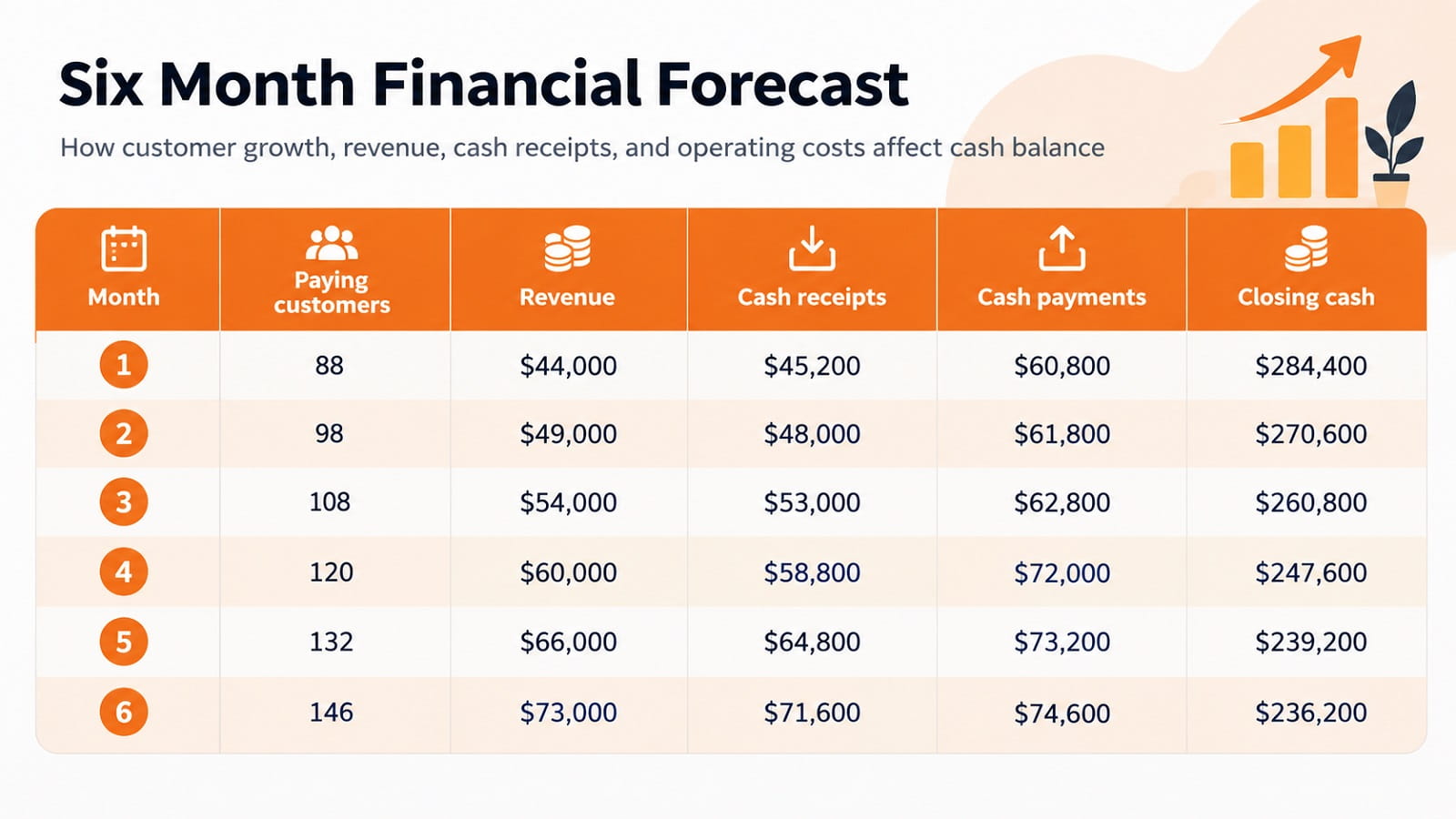
During the first month, CedarStack recognizes $44,000 in revenue and incurs $8,800 in direct service costs, leaving $35,200 in gross profit. With $52,000 in additional operating expenses, the company reports an operating loss of $16,800.
Its cash position changes differently because it receives $45,200 while making $60,800 in payments. The resulting cash shortfall is $15,600, reducing the opening balance from $300,000 to $284,400.
By month six, recognized revenue increases to $73,000 and direct costs reach $14,600. Gross profit rises to $58,400, leaving an operating loss of $1,600 after $60,000 in operating expenses.
The startup finishes the period with $236,200 in cash, having consumed $63,800 during the six months.
CedarStack's financial plan demonstrates that customer growth can improve operating performance while the company continues consuming cash. It also shows how hiring and collection timing influence financial capacity.
Management has established an illustrative minimum cash reserve of $200,000. Under the base forecast, the company remains $36,200 above that amount at the end of month six.
However, a relatively small buffer means that changes in revenue or collections could materially affect its financial position.
Testing the Financial Plan Against Different Scenarios
A financial forecast describes one possible outcome based on a set of assumptions. It cannot guarantee that customers will behave as expected or that expenses will remain unchanged. Scenario analysis allows founders to examine how important changes could affect the business.
Slower Customer Payments
Suppose CedarStack collects only 50% of each month's recognized revenue immediately and the remaining 50% during the following month. Other assumptions remain unchanged, and the original opening receivables are collected as expected.
The company's projected closing cash declines to $214,300. Revenue and operating expenses remain the same, but slower collections reduce the available cash buffer.
This demonstrates that a startup may face greater liquidity pressure without a corresponding decline in accounting revenue.
Lower Revenue Growth
If CedarStack generates 25% less revenue than originally expected in every month, while direct costs remain proportional to revenue and operating expenses remain unchanged, projected closing cash falls to approximately $170,650.
This amount is below management's chosen minimum reserve and indicates that the original spending plan may no longer be affordable under the revised assumptions.
The company would need to investigate the cause of weaker revenue and assess whether hiring, marketing, or other commitments should be adjusted.
Delaying the Planned Hire
If CedarStack postpones its planned employee hire until after month six, it saves $8,000 per month during the final three months.
Assuming this does not change revenue or other expenses, closing cash increases to $260,200.
However, delaying the employee may also affect product development, customer support, or growth capacity. A complete financial decision should consider those potential consequences alongside the immediate savings.
Scenario analysis becomes useful when its results are connected to management decisions. Founders can establish conditions that require another review of spending, hiring, or financing before a potential shortage becomes an immediate problem.
Keeping the Financial Plan Accurate
Creating a financial plan is only the beginning. Its value depends on whether management updates assumptions and compares forecasts with actual business results.
A monthly review should examine recognized revenue, operating expenses, customer collections, and cash balances. Significant differences should be investigated to determine whether they represent temporary timing changes or developments likely to continue.
Suppose a startup projected $50,000 in monthly revenue but recognized only $45,000. The difference could result from slower customer acquisition, higher cancellations, delayed contracts, or lower prices. Each cause requires a different response.
The original budget should remain separate from the latest financial forecast. The budget records approved targets, while the updated forecast reflects what management currently expects using newer information.
A rolling forecast replaces completed periods with actual results and extends the planning horizon as time passes. This allows founders to evaluate the original plan while continuing to make decisions based on current business conditions.
Financial planning should also reflect the company's business model. Subscription businesses need to monitor customer retention and billing schedules, ecommerce startups need inventory and supplier forecasts, and professional services companies must connect revenue expectations with staffing capacity and client payment terms.
As the business expands, the financial model may need more detailed reporting and dedicated responsibility for important assumptions. However, the underlying objective remains the same: keeping operating decisions connected to financial capacity.
FAQ
What Is Startup Financial Planning?
Startup financial planning is the process of forecasting revenue, expenses, cash requirements, and financial performance to support business objectives. It helps founders determine whether planned investments are affordable and how different operating outcomes could affect their company.
What Should a Startup Financial Plan Include?
A startup financial plan should include revenue projections, expense budgets, hiring and investment commitments, cash forecasts, and scenario analysis. More complex businesses may also require projected financial statements and working capital schedules.
How Far Ahead Should a Startup Plan Its Finances?
Many early stage companies benefit from a monthly forecast covering approximately 12 months, supported by a shorter cash forecast when liquidity is uncertain. Longer projections may be necessary for major investments or financing discussions.
Can a Startup Create a Financial Plan Without Revenue?
Yes. A company without revenue can plan around available capital, development expenses, operating commitments, and the resources required to reach its next milestone. Revenue assumptions can be included as scenarios but should not be treated as guaranteed income.
What Is the Difference Between a Budget and a Financial Forecast?
A budget establishes approved spending and performance targets for a period. A financial forecast reflects what the company currently expects based on updated information. Maintaining both allows founders to evaluate past decisions while adjusting future plans.
How Often Should Startups Update Their Financial Plans?
For many startups, monthly updates provide a useful starting point. Available cash and upcoming obligations may require weekly monitoring, particularly when customer payments are uncertain or financial reserves are limited.
Does a Startup Need Financial Planning Software?
Not necessarily. A well organized spreadsheet can support financial planning for a small startup. As transaction volume, financing arrangements, and reporting requirements become more complex, specialized software may become useful.
Final Thoughts
Startup financial planning helps founders understand the financial consequences of their decisions before committing resources. A practical plan connects business milestones with revenue expectations, operating expenses, and cash requirements, making it easier to evaluate whether planned growth is financially sustainable.
The CedarStack example demonstrates why these connections matter. Customer growth improved operating performance over six months, but the business continued consuming cash. Changes in collections, revenue assumptions, and hiring decisions produced substantially different financial outcomes.
An effective financial plan should remain part of regular business management. By updating assumptions, reviewing actual results, and evaluating alternative scenarios, founders can allocate resources more effectively and respond to financial uncertainty before it limits their options.

Mobina Khanki
Venture & Funding Writer at PinerookMobina Khanki covers venture capital, startup funding, fundraising, and startup finance for Pinerook, focusing on founders and investors.
 Seen first.