
Raising investment is an important milestone for a startup, but receiving capital is only the beginning of the relationship between founders and investors. Once funding is secured, investors expect to understand how the business is progressing, how their capital is being used, and whether the company is achieving its objectives. The way founders manage this relationship can influence investor confidence, strategic support, and future fundraising opportunities.
Startup investor relations involves maintaining productive relationships with existing and prospective investors through consistent communication, transparent reporting, and clear expectations. It includes sharing financial performance, explaining business decisions, addressing challenges, and identifying opportunities for investors to contribute their experience and professional networks.
For startups operating within the broader Venture Capital ecosystem, effective investor relations is an important management responsibility. A structured communication process helps founders establish credibility, maintain accountability, and build relationships that remain productive during both successful and difficult periods.
What Is Startup Investor Relations?
Startup investor relations refers to the practices a company uses to communicate with shareholders and potential financial backers. These activities generally include investor updates, financial reporting, strategic discussions, board communication, and responses to questions about business performance.
Unlike public companies, which communicate with large groups of shareholders through regulated disclosure processes, private startups usually manage relationships with a smaller number of investors. These may include angel investors, venture firms, corporate investors, and individuals participating through investment syndicates.
Each investor may have different expectations. Some shareholders prefer brief monthly updates, while institutional investors may require detailed financial statements, board materials, and regular strategic discussions. The company's financing agreements and governance structure can also establish formal information obligations.
Effective investor relations is not about making every shareholder involved in daily operations. Its purpose is to maintain an appropriate flow of information, explain company performance, and ensure that investors can provide useful support when needed.
For founders, this creates a balance between transparency and operational independence. Investors need sufficient information to understand their investment, but management must retain the time and attention required to run the business.
Why Investor Relations Matters for Startup Growth
Investor relationships are built on more than financial performance. Trust, communication quality, and the ability to manage uncertainty also influence how investors evaluate a founding team.
Startups rarely develop exactly according to their original plans. Product launches may take longer than expected, customer acquisition may be slower than forecast, and market conditions may change. Investors understand that uncertainty is part of building a new business, but they expect founders to recognize important developments and communicate them appropriately.
Consistent updates make it easier to establish this confidence. When founders regularly explain achievements, setbacks, and priorities, investors develop a clearer understanding of management's decision making. They can also identify opportunities to provide relevant advice or introductions.
Strong communication becomes particularly valuable when the company needs additional financing. Existing investors may participate in future rounds, introduce new investors, or provide references during due diligence. These activities become easier when investors have followed the company's progress and understand its strategy.
However, effective investor relations does not guarantee investment or protect a startup from commercial failure. Its value comes from improving transparency, strengthening relationships, and supporting more informed decisions.
How Often Should Startups Update Investors?
The appropriate frequency of investor communication depends on the startup's development stage, operating complexity, and shareholder expectations. Early stage businesses often experience rapid changes in product development, customer activity, and financial position, making monthly updates useful.
A monthly report gives investors a consistent view of progress without requiring frequent meetings. It also encourages founders to review important business metrics and compare actual performance with previous objectives.
As companies mature, quarterly reporting may become appropriate for some shareholders, particularly when the business has established more predictable operations. Formal board meetings and financial reporting obligations may follow separate schedules.
Consistency matters more than sending frequent messages without meaningful information. Investors should know when updates are expected and what information they will contain. Founders should also maintain communication during difficult periods rather than sending reports only when performance is positive.
Significant events may require immediate attention. A serious cash shortage, major legal issue, or unexpected development affecting the company's operations should not automatically wait until the next scheduled report. The appropriate response depends on the materiality of the event and the company's legal and contractual obligations.
What Should a Startup Investor Update Include?
A useful investor update helps shareholders understand the company's current position, recent achievements, important challenges, and immediate priorities. It should provide enough detail to support informed discussion without overwhelming readers with unnecessary operational information.
The report should begin with a concise explanation of the reporting period. Founders can describe the most important development, whether the company is progressing according to plan, and which issues require particular attention.
Financial information should follow, supported by relevant operating metrics. These figures help investors understand whether the company is growing, maintaining financial stability, and using capital effectively.
Founders should also explain significant changes rather than presenting numbers without context. A decline in customer acquisition, for example, may reflect seasonal demand, changes in marketing expenditure, or a problem in the sales process. Each explanation leads to a different interpretation of performance.
Essential Components of a Startup Investor Update
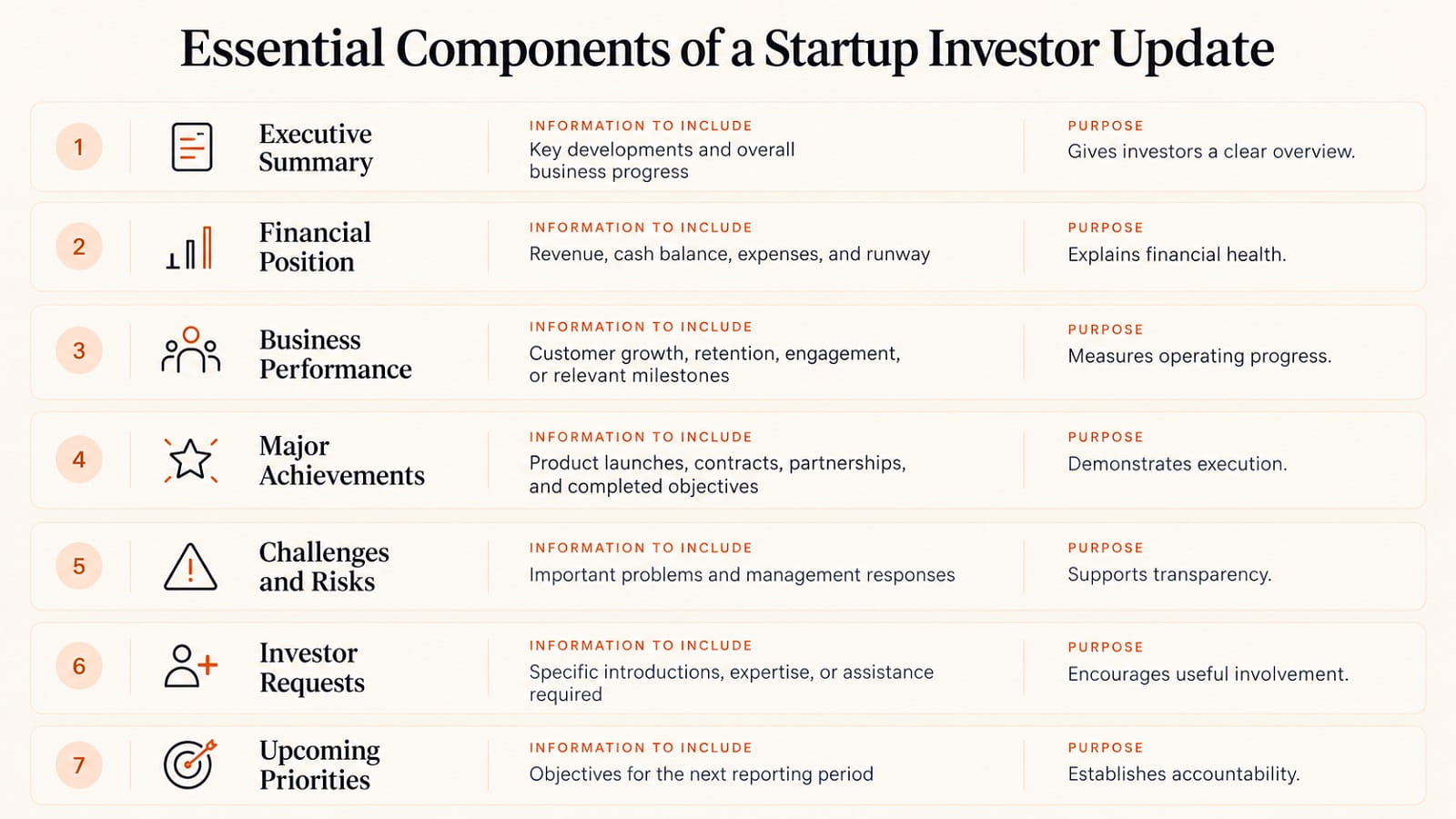
The information should reflect the company's business model. A subscription software startup might emphasize recurring revenue and customer retention, while a biotechnology startup may focus on research progress, regulatory milestones, and available development capital.
Using consistent definitions is essential. If a startup changes how it measures active customers or recurring revenue, founders should explain the adjustment and its effect on comparisons with previous periods.
Financial Reporting and the Metrics Investors Expect
Financial reporting helps investors understand whether the company has sufficient resources to support its operations and reach important milestones. The relevant metrics depend on the startup's stage, but cash management is important for almost every externally financed business.
Cash balance indicates the amount of money currently available, while net burn describes the cash consumed over a reporting period after accounting for cash inflows and outflows. Runway provides an estimate of how long the available cash can support operations at an assumed spending rate.
Consider a startup with $1.2 million in cash and average monthly net burn of $100,000. Under a simplified calculation, the company has approximately twelve months of runway if cash receipts and spending remain unchanged. In practice, revenue collections, hiring, payment obligations, and unexpected expenses can change this estimate.
Founders should update their financial forecasts as new information becomes available. A runway figure calculated immediately after a financing round may no longer reflect the company's financial position several months later.
Revenue growth should also be presented carefully. Investors need to distinguish between revenue already earned, signed customer contracts, expected sales, and opportunities still being negotiated. Treating potential future revenue as confirmed performance can undermine confidence in financial reporting.
The objective is to present an accurate picture of the business rather than select numbers that create the most favorable impression. Reliable financial reporting supports better management decisions and prepares the company for future investor scrutiny.
Building Investor Trust Through Transparent Communication
Trust develops when founders communicate accurately and consistently, including when results differ from expectations. Investors do not necessarily expect every target to be achieved, but they need confidence that management understands the business and responds appropriately to changing conditions.
Transparency requires more than reporting successful product launches or new customer agreements. Founders should also explain setbacks, operating risks, and decisions that may affect future performance.
For example, a startup might plan to acquire twenty enterprise customers during a quarter but secure only twelve. A productive investor update would explain the difference, identify the factors affecting sales, and describe how management intends to improve performance.
The explanation should separate confirmed information from assumptions. If the team believes customers are delaying purchases because of longer procurement processes, it should describe the evidence supporting that conclusion rather than presenting speculation as fact.
Investors can often provide more useful advice when they understand the underlying issue. An investor with enterprise sales experience may recognize a problem in customer qualification or contract negotiations that founders have not fully considered.
Founders should also avoid making commitments merely to reassure shareholders. Credible forecasts, realistic objectives, and honest assessments of uncertainty are more valuable than optimistic promises that cannot be supported.
Managing Bad News and Difficult Investor Conversations
Difficult situations are unavoidable in many startups. A company may lose a major customer, face unexpected technical problems, miss revenue targets, or discover that its financial resources are insufficient to complete a planned project.
When a material problem emerges, founders should assess its potential consequences and determine which investors or board members need to be informed. Communication should be timely and proportionate to the seriousness of the situation.
A useful explanation describes what happened, what is currently known, how the problem affects the company, and which responses management is considering. If the situation remains uncertain, founders should acknowledge that uncertainty rather than presenting incomplete conclusions.
Consider a startup whose runway decreases from fourteen months to nine months because customer payments are arriving later than expected. Management should explain the change in cash flow, the assumptions behind the revised forecast, and the actions being taken to address the problem.
These actions might involve improving collections, adjusting expenditures, postponing planned hiring, or evaluating additional financing. Investors can then assess the situation and determine whether they can contribute relevant experience or resources.
The purpose of communication is not to transfer management responsibility to shareholders. Founders remain responsible for operating the company, while investors provide support according to their roles and rights.
Handling difficult conversations professionally can strengthen relationships even when the immediate news is disappointing.
Managing Relationships With Board Members
Investor communication and board governance are closely connected, but they serve different purposes. Shareholders have rights established through company documents and investment agreements, while directors have formal governance responsibilities under applicable law.
Founders should understand these distinctions to avoid confusing investor preferences with decisions requiring board involvement or approval.
Board meetings typically focus on financial performance, strategic priorities, major risks, and decisions that require formal consideration. Providing accurate materials before a meeting allows participants to review the information and prepare useful questions.
A well organized board discussion should examine whether the company is achieving its objectives, which assumptions have changed, and where management needs guidance or approval.
Disagreements may arise over hiring, financing, expansion, or spending priorities. These discussions are more productive when founders present clear evidence, explain available alternatives, and identify the consequences of different decisions.
Board members may have valuable experience, but founders should not assume that every suggestion must be implemented. The appropriate decision depends on company interests, governance requirements, and management's understanding of the business.
Maintaining accurate meeting records and following up on agreed actions also reduces misunderstandings and supports accountability.
How Investors Can Support a Startup Beyond Funding
Investors may contribute industry knowledge, recruiting experience, customer introductions, and relationships with future financial partners. These resources can be valuable, particularly when founders are entering unfamiliar markets or solving problems outside their existing expertise.
However, investors are more likely to provide useful assistance when requests are specific.
A general request for help with business development gives investors little direction. A request for an introduction to executives responsible for procurement at companies in a particular industry is more actionable.
The same principle applies to recruitment. If a startup needs an experienced finance leader, founders can explain the required background, company stage, and responsibilities. Investors can then determine whether relevant candidates exist within their networks.
Investor support should also reflect individual strengths. A former technology executive may be particularly helpful with product strategy, while an investor with financial expertise may provide more value during budget planning or fundraising preparation.
Founders should recognize that investors differ in availability and involvement. Not every shareholder can provide frequent operational assistance, and investment alone does not guarantee access to extensive professional networks.
The strongest relationships develop when both parties understand the assistance that is realistically available and communicate clearly about priorities.
Maintaining Relationships Before the Next Funding Round
Startup investor relations also includes relationships with potential future investors. Founders may meet venture firms long before the company is ready to raise another financing round.
Maintaining occasional communication can help these investors understand the startup's progress. Relevant updates may include product milestones, customer growth, financial improvements, or important changes to the business model.
This approach allows relationships to develop through demonstrated performance rather than relying entirely on a fundraising presentation.
However, prospective investors should not automatically receive the same information as existing shareholders. Confidential financial data, commercially sensitive plans, and customer information should be shared according to appropriate permissions and confidentiality arrangements.
Founders should also avoid treating a positive conversation as an investment commitment. An investor may follow a company's development for several years without participating in financing.
The purpose of maintaining these relationships is to establish familiarity, demonstrate execution, and understand which investors may eventually become suitable funding partners.
How Good Investor Relations Supports Future Fundraising
A startup preparing for another investment round benefits from accurate financial records, consistent operating metrics, and a documented history of progress. These materials make it easier to explain how previous financing was used and what the company achieved.
Existing investors may also become important sources of information for prospective financial partners. New investors often want to understand how founders communicate, respond to setbacks, and manage the responsibilities associated with external capital.
A company with reliable reporting practices can provide a clearer account of its development. It can demonstrate which objectives were completed, which assumptions changed, and how those experiences influenced management decisions.
Good investor relations may also help founders obtain introductions to other investment firms or receive support from existing shareholders during a new financing round.
Nevertheless, additional investment is not guaranteed. Existing investors may face portfolio constraints, limited capital, or changes in investment strategy. Founders should therefore prepare for the possibility that future funding will require new financial partners.
Fundraising preparation should begin early enough to account for investor meetings, due diligence, negotiations, and unexpected delays. Strong investor relationships are valuable, but they do not eliminate the need for realistic cash planning.
Common Mistakes in Startup Investor Relations
One of the most common mistakes is contacting investors only when the company needs more money. Long periods without updates can create uncertainty and make fundraising conversations more difficult because shareholders have limited knowledge of recent developments.
Another mistake is presenting only positive information. Selective reporting may temporarily create a favorable impression, but it becomes difficult to maintain credibility when previously undisclosed problems eventually become visible.
Inconsistent reporting also creates problems. If a company changes its financial definitions or performance metrics without explanation, investors may struggle to compare results or understand management's interpretation of progress.
Excessive communication can be counterproductive as well. Lengthy updates containing numerous unrelated details may obscure the information that matters most. Founders should prioritize clarity and relevance instead of attempting to document every operational activity.
Confidentiality deserves particular attention. Sharing sensitive business information with recipients who do not have appropriate access can create legal, commercial, or competitive risks.
Finally, founders should avoid allowing investor communication to replace operational management. Reports and meetings should support better decisions rather than consume resources that would be better directed toward customers, employees, and product development.
Building a Sustainable Investor Communication System
An effective investor relations process should be simple enough to maintain consistently while providing information that supports meaningful discussion.
Founders can begin by identifying the financial and operating metrics already used to manage the business. These should form the foundation of investor updates, reducing the need to prepare separate information solely for shareholders.
Responsibility for preparing reports should also be clear. In an early stage company, the founder may manage investor communication directly. As the organization grows, financial and operational teams may contribute information, with senior management reviewing the final report.
Communication should follow a predictable schedule, while significant events receive appropriate attention outside that schedule. Different investors may require different reporting arrangements depending on their agreements and governance roles.
Recommended Startup Investor Communication Schedule
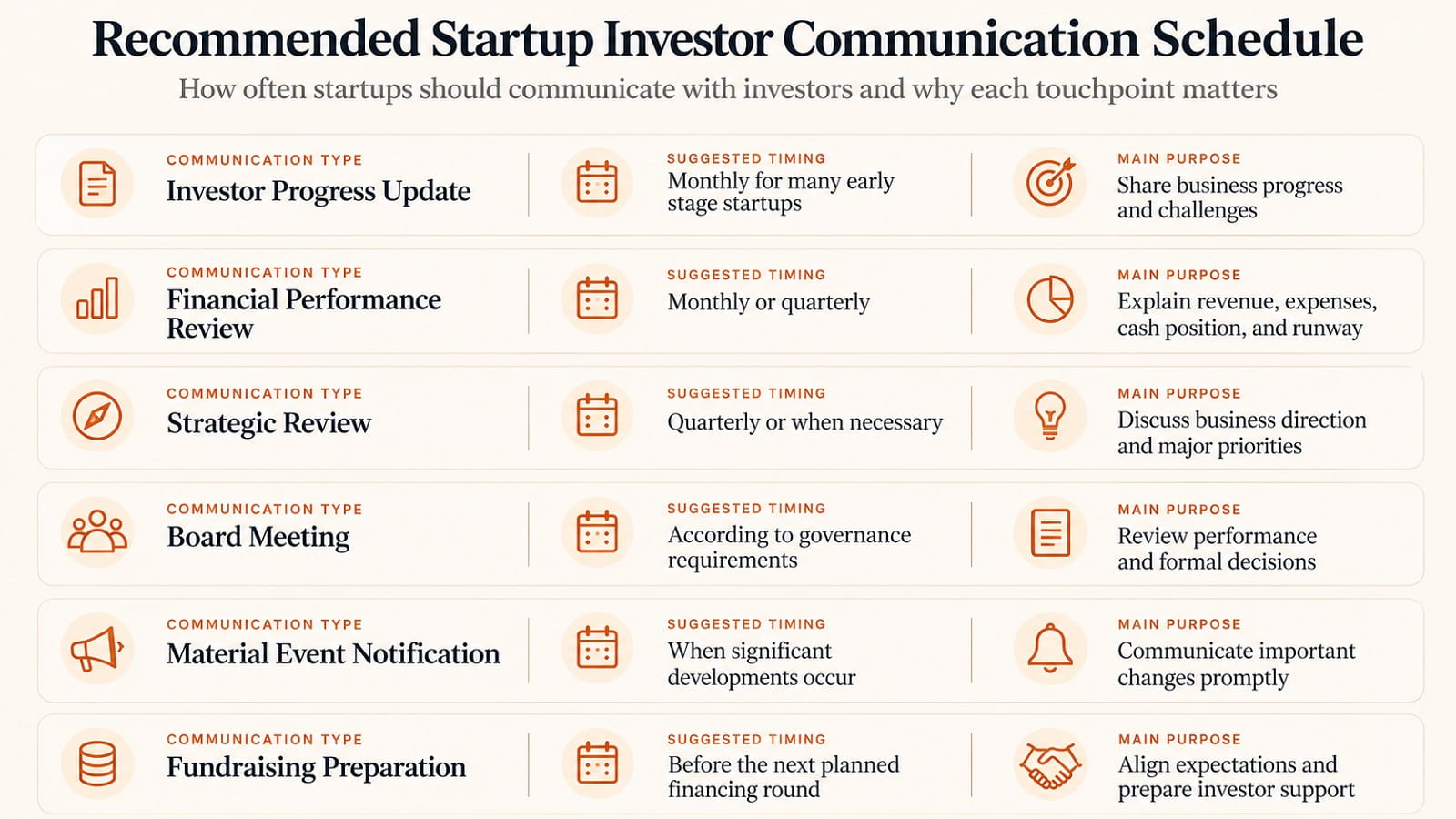
This schedule is a practical framework rather than a universal requirement. Founders should adapt it to the company's size, investor relationships, and formal reporting obligations.
A consistent system also benefits management. Regularly reviewing financial results, customer activity, and planned milestones helps founders recognize problems earlier and make more informed decisions.
The objective is to make investor relations part of normal business management rather than an additional administrative exercise that becomes difficult to sustain.
Building Stronger Investor Relationships Over Time
Strong investor relationships are built through consistent performance, reliable information, and a clear understanding of the company's direction. Founders who communicate progress regularly make it easier for investors to evaluate business decisions, recognize emerging challenges, and provide support when it is most useful.
A practical investor relations strategy should reflect how the startup operates. Financial updates need to explain changes in revenue, spending, and available capital, while business reports should connect completed milestones with upcoming priorities. When results fall short of expectations, founders should explain the reasons and outline the actions being taken rather than relying on optimistic projections.
As the company grows, communication requirements may become more formal, particularly when new investors join or the board takes on greater responsibilities. Establishing clear reporting practices early can make these transitions easier and reduce the administrative work involved in future financing rounds.
Ultimately, effective startup investor relations creates a more informed relationship between founders and shareholders. When investors understand the company's performance, challenges, and objectives, they are better positioned to contribute relevant expertise and support decisions that strengthen the business over time.
FAQ
What is startup investor relations?
Startup investor relations is the process of maintaining communication and managing relationships with existing and prospective investors. It includes financial updates, performance reporting, strategic discussions, and efforts to maintain transparency and trust.
How often should a startup send investor updates?
Many early stage startups benefit from monthly investor updates, while more established companies may use quarterly reports alongside formal board meetings. The appropriate schedule depends on the company's development stage, investor expectations, and contractual obligations.
What information should an investor update include?
An investor update should explain recent business progress, financial position, important operating metrics, significant achievements, major challenges, and upcoming priorities. It may also include specific requests for investor introductions or expertise.
How should founders communicate bad news to investors?
Founders should communicate material problems promptly and accurately. They should explain what happened, describe the likely consequences, identify remaining uncertainties, and outline the actions management is taking to address the situation.
Can investor relations help a startup raise future funding?
Effective investor relations can strengthen credibility, improve fundraising preparation, and support introductions to potential financial partners. Existing investors may also participate in subsequent financing rounds, although future investment depends on the company's performance and investor circumstances.

Mobina Khanki
Venture & Funding Writer at PinerookMobina Khanki covers venture capital, startup funding, fundraising, and startup finance for Pinerook, focusing on founders and investors.
 Seen first.