
Startup valuation determines how much a company is considered to be worth at a particular point in time. For founders raising capital, that number has an immediate consequence: it influences how much equity investors receive and how much ownership existing shareholders retain after a financing round. Yet calculating the value of a young business is rarely as straightforward as reviewing its revenue or adding up its assets.
Many startups are still testing their products, acquiring their first customers, or developing business models that have not reached profitability. Their potential value depends partly on what they have already demonstrated and partly on what investors believe they could accomplish. That makes valuation a combination of financial analysis, market evidence, and assumptions about future performance.
Understanding startup valuation helps founders approach investment discussions with more realistic expectations. It also allows them to compare financing scenarios, estimate dilution, and consider whether a proposed valuation supports the company's next stage of development.
Within a broader Fundraising Strategy, valuation connects the amount of capital a startup needs with the ownership it may exchange to obtain that investment.
What Is Startup Valuation?
Startup valuation is the estimated monetary value of a privately held startup at a specific point in time. During a priced equity financing round, founders and investors agree on a valuation that helps establish the price of new shares and the ownership investors receive.
Valuation is not necessarily the amount someone would pay to acquire the entire company. It also does not represent the cash in the company's bank account or the total amount its founders have spent building the business.
Consider a software startup that has developed a product, acquired paying customers, and demonstrated promising retention. Its physical assets may have relatively little value, but investors may believe the business has the potential to generate substantial future revenue. That expectation can influence its valuation.
The opposite is also possible. A startup may have spent millions developing technology but still struggle to demonstrate customer demand. Investors may assign it a lower valuation because important commercial uncertainties remain unresolved.
This is why different investors can reach different conclusions about the same company. They may disagree about future revenue, competitive risk, market conditions, or the returns needed to justify an investment. Startup valuation should therefore be treated as an informed estimate rather than a universally agreed measure of worth.
Understanding Pre Money and Post Money Valuation
Two concepts founders must understand are pre money valuation and post money valuation. The distinction is important because the same investment amount produces different ownership outcomes depending on how the valuation is expressed.
Pre money valuation refers to the company's agreed equity value immediately before new capital is invested. Post money valuation reflects the value immediately after accounting for that investment.
For a straightforward priced equity transaction, the relationship is:
Post Money Valuation = Pre Money Valuation + New Investment
Suppose a startup agrees to raise $2 million at a pre money valuation of $8 million. The company's post money valuation becomes $10 million.
The new investor's percentage ownership can then be calculated using:
Investor Ownership = New Investment ÷ Post Money Valuation × 100
In this example, the investor contributes $2 million to a company with a post money valuation of $10 million and receives 20% ownership.
This simplified calculation assumes that the investment involves newly issued shares and that no additional adjustments affect the capitalization structure. Outstanding convertible instruments, employee option pool changes, or other contractual arrangements can produce different results.
Founders should always confirm whether a proposed valuation is stated before or after the investment. Confusing these figures can cause a substantial misunderstanding of the equity being transferred.
How Startup Valuation Affects Founder Ownership
Valuation and dilution are closely connected because raising equity capital usually involves issuing new shares to investors.
When a company creates additional shares, existing shareholders generally own a smaller percentage of the total shares outstanding. Their number of shares may remain unchanged, but those shares represent a reduced percentage of the company.
Suppose two founders collectively own 100% of a startup before financing. If a new investor receives 20% through a straightforward share issuance, the founders collectively retain 80%.
The dilution does not necessarily mean that the founders' investment has become less valuable in monetary terms. The company now has additional capital, which may help it develop products, expand operations, or reach important commercial milestones.
Nevertheless, ownership percentages have financial and governance implications. Founders should consider not only their immediate dilution but also the possibility that the company will need additional financing in the future.
A startup that raises several equity rounds may experience cumulative dilution as new investors acquire ownership. The results will depend on each round's valuation, investment amount, and capitalization adjustments.
Understanding these effects allows founders to evaluate financing proposals based on their economic consequences rather than headline valuation alone.
Main Methods Used to Value a Startup
There is no single valuation method suitable for every startup. Investors select approaches according to the company's industry, maturity, financial performance, and available information.
Businesses with established revenue may be evaluated using comparable companies or financial multiples. Earlier stage companies often require greater emphasis on product validation, market potential, and qualitative evidence because their historical financial performance is limited.
Common Startup Valuation Methods
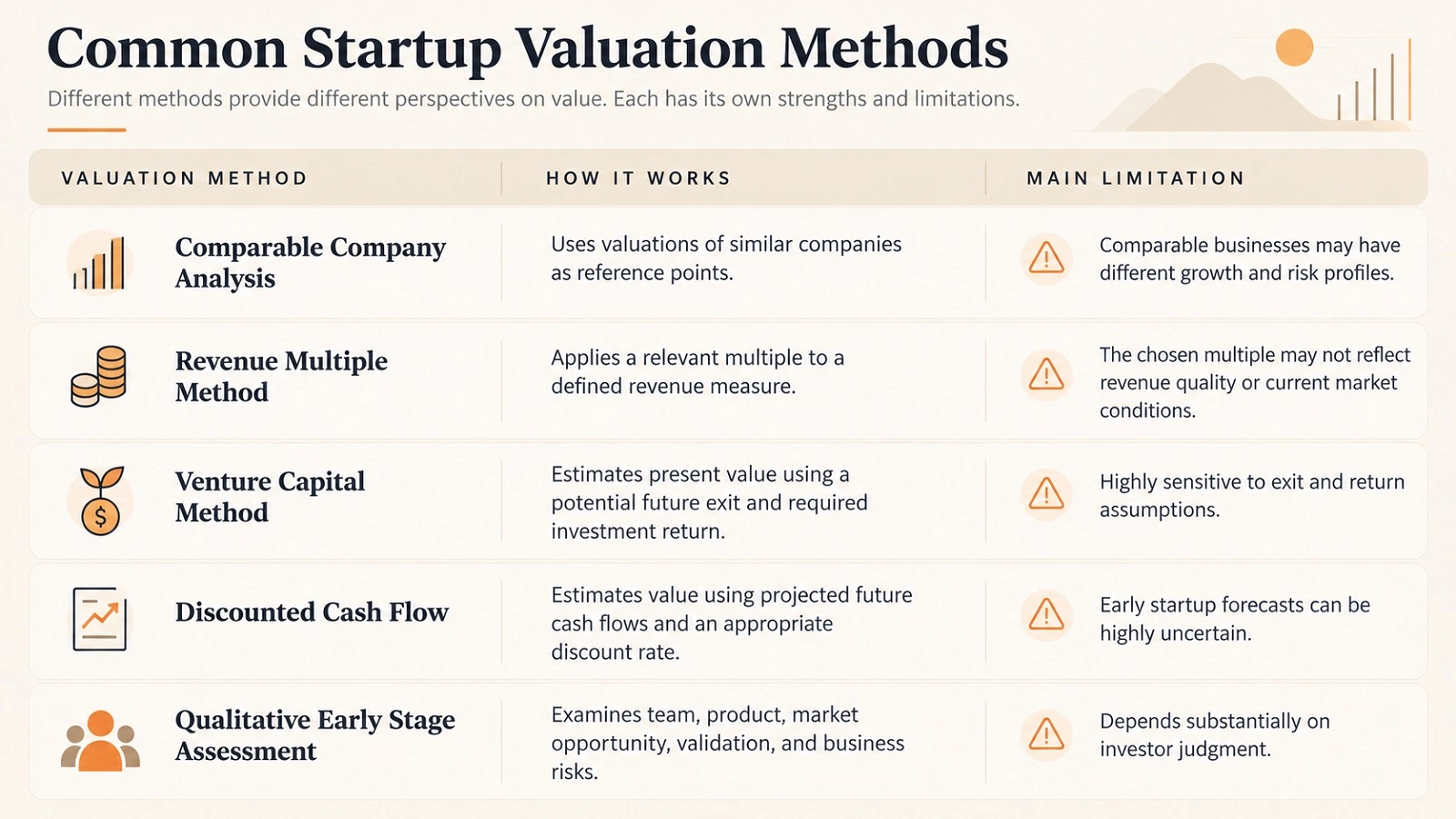
These methods can produce different estimates even when applied to the same business. A founder should understand what each approach measures and whether its assumptions match the startup's actual development stage.
For many private businesses, combining several reasonable reference points provides a more useful valuation range than relying entirely on one calculation.
Comparable Companies and Revenue Multiples
Comparable company analysis estimates startup value by examining other businesses with similar characteristics. Relevant comparisons may involve industry, customer type, business model, revenue growth, profitability, and commercial maturity.
For example, a startup selling subscription software to businesses might examine valuations associated with other software companies that generate recurring revenue. However, operating in the same industry does not automatically make two businesses comparable.
One company may have strong retention and predictable revenue, while another depends heavily on a few customers. Differences in growth rates, margins, customer concentration, and market position can justify significantly different valuations.
Revenue multiples provide a simplified way to express such comparisons. Suppose a hypothetical software startup generates $1 million in annual recurring revenue. If an appropriate comparable framework supports an illustrative multiple of five times that revenue, the calculation produces an estimated value of $5 million.
This is an arithmetic example, not a recommended market multiple. Actual multiples vary according to the type of business, financing environment, revenue quality, and growth expectations.
Founders must also distinguish between enterprise value and equity value. Revenue multiples derived from comparable companies may describe enterprise value, which is not automatically equivalent to the value of shareholders' equity. Adjustments for debt, cash, and other financial items may be necessary.
Public company valuations require additional caution because publicly traded businesses may have greater liquidity and more established operating histories than private startups.
The value of comparable analysis comes from selecting appropriate references and explaining the differences, not simply copying the highest multiple available.
Discounted Cash Flow and the Venture Capital Method
Discounted cash flow, commonly called DCF, estimates value by projecting future cash flows and adjusting them to reflect the time value of money and the risk associated with receiving those cash flows.
The approach can be useful for businesses with reasonably predictable financial performance. It is more difficult to apply reliably to early startups because future customer demand, spending, financing requirements, and profitability may remain uncertain.
Small changes in revenue growth, operating margins, or discount rates can produce substantial changes in an estimated valuation. A detailed spreadsheet does not make the underlying assumptions more reliable simply because the calculations appear precise.
The venture capital method approaches valuation from another direction. It begins with an estimate of the company's potential value at a future exit and works backward using the investment return required by the investor.
For example, an investor might estimate what a business could be worth if it reaches a particular commercial scale. That future value is then considered alongside the investment amount, expected holding period, and required return.
This method is sensitive to assumptions about future exits and investment outcomes. Founders should understand that a hypothetical acquisition value is not evidence that such an exit will occur.
Neither method should be treated as an independent guarantee of company value. Their usefulness depends on whether the forecasts and assumptions are reasonable and clearly explained.
How to Value a Startup Without Revenue
A startup without revenue cannot rely on established sales performance to demonstrate its commercial potential. Investors therefore place greater importance on other evidence that may indicate the company is addressing a meaningful opportunity.
Customer research can be valuable when it shows that a clearly defined audience experiences a significant problem. Product testing, working prototypes, pilot programs, and technical validation may provide additional information about the feasibility of the proposed solution.
The team's capabilities can also influence valuation. Experience developing relevant technology, serving the target industry, or building comparable products may help investors assess execution risk.
However, none of these factors automatically establishes a particular valuation. A strong founding team does not guarantee commercial success, and a technically impressive product may still face uncertain demand.
Consider a hypothetical medical technology startup that has developed a functioning prototype but has not yet generated revenue. Its valuation may depend on the quality of technical evidence, intellectual property, development requirements, regulatory risks, and the size of the potential commercial opportunity.
A different startup providing software to smaller businesses may be evaluated more heavily on customer interviews, adoption during pilots, and evidence that customers are willing to pay.
Founders should avoid using development spending as a direct measure of value. A company that has spent $800,000 creating a product is not necessarily worth $800,000 or more.
The most defensible approach combines relevant early stage market comparisons with a transparent explanation of the evidence the startup has established and the uncertainties that remain.
What Factors Influence Startup Valuation?
Startup valuations reflect more than financial statements. Investors consider the company's potential to create value and the risks that could prevent it from reaching that potential.
Commercial traction is often influential because it provides evidence of customer demand. Paying customers, retention, recurring revenue, and reliable growth may strengthen an investment case when the results are accurately measured.
Market opportunity matters as well, but founders need to demonstrate that the business can reach a meaningful customer segment. A large industry statistic provides limited value if the startup cannot explain its accessible market or customer acquisition approach.
The quality of the business model is another consideration. Investors may examine gross margins, recurring revenue, customer acquisition expenses, pricing power, and the concentration of revenue among customers.
Competitive differentiation, intellectual property, product quality, and relevant team experience can influence assessments of the company's future potential.
Risk factors may reduce valuation. Weak customer retention, unresolved legal issues, uncertain product demand, substantial future capital requirements, or dependence on a small number of customers can make the business less attractive.
External conditions also matter. Investor demand, financing availability, interest rates, and market expectations can influence the prices investors are willing to accept.
Founders have limited control over broad market conditions, but they can improve the evidence supporting their company's performance and reduce avoidable operational uncertainty.
Startup Valuation and Equity Dilution Examples
A useful way to understand the effect of valuation is to compare several financing scenarios using the same investment amount.
Assume a hypothetical startup wants to raise $2 million through newly issued equity. It has no outstanding SAFEs, convertible notes, or other instruments that would affect the calculation, and no employee option pool changes are introduced during the round.
The following scenarios show how the investor's ownership changes as the agreed pre money valuation increases.
Startup Valuation and Investor Ownership Scenarios

The relationship is straightforward under these assumptions. When the pre money valuation is higher, the same investment represents a smaller percentage of the company.
At a $4 million pre money valuation, the new investor acquires approximately one third of the business. At a $10 million pre money valuation, the investor acquires approximately 16.67%.
Existing shareholders collectively retain the remaining ownership percentage in each scenario.
This illustrates why valuation matters to founders, but it also shows only one part of the financing decision. A startup should consider whether the amount raised is sufficient to achieve its next meaningful milestones.
Accepting a smaller investment to reduce dilution may create problems if the company cannot finance the product development, customer acquisition, or operating requirements necessary for growth.
The table also excludes rights that could change financial outcomes. Two investors receiving the same percentage ownership may have different economic protections or governance rights depending on their agreements.
Founders should therefore evaluate the full proposed capitalization and investment terms, not just the percentage shown by a simple valuation formula.
How SAFEs and Convertible Notes Affect Valuation
Not every startup raises capital through a priced equity round. Some early stage companies use a Simple Agreement for Future Equity, known as a SAFE, or a convertible note.
These instruments allow investors to provide capital before a later financing establishes a conventional share price. Their terms influence how the investment converts into equity and can affect future dilution.
A SAFE may include a valuation cap or conversion discount. A valuation cap helps determine the share conversion price under specified conditions, but it should not automatically be described as the company's agreed valuation in a completed priced equity round.
For a standard post money valuation cap SAFE, the initial implied ownership sold is generally calculated by dividing the investment amount by the post money valuation cap, under the relevant terms.
For example, a $500,000 investment using a $5 million post money valuation cap implies 10% ownership on the basis used by that instrument. That percentage can later be diluted by newly issued shares in a priced financing and certain option pool adjustments.
Convertible notes have additional characteristics that may include interest, maturity provisions, and conversion conditions. The precise effect depends on the agreement.
When several instruments are outstanding, founders need to evaluate them together. A simple calculation based only on the new investment amount and headline valuation may not accurately describe the capitalization after conversion.
A detailed capitalization model helps show how existing shareholders, convertible investors, employees, and new equity investors may be affected.
Employee Option Pools and Ownership Dilution
Employee option pools create another important consideration when founders evaluate financing proposals.
Startups may reserve equity for employees to help attract and retain talent. Investors sometimes require the company to create or expand this reserve as part of a financing round.
The timing of that increase can materially affect ownership.
If an option pool expansion is included in the pre money capitalization, existing shareholders generally bear the dilution associated with the increase before the new investor's ownership is calculated.
If the option pool is expanded after financing, dilution may instead be shared across the shareholders at that point, including the new investor.
Consequently, two financing offers with the same stated valuation can produce different ownership outcomes.
Consider a startup receiving an offer based on a particular pre money valuation. If the investor also requires a substantial option pool increase before closing, founders may retain less equity than they initially expected from the headline valuation alone.
This does not mean employee equity reserves are undesirable. They can be important for hiring and long term company development. The issue is understanding who bears the economic cost of creating or expanding them.
Before accepting an investment, founders should review a capitalization table that reflects existing shares, outstanding instruments, employee equity arrangements, and the expected new financing.
Why a Higher Startup Valuation Is Not Always Better
A higher valuation can reduce immediate dilution when a company raises a fixed amount of equity capital under otherwise equivalent terms. That is a meaningful advantage, but it should not be the only factor guiding financing decisions.
Valuation can create expectations about future progress. Investors accepting a high price may expect the company to reach substantial commercial milestones before the next financing round.
If those expectations are not supported by realistic business performance, the startup may face difficulties when seeking additional investment.
A future financing at a lower valuation is commonly called a down round. Its consequences depend on the company's ownership structure, investor rights, and financing agreements.
Founders should also evaluate economic terms beyond valuation. Liquidation preferences, governance rights, participation arrangements, and other provisions may affect the distribution of proceeds or the company's future flexibility.
An offer with a higher valuation but more restrictive terms is not automatically preferable to one with a lower valuation and a simpler ownership structure.
The most useful financing proposal provides sufficient capital, understandable terms, and realistic expectations for the company's next stage of development.
How to Prepare a Defensible Startup Valuation
Founders preparing for investment discussions should begin with accurate business information. Financial records, customer metrics, ownership documentation, and operating forecasts need to present a consistent picture of the company.
The next priority is choosing relevant valuation references. A business with recurring revenue may benefit from comparable company analysis, while an early startup may need to rely more heavily on product validation, customer evidence, and appropriate early financing comparisons.
Founders should identify the assumptions behind their preferred valuation and recognize where those assumptions are uncertain.
For instance, a software company forecasting substantial revenue growth should explain its expected customer acquisition, pricing, retention, and operating expenses. These figures should connect to the actual resources and commercial activities available to the business.
A valuation range may be more useful than an unsupported precise figure. It allows management to examine different financing possibilities and understand their effects on ownership.
Founders should also model the capitalization structure after investment. This includes outstanding SAFEs, convertible notes, employee option pools, and other instruments that may influence equity ownership.
The objective is not to produce a calculation that guarantees investor agreement. It is to demonstrate that the company understands its financial position, can explain its business assumptions, and has considered the consequences of different investment proposals.
Common Startup Valuation Mistakes
A frequent mistake is confusing the amount invested in building a product with the market value of the business. Development expenses may explain what the company has spent, but they do not establish what investors should be willing to pay for its equity.
Another problem is relying on financing announcements involving companies that are not genuinely comparable. Businesses operating in the same industry may have very different revenue quality, growth rates, risks, and contractual investment terms.
Founders may also confuse pre money and post money valuations, leading to incorrect expectations about investor ownership.
Ignoring convertible instruments and employee option pool adjustments can produce similar errors. A simple dilution calculation may appear favorable until earlier financing commitments are included in the capitalization model.
Overly optimistic forecasts can weaken valuation discussions when management cannot explain the assumptions behind expected revenue or business growth.
Finally, focusing exclusively on the highest possible valuation can distract founders from the amount of capital needed, investor rights, and the company's likely future financing requirements.
A more disciplined approach treats valuation as one important component of an overall financing decision.
Understanding Startup Valuation Before Raising Capital
Startup valuation influences how much ownership a company exchanges for investment, but the headline figure cannot describe the entire financial relationship between founders and investors.
A realistic assessment considers the company's development stage, commercial performance, market opportunity, business model, and the uncertainty surrounding future results. Founders also need to understand how pre money and post money valuations translate into ownership percentages.
The effect of financing becomes more complicated when outstanding convertible instruments, employee option pools, or different investor rights are involved. These details should be reflected in the company's capitalization model before important commitments are made.
A defensible valuation does not require founders to predict the future precisely. It requires them to communicate what the business has demonstrated, identify the assumptions behind its potential value, and understand the financial consequences of raising capital.
Ultimately, the right valuation should support a financing arrangement that gives the startup the resources it needs while preserving a realistic foundation for future development.
FAQ
What is startup valuation?
Startup valuation is the estimated monetary value assigned to a startup at a particular point in time. During priced equity fundraising, it helps determine the price of newly issued shares and the percentage of ownership investors receive. It reflects commercial evidence, financial expectations, market opportunity, and business risks.
How do you calculate startup valuation?
Startup valuation can be estimated using comparable company analysis, revenue multiples, discounted cash flow, venture capital return models, or assessments of early business development. The suitable approach depends on the company's stage and available information. During a priced financing round, founders and investors ultimately agree on the valuation used for the transaction.
What is the difference between pre money and post money valuation?
Pre money valuation is the company's agreed equity value before new investment. Post money valuation includes the newly invested capital. In a straightforward transaction, a startup valued at $8 million before receiving $2 million has a post money valuation of $10 million, giving the new investor 20% ownership under the simplified assumptions.
How do investors value a startup with no revenue?
Investors may examine product development, customer validation, technical feasibility, intellectual property, founding team experience, and relevant early stage market comparisons. Because historical financial evidence is limited, such valuations involve substantial assumptions and judgment.
How does startup valuation affect founder dilution?
When new equity shares are issued, existing shareholders generally own a smaller percentage of the company. For a fixed investment amount, a higher pre money valuation normally results in less immediate dilution under otherwise equivalent terms. Outstanding SAFEs, convertible notes, employee option pools, and other capitalization adjustments can affect the final outcome.

Mobina Khanki
Venture & Funding Writer at PinerookMobina Khanki covers venture capital, startup funding, fundraising, and startup finance for Pinerook, focusing on founders and investors.
 Seen first.