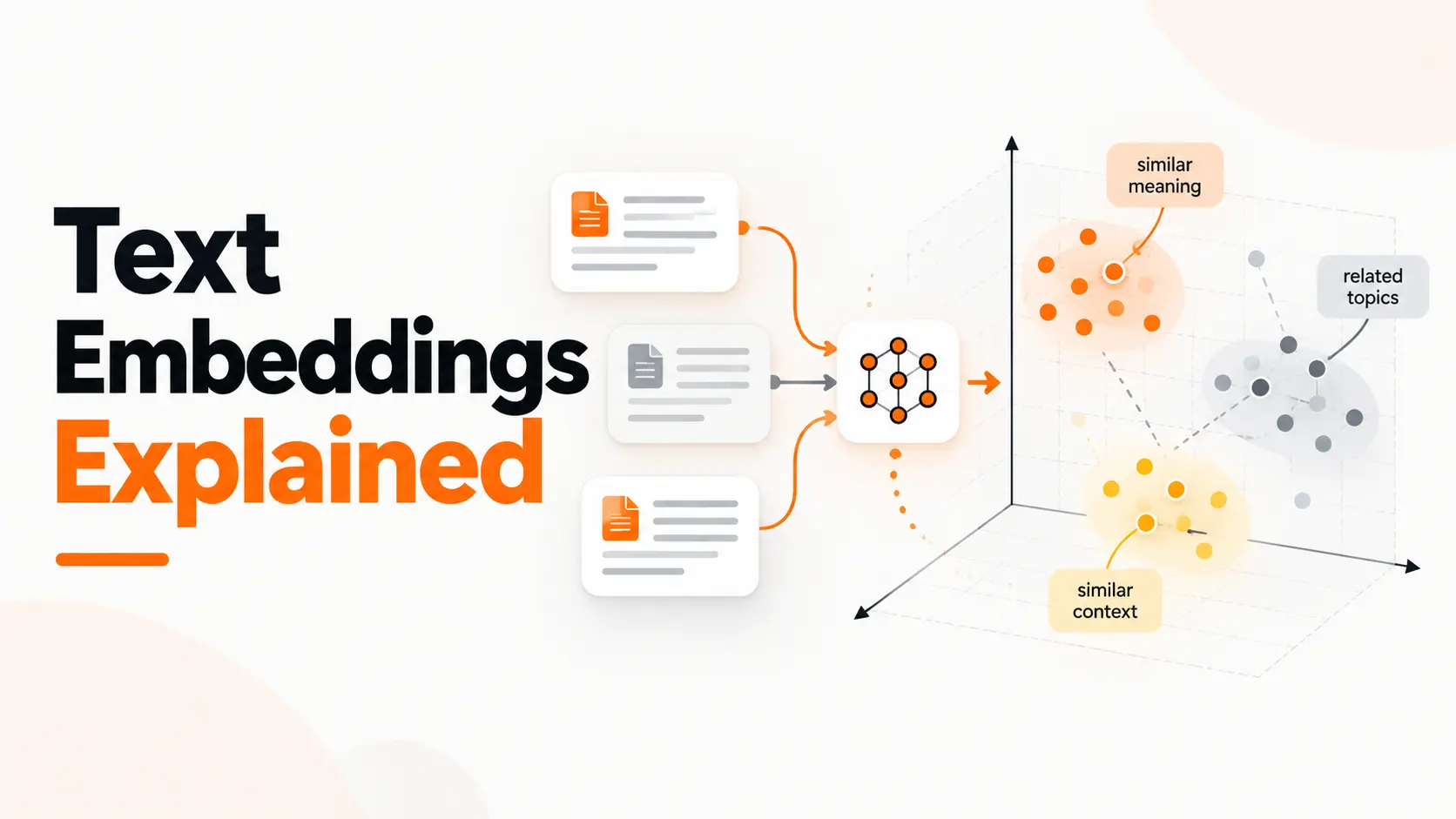
Text embeddings turn words, sentences, and documents into numerical vectors that AI systems can compare based on meaning. They make it possible to find related information even when a user's search query doesn't contain the exact words used in a document.
For a startup building AI-powered search, this means customers can find the right help article without knowing its title or terminology.
I'll explain how text embeddings work, demonstrate semantic similarity using a SaaS search example, and show how to generate embeddings with Python. I'll also cover the practical decisions involved in choosing an embedding model for a real application.
How Text Embeddings Work
Imagine a SaaS company called DeskFlow that provides project management software.
A customer searches its help center for:
"How can I add coworkers to my workspace?"
The most relevant help article is titled:
"Inviting Team Members to Your Workspace"
A keyword-based search system relies on matching words and other lexical signals. An embedding-based search system can identify the semantic connection between "add coworkers" and "inviting team members."
The process starts with an embedding model.
Converting Text into Numerical Vectors
An embedding model processes the input text and returns a fixed-length list of numbers.
For illustration, a shortened vector might look like this:
[0.24, -0.18, 0.67, 0.09, ...]
These numbers represent features learned by the model during training.
The example above is illustrative, not the output of a specific embedding model.
Real text embeddings can contain hundreds or thousands of dimensions. For instance, the all-MiniLM-L6-v2 model produces 384-dimensional sentence embeddings.
The individual numbers don't correspond to simple dictionary definitions. Meaning is represented through patterns across the full vector.
When two pieces of text express related concepts, a model trained for semantic similarity aims to place their representations near each other in its vector space.
Comparing a Question with Stored Documents
To find the right help article, DeskFlow first generates embeddings for its documentation.
When the customer submits a question, the application generates an embedding for that query as well.
The system then compares the query vector with the document vectors and ranks the results by similarity.
In our example, it evaluates these documents:
Document A: Inviting Team Members to Your Workspace
Document B: Managing Workspace Billing
Document C: Exporting Project Reports
Document A is the intended match because it directly addresses the customer's request.
This illustrates the main advantage of text embeddings: search can account for related language rather than relying exclusively on identical words.
The actual ranking must still be checked against the selected model and real search queries.
Vector Similarity and Search Relevance
Once text has been converted into vectors, the application needs a method for comparing them.
One widely used method is cosine similarity.
Cosine similarity measures the angle between two vectors. Vectors pointing in similar directions receive higher similarity scores.
A score close to 1 indicates strong directional similarity. A score close to 0 indicates little directional similarity, while negative scores indicate vectors pointing in opposing directions.
These mathematical scores are not confidence percentages.
For example, a similarity score of 0.85 does not mean there is an 85% probability that a document answers the question correctly.
That distinction matters when developing a search product.
I would use similarity scores to rank candidate documents, then evaluate whether those documents actually satisfy users' requests.
Semantic Similarity vs Exact Meaning
Consider two statements:
"The Pro plan supports 20 users."
"The Pro plan does not support 20 users."
Both sentences discuss the same product, subscription plan, and user limit.
An embedding model can assign them substantial semantic similarity because they share so much context.
Yet the statements contradict each other.
This is why I wouldn't use vector similarity alone to verify business policies, numerical claims, or contractual terms.
Embeddings help identify related information. They don't independently establish whether a statement is true.
For applications involving exact numbers or important business rules, the retrieved information needs additional validation.
Text Embeddings vs Word Embeddings
Text embeddings and word embeddings are closely related, but the distinction matters when choosing models.
Traditional word embedding methods such as Word2Vec and GloVe learn vector representations for individual words.
These methods capture relationships based on patterns found in training data.
However, a single static word representation cannot fully express every meaning of an ambiguous word.
Consider the word "bank."
It can refer to a financial institution or the side of a river.
A static word embedding assigns a learned representation to the word without independently adapting that representation to each sentence.
Modern contextual language models can represent words differently depending on their surrounding text.
Sentence and document embedding models take this further by generating representations of larger text units.
For example:
"I deposited money at the bank."
"We sat beside the river bank."
A contextual model can use the complete sentence to distinguish these meanings.
For an application that searches help articles or compares customer questions, I would evaluate sentence or passage embedding models rather than relying on isolated word vectors.
The important criterion is the information unit the application needs to compare.
Real-World Applications of Text Embeddings
Semantic search is a clear starting point, but text embeddings support several other useful features.
Semantic Search
Embedding-based search can retrieve documents with related meanings even when queries and documents use different terminology.
For DeskFlow, customers searching for "adding colleagues" can find an article about "inviting workspace members."
This reduces dependence on users knowing the exact language chosen by the documentation team.
Content Recommendations
A publishing platform can create embeddings for article titles, descriptions, or full-text content.
It can then compare those vectors to recommend related articles.
For example, an article about startup fundraising can be connected to content about investor due diligence or capital allocation based on their semantic relationship.
The system still needs additional ranking signals if recommendations must account for recency, popularity, or editorial priorities.
Customer Feedback Analysis
Startups receive feedback through support tickets, surveys, and customer interviews.
Embeddings can help group comments that describe related problems.
Messages such as "I can't invite my team" and "Adding new members isn't working" can be placed near one another in vector space.
A product team can use those groups to identify recurring themes and prioritize further investigation.
Document Retrieval for AI Applications
Text embeddings also support Retrieval Augmented Generation, where relevant information is retrieved before a language model produces an answer.
In this setup, the embedding model handles the numerical representation needed for semantic retrieval.
The language model uses retrieved passages to generate the final response.
Those are separate responsibilities.
A strong embedding model helps the system retrieve relevant evidence, but it doesn't guarantee that the language model will interpret that evidence correctly.
Generating and Using Text Embeddings
Generating text embeddings starts with sending text to an embedding model. The model processes the input and returns a numerical vector that represents its semantic features.
For a SaaS application like DeskFlow, I would begin with a small collection of help articles and a few customer questions. This makes it easier to understand how the embeddings behave before applying them to thousands of documents.
From Text to Numerical Vectors
Consider two sentences:
Customer question: "How do I add coworkers to my workspace?"
Help article: "Invite new teammates from Workspace Settings."
Both sentences express a related intention, even though they use different words.
An embedding model converts each sentence into a numerical vector. The application can then compare these vectors using a similarity measure such as cosine similarity.
The individual numbers are not readable explanations of meaning. Their relationship within the model's vector space is what makes semantic comparison possible.
For this process, I would use the same embedding model and compatible query and document configurations. Some retrieval models provide separate instructions for processing search queries and stored documents.
Finding Relevant Documents
Once the help articles have been converted into embeddings, their vectors can be stored alongside document identifiers and relevant metadata.
When a customer submits a search query, the application generates its embedding and compares it with the stored document vectors.
The most similar results become candidates for retrieval.
In our DeskFlow example, the article about inviting teammates is the intended result for a question about adding coworkers.
The application can then display the matching article or use its content in a larger AI-powered search workflow.
Before expanding the system, I would test it with actual customer questions to confirm that relevant documents rank above unrelated results. A high similarity score alone does not establish that a document answers the user's question correctly.
Choosing the Right Text Embedding Model
The most popular model isn't automatically the best choice for a product.
I would select an embedding model based on the type of text, the application's retrieval task, and the requirements of its deployment environment.
For a startup, the evaluation needs to include both retrieval quality and operating costs.
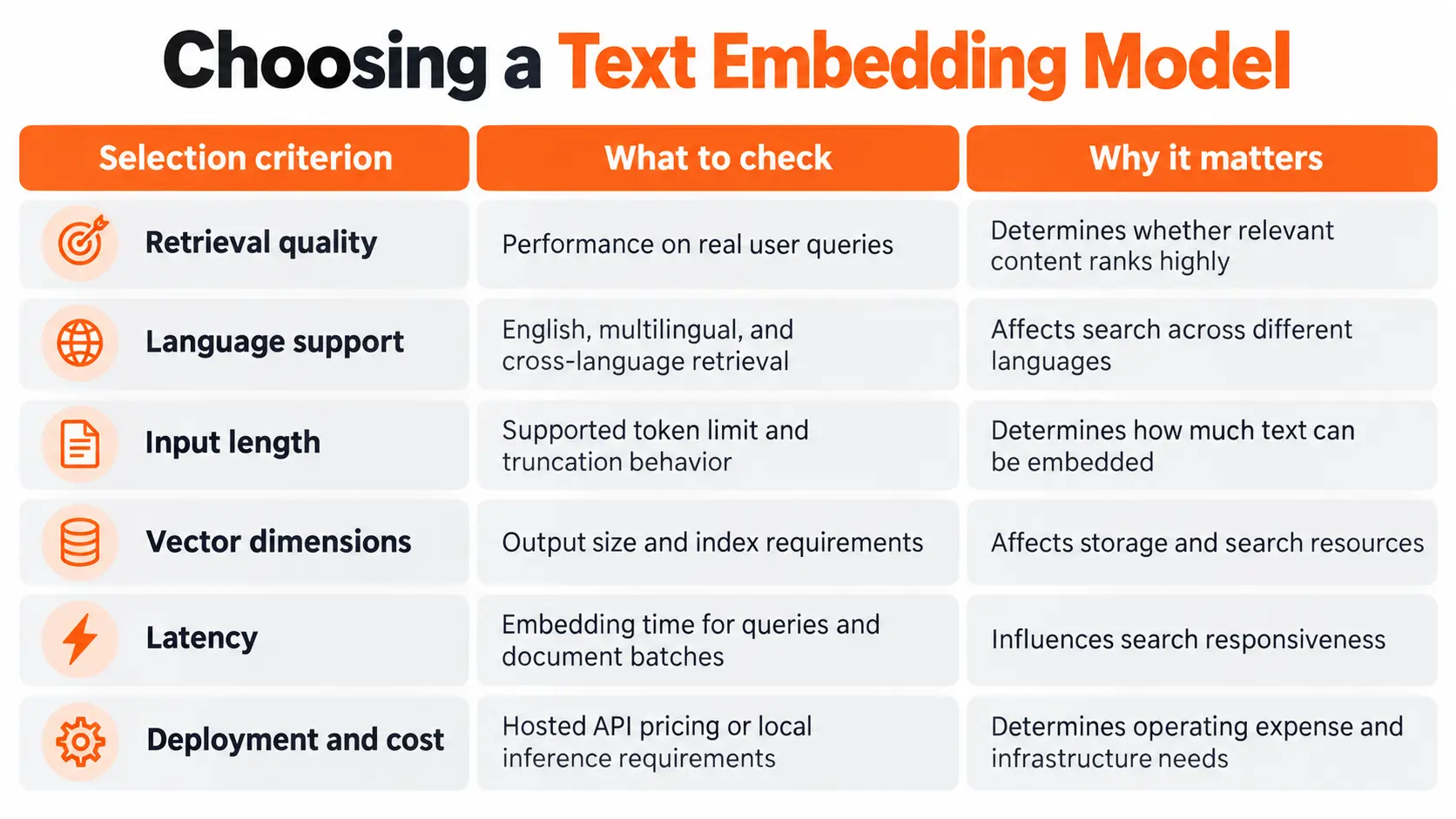
These criteria provide a better starting point than choosing a model solely from a public leaderboard.
Hosted and Open-Source Embedding Models
Hosted embedding APIs reduce the infrastructure work required to generate vectors.
For example, OpenAI offers text-embedding-3-small and text-embedding-3-large, with configurable output dimensions.
Google also provides text embedding models through Vertex AI.
An open-source model can be deployed on infrastructure controlled by the development team.
For a prototype, I would compare one suitable hosted model with one suitable open-source model using the same test queries.
The decision should account for quality, latency, cost, and data-handling requirements.
Language and Task Compatibility
A model performing well on English sentence similarity is not automatically suitable for multilingual document retrieval.
Some embedding models also distinguish between queries and source documents.
Google's embedding APIs, for example, support task types such as RETRIEVAL_QUERY and RETRIEVAL_DOCUMENT.
This distinction helps the model process each text according to its role in the retrieval task.
I would verify the intended use of each model rather than applying the same input configuration to every embedding service.
For a multilingual product, the evaluation dataset must include the languages and query patterns the application intends to support.
Evaluating Embedding Quality on Real Documents
A convincing demonstration with three sentences is useful for learning. It isn't enough to select a model for production.
Before deploying semantic search, I would create a small evaluation dataset from actual user questions.
Each question should have a documented expected result.
For DeskFlow, the dataset could contain customer questions about team invitations, subscription changes, project exports, and account permissions.
The evaluation process is straightforward.
First, measure retrieval relevance.
For each query, check whether the expected document appears among the top results.
Recall@k is useful when a question has one or more relevant documents. It measures how many of those relevant documents appear within the first k retrieved results.
Second, examine ranking quality.
A relevant article appearing first creates a different experience from one buried beneath unrelated results.
Metrics such as Mean Reciprocal Rank can help measure how highly the first relevant result appears.
Third, inspect difficult queries.
I would include questions with synonyms, product-specific terminology, negation, exact identifiers, and ambiguous wording.
These reveal weaknesses that a small collection of simple examples will not expose.
For a startup, the objective is not to maximize a benchmark score in isolation. It is to retrieve information that helps real users complete their tasks.
Text Embedding Limits in Real Search Systems
There are several limitations worth understanding before relying on embeddings as the primary search mechanism.
Exact Identifiers and Numerical Constraints
Semantic similarity is not a replacement for exact matching.
If a customer searches for error code AUTH-403, the application should preserve that identifier as a precise search condition.
A semantically related article about authentication failures may not address the specific code.
I would combine exact-match retrieval with semantic ranking when the product relies on IDs, error codes, dates, or version numbers.
Document Structure and Missing Context
Embedding an isolated paragraph can remove information needed to understand it.
For example, a paragraph listing subscription limits may become ambiguous if its plan name appears only in a preceding heading.
I would preserve document titles, section headings, and important metadata while preparing the text.
A better embedding model cannot recover context that was removed before the text reached it.
Similarity Without Factual Verification
Embedding models can identify semantically related statements without determining which statement is correct.
For a search system handling financial, legal, or account information, similarity ranking must be followed by appropriate data validation.
The system should also enforce document access permissions before returning search results.
An embedding search index must not expose private documents simply because they are semantically related to a user's query.
Moving from Embeddings to a Search Product
For a startup building its first semantic search feature, I would begin with one controlled document collection and a clear definition of successful retrieval.
DeskFlow's help center is a suitable example.
The team can prepare its support articles, generate embeddings, store the vectors with their source identifiers, and evaluate search results against real customer questions.
Once the prototype demonstrates acceptable retrieval quality, the team can decide whether it needs a dedicated vector index, more advanced ranking, or additional data sources.
I would also record the model and configuration used to generate the stored vectors. These details matter when maintaining or upgrading a search system.
The value of text embeddings isn't the numerical representation itself. It's the ability to connect a user's language with relevant information that would otherwise be difficult to find.
That is the standard I would use to decide whether embedding-based search belongs in a product.
FAQ
Can someone turn my embeddings back into the original text?
Embeddings are not designed as reversible text encodings. However, they should not be treated as anonymized or inherently secure data. Research has demonstrated that information about the source text can be inferred or reconstructed from certain embeddings under specific conditions. Sensitive vectors require appropriate access controls.
Can I create embeddings from PDF files with tables and screenshots?
Yes, after extracting or processing the relevant content. A text-only embedding model requires text input, so scanned pages and image-based tables need an extraction step. For visual information that cannot be represented adequately as text, a compatible multimodal embedding model or document-understanding system is required.
Can I store embeddings in PostgreSQL instead of a separate vector service?
Yes. PostgreSQL can store vector data, and the pgvector extension adds vector similarity operations and indexing capabilities. This allows applications to keep relational records and embeddings within the same database while using PostgreSQL's existing infrastructure.
Can I use text embeddings to search programming code?
Yes, provided the selected model supports the intended code retrieval task. Code-aware embedding models can represent source code and natural-language descriptions for relatedness comparisons. Evaluation should include programming languages, identifiers, and repository-specific terminology relevant to the application.
What happens to stored embeddings when a user deletes their documents?
The application must remove the associated vectors, source records, and search-index entries according to its deletion policy. Document deletion from the primary database does not automatically remove every derived copy. Cached results, backups, and external processing services must also be covered by the application's data-retention and deletion procedures.

Fatemeh Jahangard
Technology & AI Writer at PinerookFatemeh Jahangard covers AI, emerging technologies, and digital innovation for Pinerook, focusing on how technology shapes startups and industries.
 Seen first.