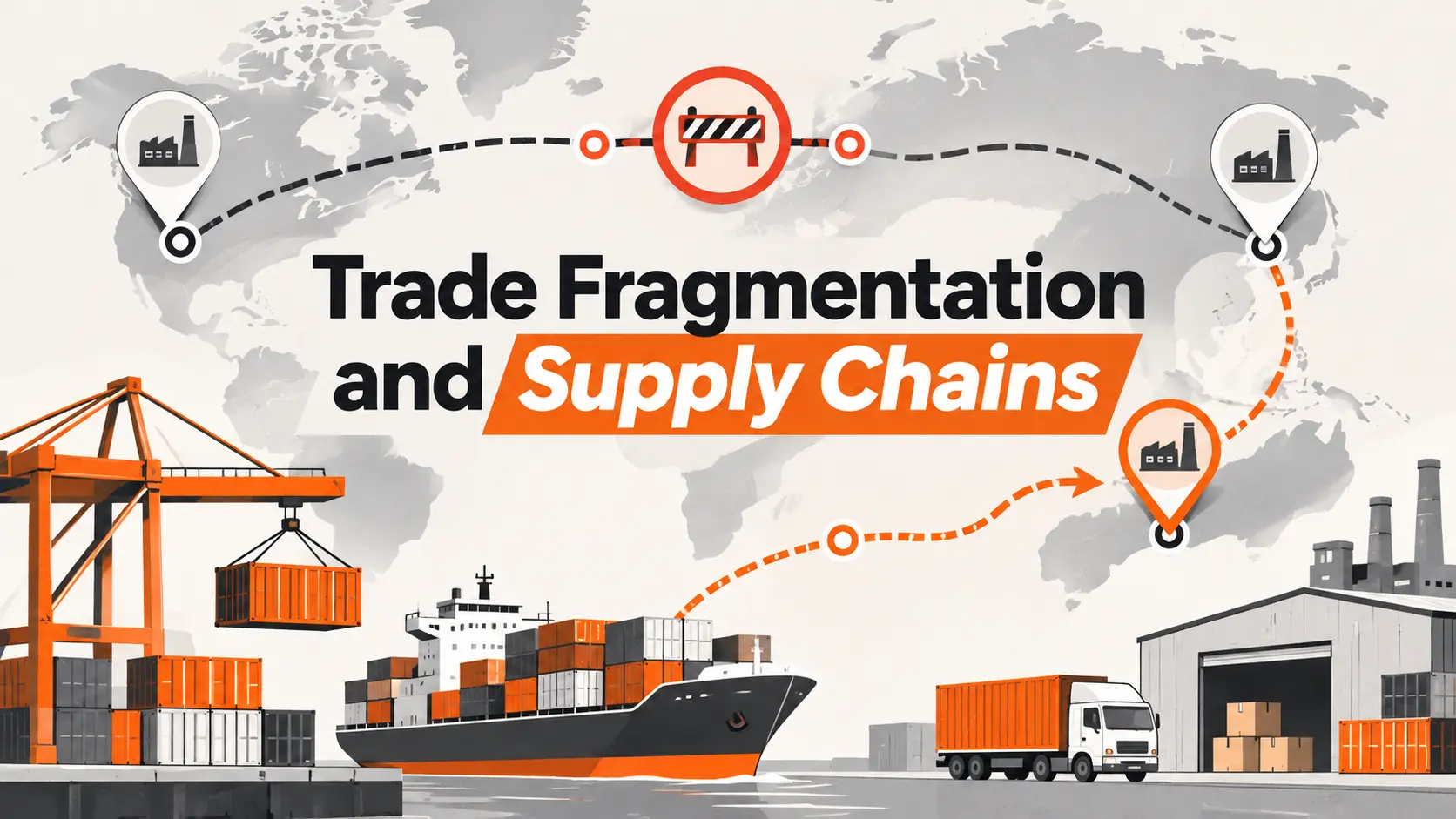
Trade fragmentation and supply chains are closely linked because a restriction on one country can affect factories, distributors, and customers in several others. When tariffs, export controls, sanctions, and industrial policies alter commercial incentives, businesses must reconsider not only where they buy a product but also where its components and underlying materials originate.
For economic analysis, the central question is whether firms are creating genuinely new sources of production or simply changing the route through which existing production reaches customers. This distinction is part of the wider Geoeconomic Fragmentation debate, but examining supply chains specifically reveals how political barriers become changes in costs, supplier concentration, and investment decisions.
What Trade Fragmentation Means for Supply Chains
Trade fragmentation occurs when policy or geopolitical differences increasingly influence which countries exchange goods and services. In supply chains, the impact extends beyond finished products. An export restriction on one specialized component can interrupt production at multiple downstream factories even if the final product is made in a country unaffected by that restriction. The economic unit that matters is therefore the production network, not simply the location on the final shipping invoice.
This is not the same as a universal retreat from globalization. A company may reduce its dependence on one market while adding suppliers in two other countries and continuing to sell globally. World trade can grow even while particular trading relationships weaken. UNCTAD reported that global trade exceeded 35 trillion dollars in 2025, illustrating why changes in the geography of exchange should not be confused with a collapse in international commerce.
Why Production Networks Are Being Reorganized
Governments increasingly treat certain dependencies as security concerns. Export controls can limit access to advanced technologies, sanctions can block counterparties, and tariffs change the relative prices of inputs. Domestic subsidies may reward production in particular jurisdictions, while new compliance obligations raise the cost of sourcing from some overseas partners. These instruments work through different channels and should not be assumed to produce identical outcomes.
At the company level, the response depends on the relative value of cost efficiency and continuity of supply. A standardized input available from dozens of producers is easier to replace than a specialized chemical, precision component, or certified machine part that has a small supplier base. Changing the supplier of the latter may require engineering changes, testing, equipment investments, and regulatory approval. The adjustment can therefore take years even when management makes a decision immediately.
Trade Diversion Is Not the Same as Moving Production
A rising import share for a third country is often presented as proof that manufacturing has moved there. But several explanations are possible. Goods may be shipped through an intermediary with little local transformation. An international producer may build a new factory that genuinely adds value in the intermediary economy. A country may also export more because its domestic firms have grown more competitive or demand has shifted. These cases have different consequences for jobs, productivity, and resilience.
An IMF study published in June 2025 distinguishes trade rerouting from trade reallocation. It finds evidence consistent with expanded domestic content in some Vietnamese exports to the United States in strategic sectors over 2018 to 2022. The same study cautions against concluding from rising trade shares alone that every connector economy has developed new productive capacity. This distinction prevents analysts from mistaking a new shipping path for a new manufacturing base.
The Hidden Dependencies Behind Supplier Diversification
A business may purchase similar components from suppliers located in three countries and still be exposed to one bottleneck. Those suppliers might buy the same raw material, rely on the same semiconductor foundry, or use the same logistics corridor. Diversification at the level of direct vendors is therefore not equivalent to diversification across the complete production chain. Mapping upstream dependencies is essential when the objective is resilience rather than simply a wider vendor list.
The same logic applies to transport and services. Ports, insurance providers, payment networks, specialized software, certification systems, and energy infrastructure can become common points of failure. A factory operating outside a restricted jurisdiction may still depend on a controlled technology or a supplier that cannot obtain an export license. The relevant question is not how many supplier names appear on a procurement register, but how independent those suppliers really are.
How Fragmentation Affects Costs, Investment, and Prices
Fragmentation can increase costs through tariffs, longer transport routes, duplicated production facilities, extra inventory, supplier qualification, and compliance. These costs may be absorbed by exporters, passed to buyers, or partly offset by currency movements and productivity improvements. There is no single mechanical relationship between a tariff announcement and the eventual consumer price. Incidence depends on competition, substitution opportunities, and contractual arrangements.
Capital expenditure is another important channel. Building alternative capacity can strengthen continuity but ties up cash before a factory produces revenue. Where scale economies are large, duplicating facilities across markets may reduce productivity. A more expensive source can nevertheless be justified when the expected loss from a long interruption is substantial. Decision makers should compare the ongoing cost of redundancy with both the probability and potential financial severity of disruption.
A Supply Chain Exposure Framework
An effective assessment combines information on criticality, substitutability, political exposure, and real production origin. The following framework is intended as a practical analytical tool, not a universal scoring model. A high score on one dimension does not automatically mean that the company should exit the relationship. It indicates where more detailed investigation may have the greatest value.
Supply chain exposure and the evidence needed for assessment
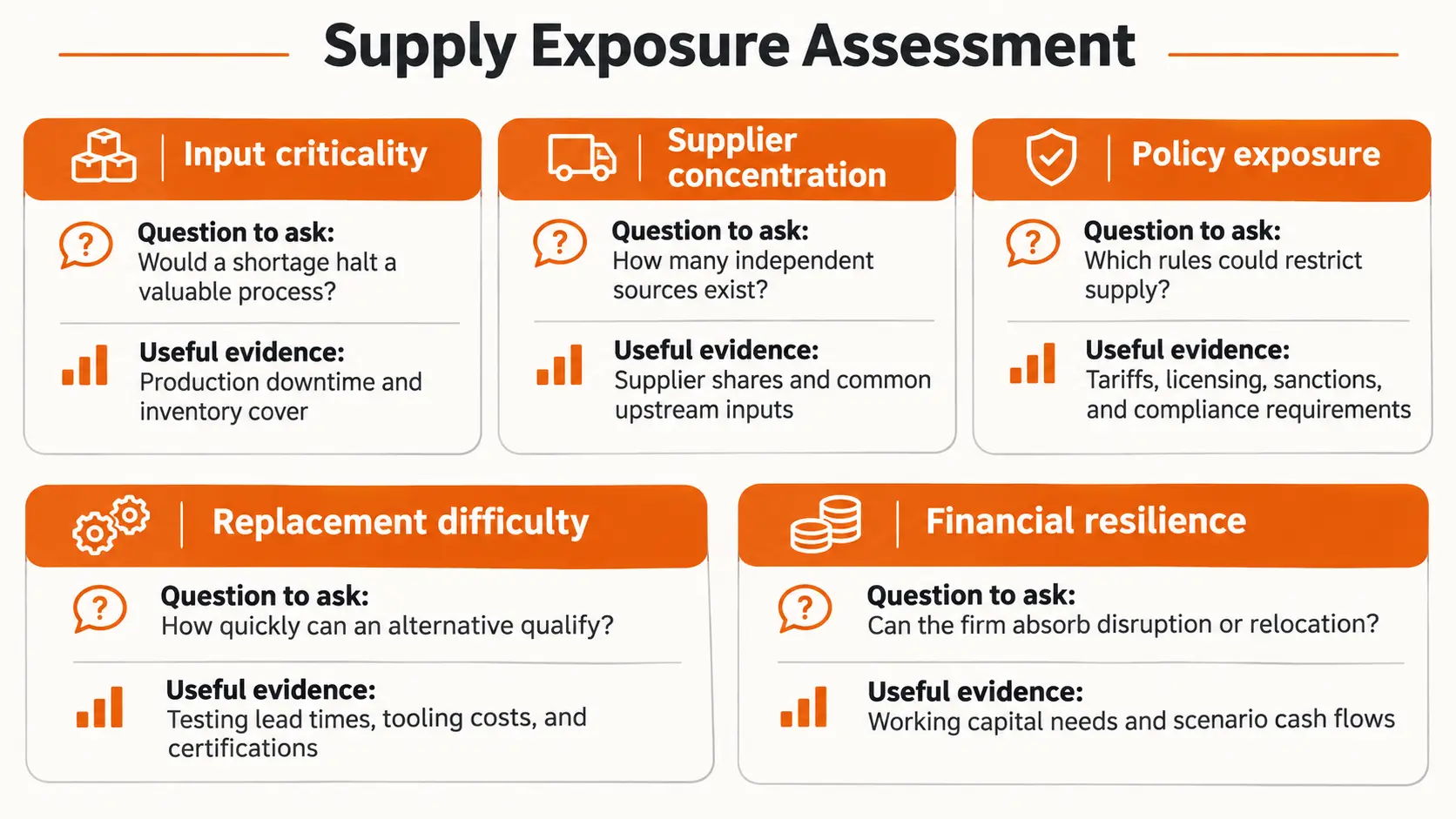
The most informative analysis evaluates each input in relation to the value of the process it supports. A low cost component can create an outsized loss when a missing part stops a costly production line. Conversely, an expensive input may pose limited strategic risk when substitutes are abundant and readily certified. This is why a percentage share of imports or a country risk label cannot replace detailed operational evidence.
What the Research Says About the Direction of Trade
The World Trade Organization found that trade between hypothetical geopolitical blocs grew more slowly than trade within the blocs in the period following the war in Ukraine. Yet its earlier analysis did not find a comparable worldwide shift toward shorter geographic trading distances. Political alignment and geographic proximity are distinct forces, and an increase in one should not be inferred from the other. A broad narrative of universal reshoring or regionalization overstates the data.
More recent WTO analysis in March 2026 points to renewed divergence in trade patterns during 2025, particularly amid tensions between the United States and China. The Federal Reserve has also cautioned that fragmentation differs substantially across products, countries, and directions of trade. The evidence is more consistent with selective reconfiguration than with a clean division of world production into two independent systems.
Connector Economies and the Limits of Resilience
Countries that maintain relationships with competing markets can attract manufacturing investment and benefit from shifts in sourcing. But an intermediary role is not automatically a durable development strategy. A country may remain highly dependent on imported components, foreign technology, or concentrated export demand even as its gross exports grow. To understand who gains, analysts need to examine domestic value added and the capabilities developed locally.
A shift from one concentrated production hub to another can also recreate the vulnerability that diversification was intended to solve. Replacing direct imports with imports that pass through a third country may reduce the visibility of exposure without eliminating it. An investor or company should distinguish the country that invoices the transaction from the countries responsible for production, intellectual property, and essential intermediate goods.
How Businesses Can Respond Without Overreacting
The first step is to identify products whose interruption would cause serious operational or financial harm. Management can then investigate upstream dependencies, estimate the lead time for alternative supply, and compare potential responses. These might include qualifying a secondary supplier, redesigning a component, holding additional inventory, negotiating flexible contracts, or investing in another production location. Each response comes with a cost and should be linked to a specific risk.
Scenario analysis is usually more useful than a single prediction about future policy. A company can compare a central case with limited restrictions, a case involving stricter export rules, and a case involving transport or payment interruptions. The aim is to identify decisions robust to several futures, rather than to commit capital whenever geopolitical headlines become more alarming. Indicators should trigger investigation before they trigger a costly strategic reversal.
Implications for Policymakers and Investors
For policymakers, supply chain security can justify attention to critical imports, but domestic production requirements and broad restrictions may impose costs on downstream industries. Policies work best when they clearly identify the vulnerability being addressed and evaluate the tradeoff between security, fiscal spending, competition, and access to global expertise. The effects can differ sharply between products, making narrow analysis preferable to blanket claims about national self sufficiency.
For investors, exposure often sits below the level of geographic revenue disclosures. A company may sell primarily in its domestic market while depending on foreign components or overseas contract manufacturing. Evaluating earnings sensitivity therefore requires looking at supplier networks, production lead times, inventory, price pass through, and planned capital spending. Strong revenue diversification does not automatically imply operational independence.
Trade fragmentation is changing the incentives that shape supply chains, but its effect is not a simple choice between global production and domestic production. Some trade flows are redirected, some factories move, and some firms build genuine alternatives that reduce concentrated dependencies. The economic outcome depends on whether those changes create independent productive capacity at a reasonable cost. A careful analysis follows the origin of value added, the structure of upstream dependencies, and the financial consequences of possible interruptions.
FAQ
What is trade fragmentation in a supply chain?
It is the reorganization of sourcing, production, and distribution relationships in response to geopolitical divisions or policy restrictions. It can affect intermediate components as well as finished goods.
Does trade fragmentation mean global trade is declining?
Not necessarily. Overall trade can increase while specific bilateral relationships weaken and companies redirect supply or production to other locations.
Why is rerouting different from production relocation?
Rerouting changes the path a good takes through trade networks. Relocation changes where meaningful production and value creation occur. Only the latter necessarily adds local manufacturing capacity.
Does buying from more countries guarantee resilience?
No. Different immediate vendors may depend on the same upstream materials, technology, logistics corridor, or specialized producer.
How can a firm evaluate fragmentation risk?
It can map critical inputs, identify common upstream dependencies, assess policy exposure, estimate replacement times, and compare financial consequences under plausible scenarios.
Are shorter supply chains always more secure?
No. Geographic proximity can reduce some transport risks, but it does not eliminate concentrated suppliers, political restrictions, or common infrastructure dependencies.

Masoumeh Jahangard
Markets & Economy Writer at PinerookMasoumeh Jahangard covers markets, economic trends, and business conditions for Pinerook, focusing on how they affect startups and growing companies.
 Seen first.