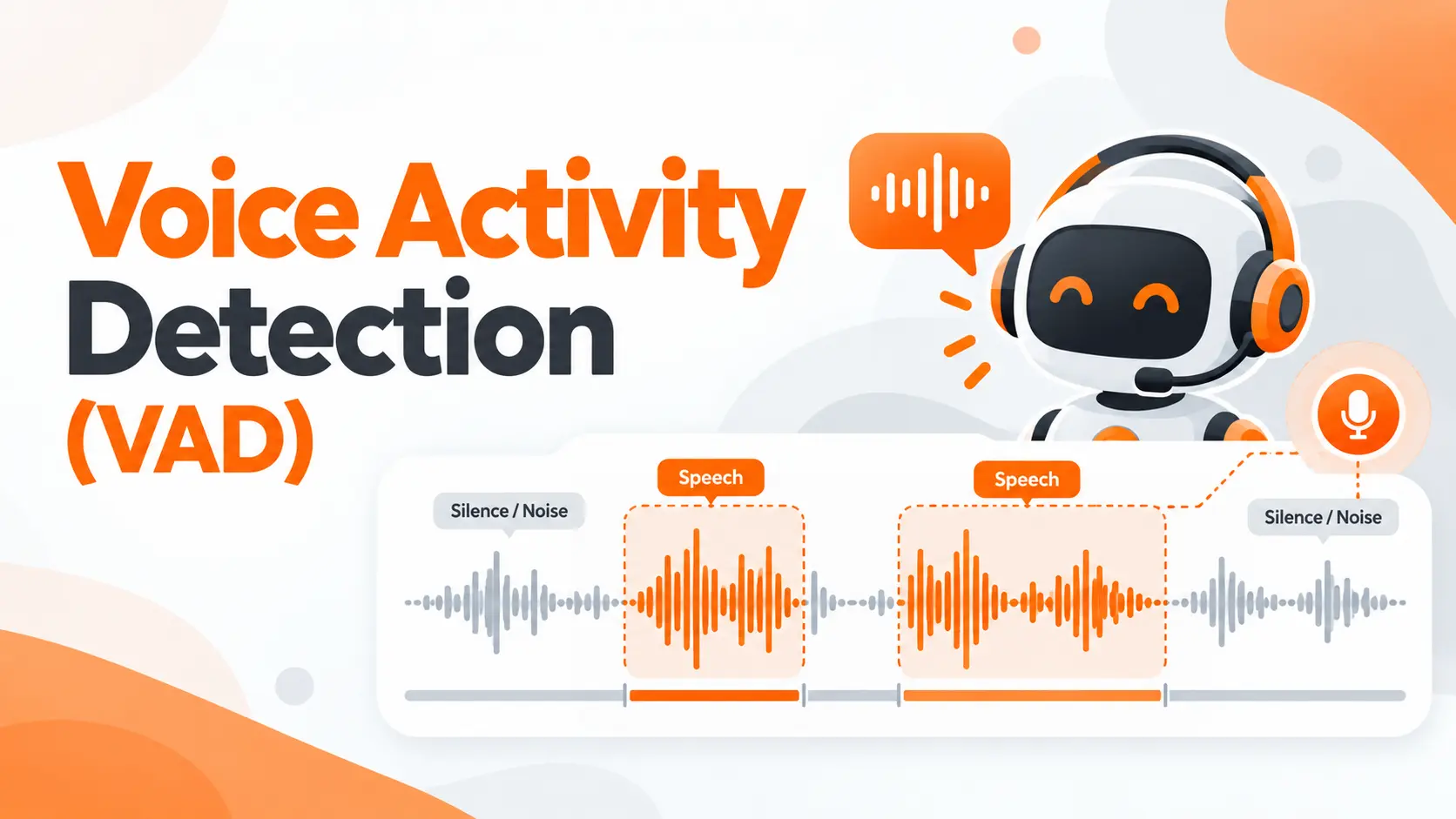
Voice Activity Detection (VAD) identifies when speech is present in an audio signal. It helps voice applications separate spoken input from silence and background noise, making speech processing more efficient and conversational systems more responsive.
But detecting speech is not the same as understanding it. A microphone can capture a customer's voice, a television, or background conversation. A VAD system needs to identify speech activity without losing quiet words or reacting unnecessarily to surrounding noise.
When selecting VAD for a voice application, I would focus on three things: detection accuracy, control over speech boundaries, and performance under the application's actual audio conditions.
How Voice Activity Detection Works
Voice Activity Detection processes incoming audio in short segments and determines whether each segment contains speech.
The process involves audio preparation, frame analysis, speech classification, and combining the results into useful speech segments.
Audio Input and Frame Processing
The first step is preparing the audio signal.
A microphone captures sound, which the application converts into a supported digital audio format. The VAD engine processes this information in short frames rather than waiting for a complete recording.
For example, WebRTC VAD accepts frames lasting 10, 20, or 30 milliseconds.
Processing audio in short intervals allows a real-time application to identify speech activity while the person is still speaking.
The audio must match the detector's supported sample rate and frame format. Incorrect audio preparation can prevent a model from operating correctly.
I would verify those requirements before changing any speech detection settings.
Speech Classification
Each audio frame passes through a detection algorithm.
The algorithm analyzes acoustic information to distinguish speech from non-speech audio.
Some detectors return a binary decision indicating whether speech is present. Neural detectors can also return a score representing the model's confidence that a frame contains speech.
For example, Silero VAD produces speech probabilities that can be compared against a configured threshold.
The detector evaluates the sound characteristics of the frame. It does not need to transcribe the spoken words to make that decision.
This distinction allows VAD to operate independently of a speech recognition system.
Speech Segmentation
Individual frame predictions need to be combined into meaningful speech segments.
A detector might classify several consecutive frames as speech, encounter a short silence, and then identify speech again.
If the application separates the audio at every brief pause, it can produce fragmented recordings.
Speech segmentation settings help determine when a detected speech region begins and ends.
The resulting timestamps or audio segments can then be passed to a transcription service, voice application, or audio-processing pipeline.
For an application that needs complete spoken requests, I would preserve enough audio around the detected boundaries to avoid losing important syllables.
Types of Voice Activity Detection
Different VAD algorithms use different approaches to distinguish speech from other sounds.
The choice affects computational requirements, detection quality, and deployment options.
Energy-Based VAD
Energy-based detection uses the intensity of an audio signal to identify potential speech.
A frame with energy above a selected threshold can be classified as active.
This approach is computationally simple, making it useful for applications with limited processing resources.
However, audio energy is not unique to human speech.
A closing door, loud music, or mechanical noise can produce strong audio signals.
For that reason, I would not rely on energy alone when the application must distinguish human speech from varied background sounds.
Statistical VAD
Statistical approaches analyze acoustic characteristics beyond basic signal amplitude.
They can use information related to frequency distribution, background noise, and the structure of speech signals.
WebRTC VAD is an established example of a lightweight detector designed for real-time communication.
It provides configurable aggressiveness levels that control how conservatively audio is classified as speech.
A more aggressive setting rejects more uncertain audio, but it can also exclude weak or difficult speech.
The appropriate configuration depends on whether the application places greater importance on avoiding false triggers or preserving quiet speech.
Neural Network VAD
Neural VAD models learn patterns associated with speech from training data.
Instead of relying exclusively on manually designed signal-processing rules, they use learned representations to classify incoming audio.
Silero VAD is a widely used example.
It supports speech probability estimation and speech segmentation, with implementations suitable for CPU-based inference.
Neural models offer a different accuracy and resource trade-off from classical detectors.
I would compare their performance using recordings from the intended application rather than assuming that one algorithm family is universally superior.
VAD vs Speech Recognition and Endpointing
These technologies operate at different stages of audio processing.
Voice Activity Detection identifies whether speech is present.
Speech Recognition, also called Speech-to-Text, converts spoken language into written text.
Endpointing determines when a speech segment or conversational turn should be considered complete.
For AI Voice Agents, this distinction matters because detecting silence does not necessarily mean the user has finished speaking.
Consider a customer saying:
"I need to change my subscription to... the Business plan."
VAD identifies the spoken portions and the silence between them.
Speech recognition determines which words were spoken.
Endpointing decides whether the pause after "to" represents the end of the customer's request.
These decisions should not be treated as equivalent.
A VAD detector can correctly identify silence while the application incorrectly assumes that the customer has finished speaking.
Modern conversational systems can combine VAD with additional acoustic or semantic signals to make better turn-completion decisions.
For example, OpenAI's Realtime API distinguishes between server_vad, which uses audio activity and silence-based detection, and semantic_vad, which considers whether the user appears to have completed the thought.
Similarly, LiveKit supports turn detection that uses signals beyond basic speech activity.
I would keep VAD responsible for identifying speech activity and use separate turn-detection logic when conversational completeness matters.
VAD Models and Tools
There is no single VAD solution that fits every audio-processing system.
For a practical evaluation, I would begin with four established options.
WebRTC VAD
WebRTC VAD is designed for lightweight, real-time speech activity detection.
It provides a binary speech classification and supports several aggressiveness settings.
Its limited computational requirements make it worth evaluating for communication systems and applications that need straightforward speech detection.
However, its output does not provide the same adjustable speech probability interface as a neural model such as Silero.
I would choose it when simplicity, predictable frame processing, and low resource consumption are priorities.
Silero VAD
Silero VAD is an open-source neural speech detector.
It supports 8 kHz and 16 kHz audio and can be used to identify speech regions in recordings or streaming audio.
Its configuration includes speech thresholds, minimum speech duration, minimum silence duration, and speech padding.
These controls make it useful when the application needs to adjust how speech segments are identified.
For a development team building a customizable voice pipeline, I would evaluate Silero against a classical detector using the same recordings.
Picovoice Cobra
Cobra is a VAD engine designed for real-time speech detection, including on-device applications.
It provides speech activity information through supported SDKs and is intended for environments where computational efficiency matters.
I would evaluate Cobra when deployment across mobile, desktop, or embedded environments is part of the product requirements.
Its licensing and integration requirements should also be considered alongside detection performance.
Managed Realtime VAD
Some realtime voice platforms provide speech detection as part of a broader conversation API.
OpenAI's Realtime API is one example.
This approach reduces the amount of speech detection infrastructure the application needs to manage directly.
However, platform-level turn detection should not be confused with a standalone VAD model.
I would evaluate managed detection when the team already uses a realtime voice platform and its available controls meet the application's requirements.
The decision should be based on the deployment environment, available configuration, audio privacy requirements, and measured detection quality.
Configuring Voice Activity Detection
Choosing a VAD model is only part of the implementation.
The configuration determines how the detector handles quiet speech, short pauses, background sounds, and speech boundaries.
I would adjust one parameter at a time and compare its effect on the same audio samples.
Speech Detection Threshold
A speech threshold defines when the model's output is treated as speech.
For a neural detector that returns speech probabilities, raising the threshold makes detection more conservative.
This can reduce false activations, but it also increases the risk of missing quiet speech.
Lowering the threshold increases sensitivity and can capture weaker speech while making the detector more responsive to unwanted sounds.
The value should be calibrated against recordings from the target environment.
A threshold of 0.5 is a documented default in several implementations, including Silero, but it is not a universal setting for every VAD engine.
Minimum Speech Duration
Minimum speech duration specifies how long detected speech must continue before it qualifies as a valid speech segment.
This setting can prevent brief acoustic events from creating unnecessary speech segments.
However, a long minimum duration can also exclude short spoken responses.
For example, a customer answering "Yes" or "No" should not be ignored simply because the response is brief.
I would include short confirmations in the test dataset before finalizing this setting.
Silence Duration
Silence duration controls how much silence the system tolerates before ending a speech segment.
A shorter duration separates speech regions sooner.
A longer duration preserves continuity across pauses but delays segmentation.
The correct value depends on whether the application processes recordings or manages an interactive conversation.
For conversational systems, silence segmentation and final turn completion must be considered separately.
Speech Padding
Speech padding preserves additional audio around detected speech boundaries.
Pre-speech padding retains audio from immediately before speech was detected.
This helps protect the beginning of an utterance when detection starts slightly after the person begins speaking.
Padding at the end of a segment helps preserve trailing sounds near the detected speech boundary.
For example, if the detector activates after the beginning of a quiet word, a pre-buffer can retain audio that would otherwise be excluded.
Padding cannot recover audio that was never captured or retained by the application.
I would verify both the buffer behavior and the actual speech timestamps when diagnosing clipped words.
Diagnosing Speech Detection Problems
The symptoms of inaccurate speech detection provide useful starting points for investigation.
Before replacing the model, I would inspect the captured audio, VAD predictions, and final speech segments.
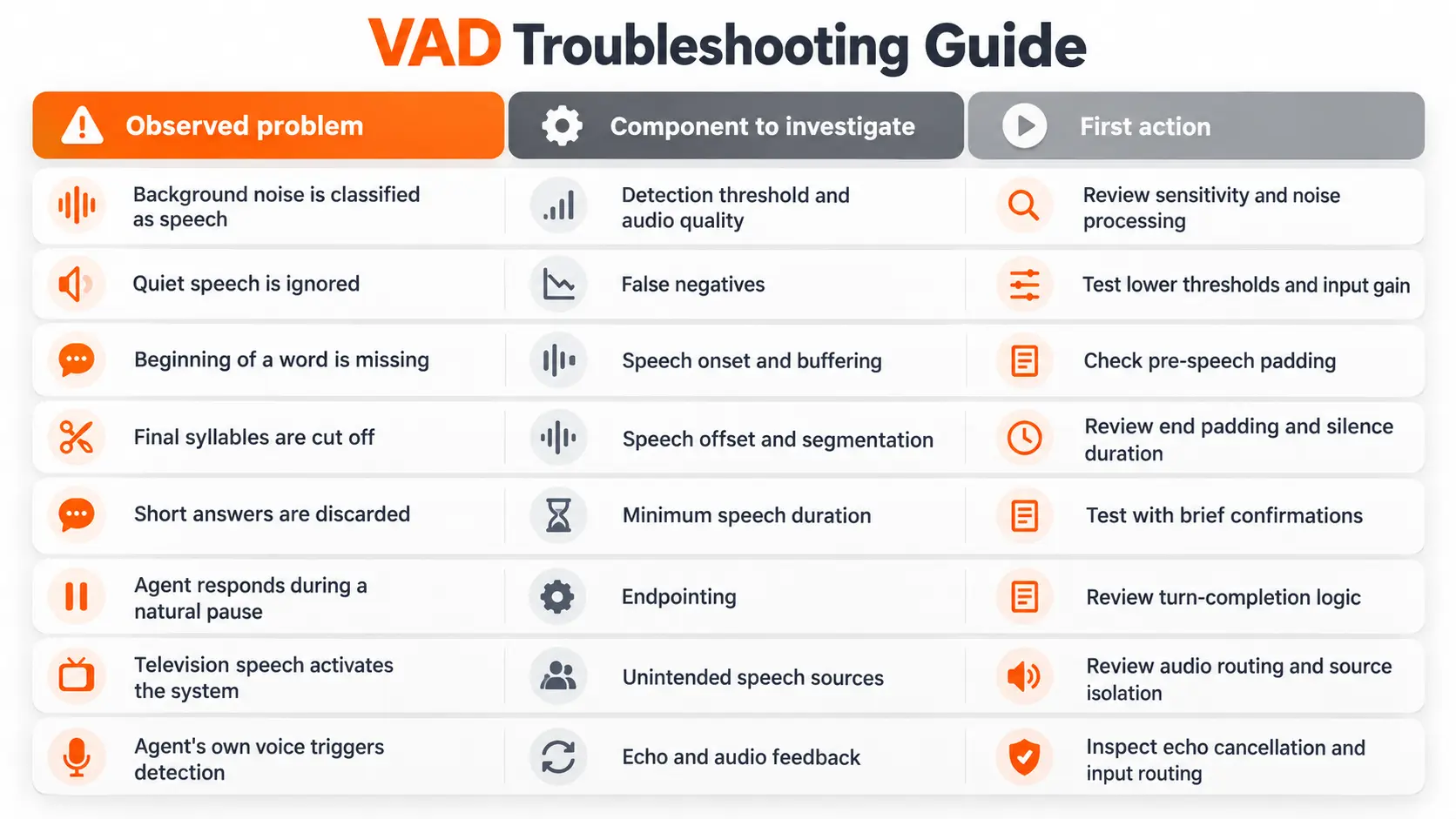
These symptoms identify areas worth investigating, not guaranteed causes.
For example, a television playing human speech can correctly trigger a detector designed to identify speech activity.
Increasing the threshold cannot reliably distinguish the intended speaker from another person speaking nearby.
That problem requires attention to audio capture, source separation, or additional application logic.
I would confirm the cause using recordings and detector output before making configuration changes.
Voice Activity Detection in a SaaS Application
Consider a fictional SaaS company called DeskFlow.
Its customer-support system uses a voice agent to answer questions about subscription plans and workspace accounts.
A customer calls and says:
"I want to upgrade my subscription to... the Business plan."
The customer pauses before naming the new plan.
A VAD detector identifies the spoken portions and the silence between them.
But if the application ends the conversational turn immediately after that silence, the agent may begin responding before hearing the complete request.
Separating Speech Detection from Turn Completion
I would first check whether the detector correctly identified the silence.
If it did, the speech detector is performing its immediate task.
The next investigation should focus on the application's end-of-turn decision.
A context-aware turn detector can help determine whether the sentence is complete before the agent responds.
This avoids treating every detected pause as a completed customer request.
Preserving Quiet Speech
Now consider a second customer speaking softly through a headset.
The first word of the request is missing from the audio segment passed to transcription.
I would inspect the captured waveform and VAD activation timestamps.
If the audio buffer contains the missing word, increasing pre-speech padding could preserve it in the selected segment.
If the detector fails to activate for an extended period of quiet speech, sensitivity and audio input quality need closer examination.
These situations require different changes.
The goal is to preserve the complete request while avoiding unnecessary processing of unrelated sounds.
Measuring VAD Accuracy
A detector that works during a short demonstration has not yet established reliable performance under real operating conditions.
I would evaluate it using audio that represents the people, devices, and environments the application will encounter.
For DeskFlow, that means collecting authorized test recordings from telephone calls, laptop microphones, headsets, and noisy workspaces.
The recordings need reference labels identifying when speech is present.
Those labels provide the basis for comparing detector predictions with the actual audio.
Precision and Recall
Precision measures how many frames classified as speech actually contain speech according to the reference labels.
Low precision indicates that the detector is producing excessive false speech detections.
Recall measures how much of the labeled speech the detector successfully identifies.
Low recall indicates that actual speech is being missed.
These measurements should be interpreted together.
A detector can achieve high recall by labeling too much audio as speech. It can achieve high precision by rejecting uncertain speech and missing valid utterances.
Neither outcome is sufficient on its own.
Speech Boundary Accuracy
Frame-level detection scores do not fully describe the quality of the resulting speech segments.
I would also compare the detected beginning and ending timestamps against the reference audio.
This reveals whether the detector consistently starts late or ends speech segments too early.
For speech recognition applications, boundary accuracy matters because missing the first or final part of a word can change its meaning.
Testing Across Audio Conditions
Evaluation should include quiet speakers, background conversations, different microphones, and realistic network audio.
I would record false detections, missed speech, and the amount of speech lost at segment boundaries.
For realtime applications, processing time should also be measured to ensure the detector keeps pace with incoming audio.
After changing a threshold or segmentation setting, I would repeat the same tests.
This makes it possible to determine whether the new configuration improves detection without introducing a different problem.
Choosing a VAD Solution
I would make the final selection based on the application's audio environment and deployment requirements.
For a lightweight communication system, WebRTC VAD provides a straightforward starting point.
For a customizable neural detection pipeline, Silero offers probability-based classification and configurable segmentation.
For on-device applications, Cobra is another option worth evaluating.
For a product already built around a managed realtime voice API, integrated detection can reduce implementation work.
The comparison should include detection precision, speech recall, boundary accuracy, processing latency, supported audio formats, and infrastructure requirements.
I would use the same labeled recordings to compare candidate systems and evaluate the actual deployment cost before choosing one.
A reliable VAD implementation is the one that preserves the speech the application needs while minimizing unwanted activations under its real operating conditions.
Final Thoughts
Voice Activity Detection is a fundamental part of speech processing, but its practical value depends on how accurately it identifies speech boundaries and separates intended input from surrounding audio.
I would begin by understanding the detector's output, selecting a suitable algorithm, and tuning its settings against representative recordings.
For real-time applications, VAD also needs to work alongside transcription and turn-completion logic without confusing silence with the end of a conversation.
The objective is reliable speech capture, not simply detecting the greatest possible amount of audio activity.
FAQ
Can VAD pick up someone who's whispering?
Yes, a VAD model can identify whispered speech when the audio contains enough recognizable speech characteristics. Performance depends on the model, microphone sensitivity, signal quality, and detection threshold. Whispered recordings should be included in evaluation if the application needs to support them.
Can VAD tell which person is talking?
No. Standard VAD identifies speech activity, not speaker identity. Distinguishing speakers requires an additional process such as speaker diarization or speaker recognition. These systems can operate alongside VAD but serve different purposes.
Can I run VAD on my device without an internet connection?
Yes. Local implementations such as WebRTC VAD and supported Silero deployments can process audio without sending it to a remote inference service. The application must include the required model files, runtime, and compatible audio-processing components.
Can I use VAD on audio files that have already been recorded?
Yes. VAD can process prerecorded audio to identify intervals containing speech. Those intervals can be used to segment long recordings or select audio for further analysis. The timestamps and segmentation behavior depend on the selected model and processing configuration.
Can I turn VAD off if my app uses push-to-talk?
Yes. An application can use an explicit button press and release to control when audio is captured and submitted. In that design, automatic speech activity detection is not required to determine when the user has finished providing input. The implementation must still handle incomplete or interrupted recordings correctly.

Fatemeh Jahangard
Technology & AI Writer at PinerookFatemeh Jahangard covers AI, emerging technologies, and digital innovation for Pinerook, focusing on how technology shapes startups and industries.
 Seen first.