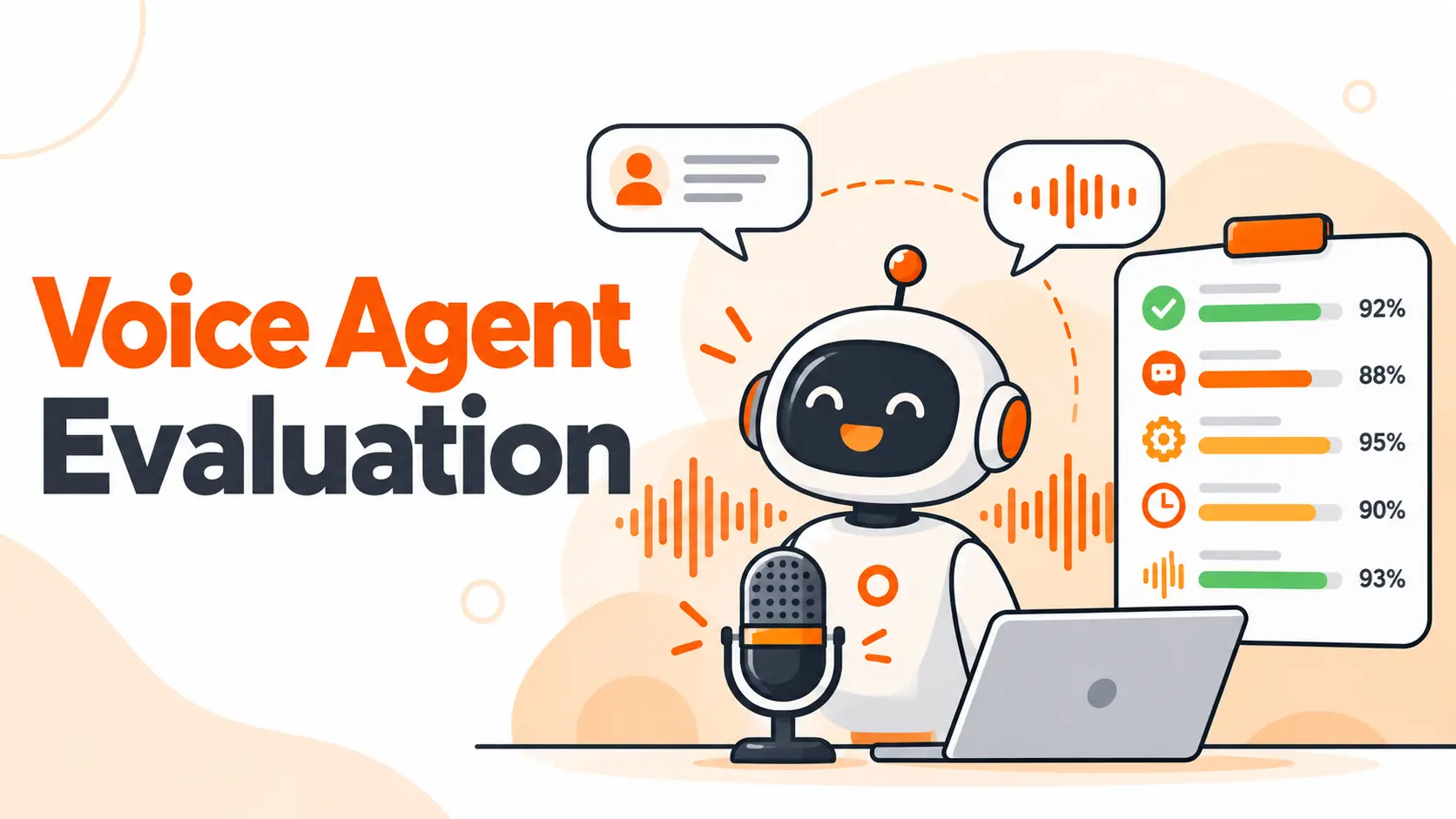
A voice agent can sound convincing, respond quickly, and still fail the task it was supposed to complete. Voice agent evaluation measures whether the system understands callers, makes the right decisions, executes actions correctly, and communicates results without compromising the conversation.
I would judge a billing assistant by whether it updated the correct account, not by how confidently it said, "Done." That distinction matters because a successful conversation and a successful business operation are not automatically the same thing.
A reliable evaluation process combines realistic test conversations, measurable performance criteria, backend verification, and repeated testing. The result should tell you what works, what fails, and whether the agent is ready to handle real customers.
How to Evaluate a Voice Agent
I would start with the tasks customers expect the agent to complete, then work backward to the decisions and technical components required to complete them.
The evaluation process has five stages:
Define the expected outcome. Specify what the agent must accomplish, which actions require authorization, and what the system must never do.
Build representative test scenarios. Include straightforward requests, incomplete information, corrections, interruptions, and failed external services.
Run the complete conversation. Test the actual speech interface, connected tools, and application logic rather than relying entirely on text prompts.
Verify the result. Compare the agent's response, executed tool calls, and final application state against the expected outcome.
Repeat and investigate. Run important scenarios multiple times, identify inconsistent behavior, and compare results after each system change.
For AI Voice Agents connected to business systems, the most important evaluation begins with defining a successful task.
Consider a customer requesting a subscription cancellation. A complete result requires more than understanding the request. The agent must verify the caller when required, interpret the cancellation date, update the correct account, and communicate the confirmed result.
If the customer hears a cancellation confirmation but the subscription remains unchanged, the task has failed.
I would make that outcome the central acceptance criterion, then use conversation and technical metrics to explain why the interaction succeeded or failed.
Voice Agent Evaluation Metrics
A voice agent needs several measurements because no single metric captures the complete customer experience.
Task Success Rate describes how often the agent achieves the required outcome. Tool accuracy, conversational behavior, speech processing, and response time help explain the result.
I would use the following framework when evaluating a customer-facing voice agent.
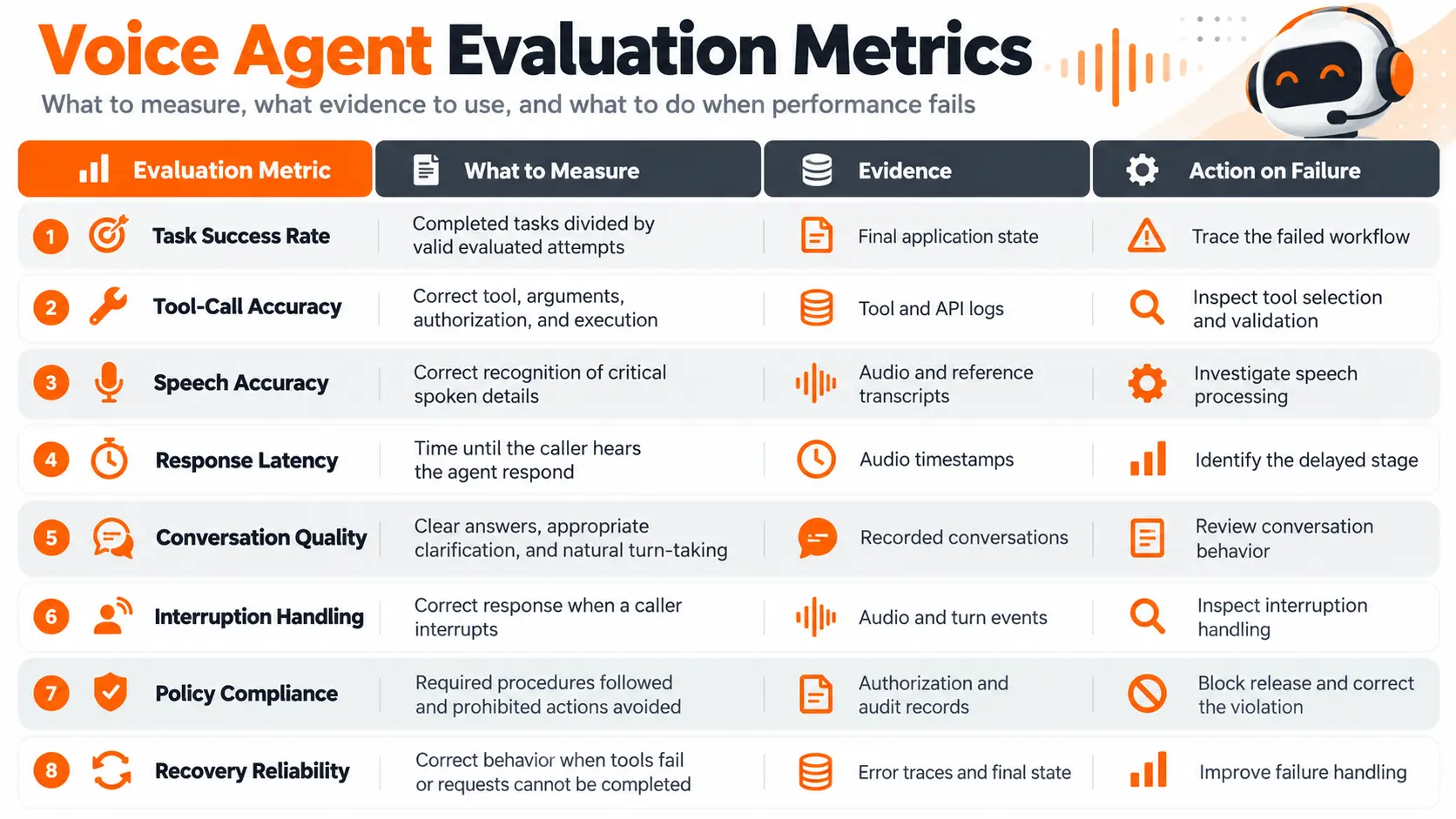
These metrics serve different purposes.
I would treat successful task completion, authorized execution, and critical policy compliance as acceptance conditions. Audio quality and latency provide additional evidence about usability.
A fast agent that makes unauthorized changes is not a successful system. An accurate agent that repeatedly interrupts callers also needs improvement before deployment.
Task Success Rate
Task Success Rate measures the proportion of valid evaluation attempts that achieve their required outcomes.
For example, if 80 out of 100 valid test conversations complete their assigned tasks, the observed Task Success Rate is 80%.
The denominator matters. An invalid test caused by a broken simulator or missing evaluation evidence should be investigated separately from a valid conversation in which the agent fails.
I would also report results by task category.
An agent that succeeds at answering product questions but fails at account changes should not receive one overall score without that distinction.
Tool-Call Accuracy
Tool-call evaluation examines whether the agent selected the correct operation, supplied valid arguments, respected authorization requirements, and handled the returned result properly.
A successful API response does not automatically mean the requested business operation was correct.
If an agent updates the wrong customer account, the API may return success while the actual task fails.
For operations that modify data, I would verify the resulting application state.
Speech and Response Metrics
For speech recognition, Word Error Rate (WER) measures transcription errors against a reference transcript. However, WER alone does not establish whether the agent preserved critical details such as dates, names, and account numbers.
Audio-native systems also require evaluation of what the agent understood, even when transcription is not an obligatory processing stage.
For latency, I would measure the interval between the caller finishing a turn and hearing the first audible response.
Both median latency and P95 latency matter. The median describes the middle observation, while P95 reveals the slower end of the response-time distribution.
Performance targets should reflect the application's real workload instead of applying a benchmark from an unrelated service.
Building Realistic Test Scenarios
A useful evaluation dataset represents the conversations the agent is expected to handle.
I would begin with the most important customer requests and define the expected result for each one.
Every test scenario should contain six pieces of information:
Caller goal: The task the customer wants to complete.
Starting conditions: Account details, permissions, and relevant application data.
Conversation input: The spoken request and any planned follow-up information.
Expected behavior: The actions the agent must perform.
Prohibited behavior: Actions or claims the agent must avoid.
Evidence of success: The records needed to verify the result.
For example, a test might involve a customer requesting a change to the billing date.
The expected result is a correctly updated billing record and an accurate confirmation. If the caller has not completed the required verification, the agent must not make the change.
This creates a measurable test instead of a subjective impression of conversation quality.
Straightforward Tasks and Changing Requests
The initial dataset should include direct requests that have sufficient information.
After those scenarios work reliably, I would introduce corrections and missing details.
A customer might say:
"Move my appointment to Friday. Actually, make it Thursday."
The agent must preserve the corrected instruction rather than act on the first date.
Another customer might request an account update without specifying the account. The expected behavior is to collect the missing information before making changes.
These scenarios reveal whether the agent can maintain task context across multiple conversation turns.
Audio and Caller Variations
Text-only tests cannot fully evaluate a voice system.
I would include authorized recordings with different speaking styles, accents, microphone conditions, natural pauses, and background noise.
The purpose is to determine whether the agent still understands the request when the input differs from a clean demonstration.
Recorded audio also allows the same spoken request to be replayed when comparing system versions.
A simulated caller adds another level of difficulty by adapting to the agent's responses during a full conversation.
Both are valuable, but neither replaces evaluation using representative real-world audio.
Testing Task Completion and Tool Calls
The most useful evaluation evidence comes from comparing what the agent said with what the application actually did.
I would examine three records for tasks involving external tools:
The caller's authorized request: What the user intended and permitted.
The executed operation: Which tools were called, with which arguments and results.
The final application state: Whether the intended change occurred correctly.
Consider an agent handling a subscription upgrade.
The customer requests the Business plan, but the agent calls the upgrade tool with a different plan identifier.
If the backend accepts the request, the operation can technically succeed while the customer receives the wrong subscription.
That is a failed task.
The reverse situation also matters. An agent might select the correct tool and arguments, but the backend could reject the operation.
The agent must not confirm success unless the required outcome has been established.
I would evaluate the execution result and the spoken confirmation as separate requirements.
Authorization and Restricted Actions
Not every request should result in an action.
Some tasks require identity verification or explicit confirmation. Others fall outside the agent's permissions.
The evaluation needs scenarios where the correct outcome is refusing the operation or asking for additional authorization.
I would make these requirements mandatory acceptance conditions.
A high average quality score cannot compensate for an agent that changes customer information without permission.
Measuring Conversation and Audio Quality
Task completion establishes whether the agent achieved the outcome. Conversation evaluation determines whether the interaction was understandable and usable.
I would listen to representative calls and examine how the agent handles the full exchange.
Clarity and Conversational Flow
The agent should provide understandable answers, ask relevant follow-up questions, and avoid unnecessary repetition.
The spoken response also needs to match the information available to the system.
A concise clarification can be better than a long answer based on an incorrect assumption.
For subjective qualities such as naturalness and clarity, human listening assessments provide evidence that numerical speech metrics cannot fully capture.
Turn-Taking and Interruptions
A conversation changes when the caller interrupts, hesitates, or corrects an earlier statement.
I would measure whether the agent stops speaking when appropriate, listens to the new instruction, and continues with the updated context.
The test should distinguish genuine interruptions from background speech and brief acknowledgments.
An agent that stops whenever it hears a sound may respond quickly to interruptions while producing a frustrating conversation.
Both interruption handling and unnecessary interruptions need evaluation.
Response Timing
Latency should be measured from the caller's perspective, including the audio delivery path.
I would examine first-response timing across ordinary conversations, tool-dependent requests, and periods of concurrent usage.
Long delays caused by external services should be identified separately from delays in speech processing.
The goal of evaluation is to establish where performance fails to meet product requirements. Changes to model selection, speech detection, or audio delivery belong to the subsequent optimization process.
Automated and Human Evaluation
Automated testing is essential for running the same scenarios consistently across multiple versions.
However, different evaluation criteria require different evidence.
I would automate checks that can be determined from reliable application records.
These include exact tool arguments, authorization status, final account state, execution errors, and measured response times.
For example, a billing update either changed the expected database record or it did not. A language model should not be asked to guess that result from a conversation transcript.
LLM-as-a-Judge
A separate language model can help assess qualities that do not have a simple exact-match answer.
These include whether the agent's explanation was relevant, whether it addressed the customer's concern, and whether its language was appropriate.
The judge needs an explicit scoring rubric and sufficient evidence.
I would compare its decisions against a set of human-reviewed examples before relying on automated scores.
Disagreements reveal whether the rubric is unclear or the judge is unreliable for a particular criterion.
An automated judge's score is an assessment, not independent proof that an external action succeeded.
Human Listening Reviews
Human reviewers remain necessary for evaluating natural speech, awkward pauses, interruptions, and unclear explanations.
I would give reviewers defined criteria rather than asking whether a conversation simply "sounds good."
For example, they can assess whether the caller was interrupted before finishing, whether the response was understandable, and whether the agent accurately described the outcome.
Using consistent criteria makes the reviews more useful when comparing versions.
Voice Agent Evaluation Example
Consider DeskFlow, a fictional SaaS company that uses a voice agent to manage customer subscriptions.
Its support team wants to release an updated agent that handles cancellation requests.
A customer says:
"Please cancel my subscription at the end of this month."
The agent replies:
"Your cancellation has been scheduled for the end of the month."
The conversation sounds natural and the response arrives promptly.
Now examine the backend.
Expected Outcome
Before running the test, I would create a test account with an active subscription and define the correct post-cancellation state.
The agent must verify the customer when required, select the correct subscription, schedule cancellation for the requested date, and communicate the confirmed result.
The test should also establish which actions are prohibited, including immediate cancellation when the customer requested end-of-month cancellation.
Evaluation Evidence
Suppose the recorded conversation shows an accurate spoken confirmation.
The tool log also shows a cancellation request, but its arguments specify immediate cancellation.
The backend confirms that the subscription was canceled immediately.
Despite the natural conversation, the evaluation fails.
The failure is not related to voice quality or response timing. It is an incorrect business action.
I would investigate how the agent interpreted the cancellation date and whether the application validated the requested effective date before executing the operation.
Correcting and Retesting
After addressing the cause, I would rerun the original scenario.
I would also test a customer who requests immediate cancellation, a customer who changes the requested date, and a caller who has not completed authorization.
These related cases verify that the correction addresses the intended behavior without breaking other workflows.
The expected outcome remains fixed for each scenario, but the conversation does not have to follow one exact script.
A valid clarification should be accepted when it leads to the correct authorized result.
Regression Testing and Reliability
A voice agent can pass a scenario once and fail it during a later run.
That is why I would evaluate important tasks repeatedly.
Repeated Scenario Testing
Suppose DeskFlow prepares 20 priority scenarios and runs each one three times.
That produces 60 evaluation attempts.
The team can report two different results:
Attempt-Level Success Rate: The proportion of successful attempts across all 60 runs.
Consistent Scenario Pass Rate: The proportion of the 20 scenarios that pass in all three runs.
These measurements answer different questions.
A scenario that succeeds twice and fails once contributes two successful attempts but does not count as consistently passing all three runs.
Three repetitions are useful for an initial stability check, not proof of long-term reliability. Larger evaluations are necessary to estimate performance more precisely.
I would report the number of scenarios, number of repetitions, observed failures, and relevant uncertainty rather than presenting a percentage without context.
Version Comparison
Every meaningful change to the agent should trigger the relevant regression tests.
A new model can improve language understanding while changing tool-selection behavior. A revised prompt can make answers shorter while weakening a required verification step.
I would compare versions using the same scenarios, expected outcomes, and test conditions.
When results differ, the team should inspect the supporting evidence before attributing the change to the model or prompt.
Repeated evaluations help distinguish a consistent improvement from variation between individual runs.
Production Readiness and Release Decisions
An evaluation framework is useful only when its results influence deployment decisions.
Before releasing an agent, I would define acceptance rules based on the risk and purpose of the application.
For a subscription management agent, these rules could require:
Correct completion of essential subscription tasks.
No unauthorized account changes in the release test suite.
Accurate confirmation of completed backend operations.
Successful recovery from defined service failures.
Acceptable conversation quality and response-time performance.
No regression on previously corrected critical failures.
These requirements do not need to have equal weight.
An agent can meet its response-time target and still be unsuitable for release because it violates an authorization rule.
Release Gates
A release gate is a condition that must be satisfied before a version is deployed.
I would distinguish critical failures from quality improvements.
A critical authorization violation should block release even if every other evaluation metric improves.
A minor variation in spoken phrasing can be reviewed without automatically rejecting a version, provided the response remains accurate and meets the product's communication requirements.
There is no universal task success percentage that makes every voice agent safe to publish. The required level of assurance depends on the consequences of failure.
Production Monitoring
Pre-release testing cannot reproduce every real customer interaction.
After deployment, evaluation should continue using permitted operational evidence.
I would monitor task outcomes, escalation rates, response latency, execution errors, and customer-reported problems.
When a new failure appears, the team should reproduce it in an appropriate test environment and add a representative scenario to the regression suite.
That makes future evaluations more representative of actual product behavior.
Final Thoughts
Voice agent evaluation should answer a practical question: can this system complete its assigned tasks correctly, consistently, and safely while delivering a usable conversation?
I would begin with task outcomes, verify important actions against backend records, and use speech and conversation metrics to explain the results.
Automated tests make evaluation repeatable. Human reviews assess qualities that are difficult to capture with deterministic checks. Repeated scenarios reveal instability, while release gates turn the findings into product decisions.
A natural voice is valuable, but reliable task completion is what makes a voice agent useful to customers.
FAQ
Can I test my voice agent without saving customer recordings?
Yes. Evaluation can use scripted conversations, synthetic audio, and test accounts without retaining real customer recordings. Some audio-quality assessments still require access to representative audio, which can be processed under an appropriate privacy and retention policy. The evaluation method should match the organization's data-handling requirements.
Will my evaluation tests still work if I switch voice AI providers?
Outcome-based test scenarios can remain valid across providers. The evaluation infrastructure may need changes to accommodate different APIs, audio formats, tool interfaces, and event logs. Keeping expected business outcomes separate from provider-specific implementation details makes tests easier to reuse.
How do I test calls that get transferred to a real person?
The test should verify that the agent selected the correct transfer destination, respected transfer conditions, and passed the required context through the supported integration. It should also verify whether the transfer connected successfully. A spoken promise to transfer the caller does not establish that a human agent received the call.
What if the caller hangs up before the agent finishes?
The application should handle disconnection according to the task's execution state. Evaluation should verify that queued audio stops, active resources are released, and partially completed operations are not incorrectly reported as successful. For actions already committed, the system must preserve an accurate record so that reconnecting or retrying does not create duplicate operations.
Can an automated test simulate someone trying to trick my voice agent?
Yes. Controlled adversarial tests can submit misleading instructions, conflicting requests, or attempts to bypass authorization rules. The evaluation should verify that protected data and restricted operations remain inaccessible. Passing a collection of adversarial tests provides evidence of resilience against those scenarios, not proof that every possible attack has been prevented.

Fatemeh Jahangard
Technology & AI Writer at PinerookFatemeh Jahangard covers AI, emerging technologies, and digital innovation for Pinerook, focusing on how technology shapes startups and industries.
 Seen first.